Policing under Socialism

This probably is a bit of a heavy and somewhat dry topic, when most of us are trying to enjoy these care free summer vacation months. However, politics is very much in the air right now. In my particular part of the world there is a Provincial election, and an upcoming Federal election; neither of which am I confident I am going to like the end results. In the rest of the world, there have been swings in the electorate in the United Kingdom, which has moved to the left with the Labour Party; and in France, as of today, it is a country stuck in the middle. The French government is neither right or left and nobody wants to coalesce with the other.

I will admit that over the years, the longer I pay attention, the more I lean to some level of a libertarian philosophy in my outlook, a growing belief that less government is more the ideal. My wishes are clearly out of step, as the governments in this country are already controlling almost every facet of our daily lives through rules, taxation and regulations. Their belief is grounded on the firm commitment to the fact that they know what is good for us, and that they need to protect us from our own self-interest. The Federal government, and a variety of NDP Provinces in the passing in their legislative initiatives seem hell bent on bringing their brand of socialism to the country. Interestingly, in portraying what they believe are just causes, completely turn away from the term “socialist”. Which can only be interpreted to mean that they can fool most of the people most of the time.

During the Russian Revolution in 1917 we came to distinguish between “revolutionary socialism”, or Communism and “evolutionary socialism”. In the latter category, the proponents sometimes refer to themselves as “social democrats”. Socialism as a movement in Canada is not new, history shows us that there have been many times that we Canadians have entertained and sought a socialist political remedy: the Socialist Party of Canada was in 1904, the Social Democratic Party in 1911, the Communist Party of Canada in 1921, the CCF IN 1932 and the NDP in 1961. It started with Tommy Douglas in Saskatchewan in ____ but since then there have been NDP governments in BC, Saskatchewan, Manitoba, Ontario and the Yukon.

Socialism’s corollary is that socialism by its nature necessitates a growth of government in all its forms. More rules and regulations are to be developed in an effort to help the “working class”. It is a political doctrine that at its base feels the need to criticize the existence of social, economic, and political inequality in society. Hinged to this theory is that only government of the people can effect the necessary changes to the social order. They believe that there is a need to limit the excesses of private ownership and a wish to expand public ownership. Therefore the state is responsible for planning– to eliminate those cycles of un-controlled capitalism.

Which brings me finally as to what is the role of the police in a socialist state? Are the police a reflection of the state? Should we care? Revolutionary socialists are for the most part against the police, because in their definition they are an arm of the proletariat and therefore there only to oppress the working class. Paradoxically, most revolutionary socialists agree however that no enforcement often leads to outright chaos. Just ask the people of Portland Oregon how their experiment with no policing worked out. At the other end of this continuum, on the far right, is a state run by a despot or dictator, where the police are there to serve only the needs of the people in power. The examples for both of these extremes is an extensive list.

In Canada, we are somewhere in the middle of that bell curve, but there have been times that the pendulum has swung the police dangerously close to the narrow ends of that graph. The Convoy protest in Ottawa and the imposition of the Emergency Measures Act, clearly moved the police to the despotic end; while the protests and de-funding of the police initiatives clearly moved the police to the left end.

In an interesting article about “professionalism” in policing, the authors argue that when people make “careers” out of policing, it creates an environment of police officers there to simply “carry out orders”; that they become part of the ruling class and just “reflective of the state”. But I digress.

I believe like most police officers that policing must be; professionally effective, accountable and legitimate. This serves to consolidate a democracy. The police should be there to serve society rather than the state. They have to be legitimized by the public and to be legitimate: they must adhere to the law and due process, need to be subject to controls, need to be accountable and transparent, and they must be politically neutral. It is a fine but distinct line and to walk it requires a degree of political sophistication and insight that often seems lacking in our current police leadership. Today for example, it would be hard to argue that police management is either transparent or politically neutral, which again reflects on any claims of legitimacy.

So even though political philosophy is often a topic that causes many to roll their eyes and take a nap, police organizations and their leaders need to be wholly cognizant and continually thinking about the role of government versus the role of the police. As the government encroaches on the rights of the private individual in order to give over to the general good, we need to be paying attention as an enforcer of laws as to whether you are acting for society or the state.

Should anyone doubt Canada’s creep into socialism, one only needs to look into the statements of Justin Trudeau or Chrystia Freeland. Both have made pronouncements and proposals clearly aimed at re-ordering the social order in Canada. National Day Care and National Dental care, are in the end, examples of those governments beliefs. They have recently introduced Bill 63, the Online Harms Act which some argue will give the government the ability to censor speech. They have recently imposed an increase in the capital gains tax, to have the rich pay more for the poor, as they paint themselves in the media as Robin Hood. They have brought in Bill C-!8, the Online News Act forcing Google and Meta to pay $100 million to news organizations and they determine the distribution of those monies. They subsidize the national CBC to carry their message forward. In the government of Quebec they even regulate the language that can be used in business. In BC the government has closed Provincial parks to the public, allowing access to the Indigenous only as part of their solution to injustice. Governments regulate how we eat, how we live, and where we live and we pay them exorbitant amounts of money in the form of taxes to do that for us. The private individual is always subsumed for the good of the greater good.

So as the country moves to a full socialist imperative how are the police forces going to react? Will they become agents of the state, or will they be agents of society? Since the RCMP can not fulfill their current Federal mandates, how is it possible to take on all these other enforcement issues? Are they to become Big Brother? The Federal government continues to expand, so do we continue to grow the police state? Those decisions are important and will determine the role of the police in the future, and just as importantly, how the police are perceived and accepted by the rest of society.

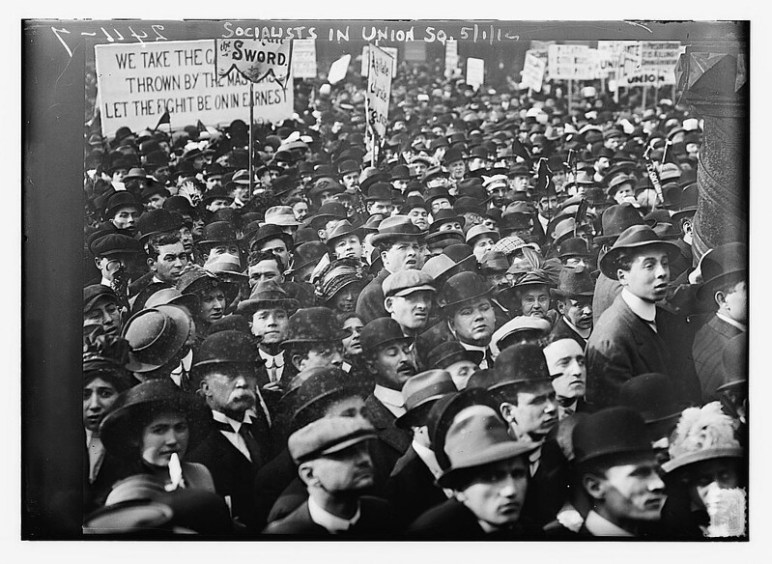
Photo courtesy of Flickr Commons – Some Rights Reserved by the U.S. Library of Congress
Collision Course

In a ruling this month by Justice Margeurite Church of the B.C. Supreme Court, it was decided that Coastal Gas Link, the company constructing the LNG pipeline from north eastern British Columbia to Kitimat British Columbia, had satisfied the requirements for an interlocutory injunction against the protestors of the natural gas pipeline.

Listen closely….can you hear the echo?

The year before in December 2018 the court had granted an interim injunction against these same protestors. That time the RCMP eventually moved in and 14 of the protestors were arrested and the encampment taken down. All of it much to the chagrin of a small sect of the Indigenous who were being supported and prompted by the usual wagon jumpers of the enlightened liberal left.

So here we are again, a year later, same issue, different court date. Ms. Church in this latest court verdict went a little further in her ruling saying –that there is evidence to suggest that the protestors had engaged in “deliberate and unlawful conduct” for the purpose of causing harm to the plaintiff and preventing it from constructing the pipeline.

Of added interest may be her comments reflecting on the general state of the laws pertaining to the Indigenous movement reflected in this particular case:
“There is a public interest in upholding the rule of law and in restraining illegal behaviour and protecting the right of the public, including the plaintiff, to access on Crown roads…the defendants may genuinely believe in their rights under indigenous law to prevent the plaintiff from entering into Dark Horse territory, but the law does not recognize any right to blockade and obstruct the plaintiff, to access on Crown roads.

In any event, another court decision, another group of lawyers, all kicking at the peripheral issues and avoiding the central dilemma of defining the role the Indigenous are to play in this country.

One would be hard pressed to imagine a more convoluted, ridiculous, and multi-layered predicament. Often mis- guided policy and vague initiatives have been all wrapped in endless litigation and court interpretation. The politically righteous argument of aboriginal rights, simmering away for the last forty years in a cauldron stirred by hundreds of lawyers. Apparently none able or overly concerned to define the central role of the Indigenous in this country. No one able to say whether the Indigenous are simply Canadians, just like everyone else, with the same rights and benefits, and subject to the laws of this country; or a “Nation” unto themselves, independent in spirit and governance, albeit financially dependent.

The popular view being force fed by the Liberal government Federally and a Provincial NDP government is that there is a 2nd “Nation” in this country. An ill-defined nation to be sure, no central authority, no common economic agenda or engine, old ways versus the new.

Non the less this “Nation” has indeed found a receptive audience in the current government and is grabbing for the ring of political acceptability and political empowerment, with ceaseless demands for increased financial resources and independence. It is demanding its own school system, its own policing and justice system, its own health care, its own social services, all to be run by a disparate range of communities.

A “nation” system made up of 634 different groups or “nations” speaking over than 50 different languages. Varied in language and cultural beliefs and spread throughout a massive geographic and often isolated area it is difficult to see a unified coherent and plausible plan.

As the years tick by this stew of government initiatives have been tendered, milked and prolonged by a legal and political community fuelled by the increasingly politically astute indigenous leadership.

Since 2000 there have been 21 cases involving indigenous rights and claims heard by the BC Supreme Court. There have been 9 cases since 1984 heard by the BC Court of Appeal, 14 cases heard by the Federal Court, and since 1970, 64 cases coming before the Supreme Court of Canada.

The result is layers of court systems all pronouncing their particular spin on what it all means. Supreme Court Constitutional decisions, common law precedents, treaties, Reserved land, “ceded” and “unceded” lands, Canadian law, Indigenous “laws”, hereditary chiefs, elected counsels, and Provincial declarations echoing United Nations Declarations.

The need for “reconciliation” spews forth at every turn, the beauty of the word “reconciliation” being is that it is infinite, there is no end. By very definition the issues can never be “reconciled.” The devil incarnate of course is “colonization”.

The movement has taken down statues, removed names from buildings, re-named Provincial and Federal Parks, and moved to ensure that any business done has to include a portion of the pie for them.

Some Indigenous are living in the most hideous squalid communities, living in poverty, poor education, no drinking water, and out of control birth rates. No hope of economic sustainment on one hand, while others are developing billion dollar city properties.

There are oil-rich Indigenous bands where the average income is $125,000 per year, and only 4% of the income comes from the Federal government, only because they are blessed by the good fortune of sitting on often barren lands but lands where there is black gold running under their feet. There are others that are almost 100% funded by the Federal government, defecating in buckets, no clean water, and no siding on their houses.

In this systemic chaos only the lawyers are winning. No one else.

It is all leading to darkening clouds and a possible storm of discontent on both sides of the two “Nations”. A low pressure system consisting of 96% of the population moving inexorably toward an Indigenous high pressure system made up of 4% of the population.

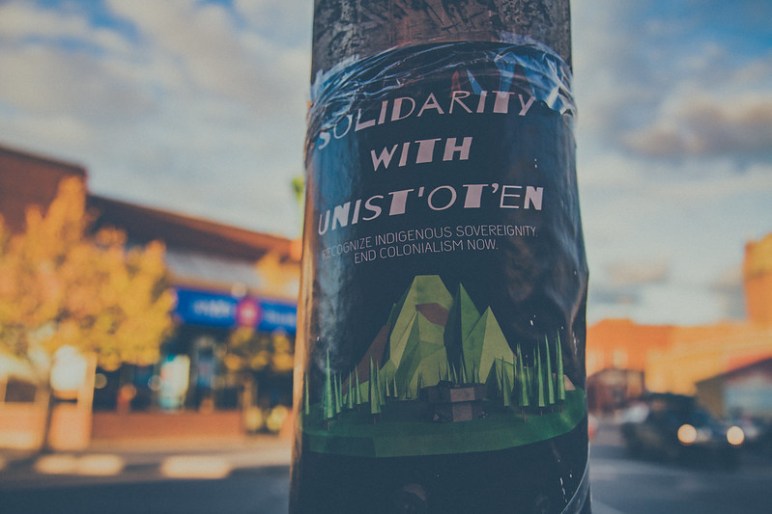
The latest example is now being played out near Houston, British Columbia. The Unist’ot’en and Wet’suwet’sen “nations” and their “hereditary chiefs” versus the rest. This latest collision to be where there is the proposed site of a natural gas pipeline to be built for a $6.6 billion by Coastal Gas Link. (The pipeline is to link to a $40 billion LNG export plant that is to be built in Kitimat, B.C.)

The NDP government of British Columbia with a straight face, state that they are both anti-pipeline and pro- pipeline. Hereditary chiefs disagree with elected counsels. Some bands are pro development seeing it as a financial windfall and the only hope out of abject poverty; others are just against it.

Last week a BC Supreme Court issued an injunction ordering that all obstacles to construction be removed. Pretty simple right?

The problem is that it was one Nation, going through their legal system, that obtained the injunction. The other Nation doesn’t recognize those laws.

Grand Chief Stewart Philip says that it is a very “complicated issue”. It’s complicated mainly because it is difficult for him to argue both for and against.

On the hereditary chief side you have reported comments like;

“It’s our territory. It’s not Canadian land. It is not the Queen’s. It’s not the RCMP’s. Its Wet’ suwet’sen land. “

The builders are “settlers on stolen land”, this is “environmental racism” all part of the “Canadian legacy of colonization”.

Immediately the BC Civil Liberties Association and the Union of BC Indian Chiefs jumped on the practised narrative, led by Grand Chief Stewart Philip who issued a statement saying: “A police exclusion zone smacks of outright racism and the colonial – era pass system sanctioned by the so-called rule of law, which our people survived for far too long”.

And in between these two nations is the politically correct RCMP. Their political masters want them to be gentle, do not offend at any cost. Their legal bosses are telling them to enforce the order and in the past, there was no hesitancy around a court ordered injunction. The Mounties traditionally and constitutionally were there to enforce the laws, not to interpret them.

But this is a different world now. This is the world of appeasement and the Mounties are going to find that they have no friends on either side.

The Mounties, god bless their souls are trying none the less, to be friends to those who can not countenance any meeting of the ways. They have asked the Indigenous protestors to meet and negotiate with the very same company that went to get the court order, the Coastal Gas Link group, who must think that they are is some sort of Twilight zone.

In the meantime the protestors have been cutting down trees and setting up their camp, while the Hereditary chiefs continue to say that the pipeline violates “Indigenous law and does not have consent”.

This is a fundamental collision. This is not going to go away.

It circles around aboriginal title which has been a decades long argument. What “title” or the “duty to confer” or “honour of the Crown” all means, with all its varied interpretations also includes such arguments as to whether treaty’s extinguished those title claims. Some even argue whether Indigenous groups in signing some of these treaties even understood them.

The countless cases which have been brought forward, have all circled around Section 35 of the Constitution Act of 1982 which proscribes to the protection of indigenous and treaty rights. Unfortunately, it didn’t define those rights, but none the less in 1995 the government began to adopt a policy of an “inherent right to self-government”, and the Penner Report to the House of Commons in 1983 spoke of this inherent right.

Adding to the legal and political confusion is the fact that the rights being claimed by the Indigenous do not come from an “external source”–they claim it is a result of Aboriginal people’s own occupation and relationship with their home territories as well as their own ongoing social structures and legal systems.

This would mean that in their view, they control and define aboriginal title.

Today, no political party, Provincial government or Federal government wants to be seen as decisive in terms of defining what these rights will be or how they would integrate with the rest of Canada in terms of self government.

The lawyers drone on in every level of courtroom. They are seemingly content in this ongoing lucrative dark hole of litigation.

The silent majority sit back and wonder where this is all leading. Is Canada prepared to have a separate entity operating within its borders, with its own laws and government, while at the same time supporting them through tax dollars. Are they prepared to let 4% determine what flows through economically to the other 96%. It seems unlikely, but there is no current political party asking that this central issue gets addressed definitively.

At some point the police are going to have to act in Houston. Every police officer involved will be left standing out in the field and roadway and it will an open hunting season for cries of violence and racism the minute they come within a few feet of the protestors.

The journalists stand by at the ready, camera rolling, salivating at the potential for filmed violence. ( the Canadian association of Journalists even jumped into the recent fray— arguing in court the fact that they were worried that the police could use the exclusion zone to prevent media from covering the RCMP enforcement of the injunction.) Maybe this is a sad conclusion but in this age of “breaking news” it is hard to dispute their intent.

None of this is new in terms of the RCMP being the potential fall guy. There have been many times in the past where the enforcement of an injunction has been violent and they have been pilloried for their abuse of power, rightly or wrongly.

The concern is that there is not a lot of confidence or recent evidence in the current RCMP management being behind their operational officers. Will they be supportive of the laws of Canada and the enforcement of those laws, or will they succumb to the un-written laws of a frenzied very vocal political “Nation”. After all it is a management group which has been genuflecting in front of the Indigenous cause in deference and in parallel with their political masters for the last several years.

We will see shortly. Time is running out in their “negotiations”.

A note to those uniform officers. Make sure those body cams are charged up and the audible is working. It may be the only friend you have in this instance.

Photo courtesy of Flickr Commons by Tony Webster