This is a blog which is more personal than most, it is about the small village of Scotch Creek, where about 1,500 people live scattered along the edge of Shuswap lake in BC’s interior. This is personal because this is a place where I lived for five years, felt that I was home there, although I am sure I never reached the status of being a “local”. I moved away about two years ago, but still feel an ill-defined connection to those that I got to know, and I often still linger and dwell when looking over my photos of that time and place. When I lived there very few people knew of the existence of this small village, but as you probably know it has now received national attention, and the expected dedicated fevered media examination, only because for the last couple of weeks, the people there have been fighting for their lives and their property, against two raging wildfires. The Adams Lake fire and the Bush Creek East fire, which came together and within twelve hours co-joined to create a seemingly indestructible inferno, a combined fire capable of travelling 20 kms in 12 hours, and then being able to surround the community of the North Shuswap.
It was a coming together for which government and the British Columbia Wildfire Service had no answer, and one where there attention had already been diverted to the more populous fires in Kelowna. But this turned into something other than just the fires, because it was also a collision between the socialist oriented BC government and to a lesser extent the Federal government, versus a small group of independent rural residents, more libertarian, more independent, and more self-reliant than currently found in most urbanized areas of the country. The BC government could not relate. In the current political mind-set, it seems that when the duly elected feel constrained, when others are not conforming to their beliefs, then they should be treated with derision. They even resort to labelling and name-calling, and always place them in the category of the far right.
For the last number of years, the citizens of British Columbia, like many in the rest of Canada have been gladly and willingly led down the path of government being allowed to control of most of our daily lives. Theirs is a utopian society where the government knows best, it is a government that will protect us, that will feed us, house us, and all the “un-housed”, and keep us safe from the mental stressors and complexities of the real world. We are to be bubble-wrapped. And when this government mind set doesn’t find like minded individuals, or when it stumbles or fails in its goals, then the general populous demand to know why; and demand to know what the government is going to do to fix it. The government continually re-enforces these beliefs and spews a constant mantra of being “there for you”. The citizens in return are expected to never question, never provoke, and the government hides behind the opaque wall of bureaucracy. We have created a population with hands continually extended palms upward, for an infusion of the always flowing monies, to hold us over, and to make all the pain go away. Money is never an issue under this regime, Provincially or Federally.
It is at least politically successful, until one hits a pocket of the public that doesn’t like the government, a group that don’t want the government making all the rules and regulations, and still exude a stubborn pride of place. It is in many ways a throwback to earlier times. Your car breaks down, you fix it, your sewer backs up, you dig the trench to fix it, and for the most part there is nobody else around anyway. This is in essence the character of the community of Scotch Creek, they are the square pegs that the government wants to try and force into the round holes of compliance.
So as these two wildfires came together, the government body charged with fighting it is the British Columbia Wildfire Service, along with the BC Emergency Management Minister, Bowinn Ma, and she in turn is backed up by the NDP Premier David Eby. The government spin during this time is too predictable “we are here for you,” “to save you”, “to protect you” from the fires. How were they going to do that? The first order of their business plan is that they are going to get you to leave, to run from the fires, and to leave everything behind, everything you worked for, everything that is your material tie to the world. Secondly the Wildfire Service will be there to “mitigate” the disaster, which in a lot of cases is not to fight the fire, but to try and “control” it. As the Scotch Creek residents watched and physically saw the flames barreling down on them, they were told to flee, but their instinct was to fight, especially when there was no sign of the Wildfire Service, in fact the Service did not show up for a couple of days. They were un-officially abandoned.
So a pocket of individuals, about 300 people reacted instinctively, they decided they were not going to lose everything without a fight. They were local, they knew the woods, the lakes, the winds and the force of the fires coming at them. They also knew with their access to boats and the lake that they could never be fully cornered, they had a planned escape hatch. And so they did fight, with every water pump, shovel, and mechanized device that they could muster. In so doing and with an inhuman amount of energy they managed to save a number of properties, and many parts of their community. It was a formidable battle, and in the end they still lost 170 properties that were completely destroyed or heavily damaged despite their efforts.
And what was their government doing? They were on the radio and the television and pronouncing in front of anyone that would listen that it was not “safe to defy evacuation orders”, that these people were “un-trained”, that they needed to leave or they would be “arrested”. When someone pointed out that they actually couldn’t be arrested, they pointed out that they could if they strayed from their own property and tried to help a neighbouring residence. The government was fully immersed in their “process” and their Command Centres issued press release after press release how these people were endangering the lives of the firefighters, these renegades were daring to disobey their direction. The media as they always do in today’s environment, echoed the government concerns almost verbatim, feeling free to chastise those that had dared to stay and fight.
The people on the ground paid no heed. But as they fought on, they were running out of diesel and water and some other necessities to survive. Their like minded residents from across the lake gathered at the Finz restaurant and marina, and they gathered together and rallied to deliver food and goods to those in the fight by boat, driving across the smoke filled lake. What was the government response to this outright defiance? They ordered the police at the road blocks to turn back the food truck, not allow it through, which one can only assume was in an effort to try and force the residents to leave by cutting off their supply lines.
A twenty person protest fringe group showed up at the roadblock, one particular day, and the police went to the media stating that these people “intended to overwhelm the police” at their roadblock. The BCWS immediately issued a social media notice that they too were leaving, it was too dangerous for them, that these twenty “protestors”, had issued “threats of violence against these safety officers”. Interestingly the media also began referring to these protestors as part of a “convoy”.
In the end, the panic was short lived. A short time later the police rescinded their concern, and the BCWS realized they over-reacted and pulled down the media post. The RCMP then felt it necessary to speak about how their officers were “well trained and de-escalated the situation quickly.” They apparently disposed of this “massive” protest of 20 people in an hour with “no violence and no arrests.”
Meanwhile, as expected the Premier was touring the sites, focusing primarily on the voters of Kelowna and the Indigenous, photo ops of comforting those that had lost their homes and belongings; Trudeau was in Kelowna as well, but was warned about coming to the Shuswap it was reported, because of the dangerous backlash that was going on there. The Vancouver media who had sent all their resources to this “climate crisis”, now wandered the evacuation centres, trying to find someone that would cry on record about having lost everything or get video of them staring through binoculars at the distant shore to see if their house was still standing.
The people at Finz, continued to say to the authorities, whether you like it or not, we are going to get help to our friends. Ever slowly, the Wildfire Service knew they were not going to win the publicity battle, the opinion tide was turning, and if there is anything the government pays attention to is the social media –so their messaging began to morph. Ms. Ma became less strident in her pleadings to comply with the government evacuation orders, never admitting they were wrong, but that they were now going to “fold these people into our operations”. They were going to co-opt these malcontents, train them in the Wildlife Service ways, and then they could begin to allow these now fully “trained residents” into the area. The extensive training by the way in the end was for one day. So in the end they were now able to supplement the 1600 “expert” personnel which they hire each year, a third of whom are summer students with the “trained residents”.
The Wildfire Service were now also facing some hardened questions. There had been a controlled burn that some folks in the area questioned as to whether or not it had aggravated the situation. The Wildfire Service denied this possibility, and quickly countered with another media conference where the controlled burn was described as being a major “… success and saved hundreds of homes”.
One may never get to the truth of it all for quite some time. The Shuswap region lost 170 properties and 137,000 hectares burned, the Kelowna region lost 180 homes or outbuildings. One would think that there need to be some questions asked, although one should know that to question firefighters is akin to asking the Pope to become a Baptist. They are to be celebrated at all times.
To date the government according to the BC Forest Minister has spent $585 million, but not to worry, “the money is there” and they are not concerned about running out of money, “whatever it takes to protect people and property”. No one pointed out in his news conference that that there are a lot of people that may tell them that they in fact didn’t do a a very good job of saving peoples property. But why quibble and distort the popular narrative.
When you look at some basic numbers, it is fairly obvious that this is about mitigation, not about saving all. There are currently about 377 wildfires burning facing these 1600 firefighters, which amounts to about 4.2 persons per fire. Clearly they are not going to fight every fire. The question is how it is determined when and where they will fight? At least 40% of their budget goes to “contracted” aviation services, 130 helicopters and 35 fixed wing aircraft. Is contracting these services the way to go? Are helicopters with their single buckets the most efficient way of fighting the fire? Firefighting is clearly a very lucrative business for some, and when large amounts of money are being expended, maybe someone should be auditing costs and the financial controls in place.
Throughout this process, it has been continually been said that these fires were “historic”, that they were the result of “climate change”. Well that is not quite true either. According to the Fraser Institute, and an examination of the data, “the annual number of fires grew from 1959 to 1990 peaking in 1989 at just over 12,000 that year and has been trending down since.”
“From 2017 to 2021 (the most recent interval available) there were about 5500 fires per year, half the average from 1987 to 1991”. The annual area burned also “peaked 30 years ago”. The Wildfire service now bends the statistics slightly, and now contends that this year, the number of fires is “six times the 10 year average”.
So the question that needs to be asked is whether the tendency for fires to become larger and more dangerous is as some claim, something that “can be traced to our approaches in forest management”. This is not a question for the individuals actually on the ground dealing with the fires, working 12 hours shifts and sleeping in pup tents, these questions are for the leaders of our government and the bureaucratic functionaries of this service. The BC Wildfire Service at the very least need to be audited in terms of management, resources and the expenditure of funds. Do I expect it to happen? No. Remember these are fire fighters.
So as the politicians slowly work there way back to their safe urban environments, the media in tow, maybe some should also realize that maybe evacuation notices should not be the only tool in their policy belt. Maybe, just maybe, they should listen to those that still project and protect their independence. They are a minority to be sure, their numbers are dwindling, but the government needs to think as to whether coercion and ignoring their input is the best policy decision. These people are in fact reminiscent of that dreaded “colonial spirit”, reflections of that “greatest generation” which for the last number of years your governments have decided need to be criticized and humiliated and spoken to as ill-educated and unworthy. The truth is that we need more of them.
And yes, they did save my old house, and I for one are very grateful for those “untrained” firefighters.
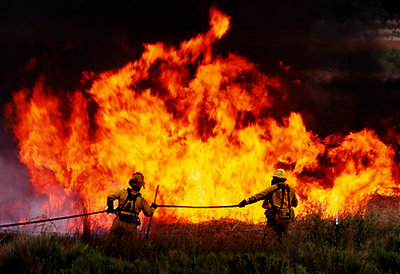
Photo courtesy of Flickr Commons by U.S. Fish and Wildfire Service – Some Rights Reserved
 Behind the Yellow Tape