This flows from an earlier blog where I offered this site as a potential forum for those that wish to write about any topic near and dear to them and most importantly, to open up the dialogue. The following is from Ian Parsons, a now retired former Inspector, with a long family history with the Mounties, who published a book in 2013 “No Easy Ride” about his experiences in the RCMP. The issues within the RCMP and its lack of leadership and direction has been at a sharpened point for at least a couple of decades, and therein lies the frustration. Ian Parsons book is linked here, but this submission is in essence part of the last chapter of his book. In it he argues for the RCMP to become a Federal entity, and to move away from contract policing. Not everyone will agree and one could easily argue the other side, but this viewpoint is clearly gaining favour inside and outside the RCMP.
I will also be posting a blog in the next couple of days, but in the meantime, my extended thanks to Ian.
HEAD SMASHED IN BUFFALO JUMP
During the summer of 2008 I visited “Head Smashed In Buffalo Jump” located near Fort Macleod in southwest Alberta, a museum/monument dedicated to Canada’s first peoples and a way of life that has long since disappeared. In spite of the numbers of tourists who frequent the location, it is a spiritual place that every Canadian should see at least once.
As one peered at the cliff where millions of buffalo met their deaths after being herded, stampeded and driven, it is perhaps easier to understand how such a massive animal who dominated the prairies for centuries could have been reduced to a smattering of herds located in protected areas of western Canada today. The buffalo might even have survived had the influx of European society, white buffalo hunters and the incursion of pioneers hungry for large tracts of farmland not led to their demise.
The Indigenous tactic of approaching a large gathering of buffalo by foot and herding them toward the edge of the cliff, stampeding them at the last moment so the momentum of the herd took the animals over to their deaths was not a conservation maneuver, but a very efficient one. The women and children waited at the bottom to butcher prime animals for their choice parts.
As I mused, another icon of the Canadian west came to mind: the Royal Canadian Mounted Police. This worthy and durable organization has been a fundamental building block of my personal being. My father joined the Force in 1930 and spent 35 years policing all parts of Canada. I followed his footsteps in 1961 and served 33 years serving from Newfoundland to British Columbia,affording me a “macro” view of the RCMP in Canada My son is embarking on his RCMP career, having recently completed his recruit training in Regina. One would think my son’s future should be assured, as the demise of the RCMP should be about as likely as the disappearance of the plains Buffalo.
However the analogy between the Buffalo and the RCMP seems rather ominous when one observes the Force as a spectator. Once the buffalo were pointed in the direction of the cliff, the run was commenced. The momentum was so great that literally nothing would prevent their rush over the precipice. It occurred to me that a similar fate may be in store for the RCMP as an entity. They seem to be heading for the “cliff”. Momentum is building. They soon may be “over the edge”. This is particularly ironic, as the plains Buffalo is one of the symbols of the RCMP.
How can this happen? What is precipitating this potential tragedy? Essentially, the increased population and complexity of Canada has overwhelmed our frontier police force. Originally, the Force accepted and discharged all facets of policing in the Canadian west. No matter what the request from Ottawa, this versatile body of men, now men and women, accepted the task and usually carried it out successfully. The philosophy of the Mounted Police has always been “Never say No!”. Even if the task overburdened the troops, the job was undertaken without question and every effort was expended to meet challenges.
Such was the case when the RCMP expanded municipal responsibilities from small prairie communities to large cities after their takeover of provincial policing in BC. In the early 1950’s the Mounted Police began policing the municipality of Burnaby, British Columbia. This was the forerunner for the contracting of several other very large municipal details in the lower mainland of British Columbia. The logistics of supplying human resources for these operations were extremely taxing, and sapped the Force in many other areas. The necessary tactic of “Robbing Peter to Pay Paul” became a common policy. Many operations ran shorthanded in an effort to “Feed the Monster” consuming human resources in southern British Columbia. Administrators of the RCMP were loathe to lobby governments in power to increase resources, and attempted to deal with inadequacies internally. Amazingly, until the late seventies, payment of overtime was not a factor. Putting in 300 hour months was not unusual for field personnel during this era. RCMP members worked any required additional hours with no compensation. Often they would toil alongside municipal police who were being compensated for overtime.
As Canada’s human tapestry began the transition to multi cultural, exacerbated by population growth, more cracks and fissures began to appear. The basic para-military infrastructure did not change, and the RCMP continued to be responsible for all levels of policing from coast to coast. Provincial contracts were demanding more and more resources, as were growing municipal contracts. Our frontier police force was attempting to be all things to all people in what was becoming a very diversified country.
The sudden and welcome addition of women in policing which compelled maternity and paternity leaves,and the new policy of having to pay overtime for additional hours worked began to take its toll. An overdue bill which had gone long unpaid in the form of hours and hours expended by an exhausted body of people was looming large. Now Detachment and unit commanders were required to dole out their resources according to fiscal budgets. Work began to be priorized. More than ever before, some investigations took on more importance than others. It became evident that, in many cases, there were insufficient person/years to do the job.
During the 1960’s, trying to balance all of these mandates coupled with being responsible for Canada’s national security caused serious shortcomings. The McDonald Commission was struck. Its mandate was to examine how the RCMP was functioning at the national security level. The resulting recommendations saw the removal of Security Services from the purview of the RCMP. At no time did the Force relinquish this responsibility voluntarily. It had to be arbitrarily removed.
Today, even with the recent Brown study that recommended changes internally, there are few executives at the upper echelon of the RCMP, or any politicians who have focused on the essential problem; multijurisdictional saturation. Currently, lofty policy statements have been forthcoming from RCMP management that speaks to elevating professionalism, improving the management environment, and tasking individual members to “meet the challenge”. Daily, RCMP detachments are operating under strength. Morale is not improving, and members are feeling more and more under siege, both inwardly and outwardly.
Sadly, the Force seems headed for the “cliff”. One is also reminded of the story of the Emperor. As he rode through the streets naked, not a single member of the kingdom would comment. The problem of “Mandate Overload” is so massive and should be so obvious, yet not a single warning has been voiced. THE TIME HAS COME TO ADMIT THAT THE RCMP CAN NO LONGER ATTEMPT BE ALL THINGS TO ALL PEOPLE. The Force has reached the point that it has so many diversified and complex tasks at so many levels; the appearance of success is becoming more and more elusive. Immediate action must be taken to bring the RCMP into the 21st century. The RCMP must be extricated from Municipal Policing and Provincial Policing contracts. Provincial contracts are up for renewal in 2012. The Mounted Police must make a transition to an exclusively “federal focus” by that time. If the RCMP brings its considerable expertise to bear primarily on federal responsibilities, ASSISTING provincial and municipal police Forces on serious and interprovincial crime when called upon to do so, there may be time to prevent this noble “herd” from crashing over the cliff. Rather than being distracted by a myriad of assorted demands, the Force could target national issues such as biker gangs, terrorism, corporate and economic crime along with all the other criminal maladies at the national level.
It will be a psychological debilitating national trauma if the “RCMP Herd” is not turned around and saved from destruction. The RCMP is a Canadian icon, etched indelibly into the Canadian psyche. Canada’s leaders have a responsibility to ensure this national treasure is preserved. The Royal Canadian Mounted Police is still admired worldwide. Canada will be a smaller country without them.
Turning the herd will not be an easy task. There will be resistance at all levels…..from the municipalities, the provinces, and from within. The logistics are difficult and complex. Resistance to change will be rampant. It will take great political courage and dynamic leadership. The alternative? The loss of a Canadian Icon.
If current leaders, both inside and outside the Force do not display courage and stamina and move on these initiatives, the Royal Canadian Mounted Police will continue to be deluged with a complexity of problems from the multi levels of jurisdiction it is now futilely wrestling with. The disasters will continue. The RCMP will sadly be swallowed up by a barrage of criticism and find itself broken and dying at the bottom of the cliff.
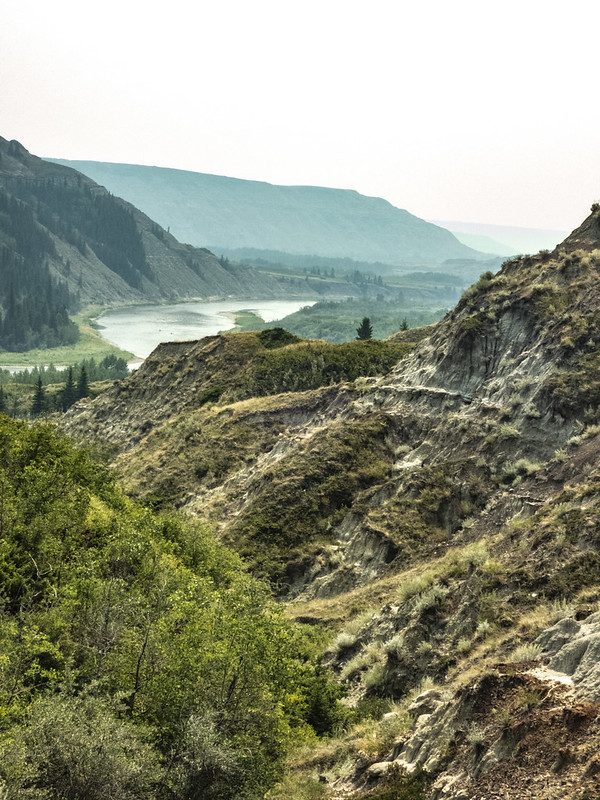
Photo courtesy of Flickr Commons – Dry Island Buffalo Jump – Some Rights Reserved
Ian can be reached at: liparsonsposse@shaw.ca
 Behind the Yellow Tape