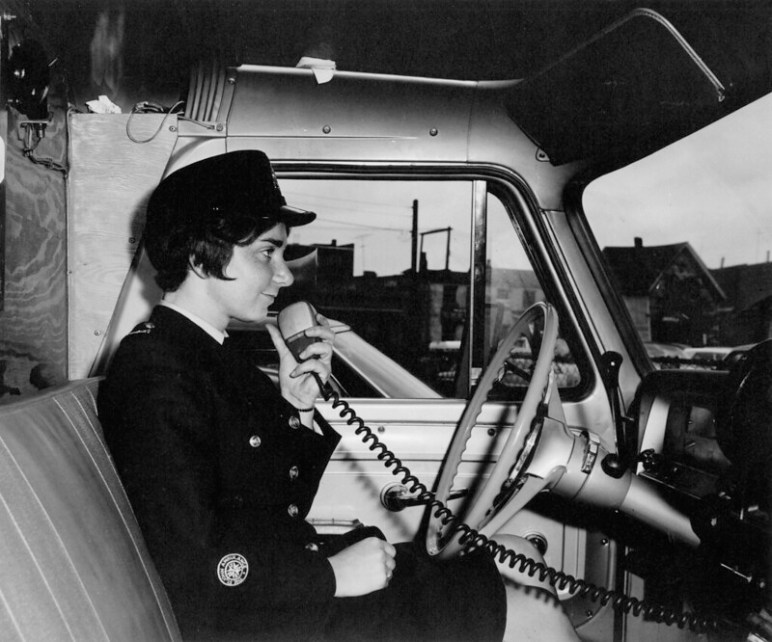
There was a small parade and ceremony in St. John’s Newfoundland the other day. An auspicious occasion as it was to mark the fiftieth anniversary of women entering the Royal Canadian Mounted Police. It was back in May 1974 when Commissioner Nadon had opened up the recruitment and application process to the women of Canada. By September 18th of that same year, Troop 17 was born, graduating on March 3rd 1975, and thus shoved themselves through the door and entered into the looming chasm which was the male policing world.
In training there were 32 of them, surrounded by 800 men recruits. The female recruits were all 19-29 years old, embarking on a novel career, but not likely thinking of any “glass ceiling”; in most cases seeing it as an adventure. In fact the term “glass ceiling” wasn’t even coined until 1978. As one of the officers said in a recent interview “they weren’t ready for us” and it is just as likely these female recruits were not ready for what they were about to encounter– both on the street, and just as importantly amongst the ranks of the male officers. They went in blind, but I am sure it did not take long for their eyes to be quickly opened.
Nowadays, the RCMP sees themselves as enlightened in these matters of discrimination and the power of women; however, in 1974 the move by the RCMP came about after having being pushed to do so by the Royal Commission on the Status of Women. They did not relent willingly. The Commission had been formed in 1967, but it still took the government a number of years to be pulled and cajoled into the age of women empowerment. They weren’t the first, the Vancouver and Toronto Police Departments had already brought women into the fold by the time Ottawa and the RCMP moved into the late 20th century.
In 1975 Captain and Tenille were singing about love keeping us together, and Jaws and One Flew Over the Cuckoo Nest were storming the box office. Prime Minister Pierre Trudeau was leading the Liberals, and Joe Clark was about to succeed Robert Stanfied for the Conservatives. Some would say it was a much simpler time, more black and white than grey. And to be totally accurate, there were female “employees” in the RCMP long before this, as they had employed “matrons” in the 1890’s for the processing of prisoners. The woman first believed to be the “first female member” of the RCMP was Dr. Francis McGill, who headed and help to establish the Forensic medicine department in Saskatchewan in 1946.
However, this group in 1975 after graduation were the front line officers and they were about to be dispersed throughout the country. It was not going to be an easy task and one could easily make the argument that the roughest part of their journey and their eventual indoctrination did not come from the street– but from their fellow officers. I was around in those early years, in 1978 I was a recruit assigned to the Newcastle New Brunswick Detachment (an area now called Miramichi City) and shortly after I arrived, the first female the detachment had ever seen, arrived as well. Newcastle was the epitome of the term rough and tumble; high unemployment and rampant poverty. It was a conservative blue collar place where a police officer could easily in the normal course of their daily duties be involved in a knock you down drag it out fight. The people who lived there were either miners, loggers or fishermen and they lived hard and played hard. It was a 23 person RCMP detachment, relatively small, but deemed large in terms of this “have-not” New Brunswick Province. The Mountie administration were initially reluctant even to send female officers to this area because of the constant environment of simmering violence. A few years later, the area would become infamous for being the home of serial killer Alan Legere .
I often have maintained and have stated categorically many times, that the toughest job in policing is to simply be a female officer. And it was in Newcastle in 1978 that I worked with “Sheila”, the first female Mountie ever to be stationed in this robust village; an above average height, slim, a quick to smile 25 year old, who immediately found herself now working with big strapping Mounties, who with little doubt, were to the right of centre socially and politically. The male officers there were quick to jump into a fight and quick to say what they meant loudly and in a clear voice. There were no niceties and they all became my friends. However, in terms of personal viewpoints, if they had done a survey in those times– almost all would have felt that women had no place in policing– and some would profess that between women being “let in” and the arriving of the Charter of Rights in 1982 it was the end of the golden age of policing. “Sheila” was from the start under an intense microscope, the subject of continual stares, in public, and even at social police functions, most pointedly by the female spouses of the other officers. She was seen as an obvious threat to domestic bliss, and she had the added burden of being attractive. Some of the spouses demanded that their husbands not be seen riding in the same patrol car with Sheila or meeting up for a work coffee break. She was assigned to the Traffic Section, because it was seen as being “safer” there. I never saw her show weakness or express exasperation; she never complained, she just kept doing her job and hoped for eventual acceptance.
When I try to analyze the root cause of the growing pains for females in those early years, it probably comes down to two simple elements. First and foremost, at that age and time, there was a clear delineation between what was the role of the male and what was the role of the female. Simply put it was a boy’s club and their treehouse and they were girls trying to climb the shaky wooden ladder to become a member of the group. In their dress Red Serge uniform, the females wore red blazers and black knee length skirts and in 1983 they gave them purses to carry their guns and handcuffs. They wore form fitting polyester blouses, with no pockets to avoid any unnecessary protuberances. They were being seen as female first, police officers second.
The second element, that flows from the first, is that policing was seen as a laborious lower level middle class job; a physical occupation, where size and weight were the primary measurements in your ability to do the job. The job back then was often simply defined as chasing “bad guys” and physically tossing them into jail. This is not to say that there isn’t a physical element to this job, there was then and there is still now. Women then and now are expected to be just as tough and willing to wander into a scrap, against someone usually bigger and stronger than them on a regular basis. But in those early years one should be reminded that there were no alternate weapons such as pepper spray, or batons, or tasers, or which came about specifically as a way to level the playing field. In those days the female officers were told to be tougher; they were punched, kicked and spit upon, and they were expected to go down fighting. They were continually being watched for signs of acquiescence or for showing female qualities. That was unfair but there are still some elements of this scrutiny even today.
There is also a female proscribed role in terms of familial and personal relationships which lingers to this day. Starting and maintaining families and households is still very much predominantly the role of the female, this while balancing a policing career in particular is a significant challenge. Throw in the sometimes still present misogynist male and night time shift work and you get some idea of how tricky it can be. Sometimes for some it has proven to be overwhelming. Female officers traditionally have not stayed in policing as long as their male counterparts, but there are few studies as to why this is happening, but clearly there are reasons for it.
For those that did manage to walk the fine line and especially to those that endured in those early years one can only show respect. Since those early days, I personally have worked with some extraordinary female officers through three decades of policing. They were hard working intuitive good investigators long before they were seen as female. Their gender was inconsequential. Many of them displayed different insights that being who they were provided them. I can’t explain it, I just saw it working.
All of this is a common saw. Since the early 20th century, women have been fighting to define their role in a male dominated society. Policing was one of the last of the true male vestiges of this 20th century. It was difficult to run at and break through those traditions. It was often an individual fight on an individual level. Those that put up that fight in those early years started that final pendulum. Today, females possibly enjoy an even greater chance of promotion and have the benefits and support networks to confront the duality of their roles. It is still hard, but all the female officers of today should be bowing in respect to the many that came before them, a time before many of the current officers were born.
I watched it from the sidelines, but I am also tipping my cap to “Sheila”.
I am sure she will smile back.
Picture courtesy of Flickr commons from the Vancouver Archives – Some Rights Reserved
 Behind the Yellow Tape