
I last wrote about unsolved homicides on February 8, 2017, it was in fact the 2nd blog that I had ever written and it was a topic of some interest for me. In that blog I pointed out, the obvious to those that are in the policing community, but not so obvious to the members of the public, that there were serious problems developing in the field of homicide; more specifically in the ability to solve them and the resulting growing pile of “unsolved” investigations. The blog outlined the declining “solvency” rates or “clearance rates” and that there was a significant and dramatic drop in the number. That article focused on the local B.C. Integrated Homicide Team (IHIT) because it was the area I happened to know best but it was a trend that was North American wide. I’ve reprinted the charts below to graphically show the trend for Canada and the United States and to show that this trend goes back a number of years, in fact decades. This despite the advances in forensics and investigational techniques and increases in police resources over this same set of years. The decline is precipitous, in 2017, IHIT was reporting their solvency rate as 43% (and I believe they were fudging those numbers). In 2003 it was at 78% and there were half the number of police officers in terms of overall manpower.
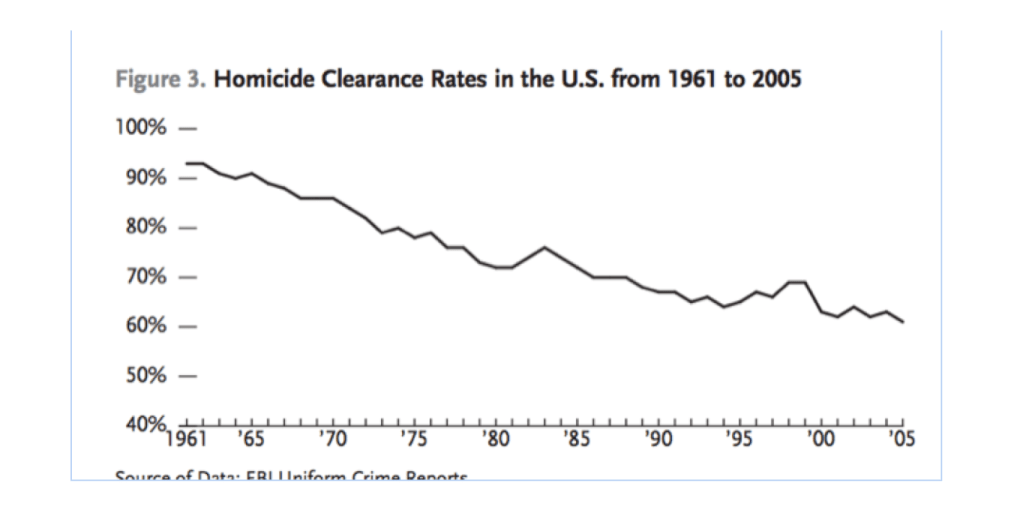
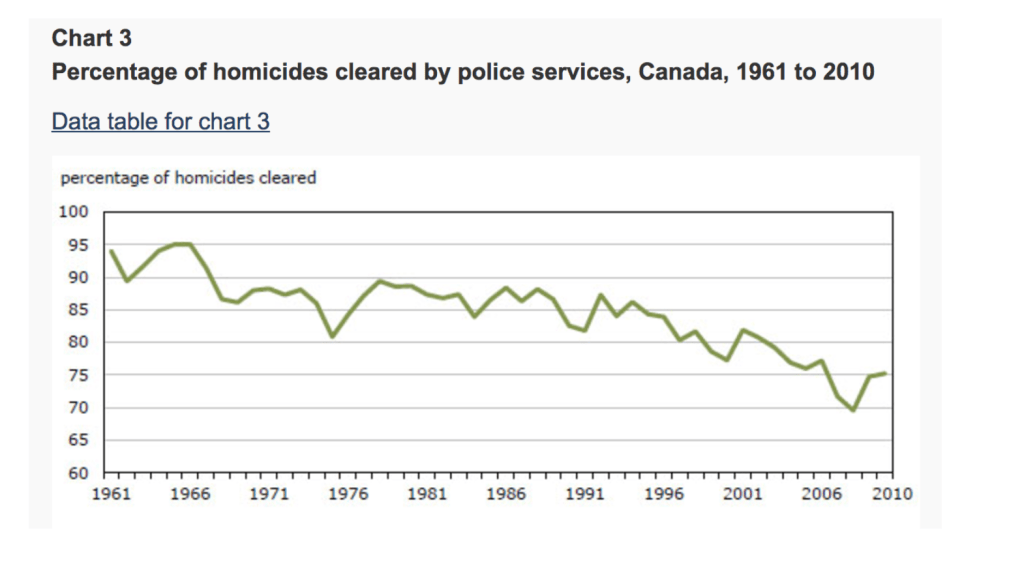
The blog in 2017 went into great detail as to all the reasons which may have been contributing to this decline, so we won’t repeat them here again. But we need to ask the question, now six years later, has anything changed or improved? The short answer, unfortunately appears to be no. The things that were pointed to in that article; rules of evidence, disclosure, the growth in complexity in terms of warrants and the surrounding case law were all legitimate excuses to varying degrees and in those areas no improvements have been made and as far as I can tell even discussed.
In speaking with a friend of mine, who is now in the academic world and who is constantly looking at homicide and the statistics surrounding the data—that data is now suggesting that the solvency rates in 2024 has dropped further and the trend is still downward, and is now hovering around a very low 30%.
It is one thing to see it in percentages, however it seems even more discouraging when one looks at it in terms of the actual number of files. Just looking at British Columbia, an area that I am most familiar with, when I last checked in 2014, there were approximately 1200 unsolved homicides in the record books for this Province. If we look into the current solvency numbers versus the file intake, using broad measurements would mean that IHIT alone, not including the municipal agencies, is adding about 25 unsolved cases to the file pile every year. So that would mean that at a minimum the unsolved cases would now add up to about 1450 unsolved homicides. The Canadian Police Information Centre (CPIC) estimates that there are 3400 cases in Canada, with Ontario and Quebec leading the way, followed by British Columbia. It goes on to say that in British Columbia there is a “significant number of unsolved murders” and they estimate there are a total of about 1700 unsolved cases in the Province. They succinctly comment that B.C’s high numbers are the result of “systemic challenges in the regions justice system”.
One may ask, what about those “Cold Case” squads or Unsolved teams that the police agencies have working on these relatively dormant files.
In British Columbia, there is an E Division Unsolved Unit for the RCMP, which is moderately successful, but in all it takes about two files per year off of that pile. Often those cold cases are prompted by a submission of older forensic DNA evidence. The public is interested so every successful case is played up by the media and the police managers. This is by no means trying to demean those results, but in terms of real numbers, there is little impact being felt to the overall list.
Some members of the public may say, well that is just a fact of life, we do not have unlimited policing resources. Which is also a fair comment. There are obvious limits to the extent of policing resources. In practice what the police are forced to do is pick and choose and put a series of organizational filters in place in order to decide which one of those hundreds of files are worthwhile. They have to make those choices also within the framework of continuing an investigation in the height of ever-increasing costly policing resources.
There are many factors which go into the decision; the age of the file and therefore the current ages of the people involved; whether there is any forensic evidence already on the file, and whether there is an already obvious suspect. Ironically, the “unsolved” unit usually takes over files where the suspect is already known, and in some senses “solved”. Was the victim a child, a mother, or some other “innocent victim”. In some cases it is just gangsters killing other gangsters and therefore, in most cases not righteous victims in the eyes of the police; although the police will never admit to this level of filtering. While standing at a crime scene, I myself have asked or been asked by managers, whether the victim was a “legitimate” victim– as harsh as that sounds. The police can not deny that if the victim had in fact lived by the gangster edict of “live by the sword die by the sword”, sympathy for that victim is automatically dulled and will adversely affect the length and breadth given any investigation. It is just a fact of policing life. Another filter which comes into play, but is never talked about is the level of public attention that has been given to the case and the victim. Call it a case of the “squeaky wheel” syndrome. The Sherman murders in Montreal come to mind. When your victims are billionaires, you seemingly get a different level of attention. The Surrey 6 murders caught the attention of everyone because of the two innocents among the dead drug dealers.
In a pure and perfect world this filtering or rationalizing is of little comfort to the families of victims regardless of their background.
The police for obvious reasons are not forthcoming about these decision making processes or their solvency rates. To be sure they are in a tough spot. Tell the truth and deflate everyone’s expectations or fudge the abject truth for something that still leads to some measure of hope. In terms of their public face they have chosen to do the latter. It’s why the police never admit to not working on an unsolved case, instead they announce that all files are “active” cases. By strict definition they are not lying, but in actual practise they are being very deceptive. There is a difference in keeping the file “open” and “working the file”. Almost all cold cases, day to day, in fact are dormant, sitting on a shelf, waiting for a “break” or a “new lead” to come out of the ether. The police are not “working” those files, at best those files will only be given a cursory view for any new information every year or two.
Also concerning when one reviews the statistics is that it is also becoming apparent that the data that is being published or distributed on websites by the police or even by Statistics Canada are being skewed. Maybe not intentionally, maybe because of errors in reporting. For instance the Toronto Police Service on their website claim that their clearance rates for homicide are over 80% since 1921. The London Ontario police list only nine “unsolved murders” since 1956. In doing a quick check of London’s numbers, it shows that just between 2019 and 2023 they had a total of 43 murders. Assuming a 30% murder rate clearance, this would mean that during that time period they should actually have about 30 unsolved murders just during that four year time period. Are they deliberately misleading the public, or do they have some top notch investigators who vastly outshine any other agency in Canada. By the way, if you go to the Government of Canada website and ask about “cold cases” you get a 404 error message, and Wikipedia lists only 217 unsolved cases in Canada. It would seem that no news is better than bad news. The Unsolved Section of the RCMP of course does not even give any numbers.
Statistics Canada, says that as of December 31, 2021, for that year, there were 525 murders solved of 788 which were committed –which gives them a 67% clearance rate. How could this be? There is clearly a disconnect between what is actually happening and the offices of Stats Canada. A deeper delve into the data seems absolutely necessary as clearly something is not adding up.
Unfortunately, this blog is not offering up any new instant solutions. It just makes you think that in an advanced society, a G7 country, with theoretically untold resources, that this should not be the case. Should we not be studying and addressing the root causes of this dilemma? What does it say about our society on a fundamental level when homicide goes unpunished or fully investigated? There is no clear fix, but as of today, the sad truth is that Netflix may be trying to solve more files than your local police department. The messaging seems all wrong.
Photo Courtesy of Flickr by Bill Selak – Some Rights Reserved
 Behind the Yellow Tape