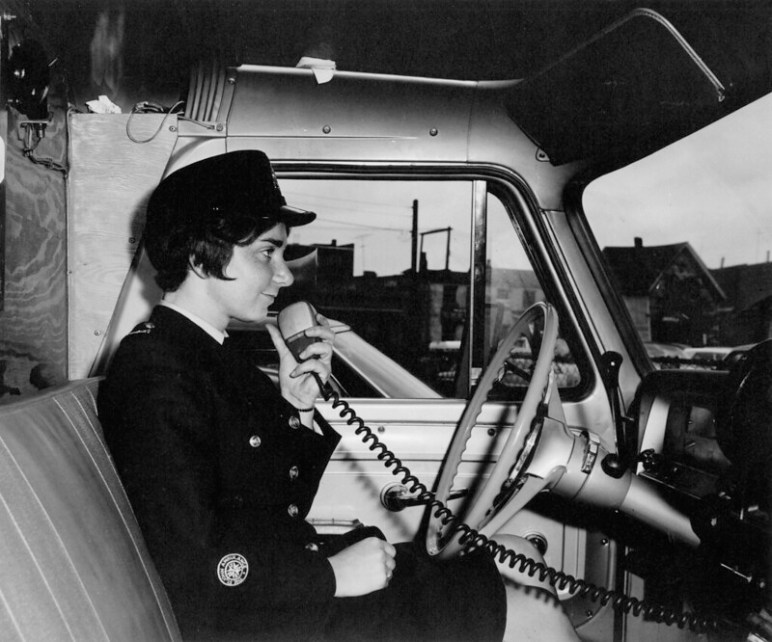
Here’s to the Women

There was a small parade and ceremony in St. John’s Newfoundland the other day. An auspicious occasion as it was to mark the fiftieth anniversary of women entering the Royal Canadian Mounted Police. It was back in May 1974 when Commissioner Nadon had opened up the recruitment and application process to the women of Canada. By September 18th of that same year, Troop 17 was born, graduating on March 3rd 1975, and thus shoved themselves through the door and entered into the looming chasm which was the male policing world.

In training there were 32 of them, surrounded by 800 men recruits. The female recruits were all 19-29 years old, embarking on a novel career, but not likely thinking of any “glass ceiling”; in most cases seeing it as an adventure. In fact the term “glass ceiling” wasn’t even coined until 1978. As one of the officers said in a recent interview “they weren’t ready for us” and it is just as likely these female recruits were not ready for what they were about to encounter– both on the street, and just as importantly amongst the ranks of the male officers. They went in blind, but I am sure it did not take long for their eyes to be quickly opened.

Nowadays, the RCMP sees themselves as enlightened in these matters of discrimination and the power of women; however, in 1974 the move by the RCMP came about after having being pushed to do so by the Royal Commission on the Status of Women. They did not relent willingly. The Commission had been formed in 1967, but it still took the government a number of years to be pulled and cajoled into the age of women empowerment. They weren’t the first, the Vancouver and Toronto Police Departments had already brought women into the fold by the time Ottawa and the RCMP moved into the late 20th century.

In 1975 Captain and Tenille were singing about love keeping us together, and Jaws and One Flew Over the Cuckoo Nest were storming the box office. Prime Minister Pierre Trudeau was leading the Liberals, and Joe Clark was about to succeed Robert Stanfied for the Conservatives. Some would say it was a much simpler time, more black and white than grey. And to be totally accurate, there were female “employees” in the RCMP long before this, as they had employed “matrons” in the 1890’s for the processing of prisoners. The woman first believed to be the “first female member” of the RCMP was Dr. Francis McGill, who headed and help to establish the Forensic medicine department in Saskatchewan in 1946.

However, this group in 1975 after graduation were the front line officers and they were about to be dispersed throughout the country. It was not going to be an easy task and one could easily make the argument that the roughest part of their journey and their eventual indoctrination did not come from the street– but from their fellow officers. I was around in those early years, in 1978 I was a recruit assigned to the Newcastle New Brunswick Detachment (an area now called Miramichi City) and shortly after I arrived, the first female the detachment had ever seen, arrived as well. Newcastle was the epitome of the term rough and tumble; high unemployment and rampant poverty. It was a conservative blue collar place where a police officer could easily in the normal course of their daily duties be involved in a knock you down drag it out fight. The people who lived there were either miners, loggers or fishermen and they lived hard and played hard. It was a 23 person RCMP detachment, relatively small, but deemed large in terms of this “have-not” New Brunswick Province. The Mountie administration were initially reluctant even to send female officers to this area because of the constant environment of simmering violence. A few years later, the area would become infamous for being the home of serial killer Alan Legere .

I often have maintained and have stated categorically many times, that the toughest job in policing is to simply be a female officer. And it was in Newcastle in 1978 that I worked with “Sheila”, the first female Mountie ever to be stationed in this robust village; an above average height, slim, a quick to smile 25 year old, who immediately found herself now working with big strapping Mounties, who with little doubt, were to the right of centre socially and politically. The male officers there were quick to jump into a fight and quick to say what they meant loudly and in a clear voice. There were no niceties and they all became my friends. However, in terms of personal viewpoints, if they had done a survey in those times– almost all would have felt that women had no place in policing– and some would profess that between women being “let in” and the arriving of the Charter of Rights in 1982 it was the end of the golden age of policing. “Sheila” was from the start under an intense microscope, the subject of continual stares, in public, and even at social police functions, most pointedly by the female spouses of the other officers. She was seen as an obvious threat to domestic bliss, and she had the added burden of being attractive. Some of the spouses demanded that their husbands not be seen riding in the same patrol car with Sheila or meeting up for a work coffee break. She was assigned to the Traffic Section, because it was seen as being “safer” there. I never saw her show weakness or express exasperation; she never complained, she just kept doing her job and hoped for eventual acceptance.

When I try to analyze the root cause of the growing pains for females in those early years, it probably comes down to two simple elements. First and foremost, at that age and time, there was a clear delineation between what was the role of the male and what was the role of the female. Simply put it was a boy’s club and their treehouse and they were girls trying to climb the shaky wooden ladder to become a member of the group. In their dress Red Serge uniform, the females wore red blazers and black knee length skirts and in 1983 they gave them purses to carry their guns and handcuffs. They wore form fitting polyester blouses, with no pockets to avoid any unnecessary protuberances. They were being seen as female first, police officers second.

The second element, that flows from the first, is that policing was seen as a laborious lower level middle class job; a physical occupation, where size and weight were the primary measurements in your ability to do the job. The job back then was often simply defined as chasing “bad guys” and physically tossing them into jail. This is not to say that there isn’t a physical element to this job, there was then and there is still now. Women then and now are expected to be just as tough and willing to wander into a scrap, against someone usually bigger and stronger than them on a regular basis. But in those early years one should be reminded that there were no alternate weapons such as pepper spray, or batons, or tasers, or which came about specifically as a way to level the playing field. In those days the female officers were told to be tougher; they were punched, kicked and spit upon, and they were expected to go down fighting. They were continually being watched for signs of acquiescence or for showing female qualities. That was unfair but there are still some elements of this scrutiny even today.

There is also a female proscribed role in terms of familial and personal relationships which lingers to this day. Starting and maintaining families and households is still very much predominantly the role of the female, this while balancing a policing career in particular is a significant challenge. Throw in the sometimes still present misogynist male and night time shift work and you get some idea of how tricky it can be. Sometimes for some it has proven to be overwhelming. Female officers traditionally have not stayed in policing as long as their male counterparts, but there are few studies as to why this is happening, but clearly there are reasons for it.

For those that did manage to walk the fine line and especially to those that endured in those early years one can only show respect. Since those early days, I personally have worked with some extraordinary female officers through three decades of policing. They were hard working intuitive good investigators long before they were seen as female. Their gender was inconsequential. Many of them displayed different insights that being who they were provided them. I can’t explain it, I just saw it working.

All of this is a common saw. Since the early 20th century, women have been fighting to define their role in a male dominated society. Policing was one of the last of the true male vestiges of this 20th century. It was difficult to run at and break through those traditions. It was often an individual fight on an individual level. Those that put up that fight in those early years started that final pendulum. Today, females possibly enjoy an even greater chance of promotion and have the benefits and support networks to confront the duality of their roles. It is still hard, but all the female officers of today should be bowing in respect to the many that came before them, a time before many of the current officers were born.

I watched it from the sidelines, but I am also tipping my cap to “Sheila”.

I am sure she will smile back.

Picture courtesy of Flickr commons from the Vancouver Archives – Some Rights Reserved

Money, Money, Money… Money everywhere

I will admit from the beginning that there is a jealous undercurrent to this story, although I am sure it is misplaced. Jealous of the current cop world is normally not where I usually find myself. I am talking about the pot of gold which can be found at the end of the Vancouver police departments rainbow. And more monies in a general sense are now being thrown into the policing circle of life than has been seen for quite some time.

The rationale varies and the rationale is wholly dependent on what side of the equation you find yourself. For the Vancouver Police Department, all is good, while on the flip side, the taxpayers of Vancouver might not be quite as charmed. The search for greater monies in the form of police salaries can sometimes cause those on the outside looking in say that those numbers are becoming excessive; especially in terms of city budgetary needs and fiscal constraints. Some would even categorize it as greedy, that there is some over-reach going on, and the justifications for it are much more tenuous. It should be noted that Plato felt that greed was a part of human nature; while Darwin in his theory of evolution felt that greed was natural and good. However despite their distinguished and historic reputations, it is unlikely that their arguments would sway many in 2023– especially those living in Vancouver.

You may not remember those days when police salaries were only in the double digits. You may forget when police salaries were never headlines, mainly because they were mid-level, average Canadian salaries. The salaries seemed in the realm of normal expectations. The average family income in 1976 as an example was $19,000 per year. My first salary in the Mounties was $13,500 in 1978. Using basic math, a cop in 1978 was therefore making about 71% of the average “family” income.

Fast forward to today and the recent headlines in the Vancouver news. The Vancouver Police Department is about to ratify a 2 year agreement which will entitle a 1st class constable (someone with at least 5 years service) a salary of $122,000. ($63.41 per hr) The average family income in Canada in 2023 is $75,452 ($39.00 per hour). Therefore, a cop working today in Vancouver will be making 161% of that average family income. In terms of other “first responders” a firefighter in Canada on average makes $83,138, 110% of the average family income. A nurse in British Columbia is $91,732, 121% of average family income. These first responder salaries it would be argued would be in line when compared with other “first responders”. When the comparison is with anyone else in public view, they are indeed eyebrow raising numbers.

In case you think an RCMP officer is now under paid, lets not forget that they too just received a large pay and retroactive increase. An RCMP officer after only three years on the job is now making a salary of $106,576, roughly 141% of that average family income.

I recently received a copy of the wage rates for the new Surrey Police Service (you know those ones battling Brenda Locke). A first class constable salary is $121,989, only slightly less than that of the new VPD raise, and if you rise to the level of Inspector with the Surrey Police Service you will be at $207,381.00. This would put one well ensconced in the top 10% of Canadian wage earners which requires a salary of at least $174,000. The median doctors salary in British Columbia is $178,810 per year.

So now you get the picture, it is in effect raining gold in the world of “first responders”. And we are not even mentioning the often gracious benefits that are also attached to some of these jobs.

The rationale provided by police spokespersons normally is two fold, that it is a thankless and dangerous job, and there is a need to sweeten the pot to attract people to the job, especially in this age of heightened public scrutiny. Ralph Kaisers of the Vancouver Police Union said that police “are finally being shown the value and support from city council…they need to be properly compensated for the work they do”. He predictably cites the “dangers of the job” and the need “to retain members” as the true drivers of this pay raise.

Let us deal with the first proposition.

There is a danger to the job, that can not be disputed. That is the primary factor when police salaries are being negotiated and has been for decades. But has that danger increased? At first blush that seems to be true. New data coming from the University of Ottawa shows that the recent 10 deaths of police officers in 8 months has not been seen since the 1960’s. But as the authors note, there are twice as many police officers working now, compared to then, therefore the overall death rate is actually lower than in the past decades. The data also shows that the leading cause of police deaths, contrary to the movies and the television, are car accidents. Justin Piche the University of Ottawa professor balks at the current claims of police officers that it is more dangerous now then in the past, and says that “…it doesn’t mean they (the Police) get to make any claims they want”. The deadliest years were 1962 and 1968 when 16 officers died in those years. Since 1962 on average there have been six and seven deaths per year while on duty. All those are tragic, and this appears insensitive when you look at cold hard figures like an actuary, but we can not dispute the numbers. From a statistical perspective, there are 70,566 police officers in Canada currently, which means as a percentage that 0.009 % of police officers are killed in the line of duty.

In Canada, union and non-union construction workers are fourth in workplace fatalities in Canada and average 20.2 deaths per 100,000 population. The top three are fishing and trapping; mining quarrying and oil wells, and logging and forestry. Policing is not even in the top 10, not even above tenth place trash and recycling collectors. Nor of course are fire personnel or ambulance attendants or nurses.

A corollary to the danger question maybe are the police busier now than then? The violent crime rate in this country according to Statistics Canada dropped dramatically from the year 2000 to 2014– then there was an upswing, from 2014 to 2021 and where it stands now is about 1/2 of what it was in 2000. Is it on the upswing, yes, is it higher than in the year 2000, no. During this time period the number of police officers in Canada have gone from 55,954 in 2000 to 70,556 in 2022, giving them a 26% increase in manpower.

It is a thankless job, but that has also been true for many many years, and in previous years there was never a need to attract people to the job so other things must have changed.

Will it help to retain members? Maybe, but that is difficult to measure. Will it attract the “cream of the crop” as described by Kash Heed, the go to analyst for CKNW and Global News? Possibly, but what makes a police officer the “cream of the crop”? There are no other jobs like it, so the prior police experience factor is the only one at play here. My guess is that you will get more officers trying to transfer from the lesser paying entities to the VPD, but whether they are the best of the best is highly debatable and definitely not a sure thing.

So what are the legitimate arguments for a pay raise for policing and in particular the VPD? It would seem that the only logical argument has been the increase in inflation. The last two years have seen 6-8% inflation rates; the VPD raise amounts to 4.5 per cent per year, for a total of 9%. Mr. Kaiser needlessly points out that “our members feel it when they go to the gas station or to the grocery store”. Hopefully he is not implying that other parts of our society don’t have that same feeling.

As an aside, of course, not everyone in society gets an inflation levelling pay raise in Canada, so the police unions with their greater societal levers can lead the way in any clawing back of earnings that have been lost to inflation. Statistically, inflation has a greater negative impact on lower income families– so the average family income which was mentioned previously, is going to be proportionally hurt by inflation much more than the higher income levels. Milton Friedman, the Nobel prize winning economist would say that inflation is ” a result of too much money…a more rapid increase in the quantity of money than an output”.

Of course the biggest immediate problem with this raise is that for the people of Vancouver it will add $30 million to the annual cost of policing in the City. Which in turn means a 2.5% increase in property taxes to cover the extra policing costs. The VPD’s 2024 budget is a net $415.9 million, $6million more than the finance team was “comfortable” with; and $42 million more than the department began operating with in 2023. The VPD is also expecting to run a $3.6 million deficit this year (They also had to throw in an extra $3.3 million for the Vancouver Fire Department). As an aside you should remember that the VPD union endorsed the current Mayor Ken Sim in his election in 2022. For his part, Sim recently put in place a “budget task force” to look into areas where savings could be found–the VPD budget is not part of that review. It is estimated that by 2028 the policing budget will be approaching $500 million.

Chief Palmer in speaking about the budget is sees it as somewhat as a fait accompli; he says “so if you go back to 1990 and you look at the trajectory its always been 20-21% (increase) which is what it is today, and what it will be in 2024, and I am sure in 2028”. In others words, there is nothing you can do about it. He says, “It costs a lot to keep Vancouver safe. Thats what it costs and people get great value for their money”.

Mr. Palmers salary by the way in 2022 was $493,932 with an additional $48,282 in allowable expenses. He is overseeing 1400 police officers. In terms of responsibility, the Prime Minister of Canada annual salary is $357,800. He is overseeing the Federal public service which now has 335,957 employees, and revenues of $457 billion. Clearly Mr. Palmer is doing very well personally and is a long way from the average worker.

The million dollar question (in keeping with the money theme), is whether or not there any saturation point? Is there some point where people begin to ask or question the ever constant growth in policing costs, which will in turn at some point force us to talk about layoffs rather than hiring? Some tough questions, despite Mr. Palmers nonchalance on the issue, are clearly just around the corner.

Photo courtesy of Bruce.Guenter via Flickr Commons – Some Rights Reserved

So many stories…

For me it is admittedly rare, but in the last couple of weeks I have been struggling with finding a topic on which to write. I have always wondered when I started this blog whether there would come a time when one would literally run out of stories or fall down the well of writer’s bloc. Would every aspect of the policing and the judicial world be written about? Was it possible to continue to write something original?

I guess I shouldn’t worry. It has been about six years now, and the stories just keep on coming. My problem this week was in not being able to choose from the multiple stories which garner headlines in this rather strange time we are living in.

The writing is often the easy part; the time consuming part is the research, the reading, the constant need to update, refresh, or follow up. You go down a lot of rabbit holes, often emerging no better off, or even more confused.

As an example, I spent two hours watching the hearings of the Parliamentary Committee on Foreign Interference, and the much anticipated appearance of Katie Telford, the Chief of Staff for the Prime Minister; a practised political operative whose very job is to to mitigate any political backlash for everything coming out of the government. She is part of the cabal. Part of the inner circle. And surprise surprise, she said nothing.

Aided by the ever smiling chair of the Committee, Liberal MP Bardish Chaggar, who spent her time trying to make sure Ms Telford was never ill at ease by any off-side questions– such as was the Prime Minister “briefed” on the Chinese efforts to influence the 11 ridings in the 2019 and 2021 elections? Ms. Telford in a clearly practised explanation said that she could not discuss what the PM has been briefed on or when he was briefed on it– on the basis of national security. She questioned the accuracy of the Globe and Mail reporting and the documents that were leaked to them which showed that the PM would have been briefed back in January; but she couldn’t and wouldn’t say what was inaccurate about the report– again National security. Suffice to say, this continuing lack of transparency in this government and by all governments in general in this country has clearly reached epidemic proportions.

Moving on to the next story.

The Federal Public Service is on strike as of this writing, the biggest question may be if and when anybody will notice. Amongst the union wish list are such items as “unconscious bias training” which is needed to “root out latent racism within the public service.” They would also like five days off a year for “traditional indigenous practices”, I’m hoping that this would only apply if you are Indigenous. What the Catholics or Protestants are demanding is unknown. They would also like more time given to attend conferences and the like; because there is no such thing as an unworthy conference to a government worker. Furthermore if they choose to work past 4 pm they would like a shift premium. The nirvana in this country is clearly doing the work of the government. Of course, most of these demands are fodder, material that can be discarded should they be offered another percentage increase in a pay raise. Isn’t it always about the money?

We also learned recently from the Canadian Taxpayers Federation that 12 former MP’s accessed about $90K in payments to help them “transition” for “life outside the public office”. It is a $15K benefit available to all MP’s. It was claimed in one instance they reported to attend a conference with the self-help guru Deepak Chopra. However, the most egregious example would seem to fall to now Victoria MP Murray Rankin who represented the NDP in Ottawa for seven years. He who has law degrees from the University of Toronto and Harvard felt it necessary to expense $15K to attend the Rotman school of management in 2019. This was in the same year that he was appointed to chair the Federal National Security and Intelligence Review Committee, which I am sure also paid a decent salary. But Mr. Rankin is a moving target, and he has once again “transitioned”. This time Rankin has now become a BC Cabinet Minister responsible for Indigenous Relations.

In other news. It is not every week that along comes a story which pushes the Indigenous funding to page 2, but it happened recently. The previously mentioned Rankin re-appeared in the latest indigenous monies being handed out– which was the announcement of the settlement of the Treaty 8 “Treaty Land Entitlements” claim. The basis of this claim is that they were not properly compensated for the land back in 1899 and now they should be given more, and they should be getting monies from the development of those lands. The biggest development in the area being the Site C Peace River power project by B.C. Hydro.

These five nations have a total combined population of about 2,076 members–they were just awarded $800 million as a result of this settlement, in addition to 110,000 more acres of land. Using rough math thats $385,356 per person. The ever spinning government said that “…its not free money…its a bill that’s gone unpaid”.

As an aside, the Blueberry First Nation, one of the five in line for the land settlement, with their 524 registered members; in October 2021 were also granted by the BC government $65 million for “land restoration, wildlife stewardship, and cultural and capacity investments”.

Then along comes the Volkswagon company story knocking the indigenous from the summit of Federal government largesse. It has now been reported that VW have been given $13 billion in subsidies to create 3,000 jobs in St. Thomas Ontario. To be fair this is over a10 year span.

Using the same rudimentary math, that amounts to $4.3 million per job. Canada was bidding against the Americans and it appears that they felt that they needed to win this bidding battle, the liberals needed some good eco news, because this factory is to build the electric cars. The only surprise may be the fact that Industry Minister Francis-Philippe Champagne couldn’t get it built in Quebec. And if you think that poor VW, who made $30 billion or so in profits last year, needs the financial help, VW who also owns Porsche and Audi, is projecting to spend $193 billion by 2027 on future production.

One has to wonder about the behind the scenes negotiations, the promises and favours being given out to get to the pot of gold, and the level of oversight that will need to be employed. These two agreements were all negotiated behind the scenes, out of view of the public, in fact the government had to be pressured into eventually even admitting the subsidies to VW. This is a government who couldn’t keep track of fraudulent CERB cheques who is doling out billions of dollars to a relative few beneficiaries and they are doing it behind a screen.

There was a good news story. The Vancouver Police Department finally moved in and began taking down the encampments on Hastings Street. This time they finally figured out that they maybe they needed to attend for more than one day– to stop others from moving back. About 600 tents have been taken down to date. Of course this is B.C. so media headlines included 700 academics saying that moving the encampments was not the right way to go, there argument being that it should not be done until housing, psychiatric care and drug counselling was all provided. They didn’t really talk about the millions of dollars already spent each and every year which has seemingly had no effect. The ivory tower is alive and well.

Pierre Poilievre marched in and told the academics to go to hell and continued to call the downtown east side a “hell on earth”. As a resident of this fair city and someone who walks and drives through the downtown war zone on a daily basis, before deciding who is right in the argument the only evidence you need is just to take a look.

In another recent VPD story, which I had to read twice, not quite believing it the first time, concerns the Vancouver PD’s new policy on “handcuffing”.

Let me quote: “factors officers should consider prior to applying handcuffs include a persons age, disabilities, their medical condition, injuries, their size, their ethnicity, or whether they are part of other equity deserving groups”. It also states that “a police officer cannot view handcuffing someone who is under arrest, detained, or apprehended as a routine action” and from now on you “can not rely on administrative direction or order issued by the VPD, or any officer or supervisor within it to protect the member from legal responsibility”. This translates to you are on your own kids, be careful who you handcuff.

Now, it has been obvious for a number of years that the VPD is in many ways a genuine reflection of the very “woke” Vancouver. Chief Palmer and the rest of upper management and the Vancouver Police Board, who came up with this new policy, are always tripping over themselves to appear “progressive”,(Remember Bella Bella?) whether it be kowtowing to the LGBTQ groups, or painting their police cars with the latest indigenous logos. This latest example however is beyond reason.

The Police Board includes the current mayor and the chief of police, along with seven others who all seem to be reasonable individuals with the required “diverse” backgrounds. So how is it that they decided that “ethnicity” should be voiced as a determining factor in terms of handcuffing? When asked where this change in policy originated, these officials point to two incidents in the last couple of years. The handcuffing of the elderly indigenous male and his grand daughter outside the bank, while being investigated for possible fraud back in 2020. They also point to the detention of Chief Justice Romilly who was mistaken as a suspect in an assault while walking through Stanley Park (he only loosely fit the description)– Justice Romilly is black. For the record, the indigenous family has been compensated and Chief Romilly also recently reached a settlement with the VPD.

So because of these two incidents, out of hundreds of arrests in the last few years, hundreds having been handcuffed with no issue– because these two cases involved an elderly “indigenous male”, and a “black” male, we now have put attending officers in the position of having to articulate and explain the need to arrest and handcuff; and that part of the explanation needs to include that they took into consideration the suspects colour of skin.

It is politics, pure progressive politics, nothing more, and it is ridiculous, just as ridiculous as the “defund the police” movement. Another example of the public not being able to tell the police from the politicians. For day to day police operations common sense will still need to prevail in terms of handcuffing, but what they have opened up is a whole can of future complaints and lawsuits against police officers for not taking their “ethnicity” or their position in society into account.

I could find no response from the union for the Vancouver Police Department. Either they feel no need to defend their members or they are scared to speak out in fear of antagonizing these same very vocal minorities. Chief Palmer I have been told, has historically enjoyed pretty good support from his officers, but signing off on this policy and his continuing need to be one with the politicians makes one wonder how the membership could continue to support him.

As a final aside. Recently resigned Premier of B.C. John Horgan. You remember him? The Premier who with his party are the flag bearers for environmental concerns, supported anti-pipeline protestors and continue to lead the charge for green energy. He has now taken a new job. He is now on the Board for Elk Valley Resources a spinoff of Teck Resources Ltd–a coal-producing business. Ethics and principles are clearly very flexible commodities.

See, I told you…too many stories…not enough time.

Photo courtesy of Jon S via Flickr Creative Commons – Some rights reserved