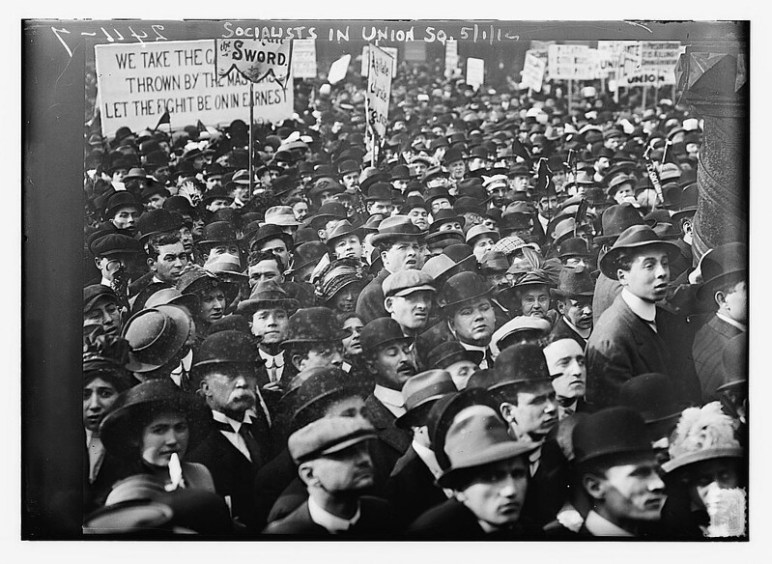
This probably is a bit of a heavy and somewhat dry topic, when most of us are trying to enjoy these care free summer vacation months. However, politics is very much in the air right now. In my particular part of the world there is a Provincial election, and an upcoming Federal election; neither of which am I confident I am going to like the end results. In the rest of the world, there have been swings in the electorate in the United Kingdom, which has moved to the left with the Labour Party; and in France, as of today, it is a country stuck in the middle. The French government is neither right or left and nobody wants to coalesce with the other.
I will admit that over the years, the longer I pay attention, the more I lean to some level of a libertarian philosophy in my outlook, a growing belief that less government is more the ideal. My wishes are clearly out of step, as the governments in this country are already controlling almost every facet of our daily lives through rules, taxation and regulations. Their belief is grounded on the firm commitment to the fact that they know what is good for us, and that they need to protect us from our own self-interest. The Federal government, and a variety of NDP Provinces in the passing in their legislative initiatives seem hell bent on bringing their brand of socialism to the country. Interestingly, in portraying what they believe are just causes, completely turn away from the term “socialist”. Which can only be interpreted to mean that they can fool most of the people most of the time.
During the Russian Revolution in 1917 we came to distinguish between “revolutionary socialism”, or Communism and “evolutionary socialism”. In the latter category, the proponents sometimes refer to themselves as “social democrats”. Socialism as a movement in Canada is not new, history shows us that there have been many times that we Canadians have entertained and sought a socialist political remedy: the Socialist Party of Canada was in 1904, the Social Democratic Party in 1911, the Communist Party of Canada in 1921, the CCF IN 1932 and the NDP in 1961. It started with Tommy Douglas in Saskatchewan in ____ but since then there have been NDP governments in BC, Saskatchewan, Manitoba, Ontario and the Yukon.
Socialism’s corollary is that socialism by its nature necessitates a growth of government in all its forms. More rules and regulations are to be developed in an effort to help the “working class”. It is a political doctrine that at its base feels the need to criticize the existence of social, economic, and political inequality in society. Hinged to this theory is that only government of the people can effect the necessary changes to the social order. They believe that there is a need to limit the excesses of private ownership and a wish to expand public ownership. Therefore the state is responsible for planning– to eliminate those cycles of un-controlled capitalism.
Which brings me finally as to what is the role of the police in a socialist state? Are the police a reflection of the state? Should we care? Revolutionary socialists are for the most part against the police, because in their definition they are an arm of the proletariat and therefore there only to oppress the working class. Paradoxically, most revolutionary socialists agree however that no enforcement often leads to outright chaos. Just ask the people of Portland Oregon how their experiment with no policing worked out. At the other end of this continuum, on the far right, is a state run by a despot or dictator, where the police are there to serve only the needs of the people in power. The examples for both of these extremes is an extensive list.
In Canada, we are somewhere in the middle of that bell curve, but there have been times that the pendulum has swung the police dangerously close to the narrow ends of that graph. The Convoy protest in Ottawa and the imposition of the Emergency Measures Act, clearly moved the police to the despotic end; while the protests and de-funding of the police initiatives clearly moved the police to the left end.
In an interesting article about “professionalism” in policing, the authors argue that when people make “careers” out of policing, it creates an environment of police officers there to simply “carry out orders”; that they become part of the ruling class and just “reflective of the state”. But I digress.
I believe like most police officers that policing must be; professionally effective, accountable and legitimate. This serves to consolidate a democracy. The police should be there to serve society rather than the state. They have to be legitimized by the public and to be legitimate: they must adhere to the law and due process, need to be subject to controls, need to be accountable and transparent, and they must be politically neutral. It is a fine but distinct line and to walk it requires a degree of political sophistication and insight that often seems lacking in our current police leadership. Today for example, it would be hard to argue that police management is either transparent or politically neutral, which again reflects on any claims of legitimacy.
So even though political philosophy is often a topic that causes many to roll their eyes and take a nap, police organizations and their leaders need to be wholly cognizant and continually thinking about the role of government versus the role of the police. As the government encroaches on the rights of the private individual in order to give over to the general good, we need to be paying attention as an enforcer of laws as to whether you are acting for society or the state.
Should anyone doubt Canada’s creep into socialism, one only needs to look into the statements of Justin Trudeau or Chrystia Freeland. Both have made pronouncements and proposals clearly aimed at re-ordering the social order in Canada. National Day Care and National Dental care, are in the end, examples of those governments beliefs. They have recently introduced Bill 63, the Online Harms Act which some argue will give the government the ability to censor speech. They have recently imposed an increase in the capital gains tax, to have the rich pay more for the poor, as they paint themselves in the media as Robin Hood. They have brought in Bill C-!8, the Online News Act forcing Google and Meta to pay $100 million to news organizations and they determine the distribution of those monies. They subsidize the national CBC to carry their message forward. In the government of Quebec they even regulate the language that can be used in business. In BC the government has closed Provincial parks to the public, allowing access to the Indigenous only as part of their solution to injustice. Governments regulate how we eat, how we live, and where we live and we pay them exorbitant amounts of money in the form of taxes to do that for us. The private individual is always subsumed for the good of the greater good.
So as the country moves to a full socialist imperative how are the police forces going to react? Will they become agents of the state, or will they be agents of society? Since the RCMP can not fulfill their current Federal mandates, how is it possible to take on all these other enforcement issues? Are they to become Big Brother? The Federal government continues to expand, so do we continue to grow the police state? Those decisions are important and will determine the role of the police in the future, and just as importantly, how the police are perceived and accepted by the rest of society.
Photo courtesy of Flickr Commons – Some Rights Reserved by the U.S. Library of Congress
 Behind the Yellow Tape
Sure can’t disagree with you
LikeLike