In 2016 the Supreme Court threw out its previous guidelines on trial delays, and in a 5-4 decision they said that the previous rules of 1992 had created a “culture of delay and complacency”. In other words, the previous rules had given the lawyers and the judges to much leeway, allowed them to go beyond a reasonable time limit for cases to get before the courts. So in 2016, they are now saying that there should be a limit, and have now put in place a guideline to put a limit of 18 months for a Provincial case, and 30 months for a Supreme Court matter.
Interestingly, when the guidelines were announced, there was a hue and cry from the lawyers. Even the minority group on the Supreme Court wrote that it was “wrong in principle and unwise in practise”. So anytime lawyers get angry or judges speak up, I tend to perk up and take note, and in this day and age, this usually means that someone has cut into someones pay cheque.
At first blush, I thought that this 18 month parameter for Provincial Court seemed reasonable as did the 30 month parameter for Supreme Court matters. I struggled to try and remember a Provincial court matter that took me longer than 18 months to put together; nor can I remember a Supreme Court matter, such as a homicide file which took me longer than 30 months to get before the courts once a charge had been approved. That being said I can think of a few horrendous public files that seem to be taking forever to get to some settlement; for example the Surrey 6 file will be going on 10 years before Mr Bacon sees inside a Courtroom. Why are these long winded affairs different than the others, is there some commonality to certain cases being a marathon more than a sprint?
How many cases are actually being constrained by these timelines, how many are in jeopardy because of this ruling?
Statistics Canada measures the length of time for trials and the types of cases which are “completed” in adult court. So here are some of the things which stand out when you delve into the numbers:
In 2014/2015 in terms of all adult cases in Canada; 49% were completed in less than four months; 42 % between four and eighteen months; 6% between eighteen and thirty months; and 3% were greater than thirty months. So of all the adult cases in Canada, there is a potential for 9% of those cases be in some sort of time jeopardy.
Now one must also remember that this is when you lump all the adult cases both Provincial and Superior Courts into one envelope. An overwhelming 99% of all adult cases in Canada are at the Provincial level.
And 77% of those 99% adult cases are “non-violent” which include such things as impaired driving, theft, breach of probation and similar type offences.
The findings of these cases show that 63% of all cases are settled by a finding of guilt, or by guilty pleas. Probation is by far the most common sentence. Only 37% of cases end in custodial sentences, and 88% of those custodial sentences, the average sentence was 6 months or less.
In terms of how long these cases take, the average or median length of time for the vast majority of Provincial cases is 120 days or 4 months. Clearly, these cases are falling inside the time parameters that have now been outlined, however, despite this decent average, 23,850 cases in Provincial court took in excess of 18 months.
One measurement of movement of a case through the courts would be how many times there is a court appearance, how many times are counsel and accused appearing, only to have the matter set further over. On average, again according to Statistics Canada, these Provincial matters took 5 court appearances, roughly the same amount of appearances that it took 10 years ago. So not much has changed in that regard.
That being said those matters going to a Superior Court took on average 565 days and over 15 court appearances. That is about 18 months, still in reasonable time considering these cases now have a 30 month window. (Homicide cases take an average of 493 days and 19 appearances)
In reviewing these numbers, there is one item that stands out, in terms of length of trials. That is the use of the Preliminary inquiry. For those unaware, a preliminary inquiry in effect is a trial before the main trial, where the Crown is obligated there is enough evidence to go ahead. One must keep in mind that this is a court option if you have been charged with an indictable offence, or a more serious offence under the law.
In Regina vs Hynes, the preliminary inquiry was described by Justice McLachlin as : “…the preliminary inquiry is not a trial. It is rather a pre-trial screening procedure aimed at filtering out weak cases that do not merit trial. It’s paramount purpose is to protect the accused from a needless, indeed improper, exposure to public trial where the enforcement agency is not in possession of evidence to warrant the continuation of the process.”
What is happened over the years is that Crown to avoid being rejected for trial often errs on the side of caution, and produces its case in its entirety. In three decades of going to Court, I never experienced a case being rejected at the Preliminary inquiry stage. Its unlikely that I was lucky, the simple matter is that few cases get rejected at this stage. As a result there are two trials of similar duration and length. Now before one says that maybe it is time to get rid of what seems to be an increasing waste of time and effort for a minimal advantage to the accused, one must realize that the Preliminary inquiry as a process is fully codified in the Criminal Code of Canada beginning at Section 535.
Is there a chance it could be amended? Yes, but keep in mind lawyers in Parliament make up the vast majority of the House, so what is the chance that they are going to cut into a segment of the law society that benefits and is able to monetize some extra court work? Like the Charter of Rights a preliminary inquiry is a costly process, but make no mistake about it, it is something that benefits lawyers.
But lets at least consider the figures for those cases involving a Preliminary hearing. There were 9179 adult cases that were completed after having gone through a preliminary; 7432 were completed in less than 30 months; however, 1747 of those cases took over 30 months.
If we total those possible files that may be in jeopardy due to the length of the cases, there is clearly a problem, with just a rudimentary examination of the stats showing that in Canada there could be 25,000 cases both at the Provincial and the Superior court level.
The damage is now beginning to come to the fore and several cases have been dismissed by the courts for not meeting the now imposed deadlines. In a recent murder case in Alberta the case against the accused was dismissed, but the case had taken five years to get to court. The accused killer walked free of the charge. Is this not as damaging to the legal system as an improperly convicted accused?
A little closer to home, as another example, the police officers charged in the Surrey 6 case with four officers facing over 20 charges has yet to go trial, and that was six years ago.
The Willy Pickton case took three years to go from the preliminary hearing to the trial itself.
All countries don’t seem to share our problem, it does seem to be part of a Canadian narrative.
For instance, in comparison, the Oklahoma bombing perpetrated by Tim McVeigh and Terry Nichols, which killed 168 people, took place in April 1995 and was the deadliest terror attack prior to the World Trade Centre. The FBI conducted 28,000 interviews, and collected close to a billion pieces of evidence. Both parties were tried and convicted in 1997, just two years after the event.
There are many other U.S. examples but suffice to say, none seem to match the turtle like pace of Canada. And yes, their laws are different than ours in some respects, but in terms of getting the case into court and tried our Canadian courts are, as now outlined by the Supreme Court, clearly built on delay.
More judges are clearly needed. Walk through the Surrey Courts anytime, and count the number of unused courtrooms if you want to see it for yourself. At a glance it would appear that at least half the courtrooms are empty. In a busy place like Surrey or Vancouver, should we not also be thinking of an evening court?
It is obvious to those who participate in this judicial system on a regular basis that the goings on inside these hallowed buildings is askew. The roosters are guarding the henhouse; what the Supreme Court calls “complacency” is actually a system well suited to lawyers, a system which is slow but lucrative. Every police officer who has spent endless hours sitting around a courtroom, can easily testify to the length of trials, the constant delays, the constant abuse of the system which seems to only aid the lawyers, and of course the accused.
There are many well known cases that seemingly drag on for months, even years. The delays are almost invariably the justice system itself, which in essence is the lawyers and judges, and to a lesser degree the Sheriffs. (A recent case in Victoria was thrown out because there were insufficient sheriffs to get the accused to the courtroom, which after having spent 3 decades going to court was a new one on me)
Ask anyone who has had to be a witness to a case recently, and ask them what they thought of their experience there. To a person, I am betting, they will say that they will never get involved again, as they sit there day after day, delay after delay, usually all in aid of the accused. They sit on hard benches for hours on end, often taking time off work, only to have the case dismissed; or to be told to come back another day. Meanwhile the lawyers seem to be always scurrying about with a practised harried look on their faces.
It is a system that must change. Eliminate endless court appearances, look at getting rid of the Preliminary inquiry, appoint more Judges and Sheriffs. Always keep in mind that a wronged person going to jail is a horrible outcome that must be avoided at all costs, but the accused person walking free because of simple inefficiency is equally in-excusable in this 21st century. Lawyers undoubtedly will be in favour of more judges, but don’t expect them to be carrying the torch for remedies which impinge on their livelihood. It will be interesting to see how many cases get dismissed before someone steps in to push things forward.
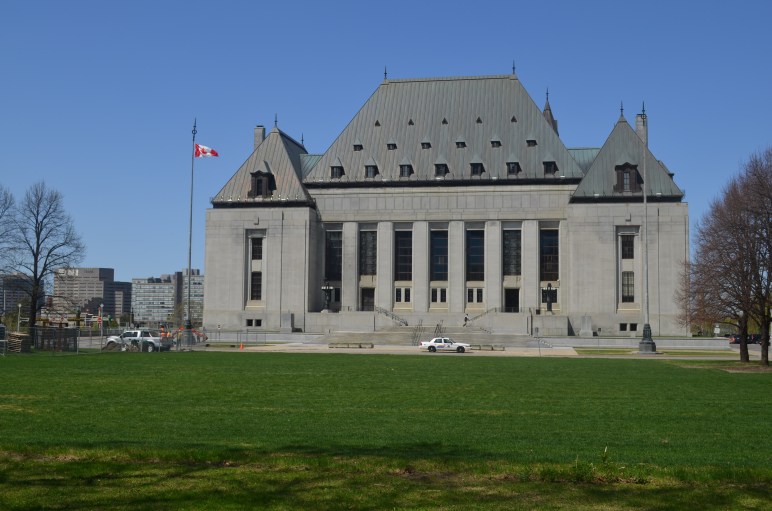
Photo Courtesy of the Author
Epilogue: On Wednesday the Senate Committee on Legal and Constitutional Affairs issued a 205 page report on legal reform in light of the Jordan decision. Not surprisingly they say that the justice system is in “urgent need of reform”. They say the courts need to do a better job of managing files (you think?) and they point out after numerous interviews of judges and lawyers in the system; that it takes 5 to 10 times longer for cases to get through the system compared to the U.K. , Australia, and New Zealand. They point to the Stinchcombe decision and the need for more urgent disclosure (see previous blog) and they also say that lawyers need to shorten the number of motions etc. They also affirm the “culture of complacency”. The Liberal government, and in particular Jody Wilson-Raybould are offering up no solutions yet, and in fact they are farther behind in Judicial appointments then ever.