The Integrated Homicide Team- cash grabs and declining solve rates


By its own admission, the Integrated Homicide Investigative Team (IHIT), the RCMP/Joint force group now is the largest homicide investigative group in Canada.

They claim coverage of “28 communities and 4 municipal agencies and have conducted over 800 homicides since their inception in 2003.” So on first blush the size of this group may seem to be what one would expect.  Are there “highly skilled analytical unit..and six investigative units” performing to police standards and meeting the expectations of the general public?

First, in terms of the size of the unit and the number of officers assigned, the size of this unit seems on further inspection to be somewhat out of sync with other agencies in Canada and in North America.

For instance, this unit is therefore bigger than Toronto with about 6 times the population, bigger than Montreal, and as big as some of the larger municipalities in the U.S. Although the 28 jurisdictions it covers seems large, one must keep in mind that IHIT is counting a lot of other smaller locations where homicide is rare and not the norm. And of course it does not respond to homicides in Vancouver the largest municipality in their area, nor do they cover Victoria or places outside the LMD like Kelowna or Kamloops.

Their claim of 800 murders during this time, means that they would have had to average 61 murders per year, when their actual average is around 40 murders per year by their own statistics.

However, it became evident that clarity in the numbers is not always possible, and the police often use broad measurement tools.

IHIT is funded by the municipal  agencies and RCMP detachments that have decided to join it, and the respective jurisdictions  pay for their contribution by  either providing manpower or monies, or a combination of both, and the amounts are determined by the homicide rates for that particular region. For instance Squamish averages 1 homicide every 10 years, so therefore pays a minimal fee.  Whereas Surrey on the other hand could have on average 20 homicides a year therefore is required to pay a much larger amount.

One of the continuous lines being delivered by the media group inside IHIT is how overwhelmed they are, too many files, not enough bodies etc. It is then echoed by the local newspapers and television, with little question or examination. So how busy are they?

Since 2003 they have been involved in 509 homicides (by the numbers provided to this writer through a Freedom of Information request – far lower than the 800 they claim in their website) This  averages out to 36 files per year. IHIT states that they have 110 personnel, of which there are 80 sworn police officers. In what seems like the constant government bureaucratic creep over their 13 year history, they have also expanded their unit to include a cold case team, investigational support unit, family/victim support unit, major case management, legal support application team, special projects, and public/media relations. They state that they have six investigative teams and the rest are part of these specialized units. Each team consists of eight officers.

So 36 files per year amongst 48 “investigative” officers works out to 0.75 files per investigative officer. Less than one file per member per year, and if you include all 80 sworn officers in the average it goes down to 0.45 files per member.

[1]Toronto Metro Police in 2016 had 69 homicides which was a big year as their normal average is somewhere between 24 and 40 but in 2008 they had 70 homicides. Almost double the caseload of IHIT, with fewer officers.

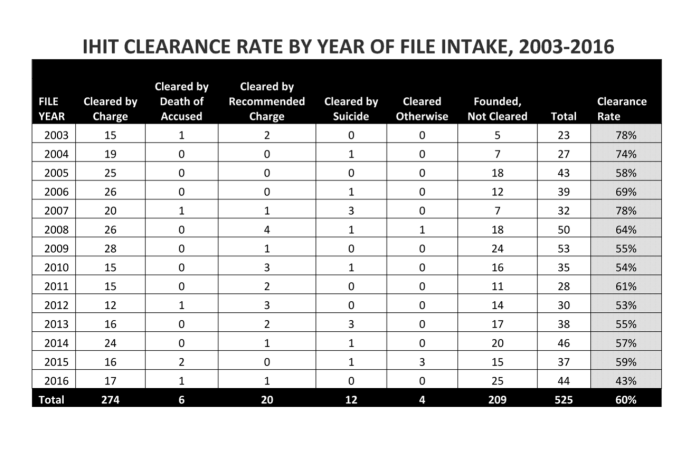
IHIT has had 44 homicides in 2016, and claim to have “cleared” 43% of them. Toronto Metro claims to have “cleared” 52%, which Toronto is not bragging about, but still almost 10% greater than IHIT.

Montreal has had a declining homicide rate for several years and had 24 homicides in 2016. The previous decade had seen an average of 34, close to the IHIT average. The Montreal police claim a solvency rate of 65% in 2016. Montreal has about 32 officers, or half the size of IHIT.

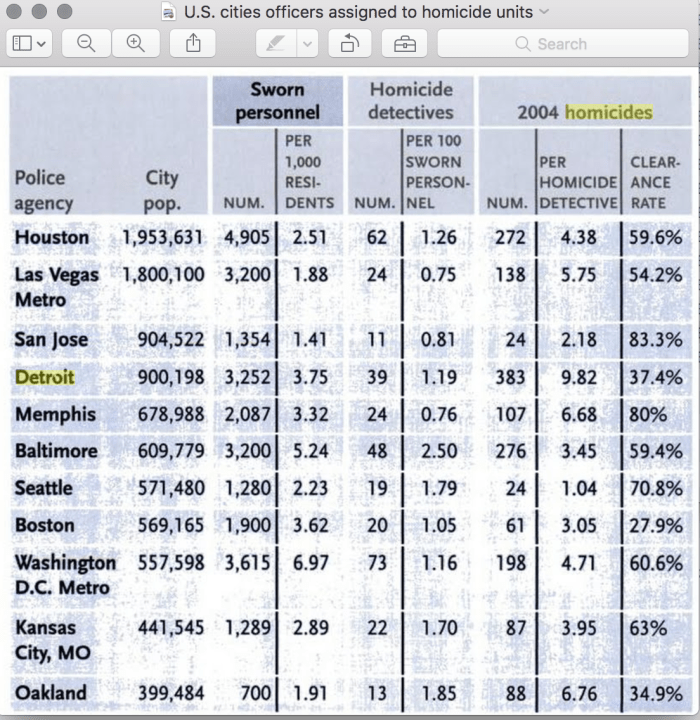
It gets even more interesting when one looks to the South where  the IHIT group is still larger than most  U.S. police departments.

Screen Shot 2017-01-30 at 3.40.01 PM.png


The above chart is in 2004 so is somewhat dated, so a comparison of the solvency rates would not be fair. What is interesting though is the number of officers per file, and the totals of files in general, in comparison with IHIT.

In Houston 62 officers for 272 murders or 4.38 per officer.

In Detroit, the most beleaguered at the time of these figures, 39 officers for 383 murders and an average of 9.82 per officer.

So if you think IHIT is busy try putting yourselves in these cities. [2]

In 2013, the National Clearance rate in the U.S. ,where they seem to be under manned by any measure,  was 64%.

IHIT’s solvency rate in 2013 was 55%. So despite having astronomical numbers compared to IHIT, it would seem that IHIT is always underperforming other agencies, all this despite having the largest group of investigators conducting homicides in Canada.

One must also examine the term “cleared” in the language of the police. For instance, if four people were involved in a murder, and one person is charged, it is considered “cleared” even though three parties may have walked away from it. If a suspect on a file is killed or commits suicide than the matter is also considered “cleared” even though you can not eliminate the possibility that they may have had the wrong “suspect”. Also, one must remember that there are a lot of homicides, where the suspect is obvious such as domestic homicides. They are far easier to get “cleared” than the gang related style murders. If you just measured the gang related files the clearance rate many sources say IHIT would have a solvency rate that would be in the teens.

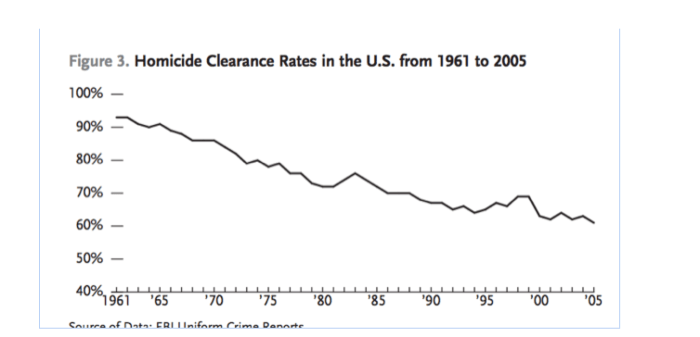
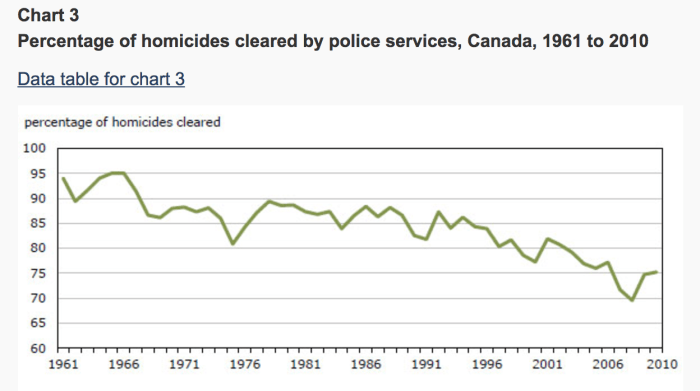
To be fair, there is a general pattern throughout North America of declining solvency or clearance rates attributed to a number of factors. So all are under performing when judged by the past, and IHIT is no different, but it is just falling a little bit faster than everyone else.

Some explanation for their under performance may be the rules of evidence, the relationships with Crown counsel, Crown Counsel itself, and policies within the RCMP itself. Disclosure, Crown insistence on “substantial likelihood of conviction”,  the complexities of warrant applications, and the lack of informants are just a few things that are often pointed to in the problems facing IHIT. All are legitimate issues.

So there are two problems now facing IHIT; declining clearance rates for the last several decades throughout all police agencies, and an IHIT group which is underperforming almost every other agency.

See the below-noted chart received from IHIT under a Freedom of Information request.

Screen Shot 2017-01-30 at 3.23.40 PM.png

When it was initially formed from its inception in 2003 and then up  to 2008 was above 64% solvency except for one year; with a high of 78% in 2003 its first year and again in 2007.

Since that time it has been in the 50% range with 2016 being the lowest ever at 43%. (*In terms of full disclosure, I was a member of IHIT for the 1st five years of its existence). It should also be pointed out that IHIT during that first five years consisted of only 4 teams of investigators; did not have a cold case team, did not have an affiant team, nor a family liaison unit. Shortly after those first five years as the solvency rate began to decline, and somewhat incongruously as this was happening, more officers were being added to the unit.

After the first five years IHIT went from 32 officers to 80 officers. Over a 100% increase in manpower and a decline of 20% in solvency in those ensuing years. During this time, the IHIT group has added a staggering 203 “unsolved homicides” to an already large pile.

A third problem plaguing IHIT is that despite falling solvency, and fewer murders than other locations throughout the country, IHIT officers are working a staggering amount of overtime and making a staggering amount of money.

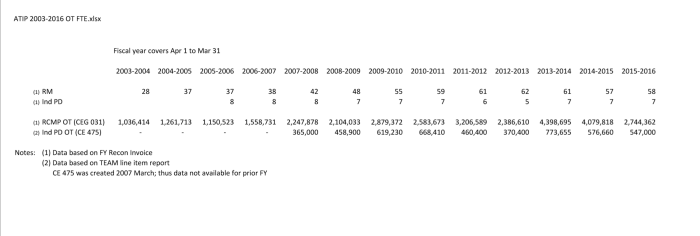
As per the above chart received once again, through Freedom of Information request, you will see that the overtime numbers are divided between the RCMP officers and the City departments who work in combination with the RCMP. So you need to add the numbers together to get the complete picture.

When you examine a few of the years in 2007/2008 the average overtime per member works out to $52,257.56. In 2011/2012 it was $54,731.00 and in the largest year 2013/2014 it was $76,063.97 per officer.

Screen Shot 2017-01-30 at 3.33.55 PM.png

The IHIT teams are made up of Constables, Corporals and 1 Sargent per team. The lowest salary of this group would be a Constable of three years who makes $82,108.00 per year. So if he is working at IHIT in 2014 his or her salary with overtime would be $158,171.00. Corporals who earn $89,910 would minimally make $165,973.00 and Sargeants with a base salary of $97,999 would be around $174,000. To give this some terms of reference the average “family” income in 2016 was $67,090, so a Constable with three years service, no specific academic degrees or technical certificates was making  247% more than the average Vancouver household.

If this were occurring in normal business practices and  managers saw this level of overtime, it would make financial sense to hire more personnel and look at shifting as a starter to stem such large expenditures. However at IHIT there is no weekend shifting. As one source told me, no one would work at IHIT if the overtime was reduced. Weekends is where the majority of the overtime is made, so in having a shift on the weekend they would be cutting off the flow of overtime monies.

Many reasonably argue that overtime seems to have now become the driving motivational force at IHIT.

IHIT, according to many sources, has become a place you go for two to three years to make a lot of money, and add an impressive title to your resume. Continuity and expertise is no longer treated as a valuable commodity. I’m told that there is often no need for this level of overtime, but it is driven by the unaccountable monies available which are made available and not the necessary investigative requirement. I observed that on many occasions while with IHIT personally, with certain officers enamoured with the financial gains that could be made. It has now become the norm.

Even so, a lot of officers don’t want this, as they are not interested in a lot of overtime and having to be away from family for long periods of time. So there is an additional problem growing  in IHIT with attracting people to the unit, even for promotion. I am told that some teams are down 40% of their manpower and many are abandoning the unit for greener pastures which usually means other Federal sections where overtime is also plentiful without the demands of being on-call and overnight shifting.

Of course, none of these issues are being talked about and why would they. They are not going to speak about the fact that  if someone is murdered there is a less than 50% chance it will be solved. If it is a gang or drug-related murder the chance is probably less than 20%.

I have been told by one source that the head of IHIT currently, Supt. Donna Richardson has even expressed growing concerns about being sued by family members of victims due to the growing inability to solve crimes.

In terms of correcting or trying to address the solvency issues the issues are more complex. There are the general broad based factors which have been occurring for the last few decades amongst the limited academic research in the field.

Often cited:

Screen Shot 2017-01-30 at 3.21.40 PM.png

Screen Shot 2017-01-30 at 3.37.17 PM.png


a) The integrated vs de-centralized unit, where the integrated teams have lost touch with the localized problems, are unable to develop witnesses and informants. It is believed that this is a fundamental problem with IHIT who have been recruiting younger and younger officers from other areas, with no local knowledge to this central unit.

b) In the 1990’s the flavour of the day in policing became Crime Prevention vs. Crime Solving. Monies poured into community policing stations etc. to the detriment of developing and solving criminal investigations.

c) The 1980’s and 1990’s saw a generational development of nobody wanting to “rat” on anybody in the criminal world. It not only became the edict of the criminal gangs, but the general public became less inclined to get involved.

d) Greater difficulty in prosecuting these cases. The most pronounced of that in this Province is the rules surrounding “disclosure” and the Crown and court guidelines of this issue. (I will talk about disclosure in a later blog, as it has become an albatross that is hindering every investigation)

All of these issues are pertinent to IHIT, but there is growing evidence of the lack of experience, due to younger and younger persons going to the unit, ill-equipped supervisors, and the lack of local knowledge is the biggest factor that needs immediate addressing. It is known that officers with only  three years service, or a 5 year drug officer with no homicide experience all have been accepted into this unit.

To compensate for this inexperience they often have to engage in a type of check list investigation. Someone lists out all the items that could be done, and they go through the motions trying to check it off the list for each and every homicide. It is very time consuming and often fruitless without some experienced oversight to direct what is important and whats not, where the emphasis should be placed based on the circumstances. It is also more expensive.

Experience was so valued  in the Vancouver City Police it used to be that you needed 15 years experience before you would ever be able to apply to the homicide section. (that too has changed because of demographics and loss of experience). In those days I should add, there were two person units, not eight, and there solvency rates were always in the 70% range.The officers were not better then, but they had more experience in a job which demanded experience, and often maintained informants and other sources in the local criminal element, something which is an absolute necessity when dealing with gang-related homicides.

So how is government to deal with this growing problem,  a problem they are either unaware of, or not wanting to talk about it. The current management of the RCMP are fully aware of the situation, as this has not developed overnight. This has been growing for the last several years, and there does not seem to be any internal desire to address these issues in the sensitive world of homicide investigation. Some of the upper managers came up through the IHIT system and were full participants in the overtime gains.  So instead of talking about what is developing as an embarrassment, they seem to be content with only assuaging the public as to their ongoing attentiveness to these investigations.

So as the gang shootings continue they seem satisfied to tell us that it was a “targeted hit” and we have nothing to worry about. The public does need to be concerned and the taxpayer needs to begin demanding some explanations. A full managerial and financial audit is needed as a starter. Time to pull back the covers.

( Recent article in the NY Times talks about the ongoing homicide solvency problem in the Bronx. They have just added 75 “White Shield” Detectives to supplement the three detectives that were handling over 400 cases last year. White Shield Detectives have to go through an 18 month training period working with senior detectives before earning their detective badges

https://www.nytimes.com/2017/02/08/nyregion/new-york-police-bronx.html?smid=nytcore-ipad-share&smprod=nytcore-ipad  )

( *By way of further update, in a Justice Institute of BC In Service Newsletter state that in 2015 police solved in Canada 451 out of 604 homicides, for a solvency rate of 75%. In 2015 IHIT’s solvency rate was 59%)


[1] http://www.torontosun.com/2016/12/27/sharp-rise-in-murders-in-toronto-in-2016

[2] http://www.nydailynews.com/news/crime/chicago-762-homicides-2016-nyc-la-article-1.2931020

[3] http://www.statcan.gc.ca/pub/85-002-x/2012001/article/11647-eng.htm#a1

Policing the Downtown Eastside amidst the collapse of the Four Pillars

LI like you am being worn out by the “epidemic” of the Fentanyl crisis. It is reported daily on all newscasts, camera footage of someone bent over an addict, trying to revive them with the usual punch in the ribs and a dose of Narcan. It is dramatic and it is sad and it is repetitive.

What ever happened to the “Four Pillars”?

Remember that political and social policy. Championed by Vancouver Mayor Philip Owen up to 2002, Larry Campbell from 2002-2005 (made Senator thereafter) and then carried on by Sam Sullivan until 2008. The current mayor Gregor Robertson rarely speaks of it, now seemingly wanting to distance himself from it.

The intent of the policy was to make illicit drug use a public health problem, not a policing issue per se, something more manageable if removed from being strictly a policing enforcement issue. The four pillars (you will be forgiven if you can’t remember what they were) were: prevention, enforcement, treatment, and harm reduction. So enforcement of the drug problem was still there, but in a reduced role and was to take a backseat to the goals of treatment and harm reduction. Admirable no doubt. Successful?

Lets analyze the four parts. How would you score each of these initiatives?  The 1st “Prevention” is almost impossible to measure, but surely no one would argue that the problem is declining or anything close to being termed a success. In fact one could argue there has been no measurable gain despite the efforts of many.

“Harm reduction” as defined by the Harm Reduction International group says that harm reduction refers to “policies, programs and practices that aim to reduce the harms associated with the use of psychoactive drugs in people unable to or unwilling to stop”. Harm reduction seems to accept the fact that most people throughout the world “continue to use psychoactive drugs despite even the strongest efforts to prevent the initiation or continued use of drugs”[1] They go on to say that the “majority of the people who use drugs do not need treatment”. This of course is the one and only initiative that seems to get government financial support whether it be pop up injection sites, or issuing Narcan kits for emergency service personnel.  This is the area where they could argue that they are making progress, but that would be difficult as we approach 800 overdose deaths. It is of course the easiest pillar and one that does not require longer term planning and development. If this is the only pillar which is working of course than we are simply on a never ending treadmill.

Thirdly there is “treatment”. This is now the media drum beat as there seems to be a consensus that there is an almost overwhelming need for treatment programs.  Just today another 38 beds were announced by the Provincial government for females. This has been obvious to many working in these streets for many years, and became especially acute after the closing of Riverview Hospital in 2012. At Riverview they dealt with the intertwined mental health issues which are an undercurrent among the downtrodden on the Eastside. One can not separate the mental health issues from the drug problem.

Treatment becomes more complicated when you are forced to consider the underlying problem of whether people are willing to go to treatment and recognizing that this is not a one-step method with the need for repeated follow up. Like alcoholism, it requires continuous vigilance.

Finally there is the “enforcement pillar”. Now relegated to fourth enforcement has now virtually disappeared.  So why is this?  Basic math seems to me that if there were fewer drugs on the street it would mean less overdose deaths. Wouldn’t an obvious at least partial cure for the problem right now, be to try and stem the flow of the drugs to the area. You will never stop it, but heightened fear amongst the drug dealers delivering fentanyl-laced products to the downtown core seems logical.

There are several problems and causes but first one must understand the nature of the policing world which has gone through some major structural changes which have for the most part done away with street level drug enforcement.

In the 1980’s the RCMP would often team up with the street crews of the Vancouver PD in the downtown Eastside, and do “street enforcement”. That no longer happens. We have entered the age of specialization and integration (something which I will write about more than once). No longer is street enforcement in vogue, but promotion and the monies are heading into specialized ” integrated “units where they can “partner” and deal with drugs on an “international” scope.

In the past there were various policing street crews, both in the RCMP and VPD and the assorted street crews and patrols and for the most part had a very strong grip on this postal code.  The officers had a good handle on who was doing what, who was bringing in the drugs, pimping the women etc. and the other assorted “trouble makers” in the area. There was a strong enforcement presence and those that walked the beat in the area were tough and there were street rules that needed to be followed. It was a symbiotic relationship between the criminals and the police.

The RCMP used to have a drug section based out of Vancouver. That is no longer. Every RCMP drug section and other Federal sections were part of a re-organization leading to the creation of “FSOC”,  the Federal Serious and Organized Crime section.

In this re-organization, the RCMP  has now done away with individualized specialized sections such as Drugs and Commercial Crime thus allowing the Federal priorities could be re-aligned into what Ottawa and the management of E Division felt was best.

In other words all of the officers were put in a big pile and then divided up in a number of teams. If your background was commercial crime, it didn’t matter, as your next case could be a drug file or a customs file. Likewise a Drug section folded into FSOC could have a white-collar crime file to attend to, or a file involving terrorist activities. In other words this re-organization has done away completely with any thought that expertise in an area must be developed and practiced over time. If this seems ludicrous, it is. Sources inside this change wholeheartedly feel that this has become a bureaucratic nightmare.

Why this re-alignment? According to the RCMP official website:

“With the federal re-engineering initiative, efforts have been under way to focus investigative priorities on groups involved in organized crime rather than specific commodities or criminal activities such as drugs, illegal firearms, contraband, or financial crimes.”[2]

The Province seems to have no handle or understanding of this transformation among the police. On July 27th, 2016 Premier Christy Clark announced that a Joint Task Force will work with the lyrical “Overdose and Alert Partnership” and Senior Police officials “to build and strengthen the actions already in place to prevent drug overdoses”. [3] Of course this is a way to keep away the critics from the back door and also give the appearance of a large investigative pro-active frontline group.

The Minister of Public Safety and Solicitor General to whom the police report in this Province, Mike Morris is quoted in the government press release as saying:

“Due to the elevated overdose rates we are now seeing, it is critical that we further develop strategies to facilitate a rapid and safe medical response to drug overdoses. Police in B.C. have been responding to the issue of fentanyl on a number of fronts with front-line police working directly with individuals engaged in high levels of substance abuse, as well as new or casual users, on a daily basis. Officers work with outreach teams and service providers to educate individuals on the overdose prevention strategies provided by health care professionals.”[4]

Again no mention of enforcement. It would appear that the Provincial response in terms of the police involvement is to have the police fully involved in the harm reduction strategy. There is no mention of increased enforcement to assist in this effort, the police are there as pseudo social workers according to Mr. Morris.

In an online “exclusive” on the RCMP Web site they state that “VPD and FSOC managers recognized that the way forward for policing transnational organized crime in Vancouver was to re-visit the integrated team concept” that they have developed “an integrated working relationship with the U.S. Drug Enforcement Administration, Homeland security investigations and CBSA, conducting collaborative operations amongst all agencies” and in fact according to VPD Mike Porteous at the time it was “working great”.

This news release was caused by their pointing to the undeniable success in Project Photoaxis, which had led to seizures in South Africa and numerous arrests of persons involved in the heroin trade. This file started in 2013, ran for two years until May 2015 when 28 persons were arrested and 37 kilos of heroin were seized in Belgium, South Africa and parts of Canada. In January 2016 the RCMP decided to issue a press release on this project, which could lead one to believe that this was a recent success.

Inspector Cal Chrustie one of the RCMP heads of this this project even went as far as to say that “we smashed the distribution and supply networks so significantly that our Liaison officers and partner agencies abroad aren’t seeing any activity there”. [5]

This further underlines the fact that “integrated” investigational teams stressing long-term investigations, using thousands of man-hours and millions of dollars is the focus of the day. (It should be noted that not insignificantly there is no mention made of the cost of this operation but there is little doubt that it was in the millions of dollars)

At the bottom of the story, Chrustie admits that there was only 1 Canadian involved, and there were no charges in Canada.

The other story, which the Police groups called, a press conference for was for Project Tainted, also in 2015, but this one at least was geared to the rapidly growing Fentanyl crisis. This too was a “joint forces operation” involving VPD, RCMP FSOC, and the Burnaby and North Vancouver RCMP and the Combined Forces Special Enforcement Unit (CFSEU). This too would have to be deemed a success as the usual parade of officers stood in front of the media showing off their seized wares of guns, drugs and bundles of money.  This too was likely a costly operation but you will never know by how much, and of course it was two years ago.

Also interesting recently in court, one of the parties charged in this Projected Tainted was a Walter James McCormick (age 51) who once out on bail got caught again in June 2016. The Crown was asking for an 18-year sentence on McCormick as the Crown argued that because Fentanyl was involved a much harsher sentence was called for. In the McCormick case from 2015  Crown is now arguing 18 years would be a suitable punishment  for trafficking in fentanyl, and of course defence is arguing that they recent media frenzy is being foisted on his client so that the Crown can be seen as taking this seriously. As much as it is a defence argument, it seems obvious that the Crown is pushing this for a political reason.

C/Supt Brian Cantera the current LMD Operations Officer and Assistant District Commander is a former “drug” cop, and an ardent supporter of “integration”.

In an interview with the Vancouver Sun Cantera stated that policing has “to shift to deal with the fentanyl crisis” but then says, “we’re simply not going to arrest ourselves out of this problem.” He says “It comes back to a multi-pronged approach, a multi-pillar approach, where you talk about prevention, education, harm reduction and enforcement”. [6] Have you heard that before?

So where is the Vancouver Police Department in all this, after all this is their physical jurisdiction and they also enforce the Federal CDSA. (Controlled Drug and Substances Act). Vancouver City police have a Drug Section, but like other police agencies do not speak of the number of people in this section. It should be noted that they now too fall under the “Organized Crime Section” of the VPD under Deputy Chief Laurence Rankin. The Organized Crime Section has an Investigations Section and this is where you find the Drug Section. Interestingly enough they do not fall under the “Operations” side of the house of VPD. So it would appear that they too have fallen under the spell of large-scale investigations and organized crime. My guess is that there is no street enforcement coming from Drugs. Any arrests in the area would probably fall to the uniform officers through the course of their other duties.

These long-term multi-agency investigative teams (if in fact there is one dealing with the fentanyl issue in downtown Vancouver) will continue to be the flavour of the day, but don’t be expecting any immediate impact. It may be years before there is another Trump like press conference. So the drugs will continue to flow into the downtown core, often watched by officers sitting in surveillance cars  part of some bigger operation.

On welfare day, the drug dealers will continue to amass outside the money dispensaries and begin to sell out for couple of days in what they must see as an unbelievably lucrative and easy market. And then the overdoses spike and calls for service go through the roof.

However, despite going after McCormick,  the police right now see no advantage in trying to pick off the dealers as they deal on the street in front of everyone. However, it would be more cost effective and maybe we won’t have to wait for 2-3 years for the next press conference claiming success.

Many think that the police have forfeited basic policing for the showy and expensive large operations and that maybe they should re-build at least one pillar of the four. The other three pillars are shaking to the point of collapse.

** By way of an update: Today, January 30th, 2017 the CBC does a report on how to stem the flow of fentanyl which it is agreed is for the most part coming from numerous pharmaceutical companies in China. They quote a 2013 UBC study which stated that the focus should be on harm reduction and not enforcement. That the “war on drugs” had failed. Of course we are now in 2017 and we are now in the middle of a “crisis” . Still Mr Pecknold the director of BC Police Services holds to the line “we are not going to solve this crisis by arresting our way out of it or seizing it at the border…Pecknold said”. Apparently Mr Pecknold doesn’t feel we should be worried about drugs crossing the border either.

Amazing take from the director of Police Services for the Province. He goes on to say the government line that what is needed is “….a co-ordinated response at all levels of government”.  Thanks for the insight.

[1] https://www.hri.global/what-is-harm-reduction

[2] http://www.rcmp-grc.gc.ca/mb/yir-bilan-13-14/message-federal-federale-eng.htm

[3] https://news.gov.bc.ca/releases/2016PREM0082-001361

[4] https://news.gov.bc.ca/releases/2016PREM0082-001361

[5] http://www.rcmp-grc.gc.ca/en/gazette/tackling-transnational-organized-crime

[6] http://www.cbc.ca/news/canada/british-columbia/bc-police-say-fentanyl-a-game-changer-struggle-to-stop-ovderdoses-on-the-street-1.3762446

Image Courtesy of Kenny Louie via Creative Commons licence some rights reserved

About

The author is a retired member of the RCMP of some 34 years spread out over three provinces in a variety of postings. Having worked in a variety of sections, but for the most part in uniform, Counter-espionage, Robbery, Sex Crimes, Serious Crime and Homicide.  As a former homicide investigator, Team leader and Commander he was directly involved in  over 200 murder cases, and three of those cases have been profiled in documentaries for television.  He has received numerous awards and commendations, including the Queen’s Silver and Jubilee Awards, and was nominated for two years running as the Police Officer of the Year while in Surrey Detachment for his investigation of the disappearance and murder of 10 year old Heather Thomas.
Image Courtesy of Vince Alongi via Creative Commons with Some Rights Reserved

By way of Introduction

As you will see from my biography, my education fermented an interest in politics and the economy but my work history and the basis for what I now am writing about comes from the world of criminal investigations. I am proud to have spent in excess of 35 years conducting a variety of investigations from the small to the large, from the simple to the complicated. Thirty-four of those years was with the Royal Canadian Mounted Police and then another three in the Corporate world. The investigative world was my world for a long time, too long some may say to have had no effect on shaping my thought processes. I hope that that is not totally true. I think it has honed my ability to tell right from wrong.

So why write a blog?

I like many have become shocked at the steadily declining emergency services world, in particular the world of policing and its unaccountability to the general public. Mismanagement has become common with morale at an all time low, costs at an all time high, and grossly inflated organizational units. While at the same time the public good is being battered  while management currency of the day is often knee-jerk with pandering reactions to the political forces that buffet them.

There is a growing legalized corruption of these services, where self-promotion and personal advancement seem to have become the leading driver of change.  Equally shocking is that there is growing obfuscation of the details, a lack of accountability and often times an obvious attempt to misdirect the information.

I don’t think the need for me to blog would be quite as strong if the Fifth Estate, which over the years I relied upon to shed a light on public matters is failing.  Reliable reporting and investigative journalism is on a troubling decline. Thorough reporting is being replaced by YouTube and Twitter feeds have become the determinants of what is newsworthy and in the public interest.  Questions are not being asked and the depth of a story is often a 30 second news bite or in 140 characters.

Therefore I hope to bring an investigational focus on some of the issues of the day.  It will be interspersed with clearly identified opinion, but hopefully most with be credible research on broad topics which are afflicting both the good of the public and the good of those involved in the services.

This will not be a “cop blog”, nor with deference will it be a stringing together of police information or a running account of the latest in the gang wars and affiliations. There are others who already do this. These sites are often based on rumour and innuendo, and they are ever changing, often confusing, and for the most part just symptoms and not the causes. My goal is to ask the relevant questions, find the broader issues which underly these problems and to venture down the rabbit hole. There is little doubt that it will offend some.

As I age and time no longer seems infinite, this blog will be both my therapy and sometimes a lectern, but mostly an attempt to provide a fair debate and a closer examination of these issues.

I claim to be neither conservative nor liberal, often living in the world of the grey, not the black and white. I may not have answers to a lot of questions.

I  also hold out the possibility that I will write about something that interests me outside of the policing world. I find that too much of a single focus of attention can be tiresome.

Hopefully there is room for an often cranky old goat amongst the overwhelming and bewildering jetsam of the net, an “older” person who is not going to write writing about retirement locations, the latest budget changes affecting pensions, or about my dog.

My heroes over time have included Woodward and Bernstein, Christie Blatchford, David Carr, and Michael Lewis, and I am a huge fan of the New York Times and ProPublica. I could never claim to write as well but they inspire me to try.

Welcome to my blog.