Here’s to the Women

There was a small parade and ceremony in St. John’s Newfoundland the other day. An auspicious occasion as it was to mark the fiftieth anniversary of women entering the Royal Canadian Mounted Police. It was back in May 1974 when Commissioner Nadon had opened up the recruitment and application process to the women of Canada. By September 18th of that same year, Troop 17 was born, graduating on March 3rd 1975, and thus shoved themselves through the door and entered into the looming chasm which was the male policing world.

In training there were 32 of them, surrounded by 800 men recruits. The female recruits were all 19-29 years old, embarking on a novel career, but not likely thinking of any “glass ceiling”; in most cases seeing it as an adventure. In fact the term “glass ceiling” wasn’t even coined until 1978. As one of the officers said in a recent interview “they weren’t ready for us” and it is just as likely these female recruits were not ready for what they were about to encounter– both on the street, and just as importantly amongst the ranks of the male officers. They went in blind, but I am sure it did not take long for their eyes to be quickly opened.

Nowadays, the RCMP sees themselves as enlightened in these matters of discrimination and the power of women; however, in 1974 the move by the RCMP came about after having being pushed to do so by the Royal Commission on the Status of Women. They did not relent willingly. The Commission had been formed in 1967, but it still took the government a number of years to be pulled and cajoled into the age of women empowerment. They weren’t the first, the Vancouver and Toronto Police Departments had already brought women into the fold by the time Ottawa and the RCMP moved into the late 20th century.

In 1975 Captain and Tenille were singing about love keeping us together, and Jaws and One Flew Over the Cuckoo Nest were storming the box office. Prime Minister Pierre Trudeau was leading the Liberals, and Joe Clark was about to succeed Robert Stanfied for the Conservatives. Some would say it was a much simpler time, more black and white than grey. And to be totally accurate, there were female “employees” in the RCMP long before this, as they had employed “matrons” in the 1890’s for the processing of prisoners. The woman first believed to be the “first female member” of the RCMP was Dr. Francis McGill, who headed and help to establish the Forensic medicine department in Saskatchewan in 1946.

However, this group in 1975 after graduation were the front line officers and they were about to be dispersed throughout the country. It was not going to be an easy task and one could easily make the argument that the roughest part of their journey and their eventual indoctrination did not come from the street– but from their fellow officers. I was around in those early years, in 1978 I was a recruit assigned to the Newcastle New Brunswick Detachment (an area now called Miramichi City) and shortly after I arrived, the first female the detachment had ever seen, arrived as well. Newcastle was the epitome of the term rough and tumble; high unemployment and rampant poverty. It was a conservative blue collar place where a police officer could easily in the normal course of their daily duties be involved in a knock you down drag it out fight. The people who lived there were either miners, loggers or fishermen and they lived hard and played hard. It was a 23 person RCMP detachment, relatively small, but deemed large in terms of this “have-not” New Brunswick Province. The Mountie administration were initially reluctant even to send female officers to this area because of the constant environment of simmering violence. A few years later, the area would become infamous for being the home of serial killer Alan Legere .

I often have maintained and have stated categorically many times, that the toughest job in policing is to simply be a female officer. And it was in Newcastle in 1978 that I worked with “Sheila”, the first female Mountie ever to be stationed in this robust village; an above average height, slim, a quick to smile 25 year old, who immediately found herself now working with big strapping Mounties, who with little doubt, were to the right of centre socially and politically. The male officers there were quick to jump into a fight and quick to say what they meant loudly and in a clear voice. There were no niceties and they all became my friends. However, in terms of personal viewpoints, if they had done a survey in those times– almost all would have felt that women had no place in policing– and some would profess that between women being “let in” and the arriving of the Charter of Rights in 1982 it was the end of the golden age of policing. “Sheila” was from the start under an intense microscope, the subject of continual stares, in public, and even at social police functions, most pointedly by the female spouses of the other officers. She was seen as an obvious threat to domestic bliss, and she had the added burden of being attractive. Some of the spouses demanded that their husbands not be seen riding in the same patrol car with Sheila or meeting up for a work coffee break. She was assigned to the Traffic Section, because it was seen as being “safer” there. I never saw her show weakness or express exasperation; she never complained, she just kept doing her job and hoped for eventual acceptance.

When I try to analyze the root cause of the growing pains for females in those early years, it probably comes down to two simple elements. First and foremost, at that age and time, there was a clear delineation between what was the role of the male and what was the role of the female. Simply put it was a boy’s club and their treehouse and they were girls trying to climb the shaky wooden ladder to become a member of the group. In their dress Red Serge uniform, the females wore red blazers and black knee length skirts and in 1983 they gave them purses to carry their guns and handcuffs. They wore form fitting polyester blouses, with no pockets to avoid any unnecessary protuberances. They were being seen as female first, police officers second.

The second element, that flows from the first, is that policing was seen as a laborious lower level middle class job; a physical occupation, where size and weight were the primary measurements in your ability to do the job. The job back then was often simply defined as chasing “bad guys” and physically tossing them into jail. This is not to say that there isn’t a physical element to this job, there was then and there is still now. Women then and now are expected to be just as tough and willing to wander into a scrap, against someone usually bigger and stronger than them on a regular basis. But in those early years one should be reminded that there were no alternate weapons such as pepper spray, or batons, or tasers, or which came about specifically as a way to level the playing field. In those days the female officers were told to be tougher; they were punched, kicked and spit upon, and they were expected to go down fighting. They were continually being watched for signs of acquiescence or for showing female qualities. That was unfair but there are still some elements of this scrutiny even today.

There is also a female proscribed role in terms of familial and personal relationships which lingers to this day. Starting and maintaining families and households is still very much predominantly the role of the female, this while balancing a policing career in particular is a significant challenge. Throw in the sometimes still present misogynist male and night time shift work and you get some idea of how tricky it can be. Sometimes for some it has proven to be overwhelming. Female officers traditionally have not stayed in policing as long as their male counterparts, but there are few studies as to why this is happening, but clearly there are reasons for it.

For those that did manage to walk the fine line and especially to those that endured in those early years one can only show respect. Since those early days, I personally have worked with some extraordinary female officers through three decades of policing. They were hard working intuitive good investigators long before they were seen as female. Their gender was inconsequential. Many of them displayed different insights that being who they were provided them. I can’t explain it, I just saw it working.

All of this is a common saw. Since the early 20th century, women have been fighting to define their role in a male dominated society. Policing was one of the last of the true male vestiges of this 20th century. It was difficult to run at and break through those traditions. It was often an individual fight on an individual level. Those that put up that fight in those early years started that final pendulum. Today, females possibly enjoy an even greater chance of promotion and have the benefits and support networks to confront the duality of their roles. It is still hard, but all the female officers of today should be bowing in respect to the many that came before them, a time before many of the current officers were born.

I watched it from the sidelines, but I am also tipping my cap to “Sheila”.

I am sure she will smile back.

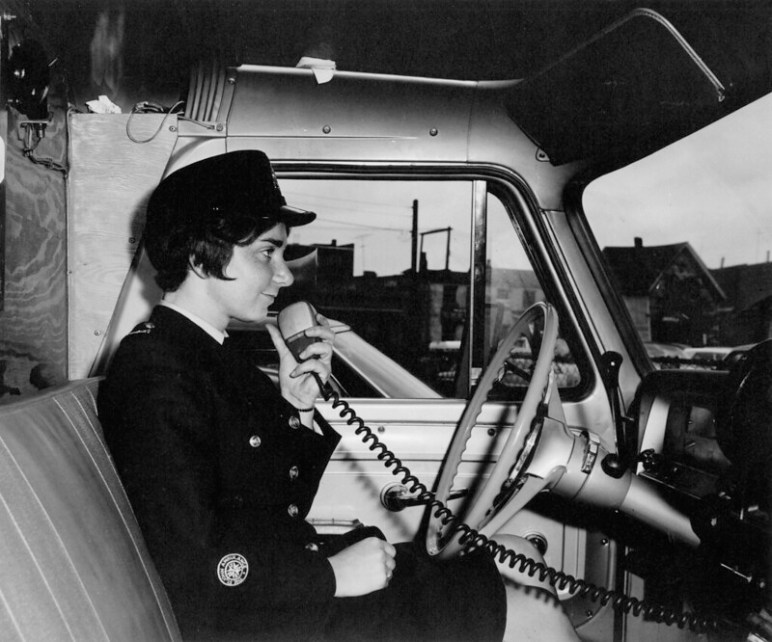
Picture courtesy of Flickr commons from the Vancouver Archives – Some Rights Reserved

Still Swinging to the Left

I will state from the outset, that when it comes to the political spectrum, I am boringly straight down the middle. I have never considered myself on the fringe of any pendulum, never wholly to the right, never wholly to the left. Many decades ago when I studied political philosophy and was exposed to the root beliefs of Marx and Mao, Hobbes and Rousseau, I walked away probably just as personally confused as when I started, at least in terms of having formed any hardened views. After gaining many years of wisdom, or at least I think that is what life experience gives you, I seem to have only settled on the fact that I still believe in some core values: personal responsibility and accountability, privacy, and the right to free speech. Does this mean that I may be now in the wrong country?

The current Liberal government in Ottawa and the Provincial NDP in British Columbia where I live, have for the last number of years driven us towards a system that would be defined as “socialism”. Socialism is defined as “a political and economic theory of social organization which advocates that the means of production, distribution and exchange should be owned or regulated by the community as a whole”. All of our politicians, for fear of being labelled, would deny following the principles of socialism, at least in any public forum, but it is clear that they are admirers of some imagined Scandinavian styled nirvana. As they see it everyone will be protected and regulated by some form of a big, comforting, arm of government.

The current crop of Canadian politicians are going to fix housing, immigration, education, and healthcare, and while they are at it, eliminate discrimination, systemic racism, and the overall general unfairness of life. They will advocate free “safer” drugs, but insist that a single individual cigarette be labelled with the dangers of smoking in case some of missed the messaging for the last 40 years. The policing world has been led for the last number of years by sycophants who have willingly absorbed this mindset of correctness to become true champions against the horrors of inequality and the lack of inclusiveness. In order to be sanctioned by the ruling liberal elites and moved up the operational chain, they have abandoned their principles and left traditional policing values behind. They are now fully tuned to the internal goals of eliminating the enemies of the new age liberalism and willing to echo the “truth” as dictated to them.

But get outside the Canadian environ and you will find that there are developing trends in other parts of the world which are beginning to question this left liberal bias, and are now considering that maybe it has gone all gone a little too far, that maybe its time to let the pendulum swing back into some middle more normal ground. This is possibly reflecting a realization that the ridiculous aspects of the “wokeness” fringe may be driving them to political extinction.

The Canadian left power constituency want no part of any reversal of the current trend. Even with the Conservatives trouncing them in the polls, the Liberal stalwarts are doubling down on their social activism. It somewhat makes sense, all their policies are aimed at the political and demographic future voter wheelhouse. Here are a couple of recent examples.

Marc Miller, the former portfolio holder for the Indigenous, now the Minister of Immigration, Refugees and Citizenship now wants to allow people who have been “illegally working and living in Canada”, and who have no documentation, that they be allowed to automatically become Canadian citizens. This would permit anywhere from 300,000 to 600,000 additional “new” Canadians. In addition, it is he and his department that will also will be overseeing the goal of 500,000 new immigrants this year (legal immigrants). Exhibiting extreme political arrogance, Mr. Miller tells his followers that he doesn’t want Canada to become “like the countries such as France, Hungary and Germany” who are reflecting the dangerous “hard far right” and are evil in their cutting back on immigration levels. He does not want to see this type of thinking “repeated in Canada”.

In the same vein, Seamus O’Regan, Justin’s long-time cohort, now sitting as the Minister of Labour, wants to make some changes to the Employment Equity Act which already sets out a “mandated diversity scheme”. The Act currently requires that the Federal government and its contractors set hiring targets for “women, visible minorities, Indigenous, and disabled”. Mr. O’Regan now plans to add LBGT and Black people to the list of those with special “hiring privileges”. The charge is being led by McGill University law professor Adelle Blackett, who is a “critical race scholar”. They steadfastly defend this policy by saying that this is not advocating a “quota system”. They try to legally get around the obvious conclusive cries of “reverse discrimination” by saying that it is fortunate because our courts, following the Charter of Rights and Freedoms, equate “equality” to mean “substantive equality”– a matter of “equal outcome” over “equal treatment.” Only academia and bureaucrats and Federal lawyers could draw this distinction.

Meanwhile, in the United States the legal stance on DEI programs is going the other direction. The big turning point was in June of this year when the Supreme Court of the United States rejected affirmative action at colleges and universities around the country, Harvard and North Carolina specifically, declaring that the “race conscious admissions programs” at those two schools were “unlawful and sharply curtailing a policy that had long been a pillar of higher education.” The Chief Justice wrote that “both programs…unavoidably employ race in a negative manner, involve racial stereotyping, and lack meaningful end points”.

This U.S. Supreme Court ruling is now rippling downwards and resulting in the DEI programs throughout the U.S. now being put to the test. Several groups are now instituting civil action against seven different law firms for their DEI hiring practises. Why law firms? Well, they are the most risk adverse of the businesses in the U.S. If they are found to be in counter step to the current U.S. Supreme Court ruling, it is bad for business, and in turn they make their living advising the Fortune 500 companies. The plaintiff groups want to “shatter diversity fellowship programs” in these firms, which they maintain “exclude qualified white and asian students”. They are also including in those claims not just “fellowships, but hiring and recruiting retreats”.

Three of the law firms have already reversed their positions rather than duke it out in court. The plaintiffs have also demonstrated that the efforts of the last number of years with these programs has not resulted in greater black and minority representation, it still lags behind. They are also civilly pursuing particular firms where executive compensation is tied to diversity goals. So far, NASCAR, MLB, Nordstrom, and Activision Blizzard have all come under scrutiny because of their “workplace affinity groups and grants to black owned businesses”. Microsoft is now “re-examining their DEI policies” and the “explicit racist quotas and preferences in hiring, recruiting, retention, and promotion and advancement”.

Now, to be sure, we are not the United States. I am coming around to the belief that Canadians are maybe wanting a form of socialism, tax the rich, give to the poor, tell the grocery stores what they can charge, disallow AirBnb, regulate what you can say, what you can see. Maybe Canadians believe the allegations of systemic discrimination and racism. Maybe we all believe, that colour of skin or one’s gender is a greater determinant of job worthiness, and that “representation” is a better goal than academic or experience based qualifications. The strange part is that so far these enlightened programs don’t seem to help, but we Canadians are steadfast, we stay the course, disregarding the hard evidence. I guess it makes us feel better about ourselves.

Personally, I am hoping that we also begin a swing back to the middle, where rational thought and common sense seems to reside– and I am also hoping for a lot of snow in Ottawa this year– and Justin feels like going for a long walk.

Merry Xmas to you all and thanks again for reading. We will see you in the New Year.

Photo courtesy of June Marie via Flickr Commons – Some Rights reserved.

Free Speech, not quite as free in policing

As everyone knows, under Section 2 of the Charter of Rights, everyone in Canada has the right to freedom of conscience and religion, freedom of thought, belief, opinion and expression. The official document of the Canadian Charter of Rights has as a preamble: “Whereas Canada is founded upon principles that recognize the supremacy of God and the rule of Law”.

One would think then, at first glance, in consideration of that “supremacy of God” line that you as a person would be free to join the “Church of Trudeau”.

Of course I am not referring to a real church, it is in fact a Youtube site created by and starring one of the police community’s own Brent Lord. However there has been a problem developing inside this pew-less church outside of the fact that Brent is a member of the RCMP currently assigned to Trail detachment. The problem is that it is a satirical site which went after Trudeau, mocking the Liberal policies, concerning all those hot take issues such as the Indigenous, Immigration and the financial spending of the Federal Liberals. Policies which can not be questioned in polite company.

There are two issues at play here, issues which admittedly have surfaced in other forms previously in the policing world. One is the basic rights and freedoms for free speech guaranteed to all Canadians, and the other is the limits that is put on police officers under their Code of Conduct regulations.

When the outraged public complained (this may have been only one person) the Mounties said they did “a fulsome review of the highly unprofessional offending materials was completed and administrative options are being considered”. This statement does not disguise their clear presumptions and equally indicates that their final findings were not ever going to favour the Mountie. But, lets leave that aside. We should also note for the record that the Constable never appeared or represented himself as a police officer on the site. This was a personal site and it was silly, more a rant than a detailed examination of any policies. One would have to question whether the Constable really thought this entertaining, it was political for sure, but whether it met the artistic threshold would be the real debate.

The RCMP in addressing the media said “The website and videos were not representative of the views of the RCMP, nor its employees as a whole, rather they were the expressions of an individual”. True. “The content and the viewpoints on the web site fell far short of meeting the levels of professionalism expected of our officers”. Probably also true, but one has to remember that the “professionalism” expected of our officers is a wandering goal post, not easily defined in this 21st century policing model.

Was Commissioner Lucki being political during the Portapique incident when trying to score some political points with the Liberal hierarchy. Was that “political”, was it “un-professional”? One must ask whether or not if this Constable had put up a supportive site for the Liberal policies and trumpeted the good deeds the Liberals would it have been measured with the same stick. Would have it been considered “un-professional” if instead he had professed a liberal progressive stance? It clearly would have been political but my guess would be that it would not have been declared un-professional. In fact, they may never have addressed the issue at all if it was about diversity or inclusion.

It is truly ironic, that we have reached a stage in this country where the right to free speech is being severely limited by the social progressive or “woke” perspective–a group that would historically have been associated with the rights of individuals and the freedom of expression. The evidence of this censorship is everywhere and it is frightening to anyone who believes that free speech is a right worth protecting. Take a look at the cases of Dr. Mathew Strauss in Kingston, Ontario who proposed some very anti-covid restrictions, or Terry Glavin who wrote an article saying quite obviously that there was no evidence of genocide in the residential schools as none of the grave sites had been examined. Recently Dr Jordan Peterson, who has become a bit of a global phenomena is being pursued by the Ontario College of Psychologists for some tweets he put out. They are ordering that he, the global academic with millions of followers, should undergo “media training”. Laughable, but apparently they are serious and threatening to take away his licence if he does not comply. Of course, it is the fact that he expresses views contrary to the current liberal regimes that have taken over our governments and their institutions that is the real reason they are going after him.

The allegation in all these free speech cases and the people involved that always gets put in the headlines is that they are discriminatory, racist, or un-professional. That is the go-to argument in every case. One person is offended, the world is offended. Stanford University, a school of world renown, in the heart of the California woke culture recently issued their proposed “Elimination of Harmful language Initiative” to address “harmful language in IT”. They found 100 words or phrases that they deemed to be “harmful”. Included are such words as “American” because it was “imprecise it should be “U.S. citizen”. To use the phrase “you guys” was deemed harmful, because it “lumps a group of people using masculine language and/or into gender binary groups which don’t include everyone”. Needless to say, this policy group have drawn some highly critical reviews. All of it simply demonstrates that maybe the pendulum is still swinging to the extreme left.

Closer to home, just today the Vancouver City Police made an announcement concerning the wearing of the “thin blue line badges”. No you can’t they said. These badges, which consist basically of a thin blue line through the red maple leaf insignia has been around since 2016 and seems to have started in Calgary. At that time, the badge was said to “recognize officers length of service to frontline policing duties” and to remember “fallen officers”. Seems like a pretty harmless thing, but apparently some from the very vocal left said that the symbol was being “co-opted by hate organizations in both the U.S. and Canada”. The evidence to back this allegation is weak and historically it was in fact an adaptation of the “thin red line”; which was worn by the red coated members of the Scottish regiment in the British army for standing ground against the Russian “foes”.

When you enter the theatre of the absurd in woke politics, the usual spokespeople surface. Grand Chief Stuart Philip who heads the Union of BC Indian Chiefs says wearing the thin blue line patch was the “equivalent to wearing a swastika”. Also laughable, but he does represent the outer fringe of the progressives and is a media favourite.

Currently if you want to wear the patch as a police officer you would have to join the BC Transit police as they still allow them to be worn. But you know it is only a matter of time before someone makes a complaint on that side of the house as well. Remember, it takes only one person to complain about having been offended.

Taking into consideration the rights of every individual including a police officer I must admit to being still firmly against politics being entrenched in policing. It is difficult to argue against the politicization of the RCMP and other municipal and provincial police agencies at the upper levels of management, which I have done in other blog posts, and then turn around and argue for police officers at the working levels to be allowed to be personally politicized. Politics is politics.

Let us consider and admit that politics is firmly embedded in the current police management culture. Are not the political policies of “inclusion and diversity” being practised in every government venue, by their very definition discriminatory. As a blatant example the CBC recently offered up their “Anti-racism, diversity and Inclusion plan”, which in its affirmative action seeking goals is offering positions in their organization, or training opportunities, to only those deemed to be under-represented. Even the recruitment process of most policing agencies is now in fact one of discrimination. They are based on race or gender and that decision to implement this policy is a political decision at its heart.

Robert Reiner wrote a book in 1985 entitled “The Politics of the Police” which explores all the problems that are intertwined when the police get political. Jack Young, a British sociologist described the police and politics as being “terrible twins”. Politics and the principle of free speech is indeed a difficult issue, not easily defined in the policing world. We are living in an age when police officers are being offered up greater freedoms in terms of health, clothing, and even grooming, while at the same time they are trying to further limit the right to speech and opinion. The upper levels do not seem to have any problem with the RCMP management in Surrey celebrating and supporting the politics of Brenda Locke, who is trying to restore the Mounties in Surrey, but these same managers do not want you to wear a badge which many regard as simply supporting fallen officers.

Wendell Holmes a famous jurist while on the Massachusetts Supreme Court said in 1892 that “a cop has a constitutional right to talk politics but no constitutional right to be a cop”. The U.S. Supreme Court agreed stating that police officers right to free speech was a “narrower free speech right”. Police officers “should not be able to make statements in their personal capacity that undermine their ability to maintain the trust of the community they serve” according to the RCMP policy.

There are extreme viewpoints at both ends of the spectrum. There was a picture recently of a police officer in Miami wearing a support Trump mask while patrolling a polling booth. Clearly this should not be allowed as you can easily draw the straight line from support to intimidation. But if cops are participating as members of the general public and are speaking out on “matters of public concern” it gets a little stickier.

There have been 13 off duty cops who were protesting the recent U.S election and participated in the march on Capitol Hill. All have been suspended or charged. Put aside all the anti-Trump bias, should police officers be allowed to march in a political protest? Should an off-duty officer be allowed to march in a Black Lives Matter march? Or a march in support of the LGBTQ community? Make no mistake about it, they would be both political marches, both are political commentary. My guess is that there would be no action taken. In fact don’t the police try to get into every Gay Pride parade wearing their full uniform and it is applauded by every news site and mainstream politician. On the other hand, the RCMP is investigating officers who supported the Freedom Convoy protest in Ottawa. Clearly it depends on which side of the political spectrum one lands as to whether you are going to be in hot water with your bosses. The politically held views of the Convoy protestors were on the wrong side of the political spectrum not to mention on the wrong end of the Emergencies Act.

I’m not a betting man, but I firmly believe that most police officers are not in favour of Mr. Trudeau and his cohorts policy decisions and initiatives. However, they are not allowed to express those opinions publicly and they were smart enough not to join the “Church of Trudeau”. Do you remember when the Police Chiefs in the United States supported candidate Trump.

Clearly, everyone’s outrage or lack of outrage depends on the current and direction of the political winds. Clearly, police officers, in the course of their duties need to maintain some level of neutrality, their whole reason for being and the core of their support depends on the appearance of fairness and a balanced viewpoint. It is just hard for the ground level to understand this when their supervisors and heads of their organizations have become extensions of their political masters. Freedom of speech and the practise of it are the most fundamental of rights. We must preserve it, guard it, and use it wisely. And it needs to apply to everyone in policing.

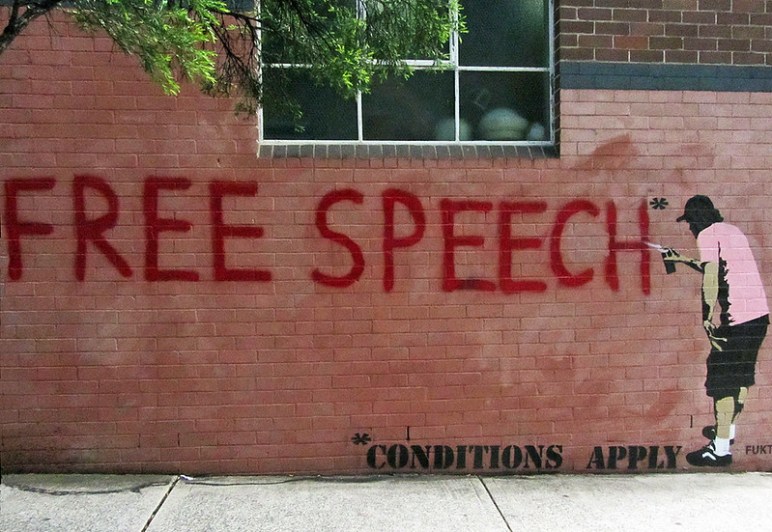
Photo via Flickr Commons courtesy of Newtown grafitti – Some Rights Reserved.