To Dig or not to Dig…

The field of policing is rich with irony and the irony in this story will become readily apparent with the telling. The subject of this blog, besides being ironic deals with the more precise issue of when politicians feel the need to interfere with police investigations and judicial processes. It is an obvious fact that politicians have a dangerous habit of dabbling in investigations. When they undertake something they are not supposed to do, they always remember to preface their actions by extolling the virtues of an independent investigational arm, one free of influence or interference, and in compliance with the Canadian constitution.They even boldly proclaim that in no way would they be associated to any strong-arming of the police to meet any political agenda.

The Federal Liberals seem to have reached a new low in terms of maintaining a pretence of an independent investigational arm. The Emergencies Act was a recent example where the politicians not believing what they were being told by the police, in fact not even asking the police, took arbitrary actions to to rid themselves of those politically embarrassing and unruly western outsiders. They self-declared them radicals and terrorists, in essence, to bring in and legally support the Act itself.

Currently in Manitoba, at the Prairie Green landfill site just outside of Winnipeg, the Federal government, the Assembly of Manitoba Chiefs, and the relatively new NDP Provincial government led by Indigenous Premier Wab Kinew have decided that they needed to get involved in a police investigation and a court process. They are telling the Province and therefore the Police that they need to excavate the site to possibly recover two missing Indigenous women, both believed to have been murdered. It would seem like a simple ask, but of course, the facts are a little more complicated, especially from a homicide investigators perspective.

Earlier, a Federally commissioned report said that any excavation of the privately held landfill site, which contains 712 tons of asbestos, a significant health hazard, would require an examination of 60,000 tons of material to be searched and that it would cost in the area of $184 million to complete. A massive expenditure for any level of homicide investigation. The search, as indicated earlier, was to be focused and based on the possibility of the bodies of Morgan Harris and Mercedes Myran having been disposed in the landfill site by the suspect. The search was also not “guaranteed to succeed”.

Logistics aside, the most relevant factor in this discussion is that Crown counsel has already layed four charges of 1st degree murder against Jeremy Skibicki, 36, for the killing of all four women. The jury trial is in fact set to begin in April 2024. In other words, the Crown and the police are ready to proceed without it being necessary to find the two bodies. An experienced guess would be that the police and the Crown have some form of confession from Skibicki before approving and now proceeding with those charges. So the excavation of the landfill is not necessary to proceed criminally, and therefore the best argument that remains for carrying out this massive examination of the landfill site is that of giving some sort of “closure”. The Manitoba government, who have legal jurisdiction had decided that the cost and the health risks involved did not warrant excavation of the site. Of course that is not where the decision ends.

The debate to exhume the landfill site has gained significant media coverage– only and simply because this is an indigenous issue. The local Indigenous have been vocal, protesting, tying it to reconciliation, saying that the government is systemically racist, and joining it to the perpetual conversation that emanates from the Missing and Murdered Indigenous women and girls Inquiry. They have a website and two separate protest encampments set up demanding the site be excavated.

The Liberal political hacks in Ottawa, sensing opportunity, echoed their support for the Indigenous protest group, and a day after the new Premier Kinew was elected, the first Indigenous Premier, miraculously announced $740,000 for the Long Plain First Nation to do another feasibility study on possible excavation of the landfill. The Assembly of Manitoba Chiefs then teamed up with , Investigative Solutions Network (who advertise themselves as “North Americas Leading Private Security and Investigative Services firm), and a company called Maskwa an Indigenous business which specializes in training for “emergency response” and offers “training services”–and together they issued a clearly self-serving feasibility report.

They now estimate the cost to be half of what was previously suggested, that it would only take $90 million, and then in small print say that the figure could go up. This also based their estimate on the work being completed in one year, a rather unlikely scenario. Their report demands “intervention from both the Manitoba Premier’s office, and the Federal government to close gaps and bureaucratic systems to ensure “immediate funding” for an excavation of the site. Their conclusion– if the funding was not provided, that by not going ahead: that it would “risk setting precedent that would be serial killers fixated on killing First Nations women are left with an impression that not only will the bodies not be recovered, but the inaction will effectively obstruct recovery of victims”. Their reasoning is clearly flawed and clearly the authors have no idea how killers behave or seek out their victims.

The Feds when they filed their initial report stated that it would take at least 6 months to prepare and train staff before they began the excavation; cost them $1200 a day for an anthropologist, $1800 a day for elders, search technicians, and up to $3600 per day for a project director. Make no mistake, any search of this scope would be, for some, a very profitable business undertaking.

The proponents point to the successful excavation of the Pickton pig farm in Coquitlam, British Columbia as an example that they could follow. Just for the record, the farm in that case was started in February 2002 and went into November 2003, cost about $70 million, and there was a possibility that there was evidence of 49 women having been killed there. There was no asbestos at this site.

Meanwhile, on the far side of the country in Kamloops British Columbia, at the site of the Tkemlulps te Secwepemc residential school, ground zero for two years of allegations of “cultural genocide” and the site of where 215 children are allegedly buried in a “mass grave”– not one piece of earth has been moved. The site which spurred headlines around the world, where ground radar examination was heralded and duplicated in many sites around the country, the site which spurred flags at half mast for over six months, and led to the Federal government ponying up $320 million for future explorations — not one shovel has been put in the ground. So the evidence which could be laying 3′ to 6′ underfoot, and an investigation which is in the hands of the Band itself (The RCMP have embarrassingly, but at the same time brilliantly, washed their hands of the investigation) –nothing has been done to forensically examine and identify the “victims”.

To be fair, the Indigenous groups in their public pronouncements have since the allegations began, walked a long way back from the initial cries of “mass graves”, which stirred up images of murder and chummed the media. They now talk about the “physical, sexual, psychological, and emotional abuse” that was unleashed on these children. Despite some mellowing of the narrative, at the same time the Justice Minister is considering a recommendation from the Special Interlocutor Kimberly Murray. She believes there should be laws brought in, to make it a criminal offence for residential school “denialism”. She compares it once again to the deniers of the Holocaust and feels that people should be charged criminally for “downplaying what happened in the institutions”. She called denialism the last step in “genocide”.

There are many members of the Band that never want an exhumation of the site, but Chief Casimir has said that they are now beginning to do “some of the archaelogical work” some two years after the fact. It seems that it is becoming increasingly obvious that the Kamloops site is not about exhumation, nor about investigation. It is about preserving a specific and particular narrative. The site in Winnipeg is being sanctioned because it is a continuation of the narrative. If and when you forensically examine a site is clearly a political decision in this country in these two cases, not an investigative one.

I am sure you can see the irony now.

Photo courtesy of Flickr Commons –Some Rights reserved
The Killings at James Smith Cree Nation…

If one ever wanted a clear picture of the utter desperation and the scope of problems facing First Nations in this country, one only needed to follow the coroners inquest that has just finished up in Melfort, Saskatchewan which was looking into the slayings at James Smith Cree Nation.

Unfortunately, but predictably, the recommendations coming from it are more reflective of our current political progressive climate, and less about the core issues. For the most part they missed the mark. We can not possibly be surprised, being that this is the age of the “victim”, this is the age of blaming, of never look inward, of instead pointing at the “system.” Let’s be honest, the Indigenous leadership in this country have turned victimization into a professional art; one which they have effectively practised at every opportunity. Their constant themes of cause and effect are always the same, then continually repeated, and the outcome sought is always the same.

Simply put, the James Smith Cree massacre is the story of a single individual with “psychopathic traits” and an “anti-social personality disorder”, a personality sculpted by abuse and crime, exposed to alcohol at the age of 13, and not soon after, transitioning to cocaine and methamphetamine. On one particular day this violent psychopath decided that he wanted revenge for some ill-defined wrong, and was also mumbling on revenge against the “Terror Squad” (part of the extensive group of Indigenous gangs that have proliferated throughout Winnipeg and Manitoba). So on September 4, 2022 after guzzling back some liquid courage with his brother, then went on a killing rampage–starting with his own brother.

Myles Sanderson had 78 previous convictions between 2004 and 2019 and at the time of the killings was “unlawfully at large” and as an occupation was dealing cocaine on the Reserve for three months prior to the killings. Most recently he had been serving five years for assault, robbery, mischief and uttering threats. In 2021 when seeking parole, he was considered an “undue risk to society”, but later in August of that same year, was still given statutory release, having served 2/3 of his sentence.

Four months after that release he was found once again in breach, re-arrested– and then in February 2022 released again.Throughout his prison life, his get out of jail card was that he was treated as an “Indigenous offender” therefore someone that the courts have been directed to deal with differently; not like other Canadians, part of a special group who had suffered “generational trauma” and through no fault of his own was one of the over “represented” in the Criminal court system. Geraldine Arcand, an elder employed by the Saskatchewan Penitentiary testified at the inquiry, about having given him his first “healing plan”.

Myles Sanderson and his wife had moved back to James Smith for the stated purpose of dealing cocaine. Despite all these efforts at understanding and empathy and despite all the socialized efforts at reform– that night he went out and killed his brother Damien, and then stabbed 10 others to death– and in the process wounded 17 others. He leaves behind his common law spouse, Vanessa Burns and their five children. At the inquiry she testified to having suffered 14 years of domestic abuse, and having reported him 12 times for domestic violence. Her suffering wasn’t over with his death, Myles on that dark day, also killed her father during the rampage.

After the killings, Myles went and hid in the nearby woods for 3 days and 7 hours. He subsequently died in police custody, after driving into a ditch in a stolen vehicle while being checked by the police. There will be a separate inquiry later this month concerning his death, because we are just as concerned about the police behaviour during his arrest, as we are of the massacre that Mr. Sanderson had perpetrated.

So this Coroners inquest, headed by Blaine Beaven, with six jurors came up with 14 recommendations, and then the Coroner added 15 more for consideration. Can you guess at what was recommended? They quickly went to the usual blaming template, aiming at all levels of government who are within easy reach. They declared that they needed “More programming and resources for offenders”..”more collaboration” (between the various agencies)…”more resources for prisoner integration”…”changes to how the RCMP deal with wanted suspects”…and in this case there is the need to “hire more elders” for the jails.

The Saskatchewan government for the record, as is also easily predictable, is “supportive” (of the recommendations)and added that they are so on top of the needed action that “some are already being implemented”. The Saskatchewan government says it wants to see more “crime reduction teams” and the RCMP for their part says it wants “greater communication”. The National Police Federation, representing the Mountie union, want “$100 million” more dollars to fund 300 more police officers, 138 of which would be there to “supplement First Nation policing resources”. (It is currently estimated that Saskatchewan is running 10% short in staffing, and an additional 7% from “soft” vacancies such as maternity leave etc.)

Another constant theme was brought up by Chief Peter Chapman who pushed for First Nations policing, which seems to be now referenced as “self-administered policing”. Chief Burns echoed his fellow Chiefs thoughts and also talked about the need for further funding of their own policing service; a police service that would be “suitable for our people”. This was followed by the usual complaint about no support and not enough monies coming from the Federal government.

Would having their own police service stopped what happened at JSCN? Would further funding and recruiting of Indigenous officers by the RCMP as Assistant Commissioner Rhonda Blackmore suggested have stopped Myles Sanderson? Would more “elders” in the prison system, more “healing plans” stopped Myles Sanderson? Would increased programming for inmates stopped him? No, of course not, Myles Sanderson was a psychopath who on that particular day was “triggered”.

All governments in Canada, Provincial and Federal are going down the road to Indigenous policing. They all agree that the 600 First Nations in this country should all have their own police services, not to mention their own laws and outcomes.

Small town police departments in this country has been fading and dying out throughout this country for many decades now, as the size and cost of policing has grown to greater and greater proportions. Practically speaking few are left because of the financial costs alone; now roughly estimated to be about $200,000 per officer per year in terms of salary and support; without adding in the costs of the initial infrastructure that is needed. Small town and village tax bases can not support this level of expenditure, it is simply economically un-feasible. Then add in the major issues of retention, staffing and training and the prospect of having multiples of small independent forces becomes patently unreasonable.

Another serious consideration is who has and can exert political control of small departments, where the officers are policing their friends and relatives, and thus opening up of the opportunities for corruption. The sole reason for having a smaller police unit in any town or village is that it is more accountable to locals, and that it can be then “tailored”. There is no other attributable reason. There is no hiding the fact that the Indigenous want political control of the police force and simply disguise it as being more “culturally sensitive”. They also don’t have the normal financial constraints, they argue that the Feds and the Provinces just need to give it to them.

Our current crop of political leaders throughout this country apparently agree, and therefore believe a separate police force, or many separate police forces, in often isolated and uneconomic regions of this country are needed as some form of twisted reconciliation logic, and they are also o.k. with the Canadian taxpayers funding it. One needs to understand the numbers.The politicians believe that the 3,394 reserves and 600 First Nations, should all have their own policing units, or “police administrations.” That 331,000 Indigenous living on Reserves, with an individual average reserve population of 600 people, should have their own individual police force to enforce the laws in a way, that is more suitable to their culture and their community needs. The costs, the jurisdictional issues, and the very ability to function under these circumstances runs counter to current police management theory which aims at integration, specialized services and shared costs. This Indigenous model simply defies logic.

This is not to denigrate the individual officers who may be currently involved. However, the thought that a police officer, from a very small community, who will do doubt be related to many that he is to police, someone who will be subjected to the volatile politics of Band councils, will somehow be able to manage and enforce the laws in a fair and equitable way, is a difficult if not impossible task. The RCMP used to move officers every 3-5 years for the simple reason that there is a tendency to become co-opted, because familiarity breeds and leaves one open to the vagaries of community politics and can call into question one’s integrity. What could lead one to think that this proposed solution would somehow be different.

Although one can easily see all the pitfalls, the government is already far down this road, and they are not seeking the approval of Canadians. Currently there are 163 policing agreements, for 1250 Indigenous officers, representing 400 First Nations in this country. They are policing about 338,000 in terms of population, which means there is on average, one officer for every 270 people living on the Reserve. In most cities the officer per capita average that is possible is one to every 800-1200 persons.

The First Nations Chiefs of Police Association claim that the Federal and Provincial governments only provide funding of $130,000 per officer, and they want more. Currently the Federal government contributes 52% of the funding and 48% is provided by the Provinces or Territories. They argue that the funding formula is unfair and amounts to “discrimination”.

The Kahnawake Peacekeepers, who police a large area of 10,000 and who boast of everyone in their department being of First Nations descent, is considered a leading example of Indigenous policing that works. The Kahnawake are now arguing for their own dedicated “highway patrol” so that they can police the 100,000 “outsiders” that pass through their territory. They also want an increase in salaries.

In British Columbia, the BC First Nations Justice Council and the First Nations Leadership Council are involved in the reform of the British Columbia Police Act. They are asking that the RCMP be scrapped throughout the Province and there be a Provincial Force set up with “expanded Indigenous policing”. They argue that there is a need to bring about “de-colonization, anti-racism, community and accountability”. They want “jurisdictional authority and funding” to bring about “self-administered policing”. Some of their suggestions/demands is that police investigation teams be replaced by an “elder, a language speaker, a spiritual leader and one RCMP officer”.

The left-leaning Liberal appointed Supreme Court of Canada has stated that the laws of this country need to “braid together”, a combination of “Indigenous laws, Federal provisions, and international standards” that are compliant with UNDRIP (United Nations Declaration of Rights of Indigenous Persons”.

Should the average person in this country be concerned? Should the average person in this country be concerned that certain citizens have greater rights, have different laws, and now seek to transform the legal and police system in their favour? Should we not be concerned that it is also being done in quiet government conversations with no regard for costing and implementation?

The RCMP testified at the inquest that their investigation involved 548 police officers, also Municipal and Federal employees, 42 separate crime scenes, 1322 investigational tasks, 257 witness interviews and over 1000 exhibits. The theory is that in the future a hand full of officers hired to form the James Smith Cree Nation police department, armed with shiny new police vehicles, will now take over that task.

In brief, Myles Sanderson grew up and was created in a world of dizzying and utter dysfunction and all the while the community watched and protected him. Unless that world changes, there will be no stopping of people like Myles Sanderson– not even by a small local culturally sensitive police department.

Photo courtesy of R. Orville Lytle via Flickr Commons — Some Rights Reserved

Some late Vindication…

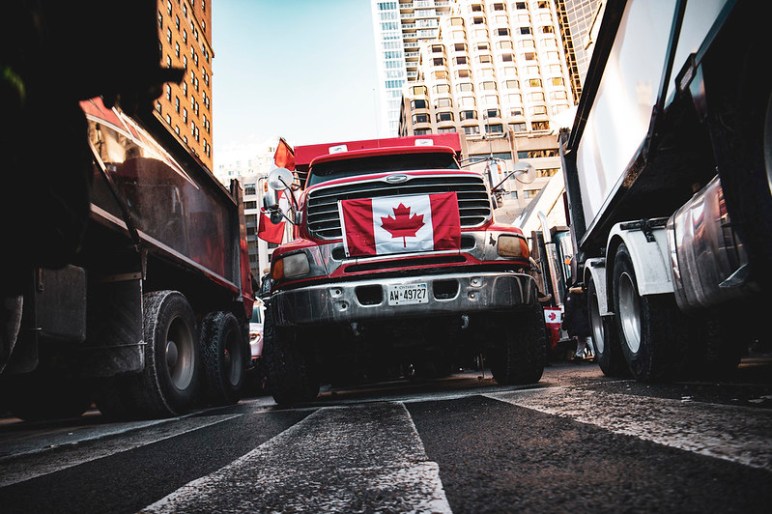
It took a 74 year old long-time lawyer and Justice, having spent a lifetime in security related matters, someone with two feet clearly planted on the ground, to finally call out the Liberals and their authoritarian ways. In the past week, Federal Court Justice Richard Mosley finally righted the wrongs of the imposition of the Emergencies Act. It was roughly two years ago that the “Act” was imposed on February 14, 2022, with grand fanfare and a concerned grimace by the Prime Minister. His forever kowtowing Ministers, and his NDP cohorts, profusely nodding in vigorous agreement standing behind him. This group of progressive liberals launched an Act designed, as it names implies, for a National Emergency, and when imposed, dictated full control over the lives of its citizens and specifically their ability to protest. There should be no mistake, this was a move that was in this writer’s opinion purely political, a move meant to show strength and determination, and aimed specifically at a group that had the audacity to question, a group that did not support the governing Liberals–in other words, they were the enemy. To put it in even simpler terms, the Liberals and their ilk did not like these protestors, these anti-vaccine rednecks, who came from afar. They were not of them.

Judge Mosley declared in his ruling that the imposition was “unreasonable and infringed on protestors charter rights”. That it did not “bear the hallmarks of reasonableness–justification, transparency and intelligibility”. He confirmed in essence what many thought –there was “no national emergency”. The faithful readers of this blog will remember a blog some months ago entitled “Sledgehammer and the Peanuts” which argued these same points; that the blaring of horns, the smell of diesel, bouncy castle encampments, and the disruption of the workday for bureaucrats in Ottawa (who were working from home through all this because of COVID) did not fit the definition, no matter how broadly interpreted, of this being a national emergency and that it certainly did not need such an all encompassing and arbitrary legal hammer.

The protest and the reaction to it did show that in Ottawa, if you put too many police departments in the kitchen, the broth will in fact be spoiled. The frustration and lack of coordination by the RCMP and the Ottawa Police Service, combined with the Doug Ford non-response, bordered on farce.

Of course this ruling was a kick in the pants for those fearless crime fighters Trudeau and Freeland; they know that this is not good in terms of going into the next election. Freeland, undeterred by a lack of factual support for her argument, went immediately running to the microphone, saying in her pedantic kindergarten teacher voice, “the safety of individual Canadians was under real threat…our national security was under real threat”. Quite an explanation.

So the Liberal government immediately have said they were going to launch an appeal. Usually the governing party of the day and any governing party would be more cautious in challenging the judiciary, normally they would “take it under advisement” or would be “studying” the case. It demonstrates the level of incomprehension amongst these Liberals as to someone having challenged their decision making, a court saying to them, no, you were wrong, and in fact you breached the Charter of Rights. How dare Judge Mosley describe the decision making at the time, as only based on “speculation” and that it had led to “unreasonable search and seizure”. The Liberals, of course have not released their legal grounds for that appeal, so I am suspecting that the Justice Department is now assigned to go find those grounds.

It is good to remember that there are four grounds to impose the Emergencies Act as clearly written: a) a public welfare emergency b) a public order emergency c) an international emergency, and finally d) a war emergency. CSIS in the Act is the defining authority in terms of what constitutes a security emergency. Clearly the latter two conditions, c) and d) didn’t apply, so the Liberals will have to continue to argue that it was a public welfare or public order emergency on a national scale. It was very interesting at the time, that CSIS Director David Vigneault in front of the Rouleau Commission, in a classic case of double-speak, said that even though the circumstances “didn’t meet the definition of a threat to national security”– nevertheless he supported the government decision. So in the end he supported what turns out to be a serious breach of rights of Canadian citizens, when he didn’t feel that there were grounds to do so. Time for Vigneault to step down.

So what will be the Liberal strategy be to fight this public relations nightmare. They are going to point to two arguments, and they have already started down this road.

First and foremost, they will point to the earlier mandated government appointed Commission that was chaired by Justice Paul Rouleau. The “appointed” Commission predictably found that it was “a failure in policing and federalism”, that it was in fact a “national emergency”. This was a bit of sleight of hand. The Commission mandate was to “examine and assess the basis for the Government’s decision to declare a public emergency…appropriateness and effectiveness of the measures selected by the government”. It was was not in fact a “legal” finding. The Federal Court with Judge Mosley on the other hand was to determine the legal “threshold” having to be met for the imposition of the Act.

Rouleau interestingly also said that it was a “difficult decision” he came to and that the “factual basis” for his finding “was not overwhelming”. I guess the lesson there for everyone is to never let the facts get in the way of a good argument.

The Commission was politically tainted, it appeared to have been set up purposely to ameliorate the decisions by the government of the day. The allowed testimony was not subject to being tested in terms of any extended cross-examination. The Minister of the day, now former Justice Minister David Lametti, during his testimony even refused to reveal the legal opinion which prompted their taking of the action, arguing lawyer client privilege. It was pointed out to him that he could have waved the privilege, but he would not. Mr. Lametti, who was so traumatized during the days of the convoy, that he moved back to Montreal, in a recent interview he now of course “disagrees totally” with Judge Mosely and is “confident” that they will win an appeal.

The other argument that the Liberals will bring is the example of what was going on at the time in Coutts Alberta and the roadblock there. It led to an investigation of an extremist group who wanted to attach themselves to the protest, and they were intercepted and charged by the RCMP. This Liberal argument is also disingenuous. The investigation and charges were brought about through the Criminal Code not the Emergencies Act. The police used the existing powers to bring that investigation to a close. So as Judge Mosley points out in his decision, the “existing laws were sufficient”, to deal with the Convoy protests, that the regular laws were open to the police and could handle the situation. The protestors that were charged, Tamara Litch and Chris Barber won’t necessarily be helped by this Federal Court decision, because they were also charged under the Criminal Code, not under the Emergencies Act.

Judge Mosley also added that “economic disruption cannot form the basis of extraordinary measures”. The Liberals during this “crisis” often argued that the Windsor border blockade was disrupting trade going into the United States. Ms. Freeland trotted that argument out again at her recent press conference, again arguing that Canada’s “economic security” was threatened. Maybe, she had not read the entire decision?

It is also interesting to read the various takes of those in the Liberal support groups, who were supportive of the government measures at the time. The CBC called it a “a divisive decision” and that illustrious leader of the NDP, Jagmeet Singh now says that he only “reluctantly supported the Act”. The Ottawa citizens who formed a civil class action against the protestors, which is seeking $290 million for their Wellington Street disruption, are still saying this ruling does not hurt them. Their lawyer Paul Champ argues that their case is about “honking, its about parking on the street, not for an afternoon of protest, but for weeks”. If one ever needed convincing that the citizens of Ottawa, and the bureaucrats who are governing this country live in a hermetically sealed environment, this is the case.

The Canadian Civil Liberties Association, a group which I rarely find agreement with, but brought the case forward to the Federal Court, said that the actions of government in this case, that the imposition of these types of laws “…are dangerous to democracy”. This decision, if looked at in a broader scope, should be seen as an examination of the very tenuous nature of democracy. The solitary Judge showed us how thin that thread really is, and for that we owe him a debt of gratitude.

Photo courtesy of Michael_Swan of Flickr Commons – some Rights Reserved.

A New Year…

Welcome to 2024, and I hope the it finds you healthy and happy and full of energy to face life’s winds, in this the year of the Dragon.

I do find that you reach a certain age in life where one spends more time looking backward, rather than looking forward, but let’s be honest, there is no such thing as the good old days. With the new year now in front of us, I feel that we need to spend some time on what is to come.

The easiest prediction is that the cost of living is going up, and house prices, despite the claims of some aren’t really coming down. The cost of policing is also on the rise and will be adding to that cost of living, usually in the form of property taxes. At some point those costs are going to be the subject of debate. In terms of groceries, never fear, Mr. Singh, our Rolex wearing NDP leader has teamed up with our expensively well tanned Prime Minister and is going to go after those bandits of the check out aisles– as soon as he and Trudeau have fixed all of our teeth.

Speaking of policing costs, in this part of the world, the transition to the Surrey Police Service will once again provide many headlines as Ms. Locke does her best imitation of Don Quixote and keeps tilting at the windmills of change in that fair city. Do you remember that this all started in November of 2021? She is clearly committed to the idiocy of her argument and is now spending $500,000 for a poll and advertising to retain the RCMP– despite the recently past legislation and having been removed from the police oversight board. The poll questions are clearly skewed to give her the results she wants, and says that 46% wish to retain the RCMP, 29% want to go forward. Of course, you will see that leaves 25% unaccounted. So they changed the questions around a bit, to show that the majority want the RCMP now. It would be funny if it wasn’t so sad and desperate. It has clearly become personal.

The other counsellors in the city are being surprisingly mum on the subject, and one has to wonder if they are sitting back waiting for the next civic election to get rid of the un-glued Locke and are just using this time to plot the coup. Then there is the RCMP leadership in Surrey who seem to at least be supporting the shenanigans of Ms. Locke –and the RCMP in Ottawa who must be still trying to find Surrey on the map and are doing their best ostrich impressions of hiding their heads, hoping I guess that it will all blow away.

So the headlines and the talk will continue, as the city petition likely heads to the Supreme Court with the city arguing in part, that the Province is limiting their “freedom of expression”. Millions of dollars are going out the door with the duplication of services, not to mention the lucrative consultants and lawyers hovering on the sidelines. No one is moving the needle, and clearly nobody is worried about the cost. The individual officers are trying to make the best of this ridiculous situation. On the positive side, again remember my resolution, the Surrey Police Service with all their present hiring needs, has found the time and put a priority on hiring Ragnar, an Occupational Stress Injury dog.

In terms of sad trends, in the past year, ten officers were killed in the line of duty, mainly in the Provinces of Quebec, Alberta, Ontario and BC. One can only hope that the new year will see an easing of this alarming trend. Police involved shootings are also up; 35 in 2022, 26 in 2021 and 15 in 2020. It would seem that unstable Canadians are turning to gun violence more frequently and it would seem that the police are using deadly force to counter it, also at an ever alarming rate. It is a bit of the old chicken and egg discussion. Is it a matter of demographics, or is there something more sinister afoot? There is definitely no evidence of it changing, nor is there any evidence of people trying to even address the situation.

The homeless situation, sorry, I mean the “un-housed” situation will continue, inextricably intertwined with mental health issues, and rampant drug use. You would like to feel that enough attention is being given to it to force some level of change, but there seems to be no political authority in sight willing to face the wrath of the liberal cognoscenti and the cries of injustice that bellow forth every time someone moves a tent. The Vancouver east side will continue to be a cesspool and an embarrassment in the eyes of the world, but freer drugs is still the current liberal cry, even though it has even proven to be statistically ineffective. So people will continue to die in this Province at the rate of 7 per day, and every month there will be a wringing of political hands asking, what can we do? That too is an easy prediction.

More body cams are being given to the police now. Some will argue that this is great thing, with Vancouver PD being the latest to proclaim their commitment. The advertisers and sellers of the technology, say it will create greater “transparency” and an “increased civility”. However, we all know it began with the cries of the woke and the vocal demand for greater police “accountability”. With little doubt it will probably cut down on frivolous internal complaints, but that comes at a very great price. Winnipeg got rid of their body cams in 2017 because of the $11 million dollars to keep the program running annually. In Baltimore, the city implemented body cams in 2016 at a cost of $11.3 million, four years later in 2020, the cost had grown to $35.1 million. One should be cautious, and realize that there is a lot of money being made by companies in selling these cameras and the enormous infrastructure around it, and also be mindful of the fact that the verdict on their effectiveness has yet to be measured. (I won’t mention the New York officer in Staten Island who had his camera burst into flames while he was wearing it, leading to the recall of thousands of them– because that would be being cynical.)

It seems that in the New Year, we will continue to immerse ourselves in being victims, part of a larger traumatized society, that is always in further need of comforting. Despite all the relative prosperity of this country. If in doubt, here is one of the more recent examples, brought to us by the CBC who search the world over in pursuit of the most needy victims. Two Canadian law professors at Dalhousie University in Halifax, feel that the requirement to verify ones Indigenous status, in other words if you claim to be Indigenous for the purpose of using it as a stepping stone in furthering your academic career, that you shouldn’t have to actually prove the substance of your heritage claim. They say that “the schools proposal, the process of verifying Indigenous heritage, risks re-traumatizing staff, students, and faculty subjected to it”.

In more international news, the National Counsel of Canadian Muslims is calling on the Federal government to remove “a cap on the number of Palestinians that can seek refuge with their Canadian extended family members from the violence in the Gaza strip.” Now, that may be a group that could legitimately argued that they have been traumatized, it would also prove a perfect escape route for any fleeing members of Hamas.

Like death and taxes, an equal inevitably for the coming year is that the size of the Public Service in Canada will continue to grow. In fact it is at a “record high”, and it will cost $151 billion this year, a 31% increase in the last seven years. Coincidentally, more of these dedicated public servants have also been “investigated” for wrong-doing, in fact more than at any time since 2015. Let’s chalk that up to COVID, which is also keeping those civil servants away from a full return to the office.

The dirty money will continue to roll through Canada this year. It is now estimated to be between $46.7 billion to $54 billion, which is the equivalent of the Nova Scotia gross domestic product. According to a recent book entitled “Dirty Money” which has been authored by a group of financial investigators and academics in Canada, their conclusion is that little has changed, and Canada remains a haven for criminals. It has grown so large that it is “corroding” Canada. The FINTRAC president on the other hand, says all good in their office, and reveals that they handed over 2,085 financial disclosures to the police authorities; who apparently have done very little with it, and the information has remained “unused or un-acted upon”.

HQ and O Division of the RCMP will continue in the new year to make headlines. We are still awaiting the sentencing of Cameron Ortis, the once favoured child of former Commissioner Paulson. That was until the Americans caught wind of Mr. Ortis and his international shenanigans, and then let the Canadians know that there was a devil in their midst. He was found guilty of four counts of breaching Canada’s secret laws, in a need to know trial, and his defence counsel was flabbergasted, and will of course launch an appeal. He is facing twenty years.

HQ will continue to prove their commitment to the war on terror, and maybe gain some favourable publicity along the way. They went on full attack mode and went after and arrested a Grade 10 terrorist. A minor, that can not be named, for planning an attack on the Jewish people “by communicating instructional material related to an explosive substance”. How else can one explain the dramatic arrest which was an operational production befitting Broadway, with a perplexed Mom and Dad standing on the sidelines saying, “I don’t know w hat happened”. Clearly, they weren’t paying attention to what their son was doing in his room, and clearly the Federal Mounties treated it as though they were going after the Baader-Meinhoff gang.

O Division also recently charged one of their own. RCMP Constable Yahsif Israel Mane Monter arrested for firearm violations, human trafficking and animal cruelty (in relation to his dog breeding business). He worked previously on Project O-HELIX which was a labour trafficking case out of Hamilton Ontario and apparently drew some ideas for his own business. What happened to the days when cops were just being charged with assault, or impaired. Oh, the good old days.

The RCMP is also starting the new year, proving to be a bit of a leaking ship, either that, or they have come up with a new police operational method which includes announcing when they are going to make “arrests”. The Globe and Mail has been told of an upcoming arrest in the BC murder case of Hardeep Nijar by “no less than three sources”; who also maintain that they have been watching “the suspects” for “months”, and that they will be “laying charges in the coming weeks”. Trudeau was the first leaker, now there are three others. One has to wonder whether the leaks are being orchestrated in order to “stimulate” the suspects into some sort of culpable action? If not, then the RCMP has a serious problem. Undoubtedly there will be further announcements or arrests as the Mounties continue to watch their suspects in the new year.

My personal resolution by the way, is to be less cynical, but I will admit, that like most of my previous resolutions, it is not likely to last. We and I do need to remember that we are not living in the Gaza, or in Eastern Ukraine. Nevertheless, there was a red flag on my Weather Network app this morning– a serious warning, because Vancouver is expecting 1 cm of snow, turning to rain. I began to feel my cynicism meter already flaring.

We need to remember in this new year, even though we are continually drawn into the realm of the disenchanted, that day in and day out, there are thousands of Mounties and coppers doing a good job, or at least trying to do a good job. The media and sometimes this blog spend very little time in exulting the good that is often done quietly and with little fanfare. It is usually less interesting, less salacious, and doesn’t grab ones attention, which is the unfortunate truth of it all.

So where does that leave us for the new year. Are we hopeful, timid, apprehensive, or eager in anticipation? One presumes that it depends on your viewpoint and your circumstance. My guess is that in the end, this year will be like most years, most of us will keep plugging away at what we do, head down, while trying to ignore the craziness around us.

Happy New Year!

Photo courtesy of Doug Anderson via Flickr Commons – Some Rights Reserved

A Submission from – Ian Parsons

This flows from an earlier blog where I offered this site as a potential forum for those that wish to write about any topic near and dear to them and most importantly, to open up the dialogue. The following is from Ian Parsons, a now retired former Inspector, with a long family history with the Mounties, who published a book in 2013 “No Easy Ride” about his experiences in the RCMP. The issues within the RCMP and its lack of leadership and direction has been at a sharpened point for at least a couple of decades, and therein lies the frustration. Ian Parsons book is linked here, but this submission is in essence part of the last chapter of his book. In it he argues for the RCMP to become a Federal entity, and to move away from contract policing. Not everyone will agree and one could easily argue the other side, but this viewpoint is clearly gaining favour inside and outside the RCMP.

I will also be posting a blog in the next couple of days, but in the meantime, my extended thanks to Ian.

             HEAD SMASHED IN BUFFALO JUMP

During the summer of 2008 I visited “Head Smashed In Buffalo Jump” located near Fort Macleod in southwest Alberta, a museum/monument dedicated to Canada’s first peoples and a way of life that has long since disappeared. In spite of the numbers of tourists who frequent the location, it is a spiritual place that every Canadian should see at least once.

As one peered at the cliff where millions of buffalo met their deaths after being herded, stampeded and driven, it is perhaps easier to understand how such a massive animal who dominated the prairies for centuries could have been reduced to a smattering of herds located in protected areas of western Canada today. The buffalo might even have survived had the influx of European society, white buffalo hunters and the incursion of pioneers hungry for large tracts of farmland not led to their demise.

The Indigenous tactic of approaching a large gathering of buffalo by foot and herding them toward the edge of the cliff, stampeding them at the last moment so the momentum of the herd took the animals over to their deaths was not a conservation maneuver, but a very efficient one. The women and children waited at the bottom to butcher prime animals for their choice parts.

As I mused, another icon of the Canadian west came to mind: the Royal Canadian Mounted Police. This worthy and durable organization has been a fundamental building block of my personal being. My father joined the Force in 1930 and spent 35 years policing all parts of Canada. I followed his footsteps in 1961 and served 33 years serving from Newfoundland to British Columbia,affording me a “macro” view of the RCMP in Canada My son is embarking on his RCMP career, having recently completed his recruit training in Regina. One would think my son’s future should be assured, as the demise of the RCMP should be about as likely as the disappearance of the plains Buffalo.

However the analogy between the Buffalo and the RCMP seems rather ominous when one observes the Force as a spectator. Once the buffalo were pointed in the direction of the cliff, the run was commenced. The momentum was so great that literally nothing would prevent their rush over the precipice. It occurred to me that a similar fate may be in store for the RCMP as an entity. They seem to be heading for the “cliff”. Momentum is building. They soon may be “over the edge”. This is particularly ironic, as the plains Buffalo is one of the symbols of the RCMP.

How can this happen? What is precipitating this potential tragedy? Essentially, the increased population and complexity of Canada has overwhelmed our frontier police force. Originally, the Force accepted and discharged all facets of policing in the Canadian west. No matter what the request from Ottawa, this versatile body of men, now men and women, accepted the task and usually carried it out successfully. The philosophy of the Mounted Police has always been “Never say No!”. Even if the task overburdened the troops, the job was undertaken without question and every effort was expended to meet challenges.

Such was the case when the RCMP expanded municipal responsibilities from small prairie communities to large cities after their takeover of provincial policing in BC. In the early 1950’s the Mounted Police began policing the municipality of Burnaby, British Columbia. This was the forerunner for the contracting of several other very large municipal details in the lower mainland of British Columbia. The logistics of supplying human resources for these operations were extremely taxing, and sapped the Force in many other areas. The necessary tactic of “Robbing Peter to Pay Paul” became a common policy. Many operations ran shorthanded in an effort to “Feed the Monster” consuming human resources in southern British Columbia. Administrators of the RCMP were loathe to lobby governments in power to increase resources, and attempted to deal with inadequacies internally. Amazingly, until the late seventies, payment of overtime was not a factor. Putting in 300 hour months was not unusual for field personnel during this era. RCMP members worked any required additional hours with no compensation. Often they would toil alongside municipal police who were being compensated for overtime.

As Canada’s human tapestry began the transition to multi cultural, exacerbated by population growth, more cracks and fissures began to appear. The basic para-military infrastructure did not change, and the RCMP continued to be responsible for all levels of policing from coast to coast. Provincial contracts were demanding more and more resources, as were growing municipal contracts. Our frontier police force was attempting to be all things to all people in what was becoming a very diversified country.

The sudden and welcome addition of women in policing which compelled maternity and paternity leaves,and the new policy of having to pay overtime for additional hours worked began to take its toll. An overdue bill which had gone long unpaid in the form of hours and hours expended by an exhausted body of people was looming large. Now Detachment and unit commanders were required to dole out their resources according to fiscal budgets. Work began to be priorized. More than ever before, some investigations took on more importance than others. It became evident that, in many cases, there were insufficient person/years to do the job.

During the 1960’s, trying to balance all of these mandates coupled with being responsible for Canada’s national security caused serious shortcomings. The McDonald Commission was struck. Its mandate was to examine how the RCMP was functioning at the national security level. The resulting recommendations saw the removal of Security Services from the purview of the RCMP. At no time did the Force relinquish this responsibility voluntarily. It had to be arbitrarily removed.

Today, even with the recent Brown study that recommended changes internally, there are few executives at the upper echelon of the RCMP, or any politicians who have focused on the essential problem; multijurisdictional saturation. Currently, lofty policy statements have been forthcoming from RCMP management that speaks to elevating professionalism, improving the management environment, and tasking individual members to “meet the challenge”. Daily, RCMP detachments are operating under strength. Morale is not improving, and members are feeling more and more under siege, both inwardly and outwardly.

Sadly, the Force seems headed for the “cliff”. One is also reminded of the story of the Emperor. As he rode through the streets naked, not a single member of the kingdom would comment. The problem of “Mandate Overload” is so massive and should be so obvious, yet not a single warning has been voiced. THE TIME HAS COME TO ADMIT THAT THE RCMP CAN NO LONGER ATTEMPT BE ALL THINGS TO ALL PEOPLE. The Force has reached the point that it has so many diversified and complex tasks at so many levels; the appearance of success is becoming more and more elusive. Immediate action must be taken to bring the RCMP into the 21st century. The RCMP must be extricated from Municipal Policing and Provincial Policing contracts. Provincial contracts are up for renewal in 2012. The Mounted Police must make a transition to an exclusively “federal focus” by that time. If the RCMP brings its considerable expertise to bear primarily on federal responsibilities, ASSISTING provincial and municipal police Forces on serious and interprovincial crime when called upon to do so, there may be time to prevent this noble “herd” from crashing over the cliff. Rather than being distracted by a myriad of assorted demands, the Force could target national issues such as biker gangs, terrorism, corporate and economic crime along with all the other criminal maladies at the national level.

It will be a psychological debilitating national trauma if the “RCMP Herd” is not turned around and saved from destruction. The RCMP is a Canadian icon, etched indelibly into the Canadian psyche. Canada’s leaders have a responsibility to ensure this national treasure is preserved. The Royal Canadian Mounted Police is still admired worldwide. Canada will be a smaller country without them.

Turning the herd will not be an easy task. There will be resistance at all levels…..from the municipalities, the provinces, and from within. The logistics are difficult and complex. Resistance to change will be rampant. It will take great political courage and dynamic leadership. The alternative? The loss of a Canadian Icon.

If current leaders, both inside and outside the Force do not display courage and stamina and move on these initiatives, the Royal Canadian Mounted Police will continue to be deluged with a complexity of problems from the multi levels of jurisdiction it is now futilely wrestling with. The disasters will continue. The RCMP will sadly be swallowed up by a barrage of criticism and find itself broken and dying at the bottom of the cliff.

Photo courtesy of Flickr Commons – Dry Island Buffalo Jump – Some Rights Reserved

Ian can be reached at: liparsonsposse@shaw.ca

Money, Money, Money… Money everywhere

I will admit from the beginning that there is a jealous undercurrent to this story, although I am sure it is misplaced. Jealous of the current cop world is normally not where I usually find myself. I am talking about the pot of gold which can be found at the end of the Vancouver police departments rainbow. And more monies in a general sense are now being thrown into the policing circle of life than has been seen for quite some time.

The rationale varies and the rationale is wholly dependent on what side of the equation you find yourself. For the Vancouver Police Department, all is good, while on the flip side, the taxpayers of Vancouver might not be quite as charmed. The search for greater monies in the form of police salaries can sometimes cause those on the outside looking in say that those numbers are becoming excessive; especially in terms of city budgetary needs and fiscal constraints. Some would even categorize it as greedy, that there is some over-reach going on, and the justifications for it are much more tenuous. It should be noted that Plato felt that greed was a part of human nature; while Darwin in his theory of evolution felt that greed was natural and good. However despite their distinguished and historic reputations, it is unlikely that their arguments would sway many in 2023– especially those living in Vancouver.

You may not remember those days when police salaries were only in the double digits. You may forget when police salaries were never headlines, mainly because they were mid-level, average Canadian salaries. The salaries seemed in the realm of normal expectations. The average family income in 1976 as an example was $19,000 per year. My first salary in the Mounties was $13,500 in 1978. Using basic math, a cop in 1978 was therefore making about 71% of the average “family” income.

Fast forward to today and the recent headlines in the Vancouver news. The Vancouver Police Department is about to ratify a 2 year agreement which will entitle a 1st class constable (someone with at least 5 years service) a salary of $122,000. ($63.41 per hr) The average family income in Canada in 2023 is $75,452 ($39.00 per hour). Therefore, a cop working today in Vancouver will be making 161% of that average family income. In terms of other “first responders” a firefighter in Canada on average makes $83,138, 110% of the average family income. A nurse in British Columbia is $91,732, 121% of average family income. These first responder salaries it would be argued would be in line when compared with other “first responders”. When the comparison is with anyone else in public view, they are indeed eyebrow raising numbers.

In case you think an RCMP officer is now under paid, lets not forget that they too just received a large pay and retroactive increase. An RCMP officer after only three years on the job is now making a salary of $106,576, roughly 141% of that average family income.

I recently received a copy of the wage rates for the new Surrey Police Service (you know those ones battling Brenda Locke). A first class constable salary is $121,989, only slightly less than that of the new VPD raise, and if you rise to the level of Inspector with the Surrey Police Service you will be at $207,381.00. This would put one well ensconced in the top 10% of Canadian wage earners which requires a salary of at least $174,000. The median doctors salary in British Columbia is $178,810 per year.

So now you get the picture, it is in effect raining gold in the world of “first responders”. And we are not even mentioning the often gracious benefits that are also attached to some of these jobs.

The rationale provided by police spokespersons normally is two fold, that it is a thankless and dangerous job, and there is a need to sweeten the pot to attract people to the job, especially in this age of heightened public scrutiny. Ralph Kaisers of the Vancouver Police Union said that police “are finally being shown the value and support from city council…they need to be properly compensated for the work they do”. He predictably cites the “dangers of the job” and the need “to retain members” as the true drivers of this pay raise.

Let us deal with the first proposition.

There is a danger to the job, that can not be disputed. That is the primary factor when police salaries are being negotiated and has been for decades. But has that danger increased? At first blush that seems to be true. New data coming from the University of Ottawa shows that the recent 10 deaths of police officers in 8 months has not been seen since the 1960’s. But as the authors note, there are twice as many police officers working now, compared to then, therefore the overall death rate is actually lower than in the past decades. The data also shows that the leading cause of police deaths, contrary to the movies and the television, are car accidents. Justin Piche the University of Ottawa professor balks at the current claims of police officers that it is more dangerous now then in the past, and says that “…it doesn’t mean they (the Police) get to make any claims they want”. The deadliest years were 1962 and 1968 when 16 officers died in those years. Since 1962 on average there have been six and seven deaths per year while on duty. All those are tragic, and this appears insensitive when you look at cold hard figures like an actuary, but we can not dispute the numbers. From a statistical perspective, there are 70,566 police officers in Canada currently, which means as a percentage that 0.009 % of police officers are killed in the line of duty.

In Canada, union and non-union construction workers are fourth in workplace fatalities in Canada and average 20.2 deaths per 100,000 population. The top three are fishing and trapping; mining quarrying and oil wells, and logging and forestry. Policing is not even in the top 10, not even above tenth place trash and recycling collectors. Nor of course are fire personnel or ambulance attendants or nurses.

A corollary to the danger question maybe are the police busier now than then? The violent crime rate in this country according to Statistics Canada dropped dramatically from the year 2000 to 2014– then there was an upswing, from 2014 to 2021 and where it stands now is about 1/2 of what it was in 2000. Is it on the upswing, yes, is it higher than in the year 2000, no. During this time period the number of police officers in Canada have gone from 55,954 in 2000 to 70,556 in 2022, giving them a 26% increase in manpower.

It is a thankless job, but that has also been true for many many years, and in previous years there was never a need to attract people to the job so other things must have changed.

Will it help to retain members? Maybe, but that is difficult to measure. Will it attract the “cream of the crop” as described by Kash Heed, the go to analyst for CKNW and Global News? Possibly, but what makes a police officer the “cream of the crop”? There are no other jobs like it, so the prior police experience factor is the only one at play here. My guess is that you will get more officers trying to transfer from the lesser paying entities to the VPD, but whether they are the best of the best is highly debatable and definitely not a sure thing.

So what are the legitimate arguments for a pay raise for policing and in particular the VPD? It would seem that the only logical argument has been the increase in inflation. The last two years have seen 6-8% inflation rates; the VPD raise amounts to 4.5 per cent per year, for a total of 9%. Mr. Kaiser needlessly points out that “our members feel it when they go to the gas station or to the grocery store”. Hopefully he is not implying that other parts of our society don’t have that same feeling.

As an aside, of course, not everyone in society gets an inflation levelling pay raise in Canada, so the police unions with their greater societal levers can lead the way in any clawing back of earnings that have been lost to inflation. Statistically, inflation has a greater negative impact on lower income families– so the average family income which was mentioned previously, is going to be proportionally hurt by inflation much more than the higher income levels. Milton Friedman, the Nobel prize winning economist would say that inflation is ” a result of too much money…a more rapid increase in the quantity of money than an output”.

Of course the biggest immediate problem with this raise is that for the people of Vancouver it will add $30 million to the annual cost of policing in the City. Which in turn means a 2.5% increase in property taxes to cover the extra policing costs. The VPD’s 2024 budget is a net $415.9 million, $6million more than the finance team was “comfortable” with; and $42 million more than the department began operating with in 2023. The VPD is also expecting to run a $3.6 million deficit this year (They also had to throw in an extra $3.3 million for the Vancouver Fire Department). As an aside you should remember that the VPD union endorsed the current Mayor Ken Sim in his election in 2022. For his part, Sim recently put in place a “budget task force” to look into areas where savings could be found–the VPD budget is not part of that review. It is estimated that by 2028 the policing budget will be approaching $500 million.

Chief Palmer in speaking about the budget is sees it as somewhat as a fait accompli; he says “so if you go back to 1990 and you look at the trajectory its always been 20-21% (increase) which is what it is today, and what it will be in 2024, and I am sure in 2028”. In others words, there is nothing you can do about it. He says, “It costs a lot to keep Vancouver safe. Thats what it costs and people get great value for their money”.

Mr. Palmers salary by the way in 2022 was $493,932 with an additional $48,282 in allowable expenses. He is overseeing 1400 police officers. In terms of responsibility, the Prime Minister of Canada annual salary is $357,800. He is overseeing the Federal public service which now has 335,957 employees, and revenues of $457 billion. Clearly Mr. Palmer is doing very well personally and is a long way from the average worker.

The million dollar question (in keeping with the money theme), is whether or not there any saturation point? Is there some point where people begin to ask or question the ever constant growth in policing costs, which will in turn at some point force us to talk about layoffs rather than hiring? Some tough questions, despite Mr. Palmers nonchalance on the issue, are clearly just around the corner.

Photo courtesy of Bruce.Guenter via Flickr Commons – Some Rights Reserved

A Murder Myth

In this age of crime podcasts and burgeoning internet sleuths, I think there may be room for a podcast or blog, whose topical subject would be all the “false” or “fictitious” information around murder cases; we could call it “Jumping to Conclusions” or “Spreading the Lie”. I was inspired to this notion this morning when I somewhat absently listened to the Simi Sara show on CKNW. Simi is the celebrated morning host for the station; who is always willing, armed with little or no knowledge I might add, to offer up solutions to fix all the wrongs in our current society. (Spoiler Alert: the solution is always more resources or more monies) She is a quick worker and can usually figure out a problem and find a solution in five minutes or less. Her investigative or journalistic “technique” is to mirror a viewpoint of her guest, a guest who always comes with an agenda, and she never feels the need to challenge or show any curiosity, she is there to agree and reinforce, on the one condition of course that it fits within the progressive acceptable dialogues.

Today’s topic on CKNW was the Highway of Tears; which was in turn entirely prompted by the finding of the body of Chesley Anita Quaw (Heron) age 29, who went missing on October 11, 2023. Chesley was an indigenous young woman who went missing from the Saik’uz First Nation, a Nation located about 85 kms west of Prince George. But the crux of the CKNW story was founded on the fact that because of where the Nation is situated, next to Highway 16, the “Highway of Tears”. And this fact alone is all the invitation that is needed for CKNW to draw a conclusion and a headline, and conflate the Indigenous narrative.

So Ms. Sara and her fellow journalists and editors at CKNW, despite having no information about the actual circumstances surrounding the death of Ms. Quaw, inferred that she must have been murdered, and that she is another victim of the “Missing and Murdered”, those that have ended along the Highway of Tears. The Highway of Tears story is an over-extended narrative which almost all news reporters have been feasting on for several years now. The Indigenous spokespeople in turn continue to fuel the narrative, after all it works in their best interests in terms of demanding a re-focusing to their plight and corollary to the need for more services and funding. So on this day, CKNW needed a guest who would talk about the “Highway of Tears” and the death of Ms. Quaw so it came about on this day that journalism was taken down another notch by Ms. Sara and her illustrious team of no fact-checking journalists. The 10 minute story was completely irresponsible, and not based on a single fact. It was shameful, and should offend anyone who relies on the news to at least bear some shred of truth and authenticity.

This was not inadvertent. Simi Sara started the show with the disclaimer that there “are no details yet”. This is an age where corroboration or confirmation is fleeting at best, although still taught in the journalism schools, it is no longer being exercised in the field. So having no details was not a deterrent to going ahead with the story, their story, one based on assumption and conjecture. They were also more than willing to comment and form a conclusion– the goal of which clearly was to resurrect the Highway of Tears narrative for dramatic affect. Her selected guest was Morgan Asoyuf, an “artist” from the Ts’msyen Eagle Clan, who was more than willing to reinforce and illustrate the CKNW investigative assumption. No need to bring on someone with at least some minimal credentials, just someone willing to be part of the act, someone that would not deterred by the lack of fact.

The show started with Simi pondering and talking about her general exasperation on having to deal with another story involving this infamous highway: “Why we are still talking about deaths on the “Highway of Tears?” She followed that up with the burning and completely inane question to her guest “Has it got any better?” (meaning one can only presume the murders on the highway) No, was the sought after answer and the guest quickly complied, and then warming to the narrative, went one step further, and added that in fact it had “gotten a lot worse”.

Simi mimicked the artist’s concern and asked her to of course elaborate. So Ms. Asoyuf went on to describe the “multiple incidents of potentially violent situations” she had encountered over these many years in driving on the highway, and then weirdly laughed when telling of the evidence that she had many times encountered “men yelling at me”. Simi was clearly dismayed and asked her how she copes with this potential violence and how she manages to fend off this always lurking danger– “how do you protect yourself?” Ms. Asoyuf then described how when she drives this remote highway, she lets friends or relatives know where she is going, and what time she is leaving. “Thats sad” replies Simi.

This moronic interview continued, with Simi asking of course as to how the community is “coping” with the finding of the body. Ms. Asoyuf is clearly now emboldened to the topic offers up her insights in these matters. She prefaces her remarks by saying that of course “as native people we are always hoping to find them alive”. She then further explains that because “these are our traditional territories” that these deaths are the “direct result of colonization” and the “targeting of indigenous women…so much racism…they think that they can kill us and get away with it”.

The interview show thankfully ends with Simi thanking the guest for her time and then attempts to sum up the devastating story we had just heard by saying, that clearly there “is no adequate safety measures” in that part of the world, and asks the audience to try and imagine a world her guest had described– one in which a woman “has to take preventative measures”. The predictable solution, by the way, was a need for “more resources” and “more funding” for “murder investigation”.

Before we go any further, here are a couple of basic facts about this particular case. Chesley Quaw was found in a wooded area “on reserve land.” Currently, there is no tie-in to the highway. Secondly, the police say that this is a Coroners case, which implies that the cause of death was not readily apparent, and the cause of death may not even be homicide. Cause of death had yet to be determined, so everything said in the media and bandied about on the social networks was nothing more than pure speculation.

This over-sized myth of murdered and missing grows and grows, by repetition, not by evidence. It is time for some context. Here are some numbers recently provided by Statistics Canada; and let us also agree that bald numbers for the most part don’t lie. They can be fudged and twisted, but they don’t lie.

These statistics are for the years 1980-2014, and during this time, there were 6,849 female homicide cases reported in Canada. Of that number 16% were indigenous women, clearly a number in greater representation to their 5% or less of the entire Canadian population. Since 1991, the number of murdered non-indigenous women has declined, while the rate of murdered Indigenous women has remained stable. Therefore, the rate of homicide for Indigenous women was almost six times higher than non-indigenous women– and in 2014 they accounted for 21% of female homicide victims. Clearly and undoubtedly there is a problem in the Indigenous community, clearly Indigenous women are getting murdered at an alarming rate. That is not a question.

The question is– is this due to colonization? Or Racism? According to the Indigenous of course it is, everything ties to colonialism. But the true answer is much more nuanced.

Between 1980 and 2014, half (53%) of the Indigenous homicides were committed by a family member, another 26% by an acquaintance– and a mere 8% by strangers. Therefore 79 % of Indigenous women were killed by a family member or a friend and acquaintance. Another interesting fact is that only 66% of those indigenous women were killed in a residence, in comparison to non-indigenous women, who were killed in a residence 88% of the time. So 17% of those indigenous women killed were killed on a street, road, or a highway, which is probably a reflection of a dangerous led lifestyle by the victim.

So the story and headline should be that Indigenous women in the vast majority of cases are being killed by their own friends and family. If Ms. Quaw is in fact a victim of homicide, the first place to look as an investigator, is to her family and friends. Not to a passing motorist on Highway 16. That is just the sad fact.

So Ms. Sara– lets do a story on the problems that infect and flourish on the reserves or Indigenous nations of this country. Take your pick on the topic. The poverty, the drug abuse, the alcoholism, the rampant birth rates, the dysfunctional families, or the ongoing in-house violence. Is the poverty the result of colonization, or is it the fact that many reserves are in un-sustainable economic regions, allowing poverty and needed government support to become a way of life? If you find poverty and drug and alcohol abuse you will undoubtedly find violence. Is ill-education the result of historic abuse or a much broader cultural and social disconnect with the 21st century? The residential schools after all were set up, however badly they performed, to address a culture and a society which was in the opinion of the politicians at the time, being left behind. Now, with guilt thrust upon us, billions upon billions of dollars are now being expended for the same reasons towards education, health and economic start ups. Is anything working? Do we need to re-examine the current concept that more money will insure success? Most importantly is there any level of personal and social responsibility in play here? Is it possible to have some introspection, or is it all the fault of the colonizers? It is easy to blame historic treatment, but surely even this argument’s validity diminishes over time.

Ms. Sara wants you to believe that Ms Quaw died because of a highway driving serial killer– there is a much greater chance she was killed or died unnaturally, because of how she lived, where she lived, and the people she was surrounded and raised by. It is time to deal with those facts and to address the underlying and dominant issues of violence and death in Indigenous society. I was offended by this story by CKNW, both as a former homicide investigator, but just as importantly as a human being wanting to find answers.

It is undeniable that we are currently in a place and time where no current government, at any level, has the courage to answer the relevant questions because of the risk of being branded as a neanderthal racist. There is no corporate entity who does not facilitate or play to the “enlightened” vocal few, there is no university willing to question rather than comply. Until there is, solutions seem unlikely, as it seems that all hard truths are only uncovered by open, fair, and honest and questioning discourse. The Report in 2019 from the National Inquiry into Missing and Murdered Indigenous Women and Girls said that the “victims” was the result of a “Canadian genocide”, that the violence occurred through “state actions and inactions rooted in colonialism and colonial ideologies”. As the years tick by, it’s becoming a weaker and weaker argument.

Maybe its time to look a little deeper, maybe its time for the Indigenous leadership to look a little inward. Maybe the answer is not just “economic reconciliation” but a reconciling and an accurate accounting of the human tragedy inside the Indigenous nations of which they are a part.

Photo courtesy of Flickr Commons via Adam Jones – Some Rights Reserved

An Open Invitation

This blog issue is somewhat out of the norm–it is more of a request and an invitation. For quite some time I have been toying with the idea of reaching out to the readers of this blog for your assistance.

I have been thinking about this idea for quite some time, an idea which has grown from a couple of observations. Firstly, the numbers of readers of this blog has grown over the past number of years. Currently the blog is being read in all parts of Canada and there has even been a reader or two from overseas. On a strictly personal level, it has enabled me to connect with the past, officers who I worked with over the years, or people that I have met through these last few decades either by circumstance or situation. In all these meetings or conversations I almost always learn something new, or hear a story I have never heard before. The stories range in scope, much like the types of people who are telling them; some are comical, some are dramatic, and some are heart wrenching and tragic.

Secondly, I have also come to realize that there are a lot of individuals out there who have a way with words. They have literary talents in my humble opinion. So then the question became for me can we harness these talents, and is this blog a possible forum for those that would be inclined to share, and just as importantly are willing to put the thankless time and effort into writing?

Are there issues that need to be covered, are there stories which bear some further investigation and examination? Of course. This is a broad world and the theoretical and practical elements of policing touch on all facets of our society. Clearly, there are many subject areas which I know nothing about. I also find myself continually asking myself whether my ideas and thoughts have been made redundant by time. The basic principles of policing remain the same, but the experiences and perspectives are clearly changing.

So I am asking if anyone out there wants to send in their thoughts and writings to me to have them posted here?

The blog would thus take on a more open magazine format. I am imagining a like a “New Yorker”, not so much the “Blue Line”. The latter magazine clearly serves a purpose and they do a commendable job, but it is an industry magazine for policing. The publisher also publishes a magazine for firefighters, and cannabis producers. There are articles by police managers, articles on “note taking” and the “history of handcuffs” (in the latest edition) set amongst a lot of advertising for body armour or flashlights. The editors of the magazine have a background in publishing industrial magazines, not policing, and I think that makes a difference in what makes it into the pages.

I see this blog and this proposal as more of a call for an open literary forum, a town hall soap box if you will, covering a wider range of topics, more philosophical, more academic than opinion. I am curious and would like to hear from all the voices on the other side –those that tend to remain silent amongst the chaos around them. I would encourage all those voices to come forward; spouses of officers, civilians, members of the public, the trainers, the staffing officers, the executive ranks, and those in uniform working the shifts and guzzling the Tim Horton’s coffee. I would also like to hear from those that like to find things out, they like to investigate, research the topic, and then present their evidence. The policing world is by circumstance and by choice an opaque world, one where shining a light into the corners of the room is frowned upon, often discouraged, and sometimes punished. That needs to change.

Obviously, there have to be some rules to the game and what I am proposing.

a) First and foremost I will need to maintain editorial oversight, the blog is in my name, and therefore forms my reputation.

b) The written work should be no longer than 1500 words, and can be sent on Pages or Word documents.

c) You will need to identify who you are but you can ask for it to be printed anonymously, but I personally will need to know who is writing. I would correspond and advise anyone whose blog I would like to post ahead of time. All submissions would be stored and maintained in a separate and secure location.

d) The subject material should not be just a personal grievance, or a personal complaint, it should have a broader audience. Nor obviously can it be racist or derogatory, slanderous or a mere rant, as neither serves any purpose and is usually in the end quite boring. It does not have to be a positive comment, but any negative, or positive comment for that matter, should be presented with the evidence. It can be irreverent but not crass.

It can either be fiction or non-fiction.

The idea is to develop, present, and to orchestrate a dialogue. Ideally it will be different than what you have seen or read in the past, it will hopefully present new ideas, or open up fresh points of view, and hopefully also entertaining.

So let me know your thoughts. Do you think there is room for something outside the normal journalistic media or industrial magazine, something that is a more considered dive into the issues of the day? I will await your comments, and hopefully your submissions.

All submissions can be sent to: pjn2243@gmail.com

Photo courtesy of Cathy Stanley-Erickson via Flickr Commons – Some Rights Reserved

Fall Reflections…

“And all the lives we ever lived and all the lives to be are full of trees and changing leaves” – Virginia Woolf

Writers and poets have spent many words in trying to capture the essence of the coming of Autumn. As nature changes to reflect the shortening of sunlight and what Keats called “the season of mist and and mellow fruitfulness”, for me it is a time to pause, a lull in time when we all re-adjust and prepare for a return to the comfortable routines. It is a favourite time for many, these days of changing colours, when the sky seems bluer, the clearer air markedly cooler. In nature, it is also a time of decay, a coming to the natural end of life. So it seems as good as time as any to reflect on the good and the not so good which have come out of these last few months. They are subjective, in no particular order, and of no particular importance.

One of my over-riding thoughts is about our news, the constant stream, less and less from traditional media, as the digression to a reliance on social media seems to be accelerating at an alarming rate. Thus, the reliability of that watered down news should be of the utmost concern. This is not new, this trend has been going for several years and it is indeed worrisome, especially for anyone who historically has valued the role of the 5th Estate. The news now is in snippets, pieces of video, pieces of conversation, mixed in with fully partisan and fragmented opinions. Press releases are being issued, and then regurgitated through the media in tiny sound bites to a public, which has clearly become disenchanted, and that disinterest is palatable. Every story is purposely planned to begin with “unprecedented”, “historic” and “never seen before”. It is like television and radio have been swallowed up by the National Enquirer. This summer as we took in the sunshine and communed with nature, our phones were constantly being pinged and alerted; bombarded by the news of “soaring inflation”, “unprecedented wildfires”, and the “historic cost of housing”. Youtube video and Instagram posts are now spliced into to be part of the actual coverage, and often polarized opinion is dangerously assumed to be fact. This trend is only disturbing if one values a functioning democracy, and therefore the need for an informed populace. One wonders whether we, the consumers, who seem addicted to instant scrolling gratification are also the problem or have we just been trained?

As one reflects on the political waves of the last few months, there does seem to be a swinging of the left/ right pendulum. Has the leftist arc of the pendulum reached its pinnacle, and is it now moving back? For sure, the Federal Liberals are coming to realize that things are not quite as rosy for their fatuous leader as they originally thought. So, in recent days they have been frantically swinging their arms in a desperate effort to fan the flames of fear, the fear over those evil right wingers marching over the horizon to destroy all the good they have created.

Pierre Polivere, the Conservative opposition, has executed a dapper change in his haberdashery from Clark Kent to Superman, and is finally feeding with some effect on the overt stupidity of recent Liberal pronouncements. His biggest concern may be that he is peaking a little too soon, as the election is still a couple of years away.

That said it does seem like we are adopting the American version of an election in which the campaigning starts at least two years in advance. This will mean that we will be very sick and very tired of hearing from any of the politicians with their dumbed down commercials filled with statements of progress and diversity, of being “there for you”, “going forward” and “working together”. For her part Deputy Prime Minister Chrystia Freeland, who has cut some of her television cable to account for the rough financial times, will continue to stand behind Justin, and nod with vigour at every statement he makes. The flame proof Bill Blair having survived being tied to Commissioner Brenda Lucki, will try and remain hidden in his new job as Minister of National Defence. Foreign Minister Melanie Joly will continue to have her minions prepare for the unforgivable possibility of a Republican being elected in the United States; as she also “revamps” her department to make it a nice place to work. The Governor General will continue to distribute her valuable wisdom and insights to anyone who will invite her to an exotic locale, and will arrive with her twenty plus entourage in tow, but sadly will only be able to offer and provide box lunches on any future flights.

Locally, the domestic theatre of the absurd politics in Surrey continues, and Mayor Brenda Locke keeps on with her obfuscation and attempt to prolong any transition to the Surrey Police Service. Brenda it would seem simply does not want to admit defeat. Meanwhile, it is costing the Surrey taxpayers $8 million a month currently for the present state of policing, but Ms. Locke will continue to tell everyone she is concerned about future policing costs. She continues to blame the Provincial government and it would seem that most of the most recent delay is because most government workers decided to take the summer off. Apparently losing $8 million a month and getting a functioning police force in place is not enough reason to postpone anyone’s holidays.

And do you remember the campaign by the Surrey Mounties and the Mountie union, the National Police Federation, where they detailed how they were the better persons for the job, and that future staffing was not an issue? This while recently we have been watching the current Commissioner Duheme touring the rural areas of Saskatchewan, and hearing story after story from his own members on the lack of staffing and the inability to do the job. The irony is overwhelming. Duheme is even saying now that there is “a recruitment crisis” and the Mounties are now at a “cross roads” in terms of their survival in their present form. So who was lying, the present Mounties in charge in Surrey or the current Commissioner?

The Federal Mounties it seems, still have not figured it out why no one is applying for their department. They now believe that to increase recruitment, the solution will be to further lower the standards. The head of the RCMP in Saskatchewan is Rhonda Blackmore. Ms Blackmore and the brass heading the Saskatchewan RCMP have now created the Saskatchewan RCMP Indigenous Recruiting Unit; who among other things recently sponsored a three day event to recruit indigenous candidates, give them tours of Regina, and were there to “help them fill out the application forms.”

Meanwhile the Feds in RCMP Ottawa, the dreamland capital, are debating reducing the time away from the use of marihuana, before working as a police officer, down to 24 hours– from the current 28 days. By putting scientific evidence aside, there belief is that would then be able to attract those daily doobie smoking future recruits who also have an interest in crime fighting.

Here is a reflective thought. How about they try and attract future police by making the RCMP a viable and expert policing organization once again? It will take longer, it is definitely not an overnight solution, but it will work.

Unfortunately, over the last few weeks and months we continue see the baleagured and beseiged Mounties being thrown to the wolves. The most recent slap in the face was the 123 page report commissioned by the B.C. Public Safety Ministry which stated that Combined Forces Special Enforcement Unit, a group of over 440 officers with a budget of over $90 million “is neither effective in suppressing gang violence and organized crime nor is it providing the Province with an adequate return on investment”. They described it’s governance as a “tangle of organizations…” that its “funding is unstable”…and that there is a “lack of continuity”…and “high rates of turnover”. The RCMP response to this damning indictment on September 8 for this report that was issued on April 16th, was that they had not yet received a copy of the report. Can anyone imagine a private company or even a government department getting this kind of review and no one being held accountable? The head of CFSEU, RCMP Assistant Commissioner Manny Mann is saying nothing, so one can only hope that he is busy preparing his retirement papers.

Further to the RCMP in Saskatchewan, in the past few months it was also announced that they will be holding two inquiries. The first is the inquiry into the eleven individuals stabbed to death on the James Smith Cree Nation. There is little doubt that it will be comparable to the inquiry in Nova Scotia over the Portapique mass murders in terms of the eventual criticism and the conclusions that will be reached.

It was also in Saskatchewan that the Province is now forming a 70 person Marshall service to deal with property crime at the cost of $20 million, to supplant the lack of attention to rural property crime from the RCMP. It has not been a good time in Saskatchewan lately and it looks like they will be front and centre in the next few months.

So as we have reflected, have we learned? Not really. There seems to be a lot of sameness and it seems that the culprits of the past few months, will be the culprits of the next few months. The problems of the past are ongoing and will continue, the solutions proposed in the past, likely will be the solutions proposed for the future.

I wish I could offer more solace, but at least we took the time to reflect and take a deep breath.

Personally, I am looking forward to the Fall, but mainly because I love baseball– and there is nothing like October baseball.

The Political Fires of the North Shuswap…and the embers of discontent

This is a blog which is more personal than most, it is about the small village of Scotch Creek, where about 1,500 people live scattered along the edge of Shuswap lake in BC’s interior. This is personal because this is a place where I lived for five years, felt that I was home there, although I am sure I never reached the status of being a “local”. I moved away about two years ago, but still feel an ill-defined connection to those that I got to know, and I often still linger and dwell when looking over my photos of that time and place. When I lived there very few people knew of the existence of this small village, but as you probably know it has now received national attention, and the expected dedicated fevered media examination, only because for the last couple of weeks, the people there have been fighting for their lives and their property, against two raging wildfires. The Adams Lake fire and the Bush Creek East fire, which came together and within twelve hours co-joined to create a seemingly indestructible inferno, a combined fire capable of travelling 20 kms in 12 hours, and then being able to surround the community of the North Shuswap.

It was a coming together for which government and the British Columbia Wildfire Service had no answer, and one where there attention had already been diverted to the more populous fires in Kelowna. But this turned into something other than just the fires, because it was also a collision between the socialist oriented BC government and to a lesser extent the Federal government, versus a small group of independent rural residents, more libertarian, more independent, and more self-reliant than currently found in most urbanized areas of the country. The BC government could not relate. In the current political mind-set, it seems that when the duly elected feel constrained, when others are not conforming to their beliefs, then they should be treated with derision. They even resort to labelling and name-calling, and always place them in the category of the far right.

For the last number of years, the citizens of British Columbia, like many in the rest of Canada have been gladly and willingly led down the path of government being allowed to control of most of our daily lives. Theirs is a utopian society where the government knows best, it is a government that will protect us, that will feed us, house us, and all the “un-housed”, and keep us safe from the mental stressors and complexities of the real world. We are to be bubble-wrapped. And when this government mind set doesn’t find like minded individuals, or when it stumbles or fails in its goals, then the general populous demand to know why; and demand to know what the government is going to do to fix it. The government continually re-enforces these beliefs and spews a constant mantra of being “there for you”. The citizens in return are expected to never question, never provoke, and the government hides behind the opaque wall of bureaucracy. We have created a population with hands continually extended palms upward, for an infusion of the always flowing monies, to hold us over, and to make all the pain go away. Money is never an issue under this regime, Provincially or Federally.

It is at least politically successful, until one hits a pocket of the public that doesn’t like the government, a group that don’t want the government making all the rules and regulations, and still exude a stubborn pride of place. It is in many ways a throwback to earlier times. Your car breaks down, you fix it, your sewer backs up, you dig the trench to fix it, and for the most part there is nobody else around anyway. This is in essence the character of the community of Scotch Creek, they are the square pegs that the government wants to try and force into the round holes of compliance.

So as these two wildfires came together, the government body charged with fighting it is the British Columbia Wildfire Service, along with the BC Emergency Management Minister, Bowinn Ma, and she in turn is backed up by the NDP Premier David Eby. The government spin during this time is too predictable “we are here for you,” “to save you”, “to protect you” from the fires. How were they going to do that? The first order of their business plan is that they are going to get you to leave, to run from the fires, and to leave everything behind, everything you worked for, everything that is your material tie to the world. Secondly the Wildfire Service will be there to “mitigate” the disaster, which in a lot of cases is not to fight the fire, but to try and “control” it. As the Scotch Creek residents watched and physically saw the flames barreling down on them, they were told to flee, but their instinct was to fight, especially when there was no sign of the Wildfire Service, in fact the Service did not show up for a couple of days. They were un-officially abandoned.

So a pocket of individuals, about 300 people reacted instinctively, they decided they were not going to lose everything without a fight. They were local, they knew the woods, the lakes, the winds and the force of the fires coming at them. They also knew with their access to boats and the lake that they could never be fully cornered, they had a planned escape hatch. And so they did fight, with every water pump, shovel, and mechanized device that they could muster. In so doing and with an inhuman amount of energy they managed to save a number of properties, and many parts of their community. It was a formidable battle, and in the end they still lost 170 properties that were completely destroyed or heavily damaged despite their efforts.

And what was their government doing? They were on the radio and the television and pronouncing in front of anyone that would listen that it was not “safe to defy evacuation orders”, that these people were “un-trained”, that they needed to leave or they would be “arrested”. When someone pointed out that they actually couldn’t be arrested, they pointed out that they could if they strayed from their own property and tried to help a neighbouring residence. The government was fully immersed in their “process” and their Command Centres issued press release after press release how these people were endangering the lives of the firefighters, these renegades were daring to disobey their direction. The media as they always do in today’s environment, echoed the government concerns almost verbatim, feeling free to chastise those that had dared to stay and fight.

The people on the ground paid no heed. But as they fought on, they were running out of diesel and water and some other necessities to survive. Their like minded residents from across the lake gathered at the Finz restaurant and marina, and they gathered together and rallied to deliver food and goods to those in the fight by boat, driving across the smoke filled lake. What was the government response to this outright defiance? They ordered the police at the road blocks to turn back the food truck, not allow it through, which one can only assume was in an effort to try and force the residents to leave by cutting off their supply lines.

A twenty person protest fringe group showed up at the roadblock, one particular day, and the police went to the media stating that these people “intended to overwhelm the police” at their roadblock. The BCWS immediately issued a social media notice that they too were leaving, it was too dangerous for them, that these twenty “protestors”, had issued “threats of violence against these safety officers”. Interestingly the media also began referring to these protestors as part of a “convoy”.

In the end, the panic was short lived. A short time later the police rescinded their concern, and the BCWS realized they over-reacted and pulled down the media post. The RCMP then felt it necessary to speak about how their officers were “well trained and de-escalated the situation quickly.” They apparently disposed of this “massive” protest of 20 people in an hour with “no violence and no arrests.”

Meanwhile, as expected the Premier was touring the sites, focusing primarily on the voters of Kelowna and the Indigenous, photo ops of comforting those that had lost their homes and belongings; Trudeau was in Kelowna as well, but was warned about coming to the Shuswap it was reported, because of the dangerous backlash that was going on there. The Vancouver media who had sent all their resources to this “climate crisis”, now wandered the evacuation centres, trying to find someone that would cry on record about having lost everything or get video of them staring through binoculars at the distant shore to see if their house was still standing.

The people at Finz, continued to say to the authorities, whether you like it or not, we are going to get help to our friends. Ever slowly, the Wildfire Service knew they were not going to win the publicity battle, the opinion tide was turning, and if there is anything the government pays attention to is the social media –so their messaging began to morph. Ms. Ma became less strident in her pleadings to comply with the government evacuation orders, never admitting they were wrong, but that they were now going to “fold these people into our operations”. They were going to co-opt these malcontents, train them in the Wildlife Service ways, and then they could begin to allow these now fully “trained residents” into the area. The extensive training by the way in the end was for one day. So in the end they were now able to supplement the 1600 “expert” personnel which they hire each year, a third of whom are summer students with the “trained residents”.

The Wildfire Service were now also facing some hardened questions. There had been a controlled burn that some folks in the area questioned as to whether or not it had aggravated the situation. The Wildfire Service denied this possibility, and quickly countered with another media conference where the controlled burn was described as being a major “… success and saved hundreds of homes”.

One may never get to the truth of it all for quite some time. The Shuswap region lost 170 properties and 137,000 hectares burned, the Kelowna region lost 180 homes or outbuildings. One would think that there need to be some questions asked, although one should know that to question firefighters is akin to asking the Pope to become a Baptist. They are to be celebrated at all times.

To date the government according to the BC Forest Minister has spent $585 million, but not to worry, “the money is there” and they are not concerned about running out of money, “whatever it takes to protect people and property”. No one pointed out in his news conference that that there are a lot of people that may tell them that they in fact didn’t do a a very good job of saving peoples property. But why quibble and distort the popular narrative.

When you look at some basic numbers, it is fairly obvious that this is about mitigation, not about saving all. There are currently about 377 wildfires burning facing these 1600 firefighters, which amounts to about 4.2 persons per fire. Clearly they are not going to fight every fire. The question is how it is determined when and where they will fight? At least 40% of their budget goes to “contracted” aviation services, 130 helicopters and 35 fixed wing aircraft. Is contracting these services the way to go? Are helicopters with their single buckets the most efficient way of fighting the fire? Firefighting is clearly a very lucrative business for some, and when large amounts of money are being expended, maybe someone should be auditing costs and the financial controls in place.

Throughout this process, it has been continually been said that these fires were “historic”, that they were the result of “climate change”. Well that is not quite true either. According to the Fraser Institute, and an examination of the data, “the annual number of fires grew from 1959 to 1990 peaking in 1989 at just over 12,000 that year and has been trending down since.”

“From 2017 to 2021 (the most recent interval available) there were about 5500 fires per year, half the average from 1987 to 1991”. The annual area burned also “peaked 30 years ago”. The Wildfire service now bends the statistics slightly, and now contends that this year, the number of fires is “six times the 10 year average”.

So the question that needs to be asked is whether the tendency for fires to become larger and more dangerous is as some claim, something that “can be traced to our approaches in forest management”. This is not a question for the individuals actually on the ground dealing with the fires, working 12 hours shifts and sleeping in pup tents, these questions are for the leaders of our government and the bureaucratic functionaries of this service. The BC Wildfire Service at the very least need to be audited in terms of management, resources and the expenditure of funds. Do I expect it to happen? No. Remember these are fire fighters.

So as the politicians slowly work there way back to their safe urban environments, the media in tow, maybe some should also realize that maybe evacuation notices should not be the only tool in their policy belt. Maybe, just maybe, they should listen to those that still project and protect their independence. They are a minority to be sure, their numbers are dwindling, but the government needs to think as to whether coercion and ignoring their input is the best policy decision. These people are in fact reminiscent of that dreaded “colonial spirit”, reflections of that “greatest generation” which for the last number of years your governments have decided need to be criticized and humiliated and spoken to as ill-educated and unworthy. The truth is that we need more of them.

And yes, they did save my old house, and I for one are very grateful for those “untrained” firefighters.

Photo courtesy of Flickr Commons by U.S. Fish and Wildfire Service – Some Rights Reserved