The Killings at James Smith Cree Nation…

If one ever wanted a clear picture of the utter desperation and the scope of problems facing First Nations in this country, one only needed to follow the coroners inquest that has just finished up in Melfort, Saskatchewan which was looking into the slayings at James Smith Cree Nation.

Unfortunately, but predictably, the recommendations coming from it are more reflective of our current political progressive climate, and less about the core issues. For the most part they missed the mark. We can not possibly be surprised, being that this is the age of the “victim”, this is the age of blaming, of never look inward, of instead pointing at the “system.” Let’s be honest, the Indigenous leadership in this country have turned victimization into a professional art; one which they have effectively practised at every opportunity. Their constant themes of cause and effect are always the same, then continually repeated, and the outcome sought is always the same.

Simply put, the James Smith Cree massacre is the story of a single individual with “psychopathic traits” and an “anti-social personality disorder”, a personality sculpted by abuse and crime, exposed to alcohol at the age of 13, and not soon after, transitioning to cocaine and methamphetamine. On one particular day this violent psychopath decided that he wanted revenge for some ill-defined wrong, and was also mumbling on revenge against the “Terror Squad” (part of the extensive group of Indigenous gangs that have proliferated throughout Winnipeg and Manitoba). So on September 4, 2022 after guzzling back some liquid courage with his brother, then went on a killing rampage–starting with his own brother.

Myles Sanderson had 78 previous convictions between 2004 and 2019 and at the time of the killings was “unlawfully at large” and as an occupation was dealing cocaine on the Reserve for three months prior to the killings. Most recently he had been serving five years for assault, robbery, mischief and uttering threats. In 2021 when seeking parole, he was considered an “undue risk to society”, but later in August of that same year, was still given statutory release, having served 2/3 of his sentence.

Four months after that release he was found once again in breach, re-arrested– and then in February 2022 released again.Throughout his prison life, his get out of jail card was that he was treated as an “Indigenous offender” therefore someone that the courts have been directed to deal with differently; not like other Canadians, part of a special group who had suffered “generational trauma” and through no fault of his own was one of the over “represented” in the Criminal court system. Geraldine Arcand, an elder employed by the Saskatchewan Penitentiary testified at the inquiry, about having given him his first “healing plan”.

Myles Sanderson and his wife had moved back to James Smith for the stated purpose of dealing cocaine. Despite all these efforts at understanding and empathy and despite all the socialized efforts at reform– that night he went out and killed his brother Damien, and then stabbed 10 others to death– and in the process wounded 17 others. He leaves behind his common law spouse, Vanessa Burns and their five children. At the inquiry she testified to having suffered 14 years of domestic abuse, and having reported him 12 times for domestic violence. Her suffering wasn’t over with his death, Myles on that dark day, also killed her father during the rampage.

After the killings, Myles went and hid in the nearby woods for 3 days and 7 hours. He subsequently died in police custody, after driving into a ditch in a stolen vehicle while being checked by the police. There will be a separate inquiry later this month concerning his death, because we are just as concerned about the police behaviour during his arrest, as we are of the massacre that Mr. Sanderson had perpetrated.

So this Coroners inquest, headed by Blaine Beaven, with six jurors came up with 14 recommendations, and then the Coroner added 15 more for consideration. Can you guess at what was recommended? They quickly went to the usual blaming template, aiming at all levels of government who are within easy reach. They declared that they needed “More programming and resources for offenders”..”more collaboration” (between the various agencies)…”more resources for prisoner integration”…”changes to how the RCMP deal with wanted suspects”…and in this case there is the need to “hire more elders” for the jails.

The Saskatchewan government for the record, as is also easily predictable, is “supportive” (of the recommendations)and added that they are so on top of the needed action that “some are already being implemented”. The Saskatchewan government says it wants to see more “crime reduction teams” and the RCMP for their part says it wants “greater communication”. The National Police Federation, representing the Mountie union, want “$100 million” more dollars to fund 300 more police officers, 138 of which would be there to “supplement First Nation policing resources”. (It is currently estimated that Saskatchewan is running 10% short in staffing, and an additional 7% from “soft” vacancies such as maternity leave etc.)

Another constant theme was brought up by Chief Peter Chapman who pushed for First Nations policing, which seems to be now referenced as “self-administered policing”. Chief Burns echoed his fellow Chiefs thoughts and also talked about the need for further funding of their own policing service; a police service that would be “suitable for our people”. This was followed by the usual complaint about no support and not enough monies coming from the Federal government.

Would having their own police service stopped what happened at JSCN? Would further funding and recruiting of Indigenous officers by the RCMP as Assistant Commissioner Rhonda Blackmore suggested have stopped Myles Sanderson? Would more “elders” in the prison system, more “healing plans” stopped Myles Sanderson? Would increased programming for inmates stopped him? No, of course not, Myles Sanderson was a psychopath who on that particular day was “triggered”.

All governments in Canada, Provincial and Federal are going down the road to Indigenous policing. They all agree that the 600 First Nations in this country should all have their own police services, not to mention their own laws and outcomes.

Small town police departments in this country has been fading and dying out throughout this country for many decades now, as the size and cost of policing has grown to greater and greater proportions. Practically speaking few are left because of the financial costs alone; now roughly estimated to be about $200,000 per officer per year in terms of salary and support; without adding in the costs of the initial infrastructure that is needed. Small town and village tax bases can not support this level of expenditure, it is simply economically un-feasible. Then add in the major issues of retention, staffing and training and the prospect of having multiples of small independent forces becomes patently unreasonable.

Another serious consideration is who has and can exert political control of small departments, where the officers are policing their friends and relatives, and thus opening up of the opportunities for corruption. The sole reason for having a smaller police unit in any town or village is that it is more accountable to locals, and that it can be then “tailored”. There is no other attributable reason. There is no hiding the fact that the Indigenous want political control of the police force and simply disguise it as being more “culturally sensitive”. They also don’t have the normal financial constraints, they argue that the Feds and the Provinces just need to give it to them.

Our current crop of political leaders throughout this country apparently agree, and therefore believe a separate police force, or many separate police forces, in often isolated and uneconomic regions of this country are needed as some form of twisted reconciliation logic, and they are also o.k. with the Canadian taxpayers funding it. One needs to understand the numbers.The politicians believe that the 3,394 reserves and 600 First Nations, should all have their own policing units, or “police administrations.” That 331,000 Indigenous living on Reserves, with an individual average reserve population of 600 people, should have their own individual police force to enforce the laws in a way, that is more suitable to their culture and their community needs. The costs, the jurisdictional issues, and the very ability to function under these circumstances runs counter to current police management theory which aims at integration, specialized services and shared costs. This Indigenous model simply defies logic.

This is not to denigrate the individual officers who may be currently involved. However, the thought that a police officer, from a very small community, who will do doubt be related to many that he is to police, someone who will be subjected to the volatile politics of Band councils, will somehow be able to manage and enforce the laws in a fair and equitable way, is a difficult if not impossible task. The RCMP used to move officers every 3-5 years for the simple reason that there is a tendency to become co-opted, because familiarity breeds and leaves one open to the vagaries of community politics and can call into question one’s integrity. What could lead one to think that this proposed solution would somehow be different.

Although one can easily see all the pitfalls, the government is already far down this road, and they are not seeking the approval of Canadians. Currently there are 163 policing agreements, for 1250 Indigenous officers, representing 400 First Nations in this country. They are policing about 338,000 in terms of population, which means there is on average, one officer for every 270 people living on the Reserve. In most cities the officer per capita average that is possible is one to every 800-1200 persons.

The First Nations Chiefs of Police Association claim that the Federal and Provincial governments only provide funding of $130,000 per officer, and they want more. Currently the Federal government contributes 52% of the funding and 48% is provided by the Provinces or Territories. They argue that the funding formula is unfair and amounts to “discrimination”.

The Kahnawake Peacekeepers, who police a large area of 10,000 and who boast of everyone in their department being of First Nations descent, is considered a leading example of Indigenous policing that works. The Kahnawake are now arguing for their own dedicated “highway patrol” so that they can police the 100,000 “outsiders” that pass through their territory. They also want an increase in salaries.

In British Columbia, the BC First Nations Justice Council and the First Nations Leadership Council are involved in the reform of the British Columbia Police Act. They are asking that the RCMP be scrapped throughout the Province and there be a Provincial Force set up with “expanded Indigenous policing”. They argue that there is a need to bring about “de-colonization, anti-racism, community and accountability”. They want “jurisdictional authority and funding” to bring about “self-administered policing”. Some of their suggestions/demands is that police investigation teams be replaced by an “elder, a language speaker, a spiritual leader and one RCMP officer”.

The left-leaning Liberal appointed Supreme Court of Canada has stated that the laws of this country need to “braid together”, a combination of “Indigenous laws, Federal provisions, and international standards” that are compliant with UNDRIP (United Nations Declaration of Rights of Indigenous Persons”.

Should the average person in this country be concerned? Should the average person in this country be concerned that certain citizens have greater rights, have different laws, and now seek to transform the legal and police system in their favour? Should we not be concerned that it is also being done in quiet government conversations with no regard for costing and implementation?

The RCMP testified at the inquest that their investigation involved 548 police officers, also Municipal and Federal employees, 42 separate crime scenes, 1322 investigational tasks, 257 witness interviews and over 1000 exhibits. The theory is that in the future a hand full of officers hired to form the James Smith Cree Nation police department, armed with shiny new police vehicles, will now take over that task.

In brief, Myles Sanderson grew up and was created in a world of dizzying and utter dysfunction and all the while the community watched and protected him. Unless that world changes, there will be no stopping of people like Myles Sanderson– not even by a small local culturally sensitive police department.

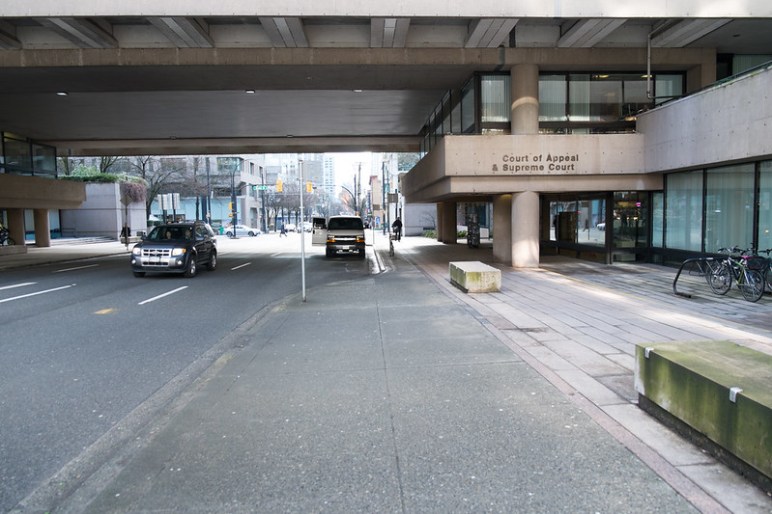
Photo courtesy of R. Orville Lytle via Flickr Commons — Some Rights Reserved
Getting to the Supreme Court of Canada, not that hard apparently…

Never have I been one to think that somehow the Americans always get it right. In fact I think I could argue that they more often than not mostly get it wrong. However, in Canada, our flaw seems to be more often than not we don’t seem to get it at all. We just seem dis-interested. In the last few weeks and months, we have watched the two countries each nominate and then elevate a person to their respected highest courts. Watching the process in both was both illuminating and discouraging.

In the U.S. the process and the subsequent hearings to determine whether one was suitable for the Supreme Court has become highly political, polarized to the point that the proceedings are often irrelevant and therefore wholly predictable because of the overwhelming party rhetoric. Both the Democrats and the Republicans engage in vitriolic hyperbole, but the candidates need to run the partisan gauntlet, and then gather sufficient support from both sides to be officially sanctioned in a vote. That is their system.

In Canada, the process is mostly behind closed doors, just the way we like it, out of the public view, and therefore never contentious. Confrontation and diligent examination is to be avoided at any cost.

Let’s keep in mind that in both cases we are not talking about a minor promotion here. The Supreme Courts in both countries, are there, at least in theory, to interpret from a judicial perspective some of the toughest questions that confront a democratic society. Their rulings once made will reverberate throughout all levels of society and literally could have life and death consequences. To assume a post in amongst the nine judges that each court holds is a serious and for most would be a personally overwhelming undertaking.

In the U.S. the Supreme Court is fundamentally there to protect the constitutional rights of each and every citizen: speech, religion, press, assembly, and the right to petition the government. The U.S. constitution as originally written is the founding and fundamental document which acts as their guide.

In Canada, the Canadian Constitution is the similar base document, which has also been bolstered by the enshrining of the 1982 Charter of Rights. Those rights are: freedom of conscience and religion, freedom of thought, belief, opinion and expression, including freedom of the press and other media communication, freedom of peaceful assembly and freedom of association. So the two base documents in the two countries are similar if not identical.

Recently Kejanji Brown-Jackson was put forward by the Democrats as their candidate for the U.S Supreme Court. Ms. Brown-Jackson is a woman and is black. That is mentioned here because it is something which is continually leading every headline of that country’s newspapers in reference to her application. She was not only the first black woman to be tendered for the job she was also the first public defender. The lady is highly qualified; Harvard Law school, editor of the Law Review, a clerk for three different judges including Stephen Breyer, of the U.S. Supreme Court, who she was now destined to replace. She served as a District Judge in the District of Columbia from 2013 to 2021, vice Chair of the U.S Sentencing Commission, and for a year served as a U.S. Court of Appeals judge.

Her credentials like most who ascend to the American highest court are impressive. Nevertheless, she needed to go through four days of public hearings, and submit to extensive questioning by the Republicans on the Committee. They researched, reviewed and then questioned her sentences from days on the court. In often un-friendly terms they described her as an “activist” judge, and accused her of being “evasive” with no base “judicial philosophy”. Senator Lindsay Graham a hardline Conservative described her as more appealing to the “hard left” and therefore a political appointment as opposed to a judicial appointment. And the Republicans presented some legitimate argument in that regard. They examined all her sentencing documents in all the child pornography cases that had come to her over the years; and then effectively demonstrated how she was very light, in fact below the sentencing guidelines on those types of cases. They asked her questions on her judicial predilections such as “how does the court define gender discrimination”.

Ms. Brown Jackson was clearly coached and was at times politically evasive on her view of certain issues, but she survived relatively unscathed and held up to most of the questions. She was therefore sworn into office on June 30th at the U.S. Supreme Court, after a very long application process, having met with all the political heavy weights on both side of the government, and having endured the four day process, and then been voted on.

In Canada, in this gentler country, there is not the same process.

Nominated for the highest Canadian court was Michelle O’Bansawin. She was to replace the retiring Michael Moldaver, who had been appointed to the Supreme Court in 2011. Before joining the Supreme Court Moldaver had been a Judge at the Ontario Superior Court of Justice and then the Court of Appeal for Ontario for over twenty years. He was a former criminal lawyer and considered a foremost expert on criminal law and the Charter of Rights.

The Canadian headlines for the 48 year old O’Bansawin, were sadly predictable, and often only made reference to the fact that she was the “1st Indigenous woman” to be nominated for the Supreme Court of Canada. So what enduring process and examination did she have to go through in Canada?

The Minister David Lameti and H. Wade McLauchlan , started off the coronation . The latter who headed up the “Independent Advisory Board” along with the Cabinet Minister, appeared before the House Committee to announce and promote O’Bansawin, on the same day she was to appear for her one and only “hearing”.

McLauchlan is a former Liberal Premier of P.E.I and a “community leader” according to his bio, and clearly a liberal political operative. There are a total of eight members of the Committee such as ; Paulette Senior, CEO of the Canadian Women Foundation; Kohrad Sioui, a Grand Chief; David Nahwegahbow who heads an Indigenous law firm and was nominated to the Committee by the Indigenous Bar Association. You are probably safe in assuming that there were no conservative people affiliated with this group and you would probably be safe in also assuming that it was weighted in favour of an Indigenous candidate.

Lameti and McLauchlan began by lauding this process that had been undertaken. They described how they had received a grand total of 12 applications; then went on to praise all the candidates who had completed what they described as a very “elaborate application form”. The requirements of that form were not presented. The three main criteria they said for the job was tellingly– that the person needed to be “bilingual”, “qualified”, and “represent Canadian diversity”. They then short-listed 6 of the candidates who were then interviewed by the Committee for an hour each. All of this less than intensive vetting was done behind closed doors. The Committee then completed a report and sent it to the Prime Minister to choose between the 3-5 that they felt were suitable. Lameti said that the candidates would be “guiding the evolution of justice” and would bring a “deep understanding of the diversity of Canada” to the job. He felt he needed to add that the process was “free of partisanship”.

Then Ms. O’Bansawin appeared in the Committee room and was given a round of applause by those in attendance in the gallery. Lameti and MacLauchlan were clearly the warm-up opening act. She appeared for what was described as an “informal chat” on the merits of her elevation to the highest judicial post in the land. For the next 90 minutes, the members of the Committee lobbed what could only be described as softball questions at her while in the same breath praising the fact that she comes from an Indigenous background. This was not even a full committee hearing, where possibly deeper evidence could have been brought forward for examination. Lameti bragged that they were trying to avoid the U.S. model and that this Canadian model was better and much more of an “independent evaluation”.

Despite their insistence that competency was first and foremost in their criteria, McLauchlan admitted that the “character” of the candidate was as important as “competency”, and boasted that she would be “bringing the element of diversity” and this would all assist in the “path of reconciliation”. Lameti also admitted that part of his “mandate letter” given to him by his government included the boosting of the “under represented” to the higher levels of the court.

So what are Michelle O’Banswin credentials? She received a B.A. from Laurentian University, and went to the University of Ottawa for her legal degree. From there she acted as “in-house” counsel for the Legal Services section of the RCMP, and then to “in-house” counsel for Canada Post. After working for the post office, she went to the Royal Ottawa Health Care group where she would stay for the next eight years, again to act as in-house counsel. There she says she developed an interest in mental health while at the “Royal”, and would get her Masters in Law, and in 2021 her PHd. Her Phd is not available for viewing(it is under “embargo”-a rather unusual move) but she described it as being about Indigenous and Mental Health issues.

In 2017 she was appointed to the Ontario Superior Court as again “the 1st Indigenous woman” and that is where she was until her nomination. She did her Phd while sitting on that Court. She was never a part of any court of Appeal.

When asked about her criminal experience, because after all about 55% of the issues which come before the Court are criminal matters, she pointed to her expertise in Mental Health and being an expert on the Gladue Principles. For those that forget, the Gladue principles are a way for the Judge “to consider the unique circumstances (“experiences”) of Indigenous peoples” in sentencing.

Even though the politician and the public servant lauded her competency, none of it was questioned or brought to the table, it was all about her Indigenous heritage. Lori Idlout of the NDP praised her appointment as she felt that there was a need to incorporate the laws of the Indigenous “before colonialism” (the Indigenous have hundreds of legal systems) into the Canadian legal system, and that finally they could finally address the facts that the “lands have been stolen from them”. Another NDP’r, a former member of the Elizabeth Fry Society was hopeful that with Ms. O’Bansawin on the court they could finally deal wit the “colonial racism” and the “over-representation” of Indigenous in the jail system (currently 50% of the incarcerated are Indigenous to the 5% of the population). There was considerable mention of the drive to “self-government” and “self-determination” that all clearly felt could be hastened by Ms. OBansawin on the court.

Was her candidacy strictly a political Liberal move to appease their favoured Indigenous constituency as one could not get around her relatively limited credentials, even the left and Liberal supporting Globe and Mail called her a “relatively inexperienced jurist”? Or was it more than that? Is it coincidental or does her appointment also foretell an outcome in two cases which are coming to the Supreme court in the next few months? Without too much exaggeration, the settlement of these cases and the decisions coming from them could prove dangerous to the unity of this country as a whole.

In early December of this year coming before the Supreme Court is a case which concerns the right of Indigenous peoples to write their own laws for child-welfare services in which the Federal government in Bill C-92 of two years ago “affirmed the right of self-government”. This bill gave the Indigenous laws in the area of child welfare the force of Federal law. This means that their “laws” will supersede any Provincial law. This has stirred up Provinces like Quebec who will argue in front of the court that it emphatically violates Provincial jurisdiction.

The second case is about an Indigenous community right to set a residency requirement for members of its council. At first blush that seems less than significant. But, it will be the first case tested under Section 25 of the Charter, which states that charter rights should not be interpreted to detract from Indigenous rights. Could this mean that the unwritten and uncharted “laws” of first Nations will not be bound by the Charter of Rights?

As a Metis lawyer for the pro Indigenous argument explained, the two cases will finally address modern “aboriginal law…and how pre-existing Indigenous law, jurisdiction, and self-government reconciles within Canada’s constitutional architecture ” . The argument at its simplest is that the Indigenous were here first, therefore their “laws” should supersede the laws of Canada.

So there you have it. Without any serious debate, without any examination of her rather limited record, written or otherwise, we now have a sitting Judge on the Supreme Court for possibly the next 27 years, who Professor Phillips an editor in chief for the Osgoode Society for Canadian Legal History describes as: “most people don’t have much sense of her, because she’s done relatively low-profile things”. This is lawyer speak meaning that she is un-qualified for this appointment, unless of course merit is measured not in competencies, but in your cultural background.

None of this is shocking anymore. This is not the first time that the Federal government has appointed someone because they are aware of their identity, we are kind of getting used to it now, when the political need is clearly held to be greater than the need for professional competence. But, in this incidence it could prove dangerous for this country, and if we don’t care, we should care. It has all been done with the efficiency and secrecy of the Catholic Church in appointing the next Pope, but without the white smoke coming from the Parliamentary chimney.

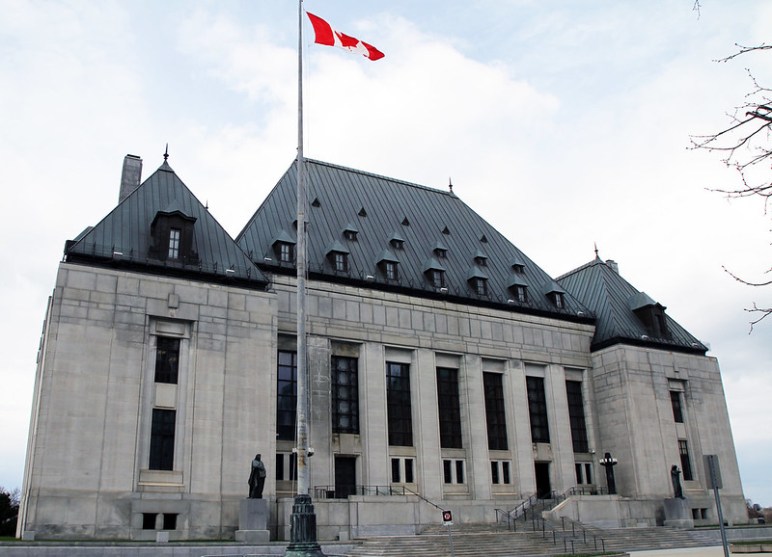
Photo Courtesy of Alex Gubord and Flickr Commons – Some rights reserved

Heroin, guns and a bullet proof vest –but not “morally blameworthy”

There are many cases that come before the courts, almost all receiving little attention or public mention, but once in awhile there are some that make you take note. From Provincial courts to Supreme Courts to Appeals courts one can almost always find a case or two that will make you scratch your head, or possibly get a little agitated.

The case that recently had me perk up and get a higher blood pressure reading is the case of Robert Mero.

He is a 34 year old male, whose father was Metis and his mother was non-indigenous; making him one fourth of Indigenous heritage. Why are we mentioning this, because it was this 25% of his heritage which was enough to keep Mr. Mero from going to jail.

In the eyes of the learned Justice Len Marchand of the BC Court of Appeal, his “moral blameworthiness” necessitated that the 40 month sentence to which he was originally sentenced (by the Supreme Court of Vancouver Judge Joel Groves )–be reduced, more accurately eliminated. Mr. Mero should not go to jail in the view of the Appeals Court as he should not be held accountable due to his Metis heritage. The sentencing was wrong according to Justice Marchand because “neither the Crown or Judge addressed his Indigenous background”.

The unwieldy terminology of “moral blameworthiness”, clearly something only lawyers could come up with, stems from the Supreme Court of Canada and what is now referenced as the Gladue decision.

Regina vs Gladue was a decision by the Supreme Court specifically dealt with sentencing principles that had been layed out in Section 718.2 (e) of the Criminal Code of Canada and had been enacted by Parliament in 1995. This section directed that the courts need to consider “all available sanctions, other than imprisonment” for all offenders. However, it needed to pay “particular attention to the circumstances of Aboriginal offenders”. (It should also be noted that these provisions were put into the Criminal Code under Prime Minister Jean Chretien and the Liberals who ironically have been recently criticized for not understanding the problems in the residential schools.)

Gladue was the first case where the Supreme Court considered these provisions and set out to try and define what factors should be taken into consideration under this newly defined law. In the Gladue case, a young Indigenous woman had appealed her manslaughter sentence of three years for stabbing her boyfriend to death (life was cheap even back then). The pitiful sentence of three years was upheld despite the appeal, but the Supreme court ruled that they should have at least considered her Indigenous background.

The changes to the Code were orchestrated and passed because of the “over representation” of the Indigenous in the Canadian judicial system. The term “over representation” is a bit of a misnomer, they were not going to jail in disproportionate numbers because they were being picked to “represent”, they were going to jail due to the massive criminal problems existing in the Indigenous populations.

This was an attempt by the Liberals of that time to solve the abnormally high criminal activity amongst the Indigenous– from the top down. Too many in jail, simple solution, just don’t send them to jail.

No need to address the actual criminal activity at its origin, which is a much more complicated set of social ills. The overall affect of course was the diminishment of personal responsibility, and broadly, it also had the affect of creating different laws or at least very different treatment before those laws according to race.

In the years since this has morphed into Judges now automatically asking for a pre-sentence report which formalize these considerations for Indigenous offenders. This sociological based report is termed a Gladue report. This report, or lack of a report was a central factor which played out in the case of Mr. Mero.

Mr. Mero’s crime in this case was not a minor crime and he would be unlikely to have received any nominations for citizen of the year in Prince George, where this matter began. A search warrant was conducted of Mr Mero’s residence by the police in Prince George in 2016. It led to the seizure of a .38 calibre pistol, ammunition, 23 grams of heroin, and a bullet proof vest. Clearly, Mr. Mero was exhibiting all the characteristics of a drug dealer.

Mr. Mero had previously served two other jail times, in 2005 and 2006. It was what the Appeals Court called a “dated criminal record”.

Mr. Mero and his defence council (he went through two defence counsels) went through all the motions that are tried in this day and age. A motion of too long to get to trial (Jordan decision) was first tried. The Judge ruled that the delays were due to defence counsel scheduling and the fact that his 1st defence lawyer had gotten suddenly sick. The court chastised the defence counsel: “Mr. Mero’s trial counsel has shown, effectively, since the beginning of the trial, an ability to delay matters on behalf of his client”.

Then the defence argued that Mr Mero who suffers from a lung disease should not go to jail because of the high rate of Covid in the jails which could prove to be detrimental to his health. Worth a try, considering the panic which has pervaded Canadian society over Covid, but this too didn’t work.

The defence counsel then argued that no Gladue report had been prepared. It turns out that they had six months to produce a pre-sentence report but failed to get one before the courts in time. So the sentencing went ahead without a Gladue report.

Justice Marchand of the BC Appeals Court felt that this was a massive oversight.

As a result he imposed a “conditional sentence” of 2 years less a day– the 1st year to be served under house arrest, to be followed by a curfew. He was placed under probation for the drug offences. This decision by Marchand was concurred with and signed off by two other Justices; Mary Saunders and Bruce Butler.

So what would have been in a Gladue report that could alter an outcome to such a degree? Usually, there is general information about the Metis “nation”, the intergenerational aspects of “colonialism” and “displacement”, racism and systemic discrimination, forced attendance at Residential schools and the “over representation” of the Indigenous in the jails of this country.

This is not to deny that Mr. Mero clearly had a troubled life. Most criminals can point to historic family issues. In his defence argument he pointed to the fact that he was “unable to complete school”, his “childhood was traumatic”, his “life was marred with addictions” and that he had “come into conflict with the law”. Mr. Mero’s father was not believed to have been at fault but he was often “away at work” and this left him with a mother who had significant mental health issues. He had runaway from home at 12 years old and got caught up in the street level drug trade, an all too common story.

However, it would be difficult for Mero to argue that these issues were directly related to his Indigenous upbringing. One need not worry because the courts have ruled that “it is not necessary to establish a direct causal link between systemic and background factors and the offence at issue”, as it may be “impossible to establish” a link. In other words you don’t have to prove a causal relationship.

The other aspect of this case which gave me pause was that this was a verdict by Justice Marchand. There are 26 Justices in the Appeals court, but in this instance Mr. Marchand was assigned the case.

Mr. Marchand is the son of Len Marchand Sr, the first Indigenous cabinet minister who once served under Pierre Trudeau. Len Marchand Jr. is a member of the Okanagan Indian Band having grown up in Kamloops, B.C. He articled and practised law in Kamloops with Fulton and Company. While there he spent a substantial part of his career working on “reconciliation for Indigenous people”, was pursuing historic civil claims of child abuse and represented residential school “survivors” and also served on the selection committee for the Truth and Reconciliation Committee.

There is no evidence here that Mr. Marchand had a clear bias in favour of Indigenous claims of “systemic racism”. Also, this is not to claim that all Indigenous cases need to be assigned based on their cultural background. But in this instance the appeal revolved around a Gladue application, central to which is the belief that there should be judicial favourable considerations granted to the Indigenous that are not available to others. That the application of the laws should be different because of their culture and background.

It is difficult to determine whether justice was served in Mr. Mero’s case, but I suspect he was merely a player of the system.Whether justice was served in this case we can leave to others, but does justice also need to be seen as having been done?

Should this case have been handled by someone who had spent the majority of his working life on Indigenous causes or is there a definite taint to this case.

Gladue is just one of the many pronouncements coming from the benches of the Supreme Court of Canada, the BC Supreme Court and in this case the Appeals Courts. They are germinated from the left leaning political dominance in British Columbia. It leads to favourable judicial appointments. Maybe well intentioned, but clearly with very pronounced political leanings. A left propensity to believe that government must protect all and everyone from the evils that society put upon us. Personal responsibility replaced by societal responsibility.

Maybe it is time for a return to the centre, where the vast majority of Canadians actually live. Not necessarily to the right or the left, but where common sense is the prevailing ethos.

The laws of this country are being diminished, watered down, leaving a large class of people now feeling disenfranchised. Many would not be o.k with rules and laws being applied differently depending on your cultural background. It is a difficult issue, but the current judicial climate seems destined to lead to trouble.

Photo Courtesy of Paul Sableman via Flickr Commons – Some Rights Reserved

A personal note

I apologize for the delay in the publication of this blog.

I have recently moved– swimming against the prevailing current and have moved back to the heart of the City of Vancouver leaving the quiet countryside. I have been surrounded by cardboard and the joys of re-connecting with life in the supposedly faster lane.

Thanks for your patience and your continuing support.

Pete

Collision Course

In a ruling this month by Justice Margeurite Church of the B.C. Supreme Court, it was decided that Coastal Gas Link, the company constructing the LNG pipeline from north eastern British Columbia to Kitimat British Columbia, had satisfied the requirements for an interlocutory injunction against the protestors of the natural gas pipeline.

Listen closely….can you hear the echo?

The year before in December 2018 the court had granted an interim injunction against these same protestors. That time the RCMP eventually moved in and 14 of the protestors were arrested and the encampment taken down. All of it much to the chagrin of a small sect of the Indigenous who were being supported and prompted by the usual wagon jumpers of the enlightened liberal left.

So here we are again, a year later, same issue, different court date. Ms. Church in this latest court verdict went a little further in her ruling saying –that there is evidence to suggest that the protestors had engaged in “deliberate and unlawful conduct” for the purpose of causing harm to the plaintiff and preventing it from constructing the pipeline.

Of added interest may be her comments reflecting on the general state of the laws pertaining to the Indigenous movement reflected in this particular case:
“There is a public interest in upholding the rule of law and in restraining illegal behaviour and protecting the right of the public, including the plaintiff, to access on Crown roads…the defendants may genuinely believe in their rights under indigenous law to prevent the plaintiff from entering into Dark Horse territory, but the law does not recognize any right to blockade and obstruct the plaintiff, to access on Crown roads.

In any event, another court decision, another group of lawyers, all kicking at the peripheral issues and avoiding the central dilemma of defining the role the Indigenous are to play in this country.

One would be hard pressed to imagine a more convoluted, ridiculous, and multi-layered predicament. Often mis- guided policy and vague initiatives have been all wrapped in endless litigation and court interpretation. The politically righteous argument of aboriginal rights, simmering away for the last forty years in a cauldron stirred by hundreds of lawyers. Apparently none able or overly concerned to define the central role of the Indigenous in this country. No one able to say whether the Indigenous are simply Canadians, just like everyone else, with the same rights and benefits, and subject to the laws of this country; or a “Nation” unto themselves, independent in spirit and governance, albeit financially dependent.

The popular view being force fed by the Liberal government Federally and a Provincial NDP government is that there is a 2nd “Nation” in this country. An ill-defined nation to be sure, no central authority, no common economic agenda or engine, old ways versus the new.

Non the less this “Nation” has indeed found a receptive audience in the current government and is grabbing for the ring of political acceptability and political empowerment, with ceaseless demands for increased financial resources and independence. It is demanding its own school system, its own policing and justice system, its own health care, its own social services, all to be run by a disparate range of communities.

A “nation” system made up of 634 different groups or “nations” speaking over than 50 different languages. Varied in language and cultural beliefs and spread throughout a massive geographic and often isolated area it is difficult to see a unified coherent and plausible plan.

As the years tick by this stew of government initiatives have been tendered, milked and prolonged by a legal and political community fuelled by the increasingly politically astute indigenous leadership.

Since 2000 there have been 21 cases involving indigenous rights and claims heard by the BC Supreme Court. There have been 9 cases since 1984 heard by the BC Court of Appeal, 14 cases heard by the Federal Court, and since 1970, 64 cases coming before the Supreme Court of Canada.

The result is layers of court systems all pronouncing their particular spin on what it all means. Supreme Court Constitutional decisions, common law precedents, treaties, Reserved land, “ceded” and “unceded” lands, Canadian law, Indigenous “laws”, hereditary chiefs, elected counsels, and Provincial declarations echoing United Nations Declarations.

The need for “reconciliation” spews forth at every turn, the beauty of the word “reconciliation” being is that it is infinite, there is no end. By very definition the issues can never be “reconciled.” The devil incarnate of course is “colonization”.

The movement has taken down statues, removed names from buildings, re-named Provincial and Federal Parks, and moved to ensure that any business done has to include a portion of the pie for them.

Some Indigenous are living in the most hideous squalid communities, living in poverty, poor education, no drinking water, and out of control birth rates. No hope of economic sustainment on one hand, while others are developing billion dollar city properties.

There are oil-rich Indigenous bands where the average income is $125,000 per year, and only 4% of the income comes from the Federal government, only because they are blessed by the good fortune of sitting on often barren lands but lands where there is black gold running under their feet. There are others that are almost 100% funded by the Federal government, defecating in buckets, no clean water, and no siding on their houses.

In this systemic chaos only the lawyers are winning. No one else.

It is all leading to darkening clouds and a possible storm of discontent on both sides of the two “Nations”. A low pressure system consisting of 96% of the population moving inexorably toward an Indigenous high pressure system made up of 4% of the population.

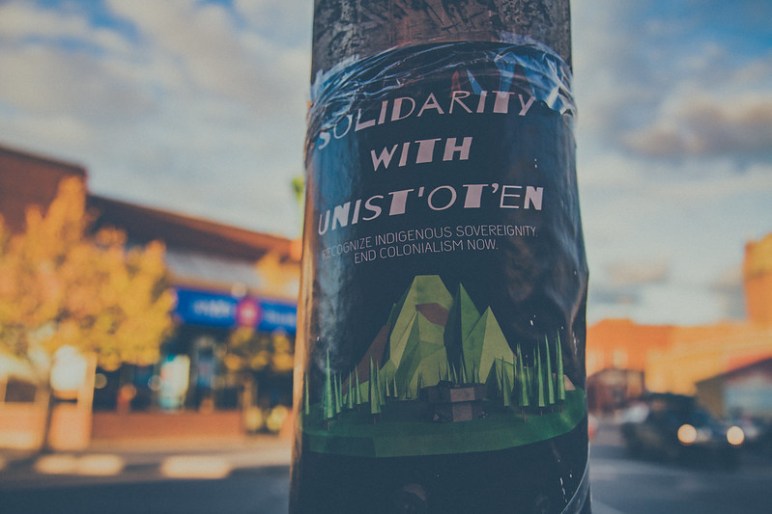
The latest example is now being played out near Houston, British Columbia. The Unist’ot’en and Wet’suwet’sen “nations” and their “hereditary chiefs” versus the rest. This latest collision to be where there is the proposed site of a natural gas pipeline to be built for a $6.6 billion by Coastal Gas Link. (The pipeline is to link to a $40 billion LNG export plant that is to be built in Kitimat, B.C.)

The NDP government of British Columbia with a straight face, state that they are both anti-pipeline and pro- pipeline. Hereditary chiefs disagree with elected counsels. Some bands are pro development seeing it as a financial windfall and the only hope out of abject poverty; others are just against it.

Last week a BC Supreme Court issued an injunction ordering that all obstacles to construction be removed. Pretty simple right?

The problem is that it was one Nation, going through their legal system, that obtained the injunction. The other Nation doesn’t recognize those laws.

Grand Chief Stewart Philip says that it is a very “complicated issue”. It’s complicated mainly because it is difficult for him to argue both for and against.

On the hereditary chief side you have reported comments like;

“It’s our territory. It’s not Canadian land. It is not the Queen’s. It’s not the RCMP’s. Its Wet’ suwet’sen land. “

The builders are “settlers on stolen land”, this is “environmental racism” all part of the “Canadian legacy of colonization”.

Immediately the BC Civil Liberties Association and the Union of BC Indian Chiefs jumped on the practised narrative, led by Grand Chief Stewart Philip who issued a statement saying: “A police exclusion zone smacks of outright racism and the colonial – era pass system sanctioned by the so-called rule of law, which our people survived for far too long”.

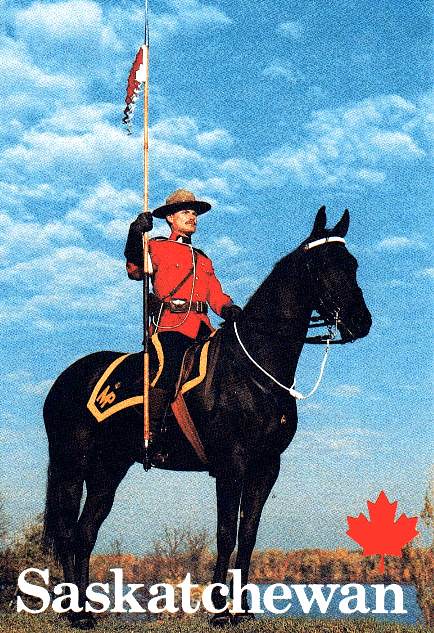
And in between these two nations is the politically correct RCMP. Their political masters want them to be gentle, do not offend at any cost. Their legal bosses are telling them to enforce the order and in the past, there was no hesitancy around a court ordered injunction. The Mounties traditionally and constitutionally were there to enforce the laws, not to interpret them.

But this is a different world now. This is the world of appeasement and the Mounties are going to find that they have no friends on either side.

The Mounties, god bless their souls are trying none the less, to be friends to those who can not countenance any meeting of the ways. They have asked the Indigenous protestors to meet and negotiate with the very same company that went to get the court order, the Coastal Gas Link group, who must think that they are is some sort of Twilight zone.

In the meantime the protestors have been cutting down trees and setting up their camp, while the Hereditary chiefs continue to say that the pipeline violates “Indigenous law and does not have consent”.

This is a fundamental collision. This is not going to go away.

It circles around aboriginal title which has been a decades long argument. What “title” or the “duty to confer” or “honour of the Crown” all means, with all its varied interpretations also includes such arguments as to whether treaty’s extinguished those title claims. Some even argue whether Indigenous groups in signing some of these treaties even understood them.

The countless cases which have been brought forward, have all circled around Section 35 of the Constitution Act of 1982 which proscribes to the protection of indigenous and treaty rights. Unfortunately, it didn’t define those rights, but none the less in 1995 the government began to adopt a policy of an “inherent right to self-government”, and the Penner Report to the House of Commons in 1983 spoke of this inherent right.

Adding to the legal and political confusion is the fact that the rights being claimed by the Indigenous do not come from an “external source”–they claim it is a result of Aboriginal people’s own occupation and relationship with their home territories as well as their own ongoing social structures and legal systems.

This would mean that in their view, they control and define aboriginal title.

Today, no political party, Provincial government or Federal government wants to be seen as decisive in terms of defining what these rights will be or how they would integrate with the rest of Canada in terms of self government.

The lawyers drone on in every level of courtroom. They are seemingly content in this ongoing lucrative dark hole of litigation.

The silent majority sit back and wonder where this is all leading. Is Canada prepared to have a separate entity operating within its borders, with its own laws and government, while at the same time supporting them through tax dollars. Are they prepared to let 4% determine what flows through economically to the other 96%. It seems unlikely, but there is no current political party asking that this central issue gets addressed definitively.

At some point the police are going to have to act in Houston. Every police officer involved will be left standing out in the field and roadway and it will an open hunting season for cries of violence and racism the minute they come within a few feet of the protestors.

The journalists stand by at the ready, camera rolling, salivating at the potential for filmed violence. ( the Canadian association of Journalists even jumped into the recent fray— arguing in court the fact that they were worried that the police could use the exclusion zone to prevent media from covering the RCMP enforcement of the injunction.) Maybe this is a sad conclusion but in this age of “breaking news” it is hard to dispute their intent.

None of this is new in terms of the RCMP being the potential fall guy. There have been many times in the past where the enforcement of an injunction has been violent and they have been pilloried for their abuse of power, rightly or wrongly.

The concern is that there is not a lot of confidence or recent evidence in the current RCMP management being behind their operational officers. Will they be supportive of the laws of Canada and the enforcement of those laws, or will they succumb to the un-written laws of a frenzied very vocal political “Nation”. After all it is a management group which has been genuflecting in front of the Indigenous cause in deference and in parallel with their political masters for the last several years.

We will see shortly. Time is running out in their “negotiations”.

A note to those uniform officers. Make sure those body cams are charged up and the audible is working. It may be the only friend you have in this instance.

Photo courtesy of Flickr Commons by Tony Webster