Productivity in Policing?

This blog’s question is whether or not one can measure productivity in policing? It is a question that has been sporadically posed over the years, toyed with, but never really answered or explored in serious fashion. Why is that? Most police departments both in Canada and the U.S. are not measuring performance accurately. In a U.S. the National Institute of Justice study which examined 20,000 plus police departments they found that very “few are measuring performance adequately”. In Canada, most of all the measurement tools employed by the variety of police services relies on the statistically broad generalized numbers and percentages; crime reduction clearance rates, response times, number of violent crimes, and enforcement productivity– such as arrests made or tickets issued. Is this the best way to measure productivity or is it even a measurement that carries any meaning in terms of productivity?

At best these are flawed measuring tools which are largely misinterpreted or skewed in their findings. For instance, is a downturn in serious crime a measure of community concerns, when those community concerns usually revolve around other problems and other types of behaviour? Should we be focused on reported crimes when unreported crimes may be the better measurement tool? In terms of the latter, statistically, it is currently estimated that in general terms, unreported crime is three times the amount of reported crime.

Albert Einstein had a phrase, “everything that counts can’t be counted, and everything that can be counted doesn’t count”. Police use a lot of surveys and polls and they talk constantly about overall crime rates, especially when the numbers portray them in a favourable light. However, I am referring here to a stricter economic definition, which is “output per unit of input”. In 2024 as policing costs soar, as transitions and cost comparisons are being trotted out in public discussions about the RCMP moving to a city Surrey Police Service, has it not come time to start looking at the issue of productivity in a more incisive and informative way? In labour terms, productivity is what drives salaries, and traditionally that comes about as a result of technological advancements, which in turn improve productivity, and thus drive higher wages. In economic theory, “workers are paid on the value of the work they produce, industries with higher productivity will tend to have higher wages”. Wages are the representative of the amount of value created in production. Do these theories apply to the economic models of policing? Is it possible to argue that the latest atmospheric increase in police wages have been the result of increased productivity?

Maybe the broad constructs of economic labour theory do not have a direct or easy application to policing models, but when there are no meaningful evaluations of police productivity there can be no meaningful evaluations for the public in terms of cost/benefit, there can be no accountability to local governments, or adequate control for police managers. When no examination is undertaken it is as the National Institute says a problem of the “the most fundamental and serious nature”.

In terms of the lack of productivity studies, police organizations often defend themselves by stating that the broad mandate and public demand for police services means that there is no single measure of productivity in everything that the police are tasked to do. That would seem to be at least partially true. How does one measure productivity of a community policing officer, or a traffic analyst, a uniform officer on the street, or a homicide investigator? How does one compare or measure output of a Federal drug section or Intel section with a uniform officer. They perform almost completely different functions, have different outputs, even though possibly similar goals. However, it seems logical that one should be able to measure the single units separately in terms of their productivity and with some degree of accuracy.

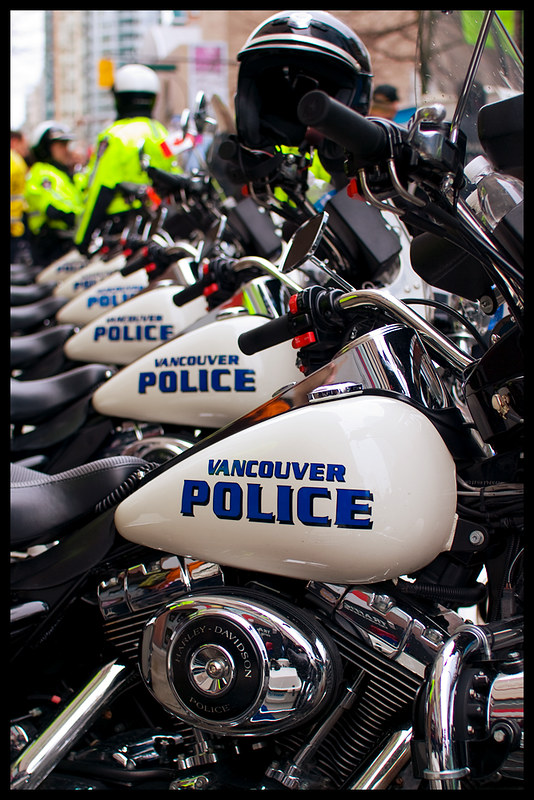
There are two broad types of measuring tools; one that measures outcomes and one that measures process. Last night I watched from my downtown apartment the arrest of an individual on the street by the Vancouver police department. The outcome was easily measured, the individual was handcuffed and was after a fairly lengthy period of time transported to jail. The process was four police cars (including the paddy wagon) and a total of six officers involved to make the single arrest. Having been part of this “process” many times over the years past I could not think of many instances where a single arrest of an unarmed male required this level of police attendance. Has productivity increased or decreased? One would certainly not see this level of police attendance and resources at a small rural police department or RCMP detachment. While stationed in Bella Coola, only one of us would be working at any one time. Can we assume from this observation that police officers are more productive in rural less inhabited locations than in Vancouver?

In another example, many times, especially in my early years I attended serious and fatal accidents as a uniform officer in a semi-rural area of New Brunswick. I was always the one holding the dummy end of the measuring tape and taking crude triangulation notes for the two of us in attendance. Nowadays, most serious traffic accidents seem to involve at a minimum of three or four police cars, a traffic analyst, traffic control people and their vehicles, and maybe someone to fly the drone over the accident. These new measurements also now take endless hours of road closures. In talking to a traffic analyst he estimated that a fatal accident now takes a minimum of 40 hours for him/her just to process the information that has been gathered. In this accident investigation comparison, the output increased in terms of details and displays or reenactments of those measurements, but has productivity increased or decreased in terms of the individual officer? Then the final question is has the overall outcome changed?

In the world I spent a great of time in, we used to attend homicide scenes with two individuals and then you would work with forensics and the uniform officers that were in attendance. Now, homicides are attended (at least in IHIT) by a minimum of eight officers, and you still work with forensics and the local uniform contingent. If you were lucky and had prosecutable charges, the Report to Crown Counsel with a variety of attachments may have been a couple of hundred pages along with boxes of transcribed statements and enumerated exhibits, as you went to trial. Now, with the advent of technologies and digitization, especially in the audible and visual recording of events, I am told that the average homicide consists of about 5,000 pages. Again, the output or volume of materials presented has clearly increased, but at least statistically the outcome is about the same. So has productivity increased or decreased?

None of this theorizing or productivity rests solely in the policing world. It would be extremely difficult to argue that the Court system and the lawyers involved have become more productive in the last number of years. It takes a great deal longer to get into court and the trials seem endless. Even the Supreme Court of Canada in the Jordan decision said it is all taking much too long. Of course, this is also the same court that gave us Stinchcombe and the ridiculous levels of disclosure now required under the law– which in turn has made the court process the equivalent of a marathon and not a sprint. How could one possibly argue that the growth of the Federal government ranks is the result of increased productivity?

Has crime become more complicated? It is something I always hear and this is a cogent argument when it is crime that involves the complications of the internet, whether it be fraud, bullying or sexual harassment. In those cases, the process has become more complicated and the outcomes also seem to be diminishing. In the standard criminal code, statutory offence or traffic offence, the crime definition has not changed, the eventual outcome has not changed, what has changed is the processing.

If you go to the politically popular single measurement of “bang for your buck”, it would clearly be ridiculous to argue that two trained police officers, making double overtime, should be standing directing traffic at a parade barricade. Is there a better more economical way to perform this task? Is this a productive use of highly paid resources? If not, then the bigger question is why is it still being done?

This is all to say, the tools of economics should and could be used in policing. Resources need to be put to the studying of the day to day performance in policing. There is nothing to be feared if one is arguing for greater productivity and use of those resources. Now, the police use broad sometimes irrelevant outcomes as a measurement of their overall worth and effectiveness. The actual process and levels of productivity are not being watched, and if policing is like the rest of the country, productivity is trending lower. Until we do and in a transparent fashion, there are going to be more and more questions by the taxpayers as to whether one can justify police budgets and the hiring of police officers going into the future.

Photo courtesy of Arty-Arnaud from Pixabay – Some Rights Reserved

Ronald MacDonald wants to go to court more…

Of course the title of this blog is not referring to that icon of our childhood, the “… Happy Hamburger Clown” of Golden Arches fame; although he has had his legal issues too (he was sued civilly for promoting child obesity.) No, this is in reference to Ron MacDonald, the current head of the Independent Investigations Office (IIO) for the Province of British Columbia. This is the group, with an annual budget of about $10 million, that is mandated to “conduct investigations into police-related incidents resulting in death or serious harm to determine whether any officer may have committed an offence”. There is a general consensus growing that the group is in trouble, it is not fulfilling it’s mandate, in fact many say they are failing and failing miserably. Mr. MacDonald himself has recently been speaking out on his own frustrations.

The police could not and should not investigate themselves was the repeated slogan coming from those of the political left of centre a number of years ago. It stirred the politicians to act in September of 2012. Like most political policy, it was the result of a political reaction to a rather immature and naive understanding of police wrongdoing. The theme had been pushed forward by a vocal minority, which in turn was then given an audience by the Davies and Braidwood inquiries, which looked into the deaths of Frank Paul and Robert Dziekanski respectively.

Paul was a 48 year old Mi’kmaq who Vancouver Police officers tried to book into the “drunk” tank, but they were turned away when the on duty Sgt said that he had only just released Mr. Paul, two hours before from cells and he wasn’t going to book him again after such a short period of time. So the officers took Paul away and returned him to the downtown alley. He was clearly still intoxicated and he subsequently died of exposure and hypothermia in the alley. However, after a total of five Crown reviews of the case, all concluded that “charges were not warranted” against the Vancouver City officers involved.

Dziekanski was a more widely reported incident where police responded to a disturbance in the Vancouver Airport, when Dziekanski a Polish immigrant who had just arrived, was wandering disoriented around the terminal and then began causing a ruckus. Four officers attended and tasered him saying they felt threatened. Dziekanski died of heart failure. The four officers believed they were both justified in their actions and within the limits of their training. Some of the officers were charged, but not for the death, but for perjuring themselves during the Braidwood inquiry. Judge Braidwood at the inquiry conclusion said that the officers “didn’t intend to cause his death”.

So what prompted the birth of the IIO was a political demand, which used as it primary evidence two cases– both of which showed there was no wrong-doing on the part of the police.

Irony aside, the first IIO chief was Richard Rosenthal, who left the job early to return to the world of academia and probably did not leave the best impression. He was then succeeded by Mr. MacDonald in 2017. MacDonald came from the legal world, he was a defence counsel for 6 years, and then a Prosecutor for 17 years and had a distinguished record. All of which makes his recent comments a little more perplexing.

In short Mr. Macdonald is now making a case and has gone public with his concerns about the lack of charges being approved in the IIO cases that were presented to Crown Counsel. What prompted his comments seems to have been, once again, a political reflex to some media pressure centred around two Indigenous cases.

One case involves a 38 year old Wet’suwet’en named Jared Lowndes, who during his arrest the police had to use a taser, a police dog, and then after ramming his vehicle, he was eventually shot in a Tim Hortons parking lot. The Crown in that case concluded and stated that they were “unable to prove that officers committed any offence in relation to the incident”.

The second case involved Dale Culver, a Wet’suwet’en and Gitxsan indigenous male who during his arrest was pepper sprayed and punched when checked by police who were answering a call where it was alleged that he was “casing vehicles”. During the course of their investigation the IIO went to three different pathologists all of whom identified the primary cause of death as “tiny blood clots in lungs”, but that the blunt force trauma by the officers was a “contributing factor”. The IIO felt that the officers should have been charged based on the “contributing factor”. The Crown in their review went to a fourth pathologist, who identified the cause of death as being “cardiac arrest due to the effects of methamphetamine”. So after seven years, the officer was given an absolute discharge.

During this time, the officer’s career has been put on hold and he had been subjected to death threats. The Union of BC Indian Chiefs, who clearly feel that they have not only the right to disagree and inflame the issue, but also feel that they should be the ultimate arbiters of any criminal case involving their own, issued a statement saying: “We have a system that says when you have a gun and a badge, you can kill any Indigenous person in any town in B.C. and not go to jail”. The stupidity of the statement went un-challenged by the government.

Mr. MacDonald regardless of whether these particular cases motivated him, says the system isn’t working. He tips his political hand a bit though when he states the people have “lost faith in the system..in particular Indigenous communities.” He may have lost faith, but far be it for me to point out to a lawyer an obvious truism. The Crown has always operated on the premise of “substantial likelihood of conviction”. They have a legal need to prove a case of guilt “beyond a reasonable doubt”. Does Mr. MacDonald not see the reasonable doubt in the Culver case?

The IIO has been on shaky ground since its inception. The mandate given from the beginning was much too broad, and this was pointed out even by Rosenthal in his departure. He said at the time that it was going to cause a backlog of causes when there was no ability to “triage” the cases.

There was also a large problem in the staffing this organization. The government of the day said that the overall intention, once established, was to have all “civilian investigators”. Remember the police could not be trusted in their theoretical framework. So they limited the ability of ex-officers who could apply, especially those from B.C. If you carry this logic forward, the thought was that investigating an “officer related shooting” did not require any policing experience or knowledge of police operational structures.

There were also internal problems in the beginning, which seem to be continuing today. In 2015 there were investigations into allegations of “bullying and harassment”, allegedly due to the culture clash from hiring former police officers. During this time 17 investigators, and five non-investigative staff left the organization, only a couple of years after its inception. Flash forward to 2023 and Mr. Macdonald began speaking out and complaining of the lack of investigative resources. By then there were only 19 investigators working and 17 unfilled positions. To add to the resourcing problems, officer related shootings had increased by three times from the previous years.

The IIO in 2023 had been called in 232 cases, of which 193 led to further investigations. At the time of the article, they had 90 open investigations involving 38 deaths. In 2023, 50% of the staff were still ex-police officers and Mr MacDonald and his management staff were in turn being internally and publicly accused of bad behaviour “which created a hostile work environment… with their “belittling behaviour”.

So now in 2024 Mr. MacDonald’s has further complaints which he recently took to the air waves on the local radio station CKNW. Mr. Macdonald is now complaining about the lack of charge approval which he says is leading to a failing in “police accountability”. In the last five years, the IIO has recommended 39 cases for charge, and only 18 were approved for charge. Even more startling is the fact that since the IIO inception in 2012, only 15 cases reached the court stage, and there were 0 convictions. There was no mention of the length of time for these matters to get through the court process, which the IIO is hesitant to speak about, at least on their own official website.

If one assumes these stats to be correct, there are only a few possible answers to Mr. MacDonalds problems. One being that cases without merit are being forwarded, or the investigations being forwarded are flawed and incomplete; and simply do not meet the charge approval threshold. Or b) the process itself is not working. If it is the former, then it also may be possible that in the vast majority of cases the police are in fact innocent, and simply doing their job and doing it properly.

If it is “the process” then there are significant layers to that problem. Understaffing is clearly one of those problematic layers, as there is no possible way that you can take on every referral with such limited staff and capabilities. So you need to cut the mandate or “triage” the files more expertly as was suggested by Rosenthal.

You also need to forget the “civilianization” of the investigative team. You need to bring in ex-police officers with high levels of expertise and with significant standing amongst other current police officers. They are out there, but you need to go and find them. Building credibility is absolutely key and they have not done that since their inception. Currently the IIO is fighting the police forces, or specifically their unions on two fronts; on the access to police notes and in the area of “lethal force experts” –who are usually ex-police officers brought in to testify. They should not have to fight these fights, and better quality investigators with greater credibility will go a long way in working through those issues.

The problems within IIO are not new. They are similar to the problems which in more recent times arose from the “de-funding” era. It is a fundamental failure in common sense. The IIO mandate and their make-up is clearly flawed and has been from the beginning. One may even have to conclude that the best people to investigate the police may be the police themselves. Whether the public perception changes and the media narrative becomes less inflammatory towards the police, or whether the government understands this, is quite another matter.

Photo courtesy of Flickr Commons by David Jackmanson – Some Rights Reserved

Decay, Disorder and Delusion

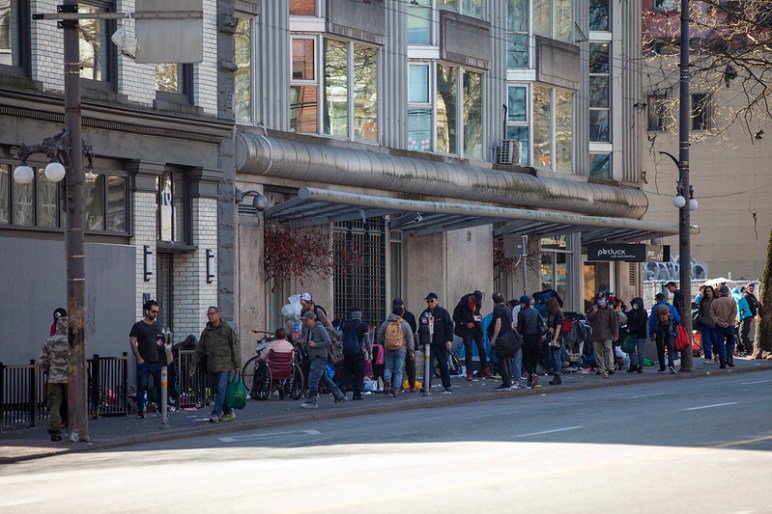
Recently, while walking in Canada’s most expensive city, in the worn 1000 block of Granville Street, I came across a middle aged man slumped; still in a standing position, balanced on an invisible fulcrum, his face pushed into the corner of a Vape store wall. Pants down passed his hips, his dirt streaked ass and genitals exposed to those walking by, all of whom were trying unsuccessfully to not look over. He was in a battle to hang on to something, immersed into a mental space few of us could imagine or would want to go. Immune to embarrassment and long past caring about anyone or anything.

I too moved on, a few paces later, coming up behind a noticeably tall girl, with dirty blonde dreadlocks, my eyes drawn to her footwear. White faux fur calf length boots, matted with the mud and small twigs of the alleyways. She shuffled beside a paunchy, unshaven, aged street tough. Although still playing the role, he had the air of someone beaten, fatigued. In this instance he was clearly the provider, able to provide her escape as he nonchalantly passed her two pills. He too was oblivious to embarrassment or any fear of getting caught.

People all living life in short instalments.

This is the Granville of old and the Granville of new. Nothing has the appearance of change in the last thirty years, while those disaffected and disenchanted are growing in numbers and pushing further outward.

Granville street is often now considered part of the infamous downtown Eastside (DTES)–just an extension off the Main and Hastings decayed and rotting epicentre. These further flung streets just purgatory to the centre hell. A neighbourhood which Wikipedia euphemistically describes as a “complex set of social issues” with a “strong community resilience”.

It is indeed a “complex” experiment if viewed from a distance through a prescribed social worker prism of generalizations and psycho/social theories. More pointedly it is an economic, political and social unmitigated disaster with no one accountable and the general public seemingly numb to the obvious.

Through the years we have been fed a continually regurgitated social theory pablum. We are over-dosing on the the do-gooders of the liberal left who are continually feeding us the pieties of helping others. This neighbourhood is a world of social workers, counsellors of very stripe, nurses, firefighters, police, doctors, housing authorities, drug experts, safe-injection sites, safe spaces, food banks, shelters, city planners, and single room occupancy hotels– part of a permanent but seemingly always crumbling infrastructure.

This city and those at the political centre are in effect promulgating an empire. An empire that caters to this underworld, but in turn is fed and nourished by the continuing misery and never-ending poverty.

These practitioners of the victim philosophy when confronted with the clear lack of progress spew forth a continual patter of under-funding and under-resourcing. They portray the “burned” out, saints in the battle and the burden they carry on society’s behalf.

Over and over again the city, provincial and federal politicians bray and echo the demands for greater funding and resources. They are the very epitome of always expecting and predicting that more of the same will yield those different results.

Depending upon who is drawing the geographical borders, the DTES is only about 7,000 people, but is often measured up to include parts of central downtown and further east. It then could total about 18,000 persons, a total of 30 blocks. Apparently the governments can not even agree on the size of the “community”. In actuality, most identify the core as about 10 city blocks.

This “community” according to Wikipedia, has an “over representation” of single males, and Indigenous and this a community overwhelmed with mental health and addiction issues.

There is a definable timeline to this ongoing deterioration.

It was during the 1980’s that the idea of this area becoming a drug haven began to develop and combined with a severe housing shortage.

In 1989 the first needle exchange began

In 1997 HIV infections entered the fray.

Between 1980 and 2002, 60 women went missing from the neighbourhood. (Pickton claimed to have killed 49 of them)

In 2003 the safe injection (they are now called “consumption” sites) sites opened.

In 2007 Vancouver Coastal Health estimated that 2,000 DTES residents “exhibit behaviours that is outside the norm”.

In 2008, the Vancouver Police Department estimated that 500 persons were “chronically mentally ill with disabling addictions, extreme behaviours, no permanent housing, and regular police contact”

Riverview hospital closed in 2012, because the government wanted to “de-institutionalize” the “mentally ill”, and with that wisdom forced many patients onto the streets.

Somewhat more currently, in 2013 a study showed that in the single room occupancy units, 95.2% had substance dependence while 74.4 % had some form of mental illness. 82% live alone and have a median age of 44 years old.

Around 2014 fentanyl began to replace heroin as the drug of choice and the amount of street deaths began to escalate.

In 2018 the area was declared a “public health emergency”.

Clearly, this litany of failure has nothing to do with an un-caring government, it is the failure of liberal policies unable to make their way out of this North American disgrace. These socially enlightened governments have purported and extolled many policies and the money has flowed accordingly. Four pillars, three pillars, task forces, committees and advisory groups have flourished.

Since 2009 it is estimated that $1.4 billion has gone into this relatively small area. That is $360 million per year, or $6.92 million per week.

At last count there are over 250 social service agencies in the DTES.

75% of the money comes from the three levels of government.

In a study done by Simon Fraser University, they found that $26.5 million of the government funding was spent on just 300 frequent offenders who were on the streets and continually embroiled in the justice system. This study further stated that there “was no evidence of improvement” and that the costs incurred per person exceeded the average per capita income in the city.

This has not been a problem where the aristocracy have pushed these people to the street, where uncaring capitalism has reigned over them. This a problem that has developed under a socialist environment and exponentially grown after successive Liberal and NDP governments. Those that forever proclaim looking after and being concerned for the common man.

Provincially the NDP ruled since 1991 beginning with Premier Harcourt and in 2001 with Glen Clark. Then along came the Liberals from 2001-2011, and now back to the NDP in 2017. The socially enlightened individuals have been in power throughout.

On the Federal side, since 1993 the Liberals have been in power except for a four year stint under Conservative Harper and we are now back to the present day Liberals under that irrepressible woke leader himself.

On the municipal side the parade of do-gooders started off with Larry Campbell, Sam Sullivan, then three terms with Gregor Robertson, and finally we have arrived at Kennedy Stewart. All of whom would proudly proclaim themselves as “progressives”.

So as we swim in this sea of social workers and broad minded politicians we are buoyed by massive amounts of money– yet, the streets stay the same. In fact they get worse.

It is an insult to reason. It is cold and lacking of any real compassion.

It calls for a truly new attempt to salvage what has been destroyed over decades. Or do we believe that this problem is insurmountable? We are in the 21st century, filled with driverless vehicles, satellite connectivity to the entire world, and have enjoyed unbridled prosperity, but this problem somehow confounds us?

Maybe let’s start with a massive forensic audit of all three levels of government.

It requires a central decision maker which excludes and ignores the three levels of government.

It needs a full assessment and culling of the 250 agencies who are now part of the system.

It needs enforcement of the Mental Health Act and it requires the authority to remove people from the street who clearly can not look after themselves. A forced drug withdrawal not a system of choices.

We should be building psychiatric hospitals rather than housing units. Definitely not housing units in the midst of the drug and criminal centres.

Is this too harsh? As one who has personally searched the streets on behalf of family friends, looking for the addicted younger sister, just to see if she is still breathing, but unable to entice her away from the diseases she was facing. Are we doing that person a favour by simply giving them a safe place to shoot up or a safe needle? Isn’t it all because we can not face the brutal truth that some may need to be forced into therapy and into hospitals?

The latest pushed policy is to provide hard drugs to the addicted free of charge thereby insuring that the drugs are safe, not fentanyl laced. Probably a good thing, but it will not clean up the streets, the tent sites, or curtail the violence. We will continue to be Canada’s safe harbour for those wounded by drugs or psychiatric disorders.

Maybe we should take those politicians that volunteer to dole out Xmas turkey dinners (with requisite photo ops) and put them in a position where they can daily view the destruction.. Let’s let them jab the needle of Narcan into the twitching chest of the addict laying in their own urine; let them attend to the sixteen year old girl beaten repeatedly, blood leaking from a broken nose and teeth, unrecognizable to anyone who knows her, whose crime was not cooperating with her block pimp. Let’s let them help hoist the body in the white body bag from the alleyway into the back of the station wagon, the stench of death indistinguishable from the nearby over-flowing Smithrites.

Over the years I have known many on the street level who have to be admired for their steadfast dedication, their ability to relate and talk to those no one else will talk to, whether manning an SRO or a needle exchange. But in small moments of honesty they will all admit that they are on a treadmill of policy and politics. This is not a problem at the ground level. This is a problem on the next level up, and the level above that.

The people in positions of authority need to be taken out of the committee meeting rooms, removed from the ever revolving academic theories in sociology 100 classrooms– their collective faces pushed into the sewage of the decrepit and disillusioned.

The madness needs to stop. It requires hard policies and a hard heart –that is if you actually care about this “community” and the people swirling around the drain.

Photo Courtesy of gotovan via Flickr Commons – Some Rights Reserved

The Pay Raise Gamble

Police officers and their managers have always had a comfy, cocoon like existence —somewhat removed from the economic up and down and cycles of the “real” world. Profit, loss and the measurement of productivity is an anathema to the world of policing.

They have often been able to “social distance” itself from the the pettiness and give and take of pesty budget concerns. “Cutbacks” during the last few decades, and especially in the RCMP has never really been in the policing lexicon.

To be sure there were years where in the “police universe” the Mounties received the short end of the stick, falling behind some of the bigger municipalities, at least for short periods of time. In the end, the Mounties were almost always dragged up the wage ladder by the other unionized forces across Canada. 

There was a time when the Federal government “froze” the wages of government workers, but that time is lost to the institutional memory of this group of officers. But for the most part, time was always on their side and the Mounties were able to live off the others. Their “universe” was a close orbit, made up of only other police agencies. When given to complain, the RCMP officers were only forced to an easy comparison. Any higher wage was justified by pointing to those other cops on the other side of the street. If they got a raise, you got a raise.

Quite naturally, there was no comparison to the economic worlds around them—those who were paying the freight. To be fair, the lack of caring or understanding of the general population mood is a characteristic of all government. Mounties policing in small towns were unfazed and unconcerned about the local budgets in terms of wages and salaries, their vision solely focused on the universal wage for police that was being determined in Ottawa. There was a constant and repetitious cry for new officers whenever a a detachment commander appeared before city counsel and never would it be couched in terms of concern for an overall budget. 

This all may be about to change.

Bankruptcy is now facing various governments on all three levels. The blame for these financial circumstances which have been thrust upon them, points directly at the “fight” against the “virus”.

Albeit, these same governments have cheered on the Federal government and their daily largesse. Every level of politician during this time had only one concern when pressed and that was to keep the electorate consoled. Only the truly brave offered up any question as to the need to be fiscally responsible.

So as the CERB cheques and business loans were shotgunned out to those in need, the deficit balloon rose to unrecognizable levels. The fiscal hammer above the political heads across the country got raised up further every day. And as gravity tells us, that hammer will eventually come down. The economic light will be shining very brightly on the unbridled spending in the next few months, and the glow from the economic fallout may be lasting for many years. 

Even before the “virus”, this blogger wrote several months ago, about the revelation that the Ontario government and various Ontario municipalities were trying to come to grips with budget shortfall issues and in particular with the growth of police budgets. The “ratcheting” of police and fire budgets was finally reaching levels where they began to get noticed. 

Defending the spending, fell to the age old axiom of the need for “public safety”. This tired and repetitious explication is now being seriously questioned for the first time in many years.

A number of police departments have three year Constable pay levels which have breached that psychological barrier of $100,000 and Police and fire services continue to grow at levels beyond the reach of the general population where salaries have stagnated for the last number of years. Police and fire budgets as a portion of municipal and provincial budgets is now the elephant in the hearing room.  

Tremors of anxiety are beginning to vibrate through the policing world as the word “cutback” is seeping in, gradually, but now discussed as an imaginable option.

This nervousness and angst finally touched down in the lotus land capital of Vancouver. This is happening in a city where government decidedly leans to the left and spends money on the services of the downtown Eastside like drunken sailors on shore leave. Although, it should not be totally surprising or unexpected when this is the same government which views whale-watching and the dispensing of cannabis edibles as suitable economic replacements for lumber or the building of gas pipelines. 

That aside, the City of Vancouver now finds itself facing a $152 million shortfall (Surrey is facing a $42 million shortfall as a comparison). The loss of jobs and shuttered businesses drying up revenues. Many argue that the full economic destruction has yet to be felt in this City of the Dispossessed.  

The other cognizant point which needs to be included in this discussion– the City of Vancouver has a legally dictated obligation to balance the budget. 

Canada’s third largest city has an overall budget of $1.6 billion. The Vancouver City Police now make up 21% of that overall budget with an annual expenditure of $340.4 million. And the greatest portion of the Vancouver city police budget is for salaries. 

To meet this $150 million shortfall the City of Vancouver has already proposed a very substantial increase of 8.2% in property taxes.

During this time they had also written to the Vancouver City police board to ask that they come up with proposals for  possible budget cuts. That was on April 14, 2020. OnApril 27th, the Police Board responded but didn’t offer any spending cuts. So City counsel imposed a 1% pay cut in the police budget, which amounted to a $3.5 million cut out of the $340 million pie for the remainder of 2020. 

They also directed, maybe more significantly, that the Vancouver Police Board in their pursuit of collective agreements with all of the three involved unions at the Police Department— that there will be  a stipulated 0% increase in 2020.  

Now, it would seem to most observers’ and probably the taxpayers of Vancouver that the proposed cuts and their proportion to the overall budget are in fact quite reasonable under these financial circumstances. But predictably, Chief Adam Palmer felt that the cuts were disastrous and went to the media with his complaint. 

What did he offer up as his major concern? 

Well “public safety” of course.

“Public safety”according to Chief Palmer was now once again in jeopardy due in part to the increase in “anti Asian racism complaints” that the Vancouver City Police were needing to now handle in the age of the virus. 

Well, it least it shows some politically correct astute thinking on behalf of the Chief, but no one is going to believe that the few cases  or a rise in commercial break-ins which have emerged have pushed this City department to the precipice. 

He also argued that City counsel did this without further conferences with him; he did not mention that he had been given opportunities to get involved in the cutbacks— but maybe being in that police cocoon may have thwarted his belief that someone would dare to cut his employees. (It should be pointed out that the Fire Department, which is always aware of its political surroundings, voluntarily made their own cutbacks.)

The Vancouver City Police union predictably also chimed in. They said that with the cutbacks and the disintegrating morale, many officers may choose to leave for the upcoming new police force in Surrey. The fact that Vancouver City could lose a number of officers to the proposed new Force is a bit of a red herring, as it is already being planned in the VPD that even outside of any budget complaints– they are going to lose a number of officers to Surrey. 

Some sources tell me that the management of the VPD are planning on the possibility that they could lose up to 200 officers to the new agency.

The ripple effect of this Surrey agency is also going to impact dramatically with the Cities of West Vancouver, Delta, and New Westminster PD’s, but that is for another blog.  

So where does this place the new union of the RCMP as they start building their case with Treasury Board for a 17% pay increase nationally. They are normally not encumbered by any sense of fiscal fallout, but along comes the damned Corona virus. The monkey wrench has now clearly been thrown into the cozy often egocentric policing world. 

It is one thing for the Federal government to feel that the Mounties need or should get a pay raise. Clearly the Liberal government is in a spending mood, so maybe Mr Trudeau will extend his daily giveaways. A 17% increase seems like a stretch at the best of times but under these depression/recession times it may be a little much to swallow all in one gulp for any government. 

But the biggest flaw in this large increase is not the willingness of the Federal government, it is that almost all of the raise would be simply pushed on to the municipalities and Provinces. At most the Feds would only have to pay 30% of that raise for those involved in contract policing. The rest, up to 90% in the case of Burnaby, or Coquitlam, has to be paid by the municipalities. As the municipal agencies are already crying to the Federal government for further financial support because of the virus burden, they would be incensed to have another huge expenditure thrust on them. 

So this leaves the Feds in a rather difficult and untenable position. Nor is it an easy one for the new leadership of the Mountie union. Now no longer needing to prostrate themselves before Treasury Board, but now facing some extraordinary budget considerations.

In terms of the policing structure in the Lower Mainland, and in the rural Provincial contracts, managers may be looking over the precipice of a significant re-structuring of the policing dynamics throughout this country. It’s possible that the virus will also be the catalyst that will re-awaken talks of Provincial forces, a Federal government RCMP/FBI, and regional police forces. 

 It could also mean– dare it be said,  “cutbacks”. 

For the younger RCMP officers, just like their Vancouver counterparts, their future may be the new Surrey PD, the same group recently lampooned by the Mountie union.

The next 12 months will be telling. The Mounties will build their case, no doubt continually underlining their current standing in the police universe and equally predictable, will be arguing “public safety”; striving for that instant 17% increase.

But, if you were gambling on the bet of a substantial RCMP raise, an odds maker may be telling you to now to “take the under”.

Photo Courtesy of Eric Flexyourhead via Flickr Commons – Some Rights Reserved

Historical Unsolved Homicides…the value of the past…….

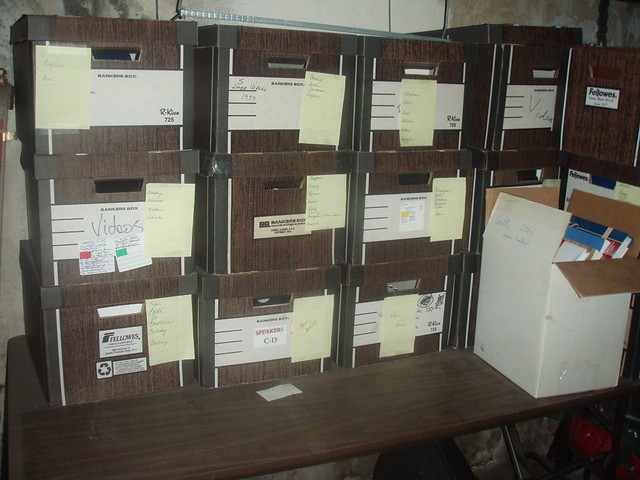
Hundreds of bankers boxes– dusty, worn and frayed at the edges, worn down by the weight of other boxes stacked on top, often damp in the corners, all lodged in inconspicuous backroom places. Out of sight and mostly out of mind, they are spread throughout this Province and the other Provinces; the responsibility of the RCMP, the OPP, the QPP and various scattered Municipal agencies. Historical mysteries sitting, undisturbed, and now in danger of being lost forever. 

Each box has scrawled on it in black marker, a number the start of which indicates the year of the file box being created; 73-1234 or 98-5678 indicating 1973 and 1998. Most will have a surname, also written on the outside of the box, underneath the number, the first indication of the box containing information on a life lived and in all likelihood a life taken abruptly away. A snapshot of a moment in time, life stories, lives abruptly ended. 

If one lifts the uniformly folded cardboard lids and peek inside one finds manila folders, each folder containing assorted government styled papers, each folder numbered, implying some form of organization. The order of importance often seems haphazard. There will be original documents, photocopies, carbon copies, compact discs, floppy discs, even blueprints and loosely bound photographs.  Each document part of a whole, each pointing to a dramatic and often gruesome ending to a life. 

Shoved into these boxes will be exhibits, exhibit reports, and boxes of 3 x 5  index cards, clues as to the relevance of the folders. Sometimes there are many of these boxes, with this same name, or number; the more numerous the boxes the more likely that this was a long case, or a more complicated case, or a case involving more than one person. The breadth and depth of the case in direct correlation to the weight and the number of  volumes. 

In police parlance these are “dormant” cases. Technically “open” or “still under investigation” as the police like to intone when asked; but they are in a deep state of slumber, never to be awoken unless something out of the ordinary occurs. Maybe a dictated annual review, which is usually sporadicly enforced, will sometimes force a reluctant officer to pull the case from the storage room, check the final pages for any “new” information and generally meander through the boxes.

Then, under most circumstances the boxes get put back, back into the darkened rooms, a single page added indicating that there has been no change in the contained information.  Some boxes may be difficult to even find.  

The paper or original information in these boxes is now being lost, inexorably beaten up by time itself and inadequate physical storage.  They all contain the most intimate of stories, real stories of people, their backgrounds, their lifestyles and their fates.  Some of the people in these boxes have prematurely met the ultimate fate, their deaths by a variety of methods only limited by the depravity and the darkness of the human spirit. Long gone to the eyes of the original investigators, but probably not forgotten. Every old investigator cognizant of the one that got away. 

They have not been solved, the killer remains free in the world, unless time and circumstances has also caught up with them as well. 

If one believes that history, or that records of the past are important,  or that every effort should be made to solve any murder, then you may be interested in this story. For this is a story of a largely ignored problem by the RCMP and other Municipal forces and the single attempt at a proposed solution, one which proved ultimately futile. 

This is a story of a need to archive and preserve police files.  It admittedly has never been fashionable to be interested in the library sciences, or the  similar but more current world of digital archiving.  It conjures up images of dusty books, microfiche and bespectacled introspective librarians, lonely figures confined to being the keepers of untold secrets. 

This is not to say that there is not public interest in unsolved homicides; one can tune into the many Netflix docs, the CBC, read Wikipedia, or the Vancouver Sun and find stories of historical murders, served up in some form of sensationalist fashion. The RCMP post pictures of historical victims and the Coroners office publicly maps out found remains cases. Unfortunately, this is mainly public fodder and a needle in the haystack in terms of trying to solve some of these cases, designed more to entice the reader or the watcher, designed for instagram investigators, not a serious study of this dark world nor a studied attempt to make a dent in the growing pile of the unsolved.   

There is an actual need for a concentrated effort to preserve, to digitize these paper files, to capture forever the information that could be lost to deterioration and neglect. 

In this Province and for most other parts of Canada, there is a relatively short historical period of time which is of primary concern. This is mainly the period from 1960 to 2003,  the dominant ages of the paper files in this relatively new country.

In general, around 2003 many police agencies slowly began to go to electronic formats, although it varies by jurisdiction. The paper format was gradually replaced, electronic data finally being made acceptable as a possible original document pushed by the quickly developing technical advancements.

It is somewhat ironic to understand that the paper age has an actual shelf life longer than the digital age, with experts estimating that paper, if properly preserved, has a life of about 50-100 years. (In our now digital storage era, the shelf life of electronic documents is only 10-20 years. Some think that since the newer material has been electronically filed it will last in perpetuity– a largely false belief.) 

However, now the paper files are of the most immediate concern. They are   reaching the end of their shelf lives, the ink is beginning to fade, the photos are beginning to deteriorate and the memories of the investigators are becoming faulty. 

The numbers of unsolved homicide files that are on “paper” in this Province are somewhat daunting. In 2016, when this blogger began to look at this issue, there were 900-1300 unsolved homicides held by the RCMP in the Province of British Columbia alone. There was another 200-300 which would be the responsibility of the Municipal Forces and there is no evidence to suggest that those Municipal agencies have been any better than the RCMP in their preservation. If one draws this issue outward, on a national basis, the situation would be magnified by 10 times. 

In British Columbia and in the Lower Mainland, since the birth of the Integrated Homicide and Investigation Team, they alone have generated at least another additional  300 “unsolved homicides”.  To be sure, those files are being captured in an electronic format, but not a format that is in a consistent with other agencies, nor are they in a position to be integrated and compared to other similar data bases. So the problem of being able to archive and preserve all information, on a fundamental basis, is growing every year. Solvency rates are also declining– further exasperating the issue. 

The police agencies are rarely asked about this archiving problem, but on that rare occasion that they are, the blame is usually placed on the constantly shifting policing priorities and jurisdictions. It simply has not been operational priority. 

Even if reviewed, there is no digitization of the file, so the only electronic reference to this file may be a name or a file number. The contents are not available to investigators without fully and physically reviewing the paper file. If an investigator feels an ongoing investigation may have some relevance to a historical file, whether it be a suspect or some other circumstance, they would need to go back and physically review the entire file, maybe on just a chance of finding some opaque reference. 

There is no cross-pollination of the information contained in those files, none of the more recent files can see or compare information on their files to older investigations.

The police agencies have a public relations mantra which is that no file is ever “closed” without it being solved. Technically they are right in their assertions, they don’t put a big “CH” (Concluded Here) on the file, but they are being totally misleading. They are trying to generate the impression that they are active and constructively reviewing and comparing these files on a regular basis. That is not true.

They are not digitizing these older files, and they are not actively investigating these files.  The only salvation for police management is that the public simply doesn’t know; the public assume wrongly, that all police files are instantly and readily available to all homicide investigators. 

There is one exception in this Province in terms of units re-investigating historical files in the RCMP. That is the Unsolved Homicide Unit of about 10-20 officers who review old files and selectively work historic files. Sounds good, but one needs to consider that each team in the group, may only take a new file every 8 months or so.

The other bit of sleight of hand is that the Unsolved Unit actually re-investigates only the “solved files”; files where a suspect has actually been already identified, but where for some reason the file was not being worked. It is hard to explain, but the fact is there are many files that have already identified suspects, but for one reason or another have been neglected. These files alone keep this unit busy and it only makes sense in terms of productivity to go for the low hanging fruit. 

Now if you optimistically assume that this group does 3-5 files per year, you can easily do the math and see the finger in the dyke problem here.  There is no way to catch up or even make a dent in the pile. It is not for lack of effort by this relatively small unit, it is just a matter of numbers. 


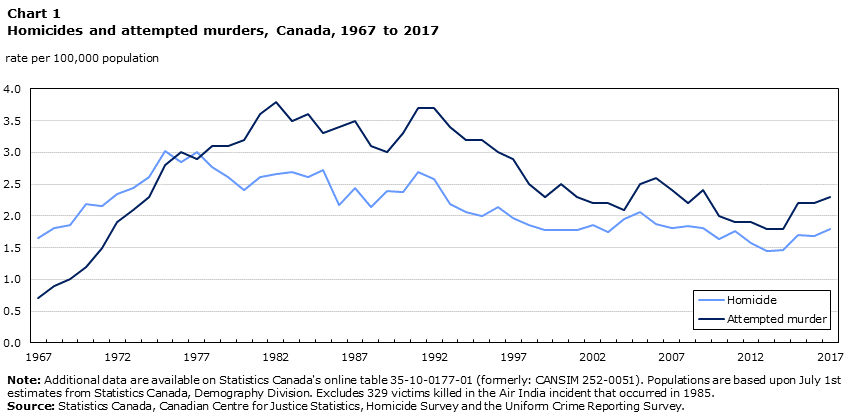
https://www150.statcan.gc.ca/n1/pub/85-002-x/2018001/article/54980-eng.htm

The preservation of historic information is finally being recognized in various forms throughout the rest of society as various organizations are striving to cope with this growing issue.

Interestingly, some locations are actually using police inspired methods to try and solve their respective archiving problems.

At Harvard University they are in the process of trying to develop an operating system for capturing their paper and digital archives using workflow modelled after “police forensic standards”. The idea is to “create, authenticate, unimpeachable source data….” at a standard that would make the archive “suitable as evidence in a criminal trial”. Now, if capturing hundreds of homicide investigations seems to be a difficult task, Harvard is attempting to go back 375 years of history.

The problems they are encountering are similar to the police issues; files with floppy discs, zip drives, tapes, and cassettes. So they are not only capturing the information, they are also preserving the techniques that are needed to retrieve that data.

In California, in a former San Francisco Church, Brewster Kahle continues with the goal he started with in the 1990’s, which was to curate and create an “Internet Archive”. His lofty goal? To save all the world’s information.

Even to the pessimist he has been quite successful: 435 billion web pages have been preserved, 7 million books, 2.1 million audio recordings, and 1.8 million videos have been preserved and digitized, and now accessible to the Public. This archive draws 2-3 million visitors daily.

This is to say that although the archiving and digitizing of police homicide files seems both time consuming and manpower intensive, it is doable. It pales in comparison to these more ambitious projects and one would think that the goal of preserving these investigations and their contents dealing with the most heinous of crimes should be a laudable goal. But so far neither the police, or their respective government administrations, feel that is part of their duty or responsibility.

Which leads me to the more personal and subjective 2nd half of this story.

For two years, the writer of this blog, along with a couple of associates joined with the School of Criminology at Simon Fraser University, the Institute of Canadian Urban Research Studies (ICURS) and the School of Applied Science in a proposal on a non-profit basis to digitally archive these old historic homicide files.

It was supported by many people including the former RCMP head of E Division, a former VP and CIO for BC Hydro, the Dean of the school of Applied Science, and the School of Criminology at SFU.

Without going into all the details, the business plan outlined the logistics of locating files and moving them to a secure facility where the paper files would be reviewed, scanned, and converted to a digital format, one that would eventually be shared by all those participating. The reviewing would be done by PHD students in combination with the departments of Applied Science. SFU was motivated by being able to have access to a vast database for research purposes and the hands on review would give students ideas for that research.

There were many hurdles to overcome, as one would guess; security clearances, privacy issues, physical security issues, evidence chains, research controls and results, database construction, expert and standards of review, personnel, exhibit issues, and photo issues.

This is just to name a few of the problems, but over a two year period, these questions were for the most part answered and a proposal was put forward to the RCMP and the Vancouver City Police.

Initially the RCMP expressed interest, each meeting leading to a few more questions on how the operation will be housed and how it will work. Budget issues often came up (we estimated that it would take a financial commitment of 1/2 of 1% of the RCMP E Division Policing budget) The biggest concern of course, was the RCMP turning over, at least temporarily, unsolved homicide investigations to an outside party, even though they would have the appropriate security clearances. At one time they even proposed the possibility of giving up space inside their HQ at Green Timbers to get around this continuity issue.

The possible expandability of this proposal was obvious. Other Municipal agencies, other Provinces, and in a utopia, a database of all unsolved homicide files in the country. One could also bring in the solved files, as they too could have links to other investigations and be of great value.

Of course all the information would be owned by the agencies themselves, and throughout there would be oversight by those same police agencies.

“Digital 229” was the Project name and it was a non-profit enterprise. No one involved was paid during this two year period, all the extra effort was put in on a volunteer basis.

So what happened?

It was a surprise to some, but not a surprise to others who felt all along that the RCMP would have a difficult time ever climbing out of the proverbial operational “box”, the inability to go against the way it was always done.

There is no clear answer as to why the idea died. In the end, we were not given a reason which made any sense. It was un-ceremonious to say the least, as we only heard through the grapevine that negotiations had been terminated; nobody made any direct contact with any of the parties involved.

After many attempted phone connections to re-ignite the business plan, an Inspector (who had not ever been involved in the process) wrote to us and gave up an excuse over needing “sole source funding”, which had also been previously addressed, as the reason of not going forward.

Was this the real reason? We don’t think so. It was clear this officer was directed to kill the project at the direction of some higher ups and to come up with some justification for it.

At one of the original meetings with the heads of the E Division RCMP one officer said he had one question. “What if you guys uncover a number of files that need further investigation?” In other words, if this process we proposed actually assisted in solving some files or pointing to possible suspects, where would they find the resources to re-investigate them?

I’ll admit to being slightly dumbfounded, the question seemed to indicate that the police were concerned about the actual solving of homicides. This was a through the looking-glass moment, a parallel reality where the police were actually more concerned about political administrative repercussions more than the actual solving of cases.

But, so ended an extensive effort to address the unsolved homicides in this Province.

It was and is disappointing of course. What we clearly lacked was a political incentive, one fired up by government.

A few years ago in 2010, the National Inquiry into Missing and Indigenous Women was announced. Their mandate in particular was to dig into the police handling of these Indigenous files. Sources tell me that E Division quickly found a number of officers to travel the Province and review all of these files, clearly in the hope that there would be no problems uncovered.

Of course, they reviewed all these files and then wrote a report, but we have been told they were not converted to digital files.

The RCMP had no problem funding these specific reviews nor in finding the personnel to conduct the inquiries.

So while you routinely watch Netflix, or tune in to CBC True Detective, and assume the mantel of being the next Columbo, one should realize there is a far better way of actually impacting this problem. Less dramatic for sure, but truly effective.

They are currently ignoring the history and one knows what happens when you ignore history.

So the files sit in the boxes, languishing in the file rooms, all in need of a boring librarian. We can see them and touch them, they are contained, but they are hidden from view. The veil of secrecy enshrouds them, protecting them from public scrutiny.

It would seem that at the very least it is owed to the families who have been touched in the most profound way possible. We need to preserve their stories. And maybe, just maybe, give them actual hope. A concentrated and earnest academic effort is needed to make this possible.

As to the suspects, the criminals who killed and remain unaccountable–maybe it’s time for that slogan from history to be resurrected, you know the one, the one where the Mounties “always get their man”.

After all, the past causes the present and so the future.

Photo courtesy of the kirbster via Flickr Commons – Some rights reserved