
Considering the sensitive nature of this topic it seems likely that some of you will be upset with the overall theory of this blog, whose theme suggests that there are numerous ongoing claims of “disability” that —-dare I say, may be fraudulent. I will also apologize ahead of time for those of you readers who have “legitimate” claims. However, I am going to openly suggest that some “veterans” may in fact be milking the system. Even if you have doubts, do you not think it possible that a system that promises tax free monies often based on subjective evidence may be seen by some as an opportunity for fraud? None of you can deny of often hearing anecdotal stories from veterans claiming numerous medical issues and their pressing need, argument and demand for compensation. There are even web platforms dedicated to the subject.
On a singular and simple level any claim for a work related injury would and should be based on solid medical evidence and therefore assumed to be legitimate. But often when I would hear these stories, it was accompanied by the casual knowing smirk or smile in the persons telling of the story which so often drew my attention and raised a cynical eyebrow. I would also hear the word “entitled” a lot, a word that makes me shiver. So I thought I should inquire a little further.
Human nature being what it is, anytime the government offers up some tax free money I naturally assume there will be a lineup. The question is how long has that disability line become. Equally true is that there is no longer any stigma attached to claiming any disability. Offers of mental health assistance and help lines predominate the commercial air waves and are often aimed at military and policing circles. Post traumatic stress disorder (PTSD) although a serious ailment is almost in vogue. Do I think PTSD is real? I do. Do I think that the system is wide open to wide spread fraud? I do.
Here are some of the most recent available numbers. Between 2014 and 2019 there was a 69% increase in RCMP members claiming “psychiatric disability” and as a result receiving disability benefits. In March of 2019 there were 16,254 recipients of disability payments, by 2024/25 that number in the RCMP had increased to 21,000. And the applications keep coming. The backlog at Veterans Affairs Canada was 20,000 in March 2007 and that backlog in June of 2020 increased by 150% to 50,000. Another somewhat startling number is that the current rate of approval for these claims is 88% in the very first instance.
The Union for the RCMP, the National Police Federation estimates that for the last fourteen years there has been a 184% increase in long term sick leave.
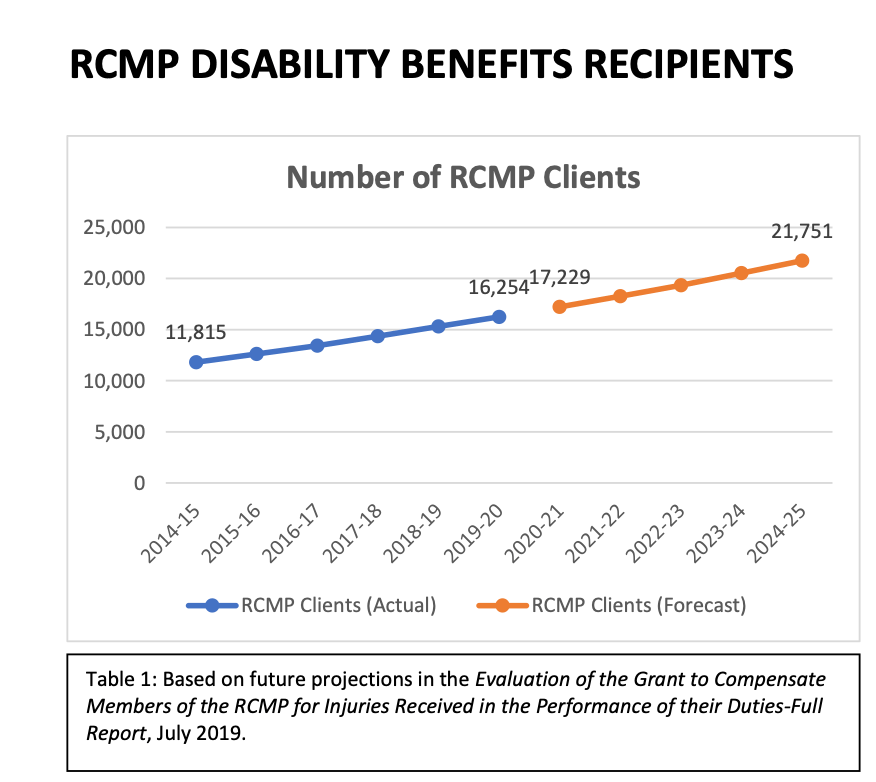
All of this should raise several pertinent questions that should demand further examination. What are the underlying reasons for these dramatic increases in health issues? How much is this costing? What pressures are being exerted on the organization when faced with this level of claimed disabilities?
Veterans Affairs Canada oversees this program and also oversees the Canadian Armed Forces. The RCMP portion of the disability claims actually only amounts to 10% of the total. So in terms of overall costs to the government, the numbers grow quickly when you add in the military claimants. In total in Canada there are 177,000 individuals claiming disability benefits, of which 20,686 are members or former members of the RCMP. Overall those claims in 2021/2022 are growing at 2.1% per year and costing VAC $606.1 million for disability pension expenditures, another $352.5 million for survivor pensions, and then if you include “special awards” the total comes to $1,046.6 million. Keep in mind that War Service Veterans are declining during this period. The level of employees needed to process these claims in Veterans Affairs Canada is 4,200 employees based in Charlottetown Prince Edward Island.
When asked, the VAC officially attributes this massive rise in claims to four different things.
a) a growing need for mental health services
b) rising number of medically released Veterans
c) the introduction of the Pension for Life program and finally
d) “improved outreach” (which could be translated into people know the money is there now.)
The most common medical complaints which generate those benefits, currently : Post Traumatic Stress Disorder (PTSD), Tinnitus, and Hearing Loss.
Most of you will have guessed where I am going with this. There has to be some consideration given to the fact that there may be a lot of frauds being committed mixed in there with legitimate claims. Even Veterans Affairs say that the “VA system is considered vulnerable” mainly due to its reliance on “self-reporting” and “insufficient verification”. However, the Federal government at the same time clearly does not want to offend “veterans”. That is a public relations no-no and believed to be political voter suicide. So VAC officially says that actual fraud is “considered rare” that there are some faking or exaggerating conditions in a system where claims they readily admit are often based on “non-visible” injuries. One estimate they offer is that fraud in the VA system is less than 0.01%. Does that not seem inordinately low considering the type of system in place and the amount of anecdotal stories abounding about?
As it turns out, that is not the experience or the conclusion of the Americans who run a similar system, and one where they spend $193 billion a year on medical disability claims. There are 900 conditions in the U.S. system that can enable a claim; sleep apnea, migraines, and erectile dysfunction to name just a few. Getting a 100% disabled designation in their system is referred to by claimants as gaining “the holy grail”. The Department of Justice, unlike Canada, believes that there is massive fraud, especially in the PTSD claims, and their studies which they have undertaken show that 20-30% of claims are exaggerated or faked. In personal injury claims in the military they estimate the fraud runs at about 20%. They have investigated and found “fraud mills”, disabled benefit receivers holding and working full time jobs, and investigators and reporters talk openly about the “claim shark” industry.
The Americans have identified, like in Canada, that the biggest growth for claims is in the category of PTSD. They have 402,000 files in their database and point out the seemingly obvious, that the biggest problem is that PTSD is the most difficult to prove or nullify. PTSD diagnosis is also on a sliding scale and it is also problematic because some of the conditions that are being looked for are such things as “flashbacks”, “nightmares”, “negative thoughts mood swings, and detachment from others” which are difficult to define.
In Canada, to claim PTSD one merely needs some level of “diagnosis accompanied by a medical statement from a doctor, psychiatrist, or psychologist in support of that claim”. There clearly are many doctors signing off on these claims, and it would be an interesting investigation to see if some doctors are being “shopped” for their signatures. Once you go through the process, you’re usually “in” as in March of 2023 there was a 96% success rate of those claims of PTSD. Psychologists, as a matter of interest believe that 9.2 % of Canadians will have PTSD in some form in their lifetime.
Now, we could assume that the American experience is not ours. That the Americans just lie more, Canadians are just more trustworthy (which is I guess what the Feds in this country believe). But if we assume that there is some level of fraud in Canadian claims we shouldn’t worry because we believe that the system will monitor and go after the cheats.
Well, that too is a a bit of a problem, because like a lot of laws in Canada there is no real internal investigative support for fraud. The Federal government answer is that there are “several different bodies” tasked with fraud investigations. Service Canada has the Integrity Services Branch, but they only investigate EI, OAS, and CPP claims. Veterans Canada says that they have “internal mechanisms to “review and audit disability benefits”, but when you look further they are only looking across departments to see if there is duplication over various claims. Public Service and Procurement Canada has an “SIID” team, which tasks against “individuals defrauding federal benefits payments” although I could not uncover any specific cases of prosecution, except for one out of London, Ontario where they charged a woman for collecting a veterans survivor benefit long after the veteran had died.
The VAC does admit to there having been over 1,000 “over payments ” some as high as $65,000, caused by persons having failed to report additional income. So they have sent out letters to try and recoup the money, and obviously this also means that there is about 1,000 veterans who may or may not have been overly careful in their filings of received income. If this myriad of oversight agencies fail, the VA says they also refer any truly fraudulent criminal matters to the RCMP. Say no more.
At this point, let me again be the first to say that there are some very legitimate disability claims and that some people have suffered a great deal in terms of their ailments and physical damages as a result of being on the job and are needing taxpayer support. (in terms of full and frank disclosure, I receive a single disability payment of about $300 a month due to a spinal injury from VAC) But, I also believe that when a government opens up the coffers and points to and even advertises a pot of potential gold, some officers come out of the wood work and begin trying to figure out how they can “get me some of that”. When you combine this with an administrative inability to confirm “significant” impairments and you have willing doctors who can be manipulated to play the system, then there will undoubtedly be fraud. I don’t believe we are different than the Americans, the difference is that the Americans are more diligent in their oversight and investigation. When I ask various individuals why they are claiming for certain ailments, you often get part of the response which includes the words “entitled” and then they rationalize that the “money is there, might as well take it”.
For me this type of rationale leaves a bitter after taste. Anyone gouging this system should be ashamed, you are tainting your service and possibly taking from those that truly need it. The equally sad truth is that in Canada you are not going to get caught. So in the end it falls back to the individual and their personal level of integrity, something which unlike Federal monies seems to be at times rather limited.


Your well written article is, in my opinion, long overdue. Tighten up controls and also ensure that legitimate claims are processed as quickly as possible. Ironically it is often “the lazy bas—- on the detachment or unit who excels at working the scam and then proudly brags about it.
LikeLiked by 1 person
Good analyses Pete and very well written as per usual. PTSD has to be the biggest scam since the travelling snake oil salesman. It is far too easy to claim PTSD. What does this say about the physical, mental, psychological and moral character of the Force’s membership. It starts with the recruiting process that all to often seeks out and hires the best DEI candidate, without any consideration for the rigors of policing.
LikeLike