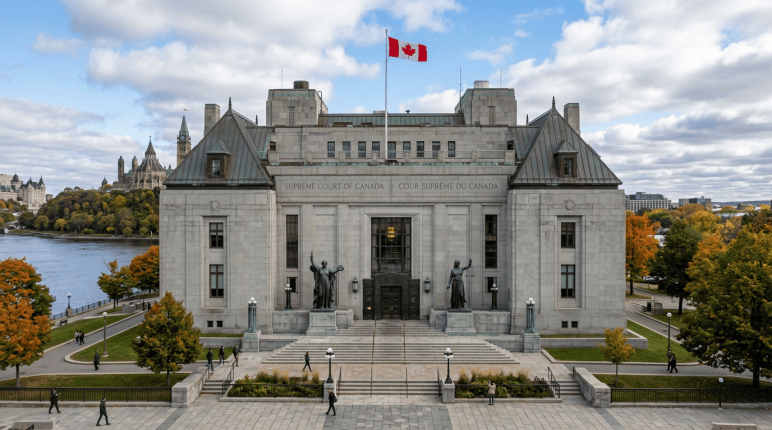
There has been a recent Supreme Court of Canada decision which needs some further attention. The case, Regina vs Cope is a criminal court case that originated in the Nova Scotia Provincial Courts in 2021, then went to the Court of Appeal, and then finally made its way to the Supreme court of Canada. In October 2026 the Court released its findings and decision.
The Supreme Court took on the case because the Court felt that the issues that surfaced in this case dealt with “how sentencing rules concerning indigenous offenders and victims work together”. Let me translate. The lower level courts found themselves at a bit of a cross roads, because in this case, the offender was Indigenous and was given a favoured sentencing treatment under the provisions of the Gladue protocols; while at the same time the female victim was also Indigenous. In a case of a female indigenous woman as a victim the Criminal Code, Section 718(4) states that a sentence should speak to “denunciation and deterrence” when the “abused is a person who is vulnerable, including because they are an indigenous or girl”. In this case the Supreme Court stated that because of the overlapping concerns of victim and offender, they should address the matter. They stated that “both these issues have been shaped by the experiences of colonization”, and “addressing them is central to the ongoing process of reconciliation”.
Harry Arthur Cope was an Indigenous male who suffered from “severe mental health issues”, who had been off his prescribed medications for a year or so and was supplanting his required meds with “illicit drugs”. He is a Mi’kmaw male as was his intimate partner and the victim of his vicious assault. The domestic attack was by every account “horrendous” and “brutal.” He had punched, kicked and smashed the victim’s head into an outside sidewalk repeatedly. She suffered “serious” injuries to her face and upper body. It was clearly a vicious attack which normally demands a lengthy sentence. He pled guilty to “aggravated assault” under Section 268(1) where to meet the definition one has to “wound, maims, disfigures or endangers the life of a person” — it is punishable up to 14 years.
The originating Provincial court Judge, Christine Driscoll, at the time of the trial and prior to sentencing, outlined the mental health factors exhibited by Mr. Cope, as well as the addiction “issues”. Judge Driscoll further ordered an “Indigenous background report” and the accused was also part of a “sentencing circle.” (a sentencing circle is when they bring in members of the community, the offender, and band elders to weigh the offence, the factors that may have contributed to it, and discuss reintegration into the community — they are part of the court process, but are not separate courts and is only applied to Indigenous offenders). In this case the sentencing circle recommended no jail time, but holistic care and in-patient treatment.
The Indigenous background report provided information about the offenders “personal history and the effects of colonialism and other systemic factors on his life”.
So as required by the law, Judge Driscoll considered all the factors and recommendations and even stated that the accused was in fact, in her opinion, “less morally capable of the crime than a person that did not carry the burdens” referring to his being indigenous. The Judge also said and pointed out that she had to consider the fact that the victim was an Indigenous girl as dictated by the Criminal Code. In the end the accused was given a five-year sentence. The defence had argued for a conditional sentence.
The defence applied to the Appeals Court.
It was then heard at the Appeals Court who ruled that the Judge Driscoll had under emphasized the connection between the offenders mental health issues, his drug abuse and the Gladue factors and that the Provincial court Judge had “produced a sentence that was disproportionate to his moral culpability”. They then reduced his sentence to 3 years (minus 18 months of remand credit— resulting in a remaining 6-month sentence.)
The Crown, now upset, then appealed to the Supreme Court of Canada.
The Supreme Court in a 5-4 decision refused the appeal by Crown and issued a lengthy statement as to their reasoning. The majority opinion was written by Justice Michelle O’Bonsawin.
So my problem is twofold. The relatively short sentence, but also the reasoning behind it. I can’t accuse the Supreme Court Justice O’Bonsawin of a pure conflict of interest, even though her decision comes painfully close, but there is a clear argument that her decision and ruling displays an obviously inherent bias.
Justice O’Bonswin is the first Indigenous Canadian to serve as a Supreme Court Justice which many could argue alone makes her decision open to bias. But one can go further. Her Phd thesis in 2022 was on the Gladue principles and interestingly, that Phd thesis has now been “embargoed” and thus not available for public viewing. She has also taught on aboriginal law at the University of Ottawa. She began her legal career with the Royal Canadian Mounted Police, and then went to the Post Office and later the Royal Ottawa Health Care group. From there on to being a Judge at the Ontario Superior Court in Ottawa where she stayed for seven years prior to being appointed to the Supreme Court of Canada. She labels herself as a “progressive” and she arrived at the court in 2022 appointed by Justin Trudeau at the height of his Indigenous crusade for reconciliation. Clearly, good timing on her part.
So the question becomes is it possible that she approaches this case with an Indigenous doctrine bias?
This is what she wrote in her decision. “Indigenous people find themselves disproportionately and excessively imprisoned, while Indigenous women and girls suffer from an unacceptably high levels of violence and abuse. Both of these pressing issues have been shaped by the experience of colonialism”.
As part of her majority decision she outlined how “discouraging or condemning the violence do not always require a longer prison sentence…these objectives can sometimes be achieved through other types of sentences”. She agreed with the Court of Appeal that in this case the original Judge did not “adequately” consider how the offender’s mental illness affected the degree of his responsibility or what type of sentence should be appropriate. She also said that the Provincial Court Judge did not give enough “weight” to the “sentencing circle” and its recommendations.
The majority opinion also held that Section 718(e) of the Criminal Code directs Judges to “braid” Indigenous laws into the sentencing process, but admittedly did not displace the Judge’s responsibility to impose a sentence. The majority opinion also maintained that even though sentencing circles remain discretionary, a failure to “meaningfully engage” with a sentencing circle’s recommendations may amount to “reversible error”.
The four that formed the dissenting opinion in this case, including the Chief Justice, countered with the opinion that the reduced sentence did not prioritize “denunciation and deterrence where victims are vulnerable”. It rejected the “braiding” interpretation of the Criminal Code section noting that Judges maintain the ultimate discretion in sentencing in accordance with the Criminal Code, and they also stated that failing to implement a sentencing circle report and recommendations cannot on its own, amount to a legal error.
So there you have it, a very slim majority decision which now goes forward into the future and the legal world of precedents.
As you can probably gather I have a great deal of difficulty with the colonizing argument as I do with the idea that some citizens, because of their background in this country are treated differently. It is a complex topic to be sure. However the historical act of colonization is in my view the least of the causes of violence in the Indigenous communities. Nor do I believe that the residential schools created generational deep psychological and emotional trauma, a case that has been extolled for years now by the Indigenous leadership and the self-appointed progressives. In my view it is the socio-economic conditions of the Indigenous people which are leading to greater violence, greater incarceration rates, and high rates of children removed from their homes. Poverty, generational substance abuse, chronic underemployment, often more the result of geography and education, are of much greater concern.
All this is in parallel with a political rejection of assimilation in Canada by the Indigenous in this country, instead now arguing and pushing for separate status. They argue for separate nations, separate rules and laws, for all the 600 plus “nations”; albeit, all to be funded by the same colonizing outsiders. This goal of multiple sovereign nations inside Canada is seemingly predicated on a removal of the need for personal responsibility from the equation, that all of the problems are the result of someone else, or the result of some system being imposed on them which keeps them in a suspended state of subservience. The argument could have been made 100 years ago, but is it still a relevant argument today in the 21st century?
As a person who has spent a great deal of time on the criminal streets and the courts I find it hard to accept that a white, brown, or black kid growing up in poverty and reverting to crime is to be treated differently than the Indigenous kid growing up in the same circumstances and in the same environment. Should the Indigenous gangsters in Winnipeg for instance be allowed greater freedom to commit crime than the South Asian gangsters in Surrey, or the Haitians finding themselves in Montreal gangs, as that is the argument. Assaulting or killing an Indigenous woman is to be treated more seriously than a woman dying in some other Canadian level of society. Did the Haitian immigrant kid have an easier way than the Indigenous child because his grandmother went to a residential school while the Haitian grandmother never went to school? When said that way, does it not seem ridiculous?
In the progressive world, which still dominates the Federal courts, the theory of reconciliation all sounds good and righteous. In reality and in application it is patently ridiculous. O’Bonsawin is projecting the academic teachings and theories of the Indigenous doctrine, a school from which she originates and has taught, an indentured part of the whole reconciliation movement. A movement that so far goes unchallenged in the courts. It seems to me that the Gladue decision has outlived its usefulness, that the systemic racism argument is redundant now and only serving to hide other painful unaddressed realities in Indigenous communities. In the Canadian courts it is upsetting the belief in the balanced scales of justice.
As stated in the Canadian Charter of Rights in Section 15(1) : ” Every individual is equal before and under the law and has the right to equal protection and equal benefit of the law without discrimination, and, in particular without discrimination based on race, national or ethnic origin, colour, religion, sex, age or mental or physical disability” .
How about we just do that?

