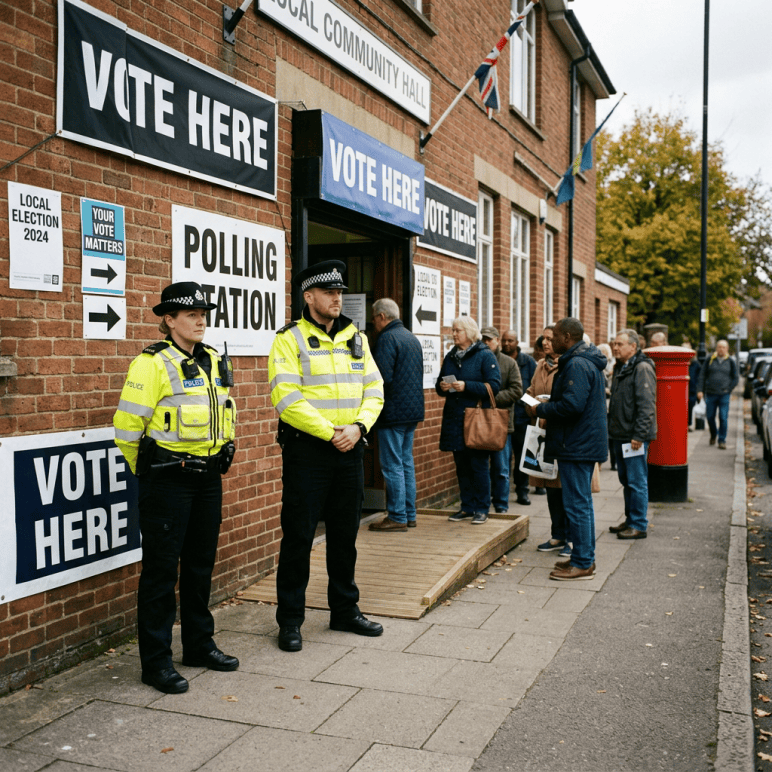
If the police are independent and free from political influence as most maintain they should be, why would it matter who gets elected? Cynics and those positioned on the left or right fringes either believe that the police are under the control and direction of our politicians and the monied establishment, or alternately that the police are not doing enough, afraid to enforce the laws, and as a result criminal chaos is rampant on the streets.
The answer of course is a little more complicated. Most would argue that both ends of the independent versus control spectrum would result in a state that would open itself up to abuse. A fully independent police force, without controls, would in effect allow the police to operate unencumbered, not facing scrutiny and could in effect make the police the real governors of the state. On the other hand, a fully controlled and politically directed police department would make it an enforcement arm of the elected, free to use against the people and in particular against their opponents. Big Brother would be in control. Lord Denning in 1968 argued for the black and white, that the police should have complete independence. He is quoted as saying that the police are not “servants of anyone, save of the law itself”. However, in this country and in Western society in general, this balancing act of police and elected officials through an independent and arbitrary board of some form has been the outcome and in general thought to be a best practise.. In terms of academic research and political thought, neither of these polar opposite positions would be a workable or desired model under any free and democratic system.
So a centralized compromise between both of those points of view is where we have settled, independence in terms of arrests and investigations, but with a broadly defined political oversight. Whatever the variance or the version of every police management system that is in place, it is predicated by the need for the public to trust in that system. The rule of law is important to our constitutional order and the idea and application of “no one is above the law” is central to that belief.
The expressed belief is that the balancing act of governance can be accomplished through policy versus operations. That principle was re-enforced in Regina vs. Campbell (1999) in this country. The setting up of police boards or similar bureaucracies is and was an attempt to distance politics from the direct involvement in the world of enforcement. In Canada and the various municipalities this compromised structure has taken the form of oversight by police boards or some form of a committee. However, this goal of semi-controlled police independence is proving to be a rather fine line to walk.
Crossing over the line has become a common problem. Granted it is often difficult to judge when the politicians or equally, when police leaders themselves have moved into the political or policing sphere and breached the acceptable line. Our relatively short history in this country is full of instances and circumstances where things went wrong where no one recognized the blending of the police with the politicians. Various commissions and inquiries through the years have pointed to a fundamental lack of adherence to this principle of legal independence. In 1981 the McDonald Commission, in 2007 the Ipperwash inquiry, in 2017 the Morden report looking into the 2010 G20 meetings, and in 2023 the Public Order Emergency Commission regarding the convoy protests and the declaration of the Emergencies Act. All pointed to the inability on one of the two power groups to separate politics from the police.
The problem seems to be both a lack of education and understanding on the part of those involved whether it be the police itself or the politicos. Equally valid I would argue is the lack of negative repercussions for those that breach the line. Do they even understand the fine line or do they wantonly disregard it? We have had a plethora of elections in my part of the world recently and almost every municipal government is elected or campaigning on a “law and order agenda”. The implication being that they can somehow direct more law and order. They can change the laws, but they cannot and should not be able to direct the operations of a police department.
To be clear the government is free to shape policing policy with directed legislation and laws, or budgets and human resources and thereby set policing priorities or initiatives. Common examples such as asking for a focus on organized crime, or the mental health crises, but it needs to always be kept in mind that the police serve the public and the law and not political agents. They can ask that there be increased enforcement of the existing laws by providing more resources in a particular area, or they can ask that emphasis be placed in terms of a particular issue, such as open air drug use, but they can not tell the police to increase the arrests without crossing over the line. In this era of rising police costs and societal demands, it is clear that some politicians sometimes feel that there is a greater demand to be directly involved, that their role is in fact to control or give direction to the police.
A further complication in maintaining the argument for police independence is the police themselves and in particular their police unionized associations. In recent municipal elections in Vancouver and in Surrey the police themselves got involved campaigning for one side or another in an effort to influence the voters. The Ottawa PD and the Toronto Police Association also backed candidates in some of the elections. If you believe in a separation of roles, this should be considered totally unacceptable, yet no real concerns are ever raised.
Then there are the police boards themselves, often an awkward mix of counsellors and citizens. Recently in Surrey the Police Board got involved in the firing of the Chief, seemingly at the behest of the mayor and a few counsellors. This same mayor Brenda Locke, while in power, also cut the budgets of the newly established police service (the SPS) in what seemed like a move to cause the Chief to fail in his goals. I find this too is completely inexcusable, but again there are no repercussions, other than the city is now being sued by the former Chief. I should note that here has been a recent update in the last few days in Surrey. In the municipal election Ms.Locke was summarily rejected and was replaced by Doug McCallum. In his previous term in office then Mayor McCallum was known to complain to the RCMP on a regular basis and wanted the police to follow his direction, one being traffic enforcement on his street. McCallum was one of the primary proponents of getting rid of this same RCMP and establishing a new municipal police department, the Surrey Police Service. The problem with both these individuals in the past and going into the future is clearly that they did not respect the line. If you want a more blatant and disturbing example of this crossover look at Trump in the U.S., who sees no line at all between his authority and the various components of the judicial system.
There is another issue. At the higher levels in the RCMP, the Commissioner actually works “under the direction of the Minister”. In 2020 after the mass shooting in Nova Scotia, RCMP Commissioner Luckie reported to the government that the Mounties would announce or describe the guns that had been used in the massacre, in a clear attempt to assist then Minister Bill Blair in his gun control campaign. When the police according to operational policy did not publicly release the types of weapons involved, Luckie was incensed and apparently chastised her investigators, displeased that she was now unable to appease her boss. However, she got caught. A more subtle instance was when former Commissioner of the RCMP, Bev Busson, was appointed to the Senate. Politically everyone perceives this type of appointment whether deserved or not, doled out by the Federal Liberals in this case, as a reward for loyal political service. No one raised a concern.
There are even instances where the laws themselves, cross over the dotted line as well. For instance, one cannot lay a hate propaganda charge without the approval of the respective Attorney General of the Province. It is seen as a politically tinged type of subjective charge and therefore needing political approval. Therefore even in the written law, there are no absolutes.
One could go on and cite many examples of the intended or intentional breaches of the independence line. All unfortunately hurt the image of the police, all shake the faith that the public has in the police to be free of political influence. When the public loses faith in the police, this also sparks cynicism of the courts and of the legal system in general. This is where we find ourselves today, where the trust and faith are gone, where many allege that when they call the police they are not being heard, or the investigation is being muddled. Some of those thoughts or beliefs can be countered with greater honesty, especially on the part of the police. Honesty from the politicians may be a little more elusive.
But maybe all we can currently hope for is for the politicians and police managers to be re-shown the line.
So to get back to the original question. No, it should not matter who wins the election. But yes, it does matter because unfortunately the politicians and the senior police leaders in this country do not know, or more disturbingly don’t care where that line is.

