A Personal Story #1 – “Mom”

Like most everyone when we think of our mothers,  I have a certain specific image which comes to mind. Something we quickly go to, without thinking, that seems to reflect who they are or were. For me, it is her sitting in a brownish green, worn,  La-z-Boy chair, next to the picture window in the living room. The room is tidy, with couch and other chairs, a few knickknacks, but nothing which catches the eye more so than the windows. This particular window,  looks out onto a large bay, part of Lake Ontario. And as you look out, through a mid size birch tree and a maple or two, you also notice a somewhat imposing cement government wharf in the foreground. It is seldom used for its intended purpose, which is a customs stop for any Americans boating across the Lakes to the Canadian side. It is better known as a swimming platform for local teenagers, or for fishing for small pan-size perch and sunfish. It is the platform for many a small child’s first caught fish.

My mother’s chair is worn but comfortable. It is like her preferred clothes, some sort of stretched working style sweatpants, a popular  garment of the older crowd, and usually a sweatshirt from a big store brand like the Bay or Sears, so no logos, or sayings in bold letters. She is sitting with her over-sized 1990’s headphones, eyes partially closed, listening to either a French broadcast,  the news, a classical music station, or the latest business report out of Toronto.

Of course this is an image which comes about from the last twenty or thirty years; in easy memory range, as it is much more difficult for me to remember her when I was a small child, or even a teenager. In the overall time spent in life, I lived with my mother for 18 years, and have been away from her, unable to observe her on a regular basis, for more than 40 years.

It is much more difficult to know of those younger years, as Edan Lepucki wrote about in the NY Times recently, those years “before they were a mother”. Pictures from those times help and allow us to put some substance to our image, but for the most part we rely on a string of stories, heard at off times, always accepted to be true, and with little corroboration from others. My mother did not even have a lot of photos, none on display in the usual mantel or bedside table.

So I needed to rely on stories. And as best as I can tell, in those more formative younger times, she was not atypical of women of her generation; a stay at home housekeeper performing all the normal assignments of her generation.  Cleaning, laundry, making meals, and making beds were the regimen.

There was little that disrupted or interrupted this routine. We, even as a family, rarely went out for dinner, never went to church, never went to the movies or to sporting events. So I never saw her outside that achingly routine element.  I have no recollection of me being out with just my mother, none of the usual mother son interconnection, and I am not sure about this, but I don’t think that there were many kids of this generation who did. However, we did go on vacation in the summers to our cottage, but even for those two months, she would fall into that familiar role of meals and cleaning regardless of where we were.  We kids, running, swimming, and fishing, always on the move with friends, always banging in and out of the cottage doors on our latest mission. And she would always be there.

Everything seemed inevitable. Meals was fish on Fridays when we were going through the charade of being good Catholics, and on the other days, always meat and two vegetables.

There was no shepherding of children from one “activity” to another like today.  I played a lot of sports, but can not remember my mother or my father for that matter, at a game, or even having driven me to a rink or a playing field.  Even if she had been there, I can not imagine my mother jumping up and down on the sidelines as is required by the overly enthusiastic driven parents of today.

It was the day and age when families had one car, and that was taken to work in most households by the father or in the terminology of the day the “breadwinner”.  So in practical terms, by necessity the home maker was stranded on this island of domesticity, with a front and back yard. Stepford wife like, but without the pearl necklaces and dinner dresses, and they were real of course, not robots. This was the 1950’s and the 1960’s where the custom of the day seems now so bland and accepting of the routine that it is often difficult to imagine.

In my mind’s eye she was always serious, determined, but maybe confused about the ultimate goal. She grew up of course where custom dictated marriage, family, loyalty, and that your role in life was to move your family further along the economic ladder and to let your children have it better than yourself.

I do have slivers of memory, brighter, and pronounced surrounding certain moments of time.

For example, my mother crying sitting on the sofa, dishcloth in hand, not saying anything when I came in the door from school.  The assassination of John Kennedy had just occurred in Dallas, gunned down in the back of convertible while he waved at the crowds. It seemed to stop time, even for me as a 9 year old. Something was gravely wrong, my mother never cried, and here she was crying real tears as Walter Cronkite intoned the news of his death. I didn’t understand a lot, but it showed a side of my mother I didn’t know, a side which seemed foreign to me.

Her younger pre-motherhood personality is even more difficult for me, as I try to put pieces of the fragmented memories into an overall picture, like a jigsaw puzzle with several pieces missing.  To even envision her being single, and acting with the frenetic pace of someone in their early 20’s, nor can I conjure up her being frivolous, or lackadaisical, as only younger people are allowed to be.

She went off to the Royal Conservatory of Music in Toronto after high school, where she studied piano and trumpet, but she spoke little about it in terms of enjoying or hating it. I have seen clippings of her public piano recitals, with small town newspaper write ups of a few column inches.  But, I do know that she cherished her graduation ring, and it was one of the very few things she kept in a 3″ x 6″  wooden jewelry box, one of maybe five or six items.

When she finished at the Conservatory, my mother went to work in a music store in downtown Montreal.  I never determined why she went to Montreal, there was no reason ever given but this would not have been a logical choice for someone from rural Ontario. But, this was my youthful mother, who at that time must have had the same stirrings of any person in their 20’s. She must have met friends, socialized, fallen in love, or woken up hung over. I can’t be sure, but there were hints. There was even shadowy talk amongst relatives, of having had a possible abortion.

In those days the music stores often contained musical instruments where patrons could come and try them out, or practise when they could not afford to buy.  One day, a large black male piano player, came into the store where my mother worked, and sat at the piano to practise. The free piano and place to practise in a quiet space, meant that he, and the single female employee, developed a friendship,  and as the story goes, it became an ongoing meeting. He would often ask my mother to play with him, affectionately calling her “Ruthie”.  This bear of a man, with a natural but dour smile was Oscar Petersen. He went on to a rather remarkable career throughout the 1950’s to the 1970’s, playing Carnegie Hall in New York, and becoming one of Canada’s iconic figures in music.

I have no idea whether he fully appreciated the long-lasting affect that he had on my mother, it is unlikely. This was a time in the 1940’s, that my mother spoke softly about, with a seeming tenderness. It was a remembrance, that she would recall and bring out at those sporadic family story times. They were the same age, and I have no idea whether this was anything more than a meeting, or a rehearsal, but I like to think at the very least, there was a fondness between the two. A shared laugh, or a shared sidelong glance, an implied romance and that my mother was happy.

Of course real life intervenes, and my mother went off on the well worn path to marriage, children, and saving for the eventual retirement. She married my father after the War Years, becoming a maternal head of an Air Force family,  living in squat and square private military residences.

We were an Air Force family and therefore moved every three or four years, and even had a stint living in France. Of course this meant new friends needed to be made, easier for us children, not so easy I suspect for my mother. She was somewhat aloof, or distant, and had only a passing interest in those people who would be in our Air Force dictated social collective. She never seemed interested in the “normal” wives circles.  I often speculate that my mother was born and lived a few decades too early. She would have fit into my generation easier I believe, maybe  even more at home with the Millennials of today.

An obvious side affect was that quite naturally she began to slowly withdraw, entering into a more insular world, a naturally fermenting process, maybe due to the boring sameness of her routine, or her square peg trying to fit into the round hole that had been dealt to her.

Although excluding herself from others, she often used the time to pursue her interests. She was a person who taught herself French by listening to cassette tapes and by listening to the Francophone news. She  had a broader interest in the world, in economics and politics, which as I got older often launched us into long political debates at the dinner table.

There was another significant factor in her life. You see, my father was prone to violence. I never saw him violent to my mother but he never held back on me though. It was a day when any kind of domestic abuse was hidden, kept from the neighbours, blinds pulled down. My mother of course was the silent witness to these beatings and I believe it drove a wedge between her and my father that could never be fully repaired. As for myself, I was saved when I physically got bigger than my father, and left the house at 18. I left with a sickly guilt of leaving the my mother and younger brother behind, like the wounded soldier leaving the battlefield to let the others continue the fight.

When I did return home for a visit, I was often updated about the continuing dysfunction between my parents. My mother and I would take long walks and have conversations, the recurring theme being her unhappiness,  and the need to escape. She told me she was going to leave “him”, that it was finally over, that she could not take it any longer. She never did leave him. It was rarely done in those days.

As time marched on, the family group evolved, and then there were just my two parents living together, children gone, and a seemingly more peaceful air, however stagnant, seemed to settle over the house. My mother continued to withdraw, not wanting to socialize or even remain in communication with the few friends she had made over the years.

While at the same time holding a mysterious sway and control over my father. Routine became the god they both worshipped, with my mother sitting next to God.  Maintaining that routine — with meals, breakfast, lunch at 12, dinner at 5:30  setting the parameters under which everything needed to fit. My parents seemed aware of each others existence, but just barely. Coming together to eat, and then once again retreating into their own apparently cloistered but contented spaces.

This almost hermit like existence, meant reading or watching tv, or listening to the radio, and sitting for long hours at a time. Her short afternoon naps became longer and like many older people,  her maladies began to exponentially increase with the years, spurred on of course by the latest reading of the medical encyclopedia.

She  never delved into or questioned what my actual work entailed over those many years. She seemed content to pictured me in some form of uniform, writing tickets. She did not believe that policing was a righteous living, it was a blue collar job and not the one she envisioned for me. She refused to come to the police graduation as she did not equate it with some sort of accomplishment.

Always at the end of the weekly Sunday long-distance conversation which went on for many years, she always expressed concern and that it would be good if I could get “off the street”  but I do not think the danger was really known to her. It was likely imagined from some television version of policing.

Her only brother, Royal, was a pilot during WWII, a dashing dark haired man, with the Errol Flynn moustache who as legend had it, cut a large swathe through both the enemy and the ladies on his return home. But he was an alcoholic. He lived in the skid rows of Canada for the vast majority of his life, but it seemed clear to me that my mother missed him dearly. Every few years, my mother would ask if I could confirm where he was, using my police contacts, or where he was living, or just whether in fact he was still alive.  He died in the streets of Calgary with the usual grotesquely distended liver, in a single room flop house, as alone in many respects as my mother, never their two worlds managing to come together after the War years.

During the 1980’s my mother was discovered to have a brain tumour, which turned out to be benign, but the operation itself, left her somewhat deaf in one ear, and suffering from partial paralysis on the right side of her face. She no longer needed to have a reason for cancelling any of the usual social interactions as this became the un- spoken and somewhat tenable reason to withdraw.  Even going to buy groceries became impossible she explained, due to her “infirmity.” She did not want people to see her, or have to talk to others, happily sending my father to “town” instead.

For me and the kids, living away, birthdays were always a card and a cheque for $100, with a “Love Mother” inscription. No notes or urgings to eat better, or get lots of rest. I was o.k with this, as this was the mother to whom,I had grown accustomed, and I gave it little thought. Clearly the 3000 miles that separated us had become a mental distance as well as physical. She never came to see her grand-children, only visiting Vancouver once from her now closeted life in Ontario.

The tenuous thread to which we clung was that often mandatory Sunday phone call. This call was often brief, punctuated by the  “wait until I get your father on the other line”, and ending with “we better let you go, it costs a lot of money for this call”.  Curiously though, she seemed to look forward to that call and would always remark on the odd time we could not keep the Sunday deadline.

From her chair, she contented herself by watching  the business reports, moving monies around her various accounts, now free to do it from home with the advent of telephone banking. She clearly longed to be a business woman, and she clearly enjoyed the thought of saving money, and listening and debating the latest moves by the Bank of Canada. Predicting the next depression was a favourite topic.

Curiously she also began to divest herself of many of the objects around the house which formed any memories. Objects which would normally be cherished in family circles. The garage was emptied, the storage room equally removed of items big and small; the chess table made by my brother in high school shop classes, old baseball gloves and child toys were without ceremony sent to the dump.  She was a hoarder in reverse. It was not talked about, and there did not seem to be an excuse given or felt to be needed.

And then it all ended.

Three years ago today, my mother got up in the middle of the night, walked out the front door, walked down to the dock she used to stare at for years, and at the age of 89, jumped in, drowning herself in the dark frigid water of Lake Ontario.  She was eventually located by a search and rescue helicopter, when a diver jumped in and pulled her into the dangled rotor blown basket.

She left a note saying “It was not what you think, it was everything else.”

To this day “everything else” remains inexplicable;  was it for an entire life, something that happened in that life, for being unfulfilled, for being unhappy, for not being loved, or all of it together? I don’t have an answer. As much as I cared for my mother, it was difficult for me to grieve. I have been too many suicides, always trying to get in the head of the victim, and to comprehend and put a logical framework around the mental thoughts at the time when they pulled the trigger, put the rope around their necks, or took the clearly fatal dose of pills. I felt guilty that It was just as hard for me to understand my very own mother.

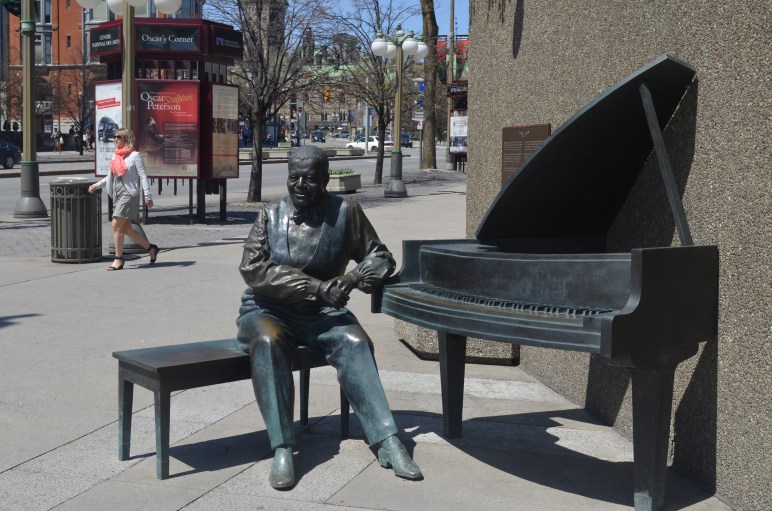
On a recent trip to Ottawa I was strolling with no particular purpose  on the sidewalk which lines the Rideau Canal, and I came around a corner at the National Arts Centre.  As I rounded the corner, there stood  a life size black stone statute of Oscar Petersen. He was seated at the piano, captured with that same smile. Inexplicably, uncontrollably, tears began to run down my face as I stared at it, trying to focus and understand these emotions coming over me. I needed to sit on the cold marble bench to compose myself.  It seemed so real,  where for a few brief seconds, I had been transformed back to that music store in Montreal, and for a few seconds, I was sitting there with the two of them.  “Oscar” and “Ruthie” in the florescent lighted store, after hours, surrounded by vinyl records and instruments.

She was in the end no doubt  more courageous than I have ever been, but also burdened by some sort of undiagnosed depression. But, I think she was also scared, and I wish it could have been me who had pulled her from the water. Because of my working life, I am forever burdened by the fact that I am still able to graphically picture her in the water; bluish tinged skin, blank stare, matted clothing and hair.  A fragility having taken over, a pallor that comes with death. I wish I could have been able to hold her one last time, that I could have pulled her from the water, to give her back one last somewhat uncomfortable hug, to tell her that it was now o.k.  I really did not want her to be alone at the end. But as usual I was a distance away.

Later, my brother and I would put her grey ashes back in the lake, the very same lake she had been pulled unceremoniously from, in front of that very same window, about 100 feet from where she used to sit, physically comfortable, but I think somehow uncomfortable in the life she had been given. As we approach Mother’s day you will forgive me I hope, for having a mixed bag of thoughts, pieces of the cheap life puzzle still  unaccounted for, scraps of memory whirling like torn pieces of newspaper never to be re-assembled.  Some good some bad.  Eighty-nine years, and for sixty of those years she was my somewhat flawed mother, but she was my mother all the same, and I miss her.

Breaking News…well, not really, just kidding

In this story rich times of Donald Trump, where the President of the United States and POTUS politics have become a long running (about 100 days so far) sitcom, a combined version of a political Gilligans Island and a Washington DC Survivor series. Like everyone else I have tuned in daily to see if the Americans with Mr Trump as their fatuous leader have launched another tweet, then a defense of said tweet, and then the round of procrastinations that follows on the alt-right and the liberal left. Its tiring but enthralling. Now that Mr Trump has thrown bombing targets of zero resistance into the mix, there now has become an element of danger added to the fray.

The media has been reinvigorated, subscriptions are up in newspapers, such as the NY Times, and the Washington Post, and the major cable news-stations are attracting more viewers, like me. Which all leads me to my complaint.

I watched two full hours of CNN, the other night, and every story line, was preceded by the announcement by a breathless anchor, usually in a sombre voice, intoning about how the next story was ” breaking news”.  One story would be followed by another “breaking news” story.  Eventually, I had to shut it off, I could not handle this artificial exaggeration of a story, which was not “breaking”,  and sometimes would not even be considered “news” on any kind of  importance scale.

CNN of course is the worst offender in this, but it is a attention getting tactic which seems to infuse all the media, including our local media here in British Columbia. They combine this with the often heard line “and in a Global exclusive”…or in “a CTV exclusive” which in the end usually means that someone talked to them and nobody else. Whether it is newsworthy seems to be secondary to saying that it is exclusive.

Of course the papers can’t sound the alarm in this way, so the newspapers instead make the headlines bigger, in capital letters, or with exclamation marks, which forty years ago usually meant the start of a war, or in the Tabloid circles of England was reserved for the Royal watchers when another baby was born into the monarchy.

A few weeks ago, in an anticipation of another snowstorm, Global dispatched all their reporters around the LMD so that they could report on the grief and upheaval that a few inches of snow may bring. The storm did not materialize, so we were left with anchor Chris Galius describing in great detail, dressed in the pre-requisite parka, telling us of the “slushy” road conditions as if a tsunami had been barely avoided.

It caters of course to a generation with numerous sources of information, a generation that seem for the most part only interested in the headlines, maybe not so much the explanation, and can scroll through several media outlets with a quick twitch of their thumbs.  The traditional media outlets are drowning in this undertow of Twitter, Facebook and Instagram. They are in a desperate fight for every viewer and advertising dollar that another claim to a set of eyes will bring them. At some point it becomes pathetic.

Everyone is falling to this ruse, and the police media sites are in full drive trying to keep up with bringing “breaking news” to us, the apparently eagerly anticipating public. Now to be fair, the media is often pestering and pushy when dealing with the police, because they want to get the “exclusive”, and break that “breaking news” story.

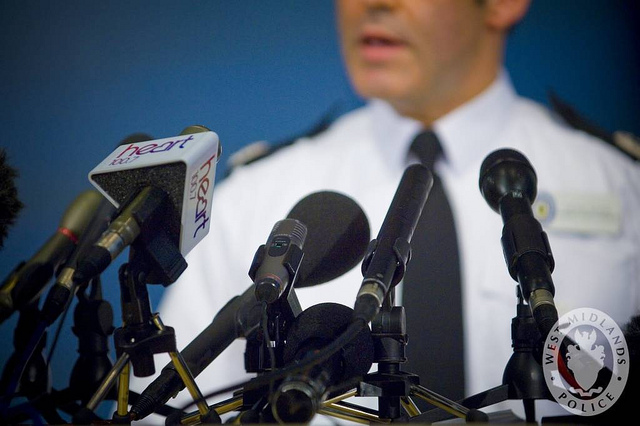
So the police issue ridiculous and premature summations often are short on detail,  such as that the killing “was a targeted hit” or “there is no safety concerns for the general public”.  They are  often issuing these pronouncements after a very short period of time at the site of the incident, so in other words they don’t really know if it was a “targeted hit” or not.  A few years ago it became au courant to have someone of a higher rank there for the photo opportunity, armed with a few day media course offered to police. A nattily attired Inspector would make sure he or she was present at the scene, to be the focal point for the 30 second sound bite.  Fire chiefs and police chiefs alike are drawn in like moths to the light.

There is also a real concern of details being spoken about which could be detrimental to the case, but that concern seems to fall on deaf ears, when there is that need to speak to the public within minutes of an event. At some point this need to feed has become secondary to a possible investigative need.

Well here is a news flash for you; every murder is targeted. And if someone is shooting someone in public places, there is a concern. These trotted out phrases have little or no actual meaning to the circumstances.

By the way, do you need to be told again that the police “are seeking the public’s help”, or do you need to see another table of guns, money, and stolen goods laid out for the photo shoot to demonstrate that there were actually things seized. Is it possible that they just keep the same table, with fake guns and money on it, and then bring it out every news story? Just kidding, but it could save a lot of time and effort.

Another trend is to have a number of senior officers at every press conference, with 5-10 individuals standing behind the speaker, not saying anything, not adding anything to the conference. But clearly, trying to make some sort of impression, as to their strength and to give one a photo impression of long and complicated investigations. The  Warhol quote “everyone will be famous for fifteen minutes in the future” seems to be in full evidence as they are often jockeying for position in this media directed receiving line.

To guide this growing police media presence,  the police now call themselves media “strategists”.  (When and why did the police feel the need to have a media strategy?) The police have gone from a “strategy” of saying nothing to the media and a perfunctory “no comment”  to one where they feel that they need to control  and guide the media stories, creating a “spin” conducive to the police efforts.

The police have become more sophisticated in their approach, and are now using the media appetite for a video or grainy photograph to use to an operational advantage.

For instance, when investigating homicides or other major crimes, the police have often used video or photographs to draw the publics attention, while at the same time not really caring about the general public commentary; but behind the scenes,  concerned with drawing out or observing a suspect once it gets played in the media, hoping the reaction of any suspect may further the investigative case.

This of course is tenuous ground, fraught with cynicism, but it invariably worked. The  media sites are forever pulled in by a 10 second black and white fuzzy video without any kind of editing or wondering of its relevance.  This should make everyone pause when seeing the news, and a police bulletin, or alert, or a “breaking news story”. Approach with a modicum of caution, as it may be part of a “strategy” of the police.

So where does this leave us in this world where Facebook now is the supplier of news for 44 % of the American public and where fact checking  and “fake news” has become a growth industry.

As writer John Irving observed in a NY Times feature, “I don’t think the news has changed much over the years, only the way we report it”.  And how it is reported of course determines the level of sophistication of its readers, and their ability to discern reality from imagined, when it is being bombarded with screaming headlines, full of pizazz,  but lacking any discernible mature content.

How can we trust when it is possible that the news is being manipulated by the hackers of Russia, or Wikileaks with their clearly political agendas. Or maybe, an investigative agency closer to home who is “strategizing” the news release to orchestrate a reaction.

It leaves us in a quandary. The Canadian Journalists for Free Expression states that (in an opinion shared by many others) that Canadian’s have a right to information; which is “the raw material of expression…enables citizens to engage fully in a democracy and hold their governments to account”.  A lofty principle no doubt, but the journalists themselves and the people they work for are abandoning or have abandoned the ability to provide researched and accurate information, and are busily festooning themselves in “Breaking News” and Youtube videos. Graphics have become the news.

They should be held accountable and follow the lead of such media sites as Politico, or the Atlantic, and the Washington Post who are some of the few remaining stalwarts of accurate and well done journalism, and who have recently been brought to further life with the advent of Trump.

In Canada, the CBC and its clear political slant pervert their attempts to be fair and accurate, and the Globe and Mail tips to the right sometimes to their detriment. Locally in British Columbia, our newspapers are dying before our eyes, as they continue to downsize their journalist ranks. The ethical use of sourcing and journalistic integrity seems to be degrading. I worry about the truth being delivered, and the truth actually being read.

As to the police. Please stop with the pat phrases, stop the officers from wanting to be in the spotlight, stop worrying about presenting a diverse set of talking heads, and please stop spinning the story. Stop being breathless, or crying, or feeling the need to show empathy as if it is more important than the job you are hired to do. The public sees you as an arm of the judiciary so they want to know the facts, and how they are impacted. You don’t need to strategize, you need to be there in times of crisis as a sturdy and competent voice, unswayed by politics, unassailable in terms of the truth. Your ethics should be unquestionable and it is then, and only then, that the public will regain their trust and appreciate your efforts.


Photo: Courtesy of West Midlands Police via Flickr Commons

A roll of ductape may be the precursor to a revamped RCMP…

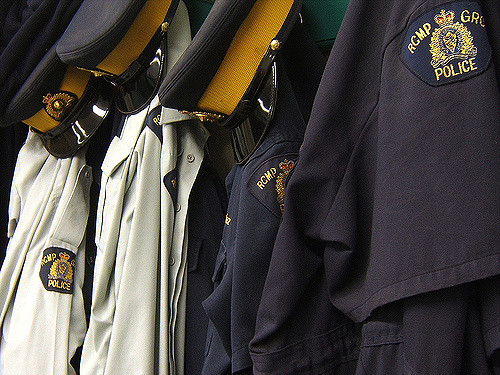
Since I have taken on the task of writing about policing issues, I would be remiss, I suppose, if I made no comment on the current union drive inside the RCMP.

Members recently have taken to making yellow ribbons out of their pant stripes, or covering those same stripes with pink tape as a form of protest over the latest wage increase.  At the same time they are filling in union cards, and have now accumulated about 9,000 names.(There are about 20,000 officers in the RCMP, not including civilian and public servants who make up another 10,000), They are being defiant in talking to the media, and it is all being driven by the officers in uniform for the RCMP.

It is being reported as something new, something which has finally come to a head over the recent disparity in pay between Municipal versus our National emblem police Force. The discontent and the fundamental problems run much deeper.

It is actually a fight that has been going on for decades, a fight which was often stymied by an archaic para-military structure, which refused or willingly ignored normal labour, staffing,  and management issues. And for the last twenty years an organization, which has ignored the “general duty officer”,  the uniform on the street. And it is the uniform officers who will need to lead this call for change.

The uniform officer in the RCMP has been the middle brother in a large family for years, often treated as a 2nd class citizen in the new world order of policing as envisioned by this more allegedly sophisticated policing entity.  The management in Ottawa became political, or more accurately, politically correct, layering demand after demand on the uniform personnel in terms of how they did their job. There are two provinces in this country that do not even have a RCMP uniform presence, so maybe even out of sight out of mind,  for those charged with formulating policy at 73 Leikin Drive., where you would have to drive to Parliament hill to see a Mountie in uniform.

Managers have been long refusing to address issues which were central to basic policing. In particular, patrol issues, which revolve around more mundane and basic needs; equipment, shifting, staffing levels, replacing officers on maternity and paternity leaves, shift differentials, levels of supervision, isolated posts, and increasing stress levels to give just a few examples. There has been no accounting for differences in the different areas of the country. There is no consideration given to an officer working in Moose Jaw or Moncton, and that they may have significantly different needs to the officer in Surrey, British Columbia.

You have to understand that almost every RCMP officer, starts their career wearing a uniform on the “front line” forming part of the “backbone” of the RCMP.  However, from that point forward fast track advancement in the Mounties equated with getting out of the uniform. The incentives are great, to get off the abysmal night shifts, to go where there is plenty of overtime to be had, and where you are seen and treated as one step above the uniform officers. Believe it or not, they often threaten the wayward officer by threatening to send them “back’ to general duty policing.

This was not always the case. This has happened during the last 20 to 30 years, where RCMP Management fell in love with an FBI style model where headlines are gained by long and complicated successful investigations. It was no longer glamorous to be a foot on the street.  It was more exciting and meaningful to be involved in wire-tapping, surveillance, and pursuing organized crime figures. They sort of bought into the TV image of NCIS, CIS and Homeland, and less the blue collar Hill Street Blues. The people that rose up through the ranks were the players in Major Crime roles, or in Federal Policing, or headed one of the proliferation of “integrated” units.

Staffing officers, and human relations roles, were often filled with officers who were tired of the street, on paternity or maternity leaves, or seeking just a 9 to 5 role. . They were no levels of expertise required, they just needed to be willing to go. The getting off of the street was the sole motivation, as the average police officer has no innate desire to leave operational policing.

Of course, while all this transformation is taking place, the uniform role is also changing rapidly. The public is video taping every interaction with the police, they are being accused of being physically abusive, often on little or no evidence, and they had GPS put in their vehicles so that management can monitor their comings and goings. What used to take two hours to handle a domestic dispute is now taking eight with the increase in forms and protocols dictated by Ottawa.

It is not widely known that when an RCMP officer goes off on paternity or maternity for as long as a year, they are not replaced. So if you are working in a small detachment with 3 or 4 on a shift and a couple go away for these reasons, no one fills in. You start the shift understaffed and your operational ability to respond is drastically reduced.

Although the violent crime rates are declining, the “calls for service” have not abated, with pocket dialled 911 calls, and more mental health issues on the street. You are now expected to administer narcotics to an overdose patient, be a social worker and therapist,  much more than you are expected to solve or intercede any crime.

In the 1980’s the uniform officers of the RCMP had a major meeting in Burnaby calling for a union because of wage issues, and declining interest by management in the day to day needs of the police officers. They shouted down all the management personnel who came to speak and there was a tangible anger in the air. The RCMP developed the DSSR system to appease and quell the anger, which was followed by a pay increase, and in the end it stemmed the flow of discontent. Thirty years later the issues are the same, the focal fortifying issue as always is  wages, but the real problems are much, much more numerous, and eating at the very foundation of the RCMP.

Throughout, the RCMP continues to cling to being the “National” police force and its storied past. They claim to be fighting all crimes on all levels.  On the Federal, Provincial,  and Municipal level.  They are spread thin, maybe too thin to do any of it well.

Now with the Supreme Court ruling two years ago, the stage has finally been set for some sort of mechanism in place where the RCMP can negotiate their own wages and working conditions. It is still a few years off as they await passage of Bill C-7 which allows the RCMP to unionize and negotiate, but prior to that, Bill C-4 which will determine the rules to form a new public service union. This will all take time, as the government inches along at turtle speeds, and Justin Trudeau and his fellow Liberals does not seem to see the RCMP as a priority right now.

In its present form, in my opinion, it is unlikely the RCMP can even survive a possible eventual union. At least not on the uniform side of policing. Maybe, that is why the Federal government is suggesting that there be two parts to the RCMP entity, one being a civilian side to handle the administrative functions and the other only handling operations.

The handling of these matters has to be brought into the 21st century, and away from those officers who have little or no background in these key fundamental building block issues. Everything from harassment claims to expense forms need to be removed from their purview, they are not capable with filling these positions in house.

As an original member of the officers wanting a union in the 1980’s I applaud the latest efforts of the uniform RCMP. Their time may have come. But, do not believe that a wage increase is the panacea, do not just settle for another wage increase. The previous officers fell for that before. And realize that with increased control will come greater accountability.

The overhaul and change must be greater than where one stands in the police “universe”,  and it must address all aspects of policing. This is a momentous task which is going to take a great deal of effort, far beyond applying some duct tape and making some ribbons. Choose your representatives wisely, and make sure the uniform group is over represented. It does not matter what group you choose to lead the certification, what is important is who makes up that group.

After all,  you are the “backbone”, at least thats what they used to tell us.  And don’t be tempted by the words of the newly minted head of the RCMP in BC, Butterworth-Carr who apparently stated “I believe an incomplete uniform undermines the distinctive role we play in keeping our citizens safe and secure”. I don’t know what that implies for the thousands of Mounties who don’t wear a uniform, but such is the wisdom of the top management right now. Commissioner Paulson  not to be outdone, followed up yesterday in a press release saying ” I have to tell you how worried I am about the impact this will have on the citizens we serve”.  The answer is nil of course, other than they may not see the police coming.. as easily as they did before, with that yellow beacon running down their legs. The public is much more attuned to the issues than Mr Paulson would like you to believe.

So good luck to all involved in this arduous, ongoing process, a battle which besides stamina will require a renewed vision, one that is not just about salaries, and hopefully, will not take another 30 years.

Photo Courtesy of Ewe Neon via Creative Commons on Flickr 


Police Salaries….the end of an era

During the last few months, on Facebook, Twitter, and the other sundry social media sites that are shared with friends and police officers, there is constant talk and sometimes outrage at the lack of a pay raise amongst the RCMP officers.

All of it is true, in terms of no pay raise for several years, and the fact that the Federal Liberals are now dragging their heels in terms of coming to an agreement. Statistics say that the Mounties are 72nd out of 80th in the police “universe”, which is the lowest that has been seen in recent memory. The RCMP members are thinking that an anticipated police union may lead them out of this quandary, and restore them once again to a salary befitting the “National” police force.

At one point in the 1990’s, the Federal Government of the day and the RCMP had a memorandum of understanding that stated that the RCMP would never lead in salary, but would not fall below 3 or 4th in the police universe. That was eventually ignored, and there have been many ups and downs since, in terms of salary levels, including wage freezes during times of austerity.

Currently Bill C-7 which would give the RCMP the ability to unionize is sitting in limbo, waiting for the re-introduction to Parliament. However, the RCMP members are having a hard time getting organized and now have two police political groups fighting for their support. The RCMP for their part in trying to slow this process down, will not allow the use of office computers to help in that organization.  Of course it is difficult to organize a group which has never been organized in a formal fashion, and one that is spread out across Canada. Clearly RCMP management is not going to assist their own members in this organization as the longer they delay it, the longer they avoid some difficult bargaining. The Federal Liberals equally don’t seem to be in any rush.

Meanwhile, the Feds are negotiating with a lot of the Federal public service groups, and they are telling the RCMP they have to wait their turn.

In the next decade it is anticipated that there will be drastic changes coming to the National police force, and other municipal and Provincial forces as well,  as exponential growth in these services come under increased scrutiny.

To understand the issue, one must understand the current levels of salaries and how they got to where they are today.  How does a police officer compare to the other types of employment? Where do they fit in, in comparison to the average family, or individual incomes?

Current Police salaries

Currently an RCMP officer after 3 years makes $82,108

A Vancouver City Police officer after 4 years     $83,000

A Saskatoon police officer after 5 years              $97,260

A Toronto police officer by 2018 will make        $98,450

In comparison

A lawyer who is a 1st year Associate in a firm   $63,250

An Industrial/Mechanical Engineer                     $61,944

A Mining Engineer                                                   $59,612

In 2014 according to Statistics Canada, the average “family” or combined income:

In Saskatchewan       $77,300

In Ontario                   $73,700

In British Columbia   $72,200

In Alberta                  $102,700

The Average in Canada in 2013 was $76,000

The Average individual salary in Canada is $47,914.00

The figures may seem distorted to be sure; is it possible that a police officer, with no or little education other than high school, and with a 6 month or less training period, is making, within 3 years, a salary greater than all family incomes in Canada (with the exception of Alberta). And not just a little bit more, the  “individual” RCMP officer is making a salary 12% higher than a “family” living in British Columbia.

Economists and the federal government consider middle class at its highest to be $120,000. (If you read my previous blog you would have seen that the average officer working at IHIT in the RCMP is making $154,000 per year with overtime).

In 2011, Statistics Canada said that the top 10% of Canadian society made above $80,400. In other words, currently a 1st Class constable who has 3 years experience in the RCMP, is making in the top 10% of Canadian society in terms of salary.

Of course, it will be argued by many of the profession, that their job is unique, that the dangers, responsibilities and complexities of their jobs make them worthy of these salaries. This could be a lengthy study all by itself, on what are the determinants in developing a relevant and appropriate salary; how do you measure officer safety, responsibility, etc., in order to make that calculation.

As an example, if one looks at the “danger” factor,  the most dangerous professions in Canada are not policing jobs; in fact the five most dangerous industries according to the Workmen’s Compensation Boards of Canada are, fishing and trapping, mining, logging, forestry, construction, and transportation and storage.

If safety and danger were the biggest factors, why is it that prison guards who are in positions where there safety is being threatened on a constant basis while their average salary is only $45,000 per year. Clearly there are other factors that need to be considered.

For years, the RCMP salaries have been based on a ratcheting scale, on what other police entities earn in Canada, often referred to as the “police universe”.  These other police services are unionized without a legal ability to strike, so inevitably resort to some arbitration process. Over time these arbitration processes seem to grow these salaries. Arbitrators generally favour a union over management, and in trying to establish a “fair result” usually increase the salaries at some level.  The other Agencies then determine their contract stance based on the latest won arbitration, and the ratcheting process or cycle begins.

The RCMP simply tags along for the ride. If Calgary is higher, or Edmonton, or Toronto, then the RCMP salaries go higher. All members of the public service in Canada have for years, used this ratcheting arbitration process to their benefit.

However, Governments and municipalities are now beginning to feel the pinch, and it is becoming a bigger topic amongst officials in City Halls throughout Canada.

Last week in Winnipeg, city counsel said that they need to consider reducing the number of police officers and that the union needed to be more reasonable in their demands. When contract talks fell apart the union once again applied to go to arbitration. They are seeking 3.5% to 4.0% wage hikes.

In 2005 the police budget in Winnipeg was $127 million and in 2015 is $216 million, an average annual increase of 7.5%. The police numbers from 2005 to 2015 had increased by 17%, and the police ratio to civilians increased to 1/509. Also, in this 10 year period the crime rate dropped by a staggering 40.65%.

In Toronto last week it was revealed in article in the Globe and Mail that 52% of Toronto Police Service made over $100,000.  600 more individuals joined the list in 2014 over 2013. Again there are complaints that the “leap-frogging of salaries” is a big part of the problem, along with generous overtime, and secure pensions. Again they point to the falling crime rate and state that these are  “contradictions that no city can tolerate”.

Of course, good salaries and benefits attract new employees. Canadian Business magazine ranked the job of police officer as the 16th best job in Canada sandwiched between an Aerospace engineer and an economic development director. They cite the level of salary vs level of education, and the security of the job itself. They point to pay increases of 17% from 2009 to 2015.

Workopolis listed as the top “surprising” jobs which can make over $100,000.00; teachers, police, firefighters and paramedics. So it is not just police but all first responders that have been beneficiaries of this ratcheting growth in salary dollars.

Suffice to say, for the last twenty years or so, policing as a “profession” went from a working class level job to one of high middle or upper income.

There is the argument that can be made, as in Canada, this has been a golden age for all. In Canada in all fields, saw a 135% increase in annual salaries from 1970 to 1980.

Yes, the RCMP has fallen behind in terms of the police “universe”, but in the real world universe they have been doing remarkably well for the last several decades. Politicians are starting to take notice.

We have now reached a stage where administrators of City budgets, and Provincial Ministers are beginning to look at this unimpeded growth and they are considering ways to start pushing it back. The salaries are out of line with the general public in many ways. Between 2000 and 2010 spending in the Canadian government increased by 25% but spending on police increased by 52% according to Statistics Canada. Police salary increases for the most part exceeded inflation during this time period which itself was at 29%.

The RCMP and the other agencies are going to need to develop their arguments as to how and why they deserve such lucrative compensation. This is not to say that they don’t deserve a pay raise, but they need to be prepared to articulate their job functions, especially in light of declining crime rates. Simply being a “first responder” is not enough.

Policing in general has always suffered from a lack of financial accountability, a lack of justification for what they often say is their value to society, and they need to get more sophisticated in that argument. The RCMP is already seeing government pulling or tearing at the edges over such things as severance pay.

My guess is that a union for the RCMP, if it ever comes about, will be a devastating blow to the government, in that it will inflate the policing budget, and the individual officers will be facing an up hill battle in terms of salaries and benefits negotiations, as the government struggles to control costs. Keep in mind that police salaries make up about 90% of a police budget. To control costs, salaries will have to come under audit.

Reducing the numbers of officers in the RCMP to counteract this problem, may be premature or alarmist, but it is a real possibility, and the police officers of today need to be prepared to take an active role in their future, and be prepared to conform to a changing economy as the golden era comes to a close. The once blue collar job of policing has become white collar, and caused increased expectations amongst the police themselves.

Demands for more money will attract public resentment, despite the police having a generally favourable perception in Canada, and there will be demands for greater responsibility to both justify and control those costs. Automatic increases will cease to become the norm, and even certain secondary functions police agencies have taken on during times of prosperity will be on very tenuous ground.  It is going to be a difficult time. As Warren Buffett once said “only when the tide goes out do you discover who has been swimming naked”. The value of a police officer and how much society is willing to pay will certainly be the fundamental question.

Photo Courtesy of Government of Alberta via Creative Commons at /www.flickr.com/photos/governmentofalberta/6071163974

(Signing of the 20 year RCMP contract in K Division – Alberta)

EPILOGUE: This week it was announced that the RCMP are finally getting their pay raise which is retroactive. 1.25% dating back to 2015, another 1.25% dating back to January 2016 and a 2.3% market adjustment as of April 2016. So a 4.8% increase overall. Although at first blush, in these economic times,  this would seem to be in line with other pay increases. However, when you look at it in terms of inflation, the inflation rate in 2015 was 1.13% and in 2016 1.43%,for a total in the last two years of 2.56%. So the raise going back to 2015 and 2016 does little more than reflect inflation rates. The 2.3% market adjustment number is the real gain. This is not seen as being enough to move the RCMP up into the higher echelons of the municipal agencies which many were seeking, and there is a growing protest currently underway. It will be interesting if it draws any outside public or government support in light of the arguments made in this column. I wish them luck, but cracks are beginning to show in the RCMP and there is little doubt more will beginning in the next few years.


Commissioner Paulson …It is time to go…


I must admit that when I reflect on the past Commissioners of the RCMP, I am very hard pressed to come up with something that I can point to which had some impact. Difficult to see where one could point to an overriding policy or change, that altered or influenced policing. There have been a succession of people in the post, of course, but very few seemed to have orchestrated significant change.

That being said, the RCMP, for the last five years has been under the guidance of Bob Paulson, who recently announced he is retiring this Spring. So, maybe it is a good time to review his record for posterity.

First a little bit of history on Mr Paulson. It will be remembered that Paulson came into the Commissioner’s job in 2011,  where some in the media described him as “a 52 year old former fighter pilot with a known appetite for risk and pushing boundaries….”

I will confess to having been surprised at Paulson’s elevation to the office of Commissioner for a few reasons. Quite frankly, in my experience,  I never saw him as an administrator; always a hands on, often a micro-manager, with a my way or the highway attitude. He did not suffer fools gladly, and in this more sensitive age of today, he may have even been termed somewhat of a bully. Socially, Mr. Paulson was one of the “boys” you might say, would not have been termed shy,  and he enjoyed regaling the listeners of his past exploits as a crime fighter.

After leaving high school, Paulson had  pursued a  career in the military,  where he trained as a “pilot”. Why he left the military is a bit of a question mark, and he was even asked about it by the media at the time but he did not offer  any clarification.

Once he left the military, Paulson joined the RCMP,  and began his service  in Chilliwack where he remained for seven years; and then went to Courtney/Comox. This was followed by a stint in Prince Rupert where he worked in Major Crime and in his resume states that he worked on some of the files that later became known as the Highway of Tears.

In returning to the Vancouver area, from 1995 to 2005 his career began to rocket, going from Sgt to Inspector.

And it was in Vancouver where he fronted Project E-Pandora, where with some fanfare he   boldly proclaimed, during his seemingly constant contact with the media, that the RCMP under his direction were going after the Hells Angels. In particular as it turned out, the East End Chapter of the BC Hells Angels.

Over $10 million went into this project, with the end result that there were 34 persons charged, 12 of them being members of the Hells Angels; and it was heralded as a significant dent in the East End Chapter of the Angels. There were a variety of offences, none of them of particular significance, but the usual litany of drugs, money and guns.

The Project was fully dependent on an informant turned agent, former doorman Michael Plante. During his acting as an agent, he was paid over $1.1 million dollars, an amount unheard of at the time.  Equally out of the norm, Paulson’s crew allowed Plante to break the law while working for them, arguably in an effort to keep him credible.

Naturally by allowing  Plante to break the law later came under serious court scrutiny, arguing over whether this allowance jeopardized or put the administration into disrepute. But, in the end he was allowed to testify, and the Project breathed a collective sigh of relief.

The second goal of this project was to have the Hells Angels declared “a criminal organization” under the Criminal Code,  a ruling that needed to be based on the evidence they gathered during the Project. They made three attempts to do this, but none of them ended up working. This was considered a significant “setback for authorities”at the time, and to this day, the RCMP in British Columbia have been working without the ability to legally state that the Hells Angels are a criminal organization.

Paulson exuded confidence throughout, told the Vancouver Sun in 2003 that they had “rattled the Hell’s Angels” and that it had been a maverick investigation that “destroyed their illusion of impenetrability”, and he downplayed the inability to get them declared a criminal organization.

By way of comparison, both Ontario and Quebec were successful in their attempts to get the Angels declared a criminal organization, and have made managed to put a significant number in jail as a result. At one time, the Quebec Provincial Police claimed to have put about 150 bikers in jail; including at different times the head “Mom” Boucher, a prominent criminal lawyer,  and the son of a mafia kingpin. The results of E-Pandora pale in comparison, but these Provincial agencies are rarely pointed to by the Federal Mounties.

It was then off to Ottawa for Mr Paulson, now glowing in the biker “success. After a couple of years in Ottawa and despite heavy competition, from other chiefs of police, persons with doctorates in law, and persons who had risen through the Federal government ranks he clearly managed to convince Stephen Harper, then the Prime Minister that he was the man for the job. Little doubt that part of the explanation would be his outlier abilities as an investigator.

He was not without detractors at the time, as the Toronto Star newspaper pointed out in an article on November 15, 2011, who had developed sources saying that Paulson had “left staffers in tears, been forced to apologize internally for blurting out insensitive comments about other members, and is a risk for government to take”.

It was not an easy time for the new Commissioner, as criticism of the RCMP had been growing for several years, and the dam seems to have burst once he took office. In no particular order, here are some of the highlights.

a) In 2012 the Oppal Commission stated that the RCMP had produced inadequate and failed police investigations. They called for an independent police agency for the Vancouver area.

This was the 2nd time there had been this recommendation and it has been an ongoing theme for several years, in particular,  in the Lower Mainland of B.C. . The RCMP, in this case, now headed by Paulson chose to simply ignore the recommendations.

To lose the RCMP in the Lower Mainland of B.C. would be a major blow to the organization in terms of numbers alone, and one has to wonder if ignoring the issue will in the end backfire against them.

b) Some Freedom of Information requests in 2014 exposed an internal RCMP report  which showed that in the previous 11 years there had been 322 incidents of corruption inside the RCMP; involving some 204 officers.

Most of it was relatively minor, as most of it of it involved fraud, such as expense claims, and the sharing of information with unauthorized parties. Paulson and the RCMP gave the pat response that they had “adapted many” of the recommendations of the study, and this seemed to placate the media and the general public, but it is very difficult to find what if anything was done to remedy these types of offences within the RCMP.

c) The shooting on Parliament Hill  in 2014, was arguably the most noteworthy and tragic event to occur during Paulson’s administration.

On October 22nd, after shooting Cpl Nathan Cirrilo in the back three times, Michael Zehauf-Bibeau, hijacks a vehicle, and then  drives  up to the entrance leading into the Parliament buildings,  carrying with him his long rifle. He was eventually gunned down and shot 31 times, the fatal shot being one in the “back” of the head. A viewing of the videos of all the events reveal a very unprepared group of guards and police who clearly had not anticipated anything like this happening.

The suspect wrestled a guard, and ended up shooting one in the leg, was shot at by another guard who emptied his gun at him but did not hit him; and Zehauf-Bibeau then ran away down the halls. He was confronted by the four Mounties, who finally had the presence of mind to form a tactical wedge, and go towards the shooter, where they eventually shoot him. This was pretty well the only thing that went right in the course of those brief minutes.

The Ontario Provincial Police did an external review (there were three other reviews) which was politely scathing to say the least. Among the things they discovered was that the Mounties had a chance to prevent Zehauf-Bibeau from entering Parliament, but that garbled radio communication caused a chance to stop him not be realized. The fact that there was no radio communication between the various security groups and the Ottawa Police led to over 300 officers responding with no guidance or understanding of what was going on. There had been many who worked on the Hill in the previous years who had complained to their managers about this untenable and indefensible problem

They went on to say that there was clearly a lack of “operational preparedness ” and that it was all a “grim reminder that Canada is ill-prepared to prevent and respond to such attacks”. The approach to protection on the Hill was “highly inadequate” and that further planning, training and resources were needed.

There were a total of 66 recommendations, based on some of the findings of limited resources due to 2011 budget cuts; and the fact that there had been previous recommendations to increase security and radio communications which had not been dealt with.

One would think that the RCMP would have been embarrassed, but A/Commissioner Gilles Michaud in his news conference, in true RCMP spin, did not apologize,  but only talked about how they were now implementing changes as a result of this tragedy and they were very confident that this would not happen again in this way.

Now, everyone in the RCMP has known for years that the Hill was not a favoured posting, and the RCMP often staffed it with people who did not want to be there, and sometimes even as a punishment. At the time they were using reservists, and persons on overtime to supplement the relatively meagre units there. They have now established a detachment styled “Parliamentary Protective Service “headed by the RCMP. Of course, it is still a posting nobody wants, so the RCMP had been recently putting recruits, fresh out of training in Depot to man the Hill. These individuals would not have done any everyday policing, so it is not clear whether the RCMP has learned anything from this event.

There was a second fallout from the Hill. Paulson, after this event, began to put the fighting of “terrorism” as a priority, no doubt wanting to make an impact after the embarrassment of the Hill.

He began to re-align resources out of Major Crime and the organized crime groups to beef up INSET (Integrated National Security Enforcement Team). A total of  500 persons by Paulson’s  calculation. INSET up to this time, internally,  was not known as being on the vanguard of investigations, but terrorism is their mandate, and therefore it fell to this unit to lead the charge.

The investigation of the shooter, Zehauf-Bebeau and his associates, according to many sources, knew no boundaries. Several operational groups such as Unsolved Homicide in B.C. were depleted of manpower, in the Ottawa directed pursuit of “Muslim Mike”, as he was known by his  co-workers. He had a history of drugs and violence and had wanted to travel to Syria but most would say that he was not anyone’s definition of the classic “terrorist”.  That did not stop the Mounties from their pursuit. So far, there is no evidence that anything has come of this, despite millions of dollars and extraordinary efforts, and all to the detriment of other operational  units which had been put on hold.

d) In 2016, Paulson captured headlines once again when he tearfully announced that the RCMP had settled the harassment suits brought forward by 500 members, and had established a $100 million fund as a base point.

There are many that are now predicting that the numbers of claimants will reach into the thousands. With this  settlement for offences dating back to the 1970’s, the Mounties by signing and agreeing have forever restricted the ability of these various investigations to ever be seen by the public. Learning the nature of all these complaints; who had been named or accused in these complaints, and whether any discipline ensued will not be subject to public examination. All are being hidden due to “terms of the settlement”.

Cynically, one would presume that the Mounties had no interest in any of these circumstances being exposed to the public. Even if one assumed that some of these cases did not have merit, there would be still a massive number of officers implicated. Some believe that this may turn out to be the biggest coverup ever perpetrated by a government agency, where the nature of these complaints reached to the higher echelons of the RCMP.

Catherine Galliford, who was one of the initial complainants and a controversial figure as a result, settled previously, but stated “I can not trust Commissioner Paulson or anyone in senior management…”.

e) Of course, there was the minor kerfuffle when Paulson used on duty RCMP officers to form his honour guard for his 2nd wedding.  Initially they tried to mitigate this, but in then end he was forced to reimburse the expenses. It was embarrassing if nothing else, but it may have been wholly consistent with someone not in touch with the regular rank and file.

f) The other tragic incident during his tenure was the mass slaying of RCMP officers in Moncton.

Justin Borque went on a killing rampage, killing three officers and wounding two others on June 4th, 2014. This was the deadliest attack since Mayerthorpe.

This was followed by calls for a public inquiry because the RCMP had ignored previous recommendations put forward after Mayerthorpe, which had told the RCMP to better equip their officers. However, the RCMP fought off the suggestion of a public inquiry, and instead called for an internal review by one of their own.

That RCMP internal report ( McNeil report), stated that there had been problems with communications, and that at issue was the the officers who had not been wearing their protective body armour at the time.

This was unsatisfactory to the officers involved, and there were calls for further review. This led to a complaint of unsafe working conditions, and the eventual laying of four charges under Section 148(1) of the Labour Code,  which relate to the equipment, training, and supervision at the time of the shootings.

The trial is supposed to start April 18th of this year and is scheduled for two months. No managers or supervisors are named. The RCMP have pled not guilty and could face fines up to $1 million. Do not be surprised if the Mounties try to settle this one before trial.

g) In January 2017, charges which had stemmed from an incident in 2010 when  a boatload of Tamil refugees arrived aboard the MV SUN into Vancouver, Canada. A six year investigation ensued. This investigation was being, once again, driven by Ottawa, Immigration Canada and the RCMP. I was hearing from individuals as to the nature of this investigation and the constant battles the investigators were facing in dealing both with their Ottawa bosses and the higher ups at Immigration. Well in the end, three of the four were acquitted, and the fourth had his charges stayed.

Defence counsel, Mark Nohra, echoed what I had been hearing, and said at the end of the trial that he was not surprised “I felt that there were so many problems with the way things were done that the jury would see that”.

h) Morale in the RCMP is described by all as being low, fueled by the fact that currently, the RCMP is now one of the lowest paid police forces in Canada. They are now 72nd out of 80 other police agencies. Nothing further needs to be said, when the RCMP used to feel that being in the top 5 was where they should have been being Canada’s National police force.

i) Finally, there is Bill C-7 which was forwarded to the Senate for review, after the Supreme Court of Canada had given the powers to the RCMP to unionize. In a 6-1 decision the Court stated that the system employed by the RCMP was “deeply unfair” and a “violation of the right to freedom of association”.  Those outside the RCMP you may not be aware of the decades long internal battle that has been going on to keep unions out, so you must keep that in mind in terms of context of this development. It is also easy to say that unionizing of the RCMP could be the biggest battle ever undertaken by RCMP management, which would have far-reaching consequences.

Bill C-7 was the government’s legislation to abide by the Supreme Court ruling. The Senate in its review however noted that the bill as it was being forwarded to them had left out a great many of what normally flows form unionization, such as rights to govern work conditions etc. Now one would assume that the RCMP in HQ had some input into the drafting of this bill. Did they intentionally leave out working conditions knowing full well that this could cause severe monetary and resourcing problems for the RCMP?

In any event, the Senate put in their amendments to bring it back into line, and now the bill sits waiting for re-introduction. The government seems in no hurray to get it back into the legislature, which may be explained by now being fully aware of  some of the possible policy and monetary implications if it is passed.

i) Finally I am going to end on another case, where the RCMP was bound and determined to get some terrorism convictions. That of course is the Nuttal and Korody case out of Victoria where they were accused of planning to blow up the Victoria legislature. Again, there had been hearing rumblings of the RCMP sparing no monies or effort in order to get this case before the courts.  Many comments were made about the fact that these two parties were far from being the classic terrorist suspects.

Of course, as you now know, both were acquitted, and they were granted a stay of proceedings, with the Judge ruling that the two had been “entrapped by the RCMP”

In summary, how does one judge these past few years. This was clearly an eventful five years under Mr. Paulson. Is the RCMP in better shape now than they were five years ago?

Morale is bad, officers are complaining about their wages, the RCMP is facing Labour charges, there are numerous harassment claims to be settled over the next several years, PTSD has become the flavour of the day, the terrorist investigations have been  a dismal flop, and more negative news is coming with the Indigenous Inquiry around the corner.

One could easily conclude that the RCMP are in worse shape than before Paulson took over as Commissioner. Again there seems to have been no redeeming accomplishments during his tenure.

Mr Paulson, is articulate and intelligent, but he was a leader without a game plan, one without an overall vision as to the good of the Force. The RCMP lack of accountability has been an issue for years, and it continued under Paulson.

He remains out of touch with the rank and file, with no better example than the recent granting of executive bonuses with an included raise.

(Deputy Commissioners got an average $34,000 bonus, Assistant Commissioners an average of $10K each. This was there “at risk” pay, and for having met all their “commitments”.)

This was a slap in the face to the rank and file.

Furthermore, just recently E Division and the Officer in Charge Craig Callens (approved no doubt by Paulson)  have elevated a few positions to the A/Commissioner rank.  No apparent reason given;  they including the head of the Surrey RCMP Dwayne MacDonald,  and the leader of CFSEU Kevin Hackett. A nice bonus if you can get it, but clearly a “let them eat cake” mindset worthy of Marie Antoinette.

Perception is now the guiding principle of the Mounties, they are seemingly consumed by it. The job functions have become secondary. The management group has become a political entity, quick to show empathy and shed tears if the situation dictates.  If cornered and confronted, they obfuscate, and have learned to dance with the best of them.

It is time for a constructive change, but admittedly it is difficult to locate optimism amongst the rank and file. Those being rumoured to replace Paulson currently are the same old guard.

It will take an impressive, true leader, to deal with the RCMP in the upcoming years, and it is not clear as to whether the Liberals are capable, or even have an appreciation for the issues.

Any new leader must be seen to be conversant with the issues, and be trusted by the mainstream members of the RCMP while at the same time, capable of making tough and politically difficult decisions. They must be able to stand up to the elected politicians and be truthful. They have to become apolitical. The cronyism must come to an end.

These are not good or even pleasant times to be a police officer in this country, or anywhere for that matter.

So it is time for Paulson, and the other managers who are part of this generational clan to go quietly, as history is unlikely to determine that the past five years were remarkable, but may in fact conclude that it was the beginning of the end. That what emerges in the next few years, will be a reconfigured RCMP, slightly tarnished, one that we may not recognize, one that may not be the gleaming icon it has been for the last century.

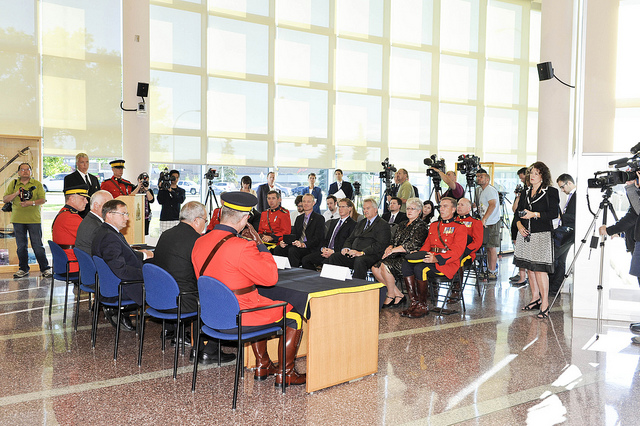
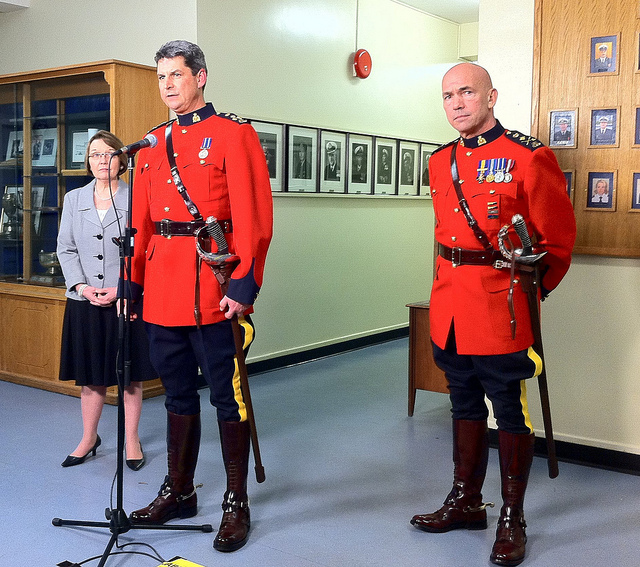
Photo courtesy via Creative Commons by the Province of British Columbia with some rights reserved. (the Photo features Paulson looking on during the swearing in ceremony for Craig Callens, who has also announced his upcoming retirement)


Time to reduce the number of firefighters?

Each day in downtown Vancouver and other municipalities in B.C, fire crews scream up and down the streets; gargantuan vehicles blasting air horns and sirens, reverberating off every nearby building.  However, in all likelihood they are not heading to a fire. Actually there is a 70 per cent chance they are going to a medical call. How did we get to this state of confusion, where the fire department is taking ambulance calls?

The cost of these daily and nightly  sojourns,  with million dollar fire trucks,  four or five fire personnel usually in tow, seems at the very least to be a misappropriation of resources. Most times they are going to a traffic accident, or to a downed individual suffering from too much alcohol, or too many drugs. They are of course usually joined by other fire vehicles, and maybe a supervisors vehicle for good measure. Upon arrival, they proceed to block multiple lanes of traffic, parking their vehicles and placing their traffic cones at 45 degrees, in different directions. Invariably, an ambulance will then attend as well.

The victims of an overdose or other medical issue is often dwarfed by the numbers of personnel and the towering vehicles parked in every direction. The fire personnel once relieved by the ambulance, often stand around, conversing with their fellow workers, seemingly unaware and unconcerned of the ensuing traffic jams, and usually in no apparent hurry to move on. The scene seems incongruous.

This  is not a firefighters traditional mandate and now the use of firefighters to answer medical calls is beginning to garner attention in many financially strapped municipalities in the U.S.  Even, in Canada, places like Toronto are re-assessing this perversion of the way these resources are used and shared with the traditional emergency health services community. They are quickly realizing that this abuse of scarce monetary resources needs to be addressed, that this is not a cost-effective way to use the fire departments.

In  Vancouver, there are currently 20 Fire Halls, with a total of about 800 employees. By their own statistics 70% of their calls are now medical calls to individuals or to car accidents.  How is that if fire calls have been declining to such a large degree, why are we not slowing down the growth of the fire department? It could be argued that we now need only 30% of what was needed many years ago.

Declining fire calls has led to the fire department, needing to justify itself in terms of resources, branching out into other territory. The route of least resistance was to grow toward was the medical call, or the call for rescue services.

So they have gradually embarked into other areas with developments like the “jaws of life” which gives them reasons to attend motor vehicle accidents, or carrying defibrillators, and training their staff to a higher level of medical expertise, which allows them to take medical calls. Coincidentally while fire calls were declining the Fire Department changed its name to the more expansive “Vancouver Fire and Rescue Services.

The fire department during this current Fentanyl crisis is using this as an opportunity to talk about their over growing workload, no time to train, complaining of “burnout”, even asking for further resources. One article extolled the need for an officer dedicated to dealing with PTSD for these over-worked fire personnel.

There is little dispute that medical calls are keeping some stations busy. At Firehall #2 in Vancouver,  in the heart of the downtown Eastside, monthly calls have doubled in the last four years, and now amount to sometimes 20 calls per day on a 10 hour shift, or 30 calls per 14 hour night shift.

Certain halls are busy with these medical calls, but there are also many sleepy fire halls in the region. Fire halls in West Vancouver for instance would be hard pressed to complain about being over worked. I spoke with one West Van fireman who in 27 years had never been to a “structural fire”, although had been to many accidents and medical calls.

And these fire personnel are not cheap.

In an article in the Georgia Strait who obtained FOI information from the City of Vancouver with reference to fire department salaries they learned:

In 2013 Vancouver’s Fire Chief was the highest paid employee in the city with a salary of $347,762. (but was expected to decrease in 2014). There were approximately 125 fire personnel working under him that were making over $100,000.00 in 2013.

http://www.straight.com/blogra/729806/why-do-so-many-vancouver-firefighters-make-six-figures-and-other-questions-raised-city-salaries

It should be noted that the overtime issue in B.C. runs across all emergency personnel lines, and is a singular problem in police services, paramedics and fire services. Paramedics, firefighters and police in B.C. are thanks to overtime, scooping up salaries well in excess of $100,000.00.

There is increasing attention being paid to the fact that modern equipment and new building materials is reducing the number of fires, and the costs of these fire departments are reaching astronomical levels.

Arbitrations are also keeping fire salaries high for one of the most under-worked professions. Often those salaries are in excess of the increases seen in other public sector jobs.

In smaller cities the Fire Department budget often amounts to a quarter of the overall budget.

Fire fighting has become a very desirable job, and firefighters rarely leave. Hundreds of applications are received every year for the few openings that come up.

Working conditions are good. Many firefighters having a second job because of the amount of downtime, and often have the luxury of sleeping during their night shifts. Twenty-four hour shifting is being used in some areas, or is often being pushed for by fire personnel. From a common sense perspective it seems illogical to be able to work a “24” hour shift, but of course it is possible in firefighting because of the extraordinary amount of downtime. They are often filling their downtime by preparing meals, working out, and polishing and servicing equipment. It is not uncommon to find them cruising in their big rigs and shopping for groceries or on a “patrol”through Kits beach.

In Toronto, in 2012, the city changed the protocols to send ambulances rather than firefighters to over 50 different types of medical emergencies. The next year the City staff recommended closing four halls and cutting 84 fire fighter jobs. While at the same time they hired an additional 56 paramedics who make a lesser salary, with an average of $65,000 in Canada.

A paramedic salary is lower than the average firefighter, as firefighters are designated as essential services in this Province, upping the ante in terms of salary bargaining.

Paramedics across Canada make between 65-$90,000. Ambulance vehicles run around $300,000 whereas fire trucks start about the same price and the larger trucks easily go over $1million.

Why this is not being done in British Columbia can partly be explained by the fact that there are two very different bureaucracies at work here. The city pays the Fire Personnel, while the Province pays the Paramedics. The two governments need to come together to work out a coherent untangling of mandates, and a cost sharing or savings sharing formula that is applied equitably. You would be increasing the direct costs to the Province but saving costs for the taxpayers of Vancouver. Some put back may be required from the City to the Province.

In November 2016 the BC Government put in another $5 million to the paramedics due to the Fentanyl crisis. However, if they truly want to make a difference and potentially save monies, we need to reduce the number of firefighters and close some of the halls, while at the same time increasing increase the number of paramedics and ambulances. Maybe not a 70% cut, as that would throw the fire department into paroxysms of fear, but but at least an effort must be made to get the need for fire services down to a number more reflective of the actual need for their services.

It is not news to fire department administrators, that the reduction of fires is a threat to their livelihood and job descriptions. Their ability to earn a substantial living is being threatened.

Is it time to go back to the original intention and mandate of the fire services? Reduce the number of firefighters, and reduce the ancillary major equipment such as $1million dollar fire trucks responding to calls. This is not a radical proposal, but one which will go against public perceptions. The media duly report every puppy rescued from a burning house (some fire trucks are carrying animal respirators – talk about branching out), cover every fire department fund raiser, and endlessly portray the firefighters as risking their lives, and of course promote their calendars.

So be prepared for the backlash. In Toronto the firefighters purchased ads on the local media all claiming of course that the government was putting “lives at risk”. Utter nonsense, as the firefighters themselves say they are merely filling the gap left by traditional ambulance services.

To recommend reducing the number of firefighters will be considered sacrilege, an attack on the emergency services world. I am just saying that we should hit the nail of the problem with a hammer, not with an expensive jack hammer. Everyone loves the image, but it is based on misperception and it is costly.

It is hallowed ground on which the firefighters walk, and you will need to be ready to hose down the flame throwing rhetoric that will come from the affected who will argue that you are “risking” the lives of your fellow citizens. I too am in favour of fire personnel, but we just don’t need that many of them.

http://www.bcehs.ca/about/news-stories/news-roll/province-announces-$5-million-to-boost-paramedic-response-to-b-c-s-overdose-crisis

** On March 9, 2017 the BC Government announced a $91.4 million funding boost for emergency services, which will go to 6 new ambulances, and 60 new paramedics. I suspect this may have something to do with the election, and not my blog post. Of course there is no cutback on the fire department, that would not do in an election period. **

Image courtesy of Liz West via Creative Commons licence Some Rights Reserved


National Inquiry into Missing and Murdered Indigenous Women and Girls –an inquiry???

Missing and Murdered Woman Image

So here we go again.

Since Confederation, Canada has embarked on over 450 inquiries or commissions. So one would think we should be somewhat expert on the makeup and conduct of these inquiries.

In Canada we seem to have developed an obsession with navel gazing; an obsession to examine and study all contentious issues often delaying any real change.  It is often the political route of greatest convenience, playing to a particular audience, in the hope of postponing structural change, or at least delaying it till it finally eaves the headlines and goes to the back pages.

An inquiry by its very definition means an investigation. To be effective, a normal expectation, is  that this “investigation” will be impartial and balanced. So what can we expect, especially in terms of the police investigational front.

One will remember that this latest inquiry was spurred by a Liberal election promise from Justin Trudeau and the seemingly ever increasing demands of indigenous group to visit the issue of murdered and missing women and girls. Defining what the indigenous groups see as the root goals, or why such an inquiry will be helpful,  are often obscure, but seem to always revert to a call for an ill-defined form of “justice”. What results will appease this request may be intangible in the end, but that is the goal.

The government estimates that this newest inquiry will cost $53.86 million.

This does not include $16.7 million that the Department of Justice will provide “to increase the number of “culturally-responsive services for indigenous victims and survivors of crime” and to establish the new Family Information Liaison Units (FILU’s) in Provincial and territorial victims services offices, to assist families and loved ones of missing and murdered indigenous women and girls. These new units will apparently help families to find the information they seek from various agencies and services (including police, prosecutors, social services, child protection services and coroners) and they will communicate this information to the families in a culturally grounded and trauma-informed manner”[1]

It is difficult to measure what a “trauma informed manner” means or how it would be different than others in any victim services office which already in most circumstances have an aboriginal court worker.

So the grand total will be $70.56 million.

This is not the first time we have had such an inquiry dealing with Indigenous issues, from August 1991 to November 1996 there was the longest running royal commission ever;  the Royal Commission on Aboriginal Peoples. That inquiry, at that time spent a staggering $60 million of public funds, and thus was the most expensive royal commission in Canada’s history for the time. The sad thing is that despite the length and the monies, nothing of any note seems to have come of it and very little reference is ever made to it.

So this newest inquiry with half the time of the last one,  may go on to bear the distinction of it becoming the most expensive inquiry to date.

It has not been without opposition. Former Conservative Prime Minister Stephen Harper, during the election, said that there was no need for further study; so of course in 2015 the Liberals and the NDP were pushing and promising that if they took office, they would conduct a National Inquiry.

At the time Harper had rejected calls for a formal inquiry saying enough studies have been done and that crimes should be investigated by the police. He went on to say during a year end interview with the Globe and Mail that “we have dozens of reports on this phenomenon, including pretty comprehensive reports from the RCMP, and others, on the nature of the crimes involved”.

The Union of B.C. Indian Chiefs said that Harper by stating that another inquiry was not on the top of his to do list, called his comments “condescending, disgusting, and racist” and that they underscore the “dire need for a national inquiry”.

How saying that he didn’t feel a need for another inquiry due to all the previous reports is “rascist” seems to defy explanation, but it is a charge  which indigenous groups seem to have no problem in going to, especially in the current political environment.

It should be pointed out that after the Conservatives loss, and now in opposition, these same Conservatives have now had a change of heart, and now feel it prudent to be in favour of the inquiry as well.

This inquiry, as the title implies,  is to look into murdered and missing women and children.  So we may ask, what in general terms is the scope of this issue. What are the actual numbers that come under this heading.

In total numbers, between 1980 and 2012 there have been a total of about 1200 files, although some indigenous groups estimate it is much higher and say the measurements are not taking all the factors into consideration.

So when the issue began to become a political football, in 2014,  the RCMP conducted a National overview of Aboriginal homicides, and then provided updates to the data in 2015.

The major and central complaint of the indigenous groups is that the police and the government in general do not pay attention to these issues and therefore many investigations are incomplete and unsolved, or did not receive the requisite attention.  So lets look at this issue. According to the RCMP report:

“The overall solve rate for female homicides occurring in RCMP jurisdictions for 2013 and 2014 was 82%. Homicides of Aboriginal and non-Aboriginal women had similar solve rates of 81% and 83%. A solve rate of 81% for homicides of Aboriginal women indicates that 26 of the 32 homicides recorded in 2013 and 2014 have been solved. 

Relationships between the offender and victim for 2013 and 2014 showed a trend similar to that found in the 2014 Overview (1980-2012). Offenders were known to their victims in 100% of solved homicide cases of Aboriginal women, and in 93% of solved homicide cases of non-Aboriginal women in RCMP jurisdictions in 2013 and 2014. Current and former spouses and family members made up the majority of relationships between victims and offenders, representing 73% of homicides of Aboriginal women and 77% of non-Aboriginal women in RCMP jurisdictions in 2013 and 2014.”

They go on to state:

“The updated data reflects that 9.3% of unsolved Aboriginal female homicide and missing persons cases captured in the 2014 Overview have since been resolved. In 2013 and 2014, 32 of 85 female murder victims in RCMP jurisdictions were Aboriginal – more than a quarter of the total number. Missing and murdered Aboriginal women continue to be overrepresented given their percentage of the Canadian population.

The update revealed the unmistakable connection homicides have to family violence. Most women, regardless of ethnicity, are being killed in their homes and communities by men known to them, be it a former or present spouse, or a family member. Prevention efforts must focus on stopping violence in family relationships to reduce homicides of women, and we are moving forward with many initiatives on this front.”

One cannot deny the data. These are the facts. The vast majority of aboriginal women are killed by persons known to them, be it spouse or not, and the vast majority of these cases are solved and charges are laid.

(If you read the previous blog you will see that in the general population the police have a 48% solvency rate in 2016).

The report does show that there is little doubt that the aboriginal women are over-represented in terms of the overall population as they only represent 4% of the population. However this is not a policing problem, this is a political and cultural problem.

One would think that the facts of  that this would seemingly  throw some water on the constant talk that indigenous murders are ignored or not investigated properly. [2] Apparently not.

In terms of our expectations of a balanced and fair investigative inquiry.  Who are the Commissioners that are going to conduct this inquiry, and how do they interpret their mandate.

They state that they are to “examine and report on the systemic causes behind the violence…by looking for patterns and underlying factors that explain why higher levels of violence occur”. To “examine the underlying historical, social, economic, institutional and cultural factors that contribute to the violence”.

The “commission will examine practices, policies, and institutions such as policing, child welfare, coroners, and other government policies/practices or social/economic conditions”

They are then to recommend:

“concrete actions to remove systemic causes of violence and increase the safety of ….recommend ways to commemorate missing and murdered indigenous women and girls….and provide its recommendations to the government of Canada by November 2017 and a final report by November 1, 2018”.  (They also suggest you go to their website if you have any ideas on how to commemorate these murdered women.)

Of course in B.C. it was only in 2012 that we also had  the Commission of Inquiry into the Missing and Murdered Women, which was presided over by Justice Wally Oppal who produced a 1148 page report with 63 recommendations, at a cost of $10 million. It was a report that addressed the policing issues as well and outlined several recommendations in how to improve the system in particular with regard to the missing persons reports. Oppal said in reference to this new inquiry,

“Before we start embarking on a national inquiry, we have to ask ourselves what will we learn from an inquiry- and I don’t think that there’s anything more that we can learn”.  He thought that the national inquiry could easily go to $100 million in terms of the overall cost.

Any inquiry can also be defined by its process, which can come in two forms. One is an evidentiary type process where there is an open and public review of important issues and events, events which would otherwise not come to light.

The other possible purpose of an inquiry is to be more of an information gathering forum to expose persons to the issues and generate public discussion. If this is the preferred method then one would have to believe that indigenous issues, whether it be education, funding, or residential schools, is not something that has been discussed or been the subject of any previous inquiry.

Although it would be difficult to argue that indigenous issues are in need of more public exposure, nevertheless this will be the  format followed by this group. This inquiry has  stated that it is not going to be a “courtroom” thus not an evidentiary inquiry that we would normally envision. So we are in for an information gathering program where all that appear before it will be accepted as fact and not questioned.

As to the Commissioners themselves, it would seem to be common sense that any inquiry and the persons conducting it have a degree of impartiality, and to achieve a balance in measuring the evidence should have different backgrounds and expertise. It is unspoken but it needs to be somewhat independent from government and impartial and not represent a particular held view.

This inquiry has named five commissioners; all of whom, although highly educated and experienced in the academic and legal indigenous issues, are all of indigenous descent. Furthermore and more incisively all of these commissioners have been gainly employed by the legal and justice system representing the indigenous perspective.  If this inquiry was on the fishing industry, would it seem right that all the commissioners of inquiry would be fishermen? Of course not. However, they expect us to believe that they will be impartial and not have an agenda.

The Justice Minister, who will eventually accept their report is also of aboriginal descent and in a rather short legal career also worked on behalf of the indigenous people. Can we expect her to look at the results of the inquiry with impartiality?

(Believe it or not, this heavily weighted group is not enough for some indigenous groups who have complained that none of the five are Inuit or from Manitoba.)

So we have a biased indigenous supportive group, with a broad mandate, and an enormous budget now embarking on at least a year of gathering “evidence” or testimony from indigenous people. And in their own words, don’t expect the traditional “western courtroom”. The goal apparently is to “incorporate indigenous customs to the process”. “Evidence” can come in the form of “…traditional story-telling, poetry or art”. Clearly there will be little or nochallenge made to the narrative provided by the indigenous groups. [3]

This will not be as once hoped an inquiry into the real issues of poverty, lack of education, drug and alcohol abuse, or living in isolated circumstances. Nor is about the third and fourth generation of the indigenous people living on a reserve welfare style system sapping both their pride and their culture.

What are we going to get? Hours upon hours of unchallenged oral history of abuse and neglect, hours and hours of discussion of the Residential schools, colonialism, and the ensuing various forms of cultural abuse.

In the end there will be a long list of recommendations, some of which will be impossible to complete, all of course needing further funds; for further reconciliation, more counselling and education, separate schools and medical systems to name a few. I suspect that these commissioners who are already fully versed in the indigenous perspective for all these matters could probably  write the report now.

They with little doubt will recommend:

“make prevention of violence against aboriginal women a genuine priority”

Call for further “police accountability” and “improve police in missing person policies”.

Oh sorry, those were already the recommendations from the Oppal Commission.

Of course, there has to be the token kicking of the police and much made of the odd police case where the missing persons investigation was not done thoroughly. As I write this, the RCMP Federal watchdog the Civilian Review and Complaints Commission recently reviewed the police actions in the northern communities. Interestingly it stated that the police policies are “outdated”, “records are incomplete” and “supervisors failed to provide guidance” (that I would not ever take issue with ) however more tellingly report that a persons ethnicity in terms of thoroughness of investigation that “there was no significant difference in the way they were handled”. They further noted that their were no “articulated steps” in 24% of aboriginal cases, but it was actually higher in non-indigenous groups at 26%.

At the end of this new inquiry there will be the requisite Mountie response, saying they have already addressed the issues and have already re-written policy and provided further training. They will tearfully promise to pledge their understanding and apologize for something.

And oh yes, the inquiry will recommend a statute or monument or similar token to the missing or murdered indigenous women. Not as noteworthy apparently are all the non-aboriginal women who have died of domestic violence.

And finally, and maybe more importantly, this will not help the indigenous people. They should be opposing this style of inquiry. Government, the police, and Canadian society has passed this stage. They need real solutions to complex problems and the forward thinking leaders of their groups need to come forward. They need economists, sociological and psychological experts, financial and business groups and the politicians to start developing a real policy on indigenous issues. They need to deal with the hard issues, such as the isolated surroundings in which many of the indigenous groups live,  they need to address the changing culture where indigenous groups in most areas have lost the ability and desire to live off the land.

Instead this will be a forum for self–flagellation.

This inquiry is just delaying real decision-making and what possible solutions there may be for another two years. Recommending more money and counselling, will be the outcome, but it should not be seen as a basis or as platforms for real solutions. Indigenous leaders themselves need to lead some problem solving efforts and get over the constant cries of victimization. Not because it didn’t exist and continue to exist, but because it is time to move on and lead their people from this morass.

This is an attempt to delay facing real issues, and provide for more selfie-inspired moments for the Liberals. This is too easy for them, and the indigenous people should not have been duped into this style of inquiry.

Indigenous children are growing up in abject poverty, in violent drug and alcohol-laden surroundings, and in isolation. Legal corruption runs amok in Band administrations and should be part of an investigative inquiry on its own. Indigenous isolated teens are drinking copier fluid, and joining suicide pacts, while clean drinking water is not available in many communities. This has been going on for decades and vast sums of monies have been spent.

The indigenous leaders, the politicians, and the legal and social worker community which dominates and flourishes in this current inquiry system should be ashamed.

Former Supreme Court Justice Willard Estey stated at one time when referring to the Canadian soldiers inquiry regarding Somalia in the mid 1990’s, that the inquiry process has been “abused beyond usefulness”. Truer words have never been spoken.

[1] c.gc.ca/eng/14701

[2]

http://www.rcmp-grc.gc.ca/en/missing-and-murdered-aboriginal-women-2015-update-national-operational-overview#p4

[3] https://www.thestar.com/news/canada/2017/02/07/missing-indigenous-women-inquiry-offers-update-at-first-media-conf

Image Courtesy of Tracy O via Creative Commons licence with Some Rights Reserved

Update: June 3 2017… So here we go…the Committee  is off to a rollicking start. First it has been slow to get going (who would have thought that about any government inquiry); indigenous groups are complaining that having to call in to schedule themselves to testify, or having to go online is too much of a burden for them; and now the Committee is likely going to ask for more time and money…none of this was predictable of course….meanwhile Justin is meeting the Pope and asking that he apologize to the indigenous groups….nobody could make this stuff up.

2nd Update:

July 12th, 2017: Marilyn Poitras has now reseigned from the Commission; two weeks ago Michelle Moreau resigned; before that three other inquiry staff members resigned; and now a Manitoba group wants new commissioners appointed. This has become a farce.

The Integrated Homicide Team- cash grabs and declining solve rates


By its own admission, the Integrated Homicide Investigative Team (IHIT), the RCMP/Joint force group now is the largest homicide investigative group in Canada.

They claim coverage of “28 communities and 4 municipal agencies and have conducted over 800 homicides since their inception in 2003.” So on first blush the size of this group may seem to be what one would expect.  Are there “highly skilled analytical unit..and six investigative units” performing to police standards and meeting the expectations of the general public?

First, in terms of the size of the unit and the number of officers assigned, the size of this unit seems on further inspection to be somewhat out of sync with other agencies in Canada and in North America.

For instance, this unit is therefore bigger than Toronto with about 6 times the population, bigger than Montreal, and as big as some of the larger municipalities in the U.S. Although the 28 jurisdictions it covers seems large, one must keep in mind that IHIT is counting a lot of other smaller locations where homicide is rare and not the norm. And of course it does not respond to homicides in Vancouver the largest municipality in their area, nor do they cover Victoria or places outside the LMD like Kelowna or Kamloops.

Their claim of 800 murders during this time, means that they would have had to average 61 murders per year, when their actual average is around 40 murders per year by their own statistics.

However, it became evident that clarity in the numbers is not always possible, and the police often use broad measurement tools.

IHIT is funded by the municipal  agencies and RCMP detachments that have decided to join it, and the respective jurisdictions  pay for their contribution by  either providing manpower or monies, or a combination of both, and the amounts are determined by the homicide rates for that particular region. For instance Squamish averages 1 homicide every 10 years, so therefore pays a minimal fee.  Whereas Surrey on the other hand could have on average 20 homicides a year therefore is required to pay a much larger amount.

One of the continuous lines being delivered by the media group inside IHIT is how overwhelmed they are, too many files, not enough bodies etc. It is then echoed by the local newspapers and television, with little question or examination. So how busy are they?

Since 2003 they have been involved in 509 homicides (by the numbers provided to this writer through a Freedom of Information request – far lower than the 800 they claim in their website) This  averages out to 36 files per year. IHIT states that they have 110 personnel, of which there are 80 sworn police officers. In what seems like the constant government bureaucratic creep over their 13 year history, they have also expanded their unit to include a cold case team, investigational support unit, family/victim support unit, major case management, legal support application team, special projects, and public/media relations. They state that they have six investigative teams and the rest are part of these specialized units. Each team consists of eight officers.

So 36 files per year amongst 48 “investigative” officers works out to 0.75 files per investigative officer. Less than one file per member per year, and if you include all 80 sworn officers in the average it goes down to 0.45 files per member.

[1]Toronto Metro Police in 2016 had 69 homicides which was a big year as their normal average is somewhere between 24 and 40 but in 2008 they had 70 homicides. Almost double the caseload of IHIT, with fewer officers.

IHIT has had 44 homicides in 2016, and claim to have “cleared” 43% of them. Toronto Metro claims to have “cleared” 52%, which Toronto is not bragging about, but still almost 10% greater than IHIT.

Montreal has had a declining homicide rate for several years and had 24 homicides in 2016. The previous decade had seen an average of 34, close to the IHIT average. The Montreal police claim a solvency rate of 65% in 2016. Montreal has about 32 officers, or half the size of IHIT.

It gets even more interesting when one looks to the South where  the IHIT group is still larger than most  U.S. police departments.

Screen Shot 2017-01-30 at 3.40.01 PM.png


The above chart is in 2004 so is somewhat dated, so a comparison of the solvency rates would not be fair. What is interesting though is the number of officers per file, and the totals of files in general, in comparison with IHIT.

In Houston 62 officers for 272 murders or 4.38 per officer.

In Detroit, the most beleaguered at the time of these figures, 39 officers for 383 murders and an average of 9.82 per officer.

So if you think IHIT is busy try putting yourselves in these cities. [2]

In 2013, the National Clearance rate in the U.S. ,where they seem to be under manned by any measure,  was 64%.

IHIT’s solvency rate in 2013 was 55%. So despite having astronomical numbers compared to IHIT, it would seem that IHIT is always underperforming other agencies, all this despite having the largest group of investigators conducting homicides in Canada.

One must also examine the term “cleared” in the language of the police. For instance, if four people were involved in a murder, and one person is charged, it is considered “cleared” even though three parties may have walked away from it. If a suspect on a file is killed or commits suicide than the matter is also considered “cleared” even though you can not eliminate the possibility that they may have had the wrong “suspect”. Also, one must remember that there are a lot of homicides, where the suspect is obvious such as domestic homicides. They are far easier to get “cleared” than the gang related style murders. If you just measured the gang related files the clearance rate many sources say IHIT would have a solvency rate that would be in the teens.

To be fair, there is a general pattern throughout North America of declining solvency or clearance rates attributed to a number of factors. So all are under performing when judged by the past, and IHIT is no different, but it is just falling a little bit faster than everyone else.

Some explanation for their under performance may be the rules of evidence, the relationships with Crown counsel, Crown Counsel itself, and policies within the RCMP itself. Disclosure, Crown insistence on “substantial likelihood of conviction”,  the complexities of warrant applications, and the lack of informants are just a few things that are often pointed to in the problems facing IHIT. All are legitimate issues.

So there are two problems now facing IHIT; declining clearance rates for the last several decades throughout all police agencies, and an IHIT group which is underperforming almost every other agency.

See the below-noted chart received from IHIT under a Freedom of Information request.

Screen Shot 2017-01-30 at 3.23.40 PM.png

When it was initially formed from its inception in 2003 and then up  to 2008 was above 64% solvency except for one year; with a high of 78% in 2003 its first year and again in 2007.

Since that time it has been in the 50% range with 2016 being the lowest ever at 43%. (*In terms of full disclosure, I was a member of IHIT for the 1st five years of its existence). It should also be pointed out that IHIT during that first five years consisted of only 4 teams of investigators; did not have a cold case team, did not have an affiant team, nor a family liaison unit. Shortly after those first five years as the solvency rate began to decline, and somewhat incongruously as this was happening, more officers were being added to the unit.

After the first five years IHIT went from 32 officers to 80 officers. Over a 100% increase in manpower and a decline of 20% in solvency in those ensuing years. During this time, the IHIT group has added a staggering 203 “unsolved homicides” to an already large pile.

A third problem plaguing IHIT is that despite falling solvency, and fewer murders than other locations throughout the country, IHIT officers are working a staggering amount of overtime and making a staggering amount of money.

As per the above chart received once again, through Freedom of Information request, you will see that the overtime numbers are divided between the RCMP officers and the City departments who work in combination with the RCMP. So you need to add the numbers together to get the complete picture.

When you examine a few of the years in 2007/2008 the average overtime per member works out to $52,257.56. In 2011/2012 it was $54,731.00 and in the largest year 2013/2014 it was $76,063.97 per officer.

Screen Shot 2017-01-30 at 3.33.55 PM.png

The IHIT teams are made up of Constables, Corporals and 1 Sargent per team. The lowest salary of this group would be a Constable of three years who makes $82,108.00 per year. So if he is working at IHIT in 2014 his or her salary with overtime would be $158,171.00. Corporals who earn $89,910 would minimally make $165,973.00 and Sargeants with a base salary of $97,999 would be around $174,000. To give this some terms of reference the average “family” income in 2016 was $67,090, so a Constable with three years service, no specific academic degrees or technical certificates was making  247% more than the average Vancouver household.

If this were occurring in normal business practices and  managers saw this level of overtime, it would make financial sense to hire more personnel and look at shifting as a starter to stem such large expenditures. However at IHIT there is no weekend shifting. As one source told me, no one would work at IHIT if the overtime was reduced. Weekends is where the majority of the overtime is made, so in having a shift on the weekend they would be cutting off the flow of overtime monies.

Many reasonably argue that overtime seems to have now become the driving motivational force at IHIT.

IHIT, according to many sources, has become a place you go for two to three years to make a lot of money, and add an impressive title to your resume. Continuity and expertise is no longer treated as a valuable commodity. I’m told that there is often no need for this level of overtime, but it is driven by the unaccountable monies available which are made available and not the necessary investigative requirement. I observed that on many occasions while with IHIT personally, with certain officers enamoured with the financial gains that could be made. It has now become the norm.

Even so, a lot of officers don’t want this, as they are not interested in a lot of overtime and having to be away from family for long periods of time. So there is an additional problem growing  in IHIT with attracting people to the unit, even for promotion. I am told that some teams are down 40% of their manpower and many are abandoning the unit for greener pastures which usually means other Federal sections where overtime is also plentiful without the demands of being on-call and overnight shifting.

Of course, none of these issues are being talked about and why would they. They are not going to speak about the fact that  if someone is murdered there is a less than 50% chance it will be solved. If it is a gang or drug-related murder the chance is probably less than 20%.

I have been told by one source that the head of IHIT currently, Supt. Donna Richardson has even expressed growing concerns about being sued by family members of victims due to the growing inability to solve crimes.

In terms of correcting or trying to address the solvency issues the issues are more complex. There are the general broad based factors which have been occurring for the last few decades amongst the limited academic research in the field.

Often cited:

Screen Shot 2017-01-30 at 3.21.40 PM.png

Screen Shot 2017-01-30 at 3.37.17 PM.png


a) The integrated vs de-centralized unit, where the integrated teams have lost touch with the localized problems, are unable to develop witnesses and informants. It is believed that this is a fundamental problem with IHIT who have been recruiting younger and younger officers from other areas, with no local knowledge to this central unit.

b) In the 1990’s the flavour of the day in policing became Crime Prevention vs. Crime Solving. Monies poured into community policing stations etc. to the detriment of developing and solving criminal investigations.

c) The 1980’s and 1990’s saw a generational development of nobody wanting to “rat” on anybody in the criminal world. It not only became the edict of the criminal gangs, but the general public became less inclined to get involved.

d) Greater difficulty in prosecuting these cases. The most pronounced of that in this Province is the rules surrounding “disclosure” and the Crown and court guidelines of this issue. (I will talk about disclosure in a later blog, as it has become an albatross that is hindering every investigation)

All of these issues are pertinent to IHIT, but there is growing evidence of the lack of experience, due to younger and younger persons going to the unit, ill-equipped supervisors, and the lack of local knowledge is the biggest factor that needs immediate addressing. It is known that officers with only  three years service, or a 5 year drug officer with no homicide experience all have been accepted into this unit.

To compensate for this inexperience they often have to engage in a type of check list investigation. Someone lists out all the items that could be done, and they go through the motions trying to check it off the list for each and every homicide. It is very time consuming and often fruitless without some experienced oversight to direct what is important and whats not, where the emphasis should be placed based on the circumstances. It is also more expensive.

Experience was so valued  in the Vancouver City Police it used to be that you needed 15 years experience before you would ever be able to apply to the homicide section. (that too has changed because of demographics and loss of experience). In those days I should add, there were two person units, not eight, and there solvency rates were always in the 70% range.The officers were not better then, but they had more experience in a job which demanded experience, and often maintained informants and other sources in the local criminal element, something which is an absolute necessity when dealing with gang-related homicides.

So how is government to deal with this growing problem,  a problem they are either unaware of, or not wanting to talk about it. The current management of the RCMP are fully aware of the situation, as this has not developed overnight. This has been growing for the last several years, and there does not seem to be any internal desire to address these issues in the sensitive world of homicide investigation. Some of the upper managers came up through the IHIT system and were full participants in the overtime gains.  So instead of talking about what is developing as an embarrassment, they seem to be content with only assuaging the public as to their ongoing attentiveness to these investigations.

So as the gang shootings continue they seem satisfied to tell us that it was a “targeted hit” and we have nothing to worry about. The public does need to be concerned and the taxpayer needs to begin demanding some explanations. A full managerial and financial audit is needed as a starter. Time to pull back the covers.

( Recent article in the NY Times talks about the ongoing homicide solvency problem in the Bronx. They have just added 75 “White Shield” Detectives to supplement the three detectives that were handling over 400 cases last year. White Shield Detectives have to go through an 18 month training period working with senior detectives before earning their detective badges

https://www.nytimes.com/2017/02/08/nyregion/new-york-police-bronx.html?smid=nytcore-ipad-share&smprod=nytcore-ipad  )

( *By way of further update, in a Justice Institute of BC In Service Newsletter state that in 2015 police solved in Canada 451 out of 604 homicides, for a solvency rate of 75%. In 2015 IHIT’s solvency rate was 59%)


[1] http://www.torontosun.com/2016/12/27/sharp-rise-in-murders-in-toronto-in-2016

[2] http://www.nydailynews.com/news/crime/chicago-762-homicides-2016-nyc-la-article-1.2931020

[3] http://www.statcan.gc.ca/pub/85-002-x/2012001/article/11647-eng.htm#a1

Policing the Downtown Eastside amidst the collapse of the Four Pillars

LI like you am being worn out by the “epidemic” of the Fentanyl crisis. It is reported daily on all newscasts, camera footage of someone bent over an addict, trying to revive them with the usual punch in the ribs and a dose of Narcan. It is dramatic and it is sad and it is repetitive.

What ever happened to the “Four Pillars”?

Remember that political and social policy. Championed by Vancouver Mayor Philip Owen up to 2002, Larry Campbell from 2002-2005 (made Senator thereafter) and then carried on by Sam Sullivan until 2008. The current mayor Gregor Robertson rarely speaks of it, now seemingly wanting to distance himself from it.

The intent of the policy was to make illicit drug use a public health problem, not a policing issue per se, something more manageable if removed from being strictly a policing enforcement issue. The four pillars (you will be forgiven if you can’t remember what they were) were: prevention, enforcement, treatment, and harm reduction. So enforcement of the drug problem was still there, but in a reduced role and was to take a backseat to the goals of treatment and harm reduction. Admirable no doubt. Successful?

Lets analyze the four parts. How would you score each of these initiatives?  The 1st “Prevention” is almost impossible to measure, but surely no one would argue that the problem is declining or anything close to being termed a success. In fact one could argue there has been no measurable gain despite the efforts of many.

“Harm reduction” as defined by the Harm Reduction International group says that harm reduction refers to “policies, programs and practices that aim to reduce the harms associated with the use of psychoactive drugs in people unable to or unwilling to stop”. Harm reduction seems to accept the fact that most people throughout the world “continue to use psychoactive drugs despite even the strongest efforts to prevent the initiation or continued use of drugs”[1] They go on to say that the “majority of the people who use drugs do not need treatment”. This of course is the one and only initiative that seems to get government financial support whether it be pop up injection sites, or issuing Narcan kits for emergency service personnel.  This is the area where they could argue that they are making progress, but that would be difficult as we approach 800 overdose deaths. It is of course the easiest pillar and one that does not require longer term planning and development. If this is the only pillar which is working of course than we are simply on a never ending treadmill.

Thirdly there is “treatment”. This is now the media drum beat as there seems to be a consensus that there is an almost overwhelming need for treatment programs.  Just today another 38 beds were announced by the Provincial government for females. This has been obvious to many working in these streets for many years, and became especially acute after the closing of Riverview Hospital in 2012. At Riverview they dealt with the intertwined mental health issues which are an undercurrent among the downtrodden on the Eastside. One can not separate the mental health issues from the drug problem.

Treatment becomes more complicated when you are forced to consider the underlying problem of whether people are willing to go to treatment and recognizing that this is not a one-step method with the need for repeated follow up. Like alcoholism, it requires continuous vigilance.

Finally there is the “enforcement pillar”. Now relegated to fourth enforcement has now virtually disappeared.  So why is this?  Basic math seems to me that if there were fewer drugs on the street it would mean less overdose deaths. Wouldn’t an obvious at least partial cure for the problem right now, be to try and stem the flow of the drugs to the area. You will never stop it, but heightened fear amongst the drug dealers delivering fentanyl-laced products to the downtown core seems logical.

There are several problems and causes but first one must understand the nature of the policing world which has gone through some major structural changes which have for the most part done away with street level drug enforcement.

In the 1980’s the RCMP would often team up with the street crews of the Vancouver PD in the downtown Eastside, and do “street enforcement”. That no longer happens. We have entered the age of specialization and integration (something which I will write about more than once). No longer is street enforcement in vogue, but promotion and the monies are heading into specialized ” integrated “units where they can “partner” and deal with drugs on an “international” scope.

In the past there were various policing street crews, both in the RCMP and VPD and the assorted street crews and patrols and for the most part had a very strong grip on this postal code.  The officers had a good handle on who was doing what, who was bringing in the drugs, pimping the women etc. and the other assorted “trouble makers” in the area. There was a strong enforcement presence and those that walked the beat in the area were tough and there were street rules that needed to be followed. It was a symbiotic relationship between the criminals and the police.

The RCMP used to have a drug section based out of Vancouver. That is no longer. Every RCMP drug section and other Federal sections were part of a re-organization leading to the creation of “FSOC”,  the Federal Serious and Organized Crime section.

In this re-organization, the RCMP  has now done away with individualized specialized sections such as Drugs and Commercial Crime thus allowing the Federal priorities could be re-aligned into what Ottawa and the management of E Division felt was best.

In other words all of the officers were put in a big pile and then divided up in a number of teams. If your background was commercial crime, it didn’t matter, as your next case could be a drug file or a customs file. Likewise a Drug section folded into FSOC could have a white-collar crime file to attend to, or a file involving terrorist activities. In other words this re-organization has done away completely with any thought that expertise in an area must be developed and practiced over time. If this seems ludicrous, it is. Sources inside this change wholeheartedly feel that this has become a bureaucratic nightmare.

Why this re-alignment? According to the RCMP official website:

“With the federal re-engineering initiative, efforts have been under way to focus investigative priorities on groups involved in organized crime rather than specific commodities or criminal activities such as drugs, illegal firearms, contraband, or financial crimes.”[2]

The Province seems to have no handle or understanding of this transformation among the police. On July 27th, 2016 Premier Christy Clark announced that a Joint Task Force will work with the lyrical “Overdose and Alert Partnership” and Senior Police officials “to build and strengthen the actions already in place to prevent drug overdoses”. [3] Of course this is a way to keep away the critics from the back door and also give the appearance of a large investigative pro-active frontline group.

The Minister of Public Safety and Solicitor General to whom the police report in this Province, Mike Morris is quoted in the government press release as saying:

“Due to the elevated overdose rates we are now seeing, it is critical that we further develop strategies to facilitate a rapid and safe medical response to drug overdoses. Police in B.C. have been responding to the issue of fentanyl on a number of fronts with front-line police working directly with individuals engaged in high levels of substance abuse, as well as new or casual users, on a daily basis. Officers work with outreach teams and service providers to educate individuals on the overdose prevention strategies provided by health care professionals.”[4]

Again no mention of enforcement. It would appear that the Provincial response in terms of the police involvement is to have the police fully involved in the harm reduction strategy. There is no mention of increased enforcement to assist in this effort, the police are there as pseudo social workers according to Mr. Morris.

In an online “exclusive” on the RCMP Web site they state that “VPD and FSOC managers recognized that the way forward for policing transnational organized crime in Vancouver was to re-visit the integrated team concept” that they have developed “an integrated working relationship with the U.S. Drug Enforcement Administration, Homeland security investigations and CBSA, conducting collaborative operations amongst all agencies” and in fact according to VPD Mike Porteous at the time it was “working great”.

This news release was caused by their pointing to the undeniable success in Project Photoaxis, which had led to seizures in South Africa and numerous arrests of persons involved in the heroin trade. This file started in 2013, ran for two years until May 2015 when 28 persons were arrested and 37 kilos of heroin were seized in Belgium, South Africa and parts of Canada. In January 2016 the RCMP decided to issue a press release on this project, which could lead one to believe that this was a recent success.

Inspector Cal Chrustie one of the RCMP heads of this this project even went as far as to say that “we smashed the distribution and supply networks so significantly that our Liaison officers and partner agencies abroad aren’t seeing any activity there”. [5]

This further underlines the fact that “integrated” investigational teams stressing long-term investigations, using thousands of man-hours and millions of dollars is the focus of the day. (It should be noted that not insignificantly there is no mention made of the cost of this operation but there is little doubt that it was in the millions of dollars)

At the bottom of the story, Chrustie admits that there was only 1 Canadian involved, and there were no charges in Canada.

The other story, which the Police groups called, a press conference for was for Project Tainted, also in 2015, but this one at least was geared to the rapidly growing Fentanyl crisis. This too was a “joint forces operation” involving VPD, RCMP FSOC, and the Burnaby and North Vancouver RCMP and the Combined Forces Special Enforcement Unit (CFSEU). This too would have to be deemed a success as the usual parade of officers stood in front of the media showing off their seized wares of guns, drugs and bundles of money.  This too was likely a costly operation but you will never know by how much, and of course it was two years ago.

Also interesting recently in court, one of the parties charged in this Projected Tainted was a Walter James McCormick (age 51) who once out on bail got caught again in June 2016. The Crown was asking for an 18-year sentence on McCormick as the Crown argued that because Fentanyl was involved a much harsher sentence was called for. In the McCormick case from 2015  Crown is now arguing 18 years would be a suitable punishment  for trafficking in fentanyl, and of course defence is arguing that they recent media frenzy is being foisted on his client so that the Crown can be seen as taking this seriously. As much as it is a defence argument, it seems obvious that the Crown is pushing this for a political reason.

C/Supt Brian Cantera the current LMD Operations Officer and Assistant District Commander is a former “drug” cop, and an ardent supporter of “integration”.

In an interview with the Vancouver Sun Cantera stated that policing has “to shift to deal with the fentanyl crisis” but then says, “we’re simply not going to arrest ourselves out of this problem.” He says “It comes back to a multi-pronged approach, a multi-pillar approach, where you talk about prevention, education, harm reduction and enforcement”. [6] Have you heard that before?

So where is the Vancouver Police Department in all this, after all this is their physical jurisdiction and they also enforce the Federal CDSA. (Controlled Drug and Substances Act). Vancouver City police have a Drug Section, but like other police agencies do not speak of the number of people in this section. It should be noted that they now too fall under the “Organized Crime Section” of the VPD under Deputy Chief Laurence Rankin. The Organized Crime Section has an Investigations Section and this is where you find the Drug Section. Interestingly enough they do not fall under the “Operations” side of the house of VPD. So it would appear that they too have fallen under the spell of large-scale investigations and organized crime. My guess is that there is no street enforcement coming from Drugs. Any arrests in the area would probably fall to the uniform officers through the course of their other duties.

These long-term multi-agency investigative teams (if in fact there is one dealing with the fentanyl issue in downtown Vancouver) will continue to be the flavour of the day, but don’t be expecting any immediate impact. It may be years before there is another Trump like press conference. So the drugs will continue to flow into the downtown core, often watched by officers sitting in surveillance cars  part of some bigger operation.

On welfare day, the drug dealers will continue to amass outside the money dispensaries and begin to sell out for couple of days in what they must see as an unbelievably lucrative and easy market. And then the overdoses spike and calls for service go through the roof.

However, despite going after McCormick,  the police right now see no advantage in trying to pick off the dealers as they deal on the street in front of everyone. However, it would be more cost effective and maybe we won’t have to wait for 2-3 years for the next press conference claiming success.

Many think that the police have forfeited basic policing for the showy and expensive large operations and that maybe they should re-build at least one pillar of the four. The other three pillars are shaking to the point of collapse.

** By way of an update: Today, January 30th, 2017 the CBC does a report on how to stem the flow of fentanyl which it is agreed is for the most part coming from numerous pharmaceutical companies in China. They quote a 2013 UBC study which stated that the focus should be on harm reduction and not enforcement. That the “war on drugs” had failed. Of course we are now in 2017 and we are now in the middle of a “crisis” . Still Mr Pecknold the director of BC Police Services holds to the line “we are not going to solve this crisis by arresting our way out of it or seizing it at the border…Pecknold said”. Apparently Mr Pecknold doesn’t feel we should be worried about drugs crossing the border either.

Amazing take from the director of Police Services for the Province. He goes on to say the government line that what is needed is “….a co-ordinated response at all levels of government”.  Thanks for the insight.

[1] https://www.hri.global/what-is-harm-reduction

[2] http://www.rcmp-grc.gc.ca/mb/yir-bilan-13-14/message-federal-federale-eng.htm

[3] https://news.gov.bc.ca/releases/2016PREM0082-001361

[4] https://news.gov.bc.ca/releases/2016PREM0082-001361

[5] http://www.rcmp-grc.gc.ca/en/gazette/tackling-transnational-organized-crime

[6] http://www.cbc.ca/news/canada/british-columbia/bc-police-say-fentanyl-a-game-changer-struggle-to-stop-ovderdoses-on-the-street-1.3762446

Image Courtesy of Kenny Louie via Creative Commons licence some rights reserved

About

The author is a retired member of the RCMP of some 34 years spread out over three provinces in a variety of postings. Having worked in a variety of sections, but for the most part in uniform, Counter-espionage, Robbery, Sex Crimes, Serious Crime and Homicide.  As a former homicide investigator, Team leader and Commander he was directly involved in  over 200 murder cases, and three of those cases have been profiled in documentaries for television.  He has received numerous awards and commendations, including the Queen’s Silver and Jubilee Awards, and was nominated for two years running as the Police Officer of the Year while in Surrey Detachment for his investigation of the disappearance and murder of 10 year old Heather Thomas.
Image Courtesy of Vince Alongi via Creative Commons with Some Rights Reserved