
A Surrey post-mortem…

We have been following this issue for a long time, so when it finally reaches a possible conclusion, I find myself obligated, with some reluctance, to write about it once again. As those of you know who have been following the story, the RCMP is now effectively losing jurisdiction, in its biggest detachment in Canada. So it is news, but it has been truly tiring to watch this fiasco unfold, led by a couple of politicians in Surrey, like MacCallum and Locke, both of whom would be perfect characters for covers on Mad Magazine.

When asked recently on a local radio show in Vancouver how I felt about the NDP and Mike Farnworth’s decision as to who was going to police Surrey, and have now decided to go forward with the new Surrey Police Service, my only answer was that I felt “relieved”. It was in my opinion, a logical, fair and proper decision, when one considers all of the circumstances and disregard those speaking who clearly had an agenda. The problem was that it took too long to make that decision, and the delays affected hundreds of police officers on both sides of the argument. We won’t mention the monetary costs of these delays. Ms. Locke should have been told from the outset to go to hell, that the process to move forward with a City force was already in motion, and she with the short term memory affliction, was in the beginning part of it ,and in favour of a city police force. Since then she has been playing revenge politics for several months, in a campaign that was both misguided and misinformed, propped up no doubt by the senior management of the RCMP, who seemed to be continually willing to feed her disinformation.

So lets do a bit of an autopsy on what happened.

The biggest issue, the Y cut at an autopsy if you will, was the ability of the RCMP to actually fulfill their policing contract in terms of staffing and resourcing. Everyone who has been a Mountie in the last thirty years, if not longer, could tell you that the Mounties have been robbing Peter to pay Paul for years. There mandate and their abilities could not meet their stated goals. They are still doing it, and they can not keep up, whether in a city, in a Province or Nationally. The numbers simply don’t add up. Everyone knew this, except apparently Ms. Locke.

Ms. Locke in a statement after the announcement said that the Province decision was “disappointing, misguided and based on inaccurate assumptions”. There are currently 1500 vacancies in the Province of British Columbia, 500 are simply un-filled positions, and there are 1000 on some form of leave. Nationally the RCMP will put about 600 officers through Depot, and E Division would get a portion of them; and there were over 800 departures from the RCMP during that same time period. Please Ms. Locke, I beg you, what don’t you understand? In their response to the Province as to how the RCMP were going to fulfill their promises, I am told that their ingenious plan was to disembowel the plainclothes sections (temporarily no doubt) and put them back in uniform and on the road. I ask you Ms. Locke, how is that not the work of the little Dutch boy putting his finger in the dyke? Did you simply accept the RCMP senior management explanation without hesitation or examination?

As we continue our pathology, we get to the vital organs, the root cause of the RCMP conundrum falls to the single fundamental justification and reason that they have managed to survive in this Province. They have always had one go-to argument. They are “cheaper”. As mentioned numerous times in previous blogs, the RCMP portrayed themselves right to the end as the Walmart, not the Gucci police department. Of course, once unionization took place that became a much harder argument, and it got even harder when the union signed the recent new contract. Now, just the negotiated back pay is killing most small town policing budgets. The other counter-argument is, you always get what you pay for.

Lets delve a little deeper. The promotion and transfer policy of the RCMP does not allow for the development of its own officers, nor provide the continuity necessary for effective and expert investigations. The RCMP has a system where if you want to advance, usually you have to move to a different section, or a different detachment. Gone is any knowledge of the particular field, and the Mounties are famous for promoting in bosses who have no idea or experience in that particular field. So the Drug corporal, goes to the Fraud Section as a Sargent, the Community Policing Sargent goes to Major Crime as a Staff Sargent, now in charge of homicide investigations. The officer who has been policing Terrace, or Anahim Lake BC for the last number of years, now finds himself standing in the atrium of Surrey detachment wondering how to get to the washrooms. This is even more true in the executive ranks, Inspector and above, who flit from station to station about every two years, all because the Federal RCMP priorities are managing “people”, “diversity” and “inclusion”, not on whether or not someone knows the job. All investigations, whether it be a break-in or a homicide depend on that in-house homegrown expertise. One simply can not seed and grow expertise in the current Mountie system.

There is a single reason why the RCMP Surrey body is laying on this theoretical stainless steel gurney. The managers and executive officers of the RCMP are the root cause of their now unceremonious departure from Surrey. The uniform contingents of the RCMP, who make up the majority presence of the RCMP in Canada, have been at the very lowest priority in terms of management attention for decades. Ottawa, Ontario and Quebec may be the central head of the organization, but the head is not attached to the body. The current and past executives have been consumed and hypnotized by such things as writing “Mission statements”, self-advancement, and thus the advancing the size of the bureaucracy. The rank structure is completely determined on the number of bodies one is supervising. So if I have 25 officers under supervision, but I can grow it to 32, I will go from a Staff Sargent to an Inspector. The exams for that promotion have nothing to do with direct knowledge of the job, but claim to be testing how you “manage people.” There are no questions as to knowledge of any given job or ones that test the level of any given expertise. If one were able to examine the internal growth of rank and structure in the RCMP, Surrey Detachment with its current bloated rank structure, would be the perfect case study. When that is the driving force in any organization, suffice to say that the Peter Principle can and will be found in the nooks and crannies of every RCMP office.

Finally, there is one issue which rarely gets talked about. The RCMP has since I have been around displayed an arrogance as to their capabilities and expertise. It seems to permeate their dealings with other organizations and it often carries over into the investigational and administrative fields. Where it started, or how it originated has never been clear to me. You were not on the “job”, as the City cops used to say, in the Mounties you were a “member” implying some elite club. They seemed to interpret the Red Serge as a symbol of some level of implied superiority –and they would continuously point out they are the “national” police force, and got to hang with the Queen and hold the door for the Prime Minister. They were the self-appointed experts in all manner of policing, whether it was in the middle of Alberta, or Quebec, or Prince Edward Island, in a small northern outpost or in the city.

There is a significant push in the Ottawa cognoscenti to make the RCMP like an FBI, this too implies some level of arrogance. (the FBI has many issues as well by the way). All of this is to suggest that maybe the de-throning from Surrey will help in some ways to bring the Mounties down to earth, to re-discover that in policing it is how you perform the job, which is and should always be the measurement, not who you are or who you represent. The arrogance needs to go away.

One has to conclude by saying that I personally enjoyed a very good career in the RCMP, they treated me well. I have no complaints. I made great and continuing friendships, got to do what I wanted to do, and worked on some interesting and challenging investigations. It wasn’t the colour of the uniform that I remember the most.

But during my service, the cracks were beginning to show, we were seeing some poor results with the often ridiculous policy and administrative decisions, most times originating in a reaction to some political thrust. When faced with legitimate push back the managers and the executives did not wish to listen to the troops on the ground, in fact they would ignore them. To voice an opinion was often met with retribution, and that arrogance would creep into administrative and investigational discussions, the newly promoted Inspector knowing better than all those that had gone before them.

Change is they say the only inevitable constant, but the RCMP are one of the worst at adapting to change. The ominous and imposing multiple levels of bureaucratic nonsense stymies all attempts to reform or simplify. Quite frankly the current executives of the RCMP should now retire or resign, they have failed, and they have gloriously failed the uniform contingents which even they referred to as the “backbone” of the organization. They talked the talk, they just couldn’t bring themselves to walk the walk. They bought into and espoused a system of aggrandizement and self-promotion leaving the true core of the organization to drift in the wind. They also became political when they should have stayed neutral and silent. They spoke of polices and agreed to policies, in which they personally did not believe, such as “systemic racism”, in order to be political and continue their chance to advance. Every press conference if called to speak to a job well done, was flooded by the executives, all rushing the stage, and squeezing in to be part of the press photo. The junior officers who solved the file, or worked the file, always pushed to the background and out of sight. They long ago decided to “spin” the press rather than be informative. They even began to lie.

I believe that you are now witnessing a ground swell in the country which in a number of years most of what we now recognize in policing will be transformed, altered– some for the good, some for the bad. The golden age of the RCMP in British Columbia seems over, they are facing inevitable change. One can not celebrate, in fact it is sad to some degree, but one can only be “relieved” that the individual officers involved can now get on with it.

The autopsy of the Surrey RCMP is complete, my alma mater has met the end, the conclusion as to cause of death– is that the patient died of internal bleeding and constant executive mal-practice.

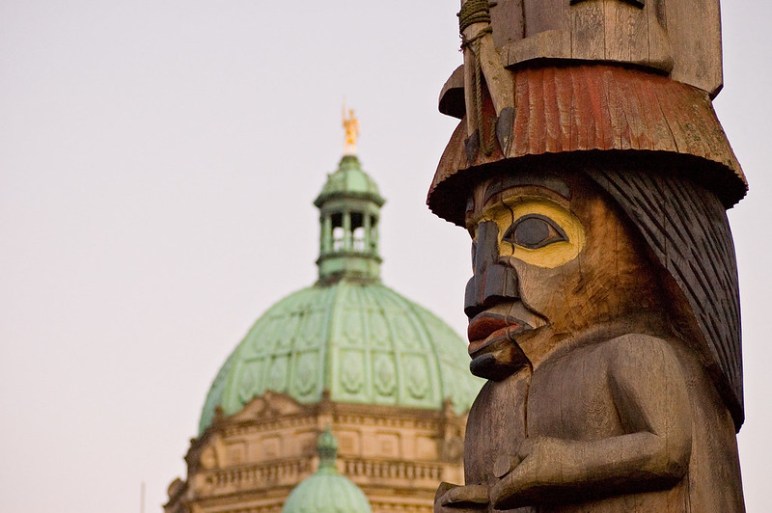
Photo provided by finalwitness courtesy of Flickr Commons – Some Rights Reserved

Policing in Canada’s LaLa Land

Hitting the headlines in the past couple of weeks was the fact that the NDP led government of British Columbia released a report by the Special Committee on Reforming the Police Act , dated April 2022, entitled “Transforming Policing and Community Safety in British Columbia”.

Fairly or unfairly, most times these types of reports receive little or no attention. This report by ten MPP’s seemed to garner headlines for two primary reasons; one being that both of the current political parties produced a bi-partisan report in a rare act of consensus; the implication being that this report could therefore actually result in action. Secondly, it was news because one of its eleven recommendations was that the currently contracted RCMP should be replaced as the Provincial level police force.

It is still a government report of course, so it will likely atrophy on those always burgeoning government shelves. Especially a report with especially grand recommendations. Even In the body of this ninety-six page report they state that enactment of their recommendations will take: “many years and successive parliaments to enact”. So if you are a bettor, bet the under, as the odds of retaining the political attention of successive governments are not good.

In terms of full disclosure, few of you who on occasion read this blog would be shattered to learn that there is a belief, that this once proud organization is structurally flawed and needs to be re-built. Nothing less than a tear down– if there is to be any hope of reformative change. If that is not possible, unlikely, or more accurately never undertaken, then there is little cogent argument against having the RCMP replaced in the Province of BC or any other contracted Province.

This current proposed structural re-alignment is not the first time that this has either been proposed. So no one should be shocked by a recommendation of this kind.

What is shocking is an actual reading of this report reveals some clear and deeply flawed assertions, some mis-held perspectives and is more a reflection of “woke” in-breeding than thoughtful contemplation.

What is truly appalling is the recommendations in this report which are not being talked about. Recommendations which are aimed at totally altering the policing structure in this province to the benefit of a single favoured political group. Even though they state that the goal was to work towards “modernization and sustainability”, the flaw and subjective bias in this report is revealed quickly at the very beginning of this report.

In their words there is a need to determine the “scope of systemic racism with policing agencies” and that their study must be “consistent with the United Declarations of the Rights of Indigenous Peoples”. Their underlining principle therefore is formed around the “increasing widespread awareness of systemic racism in policing…(therefore) transformal change is required”. This is of course a perspective that those in policing circles, if brave enough, would categorically dispute. Unfortunately, police leadership in this country are proving themselves to be sheep not shepherds.

To be fair one can not accuse this committee of not spending a great deal of time listening (and tax dollars) in the pursuit of their truth. They list over four hundred and ten agencies and individuals who came before them over the course of eighteen months. Predictably, there were the usual organizations, those that seem to appear before every committee: Civil Liberties, social workers, Downtown Eastside Women’s centre with a group called “Red Women Rising”, numerous Indian bands throughout the Province, Pivot Legal Society, and even the University of Victoria Environmental Law Centre .

The police were also more than adequately represented: the RCMP, the Chiefs of Police, various Municipal police agencies, Vancouver City Police, the Pacific Training Centre, Depot Division of the RCMP, Nelson Police Department, and the list goes on. One has to wonder what these policing groups thought of the final report and whether it reflected their views in any semblance.

This smorgasbord of agencies and individuals led the committee to come up with eleven recommendations based on hearing “clear evidence of systemic racism in policing as well as the colonial structure of police services”. Ironically, they also heard that many of the Indigenous communities were both “over-policed and under served” –all in the same breath.

The “clear evidence” of systemic racism is a little more difficult to find in the report. There were muddled explanations of that evidence, such as the one by the Human Rights Commissioner who found there were “patterns of behaviour..that create and maintain the power of certain racial groups over others”. How one patterns the entire report on a presumption, without definitive evidence of the underlying premise, is manifestly frustrating.

The police agencies appearing before the Committee, with little doubt talked about things such as service delivery, oversight, accountability, and funding. There was talk of the mental health and addiction issues, and the recommendations coming from that part of the world are also highly predictable. More resources, more funding.

So what are the Eleven recommendations? They are listed here as they appear in order in the report. I paraphrase them here, in the interest of brevity.

Leading the recommendations, first and foremost, is not the creation of a Provincial Police force but:

  1. That the Indigenous have direct input into the structure and governance of police services. The Indigenous need to be involved in the drafting of a revised Police Act.

The Indigenous clearly have now garnered a special advisory relationship in all matters of government whether it be pipelines, the environment, climate change, or lumber and mining, and this now continues into policing. Special laws and special courts already exist, and now their wish is for their own police departments. Their claimed expertise seems limitless. On page 64 of the report, they go even further in that there was a need to “establish robust and well-funded Indigenous civilian police oversight bodies…in all jurisdictions”

2. The formation of a BC wide Provincial Police Force.

This is explained as now being needed primarily because of the “fragmentation” of services. The report authors also point to the needs of of consistent education and training and the sometimes jurisdictional boundaries which interfere with communication and that consistency.

3. That the Indigenous have direct input into their police “service structure and governance”.

What the authors imagine is that the Indigenous be allowed to have their own self-administered policing services as well as the full governance over those services.

This recommendation also includes a revision of the type of training and education that will be required for all police services. In effect extending programs such as “Circle of Understanding”. In anticipation of this being a successful venture they hypothesize that the Indigenous police services may be able to expand and offer up their services to other non-Indigenous neighbourhoods and jurisdictions who are in close proximity. Logistically just to be clear, in this Province there are 13 municipal departments, and 65 RCMP municipal agencies. There are 198 “distinct First Nations”. Does that mean a potential 198 new police departments? (One wonders how one points to an apparent problem of the fragmentation of police services in the province and then recommends further fragmentation.)

The Indigenous want to be involved in oversight to “observe and oversee in (all) cases involving Indigenous peoples”.

4. That there be some revision of the Mental Health Act which includes integrating Mental Health worker attendance into the 911 dispatch system. They also recommend that there be “increasing investment in social services”.

5. That there be “equitable access to high quality police…” …which is “informed by the community”. It is not real clear as to what this even means.

6. An equitable shared “funding Model”.

7. Police Education to be increased.

8. The need to collect and report “disaggregated race-based” demographics. This is interesting because for a number of years, questions directed as to race involvement in crime were in and of themselves discriminatory. The intention here is that if they gather this disaggregated evidence they will be able to prove that there is racial inequality in the enforcement of laws in this Province.

9. Civilian oversight. Not easily done but difficult to argue against and most police officials would counter by saying that there is already policing/civilian oversight.

10. Review of the Mental Health Act.

11. The establishment of an all-party standing committee on policing and community safety.

Of course this report is much more effusive under each of these categories, but you get the intended direction.

The National Police Federation are already out on the hustings, running countering media spin, no doubt apoplectic at the thought of their union representation taking a 4,000 member hit if in fact a Provincial Force was formed. They are reverting to their tried and true arguments, calling the recommendation a “little odd” and a “little premature”. After all they say they have done “waves and waves of independent research in policing in British Columbia, and consistently British Columbians have told us they were very satisfied with policing they receive from the RCMP”. Of course it is not independent research, but that may be nitpicking, but they too are missing the point. This is not about individual police officers being liked or doing a good job. This is about the structure of an Ottawa headed police force being inert and ineffectual in terms of its ability to police portions of this country.

The possibility of a Provincial replacement force, first surfaced in 1994 under Judge Wally Oppal. It has now surfaced a couple of decades later, and will likely re-re- surface again a couple of decades from now. There is little need to concern ourselves with this recommendation.

As to the other recommendations. Public Safety Minister Mike Farnworth said the government would review the report and its recommendations and consult with “community groups” and “First Nation leaders”. Apparently you as the actual police, have no input here as to the recommendations.

This report is another ridiculous and over bearing attempt by the government to genuflect to the dialogue of the enlightened, to bow to a special interest group, regardless of the actual needs of policing. It would establish a fragmented policing structure, where different laws and different levels of enforcement would create two separate classes of individuals, laws and their enforcement based on race, not on equality before the law.

This report should be buried on the very last shelf in the dingy basement of the Legislature.

.

Photo Courtesy of Flickr Commons by Stuart Butterfield – Some Rights Reserved