Blog

Personal Story – “Heather” Part IV

It could not have been more serene or more stunning in the blend of water and mountain as the hiker walked the rocky beach of this rather remote parkland. The large lake mirroring the surrounding mountains and trees, made even more dramatic by a quickly disappearing sun, ushering in the colder air.

As the hiker absent-mindedly hiked the beach he noticed a form in the water, about 20 metres from shore. The glass smoothness of the lake made this milky white lump, very noticeable, impossible to miss, but at first glance not easily distinguishable. As he focused, a sickening thought intruded and closed in on him. It looked like a body and maybe even worse, it looked like a small body. He called 911. This call then was diverted to the nearest RCMP detachment who had jurisdiction for the area known as Golden Ears Provincial Park.

The lake at the heart of Golden Ears Provincial Park, is Alouette Lake, and is about 11 kms north of the town of Maple Ridge, a distant working class suburb in the Lower Mainland of British Columbia. It was a long forty-two kilometres from where Heather had been reported missing,

A busy tourist spot in the summer, with one road into and out of the Park. However, with the onset of Fall and the October colours, it becomes remote and almost deserted. The in and out access road is heavily treed with Western hemlock, red cedar and Douglas fir, all pushing close to the edge of the asphalt shoulders and sometimes overhanging the road.  A few hearty campers would still camp and there was always day hikers, but for the most part, standing by the lake in these surroundings,  you would not feel that you were close to any city.

Somewhat uniquely, the flow and level of the Lake is manually controlled by Park authorities, utilizing some sluice gates near one end of the lake. As winter approaches, and as a matter of routine the level of the lake is lowered.  So if one was inclined to dispose of body in the lake, unbeknownst to him, her, or them, the physical lowering of the lake level would allow for a body to be gradually exposed. The closer to the shore, this would become even more self-evident. Mistake #1 ? Perhaps.

It was late afternoon, as the body once brought to shore; was naked from the waist down while a horizontally striped sweater covered the upper torso. It was a similarly described sweater to the one that Heather had been wearing when she was last seen.

The young person’s face was now unrecognizable, water having its unkind way with human flesh as it always does;  both preserving and destroying certain parts of the body. The cold water would or could act as a preservative, but normal decay and the life in the lake could have the opposite effect, so they would work counter to each other, making trying to estimate the time in the water not an exact science.

The time of death would be hard to calculate with a degree of accuracy, and just as importantly, the actual “cause” of death, imperative to any “homicide”, may now also be hidden if not obliterated by this placid unassuming lake.  If this was Heather, and we were quite sure it was, then dental records were going to be needed.

As I learned the descriptors of the body, in its shape such as it was, I felt that I had to get hold of the parents regardless of whether positive identity had been made. They couldn’t be the last to know, so I stepped outside of the protocol, and called Pat. There was no way to get over there before the press otherwise.

Notifying someone of this type of information is gut churning,  followed by a feeling of emptiness, a feeling of uselessness, a time when you grasp for words, no matter how rehearsed. It is the hardest artificial human interaction. But, you are also responsible, you need to be the one that steps up, you owe it to them. After all, you told them that you would find their daughter.

Over the phone, Pat remained calm, or at least calmer than I would have been. However, twenty minutes after hanging up, I was alerted that we had had to send a couple of police in uniform to his house;  his girlfriend was calling saying Pat ” was going crazy”.  At last, at long last, he had broken, and his raw, abject misery was now on full display.

Mom was advised by the officers assigned to Jodie, Constables Helen Lavallee and Mike Wilson. I was not with her when she got the news, and for that I was thankful.

As Chris and I approached the Park gates it was six-fifteen, darkness had already fallen, and there was little we could do as a result. The media swarm had arrived, a few hours before us, with helicopters, and numerous reporters now being held back at the park gate.

There was nothing that could be done in the dark, so we agreed to assemble at the Maple Ridge detachment, to de-brief and prepare for the next day, and the further searching of the water and the Park that would be needed.

During the de-briefing, the attending officers described the media mayhem that they had faced. The intensity of days of pent up media demands can be overwhelming at times, and a media helicopter earlier in the day had to be forced out of the area, and a clear airspace established through Vancouver air traffic control. As it turned out, the helicopter had gotten so low to the half-submerged body, that the chopper blades were actually blowing the still semi-submerged body from its natural resting spot.

(The picture, or the “scoop” they obtained, was shown front page the next day; but it was a picture that angered many by its crassness and insensitivity; the Province newspaper lost 90,000 subscribers in the following days as a result.)

As decided the next day forty officers involved in the search were greeted with a bright and clear day, almost mocking the grim and painstaking task of walking arm in arm over the beach, looking for anything that could have belonged to Heather. If our theory was right, and Heather had been in the water for over two weeks, the water having retreated from the beach may mean that other belongings were actually on the stone beach, washed up.

After assignments were handed out, the searchers left City Hall the sight of our gathering, and began the process, aided by officers in boats, and a helicopter overheard.

Did I mention that within 20 kilometres of Alouette Lake there are six correctional facilities, three Provincial jails, two Federal prisons, and another for youth. At nearby Stave Lake there was a facility for convicted Sex Offenders. All of this adding to our list of things that needed investigative checking.

By this time, the investigative team was now working on over two hundred “persons of interest” as they say in the modern vernacular.

A few hours into the search, the officers on a skiff, located a large “hockey bag” submerged in 1.2 metres of water, but only a few metres from where Heather was floating. The lake was so clear, if you looked closely you could even see it in the notorious picture taken by the Province newspaper from the helicopter. The hockey bag had a broken zipper on the top, and it too looked like it had been in the water for quite some time. There was very little debris in the area underwater, other than the bag, and we began to immediately wonder if it had played a part in Heather being found in the lake. Had she been in the bag?

The search which also found a small hand made cloth bracelet on the rocky shoreline, near too where the body of Heather had been located. Later that afternoon, Heather’s mother Jodie, confirmed that in fact she believed that it did belong to her daughter, she had had made it herself. Another arrow through her soul and a death blow to her quickly waning optimism.

A technicians strike at the Lab delayed positive dental confirmation, but it would  eventually come through. This was “our” Heather at long last. It caused us all to take deep breaths, even though we expected this result. It still caused a pause, an ugly affirmation of the task ahead of us, a deep sadness and a resolve intertwined in this death dance.

The background media noise, always present, swelled up once again, once again to a fever pitch.  The media scratching their journalistic heads, trying to figure out a possible connection to the Maple Ridge area.

And of course, our investigative approach now shifted, and greater attention needed to be given to anything that hinted at a connection to this area with that of the Cloverdale area. The tip line, which had been slowing, now re-erupted, having drawn in the interest of those living in this 2nd geographic area north of the Fraser River.

Running in the background, other tips were coming in or being uncovered. The proverbial white van now showed up in Golden Ears, at least according to one caller. A stolen vehicle had been recovered on October 9th from the boat launch area in the park. Just two of the items which were contained in our nighttime review of the files, some re-assigned for further inquiries, all proving to be joining the growing pile of “unfounded” files.

The search however was proving to be very productive. By the end of the day at the Park, the bracelet was confirmed, but more significantly the hockey bag had been more thoroughly examined; and in that hockey bag, some undergarments, and jeans that would have fit Heather were found. Her shoes mysteriously were never found.

Some rocks were also found in the bag, no doubt with the intention of weighing the bag down. The speculation was now that Heather had been in the bag at some point, and as the lake lowered, she began to float free of the bag; only possible because of the broken zipper on the bag.

In this CSI age, everyone points to DNA as the magic elixir. To find DNA in this particular bag would be optimum of course, however, if the bag had been in the water for that presumed length of time, it may have destroyed any chance of extracting it. Reality versus television.

So this black “Winwell” hockey bag, a relatively common item, was now the first item found, that we believed likely belonged to the “suspect”. Not just a person of interest, we finally had a connection to a real suspect. We also had a 2nd geographic area, that somehow the suspect was connected to, as well as being associated to the original Cloverdale area.

As to the actual suspect, all we knew was that “he” (statistically at least) probably played sports. Rationally, it didn’t narrow things down much, but we believed that we now had an illusory “something”.  We were heartened by the fact that we may be finally pushing the investigation at least in a forward direction. A slow grind for sure, but at least it seemed to be moving.

Unbeknownst to us, it would be only two days later, on October 24th, at four in the afternoon, that a Maple Ridge “connection” would in fact be revealed.

We were still unaware that this investigation and this team, was about to go into overdrive, and time would no longer be on our side. Time would be our enemy in fact.

We were about to get the “break” in the case, a break that would begin our descent into the abyss of pressure filled days, and anxious nights, but we would be in full adrenaline fuelled throttle. The hounds would finally be on the fox.


Photo Courtesy of the Commons by Waferboard Some Rights Reserved

Merry Xmas to All….

To my few readers, first I wish to thank you for your interest and feedback over the last several months, as I indulge in this fantasy of trying to be a writer.

It has been a busy year, and like all of you I’m sure, one filled with the ups and downs of life. The good, the inconsequential, and the fearful, in this era of the Trump shadow. As Xmas day gallops toward us, for some reason it tends to make me look back with a poignant but peculiar nostalgia.

I always remember the Xmas’s lost, the Xmas’s where I worked, coming home to the kids, but sometimes coming home to an empty house.

The Xmas where I was the only officer in the town of Bella Coola, British Columbia, nestled in the middle of nowhere on the British Columbia coast. Rain poured in sheets, almost hurting as it hit the skin. I ate Xmas dinner with the only openly gay couple in town. They had recently purchased the local bowling alley, escaping and hiding from the city life they left in Vancouver. They took me in that Xmas, and served me a goose dinner in the attached coffee shop, while the rain lashed the windows in the restaurant while the dimly lit bowling lanes acted as a backdrop. It is a great and fond memory. I went home to the detachment, and then realized that the Xmas tree that I had cut was still on the back porch of the police residence, never making it into the warmth of the house.

There was the many Xmas’ working in uniform, where by three or four in the morning you found yourself parked along side another officer, smoking, or drinking coffee, yawning uncontrollably, and wondering how you were going to be able to stay up when you got home. Praying that there was not another call coming your way and you could bask in the nothingness of pre-dawn.

There was the  Xmas in Newcastle New Brunswick where I answered the domestic disturbance call. I pulled into the driveway on Xmas eve, just as the overwrought husband through the Xmas tree through the front window, landing in the front yard still adorned with bulbs and lights. I arrested Dad, but I still wonder how and where those children are now, what kind of adults they became and I hope they are ok now.

Now that I think of it, I think I spent more Xmas’ with criminals. This is not intended to imply that this was always negative.  People seem to change a bit over the holidays, even the eight per cent of the population that we dealt with routinely as police officers.  A lot of laughs were shared over the cellblock counter, despite the often desperate situation they found themselves in, and it was not unusual to see goodwill extended to others while there. As they feasted on the government supplied meat pie, slice of white bread, and instant coffee they were pretty far removed from the turkey extravaganza but they seemed to appreciate you being there in some sort of misplaced way.

There  was also something emotional about being out in the middle of the night, patrolling, sometimes alone, standing herd over the darkened houses. It gave you a sense of real, measurable worth. Things always seemed pretty good.

So to those of you who find yourself sitting in those same police cars, biding time, counting the hours until dawn, sneaking into the radio room to scoff down Xmas cake and cookies brought by considerate dispatchers; enjoy it, as it is a fleeting feeling.  It is a Xmas not experienced by most, and it highlights the sometime and somewhat elusive purpose to your profession. Police officers in Toronto, in New York, and in Brandon, Manitoba are all having and sharing that same feeling, as they stretch, and look up at the brightening sky.

Then go home and hug your kids if you have them, if you don’t, hug someone else’s kids. Yours was the night, but now the day belongs to them.

Merry Xmas everyone….may you always come home to a full house….

Pete

Image Courtesy of Creative Commons by Coral Lacey entitled “Deerly beloved” Some Rights Reserved

Personal Story – “Heather” – Part III

It was now 0500 in the morning of the next day. So with the third or fourth coffee in hand, and we were back in the Surrey detachment main office, anticipating what was to come, somehow knowing that this office, this desk, and these walls could be my home for the foreseeable future.

Although it was distant from Cloverdale and the search areas, I also knew that this place, once daybreak arrived would begin to take on an atmosphere of its own. There is an ill-defined energy which any homicide generates in a police office. People coming and going in various stages of fatigue, an air of practised urgency, and every once in awhile it would be interrupted with sporadic shots of adrenalin due to some unexpected turn in the evidence.

This early inherent urgency, or drive, can sometimes be short-lived.  There seems to be a direct correlation between victim type and the length as to how long an investigator can keep a file moving.  In this case, a small girl was a possible homicide victim, and she was still missing, in some senses an investigators nightmare.  Twenty hour days would be the norm. There would be less bitching, more cigarettes, less week-ends off, less time with one’s own family, and pizza would be the culinary favourite.  It is not like the television shows in that it is not as emotional as some would like to portray it; it is more of a machine kicking into a higher gear, but like a marathoner, where one had to control pace, and hold focus.

This first quiet moment between Chris and I was therefore likely to be the last for awhile, just a momentary pause.

This of course was the “old days”. So this investigation done on paper.  Hand written reports, forms and notes, would become the 8″ x 10″ medium through which the investigation would take shape. Paper would be filling cardboard boxes, and those boxes would eventually take up spaces around us, giving a bit of a warehouse feel. Often Librarian skills would be more advantageous than investigative skills.

Each piece of paper being assigned a number, each piece of paper being a separate piece of information. If an officer filled in a report, and it addressed or revealed four pieces of other information, then four separate reports would then be generated, then all wold be put in four different folders pertaining to each item. Laborious? You bet. Efficient? We thought so. But of course the coming digital electronic age would make this all seem comically archaic.

For instance, if we had to  search for a single item. Well we had to remember where we had seen it, and in what folder. So, as an example, if someone mentioned a white Ford pickup, we would have to remember where we read it, and in what folder. It worked well when the file may be only a couple of hundred folders and a couple of hundred pages. It relied on a good memory and a concentrated effort.

However, when the file reached thousands of pages, as this one would, it became an exercise in re-reading, duplicated efforts, and it was often frustrating. Overlaying it all,  like Poe’s Raven, was the inherent fear of missing something key to the investigation.

As the days came and went, in amoebic fashion the paper would grow, taking on a life of its own. Everything found, every person spoken to, every news item mentioned, every tip called in would need to be read, documented and filed. It was a mind numbing process and complacency was the enemy. Any follow up was hand-written and forwarded to the individual investigators. An increase in investigators naturally led to an increase in paper, the Catch-22 of police bureaucracy. In a few short days, the investigative team would grow from two of us to over forty or fifty individual investigators, borrowing from Robbery, Serious Crime, and other sections within the detachment.

Decisions big and small, would need to be made as fast as the questions could be uttered, answered more by instinct than a layered thought process. There would be no time for routine debate, or second-guessing, hoping beyond hope that somehow we had learned something over the years that would not let us down, or cause us to overlook something in our needed haste.

And of course there was numerous calls from the general public, which led to the establishment of a “Tip Line”. My immediate boss, Sgt. Mel Trekofski, wanted to pitch in, and offered to take up the monitoring of the tip line, a thankless task at the best of times. It required “carding” each individual, call-backs to verify the information, and therefore seemingly endless conversations with persons, some good, some ridiculous.

As the file went on, over five thousand tips would eventually be received, with over forty psychic callers alone. The self-described “professional” psychics would all offer up where the body of Heather could be found. So you heard the “Woods”, the “water”, and “buried in a shallow grave”. There were many calls where they went on to say who was responsible,  and in many instances it was “the father”.  But, if not then a “white individual” who “worked with his hands.”  Some even offered to take investigators to the body, something we couldn’t ignore, but of course these did not pan out, but did extend my belief that there were a lot of “crazies” in the world. I never had a paranormal observer, if Im being kind, solve a file for me, and this wasn’t going to be the first.

The logistical jigsaw puzzle continued as we needed to address staffing issues and all the usual secondary administrative issues, at times like a Rubik’s cube, multi-dimensional, spinning on the singular axis of trying to keep the investigation on track.

As the searches ended, the neighbourhood inquiries continued in earnest, as did the forensic examination of objects which had been found. Investigators were assigned to each parent, and other investigators began criminal record checks, as well as local police record checks, on all individuals spoken with or identified as part of the investigation.

Panties, jeans, shirts, jackets, socks, sandals, some of which were in dumpsters were shown to the parents in the event that they had belonged to Heather, and if not, catalogued and maintained in any event.

Neighbourhood personalities, like “Pedophile Darcy”, surfaced through the townhouse inquiries as we began to dredge through the individuals in the Cloverdale complex, and the other people in the neighbourhood. “Darcy”, was typical of the type who surfaced. Darcy, of course, drove a white van, and in his past had been caught masturbating on a child’s  bed, and had a record of sexual assault. So he became a subject of our surveillance team, and in the end we were able to eliminate him from any involvement. There were others similar to Darcy, and each took time, each tip had to be ground out, and it took several days to eliminate Darcy and the other archetypes as they surfaced.

Checks through our VICLAS (An RCMP victim Classification software) system for this area of Cloverdale surfaced a possible fifteen individuals of interest because of their sexual predations. Each of these individuals would be located, interviewed, and reported on. Each would need to provide an alibi.

Checks of all those with criminal records for sexual assault and now free in the broader City of Surrey of which Cloverdale was just a suburb, revealed another five hundred possible “individuals of interest”. It would take years to eliminate that many so we had to narrow the search, at least in the short term, to just those that had violently offended on pre-pubescent children living in the Cloverdale area. This still gave us twenty-seven names. Investigators were assigned to each.  It may surprise some to realize that in most cases these individuals co-operated, and were expecting us. When the investigators arrived some had even already prepared their statements and had their alibis in order.

Others, of course would try an investigators patience, testing their emotional mettle, and you could not help but be pulled you down into the dark reaches of sexual perversion.  In matter of fact voices, they would describe how it couldn’t be them involved, as their method was different in terms of the suffering they would inflict in their need for sexual satisfaction. Some described why she could be alive, to be kept as a sexual play toy.  Any killing of her would have be only to get rid of the evidence, and a “waste”,  and any killing of her would be a signal that things must have gone wrong. This insight would later prove to be accurate.

A crack dealer living in the complex, who had been described by persons in the complex as coming and going in another  “white van”  became an obvious possible suspect. Once identified, he admitted to dealing drugs, and offered up his sales notations, his “crib” sheets as evidence of where he was at the time of Heather’s disappearance. No “normal” criminal he explained likes sex offenders; whether in jail or on the street and the drug dealer wanted to help.

As the investigative team grew, briefings, and de-briefings were our life-blood. Every morning at about 0630 I would brief upper Surrey detachment management, and then at 0730 I would brief the investigative group as to any developments or any change in focus. At 4:30 in the afternoon a de-briefing would be held with these same officers to learn of any highlights. In between of course there was the media to deal with; calls dealing with expenses, computer check results, surveillance assignments, tip line results, and other more sundry items.

By 6:00 pm, as things slowed a little, I would sit in front of a stack of reports, about 2′ high, and begin reading. Chris would then read the same paper after me, just to insure there were a second set of eyes. We would check for any cross references, then the paper would be filed, new follow ups drafted and assigned. Coffee was my particular drug, and stretching for the long walk to the bathroom began to be a highlight which broke up the trance like nature of our task.

Three or four hours fitful sleep a night would be our routine.  Upon returning to work, the process started again. Days drifted into nights. Nights became sunrises.

Suspects surfaced and then drifted away after examination; mounds of dirt reported as shallow graves were examined and dug out; clothes continued to be turned in; suspect vehicles were identified from having been seen in the area; and the psychics from around the world persisted on being heard, each with their own, but similar investigative theories.

Americas Most Wanted called wanting to profile the case. That in turn generated two tips that proved of no value. Europe, and parts of North America were all now paying attention.

We read, often re-read, re-shuffled, and then sometimes re-assigned.

And of course, there was the ever present media, their trucks stationed inside the complex itself,  giving nightly broadcasts and voicing the concerns of the general public. With Halloween getting near, they often regurgitated the growing parents concerns with a killer “on the loose” and asking whether they would let their children go out trick or treating.

As the investigation wore on I kept remembering how I was once told (by who I can not remember) that in every murder there are five mistakes made, its just a matter of finding out those mistakes. Simple really.

Of course every murder is different, every set of circumstances different. In this case we believed that this had been an “opportunity killing” by a stranger, and likely sexually motivated. Statistically, at least, the most difficult of all types of murders as these things go. Many remain unsolved. For instance, in 1996 only 14% of homicides were committed by a stranger. In 1976 it was only 18.4%, and in 1985 17.3%. Consistently low numbers.

If you looked further, and included the age of the victim, in a U.S. study only 3% of homicides were committed by strangers of victims under the age of 12. When a sexual related offence was the motivation, it drops even further down to 1% of the cases.

In checking with the FBI on this case, we learned that there had been only 4 or 5 of these cases in Western North America at the time of Heather’s disappearance in the year 2000.  So although abduction of a child is a parents greatest fear, it is actually an extremely unlikely event. Patterns are harder to detect, as there is insufficient historical data. A serial offence on children was almost unheard of, but of course none of the statistical data, or lack of data was of much consolation for the mother and father of Heather.

Investigative pressure does grow, from the public and from within. Maybe not at the levels of the tv drama series, but it is there. The greatest pressure is put on by the investigators themselves. At some point you begin to realize, rightly or wrongly, whether solved or unsolved, that this investigation will be attached to your name, especially in police circles. You will be perceived in a different light in the future.

A sense of pride takes over, the not wanting to be beaten. The emotions shut down, as the  constant images of the victim is too disarming, too distracting. One could not function coherently if you allowed yourself to become fixated on the depravity of it all, the senselessness of it all, the speculation as to whether Heather was alive or dead. To contemplate her alive and being held was in some ways an outcome that could be worse than death.

As a bit of an escape, a need at the very least to breathe fresh air, both Chris and I took a few hours on a Sunday to step away from the office. It was day twenty-two, and I decided to drive up the Coquihalla highway, a lonely stretch of highway in the middle of British Columbia, surrounded only by trees and rivers, just in an effort to clear the fog which had permeated my nerve endings. I stopped at the only rest stop, perched at a 3000′ elevation, three hours from Surrey. It was cold and gloomy, but I went into the darkened men’s washroom in this remote part of British Columbia. There at the urinal, staring at me was the Missing poster of Heather, eye level. I had always taken pride in my ability to disassociate from files when away from work. But clearly, this file was not going to let me do that. There could be no escape, not now anyways, so I decided to head back.

As I drove down the steep decline through the highway snow-sheds, once again I began to fruitlessly re-trace all that had been done, despite my blaring radio trying to change my obsessed thought process. I kept coming back to the fact that we needed to find one of those proverbial “mistakes”. I was not greedy, not all five, just give me one.

As I approached the Detachment in the darkening hours of the afternoon, just to check in, that I got a phone call. I needed to get back a little faster, because they think they had “found” Heather.

Photo Courtesy of Creative Commons by TrixSigio Some Rights Reserved

Personal Story – “Heather” Part II

The Search and Rescue encampment at two o’clock that morning was across the street from Heather’s townhouse complex; in the parking lot of the Cloverdale Race Track, which only hours before had hosted a few hundred people attending either the harness racing, or the weekly flea market that was encamped there every Sunday.

It now had gone into night time mode, a few persons walking in and out of darkness, three or four vehicles, lit by headlights,  and some tents with hanging lanterns. A quiet had settled in, a quiet amplified by the surrounding darkness, and it was here that I dropped off Pat Thomas. As I drove away I saw him receiving some hopeful assurances from those search leaders that had remained to organize for the coming morning. He looked alone, impenetrable, in a haze which could not be dispelled by any spoken words.

As we drove out and headed back to the office, the size of the search, and the undertaking we were going to embark on, began to take shape. After discussing the matter with the search masters, we had decided to organize and plan for a one mile radius search pattern, with the townhouse complex being the epicentre; a circular mile in all directions. At first blush that does not seem very big. We were a touch optimistic and naive.

This would include, earthen ditches and metal culverts, smith rites, overgrown brush, playgrounds, residential yards, businesses large and small, under houses and sheds, and hundreds of garbage cans. Any receptacle or place that could hide a small 10 year old girls body, and any clothes or objects that could belong to that young girl.  A search of this intensity turning up all sorts of detritus, that may or may not relate to Heather, and each piece of “possible” evidence had to be screened by investigators, catalogued, and eliminated or confirmed.

We were also very close to the centre of the village of Cloverdale, and 176th St which was the main thoroughfare to the U.S. border which  just a few miles away. The thought of having to search the farmland, every street which was interlaced with eight foot deep ditches, as well as the public parklands, and the myriad styles of condo and single family  residences was daunting.

In the back of our minds, there was an omnipresent uneasiness, that maybe this was all for nought. Maybe Heather had been put in a car or truck and may have been literally out of Canada in thirty minutes.

The hub of the investigation, and what had to be at the centre of our concentrated search was the townhouse complex itself. About fifty residences, with an unknown number of occupants in each, children, teenagers, and adults. Parents that could be uncooperative at times, overly cooperative at other times.  Adults from all cultures and levels of socio-economic status. Some may be unwilling to point to anything suspicious either to safeguard their neighbours, or to hide something else that may be going on in their own sphere. And canvassing and seeking the help of all would be voluntary on their part. There were no evidentiary grounds to get warrants for individual residences. Each residence had the potential to be hiding Heather, dead or alive.

By five in the morning, now back at the Detachment, fresh coffee in hand, Chris and I began to organize the file, and prepare for the oncoming police shifts. The night had provided us some privacy, and gave us a false sense of quiet.  Daylight we knew would bring chaos, and awaken the RCMP policing giant which would demand and need to be force fed the “latest” information; so they could in turn feed others in the police food chain. Briefings would become part of my core existence, often taking away valuable time, maybe relevant, but never usually forwarding the investigation, and sometimes it seemed only to feed the voyeuristic nature of police command.

As the sun rose, the search groups went into full throttle, and vehicle after vehicle started to become part of the encampment in the parking lot, taking on the air of an  invasion group. The nearby 7-11 convenience store would draw numbers like a WalMart, all manners of uniform, buying the staples of policing; coffee, sunflower seeds, chocolate bars and pepperoni sticks.

Over the next three days, the searches would grow to over ten different Search and Rescue and Police Agencies. They came from Vancouver, Washington State, Squamish, North Vancouver, Coquitlam, Burnaby, and all points in between. Many of the police and fire that showed up were off duty and were also volunteers.

Dive teams would eventually swim the ditches, feeling for or hoping to bump into something solid, as in the mud filled waters, visibility was zero. Bloodhound dogs were in boats on the water areas, able to smell below the surface. Our own police dog services checked yards and fields incessantly.  The constant whirring of helicopters overhead was endless, as they supported the ground searchers, creating a sense of dramatic urgency.

A call went out for volunteers from the community to assist the other searchers as the geographic size of the search began to hit home.  By day three, 1200 volunteers from the community would show up. Even more were turned away. It was amounting to one of the largest searches ever conducted by the RCMP in Canada.

Could the suspect be in amongst the volunteers? Watching, keeping track of the investigation, or getting some sort of adrenaline rush. Maybe.

Upwards of 1500 people were walking through the wet fields, an arms length separating them. Some were carrying sticks and prods, to poke at anything underfoot. All walking in line, covering a mapped out grid, a human wave slowly rolling over the centre of Cloverdale.

Nothing is too small to be interpreted as evidence, especially with the voluntary searchers who intensely wanted to be part of a solution to Heather.  They uncovered and pointed out sanitary napkins, clothing, footwear, letters, anything and everything that  could be left or thrown to the ground. Garbage cans were emptied, leftover food, bottles, papers, baby diapers covered in ashtray refuse, were all dumped on the ground and then sorted by hand, letting the debris fall through ones fingers to act as a rudimentary screening device . Your olfactory organs were tested, but by the end of the day your senses became numb to the stench. Hundreds of items were seized for further examination.

For the first few days, the media scope and attention grew, daily leading most newscasts on the three television networks; now being spurred by international attention in the U.S and Europe. All started with the picture of Heather, the pretty girl in her school photo who with her staring eyes reflected your typical pre-teen, anyone’s daughter. Her photo was everywhere, stacks of her posters always on our desk, always watching over your shoulder, and as the clock ticked away, and days and nights were less discernible, it seemed to me to became more personal.

As we entered day three, the media broadcasts which had initially focused on the need to “find” became more sombre, there was a shift in tenor, the term “hope” was less used. They interviewed every passing person, child or adult, especially those who lived in the complex who would be willing to say a few words to the camera and the desperate nature of the search.

Still no tangible sign of Heather. The bike used by Heather which was found by neighbours within minutes of her disappearance was still the only single piece of evidence we could tie to Heather. There was no suitable DNA or fingerprints on the bike. On one of the days, in order to both keep up the public interest in the search and to help feed the media, I brought out the bike to be viewed by the news groups and to answer questions. Every 6 o’clock news broadcast led with the story of the search for Heather Thomas, as it would for the next several weeks.

One of the investigative thoughts was the possibility that if this had been an “opportunity” type offence, then maybe the suspect had her hidden, but not in a spot with which he or she was comfortable, and would therefore, when the neighbourhood scrutiny died down, the suspect would move the body to a better hiding spot.

So, in an effort to prompt the suspect to move the body, after three days of searching, we officially cancelled the Search, much to the dismay of the general public who inundated our office with frustrated messages. But then, after waiting a few days, letting a form of normalcy to return to the complex, we re-organized another search day to go over the same ground near the complex. It too was to no avail.

A sex related homicide was now, statistically, becoming more of a real and eventual outcome. A dark outcome for sure. We had also spent a great deal of the crucial hours and days on the search, that first 48 hours, without anything to show for it.

Hundreds of items had been seized, checked and eventually discarded as not belonging or related to Heather.

Hundreds of people from the community went home each night a little more discouraged with their search efforts.

It wasn’t for lack of trying, or for a lack of attention as every post or hydro pole in Surrey had stapled to it a picture of the missing Heather. Heather was now known to the community and the City, her fame though not wanted by any parent. A parents purest form of mental hell.

Admittedly, in the few quiet thoughtful moments, which were getting rare, I just wished that Heather would walk through the door, apologizing for running away, worried only about facing the wrath of her parents.

Did I mention that I was a single parent with an eight year old daughter at home? Always late getting home, I would visit her in her bedroom where I would always find her sleeping peacefully, her chest rising easily with each breath, thankfully oblivious, thankfully warm and dry.


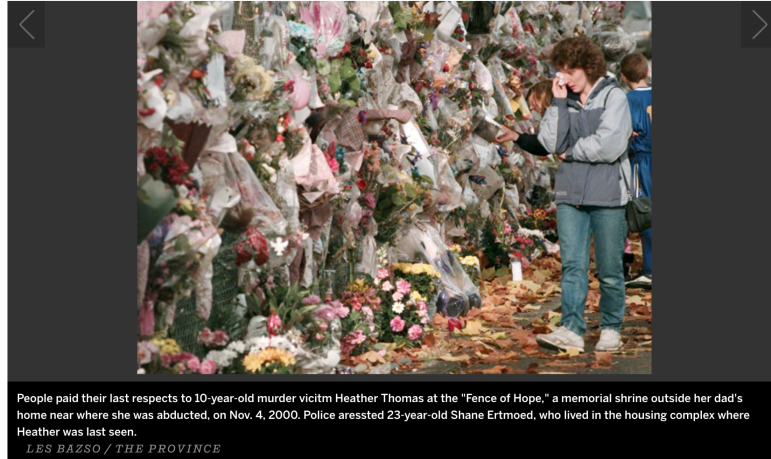
Photo Courtesy of Chris at Creative Commons Some Rights Reserved


“Darkness can not drive out darkness; only light can do that” – Martin Luther King

Cosby and his Fat Albert characters, Weinstein and his movie interests, who has become “Derailed”, Louis C.K. and his large comedy presence selling out Madison Square Gardens, Spacey and his House of collapsing Cards and most recently Charlie Rose who seems to have enjoyed flashing in his bath robe more than an in-depth probing interview.

All now overcome by the recent tide of sexual inappropriate behaviour, narrated in explicit undertones flooding over the United States airwaves. CNN has recently compiled a list, a list which they had to break down into the various categories of professions in order to keep it clear and concise in terms of the various sexual complaints being levelled. All revealed in 48 hours, in colour, and in righteous commentary.

Guilty with no trial or recourse, with most of the detail probably proven to be true,  but possibly not all of it. (Think Jan Gomeshi of the CBC where the complainants were proven to be totally unreliable) We are returning to the days of the lynch mob, led by a Liberal government, who believe in human rights and the right to free speech, unless of course you disagree with them.

One can not help but be overwhelmed, but I must admit to not being overly surprised. I have lived, like those of my generation, in an era where inappropriate behaviour was observed on an almost daily basis and the world of policing was no exception, in fact it may have been even more pronounced in this machismo environment.  In terms of levels of offence, the most observable would have been considered to be on the lower end of the scale; the leering looks, the inferential sexual comments, but the offences go all the way to criminal sexual assault. It was considered to be “way it was”, and the females learned to avoid the usual suspect cops, as there was no avenue open to them. The RCMP, alarmingly, to this day has no Human Relations department, so those who found themselves in untenable positions could only go to their immediate supervisor, who could very well have been the problem.

Whether it be the shoulder rub on the night shift, the questions about their love lives, and the casual groping at the after-shift party, it would have been impossible for any officer of the RCMP to say that they had not seen it. Can anyone of my generation deny having heard the expression “road trip rules” and its implications, where drinking and partying, and fraternizing was almost a rite of passage, often led by the married, who often acted as if having been released from a cage.

Women were considered “one of the guys” if they behaved inappropriately in return, tried to be as lewd as the guys, or told dirty jokes. Was it all some sort of defence mechanism? In most cases, likely yes. And lets not totally limit it to males, I also saw behaviour of women officers that would not be considered appropriate, all part of the rough and tumble image of policing. Uncomfortable, laughing acceptance was the norm.

I need to be clear. Did I ever witness sexual assault? No I did not. Did I ever witness sexual inappropriate behaviour as part of a bullying or power move such as in a Weinstein, where a reward was held out? No I did not. Did it occur, of course, there can be little doubt.  I learned of many serious incidents that required internal investigations, which invariably never ended up in any punishment, or at least a punishment that could be observed.

The image of policing, real or imagined, made it susceptible to this behaviour.  Joseph Wambaugh who wrote “Choir Boys” in 1975, which went on to become listed as one of the best crime novels of its time, and was a novel that glorified “choir practises”; the after shift get togethers, where copious amounts of booze was drunk, and parties with the bar maids, or the female officers was the central theme. Management looked the other way, all of it allowed and justified as a way to blow off steam, a psychological release from the vagaries of policing.

So in todays headlines, Global News is now reporting that 1100 women out of a potential 20,000 women that served since 1974, have begun the process of claims of sexual harassment by the RCMP.  This constitutes 5% of women who served during this time period who are making claims.  Three hundred and fifty three of those women have already finished up their claims, and submitted all the documentation. Seventy-two  of those women have had their claims settled. “Most” that have been dealt with so far, have been termed as “legitimate” by the overseeing Judge Bastarache. This quagmire is about half way through the reporting period.

There should be little doubt that it will go much higher. Many will be settled with little or no further investigation. If there is any substance there will be payouts. The fact that there is no provisions for in-depth investigation of these matters means that there will be some claims that will be part of the band wagon effect as there always is in this kind of structure. That is the nature of the beast, a rich beast with a $100 million bankroll, where few questions are asked, the assumption being one of guilt rather than innocence as a starting point.

That being said, just as clearly this is the biggest cover up of inappropriate conduct by a Federal agency or a policing agency in history.

Then Commissioner Bob Paulson and Solicitor General Ralph Goodale have orchestrated and condoned this cover up, no doubt to cover up a stain on the RCMP that may have been too large for the agency to handle and still survive. A Canadian version of “too big to fail”.

Is it possible that the complaints went all the way to the top, including Paulson, who with crocodile tears apologized to the offended women? We will never know. The cloud will forever hang over this historic organization.

All of it of course is legal, as Mounties, some of who have reached the highest levels, hide behind the claim process, shivering, but unobstructed in their pursuit of their careers. No names will be given, no details will be released, and all the women with legitimate claims will be paid out in order to guarantee their silence.

In  E Division, the RCMP’s largest division of officers, and where I spent a great deal of my service, I personally know of several high ranking officers who were investigated for sexual inappropriate behaviour,  and there were no observable consequences.  Some of those officers are still at work today, not only surviving but having been promoted a few ranks.

Of course I am not alone in thinking this is one of the biggest cover ups ever perpetrated in the policing world.  Several groups are calling for greater openness and transparency, pointing out that a Force which holds itself up as the paragon of virtue should at the very least provide greater details. Is it possible that the RCMP is harbouring 1100 offenders amongst its ranks? Of course, although to contemplate such a number is staggering.

The RCMP says it is working to get rid of this culture, but it has no problem allowing offenders to stay amongst their midst. Your National Police Force could have hundreds of officers who behaved badly. Interestingly, our Prime Minister Justin Trudeau who prides himself as the great defender of women, who crys at the mention of any historic wrong doing, and who was notably absent during the press conference, signed off on this agreement. The story will continue over the next few years, nothing will have changed, no one in the policing world will be held to account. It will tarnish the RCMP and all those that were part of this era.

If there is anything which grates on an old investigator, it is when justice is denied. It is when a case becomes de-railed by circumstances no longer under their control. When the perp smilingly walks free, when victims sit in courtrooms with bowed heads, feeling they have been let down by the system.

The police are the last hope that justice can be brought, arbiters of truth who are not swayed by the politics of the day, where the facts are finally brought to light, regardless of the consequences. It is the police officer where children are taught to go if in peril. It is that image which is in jeopardy.

The silence on the part of those in the current RCMP, on the fact that individuals amongst them are beating the system is deafening. The unfairness of everyone being tarnished by the same brush is a second unanticipated and dire consequence.

The RCMP and the Liberal government are now using the system they are mandated to uphold, hiding behind a flawed judicial process which does not allow any light to shine on their behaviour, a political and legal loophole.  It embarrasses me, but the fact that the perpetrators carry-on disgusts me.

So as Cosby and Weinstein will pay a massive price, as they should, their careers ended, their reputations sullied for life, a group of RCMP officers, in their bright red serge will continue marching. They will continue to expound how they are working on changing the “culture” of the RCMP. A $100 million of taxpayers dollars set aside to protect the individuals who make up that culture. No justice to be brought upon the perpetrators. Two polar results, the instant justice in the U.S., and a complete slow moving coverup by Canada’s world renowned police force.

Photo courtesy of FLICKR Creative Commons by JPMPINMONTREAL Some Rights Reserved

Epilogue:

Since this post, the numbers, which officials predicted could be as high as 1000, has now reached 4200. So of the 20,000 who were eligible under the time frame given, now 20% are claiming some form of sexual harassment. Minister of Public Safety said if the monies become in excess of $100 million, there will be more approved.

These numbers give me some pause as the business of reporting is a 35 page form, and the investigation of these claims is negligible, and with the monies apparently limitless, there is little doubt that some fraudulent claims could surface. But we will never know.  This miscarriage of justice will continue….


Personal Story – “Heather” – Part I

I received a “page”, seventeen years ago, that irritating incessant beep which kept repeating every few seconds. The message was always a phone number to call and receiving it implied by its very nature a sense of urgency. In some messages the phone number would be followed by a -911, to further underline the urgent request, which was the case in this instance.

As a member of the Serious Crime Section of Surrey RCMP Detachment, it usually meant that there had been a death, or somebody was barely hanging on, closer to death than life; and that it was likely violent, but above all else, that it was somehow “suspicious”.

It was 10:15 pm, on October 1st, 2000 when I got the page from my Sargent in charge of Serious Crime, Mel Trekofski and he in turn asked that I call to “partner” with me that night, Constable Chris Drotar, also a member of our Serious Crime Section.

Unbeknownst to us at the time, this particular page would change our lives, it would alter our perceptions of man’s inhumanity to man, and it would test our physical and mental abilities to a limit that we likely didn’t feel possible at that time. And thankfully, it would not be often repeated through the course of our careers.

We knew from the initial information that a girl had gone missing, a 10 year old girl, in fact.  Her name was Heather, and she was the daughter of Patrick Thomas who lived at the address. It was a little discomfiting to learn that she had in fact gone missing around 5:30 that afternoon. Already we would be starting with a time disadvantage, which in our world can sometimes mean the difference to success or failure.

The mother, Jodie Thomas was estranged from Patrick and lived in a different part of Surrey and would not be at the house.

Heather and her brother were at their fathers in Cloverdale,  as part of that common suburban divorce dance of shared custody. It was his week-end, but this was Sunday, and the kids were due back at Mom’s. But then things changed.

Search and Rescue had been and were still involved, along with all the neighbours who lived in the complex. Nothing of significance had been found as of yet, but the officers who were in attendance felt that “Dad” was acting strangely, and it was for that reason that we were being called; to interview Dad. The implications were obvious and unstated.

It was a typical October night, wind slighting blowing, leaves beginning to fall but not yet in full decomposition, coloured, but still clinging to the trees. We were asked to attend to Unit 26 at 17722 60th Avenue, in the usually quiet suburban area of Cloverdale, part of the not so quiet City of Surrey, B.C.

As we arrived in the dimly lit complex it was quickly noted that directly across the street was the Cloverdale Fairgrounds and the Racetrack. This was a Sunday, and on this particular day the expansive parking lot during the afternoon became a massive flea market involving hundreds of people. At the time of Heather’s disappearance there could have been thousands within a few hundred yards of the housing complex.

The wood construction of the worn town homes showed the usual green tinge along the edge and rooftops, mold that comes with incessant rains. It was an older complex, u-shaped so you could drive in a semi-circle and go out the other side.  It showed no signs of recent care, just the wear of years of  many children, a complex of about 50 units, who through its life was mostly populated with single parents and young couples starting families. Blue collar, trying to make ends meet, with a tinge of a criminal underbelly always found skirting the edges of poverty flecked neighbourhoods.

As we arrived,  it was quiet, as the people of the complex had by now retreated into their individual homes, no doubt staring out from behind partially closed kitchen venetian blinds.  Almost all had been searching for Heather around dinner time, all likely knew that she had not been located, so one can imagine the variety of explanations given to curious children as they got ready for bed that night.

As we drove up to the residence, with that usual mixture of adrenalin and apprehension, we were fearing the worst, but not quite prepared for that being the case.

The greeting uniform officers, who were unusually quiet, told us that they had searched the residence thoroughly, which is the first place to look for a child. Dad’s vehicle was parked out front, and it too had been searched with nothing found.

Inside the town home, it was like hundreds of others I had been in; some worn furniture, some new, usually a prominent t.v. and the usual evidence of active children. Right at the door, in clear view, was a knapsack, clearly a girls adorned with the usual hanging customized knick knacks which signalled that a girl owned and cherished it. It was in a position clearly in anticipation of heading out of the residence. It was clearly Heather’s and clearly untouched from hours before.

Chris and I introduced ourselves to the father, who sat in the living room, emotionless, wearing jeans and a collared shirt. Blonde, and blue eyed, of average height and build, a good looking man, he was staring straight ahead, saying little, no tears, no anger. There was little in his eyes, which is almost always the giveaway.  Nothing in his composure which indicated a reaction to  the most hellish of torments for a father. So, it was quickly apparent what the original attending officers thought was “unusual”.

I asked Dad if it was o.k. if we conducted another search of the residence, and his vehicle and he quickly and quietly agreed. He did not question why we were being this thorough. I also asked Dad if he would come to the police office, where we could take a statement, which he also readily agreed to, with no questions.

So at quarter to one in the morning, we sat in the interview room with Pat, whose demeanour remain unchanged.

Pat’s story was this.

Pat had been working on some carpentry in his residence. The two kids, Heather and her 8 year old brother Chris had asked around 4:30 to go out and play around the complex while they waited to go to their Mom’s. He said yes, but told them that they had to be back by 5:30 so that he could keep to the proscribed schedule.

Around 5 Chris came into the house, but without Heather, and Pat told him to go get his sister so that they could get ready to leave. Chris went out, could not find Heather, and came back a few minutes later saying exactly that.

Showing the usual parent frustration, Pat packed up and went out into the complex.  He began looking, talking to the various kids and parents as to whether they had seen Heather. It was learned after a short time from some of those parents, that she was last seen riding a 2- wheeled bike that she had borrowed from one of the other children.

A few minutes later, the borrowed bike was found, but no sign of Heather.  According to one witness, the bike tire was still spinning when they found it, near the front of the complex, in a parking stall on its side.

After we finished the interview around 2 in the morning, we were still just as confused as to Dad’s reaction, or more accurately, his non-reaction. Throughout he was totally co-operative, but he never mentioned the proverbial elephant in the room, which was whether we suspected him as doing something to his daughter. He just answered our questions, calmly and without hesitation.

We left the room, and dropped Pat back at the now growing Search and Rescue group on the Cloverdale Fairgrounds.  Still somewhat unsatisfied about Pat, however, we had come to one conclusion. The time-line, both drawn by the original officers, the neighbours, and our interview we felt excluded Pat from being involved. The circumstantial evidence did not leave any room or time for him to commit what would be an unthinkable act. Granted we were leaning on some years of experience and training, and trusting our judgement. Not always a comfortable feeling. And we were about to alter the scope or focus of an investigation as a result. If we were wrong, with the stakes this high, with the focus both within the police and the public that only a 10 year old girl victim can generate, it would be a decision that could haunt or taunt us for the rest of our lives.

In our opinion, we believed that Heather had disappeared, silently, although surrounded by thousands of possible witnesses.

Statistically, if this was a “stranger” abduction as we feared, the chance of Heather being alive was minimal, as too much time had passed since her disappearance. We also knew that there were only a couple of probabilities in terms of motive as to why a young girl is abducted.

If the suspect was not a family member, which was now our investigational theory, then we were now in our own personal criminal investigational nightmare. We were now looking for the needle in the haystack.

To be continued…….

Photo Courtesy of the Surrey Leader newspaper, a picture released to the public during the Search for Heather.


The new Neighbourhood cop ….

Have you noticed that the police officer on the corner, attending an accident, or answering a call to a residence, looks like more of an officer from the army manning the front lines in Afghanistan with a holster full of weapons; multiple magazines, handcuffs, batons, pepper spray, a taser strapped to the other leg, and a very obvious bullet proof vest. And if all goes according to plan, he or she may soon have a Colt 8 carbine over his shoulder, capable of firing long range at 750 to 950 rounds per minute.

Is it happenstance that the police in the last few years have chosen the nomenclature, and dutifully launched, the “war on drugs” and the “war on terror”. Our street cops have become warriors, prepared for an all out assault on the street.  Call of Duty wrapped in the guise of “officer safety”.

Do you feel safer? You shouldn’t.

The Americans, those lovers of the 2nd amendment, seem to have started this trend, which seems to date back to the riots of the 1950’s and 1960’s, and specific incidents such as the 1997 shootout in North Hollywood with the Los Angeles Police Department.

Of course this militarization of the police departments, has not exactly gone according to plan, and this increase in armaments, seems to have been co-joined with an us versus them mentality.  The predictable result is the now increasing scrutiny in U.S. police departments, and the examination of a number of shootings, where, lets just say, some of them have been questionable. It is usually where the threat was perceived, not real, but later articulated in such a manner as to make almost any movement or irregular movement suspect. Police credibility is at a dangerous low ebb.

And the Canadian police dutifully watch and follow their American counterparts, often with envy, never questioning the need for further guns, nor the number of lights that you need on a police car.

It is not going unnoticed by some for quite some time. U.S. Law Professor Peter Kraska in 2007, studying the phenomena came to the conclusion that  “civilian police increasingly draw from, and pattern themselves around the tenets of militarism and the military model”.

One of the latest incidents in Ferguson, Missouri is now drawing new attention, eliciting protests, black versus white comparisons, and footballers kneeling in protest at NFL games.

The journalist Glenn Greenwald (who broke the Snowden disclosures) writes in an article in the Intercept that he believes that it is the by-product of “several decades of deliberate militarization of American policing…a trend…a steroid injection of …a federal funding bonanza all justified in the name of Homeland Security”. He goes on to say that they have created a “domestic police force that looks, thinks, and acts more like an invading and occupying military…than a community based force to protect the public”.

All this in a time of decreasing violent crime statistics in Canada.  In 2013 the crime rate was at its lowest since 1969.

So why is this happening?

I think there are three reasons: the police and police managers clearly have fallen in love with the t.v. versions of themselves, and have been heavily influenced by what they see in the South; they have lost sight of what it actually means to be a police officer, and what their role actually is, which is the neighbourhood cop. The person behind the badge has become removed, hidden behind Vuarnet sunglasses, made distant from those that call for his or her service.

Secondly, and more importantly,  there has been a mindset developed whereby “officer safety” now dictates that there is a cone of safety around every officer, the physical interactions, acceptable in the bygone eras have been replaced by  “threat assessment ” tools; designed to eliminate or avoid the use of any kind of physical contact between the officer and the suspect.

And finally, coinciding with the “officer safety” mandate, and something not often talked about, was the removal of height and weight as a requirement for police officers. The “little police force” as the RCMP is sometimes called, was born.

Gone were the Saskatchewan and Nova Scotia farm and fishing boys, and on to what they believed would be the more sophisticated and educated officer.  But the thinking was that those applicant officers were being impeded by a height and weight standard; that to deny anyone a job because of a physical trait was patently unfair, especially if the goal was in terms of hiring more female and ethnic officers.

There was no consideration given to the value of a “physical presence”.

This seemed laudable, and made sense to the academics and the Federal bureaucrats running the RCMP, but it did not make sense to the street cop. Size matters in policing, and to say otherwise is delusional.

So how do you make up for this lack of a physical presence if officer safety is paramount? Well, you keep increasing the amount of tools which can act as equalizers. A 5 ft 4″ , 110 lb. officer when confronting an abusive drunk can equalize the situation by using pepper spray, the taser, or whatever other tool is hanging from their belt. It clearly escalates the situation, but the officers of today are being taught, that anyone infringing on their zone of safety, by its very nature, increases the perceived or real threat.

In a recent court hearing in Moncton, New Brunswick the RCMP was found guilty of one count in the Labour Code in that they failed to provide officers with use-of-force equipment, namely the C8 carbine, all of which came from the fallout from the tragic events in Moncton New Brunswick in 2014, where three uniform officers fell to sniper Justin Borque who lay in waiting.

RCMP officers believed and testified during the Labour Code hearing, that they were “out-gunned” and that they needed and should have had access to the C8 Carbine. One constable testified that when he encountered Bourque,  if armed with the carbine, he would have had the ability to “engage” with him and possibly bring the shooting to an end, possibly saving one of the officers.  Two officers had already been killed by this time, but he thought he may have been able to save the life of the third.

The C8 carbine had been recommended after another tragic ambush in Mayerthorpe, Alberta and had been approved for use in 2011. Not surprisingly, there was a slow followup in terms of training and getting the weapon in the hands of the uniform officers.

In Moncton, massive panic, miscommunication, and lack of supervision was evident once the shooting started, and as Bourque moved through the neighbourhood, there was no countering police response, officers simply kept driving into the scene; even the ambulance was directed through the “hot zone”. Nobody seemed in control of the police response. It was indeed a horrific case for the officers involved,  and not a circumstance that is often encountered in policing. Very few officers would be prepared for it.

Commissioner Paulson by way of explanation, testified that the delays in the implementation of the C8 carbine were due to the raised concerns about the militarization of the police.

Like Paulson, I do not believe that the C8 carbine would have saved the officers lives.  The officers were up against a determined individual,  a “lone wolf”, one who came fully prepared with ammunition and weapons and had decided to go on a killing spree.

There is a stark reality here though, one faced and thought about by every police officer leaving their residence, and that is that there are a few situations which police encounter, where no amount of training, no amount of weapons on your gun belt or slung over your shoulder is going to make any difference. Luck will need to be on your side. To think otherwise is also a deception.

The Moncton shooting was no different than Mayerthorpe. They were all gunned down by a sniper that got the drop on them.

Should the RCMP be guilty of the Labour Code violation. Of course. They were directed to introduce the C8 carbine as a recommendation, so they “studied” it, and like any other Federal department were extremely slow in getting things in motion.

But I also think that Paulson  was right to be concerned about the “militarization” of the police. The .308 rifle went into disuse as a city weapon a number of years ago, because there was no control where the rounds would go with such a powerful rifle, and as one instructor said, you are not going to be shooting someone a 100 yards away.

Now, apparently the C8 with its power and range is ok. God help us if the uniform officers of Whalley or Langley open fire with a C8 in a residential neighbourhood.

It should be noted that conveniently, Canada does not keep track of the number of officer shootings, and not all the police forces in the U.S. contribute to their national studies.

But the anecdotal evidence seems to be mounting, that officers in Canada, like their American counterparts are being a little to quick to escalate the situation in certain circumstances, that there training and their safety zones, are in fact catalysts to a rapid escalation of violence.

In speaking with a member of the IIO, when I asked whether I was just imagining how many shootings there were, he confirmed that there has been a drastic increase in shootings, not all fatal of course, and that these shootings were from a perceived increase in threats to officer safety.

We are still way behind the U.S. where there have been 766 people shot and killed by the police in 2017. One in five of those killed were suffering from some form of mental illness. By the numbers, more people are killed in the United States in a few days than in a few years in Europe. 

Twenty-five years ago, it was unusual to hear about the police shooting someone. It is almost a weekly occurrence now.

Simply put, if the trends continue, we are going to see more shootings, and by normal reasoning we are also going to see more people dying at the hands of the police when it may have been unnecessary. The grief this brings is not just to the victim, it also effects the police officer in a life-changing way. No officer wants to be involved in a shooting.

But we have become enamoured with the U.S. police style. We are bombarded with U.S. police images, and we seem intent on emulating it. Canadians are led to believe that we are one and the same, that the police need the carbine rifles, and the armoured police vehicles, the helicopters, and the heavy duty flashlights. We have developed the police/military strut.

As the U.S. police are coming under greater pressure now because of the tendency to shoot, maybe its time Canadian police took a step back from this increased military mirroring,  and maybe try to get back to a police presence as imagined by Robert Peel, rather than General Patton.

Photo Courtesy of Stephen Bowler via Flickr Commons some rights reserved

Personal Story #3 – “Bob”

We rushed through the darkness, eerily dark, in the only way a garbage dump could be at 2 in the morning. The lights of the police car, shone on hundreds of pairs of eyes, ground level, looking up at us.

Hundreds of rats disturbed by this single car, who had the temerity to enter into their feasting playground. A dump with rats is quite commonplace, of course, and the rats would stare normally, but the fact that I was sitting on the hood of the car as we drove, my leg wrapped around the Ford emblem in some weird safety pre-caution, poised with my trusty .38 revolver and firing randomly clearly caused them further discomfort.

The driver was my supervisor, Bob, who took great relish in circling back several times on the dirt and garbage covered dump, trying to run over them as well, as he did not want to be left out. Scaring me was not enough excitement for him. As I slid around on the hood, I could hear him laughing that barrel chested laugh, quite unsympathetic.

If the rats were hit by my bullets, in their death throes, they bounced up in the air, as if in a grisly attempt to not go down without some glory. This would also allow us to claim those that we hit. A way of keeping score.

Then it would be Bob’s turn. Bob was a better shot than I.  He always claimed that he kept track of the numbers, and that he always had more than me, and therefore I needed to buy coffee. I always believed him, why would a police officer lie.

Of course, our big game hunt only lasted a few minutes before persons living near to the dump, would call the police dispatch, saying that they are hearing gunfire nearby.  We would wait until dispatch assigned us the file, telling them we would handle it, and wait the necessary few minutes to show that we were some distance away, and then tell dispatch that when we got there, there was nothing around, and the file could be concluded. No harm done. Lesson learned.

Bob, my somewhat reluctant supervisor at this time is a 6’3″, dark curly haired fellow with a rudimentary moustache which does not reach the corner of his lips. I am being kind saying that he is 240 lbs. with a little bit of a belly. But somewhat deceptively, farmer strong, with boxer hands, and one of the only men I know who truly had no fear.

He was a practical joker, never took off his patrol jacket, even in the office, feet up, continually laughing or harassing who ever fell under his view. Smoked Players light, as did I, so of course we got along. Always clean, but always a bit scruffy, with unshone boots, and he never wore his hat, explaining that it was “just something to lose”.

He drove with one finger, easily guiding a heavy police cruiser through backroads at 160 kms if necessary, but I had no fear of his ability to keep us on the road. He could have driven at Nascar, but chose the New Brunswick rural roads instead. But, it was at those times that I did put on my seatbelt.

It was Bob that showed me that you could take mosquitos off the windshield of the cruiser with Coke.

It was Bob that showed me how to fingerprint a dead body, which is not an easy task. As rigour had set in on one body, he showed me how he could use the rigored splayed fingers, to hold your cigarette while you went about your task. Good lesson, but one I could never bring myself to fully incorporate.

It was Bob, who introduced me to the Coroner. “$25.00 Cowie” was his nickname, because for $25.00 he would pronounce anyone dead, and it was always the same cause, “heart failure”. Which when you think of it is never far from being the truth.

Bob and I had a call one time of a suicide, a depressed fellow had gassed himself in his own car, and we brought him into the morgue, his skin matched the blue colour of our police cars, and a clear sign of asphyxiation. Bob told the Coroner that we had found him in a ditch rather than in his car in the garage, and Bob had  “no idea” how he died; just to test the “heart failure” theory. He came through for us, pronouncing heart failure, but when we told him the actual details, he cursed and cursed at Bob, but changed the cause of death, to one which was more appropriate.

In another call, Bob showed me another trait.

A fellow swinging an axe like Paul Bunyon in the middle of the street had now holed himself up in his residence, and was demanding that the police attend, or he was going to kill someone. As we approached the now quiet ramshackle residence, nothing seemed out of order. I knocked on the door, when a male, clearly distraught, wrenched open the door, dressed as if he had been wrestling on the floor with some imaginary foe, saw me and quickly slammed the door again.

Again I knocked, and again he answered, but this time as he swore and slammed the door, unknowing that Bob had placed his .38 revolver in the door so it wouldn’t close, and allowed me to force the the door. Ten feet back from the door, the male glared, holding the axe with both hands over his head. I held him at gunpoint for a few seconds, and clearly the male did not have any intention of dropping the axe. It was a standoff. After a few seconds, I felt hands on my back, and gently Bob eased me to the side, so that he was the first in line, saying “if someone has to be shooting somebody, it might as well be me, you are just starting your career”. It ended peacefully and we took him into custody, where he lay crying in the back seat all the way back to the jail. No police suicide that day.

It was Bob who summed up who provided a succinct summation of police protocol when it came to officer safety, and threat assessment; “let them always throw the first punch”. Many subsequent mandatory RCMP courses on the same subject never quite captured the simplicity of Bob’s policy.  We fought a lot in that detachment, and I was never seriously hurt, but until I caught on a little better, I did get hit a few times. The more times I got hit, the quicker I seemed to learn.

Bob was clearly a street cop, but beneath the gruff exterior was a smart cop. He wrote clear, concise reports in the beautiful long hand of the day. He knew how far he could go, how far the envelope could be stretched, knew when the basis of the charge was there and could be proven. He and I would visit the local Crown on a weekly basis. Not necessarily to discuss Bob and my files, but to say hello, to let them know that there were faces behind these reports. He did it instinctively, I think unaware of how the humanizing of the process could only lead to good things in court, building a trust, and a friendship.

The question I am often ponder is whether Bob would have survived in this current age of policing. I am not so sure. Would he even get into the RCMP today? A Nova Scotia fellow with a high school education, and not fitting any current hiring priorities, it definitely would have taken a long time. And patience was not his virtue.

He lamented and threatened to quit when the Charter of Rights came in. He thought it would disadvantage the cops, the power would go to the wrong side. In his cop world, the police were trusted, but they were even-handed, their respect for higher management authority was minimal, and they had no problem saying what they thought. What was right was right. He did not look for backup, did not rely on or quote policy, common sense was his guide. He wasn’t infallible or ever wrong, but he admitted when he was. The thought of staying away from work for a sprained ankle, or a headache he would not even comprehend. He did not see colour or gender, but he was able to distinguish between right and wrong, and that was all that mattered. The general public if they had been wronged knew they were in good hands.

Bob was diagnosed with a terminal illness a number of years ago which led to him, to liquidate all his assets, getting a permanent tracheotomy, only to find out it was a misdiagnosis, and he is alive and kicking, and maybe just a little gruffer than before.

We have known and kept in touch with each other for close to 40 years now. He is part of me, and who I was as a cop. It is an interminable bond, and when we wordlessly hugged goodbye a year ago, we both knew it.  Nothing needed to be said.


Getting away with murder..there is a “substantial likelihood”

In October 2014, Theoren Gregory Poitras, 25 years old,  was found dead in Richmond, B.C.. Poitras, chose to re-locate to Richmond British Columbia from Edmonton, Alberta in what sounds like the proverbial “get out of town” scenario. Allegedly he was involved in the drug world there.

It was then  “alleged” that Sean Jacob Lee Jennings and David Nguyen also ended up in Richmond, also originally from the drug world of Edmonton, and in typical gang style killed Poitras, leaving him in his own blood, in front of an Elementary school.

The pair were charged with 1st degree murder. But in June 2017, three years later, Crown Counsel in British Columbia, very quietly, days before the trial, stayed all charges. They cited that “further evidence had been received…and there was no substantial likelihood of conviction”.

There it is, the statement, which like the Damocles sword is held over the police for each and every case which has been forwarded for charge approval. The police submit the evidence, and the Crown decides whether there is a “substantial” chance of convicting the accused.

Over the past number of years, local scuttle butt amongst investigators )there is no measurement of this statistic to reference) ; say that fewer and fewer cases are making it to trial.

Judges have even lamented to me that it seems that no one is willing to take cases to the trial stage. Add in the affinity for plea bargains, and there seems to be little seeming to work its way through an incredibly slow moving court system and actually be decided at a trial.

Is the Crown office “trying” the cases in the reports, and not in front of the courts? Is the bureaucratic need to avoid public controversy, or god forbid, the fear of losing in court, and are exposed in the public eye, keeping them from pursuing charges, when in fact charges are warranted.

We will probably never know. Crown can make these decisions in private, out of the public eye, and so far never seem to be held accountable for these decisions, or more accurately these non-decisions.

The Poitras investigation was part of a large IHIT, CFSEU, Edmonton Police and the Alberta Law Enforcement Response Team investigation. It seems Mr Jennings, upstanding citizen,  was also allegedly involved in a murder in Alberta; where he has also been charged with 2nd degree murder in a street shooting death of Alor Deng in Edmonton in July 2014.

Millions of dollars were no doubt spent in this Project, and numerous resources employed. When Jennings was arrested  for the Poitras murder, CFSEU and IHIT called a press conference to announce their successes. Now that the charge has been stayed in the Poitras murder there is now deafening silence from Crown, CFSEU and IHIT as to why this particular case has been dropped.

No one feels a need to explain.

The public will never know what “new evidence” was learned, new evidence which apparently was so significant that their case had been blown up. Did they charge the wrong guy? Did witnesses fall by the way side? Did the police contaminate evidence? Did the Crown drop the ball? This lack of openness helps no one. In fact it leads to greater distrust.

Which leads me back to this “substantial likelihood of conviction” phrase. It is used every day. Every police officer knows the phrase, from the earliest days on the job when they have been pursuing charges, submitting reports to the Crown, and awaiting their decisions. There is little questioning of the eventual decision, and more often than not there is no detailed rationale given.

All cases involve this process. As the more serious cases unfold; murder, extortion, or kidnapping for example, this same process is followed. The police meet with Crown but ultimately Crown decides with the ill-defined “substantial likelihood..” being the most significant criteria, and being their ultimate measure. I personally spent hours in Crown offices disagreeing with a lack of charge, arguing that the merits of the evidence warranted charges. Sometimes you were able to convince, but other times you were not. Sometimes you were wrong, and in my opinion sometimes they were wrong. I was fortunate to have a good relationship with most, and there were no ill-feelings even though sometimes these meetings would become quite heated. We would often leave frustrated, shaking our heads at the level of proof that was being demanded.

By way of example. Our team was investigating a shooting in Port Moody in the middle of the night between two groups of equally criminal gangsters. One was trying to “rip” the drugs of the other. It led to one group opening fire on the others, and a stray bullet went through a residence striking a lady who was laying on a couch watching television. The bullet entered her head through her eye. She awoke in a hospital with brain damage, with no idea how she got there. Many years later she is still recovering, but will never be the same.

The only witnesses in this case at this time of date were the gangsters themselves. There was no changing this fact.  After months of investigation we managed to turn one of the “victim” gang members to assist us. He agreed to testify even as to who was the “shooter”. This, now witness, did not want anything in exchange. No preferential treatment.

Crown refused to use his evidence, due to his lack of credibility since he was an admitted gangster. We argued in over three meetings that we met the threshold of charge approval, that they needed to put him on the stand and let the courts decide if he was credible. We lost all arguments, with the Crown wanting a credible witness which did not exist. The Crown and I remain friends and understand each others argument, but totally disagree with the not laying of charges. The “shooter” in this case went on to further criminal activities.

The problem of course is obvious. How do you define “substantial”? And because it is such a subjective measure, different Crown lawyers could  give different answers. It seemed to me that the more experienced, the more willing they were to go to trial, and therefore the more willing to have less of a hurdle for the evidence to jump over. I have had certain Crown Counsel say that on a scale they want a 90 % success rate. This is high and therefore to maintain that level, the cases that are maybe a 60 % or 70 % probability are pushed to the bottom and not chanced.

Substantial is defined partially as “having a solid basis in reality or fact”.  Pretty general one would have to say, which whether planned or not has led Crown lawyers in to an obvious way to side step the difficult cases. And of course some of the more difficult cases are the gang style killings.

BC has developed a reputation of a place where gangsters can free wheel (we have not even been successful in having the Hells Angels designated as a criminal organization), and I believe part of that blame falls on a Crown Counsel not willing to push with the more difficult cases. There is no incentive for them to do so, but they are contributing to an endangered public. A safety issue because there is a lessened fear of prosecution.

It has also created an us versus them relationship between the police and the Crown. There is an element of distrust, and in many cases now, Crown will not even make a decision without full disclosure of the entire case, in other words not trusting the police to deliver what they say is in the Crown submission. This too is causing grief and public safety issues (but that is for another blog).

The police of course will not criticize the Crown. They still have to live with them on a daily basis, as many Crown reports are forwarded and any criticism may be met with even further intransigence.

The decisions of the Crown are done without any oversight and accountability, other than by their peers in their own offices, or a possible appeal up the chain into the Attorney Generals office. And like all government offices, when the bureaucracy decides to turtle, it is more difficult to dig down through the layers, or find someone willing to buck the system. Their future promotion or judge appointment is decided by these very same people.

The American system, of politically elected District Attorneys is quite the opposite. Those elected want to make a name for themselves, they want to take on the big cases, they are less worried about losing in exchange. Now, before I go further, this is not an ideal system where political gain can be a factor in deciding charges, but it does make one pause.

Preet Bharara, the recently fired District Attorney of New York (fired by Trump which may make him a martyr rather than a villain) led over 100 prosecutions of Wall Street executives for insider trading, he reached settlements with the four biggest banks, conducted public corruption investigations into both Democratic and Republican officials, and was known for its terrorism cases that reached around the world.

Do you think such prosecution is a possibility in any Province in Canada? Is it because we have no crime here, no white collar crime or terrorism cases? Of course not, quite the opposite, Canada is developing quite a reputation for harbouring white collar crime in fact.

In Canada, we are seeing some prosecutions which they do go forward with blown completely out of the water, and criticism being directed at Crown and the police. Look no further than the Duffy case where he was acquitted of all 31 charges, and now there is a lawsuit against all involved for $8 million.

The Supreme Court of Canada Jordan decision which put a time limit on trials getting to court is putting added pressure on the Crown across the country, and causing apoplectic fits.

Apparently 30 months, once the charges are layed, and Crown has all the evidential material, and now need to get it into court, is beyond their capabilities.

The Supreme Court called the current Crown system a “culture of complacency”.  High Judge speak for a slow and dull bureaucracy, and one apparently not that interested. I don’t think anyone who has worked in any Federal or Provincial bureaucracy would be surprised by this description.

In this day and age, can we afford to have no accountability in such crucial matters. Maybe an independent oversight of Crown is necessary, we certainly don’t seem to be reluctant to have oversight of the police. Remember the police are only half of the judicial process, maybe its time to demand some answers from the other half of the equation.

Our Crown system needs to be subjected to a complete managerial overhaul.

Is Solicitor General Jody Wilson-Raybould the one to lead us out of this morass?  It seems unlikely.

She says that there is nothing gained by “appointing blame”. and really it is a problem for the Provinces. Sounds like a statement from a bureaucrat who has been rolling in the clover of a Federal system. Someone willing to accept complacency.

The Jordan problems are now beginning to surface. It was recently announced that notorious, full patch Hells Angel Larry Amero has just been released by judicial authorities in Quebec, due to the time it has taken to get him into court. He was arrested in November 2012 under Project Loquace, one of 100 arrested,  being one of the primary targets of the extensive investigation. He was released from organized crime charges and cocaine importation. You will remember him as being one of the victims of the shooting in Kelowna in 2011 where Jonathan Bacon was killed.  Of course this was because of the Jordan decision.

He will probably come back to work on the Vancouver docks where he is a card carrying longshoreman, that is if he is not too busy with his other life.

Clearly five years was not enough time for the Quebec prosecutors.

But hey, there is no sense in appointing blame.


Image courtesy of the_whiteness via Creative Commons with some Rights Reserved


And then there were none….

Last night I re-watched the 1976 movie “All the Presidents Men”; the story of an investigative journalistic effort that led to the discovery of the illegal activities of The Committee to Re-Elect, and then to President Richard Nixon himself. In the end there were many guilty pleas, and the resignation of the President himself. The two year long investigative reporting was unprecedented, and may be never duplicated in our current climate as we head forward, where we seem to only want news fixes, like a junkie in the alley looking for a cap of heroin. We want this short burst of adrenalin laced news feeding our eyes and not our heads, before we duly nod off.

The parallels to the situation in the U.S. in 1974 to today, become obvious upon review, almost startling. The Trump presidency is difficult to even fathom, but in no way do I think that Trump and the family lackeys who are already proven liars, are not capable of further deception, not capable of illegalities, in order to maintain their power.

The positive side of this, in some backward fashion, at least in the short term, has been the rejuvenation of an active and determined group of journalists who have now tasted blood. They have the resources, and the experience to both confront the administration and write about it. Even more importantly, they seem to have the backbone necessary to withstand the onslaught of government power run amok, who try to bend, or deny each and every story with a spin that is both dangerous and sometimes laughable.

The Washington Post and the New York Times seem to be the central figures in this relentless daily battle with the truth. Both are decorated newspapers. The Washington Post with Woodward and Bernstein were the central figures in the Watergate matters in 1974, which brought down Nixon. And here again the Post is providing in-depth laudatory coverage of the daily crisis, which is the Trump Whitehouse.

Before Trump, both newspapers were in financial trouble, both cutting personnel and funding. Since Trump, their subscriptions have increased and they have been given a temporary respite from the unenviable and seemingly inevitible dwindling of subscriptions.

The sourcing of their stories, and protecting those stories is relentless. Anybody with an interest in how to conduct, and source investigations should take note. This is not an easy undertaking, their jobs are often on the line should they misspeak or be wrong in any of their reportage.

Where is television in all of this?  Unfortunately, in the last few years, it is trying to re-invent itself, it has become a medium, not a message. They are consumed with banner headlines, breathless “breaking news” but make no mistake, and they seem to have abandoned the time and effort needed for investigative reporting. Their  “news” is no longer journalism.

In an effort to capture the attention of the latest generation, they have come to believe, maybe correctly that this generation is only capable of 30 second attention spans. Therefore anything on video, twitter, Facebook, or trending on YouTube is re-invented as the news regardless of its worth. A good video of a cat up a tree jumps the news queue and becomes headline material. It is cheaply available, and citizens with their phones have become their “stringers” in the field, at no significant cost.

In covering Potus, the TV news groups; CNN, Fox, CBS etc. are for the most part reporting what the newspapers are writing, then putting a lot of talking heads around a dais to pontificate about it.  The more outrageous the talking head, the better the chance of capturing the eyes of the viewing public so we get the likes of Kelly-anne Conway spinning ludicrous analysis and misinformation about the latest Presidential gaff posing as policy.

In many ways, this President has mastered Twitter and the wants of the new age, and has reduced governing to a sitcom. His statements, such as the one where he talks about grabbing women by the genitals, is outrageous, but it goes no further than that, the outrageousness is the news, not the meaning or the implications.  The United States reputation around the world is now tarnished, and may not recover for some time. The United States is now reduced to being a large military with an unstable leader. Sound familiar?

Of course this lack of investigational interest is all applicable to Canada, with its smaller population concentrated around the cities and the borders with the U.S., our television is a smaller mirror image of the U.S. It is astonishing to see how much the CBC National news coverage now revolves around the U.S. trending stories. In  the last couple of days, hours of repetitive footage of the hurricane stories. Here they are able to rollick in the abundance of 10 second videos that are available showing  bent over palm trees, shot through a rain covered lens;  and of course always maintaining a look out for  a “Canadian” located in the centre of the storm to give them some relevancy to Canada.

I am not saying this big story should not be reported, but it should not be all consuming. Are there no issues in Canada worthy of some form of journalism? Of course there are, but they are hampered by this new age of video at all costs, and dwindling funds to conduct those stories. A journalistic Catch-22.

As I opined before, television should be written off as a model of investigative journalism as it simply does not exist at any measurable level, nor is it even possible in their new corporate mission statements.

Newspapers in Canada are in equally dire straits, The Globe and Mail, although business oriented still is the bell-weather of Canada’s newspapers, today they announced a couple of further layoffs.

But the other problem, although we are a highly literate country, is that we are no longer reading.

The newest generation has fallen prey to the love of convenience, wanting summaries, not depth in their reporting. Coles Notes versions, not the details. They need to be constantly fed only enough for them to form an opinion in a few seconds, and damn the details.

Of course, the devil has always been in the details.

This leaves us susceptible to being victimized by misleading or downright false reporting. We are often misled by the headlines, and only when one chooses to read the whole article does it make sense, and it is usually a more calm explanation than advertised.

We are manipulated as a result. Our own governmental agencies have learned that if they issue singular statements of little meaning, it goes unquestioned. The reporters can not be bothered to check the truthfulness of the statement as they are being pre-empted and diverted to a story which may have caught the attention of YouTube and the assignment editor. If you don’t believe me, check out what is currently trending on Youtube, or what the top 10 stories are on Reddit.

Justin Trudeau gives speech after speech making generalized statements of fixing this problem or the next. It goes un-examined for the most part, but we will get pics or video of his latest selfie canoeing, or of him photo bombing a wedding. It makes me think that Trudeau may be a Canadian version of Trump, one who has mastered social media, but but not the relevant issues, but he is young, photogenic and polite. The left in the United States think he is god like, as they too are only reading the headlines. He is a former high school drama teacher, born with a famous name and reputation, how could we not be concerned about what he actually understands.

As experienced journalists are being replaced by the young, the photogenic, who stand in front of endless monitors and fast-moving graphics (I assume it is their attempt to show they are on the cutting edge of technology), and push buttons which play the latest newly trending video.

And now the Americans have confirmed that the Russians and other intelligence agencies have figured this out. You just need to put out the headlines, no need for details, nothing gets checked.

Facebook just revealed the confirmation of false ads, a total of 3000 from 470 “dark accounts”, during the American election, in-directly tied to the Russians, and aimed at altering the election to a candidate they feel they can manipulate. Despite some intrepid reporting a few months ago which Facebook initially denied, it was not until two days ago that Facebook admitted to the problem. The New York Times summed it up by saying “we are in the midst of a world wide, internet-based assault on democracy”.

None of this sounds good, or leaves much room for optimism.

Will we go back to newspapers, unlikely?  Will television be simply a stopping off point where they re-package video? Likely.

There is no immediate answer to these changing times, but this generation does need to question, and it needs to go deeper than Twitter; our democracy depends on it, and we will lose faith if truth becomes the first casualty.

Photo Courtesy of : Razvan Orendovichi via Flickr Creative Commons licence