Its Time to Move On…

I will admit to a little trepidation in composing this blog and sending the message it contains. The reason I am nervous is that I have decided that this will be my last blog under the banner of BehindtheYellowtape.ca.— that in other words, I will be closing down the web site.

This is a place which has been my writing home since 2017 and I will miss it. When I began this blog experiment I had serious doubts and questioned if I could transition from the world of policing and investigations and wander over to the left side of the brain. Could I entertain my creative side and explore the art of writing while at the same time speak to the policing issues of the day. In some ways, this site was both my therapy and my adventure. I felt the need to try and figure it out, so I took the leap.

It turns out it seemed to work out and now as I look back over these years I have written a blog roughly every two weeks; 168 blogs, totalling about 252,000 words (the equivalent of about two books). To be sure it was at times work and required a dedication and a daily time allotment. The “work” of writing was in itself mostly enjoyable and I even liked the required research that went along with it. So, I am not leaving and shutting down because of the work and the time commitment.

There are two basic reasons I am going to leave this platform; I would like the time to explore other writing possibilities and secondly I do believe that everything has a shelf life and I no longer feel that my writings have the same relevance to the topic as when it began.

This realization came gradually, as I traveled along the continuum of the work/life curve. With the passage of time, it became easier to see my growing distance away from the day to day of the police officer. Facts are facts. I have now been out of policing since November 2011 and now find myself firmly embedded in the “older” generation. The reality is that I now stand before you as a greying balding symbol of “old school” policing. The technology and the cultural changes as they advance are molding a different type of police officer; a police officer who is facing new and different challenges. The job hasn’t changed, just the way it is done. It is a proud profession and when you leave it and the retirement clock starts– at some point you need to come to the realization that your experience is not current enough to be relevant to the readers.

Of course, I could have continued to write and stick with some of the broader legal and investigative issues. However, I have already covered most of those broader issues, sometimes two and three times and at some point it tends to get repetitive. During this time I have for the most part steered clear of writing about issues such as pensions, dental plans, or veterans affairs claims, because if I am honest, those issues don’t keep my interest for very long. I have also refused to write about individual bitches and complaints forwarded to me by other officers, even though they may be of some interest. For the main reason that it is often difficult to sort out the objective truth from the subjective viewpoint in these often complicated and nuanced cases.

At the end of the day this blog has been read a couple of hundred thousand times and has even reached some readers in the far off portions of the world. Through the blog I have been able to re-connect with many distant friends some of whom I had not spoken with for decades and that has been one of the best outcomes of this whole endeavour.

There have been many that have commented on the blog and who have written to it. I have enjoyed it all. There are a core of dedicated readers and commentators who I have also enjoyed when they share their thoughts. You know who you are and I wish to thank all of you for paying attention and taking the time to read, whether you agreed or disagreed. In all those blogs and in all those years, believe it or not, there has been only four or five negative comments, which both encouraged me and made me feel that there was a silent majority for whom I was possibly giving a voice.

To be clear I am not going to stop writing. I will continue and hopefully some of it will surface on different platforms. I am also hoping that the quality of writing will continue to improve as I am very much still learning. It is indeed an art form that has a steep learning curve. I will also let you in on a bit of a secret. During the past two and a half years I have been writing a non-fiction book, which is now complete and in the process of being shlepped to a few literary agents. The hope is that it will provide an entry to the mainstream publishing world and on to someone’s bookshelf. The book is tentatively called “Ponytail” and it is the life story of Rapinder @Rob Sidhu, a member of the RCMP in Surrey and Vancouver, an officer who became infamous in his time–who ended up being a prolific drug trafficker, got caught by the Americans and served eight years in the American prison system. It was the early 2000’s when he became a real thorn in the side of the policing community of the time. For the book, I conducted over 200 hours of interviews with Rob, who has also personally contributed some of his writings for the book. It is a dark story, but one that needs to be told and will likely be of interest and be a lesson to many cops. Rob had reached out to me to write his story because he followed the blog.

I have also been working with a documentary film crew, examining the Jodi Hendrickson case, a 17 year old girl who went missing and presumed murdered in 2009. It was technically my last “murder case”. It has in turn exposed me to the world of film and film production and spurred an interest in screen-writing.

In other words, I will be o.k. and plan to stay busy.

Writing is a lonely endeavour and was often my solace in the difficult times, a place to escape, but also a place to go when feeling uplifted. I recommend the writing process to anyone, those hidden Hemingways that are out there, and maybe there is a younger version of a blog to come to speak to the issues of the day. In terms of the writing, I leave you with one last quote, this from writer Daphne Rose Kingman, “Holding on is believing there is only a past; letting go is knowing there is a future. “

Whether you are an active officer, a new recruit, or an old vet, my wish is the same, that you enjoy the best of what life has to offer in the years to come, and that you embrace all the various stages of life that are coming your way. Again, my deepest thanks.

Have a good shift.

Pete

The Gastronomic leanings of Police Officers

Philosopher Anthelme Brillat-Savarin is credited in 1826 of declaring, “Tell me what you eat and I will tell you who you are”. This has morphed slightly in these modern times to “you are what you eat”, a phrase now bandied about by every dietary consultant, gym enthusiast, protein pusher, and cross-training instructor, who are continually bombarding us with their pithy aphorisms on how to feel better and thus be a better person. If we are indeed a reflection of what we eat, or have eaten in the past, this may be a bit of a scary realization– especially for those of us in the earlier policing days, who have wolfed down the gas station hotdog, or enjoyed mountains of carbs in various forms, all doled out in the late night establishments catering to the midnight shift.

This blog is probably not for those of you who are religious in your meal consumption, you who weigh out your proteins, or create your morning shakes with your Nutribullet Pro 900. There are many police officers, old and young, who now take to social media, be it Twitter, Tik Tok, Facebook or Instagram, taking selfie poses to show off their personally cultivated abs and extraordinarily firm buttocks. Quite honestly, I don’t understand it. However, this is not yet the norm for all police officers, although this “healthy” at all costs is a growing movement in the world of the blue uniforms. The National Health Institute however, still estimates that 50% of police officers have a body mass index described as being in the “overweight range”.

Before going any further I must confess to being one of those people who now display the old age paunch and could definitely afford to lose 20 lbs. I would be much better off if I conformed to the retirement norm of 10,000 steps and replaced the peanut butter cookie with the keto nutri-bar. However that is not likely to happen–also I am a nicer person when I eat the cookie.

Throughout policing I was always conscious of my future health and the need to stay fit for the job. I was a constant gym user for all of those policing years. But, it was more maintenance than improvement as I worked shift work and was on call for many of those plus 30 years. This resulted in the consumption of mounds of pasta at late night eateries, most of which were unlikely to win any Michelin stars. According to National Health we were in those days, continuing to put ourselves in the position of “increased risk of weight gain and developing diabetes and cardiovascular” problems. In an academic explanation we were eating more “disparate meals” and we were suffering from a “displacement of the fasting/feeding cycle”. But, we didn’t spend much time worrying about it in those years and what I remember is a lot of good times, sitting with co-workers over a heart warming plate of food; admittedly, followed by many periods of indigestion and reaching for the Tums or the Pepto- Bismol.

What police officers eat is normally a result of two primary factors, availability and time of day. Those people working in remote or rural areas on a night shift are in desperate straights, often faced with a late night snack or meal from a 7-11, Circle K, a 24 hour Chevron station, or the ubiquitous Tim Hortons. (Tim Hortons by the way has an in house coffee shop located inside the classified walls of Surrey RCMP HQ- clearly a monument to bad coffee and unhealthy eating –and maybe an ode to old school policing.) Nutrition and calorie wise meals are almost non-existent in a lot of policing areas and would often be substituted by buckets of coffee and a honey crueller. In my early years, it was even more dire, as we were smokers, and there was many a long shift, where a Players Light would sustain us for 12 hours. I managed to kick the smoking habit, but not the coffee habit.

The new age police officer is much more in tune with their health. Even if they eat in an unhealthy way, they at least know they are eating poorly. They often now “prepare” their meals, lunch bags filled with nutritious small clear plastic containers with almonds, kale salads, a chicken breast and maybe a pudding cup. Don’t get me wrong, they are in all likelihood in better shape and less prone to illness– although the RCMP has unlimited sick leave and this remains a continuous problem, despite this new health awareness, there are a lot of officers calling in sick, especially on Friday and Saturday nights.

This is all to say that we seem to have lost something in our transition to the soy milk latte from the dark roast Tim’s. Is it possible that transitioning from the Salisbury steak drowning in gravy, to the pesto covered chicken breast with a salad (dressing on the side), may be altering how police are perceived and how they go about their business? Just consider the side effect of removing officers from sitting with the locals on the night shift in the local establishment. I have fond memories of Tim Hortons at 96th and King George Highway in Surrey and eating and kibitzing with the local street walkers, the ambulance attendants and the odd runaway from Surrey General Hospital. Many police officers instead are now found munching away in their vehicles, eyes fixed on their computers and cellphones for entertainment when enjoying their 10-62 (even this has apparently changed to Code 10-98).

Don’t get me wrong. I am not an advocate for obesity as a policing goal, but times are different now and I think I liked it better then. The eating habits of those bygone days seem to reflect a different attitude to the job, a type of personality more suited to the job of serving the public and being one of the members of a community. The eateries were meeting places where you became acquainted with the waiters and the cooks, where they often placed a pot of coffee in the middle of the table, and tried to entice you with the daily special. The diners and late night spots were in some ways the community policing stations of their day.

I was recently standing behind four young Vancouver City Police officers in line at the local Starbucks. All four, two women and two men looked sharp in their uniform, they were slim and looked to be in good physical shape. As they stood politely in line, people came up to them, asked them questions or made the usual “What no donuts?” remark. It made me hopeful. A few days later I was in my local Vietnamese pho shop when an older Vancouver City cop came in, and picked up an order, calling the shop owner of this cubby hole family restaurant by his first name. They shared a laugh and a nod of appreciation for the food and for the business. That also made me feel good. Although those deep fried delicious spring rolls probably were not as healthy (he should have gone for the salad rolls). It was clearly not this officers first time at the deep fried dance, as he did display more of that well-fed girth.

I liked both these groups of officers although I did not know them, but if I called the police for some form of assistance, I think I would prefer the latter, “spring roll cop”, to come to my apartment. I can’t say specifically why, maybe I just relate more to the older version. This, even though I know the first group would likely be more efficient with their words and their procedures. So was it their epicurean choices that would lead me to lean one way more than the other?

This may all be just a silly perplexing debate, of minimal importance in the overall measure of policing challenges and one for which there is no resolution, it is just merely an observation.

Maybe I am just hungry.

Photo courtesy of Andrea Clayton Vail via Flickr — Some Rights Reserved

The Harm of the Online Harms Act

First there was Bill C-11, an Act to amend the Broadcasting Act in 2023, which gave the government the ability to regulate internet content, or at least some more direct oversight. It’s stated purpose was to give “Canadian broadcasting a framework to ensure online streaming services make meaningful contributions to Canadian and Indigenous content”.

Then along came Bill C-36 which offered up in a long-winded explanation of their mandated need to amend the Human Rights Act. It stated that it would be an offence to engage in “… a discriminatory practise to communicate or cause to be communicated hate speech by the means of the internet or other means of Telecommunication in a context in which the hate speech is likely to foment detestation or vilification of an individual or a group of individuals on the basis of a prohibited ground of discrimination”. One needs to remember the words detestation and vilification as they re-surface in this latest legislative manifestation which is Bill C-63. An Act to Amend the Online Harms Act.

For the purposes of this blog, we will only speak to this latest bill which has now drawn the ire and prompted warnings from many fronts, even esteemed author Margaret Atwood, who has called it “Orwellian”. She warns us that “the definitions or lack of them in the law as to what constitutes punishable speech and or thought are so vague as to invite abuse”. Michael Geist, a law professor at the University of Ottawa points to the fact that the commission which is to enforce these latest proposed rules is not “bound by any legal or technical rules of evidence”.

To understand these growing concerns you have to sort through the interminable language and legal nuances that typically run through every piece and form of government legislation and explanation. Bill C-63 is what is called an Omnibus bill, a grouping of various Act changes all rolled into one. This type of packaging should come with a warning, as it is often used as a tactic to obfuscate some of the more controversial proposals by wrapping them around other changes.

It is clear that Bill C-63 is first and foremost an online harm bill, aimed to “reduce harms caused to persons…as a result of harmful content” that comes primarily by way of social media. It is hoping to put a stop to the online bullying and harassing, often using sexual innuendo in words and pictures as a damaging weapon. The government wish to transfer responsibility to moderate or eliminate this activity, on to the purveyors of social media and to hold them “accountable with respect to their duties under the Act”. In terms of purpose, few would argue with the intent. Whether it can be accomplished through legislation is a second real question. In any event, they are going to require that social media services submit “digital safety plans to a Digital Safety Commission”, which sounds about as “Orwellian” as George Orwell imagined.

Of course, whenever government undertakes anything, it also means the growth of more bureaucracy. In this case they want a Digital Safety Commission consisting of 3-5 appointed persons on five year terms, and a Digital Ombudsman who will advocate for the “public interest”. Those working for the Commission (they are allowed to hire “any employees are necessary” )will have authorized and unrequited access to “inventories of electronic data of the operators of the social media services”.

This legislation is also bundled with some amendments to both the Criminal Code and to the Canadian Human Rights Act (CHRA). The Criminal Code will be amended to first and foremost define “hatred”. They will also “create a hate crime offence…” when that offence is “motivated by hatred based on certain factors”.

The CHRA amendments go further and make it an offence for any instance “in which the hate speech is likely to foment detestation or vilification of an individual or group of individuals on the basis of a prohibited ground of discrimination” and “content that foments hatred..” or “incites violence”. Also, alarmingly, “the Commission is not bound by any legal or technical rules of evidence, which includes the right to get a warrant to enter a dwelling house”.

Clearly, as stated previously, the nexus of this series of amendments intent is aimed at “intimate content online” and the “victimization of children”. But the problem is that it strays and has an amoeba like ability to stray into a broader definition of any “content that incites violence, extremism, or terrorism, or content that foments hatred”. So how does one define “foment” or for that matter “hatred”. The definitions are subjective and can take on different levels of seriousness. Foment can mean; to instigate, to provoke, inspire, encourage, generate, kindle, or fan the flames. Hate can also be described according to the dictionary as; loathing, dislike, resentment, aversion, or animosity.

It is the reason why most online law experts say that the Act as written due to these broad definitions, violates constitutional and privacy rights. That the social media groups if forced to comply would by necessity have to rely on artificial intelligence and algorithms to mediate their platforms, and this will by its very nature cause a “disproportionate use of censorship”. The Canadian Civil Liberties Association point to the sections which allow searches of electronic data without warrant, which would grant sweeping powers to a single government un-elected agency and could be in a position to censor strong opposition to political authorities. The Canadian Constitution Foundation focuses on the words “detestation” and “vilification” as being too broad and they believe it would widen the various grounds of discrimination. The punishment by the way for a contravention of the hate laws should one be convicted of a “hate crime” can be as much as a “life sentence” –under these Criminal Code amendments.

Interestingly, there is even a provision which allows for a peace bond to be obtained– if someone or some group were “likely to create a hate crime”. In other words there will be an ability to exercise what they call “prior restraint” under this Act. If a Judge believes that there are “reasonable grounds” to fear some “future” hate crime, that person can be sentenced to house arrest and electronic tagging. Keep in mind a peace bond needs only one person to proceed if they can convince a Judge of their concern.

When you look at the continuum of government legislative moves, including Bill C-11 and Bill C-36 you can clearly see a rather ominous pattern. They are models of government trying to grasp greater control of what we see, read, and listen to. Also troubling is that these most recent legislative attempts are well hidden, disguised in the world of good intentions, covered with the cloak of big brother. In trying to get to the motivation one wonders if this progressive Liberal government is simply overwhelmed by the need to react. To see any evidence of public outrage as a time for them to act. In this case, online harassment and the tragic cases like Amanda Todd have been receiving constant and continued attention and the government feels the need to protect us and thus gain our continuing support.

A further question is whether it is possible that in order to be seen to be proactive and in their knee jerk reactions they produce a piece of legislation without enough scrutiny as to the side effects or results of their activism? If one considers the levels of bureaucracy and the layers of legal scrutiny that act as filters before something becomes legislation it would seem unlikely that the government has just not thought it, so if government ineptitude is not the case, then the explanation becomes a lot more sinister.

John Stuart Mill, considered one of the most influential philosophers of the 19th century who wrote extensively on the history of liberalism, described the need for protection from the “tyranny of the magistrate” and the need for protection from the “tendency of society to impose its own ideas and practices as rules of conduct on those that dissent from them…” He referenced it as the “tyranny of prevailing opinion”.

It does seem clear that this Federal government has a fundamental precept that they know better, that they in their elected duty, have been entrusted to look after us; the flip side being that we can not be trusted to look after ourselves. This, they constantly argue is all for the betterment of a progressive society and therefore self-justification to extend into every aspect of our lives. This philosophy is not new, it has been going on for some time. Rules and regulations now already saturate our work places, our private lives, where we live and how we live. We can not be responsible therefore they will be responsible for us.

This most recent legislation will protect all of us from “harm”. It is a laudable goal to be sure when it comes to the targeting of children and teens by those wanting to exploit them. However, this government whether through lackadaisical legal drafting or in a conspiratorial way is trying to gain the upper hand in what is written or spoken against their agenda. Maybe this government has been emboldened by the use of the Emergencies Act, and Covid 19, where they proved that Canadians will go along with even some of the most draconian measures –if they can be convinced that it is merely to protect them, to keep them out of harms way.

And if you think it may be far fetched to think that persons could try and control speech through this particular piece of legislation, consider this; currently, there is a lawyer in Saskatchewan, Eleanore Sunchild, claiming that residential school “denialism” should be included in the Criminal Code as a criminal offence and is equivalent to Holocaust denialism and therefore a “hate crime”.

Bill C-63 for all these reasons should be considered completely unacceptable. This Federal government unwillingly or intentionally is leading us into very dangerous territory. It is hard to believe that most Canadians continue to not pay attention.

Photo courtesy of Flickr Commons by Apionid – Some Rights Reserved

Solving the Unsolved

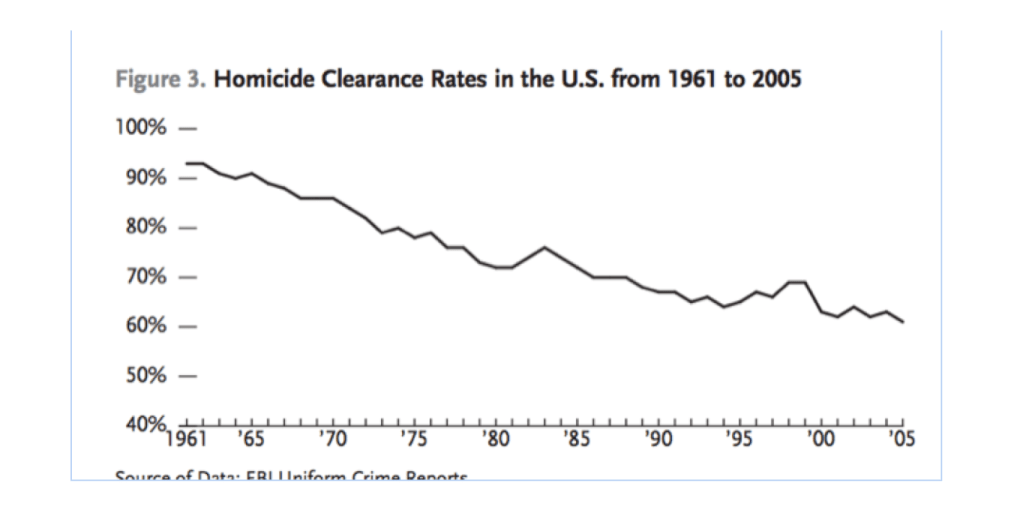
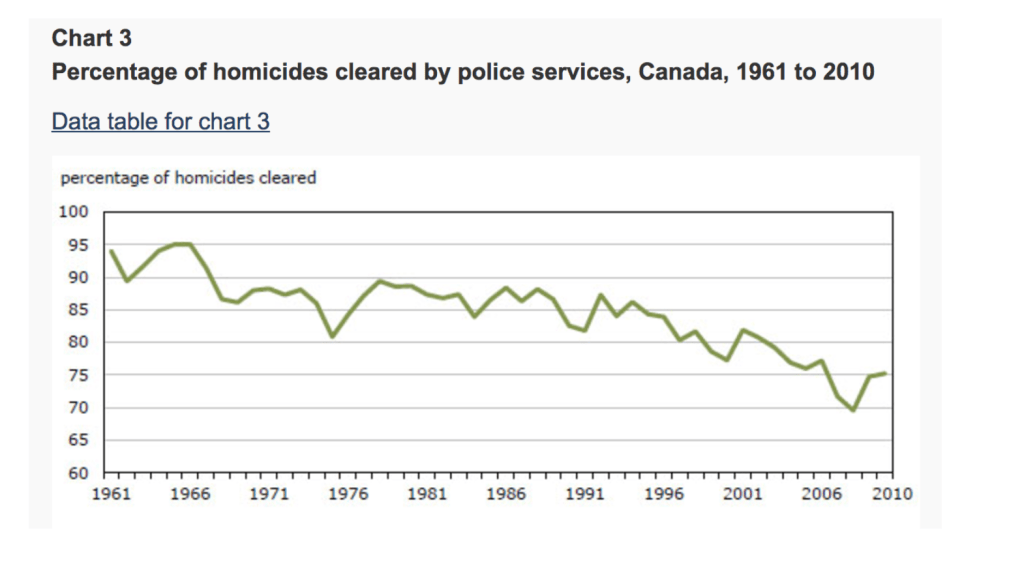
I last wrote about unsolved homicides on February 8, 2017, it was in fact the 2nd blog that I had ever written and it was a topic of some interest for me. In that blog I pointed out, the obvious to those that are in the policing community, but not so obvious to the members of the public, that there were serious problems developing in the field of homicide; more specifically in the ability to solve them and the resulting growing pile of “unsolved” investigations. The blog outlined the declining “solvency” rates or “clearance rates” and that there was a significant and dramatic drop in the number. That article focused on the local B.C. Integrated Homicide Team (IHIT) because it was the area I happened to know best but it was a trend that was North American wide. I’ve reprinted the charts below to graphically show the trend for Canada and the United States and to show that this trend goes back a number of years, in fact decades. This despite the advances in forensics and investigational techniques and increases in police resources over this same set of years. The decline is precipitous, in 2017, IHIT was reporting their solvency rate as 43% (and I believe they were fudging those numbers). In 2003 it was at 78% and there were half the number of police officers in terms of overall manpower.

The blog in 2017 went into great detail as to all the reasons which may have been contributing to this decline, so we won’t repeat them here again. But we need to ask the question, now six years later, has anything changed or improved? The short answer, unfortunately appears to be no. The things that were pointed to in that article; rules of evidence, disclosure, the growth in complexity in terms of warrants and the surrounding case law were all legitimate excuses to varying degrees and in those areas no improvements have been made and as far as I can tell even discussed.

In speaking with a friend of mine, who is now in the academic world and who is constantly looking at homicide and the statistics surrounding the data—that data is now suggesting that the solvency rates in 2024 has dropped further and the trend is still downward, and is now hovering around a very low 30%.

It is one thing to see it in percentages, however it seems even more discouraging when one looks at it in terms of the actual number of files. Just looking at British Columbia, an area that I am most familiar with, when I last checked in 2014, there were approximately 1200 unsolved homicides in the record books for this Province. If we look into the current solvency numbers versus the file intake, using broad measurements would mean that IHIT alone, not including the municipal agencies, is adding about 25 unsolved cases to the file pile every year. So that would mean that at a minimum the unsolved cases would now add up to about 1450 unsolved homicides. The Canadian Police Information Centre (CPIC) estimates that there are 3400 cases in Canada, with Ontario and Quebec leading the way, followed by British Columbia. It goes on to say that in British Columbia there is a “significant number of unsolved murders” and they estimate there are a total of about 1700 unsolved cases in the Province. They succinctly comment that B.C’s high numbers are the result of “systemic challenges in the regions justice system”.

One may ask, what about those “Cold Case” squads or Unsolved teams that the police agencies have working on these relatively dormant files.

In British Columbia, there is an E Division Unsolved Unit for the RCMP, which is moderately successful, but in all it takes about two files per year off of that pile. Often those cold cases are prompted by a submission of older forensic DNA evidence. The public is interested so every successful case is played up by the media and the police managers. This is by no means trying to demean those results, but in terms of real numbers, there is little impact being felt to the overall list.

Some members of the public may say, well that is just a fact of life, we do not have unlimited policing resources. Which is also a fair comment. There are obvious limits to the extent of policing resources. In practice what the police are forced to do is pick and choose and put a series of organizational filters in place in order to decide which one of those hundreds of files are worthwhile. They have to make those choices also within the framework of continuing an investigation in the height of ever-increasing costly policing resources.

There are many factors which go into the decision; the age of the file and therefore the current ages of the people involved; whether there is any forensic evidence already on the file, and whether there is an already obvious suspect. Ironically, the “unsolved” unit usually takes over files where the suspect is already known, and in some senses “solved”. Was the victim a child, a mother, or some other “innocent victim”. In some cases it is just gangsters killing other gangsters and therefore, in most cases not righteous victims in the eyes of the police; although the police will never admit to this level of filtering. While standing at a crime scene, I myself have asked or been asked by managers, whether the victim was a “legitimate” victim– as harsh as that sounds. The police can not deny that if the victim had in fact lived by the gangster edict of “live by the sword die by the sword”, sympathy for that victim is automatically dulled and will adversely affect the length and breadth given any investigation. It is just a fact of policing life. Another filter which comes into play, but is never talked about is the level of public attention that has been given to the case and the victim. Call it a case of the “squeaky wheel” syndrome. The Sherman murders in Montreal come to mind. When your victims are billionaires, you seemingly get a different level of attention. The Surrey 6 murders caught the attention of everyone because of the two innocents among the dead drug dealers.

In a pure and perfect world this filtering or rationalizing is of little comfort to the families of victims regardless of their background.

The police for obvious reasons are not forthcoming about these decision making processes or their solvency rates. To be sure they are in a tough spot. Tell the truth and deflate everyone’s expectations or fudge the abject truth for something that still leads to some measure of hope. In terms of their public face they have chosen to do the latter. It’s why the police never admit to not working on an unsolved case, instead they announce that all files are “active” cases. By strict definition they are not lying, but in actual practise they are being very deceptive. There is a difference in keeping the file “open” and “working the file”. Almost all cold cases, day to day, in fact are dormant, sitting on a shelf, waiting for a “break” or a “new lead” to come out of the ether. The police are not “working” those files, at best those files will only be given a cursory view for any new information every year or two.

Also concerning when one reviews the statistics is that it is also becoming apparent that the data that is being published or distributed on websites by the police or even by Statistics Canada are being skewed. Maybe not intentionally, maybe because of errors in reporting. For instance the Toronto Police Service on their website claim that their clearance rates for homicide are over 80% since 1921. The London Ontario police list only nine “unsolved murders” since 1956. In doing a quick check of London’s numbers, it shows that just between 2019 and 2023 they had a total of 43 murders. Assuming a 30% murder rate clearance, this would mean that during that time period they should actually have about 30 unsolved murders just during that four year time period. Are they deliberately misleading the public, or do they have some top notch investigators who vastly outshine any other agency in Canada. By the way, if you go to the Government of Canada website and ask about “cold cases” you get a 404 error message, and Wikipedia lists only 217 unsolved cases in Canada. It would seem that no news is better than bad news. The Unsolved Section of the RCMP of course does not even give any numbers.

Statistics Canada, says that as of December 31, 2021, for that year, there were 525 murders solved of 788 which were committed –which gives them a 67% clearance rate. How could this be? There is clearly a disconnect between what is actually happening and the offices of Stats Canada. A deeper delve into the data seems absolutely necessary as clearly something is not adding up.

Unfortunately, this blog is not offering up any new instant solutions. It just makes you think that in an advanced society, a G7 country, with theoretically untold resources, that this should not be the case. Should we not be studying and addressing the root causes of this dilemma? What does it say about our society on a fundamental level when homicide goes unpunished or fully investigated? There is no clear fix, but as of today, the sad truth is that Netflix may be trying to solve more files than your local police department. The messaging seems all wrong.

Photo Courtesy of Flickr by Bill Selak – Some Rights Reserved

200 Anomalies

I have never been a conspiracy theorist. Never. I find most theories absolutely ridiculous, not to mention logistically impossible; and all require an unfathomable level of cooperation and silence. However, there is one set of circumstances which is now stretching my ability to not think something is afoot– to the point that I am beginning to wonder if there is a concerted effort, perpetrated by a relatively large group, to conceal a major truth and preserve an accepted narrative.

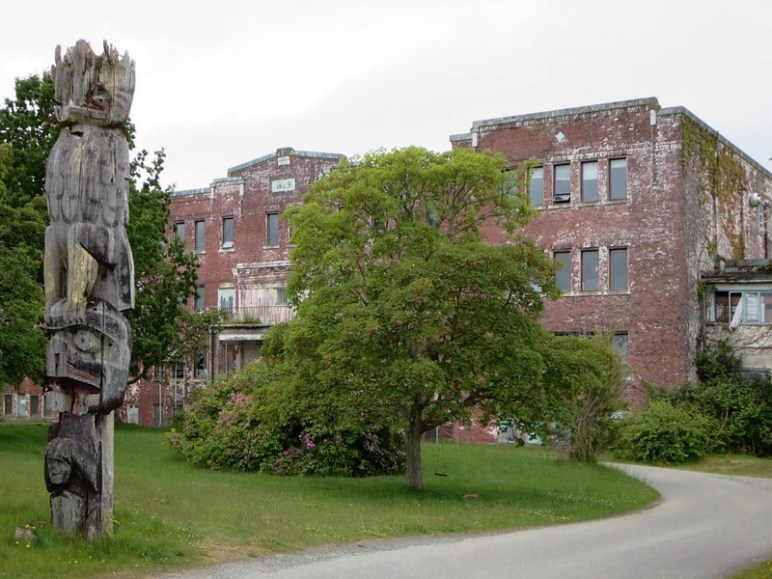
I am speaking of the Tk’emlups te Secwepema First Nation in Kamloops who in May of this year passed their third anniversary in the “investigation” of what they had portrayed as a massive burial site of Indigenous children; innocent child victims of the residential school system, whose deaths are all part of a master planned “genocide” of their culture and beliefs. It was a horrendous pronouncement. Over the past three years the Indigenous and their loyal proponents have tempered down their initial statements and their claims of “mass graves”. But it was those statements which caused Trudeau to take a knee, lowered the flags to half-mast for 161 days and sent the media into daily paroxysmal outraged headlines. The headlines completely designed to ignite “colonial” guilt. All the governments of Canada began stepping over each other in efforts to apologize and began bringing in policies to assuage that projected guilt. Everyone demanded a making of amends and our governments brought forward billions in funds in an effort to soothe those gaping wounds of what they declared as being the result of systemic racism.

The story and the outrage began somewhat innocently, with a ground penetrating radar (GPR) survey of the grounds around the residential school in Kamloops, all part of a study by Dr. Sarah Beaulieu. The Dr. through her survey, then publicly identified 215 “anomalies” below the earth’s surface. The Kamloops band and the media enjoined everyone to believe that these “anomalies” could only be the graves of tortured, mis-treated and abused defenceless children at the hands primarily of the Catholic Church. The story echoed world wide. There were even comparisons to the Holocaust.

Three years later, most reasonable voices have walked back the language. However, there are those that hold true to the original narrative. People such as Grand Chief Stewart Phillip still portray the history of the residential schools as “deeply disturbing” and that it was all a “horrible chapter in the racist history of Canada”, and that the schools were a “brutal tool of genocide”. The Kamloops Chief Rosanne Casimir is no less inflammatory in her statements and states that anyone disagreeing or doubting some of the historical “facts” she says is merely evidence of the “systemic racism and white supremacy as foundational to Canada as the very Federal laws that ripped our children away from their families.”

The conclusive evidence of this “genocide” was believed to be in easy reach, it was just below their feet in those unmarked “graves”. So how has the evidence gathering been going you might ask after three long years. How much progress has been made in the recovery of those remains? I am being somewhat facetious, as everyone knows who follows this story– not one “grave” has been exhumed in over three years. To date the Band has spent $8 million (they will not outline or detail how that money has been spent) but clearly it has not been spent on trying to recover the physical remains– which again, are the central pieces of verifiable evidence of their case, and the single irrefutable forensic piece of the puzzle.

So what are they doing? How is the obvious first step in this type of investigation been ignored? That question is not really being answered. The Chief of course assures us that the people involved in the “investigation” are doing a “very credible job” and that “the investigation continues to be carried out in compliance with Secwepema laws, legal traditions, world views, values and protocols” and that they “…are deep in the investigative work”. She insists that it is all being done with a “multi-disciplinary” approach; using archival and documentary research and analysis, “truth telling with KIRS survivors… archaelogical and anthropological surveys, …potential DNA and other forensic methods”.

That all sounds quite sophisticated although I am at a loss to understand “world views, values and protocols” but in the end, the results of their efforts to date are still unexposed, or at least have not been made public.

Meanwhile, over these past years, a contrarian narrative is beginning to mount and some experts have become suspicious of the Indigenous claims. A number of qualified and esteemed scientists and academics are starting to press forward and their investigations are revealing some interesting albeit controversial opinions. They are being ridiculed, branded heretics and racists, for even suggesting a different story. Although simply calling people names rather that attack the findings seems too easy, it seems lazy.

Some of these counter narratives and alternate findings do warrant further examination. Even at the risk of being branded a dangerous dissenter. For instance, we have now learned that at this burial site, in 1924, a septic field was built for the school, which consisted of 2000′ of trenches, 3′ deep, lined with clay tiles and running in an east to west direction. The GPR profile of the trenches would present a similar profile to the detected anomalies, which in essence is measuring disturbances in the earth patterns. (It should also be noted that Dr. Beaulieu has not publicly produced her detailed report on the “soil disturbances”)

We have also learned that Dr. George Nicholas a distinguished professor from Simon Fraser University Indigenous Archaeology Program between 1991 to 2005; in conjunction with the Band, conducted a study of the area which in essence found little of particular interest. One “alleged juvenile tooth” which was found was later proven to be not a human tooth at all. In light of this program, the list of 215 anomalies had to be reduced down to 200; because they have now determined that 15 of those sightings were actually shovel marks from that previous study.

The most extensive detrimental evidence which has now come forward comes in the highly controversial book “Grave Error”. The book has been reviewed and reported in the Dorchester Review. (The Mayor of Quesnel was stripped of his budget, and barred from Committees because of his very distribution of the book –because of a complaint by the Lhtako Dene leadership).

The authors of the book gathered data from the National Centre for Truth and Reconciliation; the Library and Archives Canada; and the B.C. Archives Genealogy resources, for the period 1915 to 1964. In examining this data they found that 51 children were documented to have died during this period of time. They were able to find accounts for 49 of the 51. The cause of death was found in 35 of those cases. Seventeen had died in hospital, 8 had died on their own reserve from accidents or illness, 4 were subject of autopsies, and 7 were subject of Coroners inquests. Twenty- four were determined to have been buried on the Indian reserve cemetery and 4 on the Kamloops Reserve cemetery. This latter is the old community cemetery on the the other side of the Reserve near St Josephs church. Whether one accepts all, or any part of these numbers, one would have at least to concede that the findings do suggest that there was no ongoing effort of concealment or a hiding of these particular children’s deaths.

In addition in 1935 the Department of Indian Affairs set out procedures for the handling of deaths of students at residential schools. Upon any death there was to be an Agent present on an inquiring committee which included a doctor, and the principal of the school and that at one time the site would have had rudimentary grave markers that likely just disappeared over time. It is also now believed that the site might also contain priests and nuns who worked at the school.

So where does this leave us? When questioned about any excavation of the site in March of 2024, the Kamloops Chief will only say that it would be a “sensitive step”, and that they are still working on the “oral tellings”. Apparently they are still content to listen to decades old recounts of the things that happened at the school, stories which under normal circumstances have a tendency to to distortion, augmentation, or inaccuracy. All the while the only true indisputable evidence represented by the bodies lay beneath their feet.

Depending on how one measures the dollars being spent, this is also proving to be a very expensive “investigation”. The Band states that they have now spent $7.9 million on the investigation, but if you include periphery expenses, there is the $3.1 million for the Student Death Registry, and a total of $238.8 million for the Residential School Missing Childrens Community Support Fund, which expires in 2025.

In all fairness, there would seem to be little doubt that the schools were in fact set up to assimilate the Indigenous culture; however there is mounting evidence that this was not a conscious effort to eradicate cultures and customs. And lets face it the Catholic Church, has come under heavy scrutiny in the last number of years for the behaviours inside the Church and under the cover of religion. However, the residential schools as cultural genocide, as the Indigenous claim, seems very much open to debate. However, to date, no debate is to be allowed. No accountability for the findings and the monies being spent are being asked for or demanded.

So is this an investigation or is it a story? The popular and current narrative is definitely needed by the Indigenous to underline and stir the flames of a move to greater political power and financial independence. Is it possible that to maintain the story and its credibility that there has been a conscious decision not to excavate for fear that it would damage the story that lies at the heart of their claims? We will never know unless there is some level of accountability, or someone on the inside deems to come forward. Is it possible that no excavation may ever be done, as has already been proposed, that it simply become a memorial site? If that happens, you can be assured that this was never an investigation, nor was it ever intended to be one– that this was just a story, in fact it may have even been a fable.

Photo Courtesy of Flickr Commons and David Stanley – Some Rights Reserved

Another change in Seasons…

As we head into Fall and wind down from summer, it inevitably seems to be a time of imposed reflection. Fall traditionally signals an ending, a time of maturity and incipient decline. This Fall though there are some unusual stirrings in the political winds of Canada and to a certain extent around the world. It could prove to be a welcome breeze, especially for any person involved in policing or involved in the legal system.

Some pundits including Time magazine have called 2024 the “year of elections” . The results in many countries seem to reflect a growing conservatism amongst the democratic countries, a swing away from the socialist progressive agenda. This is fuelled in large part by the realization that there is in fact a defined need for the police, that there is room in a democratic society for enforcement of the existing laws. There is also a desire to remove the politics out of the governmental system and oversight of the legal arms of society. Unlike years past, this time, especially in Canada, the move to a more conservative ideology may be more long lasting.

Now, before those positioned on the far right of the spectrum get too excited, a possible swing to the right is in essence, in Canada, merely a move to the centre. It only seems drastic and is being portrayed as momentous merely because of the fact that the pendulum was so far left for so many years. That being said I do believe that the vast majority of Canadians would like to return to some sort of common sense middle ground. This shifting in sentiment is often hard to discern or measure, often disguised by the fact that they are such small incremental steps. However, it is becoming much clearer that the issue of law and order has once again risen to the top.

I live in Vancouver British Columbia, the wellspring of inanity, where we learn of another grotesque criminal act on a daily basis, for the most part being instigated by the homeless, the mentally disturbed and the drug addicted. The latest was another stabbing, in broad daylight and with no motive. One male stabbed to death, another male knifed and actually had his hand severed from his body. It was perpetrated by an individual who could be the poster child of the wrong headedness of our court system, another too familiar example of where the combination of mental health and criminality collides forcefully and is played out on public streets in broad daylight. All while citizens look on or stop to record it on their phones. This latest suspect male had over 60 encounters with the police, was on probation, and had a history of assault and assault causing bodily harm. His current probation conditions was termed as being “soft”.

The story fomented the usual media hype, the Mayor coming out quickly to assure everyone that this is a “safe city” –when those of us that live amongst the daily visions of unbridled mental illness and drug abuse clearly know better. The Vancouver City Police Chief Adam Palmer when sharing the podium, seemed exasperated and in his statement gave a not so subtle hint that the suspect should not have been out on the streets. The media as usual called for instant solutions to undo the years of policy mistakes, the biggest mistake being the closing of the local psychiatric hospital “Riverview” in 2012.

In the Vancouver and British Columbia political establishment the leaders are clearly taking note of the growing public discontent and it is now looming as the single most important political election issue. Along with this is that in British Columbia there has been a dramatic up-ending of the three political parties in the Province. The Liberal Party (who re-branded themselves the B.C United), they, who were the power brokers for many years in this Province, have simply given up; they have literally withdrawn from the next Provincial election scheduled for November 2024. They have surrendered the proverbial ghost and have freed their candidates to wander away into obscurity or go join the Conservative party. This leaves it a two party race, which is polling now as a neck and neck battle between the governing NDP and the Conservatives.

The upcoming election, if nothing else, will allow the voters to distinguish between two distinct policy groups, the socialists or the conservatives, and should therefore provide a more accurate glimpse of the mood of the people. The Conservatives are predictably running on a platform of law and order and a greater move to private enterprise. They are in essence saying that they want the government to get out of the way. The NDP whose party base are traditionally the victimized and marginalized groups (you pick the group), the unions, and any and all members of the “learned” left. These “progressives” have the added advantage of massive support from the current media establishment, the Indigenous, government workers and the academic institutions. The NDP are remaining true to their ideology and are sticking with policies of all people being part of, by necessity, a fulsome government oversight apparatus. It has been a long time since there has been such a clear choice for the people going to the ballot box and currently it seems be an even battle.

It is always fun at election time to watch all the candidates feel bolstered and sharing their insights on all of the evident problems and the clear solutions that lay ahead. Solutions which they did not see while in power but have now attained a greater vision when in sight of a ballot box. What is equally clear is that it is always someone else’s fault.

When talking about crime and rampant lawless behaviour, the Provincial NDP who have been in power for the last five years in British Columbia (the California of Canada for all you Canadians who live in the east) quickly point to the Federal Liberals as the problem. And to be fair, the Feds are the governing body when it comes to the Criminal Code. The offended Feds in turn point back at the Provinces because they are in charge of Health Care and the current sitting Judiciary. The Provincial leaders then rebound and point the accusing finger downward to the cities as they are responsible for enforcement. Three levels of government, all with no defined action plan in terms of the daily carnage on the streets and apparently unable to find any solutions while in power, now telling everyone they now know the way.

As we in the West look eastward, Alberta has always been Conservative and the Prairies are very similar. Doug Ford in Ontario is now trying to get a Conservative election victory prior to any Federal Election. Newfoundland is the only true vestige left of Federal Liberal supporters.

The Federal NDP and their illustrious shrill leader Jagmeet Singh dramatically announced that he is “ripping up” his prop-up agreement with the Federal Liberals; while at the same time vowing not to be rushed into any confidence vote. It would seem that he has finally realized that the Liberals are circling the drain and he either goes down with them, or finally leaves the safety of the Liberal cocoon for the less than safe seats of his own party. His ratings are below Trudeau but he is hoping his chances will improve with a continuous socialist rhetoric of corporate greed. He is hoping that someone out there actually agrees with him, but his chances of disappearing altogether is growing. The policing fraternity are hoping that the NDP policies disappear with him.

Now Trudeau himself is another story. His actions to date only raise questions for me. As he reads the latest polls and gathers his troops in Nanaimo this week, is he being driven by pure ego? Does he think he can spend his way to a rise in the polls and another minority government? His strategy for a possible re-election is singular. He will continue to try and and will have to make Polievre turn into Trump.

Polievre for his part, will continue to try and avoid any major guffaws and keep his newly coiffed hair and refined look in place. He has to walk a fine line, because he certainly is not going to get any votes from the public service or those that depend on government contracts. The same foes of the BC Conservatives are the same foes for the Federal Conservatives. Let’s face it, what are the chances that members of the CBC vote for him?

Of course there is not a strong enough wind to blow all the usual problems off the headlines and the teleprompters of our television talking heads. In terms of specific policing issues, in the next few months the Surrey RCMP and the Surrey Police Service will continue to dominate the local BC headlines with the snail like place of getting officers on the ground and the equally slow moving RCMP in getting their officers out. The Indigenous will continue to dominate headlines with further demands and true to form, just recently tore up their latest signed agreements for a natural gas pipeline with TC Energy. There is little doubt that the RCMP will once again be manning the barricades in northern B.C.

Back east I have a growing interest in the Bill Majcher case, charged as he is with foreign interference and there are some interesting parallels to the Cameron Ortis case. There is a good chance that CSIS and the RCMP INSET (Integrated National Security Teams) may look bad on this one as they continue to struggle to be a meaningful service amongst the Five Eyes. So we need to keep our own eyes on that one. Their is evidence now coming forward that Majcher was throughout several periods of time , actually working for CSIS.

In a more general sense, the Mounties in Ottawa will continue to find themselves in an environment of increasing public suspicion. They seem to be floundering in terms of leadership and in finding their true reason(s) for being. The larger overall problems have been years in the making and it will be years in the undoing. They will however, continue to do what they still do best. They will apologize somewhere. The most recent was in Nova Scotia where they apologized to the African Nova Scotians for “historic” use of street checks.

There will be the usual public government pronouncements, the Federal government employees will continue to protest having to go back to work 3 days a week and will come up with any inane excuse they can find. Housing prices will stay the same, inflation will continue to hover around 3% and mortgage rates will have little effect on the supplies of housing. The media will continue to pump us full of doomsday proclamations; headlines about droughts, floods, fires, heat, cold, or anything they decide is “record breaking”. Our traditional news sources will continue to be decimated and their managers will continue to replace long time journalists with persons who are quick on the keys to Instagram, and Substack. Ukraine seems to be in military limbo and Israel seems to heading into the same horrendous stalemate in Gaza.

However, life will go on. Get ready, get your thoughts in order and be a little hopeful, as it is never as bad as it seems. Its only an ill wind that blows nobody any good.

Photo courtesy of Jeannine St- Amour via Flickr Commons – Some Rights reserved

Slavery and the Jane Finch corridor

The Federal Liberal government is going to come out shortly with their “Black justice Strategy”. It is a policy proposal very much in keeping with the justice according to race theme, that has taken root in the learned halls of Parliament and adopted by all of the various sociology policy wonks who rule from within. This particular new policy will sound very familiar, as it mirrors the ongoing policies which have been created around Indigenous preferential treatment under the law and now being incorporated into the institutions of Canada and the clubby genuflecting corporate world. Whether one agrees or disagrees, with this theory and approach, no one can deny the pattern and the thought process behind it.

In June of 2024 the Justice Steering Committee released 114 recommendations, which were designed to lay the ground work for the Liberal strategy and is a harbinger of what lays in store. The Steering Committee’s thought processes started with a review of the bare prison statistics. They learned or were apparently startled to learn, that blacks makeup 9% of Federal inmates– but represent 4% of the population. (I warned you that this was going to seem all too familiar) In other words there is an (wait for it) “over representation of black people in the criminal justice system”. They screwed up their faces and scratched their heads and pondered as to what could have possibly caused this skewing of the statistics? As they ponderously stirred their collective group think tank, spurred by coffee and tax payer finger foods, they debated and reasoned and nodded in mutual agreement then concluded that it had to be the fault of outside forces. Clearly they had been victimized. And since the Liberals have been the dominant force in Canadian Federal politics for the last few decades, the explanation had to be back-dated, to before their time in office. There had to be a historic explanation to be presented to the Black community and to the general voting public. What they came up with was admittedly a bit of a reach, something that would be hard for the public to rationalize, but the committee decided that the difficulties now being lived in the Black communities of Canada– could be attributed to “slavery and the discriminatory laws of the past”.

If you are confused, that is understandable. For the record, slavery was abolished in terms of Canada, prior to Canada’s actual inception; about 234 years ago, in and around the 1790’s. In terms of discrimination policies, the Canadian Human Rights Act outlawed discrimination in 1977 in Canada and some Provinces such as Ontario had similar legislation in 1944, as did Saskatchewan in 1947. In other words there were anti-discrimination laws in this country over five decades ago. This is not to say there never was discrimination, just that the laws of the country were purged of anything that would resemble discrimination in their application. In terms of the slavery allegation, one has to note that 60% of immigrants to this country came from other parts of the world making it very difficult to argue that there was inter-generational trauma under those types of circumstances.

There is no point in going over all of the recommendations of the Steering committee, they are as predictable as tomorrow’s sunrise, or, if one follows any of the policy and funding initiatives of this particular Liberal government. (It is estimated that since 2015 the Liberal government has already given $760 million to various Black groups and initiatives.)

Nevertheless, here is the broad outline of what they are proposing. They see two major initiatives that need to be undertaken; the forming of “decarceration targets” and secondly that there be “reparations” for “slavery”; in other words direct payments to make up for the wrong doing. To achieve these broad targets they declared that there is a need for dedicated Black courts and Black Federal departments and that there should be a Federal agency for the purpose of “championing and co-ordinating effects to advance the interests of Black people”. There should also be a a Black dedicated branch inside the Department of Justice– along with Blacks given prioritization for housing, specialized Black courts, funding for Black businesses, more Black court workers, and “early-career” lawyers. There should be “race reserved seats” for Judicial selection groups and that the courts should be made to consider race in bail decisions and in sentencing.

This steering committee also weighs in on the other crime related issues. They recommend a safe supply of drugs, the ability to revoke bail down to 2 instead of 3 reasons, and that the Youth Criminal Justice age be increased to 24 years old from 17. They even say that the victim fine surcharges that had been imposed and given to victims should be refunded; those charges having been in place since 1989. (In 2015 alone this amounted to $10 million).

Whether you feel this is a rational or an irrational policy, this government is noticeably out of step with the will of the “general public”. According to recent polls, roughly 70% of Canadians believe that the government should be run on a “colour blind” system. 80% of Canadians say offenders are getting off to easy, and 70% want more policing and tougher laws on drugs. However, it has been clear for many years now that this present government has become immune to the rising sentiments of its citizens? They believe they know better. The Prime Minister has always accepted the foundational belief of discrimination and institutional racism against Blacks in Canada, which he demonstrated as he dramatically took a knee at the radical Black Lives Matter protest on Parliament Hill. One has to wonder and question if this is true sentiment, or whether it is just reflective of their hope that by winning over the various ethnic and cultural groups, one by one, with favours and monies, that it is somehow going to keep them elected. Or is it based on a steadfast ideology of progressive statism, where they imagine a country and its systems, in what author Jamie Sarkonak of the National Post sums up as “a confederacy of racial groups”.

There is an obvious philosophical and ethical dilemma that supports these policies. If you are in favour of the creating and channeling of passages through the justice system based on ones colour of skin, one also has to recognize at a minimum, that the policy, in and of itself, is clearly a discriminatory act. The proponents argue that this is purposeful discrimination and designed merely to right the agreed wrongs of the past. We would also have to accept that slavery and past discriminatory laws are what put Blacks in often untenable circumstances. It is the same argument in the Indigenous movement; that the ripple effect of residential schools and colonialism has placed them in a position of precarious poverty, caused the continuing lack of education, the staggering birth rates, and the generations of alcohol and drug abuse.

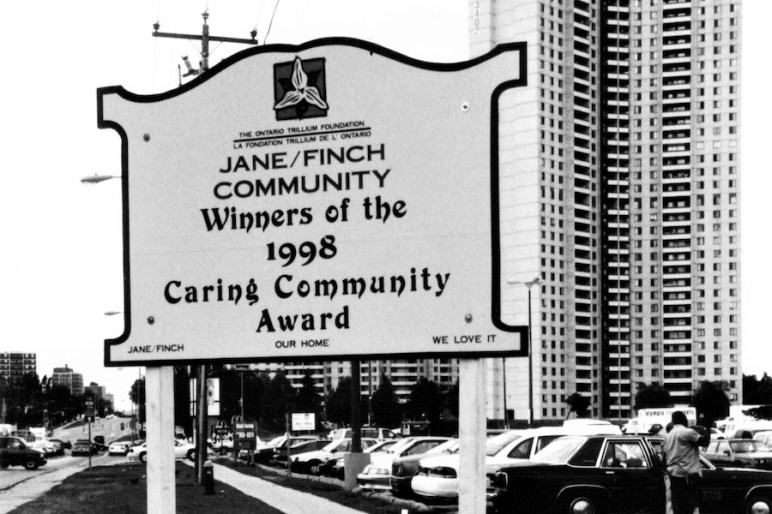
The Jane and Finch neighbourhood in Toronto has always been held up as an example of the perils facing Blacks in the city. It was the poster child for insufficient housing, rampant poverty, drugs and crime and it has gone on for years with the politicians often throwing up their hands in frustration. But ask people working or living in the hardened corridors of the Jane and Finch area in Toronto whether slavery was the root cause, their first reaction is to laugh. But, we need to accept that is exactly what the powers in government believe. It is a self-righteous and pious position, based on an academic arrogance that is being wielded and promoted by a group who feel that they just know better. To disagree or offer up an alternate explanation we are accused of being uninformed, or we are racists and insensitive to the plight of immigrants. All this while the majority of people in Canada believe and are suggesting that all Canadians should be treated equally under the law. One could safely assume that this shared belief is part of the reason that immigrants even try to come to this country.

Every immigrant group who came to this country came here or grew up here over the centuries; the Italians, the Irish, the Poles, Haitians, and the Ukrainians, all settled in their respective communities, often under very trying and impoverished circumstances. Their support came from the others that were familiar to them and had come from the same place. The evolution of their life and prosperity in Canada was brought about by a chance to further their education, to reach for jobs, to be free and have the unencumbered ability to go forward. It was not brought about by shotgunning apologies or dispensing reparation money, or brought about by demands to be treated differently then everyone else. In fact they wanted to be treated like everyone else.

The laws in this country are already there against discrimination, so if needed, enforce them. Don’t change to feed a political need or to affirm the current sociological dogma that we are all victims and that there is an ongoing and persistent institutional discrimination based on the colour of your skin. My family history in this country only goes back to the 1920’s, so I can not draw a straight line between the days of slavery three hundred years ago to my ancestry, and I suspect very few Blacks in this country, or many other Immigrant groups, can draw that straight line either.

The authors of “Struggling Well” when asked why do so many people want to be seen as victims say that it is merely a symptom of our current modern society. “It is hard to accomplish something significant, it takes years of work, dedication and sacrifice. In today’s age, a victim is recognized as being special, having achieved something. We all want that sense of achievement and being special. As a victim, you get that special attention” They sum up by saying “being a victim is an easy way out, being accomplished, despite your circumstances is tough”.

I don’t agree fully because there is in fact discrimination in the real world and some groups have different starting points than others about which they have no control, but there does seem to be a need for some hard to define toughness. A need to look inward rather than outward for the answers, as hard as that may be.

Productivity in Policing?

This blog’s question is whether or not one can measure productivity in policing? It is a question that has been sporadically posed over the years, toyed with, but never really answered or explored in serious fashion. Why is that? Most police departments both in Canada and the U.S. are not measuring performance accurately. In a U.S. the National Institute of Justice study which examined 20,000 plus police departments they found that very “few are measuring performance adequately”. In Canada, most of all the measurement tools employed by the variety of police services relies on the statistically broad generalized numbers and percentages; crime reduction clearance rates, response times, number of violent crimes, and enforcement productivity– such as arrests made or tickets issued. Is this the best way to measure productivity or is it even a measurement that carries any meaning in terms of productivity?

At best these are flawed measuring tools which are largely misinterpreted or skewed in their findings. For instance, is a downturn in serious crime a measure of community concerns, when those community concerns usually revolve around other problems and other types of behaviour? Should we be focused on reported crimes when unreported crimes may be the better measurement tool? In terms of the latter, statistically, it is currently estimated that in general terms, unreported crime is three times the amount of reported crime.

Albert Einstein had a phrase, “everything that counts can’t be counted, and everything that can be counted doesn’t count”. Police use a lot of surveys and polls and they talk constantly about overall crime rates, especially when the numbers portray them in a favourable light. However, I am referring here to a stricter economic definition, which is “output per unit of input”. In 2024 as policing costs soar, as transitions and cost comparisons are being trotted out in public discussions about the RCMP moving to a city Surrey Police Service, has it not come time to start looking at the issue of productivity in a more incisive and informative way? In labour terms, productivity is what drives salaries, and traditionally that comes about as a result of technological advancements, which in turn improve productivity, and thus drive higher wages. In economic theory, “workers are paid on the value of the work they produce, industries with higher productivity will tend to have higher wages”. Wages are the representative of the amount of value created in production. Do these theories apply to the economic models of policing? Is it possible to argue that the latest atmospheric increase in police wages have been the result of increased productivity?

Maybe the broad constructs of economic labour theory do not have a direct or easy application to policing models, but when there are no meaningful evaluations of police productivity there can be no meaningful evaluations for the public in terms of cost/benefit, there can be no accountability to local governments, or adequate control for police managers. When no examination is undertaken it is as the National Institute says a problem of the “the most fundamental and serious nature”.

In terms of the lack of productivity studies, police organizations often defend themselves by stating that the broad mandate and public demand for police services means that there is no single measure of productivity in everything that the police are tasked to do. That would seem to be at least partially true. How does one measure productivity of a community policing officer, or a traffic analyst, a uniform officer on the street, or a homicide investigator? How does one compare or measure output of a Federal drug section or Intel section with a uniform officer. They perform almost completely different functions, have different outputs, even though possibly similar goals. However, it seems logical that one should be able to measure the single units separately in terms of their productivity and with some degree of accuracy.

There are two broad types of measuring tools; one that measures outcomes and one that measures process. Last night I watched from my downtown apartment the arrest of an individual on the street by the Vancouver police department. The outcome was easily measured, the individual was handcuffed and was after a fairly lengthy period of time transported to jail. The process was four police cars (including the paddy wagon) and a total of six officers involved to make the single arrest. Having been part of this “process” many times over the years past I could not think of many instances where a single arrest of an unarmed male required this level of police attendance. Has productivity increased or decreased? One would certainly not see this level of police attendance and resources at a small rural police department or RCMP detachment. While stationed in Bella Coola, only one of us would be working at any one time. Can we assume from this observation that police officers are more productive in rural less inhabited locations than in Vancouver?

In another example, many times, especially in my early years I attended serious and fatal accidents as a uniform officer in a semi-rural area of New Brunswick. I was always the one holding the dummy end of the measuring tape and taking crude triangulation notes for the two of us in attendance. Nowadays, most serious traffic accidents seem to involve at a minimum of three or four police cars, a traffic analyst, traffic control people and their vehicles, and maybe someone to fly the drone over the accident. These new measurements also now take endless hours of road closures. In talking to a traffic analyst he estimated that a fatal accident now takes a minimum of 40 hours for him/her just to process the information that has been gathered. In this accident investigation comparison, the output increased in terms of details and displays or reenactments of those measurements, but has productivity increased or decreased in terms of the individual officer? Then the final question is has the overall outcome changed?

In the world I spent a great of time in, we used to attend homicide scenes with two individuals and then you would work with forensics and the uniform officers that were in attendance. Now, homicides are attended (at least in IHIT) by a minimum of eight officers, and you still work with forensics and the local uniform contingent. If you were lucky and had prosecutable charges, the Report to Crown Counsel with a variety of attachments may have been a couple of hundred pages along with boxes of transcribed statements and enumerated exhibits, as you went to trial. Now, with the advent of technologies and digitization, especially in the audible and visual recording of events, I am told that the average homicide consists of about 5,000 pages. Again, the output or volume of materials presented has clearly increased, but at least statistically the outcome is about the same. So has productivity increased or decreased?

None of this theorizing or productivity rests solely in the policing world. It would be extremely difficult to argue that the Court system and the lawyers involved have become more productive in the last number of years. It takes a great deal longer to get into court and the trials seem endless. Even the Supreme Court of Canada in the Jordan decision said it is all taking much too long. Of course, this is also the same court that gave us Stinchcombe and the ridiculous levels of disclosure now required under the law– which in turn has made the court process the equivalent of a marathon and not a sprint. How could one possibly argue that the growth of the Federal government ranks is the result of increased productivity?

Has crime become more complicated? It is something I always hear and this is a cogent argument when it is crime that involves the complications of the internet, whether it be fraud, bullying or sexual harassment. In those cases, the process has become more complicated and the outcomes also seem to be diminishing. In the standard criminal code, statutory offence or traffic offence, the crime definition has not changed, the eventual outcome has not changed, what has changed is the processing.

If you go to the politically popular single measurement of “bang for your buck”, it would clearly be ridiculous to argue that two trained police officers, making double overtime, should be standing directing traffic at a parade barricade. Is there a better more economical way to perform this task? Is this a productive use of highly paid resources? If not, then the bigger question is why is it still being done?

This is all to say, the tools of economics should and could be used in policing. Resources need to be put to the studying of the day to day performance in policing. There is nothing to be feared if one is arguing for greater productivity and use of those resources. Now, the police use broad sometimes irrelevant outcomes as a measurement of their overall worth and effectiveness. The actual process and levels of productivity are not being watched, and if policing is like the rest of the country, productivity is trending lower. Until we do and in a transparent fashion, there are going to be more and more questions by the taxpayers as to whether one can justify police budgets and the hiring of police officers going into the future.

Photo courtesy of Arty-Arnaud from Pixabay – Some Rights Reserved

“Don’t look away”…they just want you to look the other way…

In my many years of reading government reports, continually plowing through layers of government speak found in the endless inquiries, inquests, and investigational and administrative reviews, no report has ever brought the bile to my throat more than the latest B.C Government report entitled “Don’t Look Away”.

“Don’t Look Away” is the report of the Office of the Representative for Children and Youth (RCY) which was released this month– to look into the horrific handling of the child welfare case and death of “Colby”, an Indigenous boy, who was tortured, abused and finally beaten to death. By pure happenstance most of it was captured on video. The thought of children being purposely and sadistically hurt, in fits of pointless violence is soul crushing, even for someone hardened by years of dealing with “man’s inhumanity to man.”

This story and the report was released in the past two weeks. I have written previously of my concerns for the welfare of children in this woke inspired and administrative transition to First Nations taking over direct responsibility for child welfare. My reasons were many then and now, but the single greatest concern was my belief in the complete incapacity to logistically handle this responsibility; to be able to adequately protect children if kept within the family structure, in small, isolated and struggling communities. In theory, to remove children to safety from a violent and dysfunctional family and then move them a quarter mile away to an Aunts or an Uncles, in a community far from normal routine services. I predicted then, and still believe that this policy supported by the fragmented structure which makes up Child Protection Services would lead to the death of children. The unconscionable and damnable part of it all is that it was being done solely in the interest of Indigenous politics, not for the children, but for some form of ill-defined “reconciliation”. “Colby” and his death is for me exhibit number one in the growing evidence that this NDP government is willing to take this policy risk, even risking children to support its political agenda.

This story starts, as always seems to do in these child abuse cases, with the disturbed and maladjusted family that Colby was born into and tried to survive. Abject poverty, substance abuse, and violence surrounded him from the beginning. His mother Violet and his father Colton were both violent (Violet used to make money as a “street fighter”)were both using and abusing drugs and alcohol, and neither had the financial means of support or a proper residence to live in. Despite this Colton would be the 2nd oldest of five siblings. Violet would leave Colton after a short time, and then team up with another male, with all the same attributes as Colton. Their children predictably had to be taken away, were sent to Violet’s mother who also had problems coping, and then off to a great Aunt and Uncle– all in keeping with the policy of keeping the children in the community. The Aunt after 9 months was found to have marihuana in her car, so the children were once again moved. “They” decided, despite some arguments from some “professionals” that the children would be better off living back with their mother Violet.

So the kids went back to Violet, who was now pregnant with her fifth child. The back and forth, house to house rhythm, was in full swing. One year later, after further “concerns” were received from the RCMP and the Ministry of Children and Family Development, Violet’s children were taken away once again. This time placed in the care of another but distant “extended family member”, namely, Staci, and her partner Graham. There was no initial “safety visit” for Colby and his sister, despite Colby having some extensive medical issues. In the ensuing time period, while living with Staci and Graham, Colby stopped being sent to school, was not attending doctors appointments, and was becoming a human skeleton from malnutrition. No one was paying serious attention despite all the red flags, or went to any effort to investigate what was going on inside the walls of that house.

I will hold off on the horrendous details, but on February 26, 2021 after being beaten for 9 minutes by Staci, Colby was taken to an Emergency Room where he eventually died as the result of his injuries. The whole matter was caught on an internal house video. Staci and Graham would later be charged with manslaughter and aggravated assault, and receive 10 years for the manslaughter and 6 years for the aggravated assault–to run concurrently. Violet, Colby’s mother would die of a drug overdose 20 months after Colby’s death. It was all so predictable.

So what did RCY and their “investigation” into this matter uncover? We must first understand that this is an office, inside the NDP government of BC, and this is a Provincial government which has a fundamental belief that one can not criticize anything even remotely connected to the Indigenous. Just as importantly, there is currently a Memorandum of Understanding between “The Nation” and the MCFD which is actively promoting the transition to an independent child welfare system to be run and controlled by the Indigenous– which has as one of its central policies “kinship care”. (Since 2008, there are now 3 x more children in “Kinship Care” than in traditional foster care)

The report starts off and overtly states that the authors wanted to view their investigation through “an Indigenous lens” and that it was implicit that they needed to challenge the “implicit colonial and racial mindsets” that they assumed to be in place. The staffing of this investigational group included “cultural advisors” from the Indigenous community who would guide them with their “Sacred Teachings”. They hoped that their report and their investigation would go a long way in helping Colby’s “community” to begin their “healing journey” and that this “investigation” was just part of a “sacred story investigation”.

They described Colby’s story as a story of a family that their “dignity was stripped away, bit by bit, through the use of “stigmatizing language, judgemental attitudes and harmful actions”. That the family suffered from “inter-generational trauma which resulted in violence and substance abuse”. That Violet was a “beautiful spirit” and the father a “creative and talented artist”. That the abuse suffered by Colby at the hands of his relative was “strikingly similar in nature to the horrors inflicted at….residential schools”. They felt that part of their report could be summed up as being the result of “current colonial child welfare practises…”.

They blame the lack of support (although there were a total of seven agencies involved in this family), and they call for the future need for more “wrap around supports”. They also call for “external income supports” and better housing. The authors felt that there was a pressing need to “dismantle the pervasive colonial systems” and for what Dr. Cindy Blackstock, a long time advocate of Indigenous rights used to call “loving justice”.

Clearly they believed if you can’t blame the policy, and if you can’t blame the family, you must blame the colonial system. As to solutions, well, they are also predictable. To develop a “child and youth action plan”, develop an “outcomes based framework for measurement and accountability”, strengthen “information sharing” between agencies, because there was “confusion around transition points”…blah blah blah.

This investigation looked at 14 other children’s cases, involving eight families –three other children had died.

Nevertheless the authors are relieved to state that they can now reinstitute and resume the process of granting jurisdiction of child welfare to the BC Nations.

Not all First Nations, but many, are centres of generational issues of poverty, substance abuse, and violence so ingrained and pervasive that at times it seems insurmountable. They are also often situated in inhospitable and un-economic zones, where hope of a better life is often extinguished at an early age. It does not matter who one chooses to blame for the problems, the question that needs to be addressed is whether or not they are sufficient social resources and viable safe zones under the “kinship” program in such communities. It is a laudable goal, but one has to wonder how on 630 First Nations, where 57 % of those Nations have a population size less than 1000, that logistically they can even come close to independence in the running of a child welfare system. This while knowing that an Indigenous child is 18 times more likely to come into government care, and currently Indigenous children represent 67% of all children in care. The situation is by all real accounts dire. Even the current “colonial” child welfare system is itself overwhelmed and understaffed and hampered by an abundance of government silos. They are in no position to be a supporting authority.

The Indigenous point continuously to their endless struggle to perpetrate their history and customs and they espouse that to do so, they need their own laws, their own government, and their own child welfare system–and right now children it would seem are the acceptable collateral damage for the cause. This report is a disgusting cover-up for a flawed and impossible policy; perpetrated by the leadership of this Provincial NDP government, with the whole-hearted support of the Federal government and the leadership of the Indigenous Nations. Someone needs to save the children.

Photo courtesy of Flickr Commons by Agirard – Some Rights Reserved

Policing under Socialism

This probably is a bit of a heavy and somewhat dry topic, when most of us are trying to enjoy these care free summer vacation months. However, politics is very much in the air right now. In my particular part of the world there is a Provincial election, and an upcoming Federal election; neither of which am I confident I am going to like the end results. In the rest of the world, there have been swings in the electorate in the United Kingdom, which has moved to the left with the Labour Party; and in France, as of today, it is a country stuck in the middle. The French government is neither right or left and nobody wants to coalesce with the other.

I will admit that over the years, the longer I pay attention, the more I lean to some level of a libertarian philosophy in my outlook, a growing belief that less government is more the ideal. My wishes are clearly out of step, as the governments in this country are already controlling almost every facet of our daily lives through rules, taxation and regulations. Their belief is grounded on the firm commitment to the fact that they know what is good for us, and that they need to protect us from our own self-interest. The Federal government, and a variety of NDP Provinces in the passing in their legislative initiatives seem hell bent on bringing their brand of socialism to the country. Interestingly, in portraying what they believe are just causes, completely turn away from the term “socialist”. Which can only be interpreted to mean that they can fool most of the people most of the time.

During the Russian Revolution in 1917 we came to distinguish between “revolutionary socialism”, or Communism and “evolutionary socialism”. In the latter category, the proponents sometimes refer to themselves as “social democrats”. Socialism as a movement in Canada is not new, history shows us that there have been many times that we Canadians have entertained and sought a socialist political remedy: the Socialist Party of Canada was in 1904, the Social Democratic Party in 1911, the Communist Party of Canada in 1921, the CCF IN 1932 and the NDP in 1961. It started with Tommy Douglas in Saskatchewan in ____ but since then there have been NDP governments in BC, Saskatchewan, Manitoba, Ontario and the Yukon.

Socialism’s corollary is that socialism by its nature necessitates a growth of government in all its forms. More rules and regulations are to be developed in an effort to help the “working class”. It is a political doctrine that at its base feels the need to criticize the existence of social, economic, and political inequality in society. Hinged to this theory is that only government of the people can effect the necessary changes to the social order. They believe that there is a need to limit the excesses of private ownership and a wish to expand public ownership. Therefore the state is responsible for planning– to eliminate those cycles of un-controlled capitalism.

Which brings me finally as to what is the role of the police in a socialist state? Are the police a reflection of the state? Should we care? Revolutionary socialists are for the most part against the police, because in their definition they are an arm of the proletariat and therefore there only to oppress the working class. Paradoxically, most revolutionary socialists agree however that no enforcement often leads to outright chaos. Just ask the people of Portland Oregon how their experiment with no policing worked out. At the other end of this continuum, on the far right, is a state run by a despot or dictator, where the police are there to serve only the needs of the people in power. The examples for both of these extremes is an extensive list.

In Canada, we are somewhere in the middle of that bell curve, but there have been times that the pendulum has swung the police dangerously close to the narrow ends of that graph. The Convoy protest in Ottawa and the imposition of the Emergency Measures Act, clearly moved the police to the despotic end; while the protests and de-funding of the police initiatives clearly moved the police to the left end.

In an interesting article about “professionalism” in policing, the authors argue that when people make “careers” out of policing, it creates an environment of police officers there to simply “carry out orders”; that they become part of the ruling class and just “reflective of the state”. But I digress.

I believe like most police officers that policing must be; professionally effective, accountable and legitimate. This serves to consolidate a democracy. The police should be there to serve society rather than the state. They have to be legitimized by the public and to be legitimate: they must adhere to the law and due process, need to be subject to controls, need to be accountable and transparent, and they must be politically neutral. It is a fine but distinct line and to walk it requires a degree of political sophistication and insight that often seems lacking in our current police leadership. Today for example, it would be hard to argue that police management is either transparent or politically neutral, which again reflects on any claims of legitimacy.

So even though political philosophy is often a topic that causes many to roll their eyes and take a nap, police organizations and their leaders need to be wholly cognizant and continually thinking about the role of government versus the role of the police. As the government encroaches on the rights of the private individual in order to give over to the general good, we need to be paying attention as an enforcer of laws as to whether you are acting for society or the state.

Should anyone doubt Canada’s creep into socialism, one only needs to look into the statements of Justin Trudeau or Chrystia Freeland. Both have made pronouncements and proposals clearly aimed at re-ordering the social order in Canada. National Day Care and National Dental care, are in the end, examples of those governments beliefs. They have recently introduced Bill 63, the Online Harms Act which some argue will give the government the ability to censor speech. They have recently imposed an increase in the capital gains tax, to have the rich pay more for the poor, as they paint themselves in the media as Robin Hood. They have brought in Bill C-!8, the Online News Act forcing Google and Meta to pay $100 million to news organizations and they determine the distribution of those monies. They subsidize the national CBC to carry their message forward. In the government of Quebec they even regulate the language that can be used in business. In BC the government has closed Provincial parks to the public, allowing access to the Indigenous only as part of their solution to injustice. Governments regulate how we eat, how we live, and where we live and we pay them exorbitant amounts of money in the form of taxes to do that for us. The private individual is always subsumed for the good of the greater good.

So as the country moves to a full socialist imperative how are the police forces going to react? Will they become agents of the state, or will they be agents of society? Since the RCMP can not fulfill their current Federal mandates, how is it possible to take on all these other enforcement issues? Are they to become Big Brother? The Federal government continues to expand, so do we continue to grow the police state? Those decisions are important and will determine the role of the police in the future, and just as importantly, how the police are perceived and accepted by the rest of society.

Photo courtesy of Flickr Commons – Some Rights Reserved by the U.S. Library of Congress