Fund or Defund…

Golden United States one dollar coin with a large dollar sign

Starting on this next phase in the blog, I thought maybe it was time to address some of the fundamental questions of the current dialogues in policing. One of those current and most topical baseline arguments is whether or not the police departments of this country are underfunded and under resourced or is the opposite true, that they need to be de-funded. Chiefs of police at every annual city meeting say they need more resources and ask for more money. Most if not all police officers are of the this same opinion,–that they are under staffed. and therefore unable to properly do their jobs. And then there is the other end of the spectrum, the liberal left that argue that we need less police, more social workers, more compassion and empathy focussing on the disadvantaged, downtrodden and racially stereotyped. Despite all this surface debate, the general public remains for the most part in the dark as to the facts surrounding this central question. Even when pressed on resourcing issues, the police response is often couched in veiled terms so that the average citizen is still left to wonder who is right. This seems like a good time to try and answer this question.

To try and do this we will need to also take a comparative look at the Canadian policing experience, their current level of resources, the costs, the levels of crime in Canada and finally how Canada’s experience compares to the global policing universe.

First, let’s look at Canadian police resourcing. In 2023 there were 71,472 police officers in Canada, 892 more than in 2022. Nineteen thousand of those officers were with the RCMP, who as an organization make up 26.5% of the overall total. The rest of the officers are in either Municipal or Provincial police departments. As a matter of interest, of the 71,472 –55,043 were male and 16,429 were female (22%).

When talking of these overall numbers and whether there is a need to increase or decrease the numbers, the issue of representation and diversity are the ever present underlying goals. So let’s briefly speak to this issue. In the RCMP, females comprise 35% of divisional managers and officer level positions in some divisions and 42 % of leadership positions within the Information Management and Information Technology Services program. Five of the eleven senior executive positions in the RCMP are held by women. The numbers in the municipal agencies, Vancouver City Police as an example, are roughly the same; the VPD estimate that 30% of their ranks are female, while close to 50% of their executive ranks are female. We can safely conclude that currently females are over represented in terms of the nunbers inside policing, but still under represented in terms of the overall general population in Canada which is 50.6 % female.

Ethnic racial groups in Canada are 26.5 % of the Canadian population as of 2023. Only 13% of RCMP officers identify as belonging to an under represented ethnic group, while in the Municipal agencies it was only 7% of the officers. So if one believes that a police officer should be reflective of the general population, there clearly will be a continuing need to hire more from the minority groups as well as females. If there is an expansion in hiring, or a need to increase the overall resources, it is quite clear that the current government policy will dictate that the preference will be given to one of these two groups, which often all represent some different issues in terms of recruitment.

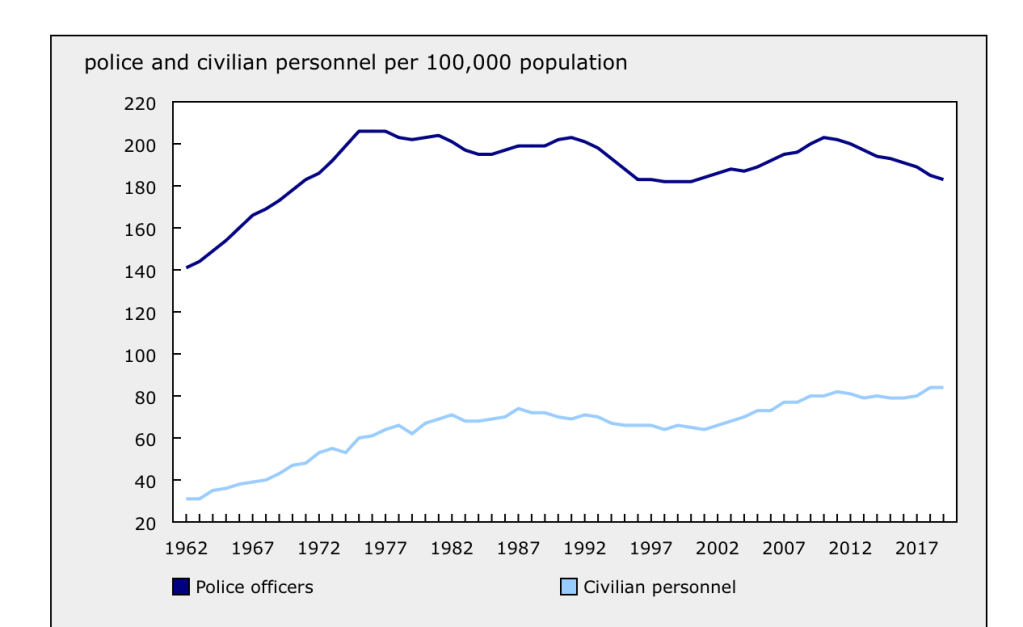
Diversity and inclusion aside, in terms of staffing/resourcing, Canada is now at a ratio of 178 officers per 100,000 in population. This is now the lowest level since 1970. We have to be very careful here as this widely used ratio is determined solely by the measurement of the “calls for service”. That being said, in Canada using this form of measurement means that this ratio is at the lower end in the policing universe. Recently part of the lowering of this ratio has been the increases in overall population in the last few years. For example in 2022-2023 there was a large jump in immigration, close to 1 million people in 2022 and another million again in 2023. If population rises and police resourcing stays the same, obviously the ratio gets lower. If we maintain the ratio, that 2,000,000 increase in population alone would dictate the need for another 3,560 officers. However, that will not be the total explanation.

Before we go further, we must also add in roughly 34,193 full time equivalents or personnel who are in support positions in policing– 88% of which were civilians. So if we add those numbers to the number of fully trained police officers, the actual number is 105,666 employees not 71,472.

There is a further problem in using the metric “calls for service” especially in reference to the RCMP. Currently it is estimated that in Ontario and Quebec there are 2,649 RCMP officers. In those two Provinces, they are not the police of criminal jurisdiction and therefore are not answering “calls for service”. They are there to enforce “Federal” statutes and are in “specialized roles”. So we must subtract the 2,649 from the estimated 19,000 RCMP officers, so this brings us down to 16,351 in terms of potential RCMP officers involved in “calls for service”

So what was the number of “calls for service” ? In 2022/2023 calls for service were actually down 2% from previous years but added up to a total of 11.6 million calls. (Of that, only 2.96 million were responded to by the RCMP- which a general average of 181 calls for service per year amongst the RCMP)

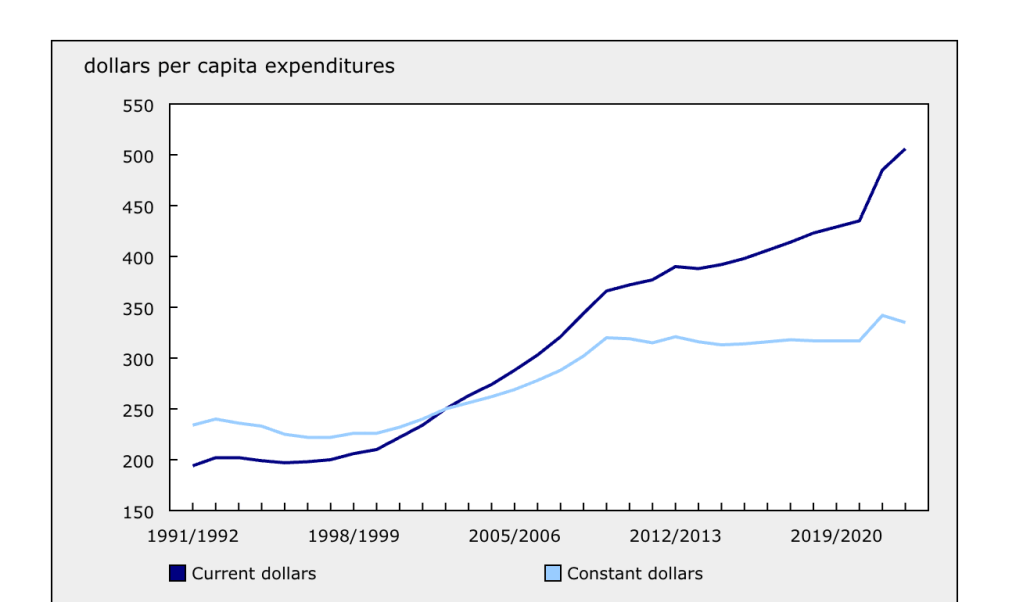
The policing overall Canadian cost was $19.7 billion, a figure which is up 6% from the previous year. Any decision to save or spend money in policing has to take into consideration that salaries and benefits make up 61% of that overall budget. If there is a call for cost cutting measures, it is unlikely that any significant cost cutting could be done without cutting personnel. On an individual level that is about $335.00 per person in Canada, which is a drop of 2% per individual.

In terms of current dollars and also in terms of constant dollars, the cost of policing and the monies being spent has been on a steady increase since the early 1990’s , as demonstrated below.

So the overall cost is increasing and but the individual cost for that has minimally decreased. So how does that compare globally. Remembering in Canada we are at 178 per 100,000, here are some of the numbers from other countries around the world.

Argentina – 798 per 100,000; Belgium 331; Chile 167; Denmark 196; Finland 132; Hong Kong 533; Italy 456; and Monaco 1302.

So it would seem that we are relatively in line with the Scandinavian countries but we will never reach the safety consciousness of Monaco, who take great pride in safe guarding the billionaires in that tiny country. What about the U.S.? Well, it varies. The numbers depend on the State, with a low in the range of 206 to 372; but some of the larger cities like Washington D.C. are at around 500. (The same seems to hold true in Canada in the bigger centres –for instance Vancouver City Police ratio is 220-230 per 100,000.)

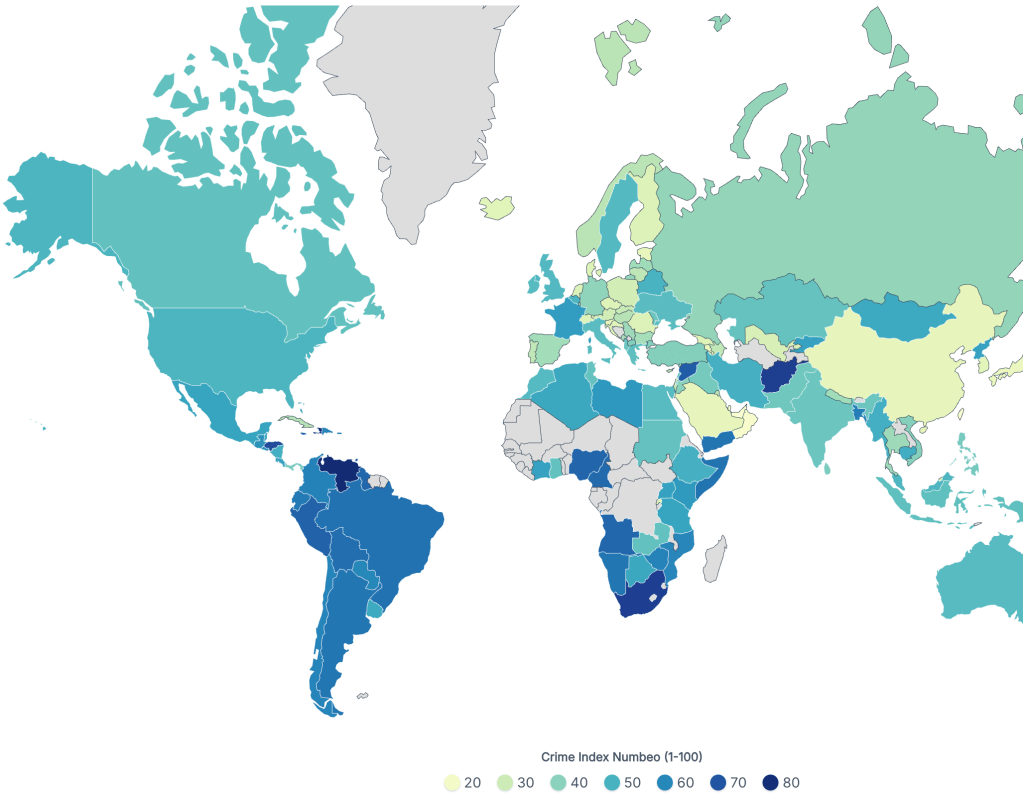
Whether we need a greater ratio of police officers has also to be measured against the levels of crime in each country. One of those measurements is the crime severity index.

Around the world it looks like this.

Clearly Canada is in the middle to lower range in terms of this particular measurement, whereas the South American countries are at the higher end.

In terms of the overall ratio of police per 100,000 the numbers as seen in the above chart it has been relatively constant since the 1990’s.

In March 2026 the Auditor General reported that the RCMP are “experiencing, critical worsening staff shortages across the Prairie Provinces (Saskatchewan, Manitoba, and Alberta), highlighting a shortfall of some 3400 officers. It describes “failed recruitment targets, high attrition” and a “flexible posting policy” as the main culprits. They do say that there have been a high number of applicants, but they have only accepted 6% of those that applied (which does make you wonder what level of quality are applying), and that it takes 330 days to process an application. Apparently the executive management of the RCMP also “mis-judged” the number of applicants needed. One would think that in this day and age of technology “mis-judging” numbers would be difficult, but apparently they did. On the positive side, I am also being told that the hiring process is currently under a major renovation in the RCMP and that they have launched pilot projects giving Provinces greater control of the hiring, training, and positioning of new officers, to try and fix this rather dramatic shortfalls.

I think we can come to some conclusions. Clearly the police resourcing numbers are low in Canada in comparison to other countries. However the police to people ratio has remained relatively constant. There is an argument to be made for a moderate increase in hiring, especially in RCMP criminal jurisdictions, however it becomes a less worthy argument in terms of the major cities. There are some other highly interesting statistics which further blur the argument for a need for increased resources. The VPD have noted that in terms of “calls for service” they now justify a need for increasing funds saying that there are a greater number of “higher intensity events” and there has been an increase in “complexity” of those calls. For those that don’t know they measure “high intensity” calls as ones where 6 or more officers respond. (It seems to me just from personal observation that almost every call results in 4 to 6 officers now) Since 2020 they say those calls have gone up a staggering 45%. So I might be right in my personal observations. And they also argue that the increased “complexity” in files has led to an increase of 9 minutes being spent on scene per file. (I don’t know how that cannot also be a sign of less productivity…but I will leave that to you.)

Another conclusion we can make is that the increase in police salaries has now reached a point where cost is an even more significant factor in terms of any planned expansion. The taxpayer may find any increase in police resources needs to be examined in much greater detail and a little more frugally due to the ever increasing police salaries.

It is also clear that the resourcing problems of the Municipal and Provincial policing agencies is different than that of the RCMP.

The RCMP issues are structural and policy related as the Auditor General pointed out. Their “staffing crisis” more often lies in understanding the difference between “hard” versus “soft” vacancy rates. Soft vacancy rates are things such as medical, parental or occupational injuries. Their policies and the organizational structure of the RCMP is more at the root of their problems. So an increase in resources could be argued, depending on the cost factor, as long as there is parallel structural change.

The Municipal agencies such as Vancouver City Police, the Surrey Police Service etc are also facing a general lack of resources, but largely due to vacancy rates, not due to structural issues like the RCMP are experiencing in the Prairies. One can only believe that the issues being experienced by the Municipal agencies may be a lesser challenge and can be overcome over time. (Vancouver PD for instance has just got approval for a new in-house training centre)

However, it is not as clear how or whether the Mounties are going to get over their issues. One can understand why the Federal Mounties may be hoping to just get out of criminal work altogether. Katy Perry’s boyfriend on his last days in the job even stated that was what was needed. Get out of the resourcing problem by simply quitting the job.

And we can also finally conclude that there is no plausible argument for defunding. The current levels are already at the bottom end of the global scale, at least if one believes there is always the need for some level of basic policing. The citizens of Portland Oregon can give you some real life answers as to what happens when you dispense of those people that respond to those “calls for service”.

Crumbling Integrity

Constant bitching about issues facing police is commonplace, a well practised pastime among the veterans of the blue. People will point out that this blog makes its living in this realm of grumbling discontent. Even for the new 21st century cops, bitching and complaining is a rite of passage and there seems to be no shortage of topics to entertain both groups. Resourcing, shifting, promotions and transfers, all seemingly preoccupying the officers now taking up two tables at Starbucks. The old guys and gals in Tim Hortons, like to talk about pensions, Veterans Affairs, and the cost of living index. The belly aching is never-ending and usually never solved.

Something does seem to be different now though. The transition to the new age does not seem to be going as smoothly or as expected. Morale seems deflated, the concern more serious. Is there a fundamental shift in the role of police or just the same old longing for the “good old days”?

An astute RCMP friend of mine of the younger generation, who is well read on the issues of the day, recently opined that we are in fact watching the “crumbling” of an organization. He may have been over-stating the situation a little, but there does appear to be increasing evidence of a significant deterioration; an acute erosion of the “job”, both in how it is done, and how it is perceived. It seems partly due to the fact that society is bending to new norms, and those new norms are incongruent, often out of sync with the historical understanding of the job. At its root may be that police organizations have now completely and willingly blurred the line between the governmental executive branch and the independence of the judicial and policing arms of government.

There have been a couple of recent stories which seemed to serve as an illustration of this fundamental change.

First, was the Senate committee hearings on the imposition of the Emergency Measures Act and the various witnesses and their attempts at defending those measures.

Secondly was the slip up by none other than the Chief Justice of the Supreme Court of Canada, Richard Wagner, who inadvertently displayed his political affinity and loyalty to the “progressive” government of Justin Trudeau. This has led to a complaint and investigation by the Canadian Judicial Counsel on the remarks of Mr. Wagner– to determine whether he had had taken the “liberty to express progressive consensus at the expense of judicial neutrality”.

However, let’s first deal with the Senate hearings, which at times bordered on farce as government officials tried to justify and explain the imposition of the Act in the fight against those dastardly convoy protestors. Otherwise known as the insurrection that never was. Highlights included the fact that Marco Mendocino, the Minister of Public Safety, said that the police “requested” the imposition of the Emergencies Act, the clear inference being that the police were out of options and needed the government to come to their rescue. It has now been established that he deliberately misled the public, the police never asked for it.

As the committee progressed it became obvious to all that the success of the Freedom Convoy was largely due to the failures of senior law enforcement, and the Provincial, Municipal, and Federal governments. They, to put it gently, failed to anticipate and enforce the laws that were always available to them. Commissioner Lucki in her cringe worthy testimony could not, and would not admit to any enforcement failures. Nevertheless, she was forced to confirm under oath that they did not ask for the Emergencies Act. Pushed further in her testimony, she found herself in the position of trying to defend her political masters. She was clearly uncomfortable in criticizing the government, and spent most of her time saying that the Act was in the end beneficial, regardless of how it came about. She did prove herself a diffident public servant to Mr. Trudeau and the Liberals.

It was this failure in enforcing the laws of the day, and then failing to admit to those “sequence of failures that Howard Anglin, writing in the National Post concluded– led to the serious consequences of the police and government combining to use “extraordinary police powers and otherwise unlawful tools of government coercion” to upend which was for the most part a legal protest.

It was in essence “a breakdown in the rule of law”, and this gets to the apparent fundamental shift that is occurring in policing.

The police are the most visible in terms of the upholding the rule of law in this country. When they “fail to enforce the law, or choose not to enforce the law, or enforce the law unevenly, the rule of law is compromised, and the perception of the public and the need for the law to be seen as being fair and consistent is irreparably harmed.” The RCMP for many years now has clearly fully embedded itself with the progressive wing of the Liberal party; its policies and operations designed and implemented to appease the current political narrative and to be sensitive to the political base of the Liberal party.

Mr. Anglin cites several examples where the police reacted and acted on the direction of the governing party. How else he asks could one explain the lack of enforcement for the blockades in 2020 of the Coastal gas pipeline, the broad daylight vandalism of statutes whether it be the Queen, Sir John A, or Edgerton Ryerson? How did the downtown Eastside of Vancouver become the current hive of violence and destruction under the watchful eye of the Vancouver City Police, other than through the lack of enforcement of bylaws, drugs, and public mischief. They too have been caught up in substituting a social democratic approach for a clear enforcement need.

In 2013 the blockade of CN Rail by Indigenous led protestors, was ignored by the police. Anglin points to Judge Brown of the Ontario Courts who asked why the Ontario Provincial Police were coming to court for an injunction, when they already had the powers of arrest to stem the blockades. It got even worse in Judge Brown’s court because the police later still failed to enforce the injunction. The police who were still being hoisted on the petard of the woke led Judge Brown had to chastise the police that “discretion in how to enforce the injunction is not extended to not enforce the injunction at all”.

We have since seen the torching of churches, the wanton eco-terrorist destruction of a pipeline site, and the broad daylight destruction of historical statues; all examples of laws not being enforced. Choices to enforce clearly now being dictated by the political arms of municipal, Provincial and Federal governments. The current managers and executives in the policing world have been promoted, and have recognized that the way to climb the ladder is to become one with the liberal philosophy which is clearly the flavour of the day. They recognized that one must obey the woke prescription, suborn any principles of truth, and ignore the reality brought to your attention by the rank and file.

Anglin, who is a research professor at Oxford, defines the rule of law as ” a society that is governed by predictable rules, duly enacted by accountable officials, publicly disseminated, and consistently enforced”. The rule of law, in particular the enforcement of those laws, are critical to a functioning democracy. The police have in effect now been compromised at the expense of political expediency.

The second example are the statements made recently to the Le Devoir newspaper on April 9th, by the Chief Justice of the Supreme Court Richard Wagner. When speaking about the “Freedom Convoy” and the imposition of the Emergencies Act said that the: “forced blows against the State, Justice, and democratic institutions, like the one by protestors, should be denounced with force by all figures of power in the country”. He describes the convoy as the “the beginning of anarchy where some people have decided to take other citizens hostage”.

Apparently this learned judge was unaware that there is a canon in the practise of judges summed up in the Ethical Principals for Judges which says that: “statements evidencing pre-judgement may destroy impartiality”. In other words, judicial comment on political matters is totally inappropriate.

It could not be more relevant in light of the Committee hearings. There are currently four legal challenges to the Emergency Act imposition, some of which may wind their way to the Supreme Court of Canada, where Mr. Wagner would sit in judgement. His self-admitted bias is obvious. A group of lawyers have filed a complaint with the Canadian Judicial council. Bruce Pardy, a Professor of Law at Queens University says that Wagner has taken “liberty to express progressive consensus at the expense of judicial neutrality”.

Some say we should not be surprised. After all he is an appointee of Mr. Justin Trudeau. He was preceded by the very liberal and also very woke Beverly McLachlin.

Mr. Wagner has a bit of history when it comes to being and wanting to be “progressive”. In an article in 2018 with the Toronto Star he said that “his court was the most progressive in the world” and must lead in promoting “progressive moral values”. Professor Wanjiru Njoya in writing about the Wagner statement has “narrowed reasonable to progressive ideals alone” that only “progressive perspectives are reasonable”.

It would also be arguable that the Supreme Courts decisions leave little doubt in which way the Supreme Court seems to lean to the progressive agenda. In the news recently was the R vs. Bissonette decision where Wagner, writing for the majority said that the conviction of Bissonette, in the killing of six in a mosque in 2017, and sentencing him to consecutive life sentences was an act of “cruel and unusual punishment”. He said that the sentence “presupposes that the offender can not be rehabilitated” and was “degrading in nature and incompatible to human dignity”. It was he wrote contrary to Section 12 of the Charter of Rights.

In R vs Sullivan this same court struck down Section 33.1 of the Criminal Code which said that “automatism” is not a defence to assault or bodily harm cases. In two separate cases two individuals who had voluntarily taken levels of drugs which rendered them in a state of automatism were now wanting to use it as a defence. Sullivan one of the defendants had attacked his mother with a knife, Chan the other defendant had stabbed and killed his father while high on magic mushrooms. The court ruled that this section was unconstitutional as it violates Section 7 and 11 (d) and that they should have been allowed to use this defence.

In a case of the Beaver Creek Cree Nation who is suing for damages to their hunting and fishing rights, the Court echoed the political mantra of the day. In this case the Band, who had already spent over $3 million in their case, felt that they should receive “advance costs” which is where the legal fees are paid in advance by the government, when it is “a matter of public interest”. A rare and unusual request to be sure, and one that is rarely granted. The Supreme Court overruled the Alberta Court of Appeal and said that the government should pay up front, saying the “pressing needs must be understood in the spirit of reconciliation and from the perspective of a First Nation, because it would have its own spending priorities”. The government was ordered to pay $300,000 to the Band to assist them in the suit against this same government.

It is not important whether you agree with the actual decisions or not, what is important is that the political sentiment of this current government in power has now been imposed on the police in their policies and operations, as well as to the highest court in the land.

The independence of both arms of government is questionable if not compromised. Their impartiality in the application of the laws of the land has been severely damaged. If one believes that a democracy has at its core the bindings of law, one could easily argue that our very democracy may be being damaged. One has to believe that all are treated equally under the law.

Contrary to the idea of fairness and an un-biased police force, the RCMP has been busy with the apparent priority of re-writing its “core values”, saying “society has changed, the policing landscape has changed”

“Professionalism” has now been replaced with “excellence” and that they now recognize their historical role “especially when it comes to Indigenous people”. Now the RCMP will “value and promote reconciliation, diversity and inclusion…”

It leaves little doubt as to who is now guiding the RCMP. This ball of tightly wrapped righteousness is rolling down the societal hill, carried by its own momentum, and it is unclear as to who would ever dare to step in its way.

These are disconsolate times, good reason to be bitchy.

Photo courtesy of Government of Prince Edward Island via Flickr Commons – Some Rights Reserved