Policing in the age of Misinformation and Distrust

Wooden City Conference Center podium with microphones in an empty auditorium

We are in a crisis of honesty in this country. No one believes anyone, nobody trusts what they hear, let alone what they read. All of us are now franctically checking the source of the information so that we can judge whether it is real, fake, or somewhere in between. It also takes us twice as long to read the news because we need to fact check every story through another “trusted” source.

I was a long time reader of the NY Times and the New Yorker, but they turned on me. The Times motto of “all the news that is fit to print” is now all the news that they want you to see and as long as it fits the socially progressive and Democratic agenda. The New Yorker is/was famous for its illustrious past and well informed narratives and their prolific and amazing stable of writers; John Updike, Joan Didion, and Malcolm Gladwell to name just a few. The New Yorker always had a “progressive” and liberal attitude, however it seems that now they have officially crossed over the line to becoming advocates and not observers. Recently I watched a documentary on the New Yorker which covered the period of time during the 2nd election of Trump versus Kamala Harris. It was a behind the scenes look, with interviews of the writers and the process in putting together a magazine issue on the election. Their bias for Harris and their abject fear and loathing of Trump was on full display. Even the selection of the cover when Trump won was designed to show their hate of the outcome. There was no pretence of fairness, no attempt to cover the story from all angles, there was only one angle in their view. I also think Trump is a buffoon, but I also appreciate and have long applauded good journalism, this documentary was truly revealing and therefore disappointing.

In the last number of decades in the police universe, there has been a consistent push towards an emphasis on media relations; a need to be seen to be out there, a need to push the “breaking” news out as fast and as efficiently as possible. The police bought into the need to be always appear to be front and centre, and therefore in control. They were not deterred in their rush to judgement, even if sometimes it was to the detriment of the facts. They believed it made them seem forthright, professional and that they were indeed servants of the people. They were only there to serve. It should be said that there is not something inherently wrong in this guiding principle, but part and parcel of such an approach, is that it needs to be accompanied by a high degree of honesty and belief in what was being said. If you were intent on putting out a press release or holding a press conference then one should assume that one needed to come armed with the facts and significant pieces of information that were relevant to the story. And more importantly you needed to be willing to reveal that information.

The police agencies in their sometimes well earned cynicism of the Fifth Estate sometimes felt that it was enough to be just standing there and besides looking to be in control, they would also be in a better position to control any narratives that flowed from it. That they could be somewhat manipulative in creating a positive viewpoint of the police. It should be remembered that these were the decades of the “media managers” and “media consultants” who studied and influenced how a company or an agency should “project” itself to the general public in an effort to control that public image. Over the last number of years what it did do was automatically force viewers or readers to interpret what was being said –to read “between the lines”.

So we are now at a point in time where everyone has caught on. We don’t trust the media, the politicians, the police, the medical establishment, or anyone for that matter who is trying to influence our opinion or make us believe. COVID underlined the problem of blind trust. We are now learning of some of the misinformation surrounding the vaccine and the implications of its use. We were constantly told that it was a time of “crisis”, therefore we were not allowed to question. Recent polls now show that god forbid that if we entered another viral age, most people would not conform or believe the authorities.

Currently, we are told we are in a “tariff war”. However we are not allowed to see the details of the derailed agreement and we are told that there is now a need for an associate membership in the European Union, but no details in either case are provided on how it all works. Both are cases of political and social media press management, where the details are being withheld and one can only walk away with a feeling of distrust.

I am not the first person, nor will I be the last who is concerned about this lack of trust. It has been talked about politically and studied academically for some time. The general policing approach to alleviate this lack of trust, according to many and even to the United Nations is “community policing” and the need “to feel heard”. Many studies and the U.N. emphasize that the diverse communities need to feel “heard, protected, and represented”. That this is the only practical way to build trust. In their view they address distrust as a phenomenon of being displaced, they do not look at the much larger picture. However, if one turns to the psychology behind a lack of trust, the literature actually points to the need for “consistency”, “transparency”, and “competence”. From a psychological perspective distrust is often the result of overpromising, being defensive, and hiding the hard news. In my view this is the heart of the matter and it is not solved by a community policing agenda.

This is not to say that the RCMP, our largest policing agency, has not paid attention to this lack of trust. The RCMP has since 2015 been paying lip service to the need for transparency, integrity and open government. The RCMP actually has a”Transparency and Trust Strategy” and by 2023 began calling itself an “international leader in public safety, transparency, open government practices and embody principles of trust, transparency, integrity, accountability and participation.” Should you need proof of this feel free to go to the website and read the 35 page document . Like most readers, I had no idea that this existed, but apparently the Mounties have been dragged into being more open because of the Federal Government commitment to the Open Government Implementation Plan . It is a difficult read, filled with the usual government bromides, with not much of any substance.

However, the document does clearly show that the “transparency” that they are seeking and have accomplished is about data sharing for academia and other interested parties. It is not about grass roots and operational honesty. By the way, this past eleven years of this policy has resulted in only data releases concerned with “calls for service”, “diversity statistics” and “police intervention options”. In this policy paper which advocates openness it is always followed with the caveat of the overriding need to respect “privacy, security, and confidentiality”.

For anyone who has put a Freedom of Information request forward, or if you ask any journalist or academic as to the state of transparency in the RCMP, they usually answer with a laugh.

So how do we combat this lack of trust, or more specifically how do the police regain that trust which clearly has eroded over the last number of decades. Is there a way out? First, we must start with the old dogma that “trust isn’t owed, it’s earned”.

Data transparency is one thing and for statistical analysis may be of some value, but the transparency needed to restore trust in the policing agencies is much more basic. Until the front line managers can be more open as to the realities of policing, it is only that will eventually restore trust and with it integrity. For instance managers or supervisors need to speak of the staffing and resourcing issues which is being faced every day and affects their ability to police. Did you know that the RCMP is so desperate for bodies that the Commissioner has recently issued a directive to the Depot training staff that they are not to fail more than 10% of the recruits? Did you know that the biggest issue facing that training staff is English as a second language?

Did you know that there are historically about 1700 unsolved homicides in British Columbia alone? Since the formation of IHIT they have generated 350 unsolved homicides. Across Canada there is about 12,000 unsolved cases. Have you ever heard police executives talk about the enormous efforts needed for unsolved cases, or talked about the fact that there are too many to even be managed. Instead the general public is led to believe that no file is untended, that all open files are being actively worked. IHT now wants you to believe that the formation of another team for gang related homicides is the cure. The VPD on their unsolved web site, display 17 cases, do you think that is an accurate number?

Have you ever heard the police talking about their frustrations with Crown, or the ridiculous amount of time it takes to get a case into court and then through the courts? Have you ever heard Ottawa talk about the mind boggling problems with resourcing internet crime and their inability to even make a dent in those types of cases and that they are madly scrambling to fill all these “Federal” positions. Have you heard the final policing costs for the World Cup yet? Have you ever wondered why the RCMP is not investigating the alleged grave sites at residential schools where children were allegedly murdered?

It is about time that a new approach is undertaken by police managers. It is time to speak the truth and no longer hide behind the need for privacy, security reasons, or opaque investigative purposes. I understand the need for managers to “toe the line” but if you can’t or won’t provide sufficient and truthful detail, don’t say anything at all. The only way the public is going to begin to regain trust in the police is if they stop thinking they are being manipulated and that the police are coming to them with straightforward answers. It’s the only way. It’s not by sharing data on diversity. Trust isn’t owed, it’s earned, and they need to be aligning their words with their actions.

Fund or Defund…

Golden United States one dollar coin with a large dollar sign

Starting on this next phase in the blog, I thought maybe it was time to address some of the fundamental questions of the current dialogues in policing. One of those current and most topical baseline arguments is whether or not the police departments of this country are underfunded and under resourced or is the opposite true, that they need to be de-funded. Chiefs of police at every annual city meeting say they need more resources and ask for more money. Most if not all police officers are of the this same opinion,–that they are under staffed. and therefore unable to properly do their jobs. And then there is the other end of the spectrum, the liberal left that argue that we need less police, more social workers, more compassion and empathy focussing on the disadvantaged, downtrodden and racially stereotyped. Despite all this surface debate, the general public remains for the most part in the dark as to the facts surrounding this central question. Even when pressed on resourcing issues, the police response is often couched in veiled terms so that the average citizen is still left to wonder who is right. This seems like a good time to try and answer this question.

To try and do this we will need to also take a comparative look at the Canadian policing experience, their current level of resources, the costs, the levels of crime in Canada and finally how Canada’s experience compares to the global policing universe.

First, let’s look at Canadian police resourcing. In 2023 there were 71,472 police officers in Canada, 892 more than in 2022. Nineteen thousand of those officers were with the RCMP, who as an organization make up 26.5% of the overall total. The rest of the officers are in either Municipal or Provincial police departments. As a matter of interest, of the 71,472 –55,043 were male and 16,429 were female (22%).

When talking of these overall numbers and whether there is a need to increase or decrease the numbers, the issue of representation and diversity are the ever present underlying goals. So let’s briefly speak to this issue. In the RCMP, females comprise 35% of divisional managers and officer level positions in some divisions and 42 % of leadership positions within the Information Management and Information Technology Services program. Five of the eleven senior executive positions in the RCMP are held by women. The numbers in the municipal agencies, Vancouver City Police as an example, are roughly the same; the VPD estimate that 30% of their ranks are female, while close to 50% of their executive ranks are female. We can safely conclude that currently females are over represented in terms of the nunbers inside policing, but still under represented in terms of the overall general population in Canada which is 50.6 % female.

Ethnic racial groups in Canada are 26.5 % of the Canadian population as of 2023. Only 13% of RCMP officers identify as belonging to an under represented ethnic group, while in the Municipal agencies it was only 7% of the officers. So if one believes that a police officer should be reflective of the general population, there clearly will be a continuing need to hire more from the minority groups as well as females. If there is an expansion in hiring, or a need to increase the overall resources, it is quite clear that the current government policy will dictate that the preference will be given to one of these two groups, which often all represent some different issues in terms of recruitment.

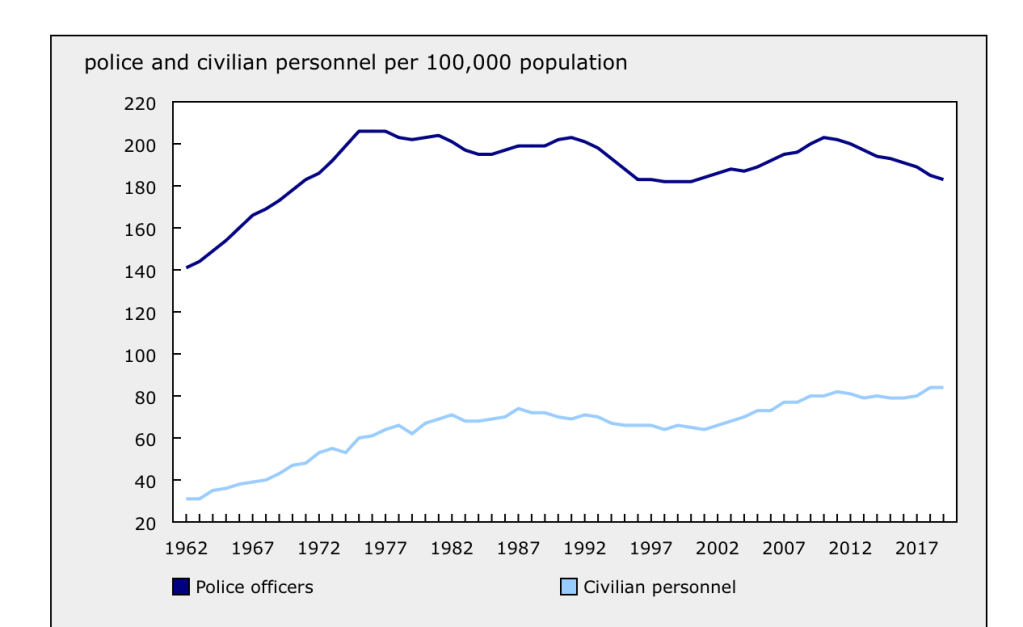
Diversity and inclusion aside, in terms of staffing/resourcing, Canada is now at a ratio of 178 officers per 100,000 in population. This is now the lowest level since 1970. We have to be very careful here as this widely used ratio is determined solely by the measurement of the “calls for service”. That being said, in Canada using this form of measurement means that this ratio is at the lower end in the policing universe. Recently part of the lowering of this ratio has been the increases in overall population in the last few years. For example in 2022-2023 there was a large jump in immigration, close to 1 million people in 2022 and another million again in 2023. If population rises and police resourcing stays the same, obviously the ratio gets lower. If we maintain the ratio, that 2,000,000 increase in population alone would dictate the need for another 3,560 officers. However, that will not be the total explanation.

Before we go further, we must also add in roughly 34,193 full time equivalents or personnel who are in support positions in policing– 88% of which were civilians. So if we add those numbers to the number of fully trained police officers, the actual number is 105,666 employees not 71,472.

There is a further problem in using the metric “calls for service” especially in reference to the RCMP. Currently it is estimated that in Ontario and Quebec there are 2,649 RCMP officers. In those two Provinces, they are not the police of criminal jurisdiction and therefore are not answering “calls for service”. They are there to enforce “Federal” statutes and are in “specialized roles”. So we must subtract the 2,649 from the estimated 19,000 RCMP officers, so this brings us down to 16,351 in terms of potential RCMP officers involved in “calls for service”

So what was the number of “calls for service” ? In 2022/2023 calls for service were actually down 2% from previous years but added up to a total of 11.6 million calls. (Of that, only 2.96 million were responded to by the RCMP- which a general average of 181 calls for service per year amongst the RCMP)

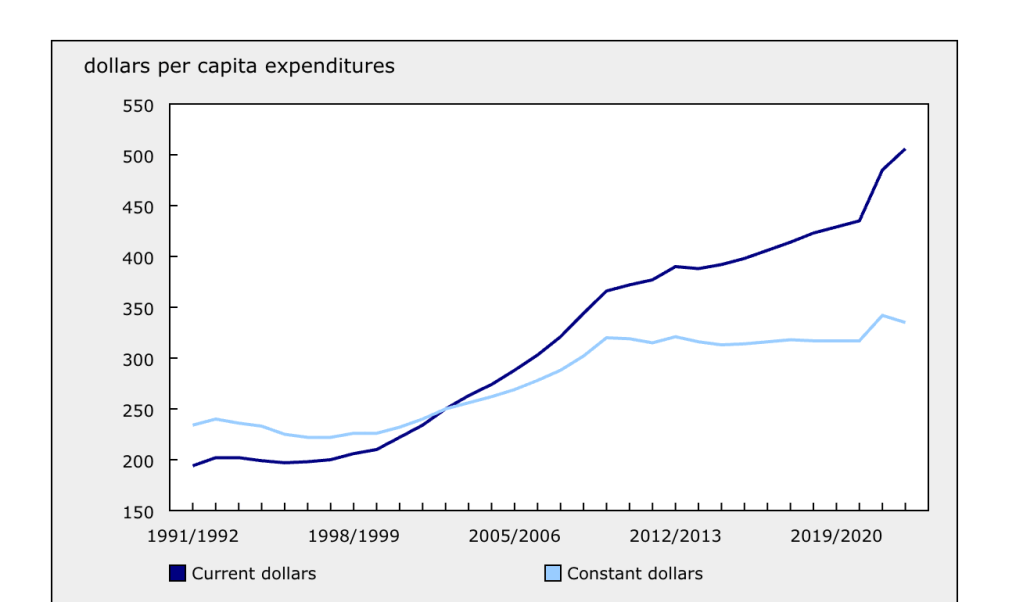
The policing overall Canadian cost was $19.7 billion, a figure which is up 6% from the previous year. Any decision to save or spend money in policing has to take into consideration that salaries and benefits make up 61% of that overall budget. If there is a call for cost cutting measures, it is unlikely that any significant cost cutting could be done without cutting personnel. On an individual level that is about $335.00 per person in Canada, which is a drop of 2% per individual.

In terms of current dollars and also in terms of constant dollars, the cost of policing and the monies being spent has been on a steady increase since the early 1990’s , as demonstrated below.

So the overall cost is increasing and but the individual cost for that has minimally decreased. So how does that compare globally. Remembering in Canada we are at 178 per 100,000, here are some of the numbers from other countries around the world.

Argentina – 798 per 100,000; Belgium 331; Chile 167; Denmark 196; Finland 132; Hong Kong 533; Italy 456; and Monaco 1302.

So it would seem that we are relatively in line with the Scandinavian countries but we will never reach the safety consciousness of Monaco, who take great pride in safe guarding the billionaires in that tiny country. What about the U.S.? Well, it varies. The numbers depend on the State, with a low in the range of 206 to 372; but some of the larger cities like Washington D.C. are at around 500. (The same seems to hold true in Canada in the bigger centres –for instance Vancouver City Police ratio is 220-230 per 100,000.)

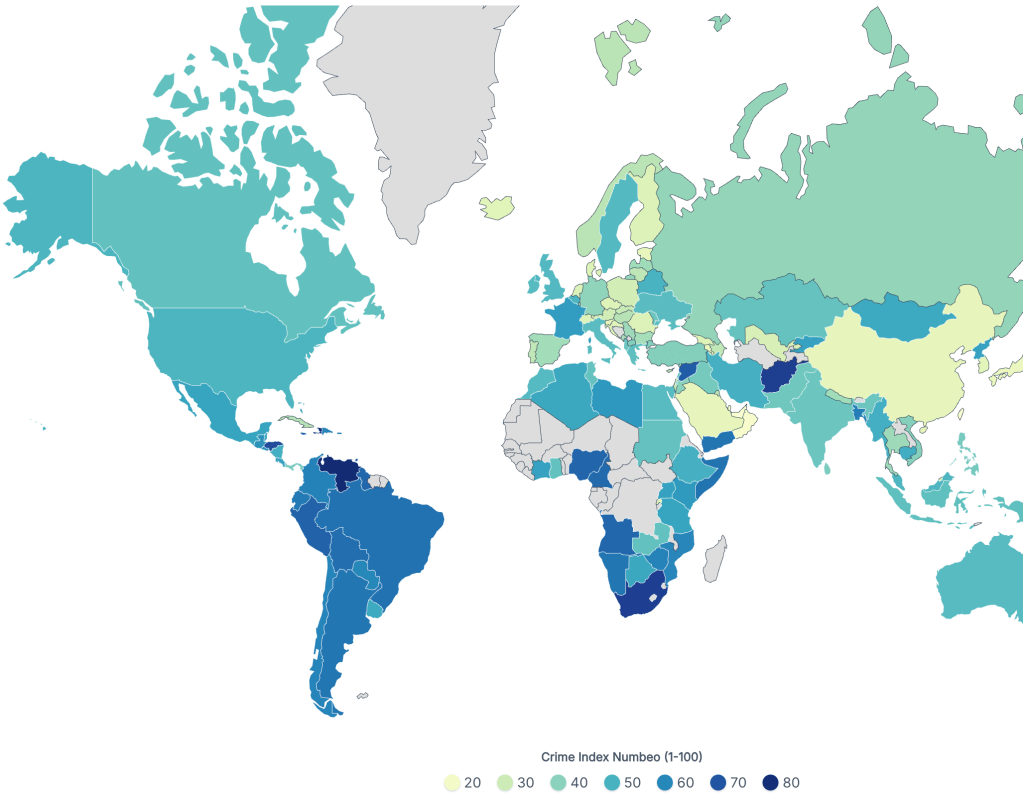
Whether we need a greater ratio of police officers has also to be measured against the levels of crime in each country. One of those measurements is the crime severity index.

Around the world it looks like this.

Clearly Canada is in the middle to lower range in terms of this particular measurement, whereas the South American countries are at the higher end.

In terms of the overall ratio of police per 100,000 the numbers as seen in the above chart it has been relatively constant since the 1990’s.

In March 2026 the Auditor General reported that the RCMP are “experiencing, critical worsening staff shortages across the Prairie Provinces (Saskatchewan, Manitoba, and Alberta), highlighting a shortfall of some 3400 officers. It describes “failed recruitment targets, high attrition” and a “flexible posting policy” as the main culprits. They do say that there have been a high number of applicants, but they have only accepted 6% of those that applied (which does make you wonder what level of quality are applying), and that it takes 330 days to process an application. Apparently the executive management of the RCMP also “mis-judged” the number of applicants needed. One would think that in this day and age of technology “mis-judging” numbers would be difficult, but apparently they did. On the positive side, I am also being told that the hiring process is currently under a major renovation in the RCMP and that they have launched pilot projects giving Provinces greater control of the hiring, training, and positioning of new officers, to try and fix this rather dramatic shortfalls.

I think we can come to some conclusions. Clearly the police resourcing numbers are low in Canada in comparison to other countries. However the police to people ratio has remained relatively constant. There is an argument to be made for a moderate increase in hiring, especially in RCMP criminal jurisdictions, however it becomes a less worthy argument in terms of the major cities. There are some other highly interesting statistics which further blur the argument for a need for increased resources. The VPD have noted that in terms of “calls for service” they now justify a need for increasing funds saying that there are a greater number of “higher intensity events” and there has been an increase in “complexity” of those calls. For those that don’t know they measure “high intensity” calls as ones where 6 or more officers respond. (It seems to me just from personal observation that almost every call results in 4 to 6 officers now) Since 2020 they say those calls have gone up a staggering 45%. So I might be right in my personal observations. And they also argue that the increased “complexity” in files has led to an increase of 9 minutes being spent on scene per file. (I don’t know how that cannot also be a sign of less productivity…but I will leave that to you.)

Another conclusion we can make is that the increase in police salaries has now reached a point where cost is an even more significant factor in terms of any planned expansion. The taxpayer may find any increase in police resources needs to be examined in much greater detail and a little more frugally due to the ever increasing police salaries.

It is also clear that the resourcing problems of the Municipal and Provincial policing agencies is different than that of the RCMP.

The RCMP issues are structural and policy related as the Auditor General pointed out. Their “staffing crisis” more often lies in understanding the difference between “hard” versus “soft” vacancy rates. Soft vacancy rates are things such as medical, parental or occupational injuries. Their policies and the organizational structure of the RCMP is more at the root of their problems. So an increase in resources could be argued, depending on the cost factor, as long as there is parallel structural change.

The Municipal agencies such as Vancouver City Police, the Surrey Police Service etc are also facing a general lack of resources, but largely due to vacancy rates, not due to structural issues like the RCMP are experiencing in the Prairies. One can only believe that the issues being experienced by the Municipal agencies may be a lesser challenge and can be overcome over time. (Vancouver PD for instance has just got approval for a new in-house training centre)

However, it is not as clear how or whether the Mounties are going to get over their issues. One can understand why the Federal Mounties may be hoping to just get out of criminal work altogether. Katy Perry’s boyfriend on his last days in the job even stated that was what was needed. Get out of the resourcing problem by simply quitting the job.

And we can also finally conclude that there is no plausible argument for defunding. The current levels are already at the bottom end of the global scale, at least if one believes there is always the need for some level of basic policing. The citizens of Portland Oregon can give you some real life answers as to what happens when you dispense of those people that respond to those “calls for service”.