
Starting on this next phase in the blog, I thought maybe it was time to address some of the fundamental questions of the current dialogues in policing. One of those current and most topical baseline arguments is whether or not the police departments of this country are underfunded and under resourced or is the opposite true, that they need to be de-funded. Chiefs of police at every annual city meeting say they need more resources and ask for more money. Most if not all police officers are of the this same opinion,–that they are under staffed. and therefore unable to properly do their jobs. And then there is the other end of the spectrum, the liberal left that argue that we need less police, more social workers, more compassion and empathy focussing on the disadvantaged, downtrodden and racially stereotyped. Despite all this surface debate, the general public remains for the most part in the dark as to the facts surrounding this central question. Even when pressed on resourcing issues, the police response is often couched in veiled terms so that the average citizen is still left to wonder who is right. This seems like a good time to try and answer this question.
To try and do this we will need to also take a comparative look at the Canadian policing experience, their current level of resources, the costs, the levels of crime in Canada and finally how Canada’s experience compares to the global policing universe.
First, let’s look at Canadian police resourcing. In 2023 there were 71,472 police officers in Canada, 892 more than in 2022. Nineteen thousand of those officers were with the RCMP, who as an organization make up 26.5% of the overall total. The rest of the officers are in either Municipal or Provincial police departments. As a matter of interest, of the 71,472 –55,043 were male and 16,429 were female (22%).
When talking of these overall numbers and whether there is a need to increase or decrease the numbers, the issue of representation and diversity are the ever present underlying goals. So let’s briefly speak to this issue. In the RCMP, females comprise 35% of divisional managers and officer level positions in some divisions and 42 % of leadership positions within the Information Management and Information Technology Services program. Five of the eleven senior executive positions in the RCMP are held by women. The numbers in the municipal agencies, Vancouver City Police as an example, are roughly the same; the VPD estimate that 30% of their ranks are female, while close to 50% of their executive ranks are female. We can safely conclude that currently females are over represented in terms of the nunbers inside policing, but still under represented in terms of the overall general population in Canada which is 50.6 % female.
Ethnic racial groups in Canada are 26.5 % of the Canadian population as of 2023. Only 13% of RCMP officers identify as belonging to an under represented ethnic group, while in the Municipal agencies it was only 7% of the officers. So if one believes that a police officer should be reflective of the general population, there clearly will be a continuing need to hire more from the minority groups as well as females. If there is an expansion in hiring, or a need to increase the overall resources, it is quite clear that the current government policy will dictate that the preference will be given to one of these two groups, which often all represent some different issues in terms of recruitment.
Diversity and inclusion aside, in terms of staffing/resourcing, Canada is now at a ratio of 178 officers per 100,000 in population. This is now the lowest level since 1970. We have to be very careful here as this widely used ratio is determined solely by the measurement of the “calls for service”. That being said, in Canada using this form of measurement means that this ratio is at the lower end in the policing universe. Recently part of the lowering of this ratio has been the increases in overall population in the last few years. For example in 2022-2023 there was a large jump in immigration, close to 1 million people in 2022 and another million again in 2023. If population rises and police resourcing stays the same, obviously the ratio gets lower. If we maintain the ratio, that 2,000,000 increase in population alone would dictate the need for another 3,560 officers. However, that will not be the total explanation.
Before we go further, we must also add in roughly 34,193 full time equivalents or personnel who are in support positions in policing– 88% of which were civilians. So if we add those numbers to the number of fully trained police officers, the actual number is 105,666 employees not 71,472.
There is a further problem in using the metric “calls for service” especially in reference to the RCMP. Currently it is estimated that in Ontario and Quebec there are 2,649 RCMP officers. In those two Provinces, they are not the police of criminal jurisdiction and therefore are not answering “calls for service”. They are there to enforce “Federal” statutes and are in “specialized roles”. So we must subtract the 2,649 from the estimated 19,000 RCMP officers, so this brings us down to 16,351 in terms of potential RCMP officers involved in “calls for service”
So what was the number of “calls for service” ? In 2022/2023 calls for service were actually down 2% from previous years but added up to a total of 11.6 million calls. (Of that, only 2.96 million were responded to by the RCMP- which a general average of 181 calls for service per year amongst the RCMP)
The policing overall Canadian cost was $19.7 billion, a figure which is up 6% from the previous year. Any decision to save or spend money in policing has to take into consideration that salaries and benefits make up 61% of that overall budget. If there is a call for cost cutting measures, it is unlikely that any significant cost cutting could be done without cutting personnel. On an individual level that is about $335.00 per person in Canada, which is a drop of 2% per individual.
In terms of current dollars and also in terms of constant dollars, the cost of policing and the monies being spent has been on a steady increase since the early 1990’s , as demonstrated below.
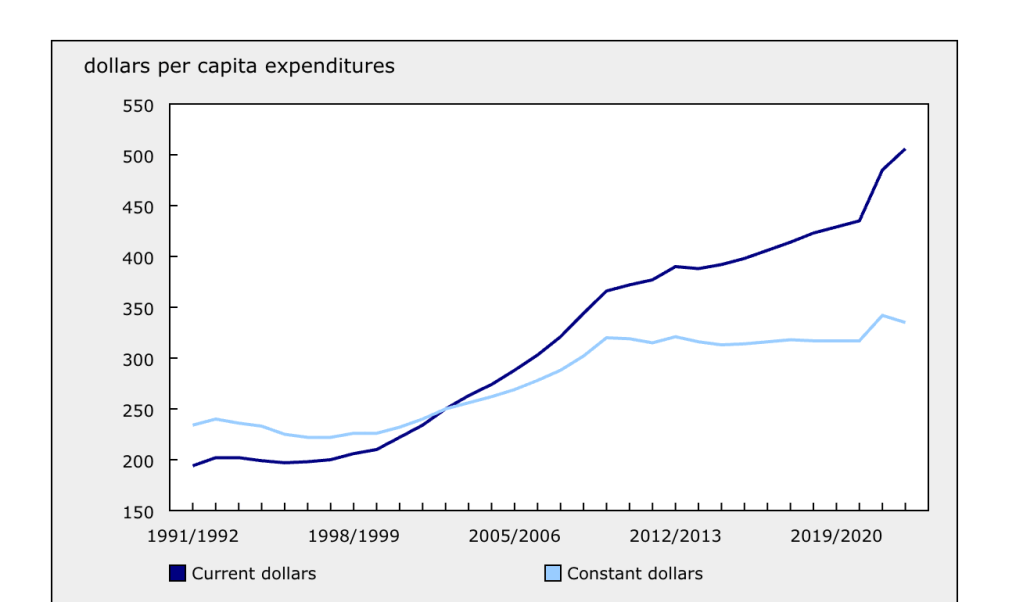
So the overall cost is increasing and but the individual cost for that has minimally decreased. So how does that compare globally. Remembering in Canada we are at 178 per 100,000, here are some of the numbers from other countries around the world.
Argentina – 798 per 100,000; Belgium 331; Chile 167; Denmark 196; Finland 132; Hong Kong 533; Italy 456; and Monaco 1302.
So it would seem that we are relatively in line with the Scandinavian countries but we will never reach the safety consciousness of Monaco, who take great pride in safe guarding the billionaires in that tiny country. What about the U.S.? Well, it varies. The numbers depend on the State, with a low in the range of 206 to 372; but some of the larger cities like Washington D.C. are at around 500. (The same seems to hold true in Canada in the bigger centres –for instance Vancouver City Police ratio is 220-230 per 100,000.)
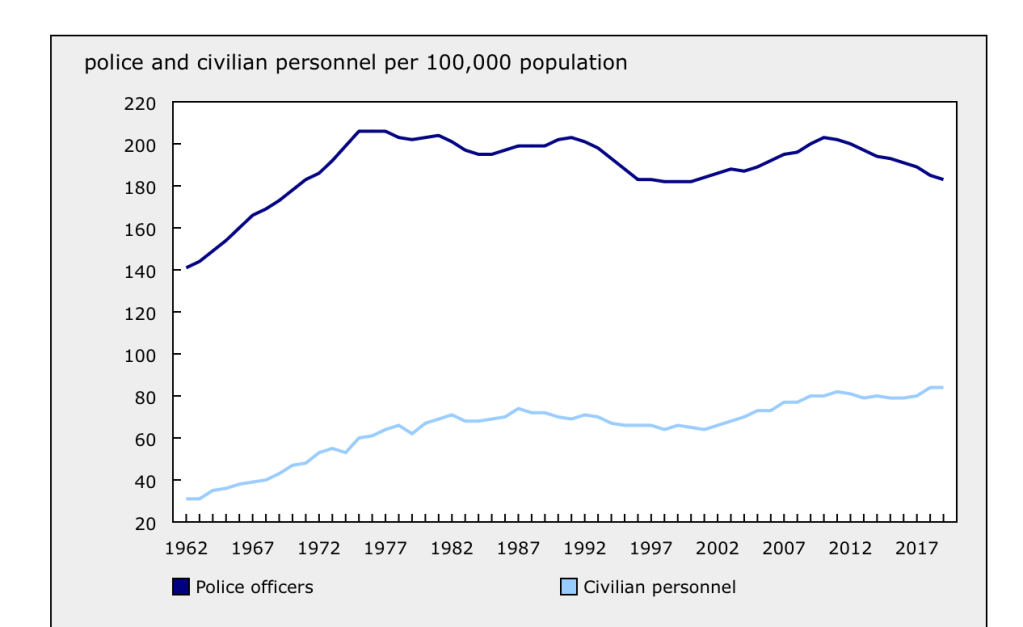
Whether we need a greater ratio of police officers has also to be measured against the levels of crime in each country. One of those measurements is the crime severity index.
Around the world it looks like this.
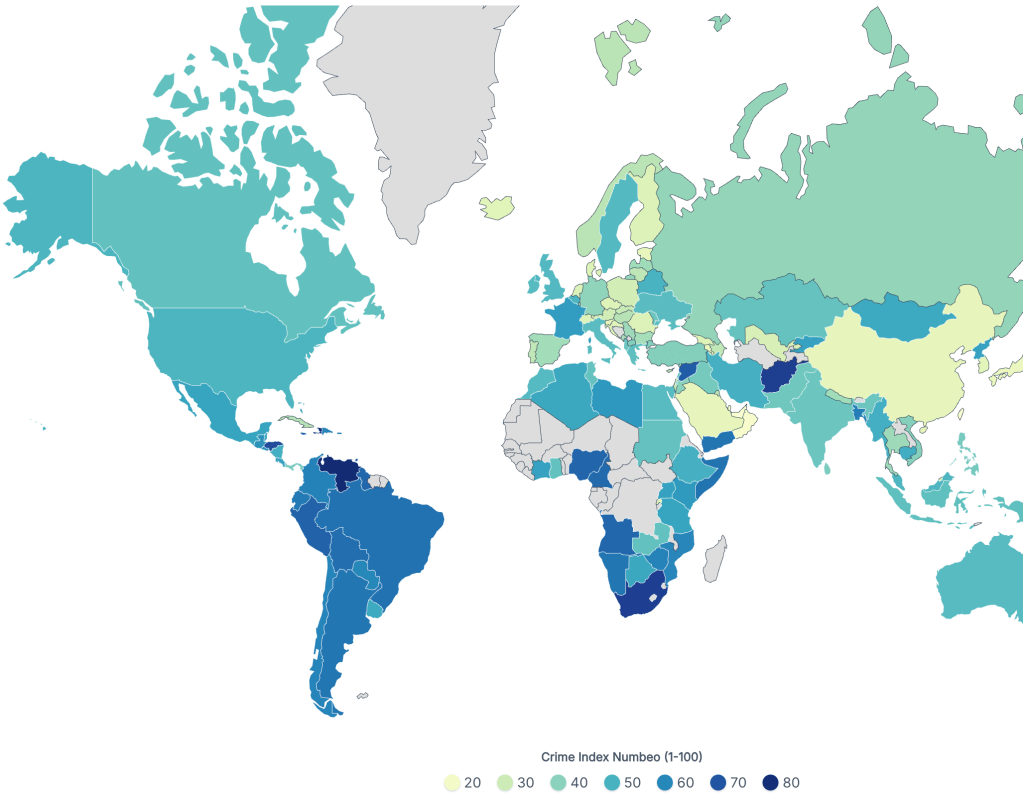
Clearly Canada is in the middle to lower range in terms of this particular measurement, whereas the South American countries are at the higher end.
In terms of the overall ratio of police per 100,000 the numbers as seen in the above chart it has been relatively constant since the 1990’s.
In March 2026 the Auditor General reported that the RCMP are “experiencing, critical worsening staff shortages across the Prairie Provinces (Saskatchewan, Manitoba, and Alberta), highlighting a shortfall of some 3400 officers. It describes “failed recruitment targets, high attrition” and a “flexible posting policy” as the main culprits. They do say that there have been a high number of applicants, but they have only accepted 6% of those that applied (which does make you wonder what level of quality are applying), and that it takes 330 days to process an application. Apparently the executive management of the RCMP also “mis-judged” the number of applicants needed. One would think that in this day and age of technology “mis-judging” numbers would be difficult, but apparently they did. On the positive side, I am also being told that the hiring process is currently under a major renovation in the RCMP and that they have launched pilot projects giving Provinces greater control of the hiring, training, and positioning of new officers, to try and fix this rather dramatic shortfalls.
I think we can come to some conclusions. Clearly the police resourcing numbers are low in Canada in comparison to other countries. However the police to people ratio has remained relatively constant. There is an argument to be made for a moderate increase in hiring, especially in RCMP criminal jurisdictions, however it becomes a less worthy argument in terms of the major cities. There are some other highly interesting statistics which further blur the argument for a need for increased resources. The VPD have noted that in terms of “calls for service” they now justify a need for increasing funds saying that there are a greater number of “higher intensity events” and there has been an increase in “complexity” of those calls. For those that don’t know they measure “high intensity” calls as ones where 6 or more officers respond. (It seems to me just from personal observation that almost every call results in 4 to 6 officers now) Since 2020 they say those calls have gone up a staggering 45%. So I might be right in my personal observations. And they also argue that the increased “complexity” in files has led to an increase of 9 minutes being spent on scene per file. (I don’t know how that cannot also be a sign of less productivity…but I will leave that to you.)
Another conclusion we can make is that the increase in police salaries has now reached a point where cost is an even more significant factor in terms of any planned expansion. The taxpayer may find any increase in police resources needs to be examined in much greater detail and a little more frugally due to the ever increasing police salaries.
It is also clear that the resourcing problems of the Municipal and Provincial policing agencies is different than that of the RCMP.
The RCMP issues are structural and policy related as the Auditor General pointed out. Their “staffing crisis” more often lies in understanding the difference between “hard” versus “soft” vacancy rates. Soft vacancy rates are things such as medical, parental or occupational injuries. Their policies and the organizational structure of the RCMP is more at the root of their problems. So an increase in resources could be argued, depending on the cost factor, as long as there is parallel structural change.
The Municipal agencies such as Vancouver City Police, the Surrey Police Service etc are also facing a general lack of resources, but largely due to vacancy rates, not due to structural issues like the RCMP are experiencing in the Prairies. One can only believe that the issues being experienced by the Municipal agencies may be a lesser challenge and can be overcome over time. (Vancouver PD for instance has just got approval for a new in-house training centre)
However, it is not as clear how or whether the Mounties are going to get over their issues. One can understand why the Federal Mounties may be hoping to just get out of criminal work altogether. Katy Perry’s boyfriend on his last days in the job even stated that was what was needed. Get out of the resourcing problem by simply quitting the job.
And we can also finally conclude that there is no plausible argument for defunding. The current levels are already at the bottom end of the global scale, at least if one believes there is always the need for some level of basic policing. The citizens of Portland Oregon can give you some real life answers as to what happens when you dispense of those people that respond to those “calls for service”.