Blog

Machiavelli in the Midst

.

It keeps pulling you back, you try to get out, and it just pulls you back in again, a sucking vortex of palace intrigue. An Ottawa drama, part Downtown Abbey, part the Office; backroom politics on full enticing display. Throw in the ridiculous opposition parties with over the top hyperbole and a salivating ‘breaking news’ media, and admittedly it makes for a delicious soup for the political junkies. We all know, or at least presume, that behind these syrupy politicians there is often a hidden counter message, but we are not often given a glimpse of the nuances, the real dialogue, where honesty often hides behind the curated media releases.

Trudeau’s gossamer world of appointments based on identity politics and minimal merit are now crashing head long into reality, a reality played by a group of less than pure politicians. The Liberal policy planks of women advancement and Indigenous reconciliation are being gutted– ripped from their promised platform by a woman who maybe should be identified as more Louis Riel than a Federalist Trudeau Liberal.

We have now learned that Ms. Raybould was audio recording her meeting with Michael Wernick and has now provided a 17 minute tape to the Justice Committee, unbeknownst to Mr. Wernick. So, it would appear that JWR (as the fawning press like to call her) has more in common with Michael Cohen, the greasy lawyer for Trump than any of us would have thought, or has been written in a previous blog where we compared the two. Cohen recorded Trump during the time he was negotiating with the ‘affair’ girls. Cohen wanted Trump on the record, for blackmail or for just covering his posterior, it is not quite clear.

So we would be remiss if we didn’t ask Ms. Raybould as to why she was recording her discussion with Michael Wernick? What was her intent?

Having been around for a few years in policing, this writer dealt with wiretaps, interview recordings, and the surreptitious recording of suspects. It becomes very clear if operating in this world, that if one is recording someone else, unbeknownst to that party, they are hoping for one of two possibilities. That the recorded person says something out of the ordinary, or, they are hoping to entice that recorded person into saying something out of the ordinary. In other words, there is a singular purpose to the effort. Was Ms. Raybould recording this conversation as possible “evidence” of wrong-doing, or is it a little more sinister, something that she could use as a weapon against the powers to be, especially if they tried to get rid of her.

“it is better to be feared than loved, if you can not be both” – Machiavelli

The questions that this recording and its content engenders are numerous. Remember that she never mentioned having a recording of Wernick when she testified for 4-5 hours. Did it slip her mind? Did she not see it as relevant at that time? What changed? Did she record anyone else? Are there other recordings that she doesn’t think are relevant at this time?

The recording basically covers the same territory as has been outlined by JWR and Wernick. There is nothing earth shattering in it. It is clear that the Liberals were putting pressure on her, and it was equally clear in what she said and how she said it, that JWR was adamant and somewhat belligerent about having made up her mind. Wernick says the Prime Minister is concerned that they are not considering a DPA (Deferred Prosecution Agreement) even though it is a tool that is open to them, and the loss of jobs for SNC should be a consideration. Wernick on a couple of occasions argues with her about it constituting in undue pressure saying “I’m not seeing anything inappropriate in it”. This of course fits with what he said during his appearance before the Justice committee.

There are some other tantalizing clues in the audio recording.

Wernick expresses concern that it is not good that the Prime Minister and his Justice Minister are at “loggerheads”. Clear indication that this is not the first disagreement which has occurred between JWR and JT.

Ms. Raybould is clearly agitated in this conversation. She in clear and no uncertain terms says that she believes that this is “interference”…that they are “politically pressuring me”. Was she speaking to the recording? It was a very clear and concise choice of words, somewhat out of sync, but deliberate in their delivery.

She is also clearly agitated by the fact that Wernick tells her that the PM may get some advice from Beverly McLaughlin, the former Supreme Court Chief Justice. You don’t have to read too far between the lines to see that they are questioning her competence, and she does not like it.

She even misstates during the phone call that she has “evidence” of a copy of the Section 13 being sent early in September to the PMO; then quickly changes it to having notes of it being sent to the PMO. This slip in language is further evidence that this phone call, her note-taking, her direction to her staff to take notes on this matter, is clearly indicative that Ms. Raybould was in the stages of preparing her personal case. She felt the need to prepare a case against her leader and his minions, but is she preparing this case because of her ‘principles’ or is this because, as she states in this very conversation that she is waiting “for the other foot to drop”? Her “dream job” after all (at least in her mind )was in jeopardy. So was this plotting and framing a case about her job security or was it for standing up for prosecutorial independence?

It is this writer’s belief that JWR was not taking this stance because of the SNC-Lavalin affair. What has often been largely ignored in the reporting to date is the fact that JWR has shown no previous problem with interfering in the judicial process– she has in fact interfered in a direct way on more than one occasion. Whether it be the Colten Boushie trial in Saskatchewan, or in the Restoule case, which has been outlined by former Judge Brian Giesbrecht of Manitoba in his article in the CTC Journal.

In the Restoule case, Indigenous lawyers argued that treaty annuity payments in the Robinson treaties (covering the Northern Great Lakes) should be retroactive for the last 150 years. A “practise directive” was issued by JWR’s office which deliberately weakened the Crown case making it inevitable that the Judge would “find for the plaintiff”. In effect the Minister “threw the game”. Other indigenous groups are now lining up to try and get the same rulings in their cases. This could cost in the “billions of dollars” and an anonymous Crown stated at the time and that if “these directives are not reversed there will be huge financial consequences for taxpayers”.

How this is not a conflict of interest should be the first question. When the Justice Minister, a former Assembly of First Nations Executive, is making policy and issuing directives directly affecting the Indigenous and their future claims. (Do you remember the furor by the opposition when Morneau was involved in legislation affecting the insurance industry) But besides being a clear conflict, it is also clear evidence that JWR has no compunction in interfering in the judicial process. She just doesn’t want to interfere for SNC Lavalin.

One of her last acts as the Justice Minister, after being demoted, was to affirm her Practise Directives to the Justice Ministry where it was stated that they should cease “adversarial” arguments in all litigation involving “indigenous claims”. In other words, find a settlement with the Indigenous claims, do not take them into court.

In this audiotaped phone call it starts with Wernick saying that he is “not calling you about the litigation directive”. Was there a previous dispute about the litigation directives? Were her directives which could effectively cost the taxpayers millions if not billions of dollars maybe being seen as a cause gone too far, even for the Liberals?

We have also now learned, apparently by a Liberal leak, that Ms. Raybould was trying to have a Manitoba Justice, Justice Glenn Joyal elevated to the head of the Supreme Court of Canada. An unusual move as Joyal was not already a member of the Supreme Court of Canada. The credentials of Mr. Joyal aside, apparently Ms. Raybould planned to then move an Indigenous judge into the vacated Manitoba Court of Queens Bench. Apparently, Trudeau did not go along with this recommendation and instead appointed Richard Wagner.

The leak itself has caused consternation among the Conservative and NDP pundits (although they had no concerns about the original Globe and Mail leak–which clearly pointed at Raybould’s office), but the fact that Ms. Raybould’s was maybe orchestrating another pro- Indigenous political move, seems to be secondary to the partisan commentaries.

It is mesmerizing that Ms. Raybould is escaping close scrutiny of her motivations and tactics. Is it possible that our level of political correctness does not allow for the same scrutiny for a woman, and that an indigenous woman is somehow fireproof? Is it possible we overlook a clear conflict of interest, a single issued focused minister, who is in the habit of recording her colleagues, and instead want to believe her to be some form of principled Mother Theresa?

This blog would never be judged a supporter of Justin Trudeau and this group of Liberals. They have brought this on themselves. But they are awakening now to the fact that there was a Machiavelli in their midst, someone capable of deceit who was prepared, if scorned, of taking all of them down.

In July 1974 Richard Nixon went down in flames over a recorded conversation, the infamous “smoking gun” tape that had been exposed by Alexander Butterfield. Ms. Raybould’s tape may also be her downfall, as the element of mistrust of her is now forefront in Liberal caucus minds and the cracks in her armour are beginning to appear.

Does Ms. Raybould have an agenda? There should be little doubt.

She clearly has designs on being a power player in the Liberal party in the future. That is why she has not left the Party, which seems counter-intuitive in light of her slagging of Justin. How could one possibly argue their personal “principles”, say you have no confidence in the leader of that party, while at the same time stay in the Liberal party?

Today as this is being written she is arguing that she should be allowed to remain in caucus. She clearly wants to stay and take advantage of being in the Liberal circle. One can only wait and see if the Liberal caucus will be swayed by her claim of pure intentions and that she is doing the “best job she can” as she told Global News in a somewhat arrogant and testy reply as to whether she should resign.

In her public posture she will keep polishing the teller of truths narrative. She has no other choice, but one wonders if the recording was a step gone too far in terms of her political agenda. Whether it was a mistake or not, it clearly was a revelation of her true character.

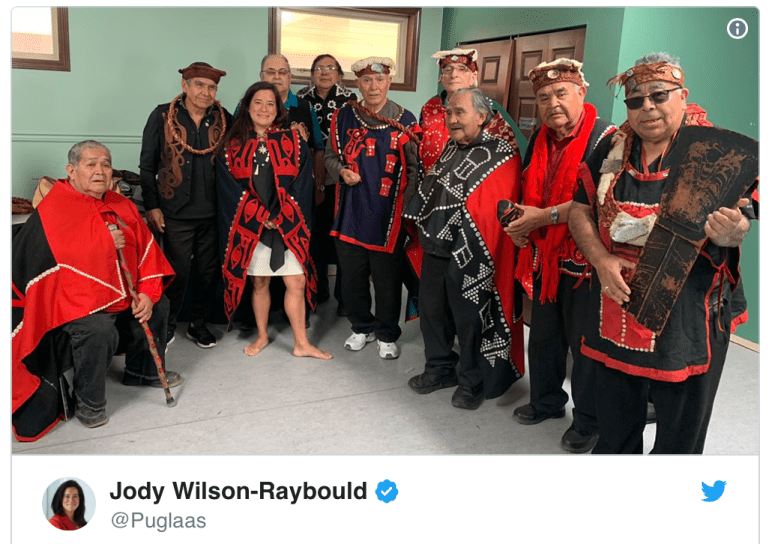
During a recent feast hosted for her in Campbell River on Vancouver Island her tried and true repetitive theme came through– “I come from a long line of matriarchs and I am a truth teller in accordance with the laws and traditions of our Big House…”.

One has to wonder whether “her truth” is actually the same as our truth and whether the “Big House” includes the Houses of Parliament.

Photo courtesy of Jody Wilson-Raybould via Twitter

“20th century vs 21st century”

Sit and eavesdrop in any worn, linoleum floored coffee shop, anywhere in the grey haired parts of this Province, anywhere where you can find the blue wall retirees, and you will hear 20th century retired cop bitching about the present state of policing. The “good old days” is a tried and true theme with this coffee klatch audience, sagely nodding in agreement, or shaking their heads about the latest RCMP news tale. They lament the old times, when “men were men” or any other tired aphorism– in between the normal senior comparisons, about ill-health, urination, and the kids.

Was it all good then? No, it wasn’t. Was it fun? Yup, for the most part. But time heals and memories often become selective, making it easier to forget the alcoholism, the suicides, the divorces, and the inevitable creeping cynicism.

But as we march forward through 2019, it is clearly time to give over to the 21st century cop, to pass the baton or torch which was long held high. It is time for this generation of police to start ignoring the allegedly wise and learned 20th century cop. They are irrelevant, their stories are clearly of a different time, a time that will never be re-captured. It is time for the 20th century cop to let go, time to stay quiet. Nothing is being gained by bemoaning the passage of time.

Let’s consider some of the subtle and not so subtle differences.

The recruits of yester-year came from the Prairies, the Maritimes and the rural areas in between. They were often escaping life on a farm or on a fishing boat. The pay was irrelevant, the 19 year old wanted to get away. It was a steady job with a pension, yes, but more importantly it looked exciting and often a path out.

No real qualifications were needed. Strong backs more important than advanced matriculation. Ability to fight, withstand abuse and go through the door without questioning, were the valuable and lauded attributes.

The 21st century individual needs to question, in fact doesn’t understand why anything would go unchallenged. Their better educations tend to lead one to question and a greater appreciation for the grey area; no more the black and white of the 20th century where there was only right or wrong. It did seem simpler then.

The 20th century cops were physical specimens. As one neared graduation local Regina club goers knew not to take on the 5th and 6th month recruit. They were in the best shape of their lives but it was all down hill from there. In the 20th century the ability to fight was more valued than the 21st century Queens Silver Jubilee medal.

The 21st century cop is less physical, less the body builder, more the marathoner. The latest individuals leaving Depot or the Training Academy try to eat well, they “maintain”, drink tea rather than copious amounts of black coffee, go to yoga and are usually fitted in Nike or Adidas from head to toe. Their ball cap is always backwards. They pack their own lunches in neat compartmentalized lunch bags– no longer are they caught wolfing down the lasagna special at the Knight and Day at two in the morning.

Salaries were almost irrelevant to the 20th century cop, the government was presumed to be looking after them, so they rarely checked their pay cheques. They were never going to get rich, but they would always have a roof over their heads. Their economic goals were firmly middle working class.

The 21st century Mountie has greater expectations, they expect to live well, and often marry accordingly. Two vacations a year, two good vehicles, and eating out are regular activities, and with a little overtime can reach the upper echelons of society.

They are considering unionization, a possibility unheard of and demonized by the 20th century cop. The 20th century cop was more likely to be wearing a gas mask and holding plexiglass shields, breaking up union demonstrations, not organizing them.

Until the 1970’s police officers were only men. Think about that and one will begin to understand the uncomprehending looks, when trying to explain harassment, bullying and life in the blue bubble during the 20th century.

The 20th century female cop who appeared in the 1970’s had the most difficult job in policing, there should be no doubt. They were harassed and subject to intense bullying.

In the 21st century women have become hiring priorities and are now running the organizations that once could not comprehend them. They are now controlling the dialogue. “Inclusion” can be heard around the water cooler.

By the same measure the 20th century male cop was also abused; harassed as a matter of course, starting in Depot where the training syllabus depended on a strict regimen. The theory being that it could only make you tougher, it was just discipline. Trainers went to the Depot Pub to celebrate when one of the recruits “couldn’t take it” and had dropped out as a result of their abuse. A troop of 32 rarely graduated with all 32, at least two or three failed or quit, usually because the abuse and ridiculous punishments was not what they anticipated. It was part of the curriculum. No complaints were heard, but graduation meant that you beat them at their own game. You were now a “member”.

The 20th century cop who grew in this world does not understand the problem with harassment, doesn’t understand the definition of bullying growing up in this atmosphere of survival of the fittest. The 20th century cop admired the female officer who was “one of the boys”. The 20th century cop often did not abide or recognize the line where that behaviour became sexual, often based more out of ignorance than evil intent. When measured in the 21st century it was all wrong. When measured in the 20th century it was also wrong, but the perpetrators did not recognize it, abuse of their power and position, somehow an extension of a man’s right in a man’s world.

The 20th century cop talked to people. They didn’t like being in the office, where they could be encumbered by bosses and extra duties. The placement of computers in police cars was the key to bliss and the avoidance of the bosses. The 21 st century cop seems to enjoy the office, more socializing possible, the loneliness of a single person patrol car an anathema to this forever socially integrated group.

The 20th century cop avoided the press, the media were the enemy. Say nothing was the dogma. The 21st century cop has a full corps of media relations officers and knows to include media considerations in the investigational process. Twitter launches before police have even got to the crime in many cases. All 21st century cops are aware of cameras.

The 20th century cop had no awareness of “career”. They depended on assessments by their peers and the passage of time to lead to promotion. All in due time and they expected to ride a police car for many years. The 21st century cop who has been exposed to early promotions plans on only a few years in the “harness” and have preconceived notions as to what rung of the ladder they should have reached. The first promotion to Corporal for the 20th century copy was often fifteen to twenty years, they were part of the baby boomer bubble. Coming behind the bubble the 21st century cop is promoted much earlier, sometimes as early as five years.

The 20 century road cop was surrounded by experienced officers, it was not uncommon to have many officers holding twelve or fifteen years of service. The 21st century road cop averages about eighteen months service. Guidance for them is almost non-existent. Even the newly minted bosses sometimes have less seven or eight years service.

The 20th century cop started off with a Sam Browne holster, a .38 revolver constantly swivelling about on his hip, a couple of plastic holders for a trusted yellow plastic flashlight, and maybe a baton. When they got pepper spray issued, they used it more on themselves while horsing around then they did on any contrite suspects.

The 21st century cop carries the 9mm, extra handcuffs, pepper spray, gloves, a taser, a collapsible baton, a radio hearing bud, mechanical tools, and a carbine rifle. There are no more foot chases, nor any such thing as a roomy police car.

That .38 revolver rarely came out of its holster. Most 20th century cops were not going to shoot anyone for erratic behaviour, or disobeying their commands to comply. If there were no other options, it was going to get physical. The 21st century cop believes in a circle of safety surrounding them that can not be breached.

When confronted with violence, the 21st century cop turns to escalating levels of tools while the 20th century cop takes off his watch, not wanting to cause any damage to the watch his or her kids gave them. They anticipated violence, but first try to figure out how to try and talk to the individual. The bad guy was allowed the first swing. Rarely were there charges for assault of a police officer if there was a fight and just as rarely would there be a complaint about assaultive behaviour.

The 20th century cop has no conception of the approach undertaken by four officers at the Vancouver airport, where a single male threatened them with a stapler. The 21st century members in this case did not hesitate to go to their tool belt to avoid a physical confrontation. If they had wrestled the man to the ground the 20th century cop may also have inadvertently caused the man to have a heart attack– but there would not have been the same toll. Nobody would have gone to jail.

The current spate of complaints against police is a glaring and often abusive example of the 20th century cop being held to 21st century management. The vast majority of the cases which are hitting the public eye and seem examples of brutality or ill-advised police decisions are often just the result of two completely different mind sets, 20th vs 21st.

The 20th century cop is continually being exposed by cell phone video technology, no matter the level of the confrontation. The 21st cop is always aware of being watched.

The 20th century cop wanted to be able to type, and often wrestled with carbon copies and with a ham fist pounded the typewriter keys. The 21st century cop knows “apps”. “There is an app for that” may have become the mission statement.

The 20th century cop talks to the neighbours at the scene of a crime, the 21st century cop asks if there is any video. In this new age; if there is no DNA, or no video, there is no crime.

In the 20th century the Operational Manual was a “guideline”.

In the 20th century there was the Blue Wall. No more, as brick by brick it has been dismantled. There is no concept of a blue wall being acceptable in the 21st century.

In the 20th century cops were held in high public esteem, a positive element of society, a black and white answer in the non-political world of policing.

The 21st century cop is political, forced there by social media and the new 180 character journalism.

The old school guy or girl rising through the ranks replaced by the politically correct, where you are recognized for your identity and gender as much as your resume. It is no individual’s fault, it is just accepted as being a better way.

In public, the 20th century cop stands erect, Ray-Bans in place with a stern demeanour. The 21st century cop is often seen dancing or marching in the latest cause parade. They both still look ridiculous.

So where does this leave us?

In the Venn diagram of 20th and 21st century policing the area of congruence is becoming smaller and smaller. The commonalities are disappearing. Neither side is right or wrong, they are just different.

Policing has not changed, the police are still the medium between the interactions of people. You are still trying to discern right from wrong, Your principles should still be your guide. In the end, it is no more complicated than that.

So here is to the 21st century cops, assiduously working to “maintens le droit”.

It is indeed a new world, full of both the same and different problems.

Learn from history, but ignore the old silver backs chirping on the sidelines like Statler and Waldorf, as they wander in search of the early-bird special.

Listen to their stories out of respect, but make your own stories, and enjoy the ride. We did.

Photo courtesy of Dennis Sylvester Hurd via Flickr Commons – Some rights reserved

Two hearing rooms, two witnesses, two versions..

It was a sort of twist on a “worlds colliding” storyline; in one day, one was able to watch seven riveting hours of two committee hearings, in front of two justices committees, with two different witnesses. Different issues, different countries, but both witnesses trying to heave over their respective political institutions, both, like moths having now apparently seen the light and have been drawn to the flame of righteousness.

One claimed that he had now realized his past lies and deceptions, and now felt the need to tell the truth. His jail sentence about to begin in a couple of months adding to the drama, and no doubt his ability to easily appear in public may be hindered by incarceration. The truth he told was that he had lied and cheated on behalf of his President, the President of the United States.

The other witness, was wanting to speak “her truth”. Not a singular truth, “her truth”. A woman scorned apparently, removed from her dream portfolio and her dreams of promoting the indigenous agenda on behalf of Canadians flattened by a vengeful Prime Minister; removed because she claimed that she had failed to buckle under political pressure and interference in the judicial process. At least that was her story. She too had found the path to righteousness.

In viewing these committee hearings it is often difficult to narrow in on that stated truth as the political grandstanding in both these committee rooms was in full bloom. Difficult for the viewing public to try and draw some conclusion as to who was telling the truth; a he/ he said, or a he/she/he said quandary. The facts too often twisted and turned to fit the reporting or political agendas.

Of course, one of these individuals we are talking about is Michael Cohen. A fixer of problems in the sordid world of blackmail and sexual impropriety, aided by dispensing copious amounts of money, all in the effort keep the President from being tarnished. In the end his success at fending off the “fake news” could be debated.

The other, Jody Wilson-Raybould, the Attorney General and Justice Minister for the Government of Canada under Trudeau and the Liberals. She is claiming that she resigned under pressure from her boss and his political cabal, that she was being pressured to interfere with the Judicial process in an effort to make a good deal for the business and Quebec based conglomerate SNC-Lavalin.

In our effort to get to the truth in both cases, we should judge both of these individuals by three criteria; the criteria that is practised in most criminal or civil cases and told to most juries. That is, that anytime one is being asked to judge or weigh evidence, one should consider the following criteria.

Credibility. Does the witness appear or come across as credible?

Corroboration. Can any evidence of the witness be corroborated?

And finally, what are their motives, does the witness have a possible agenda, or an ulterior motive in coming forward? Strong motives have a tendency to warp the truth.

These principles of truthfulness apply to any judgement or determination that one is trying to make, whether it be on the gangster turned witness or a domestic dispute in family court.

Let’s first deal with Mr. Cohen as he seems to be the most black and white out of the characters, and like most men, somewhat easier read.

Cohen confessed to previous lies, previous deceptions, previously aiding the President to hide his misogynistic exploits, and altering tax returns to help the President. One may or may not be surprised by the depth of the loyalty he had shown. He was Trump’s “personal lawyer” for ten years, but solicitor client privilege went out the window when Prosecutors from two different offices began to put their feet on his neck.

Ms. Wilson-Raybould, is also a lawyer, who despite a paper thin resume, leapt to the top of the political food chain, aided no doubt by the fact that she was a woman, but more importantly an indigenous woman. She was given a substantial and powerful Ministry despite this very limited judicial experience, a combined portfolio of Justice Minister and Attorney General. As the Attorney General she oversaw the Public Prosecution Service who was overseeing the prosecution of SNC-Lavalin.

“A little over three years” by her own admission was the height of her legal career working in the Crown office at 222 Main St in Vancouver where she no doubt handled copious amounts of theft, shoplifting and minor assault files; but nothing much larger than that. From there she she went on to work as Regional Chief for the B.C. Assembly of First Nations. With this limited legal background she was placed overseeing the broad and often complicated mandate of Canadian law and its applications. It would be like making a four year officer the Chief of Police, or the Commissioner of the RCMP.

She was both in practise and in theory effectively a one issue Minister, an activist lawyer for Indigenous rights. One must keep this in mind when we consider the eventual outcomes.

So what was Mr Cohen’s motive? He had already pled guilty to criminal offences, for which he will be going to jail. His reputation has been effectively destroyed, at least for the near future. He could maybe expect some leniency in sentencing, which will happen in about a month, but the Special Prosecutor has already written a letter on his behalf in terms of his assistance in their investigation. It would seem that he has little to gain at this stage.

His sole motivation seems to be to try and salvage his tattered reputation and come out a bit on the good side if at all possible. He also seems to enjoy the attention.

Ms. Wilson-Raybould motive? A little more difficult to figure out.

What was covered in the hearing to some degree was that she was demoted from her job as Attorney General and the Minister of Justice, and she believed that her being moved was the result of her refusal to bow to political pressure. She clearly was angry on her removal from being the Attorney General. Several members of the press during the time of the swearing in ceremonies even commenting on her clearly obvious stone-faced cold demeanour. She went from in her words “her dream job” and being in one of the most powerful Cabinet positions, to a 2nd tier cabinet post, usually reserved for those on the way up or on the way out.

Clearly Ms. Wilson-Raybould may have had revenge in mind, both on her Prime Minister and those around him. It seems as likely a motive as any. There is little doubt that she decided to come forward only after being demoted. If she had remained as Attorney General, we would not have heard any of these allegations of wrongdoing, and she would have been campaigning for Trudeau and the Liberals. She still remains in the Liberal caucus although she has told everyone that now she has no confidence in the Prime Minister.

The one question that was never asked of her was whether or not she leaked the story to the Globe and Mail. Was she the “unnamed source”? Gerald Butts in his testimony made reference to being contacted by the Globe and Mail for the requisite media reaction, and he said that the reporter seemed to be describing the one and only meeting he had with Ms. Raybould at the Chateau Laurier. There were only two of them there, and if she or someone close to her did leak the story, revenge would be confirmed as her sole motivation and may have actually put her in a precarious legal position. Mysteriously no one questioned this possible angle.

If revenge was her motive, then her statements should be viewed in a more severe light.

Lets now consider corroboration. Mr. Cohen produced some supporting documents, such as income tax reports, and the payments to the female dalliances. He named others that were in the room and almost dared the committee to bring them forward. He has also gone on record in several court room appearances, and as mentioned before, the Special Counsel’s office, who would have tried to corroborate his evidence.

Ms. Wilson-Raybould used her “self-made” notes of these occasions, braggingly asserting that she always takes copious notes, and early on had instructed her Chief of Staff to take detailed notes on anything to do with SNC. When asked if the Committee could have those notes, she said she would take it under advisement. However, her direct quotes, as they normally do, came across as being accurate and irrefutable. However, equally noted was the fact that there may have been other references in her notes she did not wish exposed.

In an opening statement of some fifty minutes and then four and a half hours of questioning and clarification Ms Wilson-Raybould went over how she had received a Section 13 note from the Director of Public Prosecutions which detailed the reasons they decided that they would go ahead with the prosecution and not the Deferred Prosecution Agreement.

It is a private document so the contents of the reasoning put forward has not seen the light of examination. This was around September 12th 2018 and Ms Raybould was on vacation in Australia, and returned to Ottawa on the 16th of September, and stated that by September 18th or 19th she concurred with the Director and they would go ahead with the Criminal prosecution. As she emphatically said throughout the hearing, she had therefore, “made up her mind” after a couple of days of review.

This becomes a central issue because even though she said she made up her mind, after meeting with the PM and the Clerk of the Privy Counsel Office, she agreed to further meetings with Michael Wernick and the Deputy Minister of Justice. She even said that SNC could write her a letter that she would forward to the Public Prosecution Office.

Gerald Butts testified that he was not aware of her having “made up her mind” until her testimony before the Judicial committee. She herself stated that at no time did she tell the PM, the Clerk of the Privy Counsel Office, or the PMO that she had made up her mind and that she was not interested in discussing it further. She also stated that at no time did she think anything was being done illegally, which one would assume means that there was no obstruction of justice taking place.

She then detailed twenty “points of contact” which were ten phone calls and ten meetings over the next few months; from September to December 2018, where she felt she was pressured by both the PMO, the PMO staffers, and the Clerk of the Privy Counsel Office to consider a relatively new tool in the prosecution briefcase, a Deferred Prosecution Agreement.

It would seem that Ms Wilson-Raybould was playing two sets of cards; one appearing to be compliant and interested in other options, while at the same time stating privately that she thought this was political interference. Even in her one and only meeting with Butts, she prompted the two hour dinner, not him, and was texting friendly notes before and after the meeting. He says that she only brought up SNC Lavalin near the very end of the dinner, that most of the conversation pertained to other indigenous issues, which is very much in keeping with her priorities, and therefore logical.

After seeing the outcry over GM in Oshawa of 1500 jobs, it is not much of a stretch to say that the government would be worried in terms of public policy, and whether a DPA option would be a more suitable outcome. Keep in mind that this is not a get out of jail free card as some have put out there, it is simply a guilty plea but limits the effects on the company itself, its shareholders, contractors, and invested pension funds. It was a plea agreement proposal. What this all came down to was whether speaking about the secondary political issues to an Attorney General around a prosecution was in fact interference?

Ms Wilson-Raybould testified as to “veiled threats”; references to finding a “solution”; a direct confrontation with the PM as to whether he was politically interfering? She admitted that he said, no, that he affirmed that it was her decision, and in her own words there was nothing illegal about this pressure, but that it was “inappropriate”.

Lets also keep in mind that Ms Wilson-Raybould had no problem interfering in the Colten Boushie/Gerald Stanley case in Saskatchewan. She had no problem eventually amending the law to alter the jury selection process to appease the Indigenous activists over this case, and passed Bill C-75.

This is also the same Minister who has offered up Section 35 Directives for three different issues– HIV, Terrorism, and of course, where she directed the Department of Justice on Indigenous Litigation. This latter Directive issued by this Justice Minister is an interesting document considering her apparent principle of not interfering in the judicial process.

In this directive she is directing the Department of Justice. She states that “the Attorney General may seek to intervene in cases that raise important issues, particularly ones that may affect reconciliation”. It goes on, and enforces or “ensures its relationships with indigenous peoples..rights to self-determination, including the inherent right of self-government”. So a former advocate for the Assembly of First Nations is issuing a directive dealing with and enforcing indigenous rights. Is Trudeau advocating for his constituents and jobs in Quebec any different? Are they both not clear conflicts of interest?

So her stated reluctance to interfere in the judicial process seems at least a little bit suspect.

She feels she should not have been put under this pressure, which for the most part centred on their asking for at least an outside legal opinion before she proceeded. This suggestion does not seem illogical, it is common practise. (She did not seem to have problems asking for legal advice as to what she could testify to) She also blocked a Deputy Minister of Justice report that was supposed to be sent to the PMO. Why? Was she worried about a counter opinion to hers?

She was asked whether the subsequent quitting of the Cabinet and the Veterans Affairs Ministry was the result of this pressure. She said she could not comment on this as it being of Cabinet privilege, although Butts and Wernick did not seem to be similarly constrained, even though the latter two were both under the same guidelines.

This was very convenient for her. She did not mention that she had in fact been offered the Department of Indigenous Affairs, not Veterans Affairs.

This is a big difference in light of the all-consuming importance this Liberal government puts on Indigenous issues (even creating its own Ministry). It made perfect sense to put her in this portfolio, and it would not have been considered a demotion. This totally crushes the theory that she was demoted because of her principled stand on SNC, and therefore hurt her credibility in terms of the political narrative that she was pushing.

It is pretty apparent that Ms Wilson-Raybould brought this forward because she was angry. She wanted to keep this “dream job”, and when told by the PM expressed shock and confronted him in saying that this was about other issues, i.e. SNC Lavalin. Both the PM and Butts who was listening in, said no, it was a logical choice and it had been spurred by the retiring of Scott Bryson. They said they were surprised by this statement. The phone call ended.

A few days later she turned down the Indigenous Affairs job, because she now stated that she could have nothing to do with running a Ministry that oversaw the Indian Act. Would the Justice Ministry and the Attorney General’s office not have to on occasion enforce the Indian Act? Was she not responsible for carrying out all laws in this country?

They then offered her Veterans Affairs, which she took, was sworn in, and then quit that as well. Swearing allegiance to the Liberals and the PM during the swearing in ceremony, but in a few days losing confidence in this same group.

Her partner and friend, Jane Philpott, who was offered Treasury Board, was “excited” according to the Prime Minister when she took the job and then abruptly also quit a little while later; in defence apparently of Wilson-Raybould. She was the previous Minister of Indigenous Affairs, and interestingly offered up the fact that Ms Raybould would be upset, and would think that her shuffle was because of SNC Lavalin, before it was mentioned by Ms Wilson-Raybould.

Both expressed an inability to have confidence in their leader Mr. Trudeau, but both seemingly want to stay Liberals. The press are forever asking Trudeau as to why he would leave them in caucus. Philpott and Wilson-Raybould are rarely asked to defend their staying in the Liberal caucus.

The Conservatives and the NDP loved Ms Wilson-Raybould. They had after all found the holy grail, one that would lead them to the promised land, to an election where they had a chance of being elected. The Liberals are confused, angry with these allegations and besmirching of their cause, but don’t want to appear to be against the two women, who after all are still standing in their midst.

The press revelled in the “principled” and “brave” Jody Wilson-Raybould. while her indigenous father, ridiculously screamed racism from the sidelines. The story line being that the nasty Trudeau and his cronies had blackballed this outstanding example of an exemplary brave indigenous cabinet minister.

It was eye-opening to see the Press pick and choose their subject lines, often ignoring what the actual evidence that had been stated; which you would only know if you sat for all of the testimony. They pushed the dramatic elements of confrontation. The CBC was buffeted by the winds of Trudeau slamming on the one hand, while at the same time wanting to defend the “principled” Wilson-Raybould. (As an aside, Ms. Philpott is married to a CBC radio journalist)

Mr. Scheer not to be left behind in the expressions of shock, called for the resignation of the Prime Minister. No need for further witnesses in his opinion, Ms Wilson-Raybould was a “compelling” and “truthful” witness. He accepted all of her testimony as gospel. Why would she lie? After all she had her own notes to fall back on.

The two male witnesses who at times claimed a totally different narrative, often backed up by surrendered text messages, were not to be believed. One the head of the PMO and the other the head of the PCO. Both of long-standing duration in government, both articulate, and both telling a different version of the events.

Both expressed confusion as to what had been termed “inappropriate”, in fact both testified as to the need in this case to speak to the public policy surrounding this decision. Both said they were unaware of any “inappropriate” discussions, and both confirmed that neither had been told by Wilson-Raybould’s decision being set in concrete. Wilson-Raybould admitted that she never told either of these parties or the PM of her concern about the interference directly.

But apparently their evidence was not to be believed. Their truth was not her truth.

There is little doubt that the Liberals wanted her to consider alternative prosecution. The Liberals are very tied to the SNC conglomerate, and have been for many years. It is also true that the Liberals consider themselves the defenders of Quebec, so anything affecting jobs in Quebec, a political haven, was serious. They were too smart to direct Ms Wilson-Raybould, so they offered up other meetings in an attempt to persuade, and cajole, and even pushed her into seeking an outside legal opinion. Their intentions were political and thus they were attempting to alter the judicial outcome, it was in their political interest.

Does anyone believe this does not go on, on a regular basis? Does anyone believe for example, that the oil companies have not been lobbying regarding the pipeline; does anyone believe that the Indigenous are doing backroom deals in terms of that same pipeline? Does anyone believe that the Prosecution office does not take politics into consideration? (read my previous blog). We can and should not be that naive, there is always a need to ask questions.

It is wrong in principal. There should be a line that can not be crossed. But normally in Canada we are wilfully blind to these shenanigans.

Was that line crossed in this case? It may never be fully known. What is apparent though in reviewing both of these witnesses is that evidence of Ms Wilson-Raybould should at the very least be tested, her motivations were not pure, nor principled. Principles can not be brought out only when convenient.

So who of the two were the most credible? Cohen or Wilson-Raybould?

In this case, if sitting on the jury, and objectively measuring truthfulness of these witnesses through the lens of corroboration and motivation, the confirmed liar Mr. Cohen may have outdone the righteous Minister, and he may be the most believable.

Carol Goman who wrote the book, “Silent Language of Leaders” says men are often more boastful, but men and women equally lie, it all “depends on the destructive effect of the the lie being told”.

Photo “Black and White Justice” courtesy of Phil Roeder via Flickr Commons Some Rights Reserved

Update

First, a correction. A reader informed me that Jody Wilson-Raybould actually received the S.13 notice from the Prosecutor on September 4 not 12th as I reported, and then returned home on the 12th. She testified that she had her mind made up by Sept 16th, two working days after returning home.

Of course, since I wrote this blog, other developments have occurred. The tide seems to be swinging a little against Ms Raybould, with the leak that she and Trudeau had an earlier disagreement over Judge selection with her not getting her way in terms of the appointment. Her apparent recommendation for Chief Justice of the Supreme Court was Justice Glenn Joyal of the Manitoba Court of Queens Bench. If that had happened the broader plan was then to replace Joyal with an “Indigenous” Chief Justice for Manitoba Queens Bench. Many are demanding an investigation into the leak of this investigation, including Ms. Raybould. Of course, she did not demand an investigation on the earlier Globe and Mail leak, which of course benefitted her position and office, and started this whole thing rolling along.

If this is true, there is a great deal of more credence given to the theory that JWR was upset with Trudeau who rejected her Chief Justice bid. Makes it all the more plausible that she was angry over her move, nothing more, and she decided to hit back.

The drama continues.

Show me the Money…

A rumour was recently heard that the RCMP may be in line to get a 12% pay raise; but before everyone jumps for joy and goes out and buys the new F150, or puts up that downpayment on the east end fixer upper, all of which you have been putting off for the past seven frozen years– there was a bit of a caveat in that rumour. There was no term or length mentioned, nor was it thought to be retroactive. So if 12% seems great, imagine it spread over the next five years and it loses some of its lustre.

A needed pay raise seems to be on the lips of almost all officers in the RCMP. Meanwhile they wait. The yet to be certified National Police Federation (NPF) state that in terms of their priorities, an interim pay agreement is the first order of business should they reach the goal of certification.

The NPF are currently in a holding pattern, much to the dismay of many RCMP members. They are being held in abeyance by those upstart C Division members, otherwise known as the QMPMA, who are challenging bill C-7, which allows for the unionization of the RCMP, but it only allows for a single representative union. The votes are in throughout the country, but the results are not being revealed until such time as the challenge launched by the QMPMA has been reviewed by the Federal Public Sector Labour Relations and Employment Board (FPSLREB)

The Quebec members are challenging the constitutionality of Bill C-7, in particular where the Act calls for a single police voice. Though the Board can not change or amend Bill C-7, they can decide whether the law infringes on Quebec members Charter rights. The hearing is currently scheduled for March 26-27, and a ruling should be given within the week, or so they promise.

Clearly the NPF does not want a ruling in favourof the QMPMA and its 800 members; it argues and wants to represent Canadian RCMP officers as a whole, not a sum of many parts.

The QMPMA for its part and partially in response says it is being unfairly scapegoated for these further delays. It has argued in the past and continues to argue that there should indeed be one union representing Canadian Mounties, but feel that Quebec, because of its cultural and language differences, should have a strong position or seat at the executive table. They say there are “geographical, functional, administrative, and linguistic characteristics” which make them unique.

To reflect their distinct nature, for instance in the proposed seven member Executive counsel, they believe that there should be a guaranteed Vice-President position coming from or guaranteed to the QMPMA . The problem is arguably two-fold; only 4.4% of the RCMP works in Quebec so the mere numbers do not demand such over representation and secondly; it is the question as to whether cultural and linguistic differences are measurable in terms of police work. Many would say that the police role in a union or bargaining unit, should be relatively blind to cultural differences, thereby making it a moot argument.

Whether one believes that a special seat should be reserved for Quebec members is a political issue, it is not an argument that is impactful in terms of the economics of labour. The members will need to decide, but in the meantime this issue seems to be destined to be played out further for at least the short term. If the Board rules in the favour of the QMPMA, one could only think that this would force some serious coming together on the part of the NPF to try and resolve the issue, rather than force further delays.

Politics aside, there is little argument over what constitutes the primary issue in the short term, everyone seemingly is banging the same drum of necessity for “a pay increase”. They reflexively point to the current seven year freeze on the RCMP salaries as the obvious and primary justification for a pay raise. The freeze has meant they have fallen behind the other police forces which form their universe.

The RCMP salary structure over the years has always relied on the police “universe” which is made up of other municipal and Provincial agencies who negotiated their own separate pay increments. The Mounties simply attached themselves to these groups and watch as the “ratcheting” effect forces the Federal government to try and keep the RCMP officers in the same general range– an apple to apple comparison they argue. Just as clearly, the RCMP management has been woefully inadequate in their ability to keep up, as there are current claims that the membership is now 65th out of 80 police agencies. Implicit in this argument of course is that the RCMP by its very nature should at least be in the top ten.

Is this an opportunity to address some of the glaring problems of the salary structure?

Every officer in the RCMP are viewed as being the same, doing the same job, interchangeable. Therefore one raise, one salary fits all. It falls from this logic that everyone in the RCMP is equal in value, therefore, the pay should be exactly the same across the board.

Clearly this automatic pushing up of salaries has stalled in the past 7 years, but it is equally clear that there are some who are studying this ratchet effect, and questioning the viability of continuing with this same model. It naturally leads to the discussions as to whether police officers are becoming unaffordable.

Will the discount coupons that municipalities in this country get by using cheaper Mountie labour be removed by unionization? Will political control of the police service in their community be more viable if they are paying the full bill when the discount disappears as a result of increased salaries.

This one size fits all in terms of pay raises has pointed to some recurrent issues over the years which have never been dealt with in any substantive way. The single pay structure has created holes in the system, impediments that have negatively impacted such things as recruitment and retainment.

For many years there has been internal and eternal debates across the country. Does an RCMP officer stationed in New Brunswick deserve the same pay as an officer working in Surrey? Does an officer working in uniform on the streets deserve the same salary as an officer working in an administrative function?

Is it time that the RCMP gives some consideration to the clearly obvious, that all jobs in the RCMP are not the same, and all officers are not working in the same location.

If one looks at some agreed upon factors for employment classification programs which lead to a determination of a salary, in most jobs and in most circumstances, they can be summed up in nine categories:

  1. geographic location
  2. Industry – what industry are you in? are you a lawyer working for a large firm, or are you a public prosecutor
  3. Education
  4. Experience
  5. Performance Reports
  6. Whether or not your’e a boss- Supervision
  7. Associations and Certifications
  8. Hazardous Working Conditions
  9. Shift Differentials

What is interesting in reviewing these categories is that the one size fits all argument of the RCMP does not fit into most of these factors. Geographic location, industry, education, performance reports, associations or certifications have no bearing on the actual salary determination in RCMP negotiations with Treasury Board. Five of the nine factors that should be considered are not in the RCMP model.

The disconnect is the most obvious when one considers the geographic factor. There is no allowance for where you live in the calculation(with the obvious exception for isolated posts). An officer can pay $300,000 for a house in the Maritimes where in Vancouver the average house price is $1.2 million. When there is a requirement to work and live in the area you are policing, how can this still not be a factor.

A New Jersey police officer makes about $70,000 per year, whereas an officer in Wyoming makes about $40,000.00 per year. Almost the entire difference is due to the geographic component.

The average Toronto police officer makes $98,000 and more than half of those officers make over $100,000. This partly comes from the labour argument of having to live in an expensive city. Burnaby or Richmond RCMP officers can easily make this same argument, but it is not quite as simple if you are in fact working in Weyburn, Saskatchewan.

Going down the factor list. Education is at a bare minimum to get into the RCMP, let alone a consideration in determining ultimate salaries. There is no accounting for graduate degrees or specialized courses of study when factoring in how much money someone should earn.

Experience is not a factor, the only pay raise that is expected is one where one is promoted, where one would be taking on supervisor duties. There is no value given to someone being on the job for a length of time. A twelve year member makes the same amount of money as the three year member. Somewhat ludicrous when one considers the amount of “learning on the job” that is experienced and is especially particular to police work.

How well you do the job is not really a salary issue either. Yes, there are performance requirements in terms of bare minimum, but the officer doing a great job is not rewarded through any kind of salary renumeration. There is no structure in place to measure or implement such a scheme.

There are a couple of factors that do apply currently. There are in fact shift differentials in place, and everyone points to the hazardous nature of the job.

One should be cautious about the hazardous nature of the job in arguing it as a primary factor. It is not as cut and dry as imagined by the general public. Statistically policing is not the most dangerous job, in fact it is not even in the top ten. The QMPMA argue in their web page writings, that their officers are on the “front line” implying a greater need for consideration. Are they on the front line in a non-contract Province?

Statistically the most dangerous policing job may in fact be highway patrol, or an officer working in a rural area, far from backup.

So is it possible in this age of data and data scientists that some form of algorithm could calculate some base salary which is consistent with the specific job, in a a specific location, or take into account some specialized training or experience. Could it be loaded in such a way that measurements could be made of the level of hazard to a specific job, that there would be greater compensation for those working in uniform interacting with the public everyday? Could those calculations make it more palatable to be working in shift work, in uniform, in an expensive city? Could this be beneficial in keeping officers on the road? Possibly.

In a discussion of RCMP salaries and the expectations of a pay raise, one would be remiss if one did not examine the current salary figures, especially in comparison to the general public. Consider the following:

The average police officer in the U.S. makes $54,462 as of January 1, 2019. Now, this is U.S dollars, so let’s add another 25% to take into account the American dollar. That would be an additional $13,615,50 for a total salary of $68,057.50.

The RCMP fresh from Depot Mountie makes $53,144 and at the end of 36 months is making $86,110.

The average RCMP officer makes $94,081.

To be in the top 10% of compensation for all employments in this country you need to be above $93,000. So the vast majority of police officers in this country, and in particular the RCMP are already making in the top ten percentile. If one is going to argue financial need, it is tentative ground. The highest paid public servants are currently, police, fire and ambulance workers.

When one considers all these factors and arguments, is there any expectation that this is anything more than food for thought?

No.

It seems unlikely that any union in its early stages could venture down the road of changing the current salary structure and in fact there may be no current capability to undertake a more complicated formula. And, everyone knows RCMP management is not exactly a troupe given to improvisation. And, if you listen closely you can hear the howls of dismay even on reading these suggestions, as there is normally not much sympathy in the East for the members on the West Coast. A brother and sisterhood maybe, but when it comes to money most Mounties have historically been quite insular.

If one is reading the tea leaves, in terms of where the Mounties are headed both in salary and in terms of the structure of the whole organization, one also can not discount the recent developments; the emphasis on Federal over Provincial policing; Surrey the largest Canadian RCMP detachment going to a Municipal force; the removal of the administrative role for the RCMP; an advisory Board to begin exerting its influence over change in the RCMP; and a growing concern amongst the public and the politicians as to the ratcheting of police salaries.

This also may be for nought as the other rumour being heard out of Ottawa is that the RCMP may be aiming to get out of contract policing altogether. Throwing uniform policing back to the Provinces, and heading for an FBI styled RCMP. Commissioner Lucki to be the next Herbert Hoover?

Either way it is clear that any new union is going to have its hands full in the next few years and hopefully it will not end up spending its time just re-arranging the deck chairs on a sinking ship.

It is difficult to imagine Mounties arm in arm, bullhorn at the ready screaming “Workers of the world unite”! And it may be a little premature to picture the red serge marching in lockstep to the Communist Manifesto, as imagined by Karl Marx and Frederick Engels.

Maybe Bob Dylan summed it up the best.

Photo courtesy of Flickr Creative Commons and “Images Money” with Some Rights Reserved.

Frat boys and egos gone Wild

As one watches a police officer sit in the accused box inside a secure courtroom, only the back of the head visible from the gallery, the background droning noise of lawyers speaking in hushed self-importance, one can not help but be disheartened. This is not the place cops are supposed to find themselves; silent, not reacting, heads bowed in shame or avoidance.

But recently, this is where three of the four accused Mounties found themselves. After many years of courtroom haggling and delays; Attew, Brassington, Michaud and Johnson now join an infamous group of cops gone bad, or more accurately, a case of cops gone stupid.

They did however, for the most part, manage to get away with it. Destroying their reputations, putting the battered RCMP back in the news for the wrong reasons, and almost sinking a large investigation–but in the end it did not hurt them, at least in terms of what resulted during a few hours in Vancouver courtroom 67.

Six criminal charges against Dave Attew, seven criminal offences against Derek Brassington, and three criminal charges against Danny Michaud. All pled away, discarded by Crown Chris Considine. All reduced down to a single criminal count against Brassington and two summary conviction offences under the RCMP Act pertaining to Section 48(1) against Michaud and Attew.

In a somewhat rare move, the criminal charges against Attew and Michaud were discarded, replaced by a single new charge under the RCMP act, which states that any member who “concerts or connives at any act whereby any rule, order or regulation made”. Thirteen criminal charges minimized almost to the point of insignificance.

Only this to show after years of delays, trips to the Supreme Court of Canada and a denied Jordan application. Charges of breach of trust, obstruction and fraud reduced to almost nothing. Hundreds of thousands of dollars in court time, lawyers, judges, investigators both within the RCMP and the Ontario Provincial Police, exchanged in essence for some community work service. Michaud has even been paid for the last eight years while sitting at home.

Despite two facing charges of fraud for unjustified overtime claims, no doubt amounting into the thousands of dollars, only Mr Brassington was fined $10K. Mr. Attew gets to keep his money.

There was a nagging feeling throughout watching the proceedings that the Crown (and no doubt in consult with the RCMP management) did not have an appetite for a trial and the prolonged embarrassment that would have played out over several weeks in a courtroom in full view of the media. This was a whitewash—the alternative explanation is that Mr. Considine is the worst deal maker in Provincial criminal history. Clearly, they wanted this to quietly go away, and except for a few uncomfortable days in the media, it will in fact disappear from the public conscience.

So what actually went wrong? We were told in court, that this investigation was being led by S/Sgt Dave Attew, “one of the top investigators in the Province”. His now wife, in a letter to the court talked about him being a “golden boy”. How did he and the apparently equally talented Sgt. Derek Brassington get so led astray. These self-purported talents to the world of investigation pulled down into the cesspool of criminals. Were they outwitted by some 21st century Dr Moriarty? No, they were pulled under by some twenty something girls whose singular talent seems to have been the ability to date blinged out thugs.

This group of wayward Mounties wants you to believe that this all happened because of the high stress involved in the investigation, the organizational and media pressure, the need to cultivate ‘gangsters’ to testify, that they had to ingratiate themselves to this hideous criminal element; all while selflessly sacrificing their families and putting themselves in jeopardy. While this plays well in the courtroom, it is unadulterated nonsense.

The answer is more simple. This was a massive failure of supervision, coupled with misogynist men acting like pubescent boys, and of greed.

To begin to understand one needs to know the organizational structure within IHIT at the time of this file. There were several investigational teams within IHIT, and these teams of eight are led by Sargents. The primary investigator for any homicide file usually is assigned out of the members of those teams.

Then there is the Team Commander, a person who is assigned and is supposed to be somewhat above the fray, one step removed from the Investigative teams and his or her job is simply oversight, watching the running of the file, both in terms of investigational direction and the administration of the file.

The Team Commander does not, or at least should not get involved in the actual investigational operations. This is also true of the role of the Primary investigator, who is mandated to stay free of being side-tracked operationally.

Above these teams and assignments there is also a full time Administrative officer, who oversees expenses, overtime claims and other such tasks, on behalf of the entire IHIT unit.

Prior to the Surrey 6 file all of these individuals had a history and a reputation for overtime claims, they were accustomed to inflated pay cheques. IHIT management watched over as members of this group established a pattern of working continuously, unchallenged as to the need or justification for countless hours of overtime. There was even a unique custom in IHIT at the end of each fiscal year; the big claimers would come together to compare T-4’s, seeking boasting rights as to who had made the most money. Among this group was Attew, and some future Inspectors like Brian Cantera, and Gary Shinkaruk.

Attew was clearly the leader of this group. He had come from Richmond Detachment for a brief stay in Surrey before joining the newly formed IHIT. His fellow workers in Richmond Detachment were none other than Joe Sabotin, Danny Michaud, and Paul Johnston. All no doubt aided in their coming to IHIT by Attew. Brassington came from Langley Detachment but was known to be a fan of Attew. Therefore all unlikely to question, or voice operational opposition.

This was a culture of free spending and inflated salaries through overtime. Company cars, late nights, road trips, inner office romances, all buoyed by a sense of importance, of important work being led by elite investigators. They were considered above normal scrutiny. It was largely a boy’s club. They took advantage of this fraternity atmosphere, seemingly never impeded, at least in those days, of any thoughts of family and children.

The Officer in Charge of the IHIT group, who at the time of the Surrey 6 was newly minted Mountie Supt. John Robin. Mr. Robin came from retirement as an Inspector with the Delta PD., and was then sworn in as an officer with the RCMP. This raised some eyebrows at the time. A very lucrative move to be sure, but it caused one to wonder if being new to the RCMP he was in the best position to supervise the RCMP’s only homicide unit.

When the Surrey 6 file came in, not one, but two teams were tasked with attending this file. One team called was headed by Sgt. Joe Sabotin and the other team was headed by Sgt Derek Brassington. Both were relatively newly promoted Sargents.

One other myth that should be dispelled at the outset. This was not a complicated file, labour intensive possibly, but not one that was overly difficult to fathom or an incident that had not been dealt with hundreds of times in the past. There was one murder event, inside a single crime scene, with multiple victims all inside the same scene, and multiple suspects from a single criminal group. The Press labelled it a “big” file only because of the number of victims. Experienced investigators also knew that “turning” someone in the criminal group would be needed if the file was ever going to be successful in terms of the laying of charges. That too was not unusual in these gang style homicides.

S/Sgt Attew claimed in court that he was “reluctantly” pulled in to head the investigation and oversee the two teams as the Primary Investigator and Team Commander. This seems a little self-serving.

S/Sgt Attew, who was a S/Sgt early at 18 years service was also not the most experienced investigator in IHIT at the time. Sgt Brassington himself had only 13 years service. In the world of homicide investigation they would not be considered senior officers.

So a friendly group of relatively inexperienced investigators, with a penchant for overtime and a high living lifestyle was paired with a new boss in IHIT, one unfamiliar with the protocols.

As this file progressed, Attew, the team commander and alleged primary investigator, ignored the rules of the command group and became directly involved in cultivating the killer to turn witness —the person the Court refers to as “Witness X”. Attew was just as interested, apparently, in the fact that Witness X, also had a girlfriend who the courts are calling “Jane Doe 2”.

Brassington, who was also acting as a cultivator of this killer began to travel and hang around with this core group of gangsters and their girlfriends. Brassington began to spend time with “Jane Doe 1”, a former girlfriend of both Jamie Bacon and high level gangster Kevin Leclair.

Both girls were in their twenties, while Attew and Brassington were pushing forty years old. They traversed the country, staying in hotels with these “witnesses”, and the restaurants evolved into bars, where alcohol became the fuel for relaxed inhibitions and common sense.

Brassington told the court that he “fell in love” with Jane Doe 1, walking hand in hand in Victoria, having sex at the “safe house”, sometimes in front of others (at one time another female officer was present).

Attew for his part, was pursuing Jane Doe 2, sneaking to her hotel room, rolling around the bedroom, groping her, kissing passionately, or “sexual touching” as the courts like to call it. Not on one occasion, on several occasions. If anything Attew was a persistent lover, if not a persistent investigator. One incident occurred in Montreal, where they ran up an $800 bill for liquor as all of them came together, in the bar where Jane Doe 2 was now working. Attew went to her apartment in his conjugal pursuit bringing new meaning to “witness management”.

They were claiming overtime of course during this time and claiming and righting off their escapades to “expenses”. We never will learn about how much money was involved, but it would have been substantial over many months.

During this investigation, they also formed inside IHIT, their own Witness Management team or unit, which was led by Sgt Ross Joaquin, formerly of the undercover unit. Why was there a need for a separate unit? The RCMP already had such an independent unit. But by doing so, this gave these investigators greater control of all activities surrounding these witnesses. Convenient at least for sure, in terms of what was going on. Where Joaquin disappeared too has not been mentioned.

Michaud, who had only been at IHIT for six months was assigned to this unit, giving him the free ability to travel with and party with this group. Also convenient.

So Dave Attew, who was either the Primary and the Team Commander or both was directly involved in witness protection, as was the Team Leader of one of the other teams, Brassington. Common sense, not so common in this case, would seem to indicate that all this could only end badly.

One must understand that although there were lots of officers indirectly working on this file, a core group, maybe 10 or 12 would likely meet every day to ‘brief’ on this file. It would be impossible that this group would not know of the comings and goings of Attew/Brassington et al., It would or should have caused all to question what was going on. Where that group disappeared to is also a question likely not to be answered.

Where was John Robin? Who was running the investigation and all its disparate parts while two of the main leaders were frolicking? Who was signing overtime and expenses?

It all unravelled of course, when Brassington’s loyal lover began telling everyone she was in a “relationship” with Brassington, even telling Michaud.

Over goes the apple cart, Brassington finally gets confronted by John Robin, who runs to the Commanding Officer of E Division Gary Bass, who finally does the proper thing and notifies the Ontario Provincial Police requesting that they launch an internal investigation.

The Ontario Provincial Police after many months, were in the end probably not awed by these supreme investigators. That had to leave shaking their heads and they ended up recommending over twenty criminal charges.

Among the things they uncovered: “hitting on other women”, “boasting about their undercover police work”, Attew making “inappropriate overtures” while hanging at a bar in Whistler, and Brassington bobbing in a hot tub at the YMCA boasting about the monies he was making and confessing to having an affair. All this while falsifying overtime claims and expenses for thousands of dollars. Even one officer, Michaud, got caught lying to his fellow brother officers in the OPP about when he knew about the Brassington affair.

At no time did these smart guys ever consider they were being “set up”? At no time did they not think that they were both compromising the investigation, and possibly endangering officers lives? At no time did they consider that this breach of trust was in fact a criminal offence, a straight indictable offence, punishable by a possible five years in jail? Clearly they did not think they would get caught as they followed their penises across the country.

It is the stupidity of of it all that resounds. These were future poster-boys for the “MeTooMovement” but there was not an officer or manager in sight who thought to question what was going on, no officer knowledgeable enough to see that operational protocol was being violated from the outset. And none of the members of the investigative team had the temerity to speak up.

Accountability in the RCMP and in particular in this Province never seems to get past the first level, and in this instance the Crown has joined in to promote this miscarriage of justice. As for the taxpayer, you are out a lot of money, the lawyers even got special permission to charge more for their services.

The RCMP management breathes out a collective sigh of relief knowing that once again backroom deals have cleared out the skeleton from their closets and quickly buried them in the backyard.

Harry Truman said “the buck stops here”, not so true amongst the upper levels of the RCMP. They are quite content to let these officers take the fall, no consideration as to who was responsible for oversight. It all sounds too familiar.

Attew, Sobotin, Brassington, Johnson, and Michaud are now all divorced.

Attew is off to a rehabilitation program for a month in the interior of British Columbia at a hotel, all paid for by Veterans Affairs. After all he is retired police officer suffering, again according to his defence counsel, with depression, suicidal thoughts, and panic attacks.

Brassington will likely go back to working with his brother in construction and begin a new chapter as he has found a new “love of his life”.

Michaud will possibly remain with the RCMP as he continues to be paid and he faces the next question as to whether this breach of the code of conduct will mean that he will be removed from the RCMP.

Johnston still is awaiting court in March, but he is in a real fight for his life– battling cancer.

As one sat in the public gallery watching the court grinding on in its inimitable way, slightly out of touch with reality, it was difficult not to be sympathetic to the officers sitting in the courtroom. The fall from grace is indeed unforgiving on a personal level.

But hen as one looked down the row of seats there sat Eileen Mohan, mother of the 18 year old Chris, who was heading off to basketball one minute, and in the next face down in sheer terror as his life was about to be ended. She has weathered and is dealing with the unfathomable. It is unknown whether she even comprehends how close this entire case came to crashing.

Justice was jeopardized by this group of officers. This was not a game. This was not a frat party. There, standing in front of you, is the face of the breach of the public trust, it’s in the face of Eileen Mohan.

As a member of the public you should be very angry and if you are a police officer who plays within the lines you should be disgusted. Your job just got a whole lot harder.

Photo courtesy of Roger Williams via Flick Commons Some Rights Reserved

Disclaimer: The author was both a Team Leader and a Team Commander in IHIT during the time of Attew, Brassington and Paul Johnson. They were on a different team.

Jumping Ship….

If you have been keeping track you may have noted that some significant officers of the Executive rank of the RCMP have decided that now is a good time to get out of Dodge. Maybe most noteworthy is Kevin Brosseau the Deputy Commissioner, who was in the running for the Commissioners job; and a couple of months ago another Deputy Commissioner, Joanne Crampton, announced her retirement. She too had been in the running for the job of Commissioner. So both have announced their departure after they were jumped over in terms of rank, by the eventual winner of the Commissioner sweepstakes by Goodale friend Ms. Lucki. In Ottawa, where the Peter Principle seems to run freely and where nepotism is of second nature, one would have to assume that both saw the writing on the wall, that the ultimate brass ring was now officially out of reach.

Meanwhile, out on the West Coast, another darling of the political identity movement, Deputy Commissioner Brenda Butterworth-Carr has also announced her retirement as head of E Divsion. She too was rumoured to be in the running for the Commissioners job and according to some reports was in effect the front runner. Many speculated that the person who was once trumpeted by the Vancouver Sun as a “trail-blazing First Nations leader” saw the grass growing greener on the other side of the political fence, time to put the resume to monetary use.

It is not unusual of course for people to depart, especially when most have a furtive eye on lucrative second jobs, and ex Mounties seem to have a knack for not wanting to retire, and often have ambitions of joining Canada’s 10% economic elite.

To accomplish this they seem to have developed the ability, like “Bumblebee”, to morph into jobs where their lack of expertise does not hinder their aspirations. There are many examples, such as Bill Blair who mysteriously found a new calling in the marihuana industry as a preamble to launching a political career with the Liberals; Julian Fantino, former Chief of the Toronto Police Service who once called the legalizing of marihuana equivalent to the legalizing of murder; and a former West Vancouver Police Chief, the illustrious Kash Heed, who never saw a camera he didn’t like, or a podium he didn’t want to stand on, has also been advising the marihuana industry for years.

Ms. Butterworth-Carr not letting any grass grow under her feet, has joined the ranks of the disaffected and announced her new 2nd job as the incoming Deputy Minister and Director of Police Services for the Province in Victoria; replacing Clayton Pecknold. Needless to say, she has raised a few eyebrows, and concerns about this possible conflict of interest.

Ms Butterworth-Carr was not in her current role as the titular head of the RCMP in British Columbia very long, only have taken the job with great fanfare in March 2017. So she has been in her current top post for two years, maybe long enough to get a cup of coffee at the in-house Green Timbers Tim Hortons, but clearly not enough time to undertake any initiatives of significance.

Her CV is replete with First Nations references and the requisite buzz phrases: “strategic planning” “coaching” “mentoring” and the always suspect assignments of community policing, employee safety and crime prevention. It is therefore fair to question her qualifications for the job as deputy minister where she will be “superintending” policing in the Province, “establishing Provincial Policy standards” and “inspecting and reporting on the quality of police services”, amongst and including the municipal police agencies.

Between her anticipated pension and her new salary, an educated guess will put her pension and salary income over $300,000.00. Clearly she will be joining the select few with a combined salary as much as the Chief of Vancouver City Police and far in excess of any other police chief in the Lower Mainland.

But qualifications and exorbitant compensation aside, what is more curious is both the timing and obvious conflict of interest in this appointment.

During her brief tenure, she saw the City of Surrey vote to pronounce that they are going to go to a Municipal force, a major move which must have sent some shock waves even to the often seemingly disconnected Ottawa RCMP establishment.

As Professor Rob Gordon of Simon Fraser University has said this move by Butterworth-Carr has left him “astounded by the bravado with which they have gone ahead and done this”. What he is referencing is that the City of Surrey must submit a plan to the Province to leave the RCMP, which will need the approval of Mike Farnworth the current Minister of Public Safety and Solicitor General. An advisor to this application will be none other than Butterworth-Carr in her new role, the former RCMP spokesperson and defender of the Surrey RCMP.

To be fair, Butterworth-Carr has never said she disagreed with the people of Surrey a possible indication that she is at least politically savvy enough to avoid the obvious pitfalls. However, since the election in Surrey, she has clearly been directed or taken her own initiative to show and demonstrate how the RCMP, in her opinion is doing an exemplary job in Surrey.

There was evidence of this public defence during a bizarre interview with Global news.  She along with Assistant Commissioner Eric Stubbs and Assistant Commissioner Kevin Hackett presented themselves saying they wanted to speak to the Forces “successes and challenges”. So on December 17, 2018 the three sat, looking uncomfortable, to clearly try and curtail the buzz over the election in Surrey and all the negative news which has been circling the RCMP over the last several months.

They clearly were not prepared despite this interview being by their request. When asked what were the big successes in 2018 Ms. Butterworth-Carr pointed to the “technological advancement” of the RCMP; that they were “piloting digital evidence” and “advancing interactions with Crown”.

If that wasn’t head scratching enough, they promised they were going to be more “tenacious with the social media environment” and they were going to “get out in front of news stories”. They said that the RCMP needs a “progressive culture” and that they were working at improving the “workplace culture”.

Of course the Global news anchor recognizes government nonsense patter when she hears it, so she then asked about the Lemaitre inquiry. Ms. Butterworth-Carr said that she was not in “a position to respond to that”. There was no follow up question, so it was never asked why the head of the RCMP for the entire Province would not be in a position to respond to this issue. The RCMP have been perfecting for many years the old dodge and hide but this defied normal logic.

When asked about the Surrey election and the move to go to a municipal police force she said that it would be up to her Federal and Political masters (she of course did not mention that she was heading over to be one of the politicos -a fact that at the time of the interview must have been known to her)

She did say that the RCMP is “delivering an exceptional service”, which she also had mirrored in an internal memo to her RCMP brothers and sisters saying that there had been “great work done by the RCMP”.

Near the end of the interview, as if he had been jabbed under the table, Mr. Hackett then jumped in to this fragmented interview, with the observation that in travelling the Province with Mr. Stubbs they had noted that there was a lot of “positivity out there”.

So there you have it, the three top Mounties in the Province and their take on the current political and criminal climate in British Columbia. Is there any wonder this group is in trouble or that Ms. Butterworth-Carr is bailing out? With their promises to meet with Crown more often and maybe sending their files in PDF rather than on discs, the RCMP officers watching this display must have felt positively giddy about the future.

It was a glaring example of the total lack of leadership in the RCMP. From top to bottom there is a shortage of principled, dynamic, and informed leadership. Maintaining the status quo, doing the same thing over and over again and but expecting different results and expecting the general membership to fall in line, is in fact the sign of insanity,

The system is such that the commissioned officers of the RCMP need to comply with and be part of an accepted creed of conformity to government and political needs, and they literally spend hundreds of hours playing the system, learning the new terminologies, and gaming the new political identities.

But just once, you would hope that someone arrives at a higher level, with some vision of the future, with some solutions to the pressing problems, and with some ability to communicate that vision. Just once, you would like to see some of them stay around long enough to enact that commitment. Just once, you would like to see someone turn down the rolls of money being wafted tantalizingly under their noses because of their inflated sometimes conjured resumes, and instead hang around long enough to have some success.

This group needs to spend less time on LinkedIn, more time on honesty and integrity, and less time echoing their political masters. In the wise words of Sir Winston Churchill, “kites rise highest against the wind, not with it”.

Leaders become leaders when they step forward and only when they are accepted by their followers. The RCMP is in desperate need of a leader unencumbered or enamoured by trappings or future benefits.

In terms of Ms. Butterworth-Carr and the announcement of her new job, the management of the RCMP and the NDP lead government will likely put on their blinders once again ignoring the obvious conflict and maybe a little jealous of her financial windfall. The police rank and file will resignedly shrug their shoulders, give a ‘told you so’ smirk, and carry on, as there is no other choice.

Potter Stewart, a former associate justice of the U.S. Supreme Court said, that “ethics is the difference between what you have the right to do, and what is right to do”. Sadly, there seems to be no one in the upper echelons of the RCMP or in the current B.C. government that seems to understand that distinction.

Photo Courtesy of DVIDSHUB via Flickr Commons – Some Rights Reserved

Want to be a Terrorist? Call the RCMP help line..

In the last couple of months, the RCMP and its multiple investigative arms have been dealt several kicks to its institutional gut. They have had three major cases stayed in the last couple of months; one involved money laundering, another drug smuggling, and the third was a case of domestic terrorism. They say time heals and thanks to our speedy court system, all of these cases have had some years pass, making us forget the RCMP management bouquets of self-congratulations and the blowing of trumpets at the time of the original arrests. All three of these cases deserve scrutiny and demand some explanations, however the novelty of the terrorist case may be the most interesting and the most concerning.

The RCMP foray into the case of domestic terrorism involved the two now infamous “targets”; John Nuttall and Amanda Korody. A startled public expressed shock and consternation, as for some reason most Canadians still believe they are immune to this kind of thing, while the media tried to outdo each other with terrorism hyperbole.

A trial and the appeal courts five years later however found something quite different. After the initial trial the presiding judge basically overruled the jury, and announced that the two had been entrapped and entered a stay of proceedings on all charges. A couple of more years later, the Appeals court agreed with Judge Catherine Bruce, that this was a “clear case of police manufactured crime…”. That the police “did not disrupt an ongoing criminal plan” as had been advertised, in fact the police conduct of this file was a “travesty of justice”. Harsh words, even for a court system which is never reluctant to put the police on trial.

It is too easy to just say that the police “screwed up” in this incidence. One needs to dig down, sift through some layers of bureaucracy and investigational mandates, to begin to understand where this case went wrong and to begin to understand who should be accountable.

One has to start with the “targets”. Who were these terrorists, Nuttall and Korody? Well, their most notable feature may be the fact that they were two heroine addicts on the methadone program; they did not have their own residence living with Nuttall’s grandmother in a basement suite. They were on financial assistance, spent hours watching endless videos, and, rarely left the house. But somewhere in this sad, desperate, and often mindless existence, Mr Nuttall and Ms Korody decided to convert to Islam. Why? That will be left to the psychiatrists, but in hindsight their religion choice was probably the most significant factor. They likely would have gone unnoticed if they had turned to a different God.

It was 2013, the year of the Boston Marathon bombing by the Tsarnaev brothers. Islamic terrorism around the world was front and centre, both in the news and in the minds of the Ottawa Federal authorities. It would be a year later when a lone gunmen known in B.C. circles as “Muslim Mike” would attack the Parliament buildings in Ottawa. The political climate and the police were on edge. And it was the beginning of this mis-guided investigation.

There was a political environment fermenting in Ottawa, bubbling over with a need to thwart any budding terrorism. A need for the RCMP to prove itself to the world of our contribution to the righteous fight against terrorism. Instead, this investigation would turn out to be a shining example of institutional investigational “tunnel vision”, susceptible to over reaction and seeing ghosts where none existed.

It is also a story of how once the police machine is grinding along it is very difficult to reverse or stop the process, often rolling over any contrary narrative, or any human rights in the process. It is a difficult to explain, a mindset of how everything undertaken must be a success, there was no other option.

Compounding this clouded vision was a lack of supervision, a lack of understanding of the law, and two factions in the RCMP who were at odds with each other on how to proceed.

Clearly he was a violent person, but there are many of them that come across the police blotter, so what made him different than the others. How did this common criminal step over the threshold into terrorism?

In July 2012, the first mention of Nuttall showing some signs of his new prescription for life occurred when a female accidentally overheard a conversation on the street. Mr. Nuttall was on a cellphone, talking or yelling, about “blowing up” Islamic countries and making references to the “afterlife”. The female contacted the police, who attended and spoke with her to verify what she heard. When they spoke with her they noted that she was intoxicated.

A few months later another individual, who the courts call M.C. met Mr. Nuttall at a mosque. The recently converted Nuttall spoke of having killed a Jewish woman (which was later determined to be false); and he wanted help travelling to Afghanistan to take part in a violent jihad. Mr Nuttall was banned from several mosques because of his aberrant behaviour and the individual M.C. expressed concern for Nuttall’s mental health.

There should be no doubt that Nuttall was violent: convictions for robbery, kidnapping, aggravated assault and at least two incidents of domestic violence against his girlfriend/spouse Amanda Korody. All the files referred to his mental instability and behavioural issues.

In normal times, under normal circumstances, Mr Nuttall would have continued to be a proverbial flag in police computers a notation on his police file should he pop up in terms of any investigation or complaint. He seemed more of a subject for the Mental Health Act, seeming to always exhibit behaviour consistent with mental instability. In this case, if he was indeed a wannabe terrorist, he had no problem announcing to the world or anyone that would listen, that he was one, or at least wanted to become one.

An overheard phone call by itself does not warrant too much further action, but then along comes the Canadian Security and Intelligence Service (CSIS), who sends a letter to the Integrated National Security Enforcement Team (INSET) stating that Nuttall was a “potential threat to national security”. It was a “tip”, there was no source of the information given, and there were no actionable details.

A couple of months after this, CSIS sends another letter, updating their information to INSET; upping the ante as it were, now declaring that Nuttall had tried to purchase or had bought potassium nitrate. A chemical that can be used in the creation of explosives. This report too was unconfirmed at the time and in the end never corroborated.

So armed with this rather limited and unbacked information, INSET launches into an investigation. They conduct surveillance on Nuttall and Korody, and quickly learn that they are quite boring, never leave the house, and appear to have no life outside the walls of their house.

Yet, despite the negative findings, and despite it being uncorroborated information, this investigative group decides somewhat surprisingly that they will enter into an expensive undercover investigation, a technique usually used when in possession of much harder information. No terrorist activities had been uncovered, they had little more than one individual, Mr Nuttall, who may have been qualified for examination under the mental health act to justify this next step.

There was no evidence that Mr Nuttall was involved with a terrorist group, but to give the benefit of doubt, the police in this instance presumably must have felt there was enough there to warrant some form of “infiltration”.

There were three investigational groups that became directly involved. The respective mandates and the nuanced differences was where this file left them susceptible to mistakes.

CSIS is an intelligence agency that deals only in intelligence, it does not go to court, its investigations do not face scrutiny or examination in any public forum. It does not want to be exposed to any public light, out of necessity they argue.

CSIS was formed in the early 1980’s when the MacDonald Commission took Security Service away from the RCMP and formed this alternate agency (the primary reason, ironically considering this case, being that the Commission felt that the RCMP lacked the political sophistication to investigate groups such as the FLQ at the time).

The effectiveness of CSIS and its contributions to our national security, are up for conjecture and debate, as no one is fully versed on what they are doing; short of the cabinet committee on security and intelligence. Therefore, the public will likely remain in the dark, now and into the future. It can be argued that there is an investigational necessity to secrecy in the world of intelligence, but the fact that there never will be a shining light on their operational effectiveness, also makes for a convenient and easy hiding place, and is fully reliant on the public trust of Ottawa and its politicians.

With this mandate and with this structure at CSIS, when they receive or are exposed to information which is of a criminal nature, they are mandate bound to turn it over to the police for further investigation, which in this case is INSET. When CSIS makes the decision to turn over this or any criminal information, in some ways their interest in the case fades, as does their willingness and ability to cooperate.

INSET is the Federally directed group within the RCMP, with sections in the various Provinces including British Columbia. For a number of years it has been an innocuous group, hardly heard from, with a reputation of a good place to spend your retirement years, a sleepy hollow, an arm who often liked to hide behind the nomenclature of “national security” if ever questioned. As a result INSET is rarely heard or seen in the public eye.

However, over the last few years it has enjoyed a renewal, brought on by greater Ottawa Federal interest, a large increase in their manpower resources and budget, and this section began to catch the eye of Major Crime investigators who wanted a little quieter lifestyle. As an example, two of the three INSET investigators who formed the investigative group in this Nuttall case came from Major Crime backgrounds. One other thing should be noted and may be a key to understanding what went wrong, is that these major crime investigators brought with them some major crime investigative techniques; which often included undercover operations. That was their experience, it was part of their toolbox.

The third group of significance who may have played the most significant role in this investigation was the “Undercover Shop”. A relatively small section, which developed about 30 years ago. It was a group specifically designed to get close to the criminal element by being one of them, becoming entrusted by them, with the ultimate goal of obtaining confessions or uncovering criminal ties. It enjoys a somewhat misplaced allure not often found in other investigational teams.

As the years have moved on they have become more exposed through the courts, the techniques often on full display, the methods studied in criminology courses. They even talk about it on their own public website. If you were listening to talk radio today you would have heard their techniques being the subject of talk radio. Any technique that is exposed to such a great degree, is less effective and possibly dangerous.

Over they years the Undercover Unit developed tried and true “scenarios”; staged one act plays with police officers pretending to be part of the criminal element, designed to further their credibility with the target; all hopefully leading to a point where the target fills the need to inform “Mr. Big” about his previous criminality. Ultimately the target wants to please, to gain approval of the actor playing Mr. Big and the acceptance and protection of the fake criminal group. In some cases, these scenarios drag on, and there can be over over fifty such “scenarios” or more, but in this Nuttall case, there were only twenty-eight, which may also be a flag of either wanting the file to end, or one borne of a hurried desperation to reach the goal.

In the late 1990’s the U.C. unit became heavily involved with Major Crime teams and began to deal almost exclusively with homicide cases. since 2008 they have been involved in some 350 cases in which 95% have resulted in conviction.) These were cases where murders had been committed, the suspect had been identified by major crime investigators, and the goal of the undercover operation was to get a “confession” to the crime, often to corroborate and verify the circumstantial evidence in the case. It was an important role to play, but it was not up to this group to conduct the investigation.

The Undercover Unit’s exposure in the courts over the last ten years has led many investigators, lawyers, and academics to question whether their techniques are becoming fragile; that these techniques only work on the feeble minded, the un-connected, the neophytes of the criminal world. The unit was becoming less successful with more exposure, and several times have been called out by their “targets” as being the police. They do not talk about the cases that went wrong, nor should you ever hear about them, at least in theory.

So these two factions came together, INSET and the U.C. group, no doubt with the approval of upper management in both B.C. and in Ottawa and a decision was made that an undercover operation would be undertaken. Even though there had been no offence committed, by Nuttall or Korody, and maybe just as notable even though there was no confession being sought. This was by its very design somewhat of a fishing trip, characteristic in some ways of any “infiltration”.

The U.C. group was about to undertake an operation with no goal other than the infiltration of these two abhorrent but sad individuals, but began using a technique that was geared to obtaining specific results, a confession, a “Mr. Big”. The nature of the scenarios were a combination of a need to infiltrate, but they also began using techniques aimed at ending at a Mr. Big. This seems somewhat counter-intuitive from any investigators standpoint and could lead to confusion in the goals if nothing else. How does one aim for a confession if there is no crime? The very setup and the road they were going down was pre-destined to lead to claims of entrapment. They needed to create the crime and push the two targets toward it, the building blocks to an argument of being entrapped.

One should also point out that these types of operations can easily get into the millions of dollars in terms of cost, but there was no municipal or provincial budget oversight–INSET and the U.C. group were playing with Federal monies. (It is interesting to note that with this new found interest in terrorist files in Ottawa, INSET’s budget went from $717,000 in 2003 and in 2013, the year of this case, it was at $22.9 million.)

So the Undercover Operation began. The “hook” or “bump” into Nuttall by the undercover operators was tried and true, the old “would you help me look for my sister” line to act as a public introduction. Nuttall fell hook line and sinker, which in some ways should also have been a red flag, a warning signal as to Nuttall’s mental capacity and competence. He eventually became so enamoured with the operator that he even declared his love for him.

Without going into all the scenarios that were employed, suffice to say that Nuttall throughout: talked of extravagant plans, made ridiculous demands, was unable to focus, could not carry out the simplest of tasks. He went from wanting to kill civilians, to wanting to kill soldiers, from wanting to blow up a nuclear submarine, to blowing up a passenger ferry but not wanting to kill children or innocents. He wanted to blow up the “train” to Victoria, so was quite disappointed to find there was no train that went to Victoria.

He went from wanting to build rockets, and getting access to sniper rifles, to eventually settling for the building of pressure cooker bombs just like the Boston bombers. This more controllable goal was pushed at the suggestion and direction of the Undercover group.

The U.C. “shop” continued to focus on getting Nuttall to write down his plans, no doubt believing that it would be corroboration of his intent and capabilities. Nuttall claimed to have those plans on his laptop, then discovered to not having plans, to being asked to write down plans, and then not being able to physically complete them.

His goals went from freeing Omar Khadr, to forcing the American army out of Afghanistan, to having all the prisoners released from Guantanamo. He was “in training” when he was playing “paintball”. His goals, dreams, needs and plans changed daily. He could not carry out a common grocery list even when directed by the UC operator.

So it was borne out of necessity that the Undercover group began to direct him. (It should be noted that the primary undercover operator despite all of the above, testified that he did not believe that Nuttall was “incapable”).

Once the police begin to direct, all the police personnel involved should have been aware that they were no longer toying with “entrapment” they were now within its grasp. And as early as May 2013 some opinion inside the U.C. shop began to talk about the fact that they were exerting too much influence through the primary undercover operator. One of the investigative team Sargents argued that Nuttall and Korody did not represent a “risk”. Sources say that this Sargent ended up leaving the investigative team, turning over the running of the file to someone with more intensity to push this file.

So it carried on, with Nuttall carrying on his delusional path. At one point he even breaks down crying because he can not write out a plan as he had been directed. He fears the wrath of the undercover operator because he couldn’t do what he was told, even on one occaisson bringing a “marble gun” for protection. After finally settling with a plan, albeit unwritten, to blow up the Parliament buildings in Victoria.

Nuttall insists on videotaping a “recce” to check out the target area discreetly. He is promptly seen talking to police, tourist guides, and using his own name, clearly not having learned the lesson that he should be somewhat covert.

Nuttall emerges from this mayhem, with an agreement with the undercover team to build pressure cooker bombs, just like the Boston brothers. The undercover team manages to control this process, to the point that they were able to make them inert and give them back to Nuttall, so they could be buried in the bushes outside the Victoria Legislature buildings. (They also forget to get the appropriate warrant to give the “bombs” back to Nuttall with a minute trace of C4 and the courts pointed out that the RCMP had in fact broken the law)

Nuttall gets cold feet as the moment nears, to the point of asking for a “spiritual advisor”, and refers to dying like a “martyr”. Graciously, he says he would bequeath his paint gun to the undercover operator for future training purposes.

In the end of this farcical operation, they are allowed to bury the bombs in the “bushes”, and then went and sat in a hotel room waiting for the news to report their feat. Of course, they were bitterly disappointed when the news did not erupt.

With little trouble they were then arrested.

Equally surprising in this tale of misdeeds is that at the end of it all, the police managed to convince the Crown to lay charges.

And then, after the stay of proceedings placed by the trial Judge, The Crown had the audacity to appeal it, spending more tax dollars on clearly a fruitless mission. The Crown, argued in its appeal, that the two suspects were “completely responsible for crafting and carrying out the plan…and the RCMP operation was not manipulative”. It must have been hard keeping a straight face in their applications. There may have been mistakes made by the trial Judge in terms of some of the more legal issues, but no one could possibly argue that this was not entrapment.

The trial judge, Justice Catherine Bruce rightly said that the undercover operator “actually propelled Nuttall to a more extreme view”. She said the RCMP “instigated and skillfully engineered the very terrorist act committed by the defendants”. The RCMP “induced the commission of an offence..without reasonable suspicion or while acting mala fides”. One can forgive the odd Mountie from not understanding “entrapment”, but how do a group of lawyers not understand it.

So where does this leave us. After millions of dollars spent in lawyers and police operations and the errors in judgement will there be repercussions? Obviously not, this is government, this is the infallible RCMP, after all they are not holding anyone responsible for hundreds of millions of dollars in sexual harassment claims.

It should raise questions, not just confined to the individual officers, but to the upper echelons, the supervisors who read and approved of these actions. We have a multi-layered and dysfunctional RCMP in terms of investigational mandates and recognition as to what constitutes a security threat. Sources are telling me that there is another three year long operation, which has also fallen under the same spell as Nuttall. That is trying to find suspects where none exist.

All of this is amplified by an Ottawa which has a severe disconnect with those officers on the ground who are conducting the investigations.

Miscommunication and understanding was compounded by a dogmatic and unbendable and unimaginative Undercover group who continue to use outdated techniques, not being able to recognize that the circumstances should not have been addressed by another “Mr Big”.

It was hurt by an intransigent investigative team, who seemed incapable of understanding entrapment, who just let the machine grind forward. One does not believe for a minute that the officers involved were ill-intentioned. They were struggling inside some vague criminal laws, were lacking sound guidance from Crown along the way and needed a fuller appreciation of the level of sophistication needed to prove an act of terrorism.

There is a monumental lack of understanding that a terrorist act is a political act. There is a 120 year old saying that “One man’s terrorist is another’s freedom fighter”. Nuttall and Korody were neither.

Was Mr. Nuttall and Ms Korody dangerous individuals? To be sure. There are lots of dangerous people out there, just read Twitter.

There is a layered dysfunction in the RCMP. It is an organization consumed by gender and identity politics while a tornado of police needs and demands circle. Always trying to be the one fits all agency, all things to everyone. Doing everything, but not anything well. Whether it be white collar crime, child or internet crime, it never admits its failure, nor do they admit that they have been pulled in every direction while the government ignores or exacerbates chronic manpower and resource issues. They have grown or have been stretched too far, now too big to succeed. Only strong leadership and an honest appraisal of the capabilities and needs of this organization will pull it out of this flat spin.

*All the quotes in this story can be found from the judgement itself listed here:  2018 BCCA 479.

**Also, in terms of full disclosure, the author has had experience in major crime cases, and specifically in major crime cases, where an undercover operation which used the Mr. Big was employed. Some were successful, some were not. The author also was a member of Security Service which then became CSIS.

Photo courtesy of Google Pics- Some Rights Reserved

A Christmas at the end of the road…

As the late admired journalist David Carr said when asked about his journey from crack cocaine addict to NY Times reporter, he explained that indeed he had led a “textured life”. It resonated with me, in that my life has not been a straight line, maybe not even a crooked or jagged line. There has been no A to B followed by C; no real planning, no career to wife, house, children and the apparent ultimate goal of mortgage free retirement.  

It was just one of these unconventional, somewhat twisted career moves that led me to an isolated rain soaked valley, one which literally sat at the “end of the road”.  Comfortably nestled in isolation, pushed up amongst the coastal mountains lies the village of Bella Coola, my third posting in what was then a still young career. I was going there from living and working in downtown Toronto; within 48 hours transitioning from a surveillance assignment on Yonge St., only to find myself standing in front of the nondescript police detachment on MacKenzie St. in Bella Coola, British Columbia.

If you should choose to drive there, turn directly west on Hwy 20 from Williams Lake and begin your drive, across the sparse Chilcotin plateau, periodic marshy lakes interrupted by seemingly never ending patches of cedar and spruce. You will gradually enter a new, sometimes forgotten world, winding through sparsely settled Alexis Creek, Riske Creek, and Anahim Lake. A still wild land, untouched, ignored for the most part by the rest of the Province.

After 4 or 5 hours, the Coastal Mountains begin to frame the horizon and you think that you must be near the end when the asphalt abruptly turns to dirt. Most are usually not prepared for this final phase, one where you begin to descend into the Valley. You are now on the “Hill”

This “Hill” (in any other place it is a Mountain) is a sometimes one-lane dirt road, descending 4020′ over 19 kms, with road grades of 15-18%, nicknamed, inadvertently tongue in cheek, as the “Freedom Road”. Denied government funding local citizens in 1952 took it upon themselves to complete this highway connection, one that government engineers said was impossible. Stubbornly, armed with brashness and bulldozers these rugged individuals pushed it through on their own and “freedom” and access was gained to the rest of the world, or at least that small part of the world which allowed an exit from their isolation.   

So it was that in 1984, I found myself standing in front of the brick, flat-roofed square detachment, a townsite surrounded on three sides by mountains, the sides of the valley about a mile away. Cloud cover, I learned was never far away, often hovering at 1000 feet. A box designed by nature, unable to see too far up, or too far to the sides. The rain feeds the dense forest, its foliage of hanging mosses and green carpeted limbs make it almost impenetrable.

Tourism now seems to be supplanting the days of logging and commercial fishing which were the original economic engines, and Norwegian settlers from Minnesota, began living side by side with the Nuxalk First Nation.

The centre of town, is about 300 yards long, with the central road dividing the Reserve from the “white” side. There is a Co-op grocery store, Kopas’ General Store, and the hotel restaurant which was then the Cedar Inn.

The Reserve is three or four rows of sub-standard housing, ill-fitting doors, a variety of window coverings, from flags to plastic bags. Dogs running in groups, lazily stirring in driveways or yards if provoked.

Few are making a living “off the land”, struggling teenagers fully aware of life on the outside, consumed much like their city counter parts with all that is playing on large screen t.v.’s. Everything that they want achingly out of reach.

There are no jobs to speak of, generations of welfare and isolation further further quelling any chance or desire for economic freedom; other than the usual small town government employment. In re-visiting a couple of years ago, depressingly, nothing has changed, although the police now live in a rather large conspicuous yellow modern styled building. An ignoble and incongruous bus shelter, now sits on the main drag, and appears to be the only other new addition in 30 years.

It was here my two year “isolated post” began.

And It was here, in these surroundings, that I found myself that first Xmas Day in 1984. Alone for the holidays as the other three officers like most of the residents of Bella Coola, had left town for the holidays. Besides being the only cop in town, the only breathalyzer operator, the sworn in sheriff for civil action, I was the holder of the keys for the local garage should a tourist run out of gas during the holidays. 

The rain pelted down, bouncing off the pavement, and as I looked out the front detachment window, there was not a sole in sight, not even a passing vehicle. Clearly, those that were around, were now content to surround themselves with family in their respective houses as it neared Xmas dinner hour. It was getting dark at 2 in the afternoon and the sides of the valley had already begun to close in. I stood there in my ball cap, uniform shirt, and jeans held up by a holster pondering how to pass the time. 

A Xmas tree, which I had proudly felled myself days before, was laying on the back porch, yet to be brought into the house. There seemed to be no point in bringing it in, especially when I had just discovered that there were no decorations to speak of anyway. With the greenish shag carpet in the living room, and no decorations, it would have looked ridiculously more like a tree having grown up through the floor. It stayed on the porch.

Xmas dinner had not been planned for either, the local restaurant was closed, the only day in the year which received this honour. Not wanting to be alone with thoughts of Xmas’s from the past, I decided that I would take a patrol of the townsite and the area further up the Valley; more out of boredom than diligence. I backed the police car out of the carport, put on the defogger and the windshield wipers on full force and began the usual rounds.

A few lights shone in the houses on the Reserve, but the rest of the town site had become ghostly, little signs of life, the odd and sparse string of Xmas lights blinking at the Co-op and the Liquor Store entrance ways, their closed signs stating the obvious hanging in the doorways. I decided to head up the highway, up towards Hagensborg.

Hagensborg is just a small collection of houses, a small convenience store, a bar and a faded yellow clapboarded bowling alley.

As I drove slowly by, I could clearly see a light on in the bowling alley, near the front of the building, which served as the coffee shop and catered to the bowlers. I couldn’t be sure but this seemed out of the norm having driven by on the single road highway many times. It had been vacant in previous years, but I had heard that some people had recently bought it, and trying to make a go of it. The rumour was that a “homosexual” couple were escaping Vancouver and the burgeoning AIDS epidemic, escaping to nature, escaping to where the disease would not find them. Why else would someone who was “homosexual” move to Bella Coola, at least that was the local scuttle butt. Bored, and having lots of time on my hands, I thought I should rattle the door handles, just to make sure it was ok.

The rain was incessant, stinging the bridge of my nose, as I climbed out of the security of the police car, and went up to shake the front door, not really expecting an answer.

The door suddenly opened and a middle aged man, with a slight paunch, dressed in khakis and a flannel shirt framed the doorway. “Hello officer” and I was hit with the smell of roasting food and the warmth of the insides flowing out. “Hey, come on in, come in” gesturing and opening the door further.

A couple of steps in as I was muttering something about not wanting to disturb them, that a second man appeared coming out from deeper inside the cafe. A similar aged man, a dress shirt over jeans, short perfectly groomed hair, smiling broadly, and with a pair of clearly used oven mitts on both hands.

I began to explain again that I was checking on the property, when I felt myself being swept up by the effusiveness of the two. Without waiting for an answer, they told me to have a chair, directing me by the arm, to have some dinner with them. “After all…” they had cooked a goose and had more than enough to go around, the deliciously browned bird sitting prominently on the counter, proof of their apparent predicament and the need for company. They both talked at the same time, resisting seemed futile, despite my “not wanting to impose”.

So I sat as minutes became hours, and I listened. They talked about their previous life in the city, why they came to Bella Coola, what they loved about the place, what they hated, their backgrounds, the bowling alley being a dream of owning their own business, Xmas, and plans for New Years. Their voices seemed as one, and as I sat, I was enveloped and drawn into their kindness. It was an atmosphere usually reserved for long friendships.

I ate sweet dark goose meat, mashed potatoes, gravy, stuffing, vegetables, sitting near the picture glass window, the heat inside causing condensation to form on the single large window, the rain noisily pelting the glass, the abandoned dark bowling lanes off to my left, the police car once in a while shimmering in the flickering light a few yards away in the darkened outside world. How did I get here, how did I come to be sitting in this pinpoint of light and time, at the end of the road, eating what I remember as one of the best meals I had ever eaten, eating with two people who were strangers 30 minutes before. One of those jagged turns in the road.

And 34 years later, I still remember those two gentlemen. I don’t remember their names, but I remember them. I picture the scene that night as if it were yesterday.

They didn’t last long in Bella Coola, maybe another year or two, and then they were gone like they came in; without a word or anyone expressing surprise that they had left.

Every Xmas I think of them, who are probably in their 80’s by now. I do hope and believe that they survived. I picture them sitting down for another Xmas dinner, happily reminiscing about the year or two they spent in Bella Coola; remembering the year they had that “young” Mountie in for Xmas dinner, the Mountie who had taken the time to check on them.

Merry Xmas and a Safe New Year to you all, and thanks for reading.

Photo courtesy of Google Pics…an actual picture of the Hill..some Rights Reserved.

The Politics of “First Responders”

In March 2017, there was a blog on this site which posed the question as to whether it was time to cut back on Fire Services, who despite a diminishing need for their services,  were in fact expanding in terms of manpower, equipment, and general presence.

The self-justifications for the fire services expansion all hinged on their incursion into medical calls, fanned by the publicity burning opioid crisis. It was the continuing perpetuation of the somewhat mythical life saver dynamic, they being the foremost and therefore indispensable “first responders” that made up the Group of Three.

What stirred this pot which highlighted the decreasing need, was the review in Ontario of the Fraser Research Report, which reviewed Fire Services in Ontario for the period of 1997-2012.  It discovered that during this time period in Ontario the number of firefighters increased by 36.3% while fires (including autos) had decreased in the same period by 41.4%.  In British Columbia in this same time period the number of firefighters had increased by 43.8%.

The hourly wages for firefighters followed suit, in Ontario, their wages went up 47.8% in this same time period, whereas price levels only increased by 34.6%.

All of this growth in both wages and infrastructure, while at the same time there has been a phenomenal decline in the need for “fire” services. There are some estimates that say as little as 5% of the fire department calls now relate to actual fires.

Clearly, this should call for most persons aware of ever dwindling municipal budgets and ever increasing tax levels, that maybe one could do away with some of the equipment, halls and personnel involved in firefighting. Although Ontario did cut back some of their services, most areas including British Columbia seem oblivious to the seemingly obvious.

So how is it that governments, municipal counsels, and the governing bodies seem to have missed this obvious decline in the need for fire services?  In searching for explanations one finds a masterful blend of self-promotion, coupled with an outright expansion of their roles outside of their intended mandate, which this blog covered previously.

Now it would seem that we need to add another component, a political component.

But we need to review how we got this new level.

With subtle flourish even the modern day lexicon has been transformed. No longer, police, fire and ambulance. Now, all are “first responders”.  Their’s is the only one group who has a vested interest as being on par with the others, both in terms of how they are viewed, how they are paid, and the significance of the role they play.

To their credit the firefighters early on figured out that they needed to expand their roles, they need to aggressively move into other mandates, areas where they were not before. In terms of mandate, of course the only place for them to go was to cross-over into the ambulance and police services.

They even made the subtle name change from Fire Department, to Fire and Rescue Services as they jumped headlong into car accidents and medical calls and they have been remarkably successful. They point out in somewhat boastful tones that they estimate 70% of their calls are now medical, as they “rescue” opioid overdoses, or respond to heart attacks. This is true, even though they do not and can not provide the same level of service as the paramedics.

Even their “rescue” capabilities, has become more specialized, now under the umbrella of “Technical rescue”.  ‘Auto extraction’, marine, or bridge rescue components are now separate tranches, in an attempt to be more expansive and all inclusive.  They have also  become, through little debate, the Hazardous Material experts.

Why? Their very employment and infrastructure survival depends on a sleight of hand, the general public needs to believe that they are the “first responders” of record. They need to convince you that they are the white hats, always there, always the first on scene. They are the life savers which we can not do without.

In B.C. there was a recent budget increase for paramedics of $31million.

The firefighters had the audacity to actually complain that it had cut into their calls for service. They justified their complaint saying that they were often first and more capable of getting to a scene “quicker”. The argument of getting there first by the way, is a constantly repeated theme. The obvious counter argument would be if there were more paramedics on the road, people more qualified, than their ability to get there first becomes moot.

The fire departments are unflagging in their efforts. Vancouver Fire Department and “Rescue Services” prior to the municipal elections were asking for an additional 21 fire personnel. They justify this of course on the need  to respond to 6200 opioid calls.

All of the above has been obvious for quite some time but what caught one’s eye during these same elections in the Lower Mainland was a somewhat new twist. It would appear that the firefighters are now honing their political voice, enhancing their political efforts, and are now becoming an active political force, a true definition of a self-interest group.

No more was this more obvious than in the City of  Burnaby, who have now elected an independent mayor, a former firefighter, Mike Hurley in an upset victory over Derek Corrigan.

Burnaby is an interesting case study.

All 281 firefighters in Burnaby belong to the International Association of Fire Fighters, Local 323.

If one visits their website, they make no mistake as to what they believe: “When it comes to Political Action, we support those that support us” – May 17, 2014.

It is equally clear from their website that the building block from which any political action will flow is the charities. Golf tournaments, city fairs, parades, and charitable balls dominate their photos and exclamations of fealty to the community.

In recent years the Burnaby firefighters came into the news on a couple of occasions, one when Burnaby firefighter Nick Elmes and a couple of others formed the Florian Knights, who met with and were sanctioned to wear their “colours” by the Hells Angels. They used to ride to work showing their “colours” before management stepped in.

Then there was Bryan Kirk, a 36 year firefighter who decided to retire after being confronted on his support of “Camp Cloud” which was the campsite put up by Indigenous protestors at the site of the Trans Mountain pipeline in Burnaby. The camp was eventually taken down, via court injunction by the Burnaby RCMP, but Kirk supported the protestors and went on record saying “I’m more inclined to put out the Olympic torch then put out a First Nation ceremonial fire”.  (Newly elected Hurley is also on record, aligning with Kirk, saying that he supports no pipeline.)

As one watched the celebrations at the Hurley election campaign, which was held at the Firefighters Public House in Burnaby, where a smiling Hurley was surrounded by Firefighters in similar styled t-shirts as they celebrated one of their own being elected. One could guess that a serious look at the monies being spent on the firefighters in a time when municipal budgets are under crises will not occur in Burnaby, at least while under the faithful guidance of Mr. Hurley.

This was not the only example.

In Langley the Langley Township Fire Department IAFF Local 4550 were out endorsing certain candidates.

In Surrey, the Surrey Firefighters endorsed Tom Gill for mayor (who lost to McCallum). Already on counsel in Surrey was the former firefighter Mike Starchuk, who was a firefighter for 32 years, and still headed up one of their Charitable foundations.

In 2014 Surrey First party raised $1.7 million in support of Linda Hepner– one of the biggest donors, if not the biggest were the Surrey Firefighters who donated $32, 564. 01.

In fairness, it should be pointed out that other “first responders” have become active in politics. Former police officers have taken roles as counsellors on various cities and townships, and one ex-RCMP member is now mayor of Pitt Meadows.

But this firefighter involvement seems different. It seems more organized, more overt, with an exposed agenda. A concerted effort to get their candidate elected.

Many will argue that they are members of the public, they too therefore have a right to get involved in the politics of the day. That is true and there are special interest groups who put forward candidates, and organize to support those candidates. But this seems somehow different.

One needs to ask, do fire, police and medical personnel hold a special role in our society? Clearly their mandates enter into our lives in different ways than other members of the general public. Are they in a position of undue influence? Do they have access to the media which is not available on a regular basis to the members of the general public?  Should or could it be perceived that there is a political component to the service provided by “first responders”? Police are held back from overt political support by a pressing need to be neutral in terms of the laws and its applications. Should medical and fire service be bound by any kind of neutrality?

It is the slippery slope of mixing politics with your role, especially one that is specifically mandated to serve the public. One should be equally alarmed at the Chiefs of Police supporting a particular party, or ambulance attendants supporting a particular pro-union politician.

One can not help but feel that the firefighter new found interest in municipal politics is also being influenced by the need to get a friendly face on the inside. One who will not question the need for greater and greater expansion, who will not look at the statistics, one who will not worry about unneeded financial expenditures. Is there a faint taint on the Burnaby election?

Maybe we need to go back to “police, fire or ambulance?” which is the first question still asked by 911 operators. Maybe the three services should be examined as separate entities, both in terms of budget and mandate, not as a single group of “first responders”. Taxpayers need to pay attention.

But hey, it’s the Xmas season, and the firefighters are busy setting up the Bright Nights Xmas Train in Stanley Park, where a portion of the proceeds goes to the BC Professional Fire Fighters Burn Fund. The media will be fawning over the children and the sponsoring firefighters on every news channel and after all who could argue with the cause. It’s brilliant and not just because of the 3,000 lights.

It used to be beefcake calendars, it’s much more subtle now, but the impression remains the same.

Photo Courtesy of  Pete at Flickr Commons – Some Rights Reserved

Healing Lodges – just a better place to be

Tori Stafford was last seen alive on April 8, 2009, shortly after leaving school, heading home, captured on a video camera going down Fyfe avenue in small town Woodstock Ontario. She was being led by the hand by a woman, feeling be-friended,  no doubt filled with an eight year old’s optimism.

Almost three months later, on July 21, 2009 her body was found in nearby Mount Forest, naked from the waist down, her Hannah Montana t-shirt and a pair of earrings she had borrowed from her mother her last vestiges of her short time on earth. She had suffered broken ribs, a lacerated liver and had died as a result of repeated blows to the head with a claw hammer.

A slow torturous death. Unimaginable to most, perpetrated by two individuals, 28 year old Michael Rafferty and 18 year old Terry-Lynne McClintic. In a trial Rafferty was convicted of sexual assault, kidnapping and first degree murder.

Originally charged with being an accessory to the murder, McClintic eventually pled guilty to a higher charge of first degree murder.

It was a case that in the view of the general public demanded retribution, they needed to pay for their crimes. We have become inured to a lot of public deaths, not this one, it was one of those that went to a level that causes a visceral reaction, you taste the bile in your throat.

She was sent to the Grand Valley Institution for Women in Kitchener, Ontario, a normal conclusion in our Canadian judicial world to a heinous crime. Justice, or some form of justice meted out.

But then she entered our correctional system. And that is where the story re-ignited.

There is a couple of truisms that usually play out by those prisoners doing “Fed time”. First and foremost they quickly develop the need to survive; they need to find the easiest route through the system, the best jobs, the placement of video cameras, where you sit at dinner, who you befriend, who you don’t. A child killer has a path fraught with even greater peril, their heads becomes a swivel, their own deaths anticipated.  If you are capable, you learn the game and then you learn how to play the game.

A second truism is that those that are incarcerated find religion on a regular basis. It would be fair to say that not many murderers or child killers are religious when they enter the institution. But imprisonment, like imminent death, seems to assist in finding that religious part of your soul and lo and behold a child of God is often re-awakened.

Federal institutions are not fun places and one suspects that McClintic somehow learned of a better place to be during her first years in prison. Somehow she became aware of “healing lodges” which had been created primarily for indigenous women prisoners.  Apartment style living, a kitchen, visitors, no guards, versus 8 x 10 cell living, constantly staring at your requisite Orange is the new Black poster. Who could deny the appeal?

One can imagine the semblance of the conversation, where she was told that you had to be Indigenous to get in (which isn’t true), so she asked how do they test for that? They don’t, she was told. You can just say you are.

It is only a short step to then apply, declaring oneself indigenous and probably throwing in for a little positive aggrandizement, that she was very spiritual in nature.

It took eight years, but at last she got her wish, making it to the Okimaw Healing Lodge.  She had just begun enjoying the comforts of something like a home when all hell broke loose; her case came back into the public eye, and finally the Liberals broke down and made sure she got sent back, the public backlash too much for the sensitive Liberals. Sensitive to public outcry, not the plight of the victims family.

One should not resent Ms McClintic, she was just working the system and it almost worked. It may be that her fellow women prisoners are having a good laugh about the whole thing, McClintic now a heroine for gaming “the man”.

But one must hold the “system” accountable. How the decision was made reeks of a bureaucrat not doing a proper job, but should we not be questioning the very existence of the healing lodges themselves.

According to Correctional Services Canada, a healing lodge is a place where “we use aboriginal values, traditions and beliefs to design services and programs for offenders. The approach is “holistic and spiritual”. A religious treatment of the whole being.

Non-indigenous can also live at a healing lodge however they must follow “aboriginal programming and spirituality”. You must be the same religion, in line with indigenous spirituality. One would think that a person fitting this category would be a rare phenomena.

Spirituality is “the quality of being concerned with the human spirit or soul”. But by no means is indigenous spirituality monolithic, there is no religious uniformity across the country, in fact of the 1.7 million indigenous, two out of three identify as being Christian. So it is sometimes difficult to understand what is being sought or would be practised.

Healing Lodges are funded either by Correctional Services Canada (CSC) and staffed by CSC, or funded by CSC and managed by “community partner organizations”.

There are a total of 9 lodges in Canada, 4 run by CSC and 5 by “community partners.”

How they came about is an example of the Ottawa world and the rarefied air they breathe. A constant whirling mix of academia, politicians intent on re-election, and business leaders trying to get in on the gravy; all feeding off each other, absorbing the latest en vogue thoughts and processes, all circling and feeding. A bureaucracy, acting autonomously, guided by the political flavour of the day, then developed and constructed without scrutiny. Nobody allowed to question or look within, and the process itself hidden behind multiple meetings in multiple layers, conducted in their own governmental language.

This force moves and adapts very slowly, moving in concentric circles, through steering committees, Senate and Parliamentary committees, inquiries, task forces, and fact-finding missions. They are unaware and uncaring of the public looking in, common sense often in short supply. To question is to be tossed out of the circle cut off from the government teat. Costs are not often part of the equation. It is from this process that came the belief that a healing lodge made perfect sense.

In 1990 there were calls and plans being made for five new regional correctional facilities.

A task force, as is often the case, was lurking in the background. The Task Force for Federally Sentenced Women, who in their report “Creating Choices” recommended that one of these facilities be specifically designed and run for indigenous women.

The Native Women’s Association, a Federally funded advocacy group, one of the groups in this Ottawa circle of life, proposed the concept of a healing lodge.

There was also a group at the time of  “former Federal aboriginal offenders who were advising the CSC”.  This would normally make one scratch their collective heads, however it is true. They of course agreed wholeheartedly and supported the Native Womens’ Association in the need for and development of a healing lodge.

So what is the logic behind this clearly subjective policy proposal. According  to the CSC there were two main reasons:

“Mainstream programs don’t work for Aboriginal offenders.”  This seems to have been presented as a statement of fact, but it is difficult finding any verifiable research this pronouncement is based upon.

Secondly, they stated that there is a dramatic “over-representation” of Indigenous people in Federal facilities. (Apparently persons convicted of crimes were now “representatives” and not convicts) They were not wrong.

In 2017 Indigenous individuals made up only 5% of the Canadian population; yet 25% of the males and 36% of the females behind bars were Indigenous. This number is expected to continue to grow, mainly due to the ever expanding birth rates and the continuing problems experienced by the Indigenous.

If one accepts the concept of needing a special place, a place where they would be treated differently from all other inmates, then the obvious next question is do they work?

A review of the digital brochures for each of these facilities talks about a holistic and spiritual approach, training and maintenance skills promoted as in other facilities, but all given the opportunity to “heal”, “grow spiritually”and re-connect with Aboriginal culture”.

Again, little to no evidence of its effectiveness, but they continually issue the statement that  “culturally-appropriate environments can contribute to the healing process of offenders”. That participants develop a “stronger familiarity with Indigenous history and traditional languages”. Not exactly an insurmountable goal, and it would be unfair to expect any kind of reduction of criminal activity, as this is after the fact after all. Heinous crimes have already been committed.

By offering beyond the usual training and teaching found in any correctional facility, does the offering of “weekly sweat lodges”, “pipe ceremonies”, “smudging”,”medicine wheel teaching”, “carving”, “beading” and “sun and rain dances” lead to a lesser recidivism rate among indigenous? Is it any better training than what is offered already to the rest of the prison population. Or is it serving as just an easier place to do your time.

In a 2013 government backgrounder, the government said that the recidivism rate was 6%, when the national average was 11%.

However, in an earlier government analysis in 2002, it measured the recidivism rate as being 19%, compared to 13% for indigenous released from minimum security facilities. A dismal failure.

In 2016 the National Post reported that 18 inmates had escaped from healing lodges over the previous five years. Not unexpectedly, as there are only security guards watching video monitors, instructed only to call the police if someone walks away.

There is even a lack of acceptance by the Indigenous Reserves where the healing lodges have been proposed. In 2012, a Review by the government found that there was a problem with community acceptance as not every aboriginal community wanted or was willing to have the lodges in their communities.

So where does leave us. Everyone knows that the ‘real’ problems for the indigenous: substance abuse, inter-generational abuse, residential schools, low levels of education, low employment and income, sub-standard housing, sub-standard health, isolation, violence, greater inclination to gang violence, and mental health issues are the reasons the Indigenous and their youth incarcerations rates are at stratospheric levels.

In March 2018 the government released a report entitled ‘Updated Costs of Incarceration’. A male offender in a minimum security institution costs $47,370 per person or $130 per day. A female offender in a minimum security institution costs $83, 861 or $230 per day. An inmate at a healing lodge is the most expensive, costing $122,796 or $336.00 per day.

The Salvation Army gives out a bowl of soup and a prayer on the skids of Vancouver each and every day, before providing food and lodging, combining their spiritual beliefs of salvation with a social cause. But they are dealing and providing at the source. There is a measurable impact.

The Federal government has released records indicating that since 2011 over 20 child killers have been sent to healing lodges. The Liberal defence in the McClintic case is that the Conservatives did it too.

These lodges are better for the inmates, providing a nicer place to be, but as a tool in the Corrections toolbox, they have been a costly and failed experiment.

Is it not time to close down this experiment?  Besides, we don’t want McClintic to have a nicer place to stay.

It isn’t fair to Tori.

Photo Courtesy of Carlos Ebert via Flickr Creative Commons – Some Rights Reserved