The Politics of “First Responders”

In March 2017, there was a blog on this site which posed the question as to whether it was time to cut back on Fire Services, who despite a diminishing need for their services,  were in fact expanding in terms of manpower, equipment, and general presence.

The self-justifications for the fire services expansion all hinged on their incursion into medical calls, fanned by the publicity burning opioid crisis. It was the continuing perpetuation of the somewhat mythical life saver dynamic, they being the foremost and therefore indispensable “first responders” that made up the Group of Three.

What stirred this pot which highlighted the decreasing need, was the review in Ontario of the Fraser Research Report, which reviewed Fire Services in Ontario for the period of 1997-2012.  It discovered that during this time period in Ontario the number of firefighters increased by 36.3% while fires (including autos) had decreased in the same period by 41.4%.  In British Columbia in this same time period the number of firefighters had increased by 43.8%.

The hourly wages for firefighters followed suit, in Ontario, their wages went up 47.8% in this same time period, whereas price levels only increased by 34.6%.

All of this growth in both wages and infrastructure, while at the same time there has been a phenomenal decline in the need for “fire” services. There are some estimates that say as little as 5% of the fire department calls now relate to actual fires.

Clearly, this should call for most persons aware of ever dwindling municipal budgets and ever increasing tax levels, that maybe one could do away with some of the equipment, halls and personnel involved in firefighting. Although Ontario did cut back some of their services, most areas including British Columbia seem oblivious to the seemingly obvious.

So how is it that governments, municipal counsels, and the governing bodies seem to have missed this obvious decline in the need for fire services?  In searching for explanations one finds a masterful blend of self-promotion, coupled with an outright expansion of their roles outside of their intended mandate, which this blog covered previously.

Now it would seem that we need to add another component, a political component.

But we need to review how we got this new level.

With subtle flourish even the modern day lexicon has been transformed. No longer, police, fire and ambulance. Now, all are “first responders”.  Their’s is the only one group who has a vested interest as being on par with the others, both in terms of how they are viewed, how they are paid, and the significance of the role they play.

To their credit the firefighters early on figured out that they needed to expand their roles, they need to aggressively move into other mandates, areas where they were not before. In terms of mandate, of course the only place for them to go was to cross-over into the ambulance and police services.

They even made the subtle name change from Fire Department, to Fire and Rescue Services as they jumped headlong into car accidents and medical calls and they have been remarkably successful. They point out in somewhat boastful tones that they estimate 70% of their calls are now medical, as they “rescue” opioid overdoses, or respond to heart attacks. This is true, even though they do not and can not provide the same level of service as the paramedics.

Even their “rescue” capabilities, has become more specialized, now under the umbrella of “Technical rescue”.  ‘Auto extraction’, marine, or bridge rescue components are now separate tranches, in an attempt to be more expansive and all inclusive.  They have also  become, through little debate, the Hazardous Material experts.

Why? Their very employment and infrastructure survival depends on a sleight of hand, the general public needs to believe that they are the “first responders” of record. They need to convince you that they are the white hats, always there, always the first on scene. They are the life savers which we can not do without.

In B.C. there was a recent budget increase for paramedics of $31million.

The firefighters had the audacity to actually complain that it had cut into their calls for service. They justified their complaint saying that they were often first and more capable of getting to a scene “quicker”. The argument of getting there first by the way, is a constantly repeated theme. The obvious counter argument would be if there were more paramedics on the road, people more qualified, than their ability to get there first becomes moot.

The fire departments are unflagging in their efforts. Vancouver Fire Department and “Rescue Services” prior to the municipal elections were asking for an additional 21 fire personnel. They justify this of course on the need  to respond to 6200 opioid calls.

All of the above has been obvious for quite some time but what caught one’s eye during these same elections in the Lower Mainland was a somewhat new twist. It would appear that the firefighters are now honing their political voice, enhancing their political efforts, and are now becoming an active political force, a true definition of a self-interest group.

No more was this more obvious than in the City of  Burnaby, who have now elected an independent mayor, a former firefighter, Mike Hurley in an upset victory over Derek Corrigan.

Burnaby is an interesting case study.

All 281 firefighters in Burnaby belong to the International Association of Fire Fighters, Local 323.

If one visits their website, they make no mistake as to what they believe: “When it comes to Political Action, we support those that support us” – May 17, 2014.

It is equally clear from their website that the building block from which any political action will flow is the charities. Golf tournaments, city fairs, parades, and charitable balls dominate their photos and exclamations of fealty to the community.

In recent years the Burnaby firefighters came into the news on a couple of occasions, one when Burnaby firefighter Nick Elmes and a couple of others formed the Florian Knights, who met with and were sanctioned to wear their “colours” by the Hells Angels. They used to ride to work showing their “colours” before management stepped in.

Then there was Bryan Kirk, a 36 year firefighter who decided to retire after being confronted on his support of “Camp Cloud” which was the campsite put up by Indigenous protestors at the site of the Trans Mountain pipeline in Burnaby. The camp was eventually taken down, via court injunction by the Burnaby RCMP, but Kirk supported the protestors and went on record saying “I’m more inclined to put out the Olympic torch then put out a First Nation ceremonial fire”.  (Newly elected Hurley is also on record, aligning with Kirk, saying that he supports no pipeline.)

As one watched the celebrations at the Hurley election campaign, which was held at the Firefighters Public House in Burnaby, where a smiling Hurley was surrounded by Firefighters in similar styled t-shirts as they celebrated one of their own being elected. One could guess that a serious look at the monies being spent on the firefighters in a time when municipal budgets are under crises will not occur in Burnaby, at least while under the faithful guidance of Mr. Hurley.

This was not the only example.

In Langley the Langley Township Fire Department IAFF Local 4550 were out endorsing certain candidates.

In Surrey, the Surrey Firefighters endorsed Tom Gill for mayor (who lost to McCallum). Already on counsel in Surrey was the former firefighter Mike Starchuk, who was a firefighter for 32 years, and still headed up one of their Charitable foundations.

In 2014 Surrey First party raised $1.7 million in support of Linda Hepner– one of the biggest donors, if not the biggest were the Surrey Firefighters who donated $32, 564. 01.

In fairness, it should be pointed out that other “first responders” have become active in politics. Former police officers have taken roles as counsellors on various cities and townships, and one ex-RCMP member is now mayor of Pitt Meadows.

But this firefighter involvement seems different. It seems more organized, more overt, with an exposed agenda. A concerted effort to get their candidate elected.

Many will argue that they are members of the public, they too therefore have a right to get involved in the politics of the day. That is true and there are special interest groups who put forward candidates, and organize to support those candidates. But this seems somehow different.

One needs to ask, do fire, police and medical personnel hold a special role in our society? Clearly their mandates enter into our lives in different ways than other members of the general public. Are they in a position of undue influence? Do they have access to the media which is not available on a regular basis to the members of the general public?  Should or could it be perceived that there is a political component to the service provided by “first responders”? Police are held back from overt political support by a pressing need to be neutral in terms of the laws and its applications. Should medical and fire service be bound by any kind of neutrality?

It is the slippery slope of mixing politics with your role, especially one that is specifically mandated to serve the public. One should be equally alarmed at the Chiefs of Police supporting a particular party, or ambulance attendants supporting a particular pro-union politician.

One can not help but feel that the firefighter new found interest in municipal politics is also being influenced by the need to get a friendly face on the inside. One who will not question the need for greater and greater expansion, who will not look at the statistics, one who will not worry about unneeded financial expenditures. Is there a faint taint on the Burnaby election?

Maybe we need to go back to “police, fire or ambulance?” which is the first question still asked by 911 operators. Maybe the three services should be examined as separate entities, both in terms of budget and mandate, not as a single group of “first responders”. Taxpayers need to pay attention.

But hey, it’s the Xmas season, and the firefighters are busy setting up the Bright Nights Xmas Train in Stanley Park, where a portion of the proceeds goes to the BC Professional Fire Fighters Burn Fund. The media will be fawning over the children and the sponsoring firefighters on every news channel and after all who could argue with the cause. It’s brilliant and not just because of the 3,000 lights.

It used to be beefcake calendars, it’s much more subtle now, but the impression remains the same.

Photo Courtesy of  Pete at Flickr Commons – Some Rights Reserved

Healing Lodges – just a better place to be

Tori Stafford was last seen alive on April 8, 2009, shortly after leaving school, heading home, captured on a video camera going down Fyfe avenue in small town Woodstock Ontario. She was being led by the hand by a woman, feeling be-friended,  no doubt filled with an eight year old’s optimism.

Almost three months later, on July 21, 2009 her body was found in nearby Mount Forest, naked from the waist down, her Hannah Montana t-shirt and a pair of earrings she had borrowed from her mother her last vestiges of her short time on earth. She had suffered broken ribs, a lacerated liver and had died as a result of repeated blows to the head with a claw hammer.

A slow torturous death. Unimaginable to most, perpetrated by two individuals, 28 year old Michael Rafferty and 18 year old Terry-Lynne McClintic. In a trial Rafferty was convicted of sexual assault, kidnapping and first degree murder.

Originally charged with being an accessory to the murder, McClintic eventually pled guilty to a higher charge of first degree murder.

It was a case that in the view of the general public demanded retribution, they needed to pay for their crimes. We have become inured to a lot of public deaths, not this one, it was one of those that went to a level that causes a visceral reaction, you taste the bile in your throat.

She was sent to the Grand Valley Institution for Women in Kitchener, Ontario, a normal conclusion in our Canadian judicial world to a heinous crime. Justice, or some form of justice meted out.

But then she entered our correctional system. And that is where the story re-ignited.

There is a couple of truisms that usually play out by those prisoners doing “Fed time”. First and foremost they quickly develop the need to survive; they need to find the easiest route through the system, the best jobs, the placement of video cameras, where you sit at dinner, who you befriend, who you don’t. A child killer has a path fraught with even greater peril, their heads becomes a swivel, their own deaths anticipated.  If you are capable, you learn the game and then you learn how to play the game.

A second truism is that those that are incarcerated find religion on a regular basis. It would be fair to say that not many murderers or child killers are religious when they enter the institution. But imprisonment, like imminent death, seems to assist in finding that religious part of your soul and lo and behold a child of God is often re-awakened.

Federal institutions are not fun places and one suspects that McClintic somehow learned of a better place to be during her first years in prison. Somehow she became aware of “healing lodges” which had been created primarily for indigenous women prisoners.  Apartment style living, a kitchen, visitors, no guards, versus 8 x 10 cell living, constantly staring at your requisite Orange is the new Black poster. Who could deny the appeal?

One can imagine the semblance of the conversation, where she was told that you had to be Indigenous to get in (which isn’t true), so she asked how do they test for that? They don’t, she was told. You can just say you are.

It is only a short step to then apply, declaring oneself indigenous and probably throwing in for a little positive aggrandizement, that she was very spiritual in nature.

It took eight years, but at last she got her wish, making it to the Okimaw Healing Lodge.  She had just begun enjoying the comforts of something like a home when all hell broke loose; her case came back into the public eye, and finally the Liberals broke down and made sure she got sent back, the public backlash too much for the sensitive Liberals. Sensitive to public outcry, not the plight of the victims family.

One should not resent Ms McClintic, she was just working the system and it almost worked. It may be that her fellow women prisoners are having a good laugh about the whole thing, McClintic now a heroine for gaming “the man”.

But one must hold the “system” accountable. How the decision was made reeks of a bureaucrat not doing a proper job, but should we not be questioning the very existence of the healing lodges themselves.

According to Correctional Services Canada, a healing lodge is a place where “we use aboriginal values, traditions and beliefs to design services and programs for offenders. The approach is “holistic and spiritual”. A religious treatment of the whole being.

Non-indigenous can also live at a healing lodge however they must follow “aboriginal programming and spirituality”. You must be the same religion, in line with indigenous spirituality. One would think that a person fitting this category would be a rare phenomena.

Spirituality is “the quality of being concerned with the human spirit or soul”. But by no means is indigenous spirituality monolithic, there is no religious uniformity across the country, in fact of the 1.7 million indigenous, two out of three identify as being Christian. So it is sometimes difficult to understand what is being sought or would be practised.

Healing Lodges are funded either by Correctional Services Canada (CSC) and staffed by CSC, or funded by CSC and managed by “community partner organizations”.

There are a total of 9 lodges in Canada, 4 run by CSC and 5 by “community partners.”

How they came about is an example of the Ottawa world and the rarefied air they breathe. A constant whirling mix of academia, politicians intent on re-election, and business leaders trying to get in on the gravy; all feeding off each other, absorbing the latest en vogue thoughts and processes, all circling and feeding. A bureaucracy, acting autonomously, guided by the political flavour of the day, then developed and constructed without scrutiny. Nobody allowed to question or look within, and the process itself hidden behind multiple meetings in multiple layers, conducted in their own governmental language.

This force moves and adapts very slowly, moving in concentric circles, through steering committees, Senate and Parliamentary committees, inquiries, task forces, and fact-finding missions. They are unaware and uncaring of the public looking in, common sense often in short supply. To question is to be tossed out of the circle cut off from the government teat. Costs are not often part of the equation. It is from this process that came the belief that a healing lodge made perfect sense.

In 1990 there were calls and plans being made for five new regional correctional facilities.

A task force, as is often the case, was lurking in the background. The Task Force for Federally Sentenced Women, who in their report “Creating Choices” recommended that one of these facilities be specifically designed and run for indigenous women.

The Native Women’s Association, a Federally funded advocacy group, one of the groups in this Ottawa circle of life, proposed the concept of a healing lodge.

There was also a group at the time of  “former Federal aboriginal offenders who were advising the CSC”.  This would normally make one scratch their collective heads, however it is true. They of course agreed wholeheartedly and supported the Native Womens’ Association in the need for and development of a healing lodge.

So what is the logic behind this clearly subjective policy proposal. According  to the CSC there were two main reasons:

“Mainstream programs don’t work for Aboriginal offenders.”  This seems to have been presented as a statement of fact, but it is difficult finding any verifiable research this pronouncement is based upon.

Secondly, they stated that there is a dramatic “over-representation” of Indigenous people in Federal facilities. (Apparently persons convicted of crimes were now “representatives” and not convicts) They were not wrong.

In 2017 Indigenous individuals made up only 5% of the Canadian population; yet 25% of the males and 36% of the females behind bars were Indigenous. This number is expected to continue to grow, mainly due to the ever expanding birth rates and the continuing problems experienced by the Indigenous.

If one accepts the concept of needing a special place, a place where they would be treated differently from all other inmates, then the obvious next question is do they work?

A review of the digital brochures for each of these facilities talks about a holistic and spiritual approach, training and maintenance skills promoted as in other facilities, but all given the opportunity to “heal”, “grow spiritually”and re-connect with Aboriginal culture”.

Again, little to no evidence of its effectiveness, but they continually issue the statement that  “culturally-appropriate environments can contribute to the healing process of offenders”. That participants develop a “stronger familiarity with Indigenous history and traditional languages”. Not exactly an insurmountable goal, and it would be unfair to expect any kind of reduction of criminal activity, as this is after the fact after all. Heinous crimes have already been committed.

By offering beyond the usual training and teaching found in any correctional facility, does the offering of “weekly sweat lodges”, “pipe ceremonies”, “smudging”,”medicine wheel teaching”, “carving”, “beading” and “sun and rain dances” lead to a lesser recidivism rate among indigenous? Is it any better training than what is offered already to the rest of the prison population. Or is it serving as just an easier place to do your time.

In a 2013 government backgrounder, the government said that the recidivism rate was 6%, when the national average was 11%.

However, in an earlier government analysis in 2002, it measured the recidivism rate as being 19%, compared to 13% for indigenous released from minimum security facilities. A dismal failure.

In 2016 the National Post reported that 18 inmates had escaped from healing lodges over the previous five years. Not unexpectedly, as there are only security guards watching video monitors, instructed only to call the police if someone walks away.

There is even a lack of acceptance by the Indigenous Reserves where the healing lodges have been proposed. In 2012, a Review by the government found that there was a problem with community acceptance as not every aboriginal community wanted or was willing to have the lodges in their communities.

So where does leave us. Everyone knows that the ‘real’ problems for the indigenous: substance abuse, inter-generational abuse, residential schools, low levels of education, low employment and income, sub-standard housing, sub-standard health, isolation, violence, greater inclination to gang violence, and mental health issues are the reasons the Indigenous and their youth incarcerations rates are at stratospheric levels.

In March 2018 the government released a report entitled ‘Updated Costs of Incarceration’. A male offender in a minimum security institution costs $47,370 per person or $130 per day. A female offender in a minimum security institution costs $83, 861 or $230 per day. An inmate at a healing lodge is the most expensive, costing $122,796 or $336.00 per day.

The Salvation Army gives out a bowl of soup and a prayer on the skids of Vancouver each and every day, before providing food and lodging, combining their spiritual beliefs of salvation with a social cause. But they are dealing and providing at the source. There is a measurable impact.

The Federal government has released records indicating that since 2011 over 20 child killers have been sent to healing lodges. The Liberal defence in the McClintic case is that the Conservatives did it too.

These lodges are better for the inmates, providing a nicer place to be, but as a tool in the Corrections toolbox, they have been a costly and failed experiment.

Is it not time to close down this experiment?  Besides, we don’t want McClintic to have a nicer place to stay.

It isn’t fair to Tori.

Photo Courtesy of Carlos Ebert via Flickr Creative Commons – Some Rights Reserved


Historical negativism…reaching Orwellian levels in this country

Historical negativism or denialism is the illegitimate distortion of historical records, which James McPherson, the Pulitzer winning historian further describes as a “consciously falsified or distorted interpretation of the past to serve partisan or ideological purposes in the present”.  A “cultivation of a specific political myth, sometimes with the consent of government.”

Which brings one to the 2nd last apology by PM Trudeau and the Liberals. (It is admitted that keeping track of the numerous apologies is getting increasingly difficult)

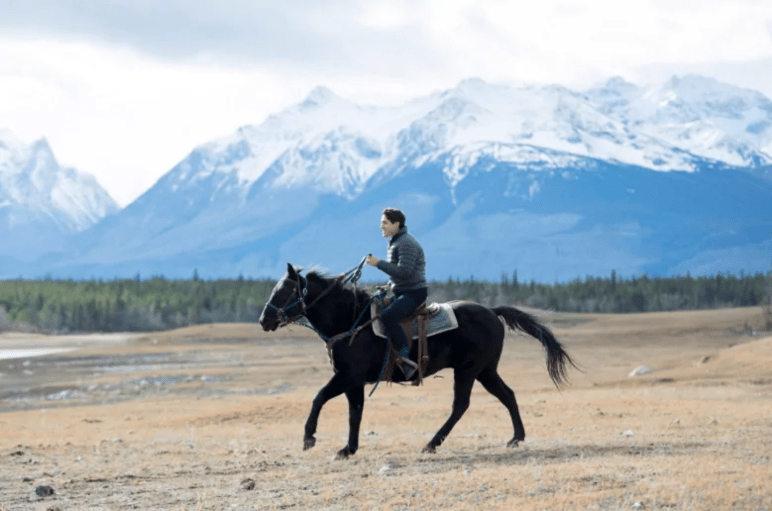
We were recently exposed to Trudeau riding in on a black steed, in a set-up photo moment. He was cantering in to dramatically apologize to the Tsilhqot’in in Nemiah Valley part of the Quesnel area of British Columbia.  He had travelled across the country to once again apologize for events which occurred over 150 years ago; events that occurred on October 26, 1864, an event which has been termed by historians as the “Chilcotin uprising”.

This “uprising” was carried out by the self-designated “War Chiefs” of the Tsilhqot’in: Chief Klatsassin, Telloot, Tahipitt, Piele and Chessers.  As the Liberal story goes they had been arrested 150 years earlier, convicted of murder, sentenced to death and eventually hung. This was a travesty according to your current government.

Apologizing to persons convicted of murder is unusual even in this day and age, even for this current group of politicians. Pictures of our theatrical PM Justin Trudeau literally riding in to set the record straight, to apologize for the execution of six chiefs of Tsilhqot’in more than 150 years ago seemed curious, worthy of further exploration.

In fact this was not the first apology for this event. In 1993 the B.C. Government apologized originally and erected a cairn in memoriam.

This first apology, as it turns out, was as a result of an Inquiry in British Columbia headed by Justice Anthony Sarich, who had been tasked to explore the “native people of the Cariboo-Chilcotin and the Justice system of the Province”.

He  issued a final report: “Report on the Cariboo-Chilcotin Justice Inquiry, 1993.”

In his report Justice Sarich talked about this historical event which was referred to as the  “Chilcotin uprising” or sometimes the “Bute Inlet massacre”.

There appears to have been no argument at any time that the Chiefs were innocent, but he said that there was “concern that the chiefs were induced to surrender and give inculpatory statements on a promise of immunity by Magistrate Cox”. In other words they had been “tricked” into surrendering and in doing so made some statements that implicated themselves.

Sarich stated that throughout the Chilcotin region, the story of this “uprising” had verbally been portrayed in the Indigenous community as the Chiefs defending their land, an effort in the fight against colonialism. So Sarich now had to confront two versions of the story; the documented historical version including trial transcripts and the one being verbally passed down in the Indigenous community.

Sarich in his final report, somewhat surprisingly, and not very Judge like, could not come to a conclusion and as the flavour of the day was appeasement, said “whatever the correct version that episode of history has left a wound in the body of Chilcotin society. It is time to heal that wound.”

So, on the basis of “whatever the correct version”, the BC government formerly apologized to the Indigenous of the Chilcotin in 1993.

Not to be outdone, the Trudeau government, who seems to search the historical records for anything resembling a good bandwagon when it comes to anything Indigenous also issued a “Statement of Exoneration” in March 2018 in Parliament. Of course, the opposition parties on hearing an apology to the Indigenous felt naturally compelled to join in unified approval. After all, how could any apology to the indigenous not be assumed to be well researched, another step toward reconciliation. Perception is  everything, it is part of the reconciliation dogma.

What really catches ones attention were the actual words in the Exoneration document drafted by the Liberals. It said that the Chiefs are “fully exonerated because they were acting as one independent nation engaged in war with another when they were attacked and killed… a betrayal of trust” .

Even a dim historian, would wonder how was it possible to be a Nation at “war” when we were not yet a nation.  This occurred in 1864 and our country was formed in 1867. Needless to say there neither was there a recollection of our yet to be “country” at “war” at the time.

Trudeau said the Chiefs were “protecting their Nation which was under threat” and they had acted “in accordance with their laws and traditions”.

So where did all this start?

In 1864 Governor Frederick Seymour was the colonial administrator in the region at the time and because of the interest in the extraction of gold, he also had a Gold Commissioner named William Cox. The governor had authorized or sanctioned the building of a wagon road from Bute Inlet to Fort Alexandria, with the idea being to connect it eventually to the Cariboo road, and then on to the gold fields of the Cariboo.

The killings for which the Chiefs were convicted began on April 29, 1864 when a ferryman, connected to the road crews, Timothy Smith, was confronted by the Chiefs. Whatever form the confrontation took it did not end well for Smith. They demanded food, shot Smith, and then threw his body into the river. The Chiefs then looted the food stores and supplies taking with them a 1/2 ton of provisions.

The following day, the Chiefs then attacked a workers camp in which three men were injured and escaped down river. Peterson Dane, Edwin Mosely and Buckley (last name unknown) escaped down the river, but the remaining crew were all shot or hacked to death. Their bodies were also thrown into the river.

Four miles further down, a foreman William Brewster was working on blazing the trail along with three others. They too were attacked by the Chiefs, and all were killed. Brewster’s body had been mutilated, his penis cut off and stuffed in his mouth, his heart cut out of his chest and eaten.

Later a settler of Puntzi Lake, William Manning, who was not related to the work crews was also killed.

A few days later, a pack train which was travelling through the area was subsequently “warned” about the Chiefs and the killing rampage, but the train decided to carry on. They were “ambushed” by the Chiefs and all were killed.

By the end of this spree, nineteen persons had been killed, shot or hacked to death.

Governor Seymour on hearing of the killings sent crews of twenty, and then fifty people in an effort to locate and arrest the Chiefs. All were to no avail.

This led to an eventual meeting of Commissioner Cox with the Chiefs. Cox apparently gave them assurances of friendship, and when the Chiefs came forward, all were arrested in what had to have been one of the original ‘sting’ operations.

In a trial all were convicted and sentenced to death by Justice Begbie who was fluent in both the Shuswap and Chilcotin languages. Their defence at the trial (and there is a transcript) was that they were “waging war”. The road crew they argued had been sent by the Colonial government, and therefore they were “under threat of smallpox and further loss of land”.

This was presented by Trudeau in his speech, in the Liberal revision said that the colonial government was “unwilling to accept that these six chiefs were leaders and warriors of the Tsilhqot’in Nation”…and that they were trying to “maintain rights to land that had never been ceded.”  Then adding that they were “well regarded as heroes by their people”.

The heart of the issue is the motive. The Chiefs, and now this latest government all seem to believe that they were an “unceded” nation that could lay claim to any and all lands at any time. Therefore they could self determine if the road crew was on their “territory” and therefore conclude that the very building of the road was an act of war by a colonial government.

It stretches ones incredulity. The other possibilities and far more likely motives were “plunder”, “revenge”, and “starvation”.

The fact was that these individuals were innocents, killed in cold blood, persons working on a road, not at “war”. These were defenceless individuals who were slaughtered, mutilated and their bodies thrown in the river all seemed to escape the government vettors of apologies.  There was no innocence here. There was no denial of the killings. Judge Begbie in his comments called the Chiefs “cruel, murdering pirates”.

If this trial was conducted in 2018, it is highly likely that their self declaration of war on a nation would not bear much evidentiary weight. The fact that they made inculpatory statements, and had been tricked into being arrested may have tainted any inculpatory statements they made, but it would not have led to a finding of innocence.

Mel Rothenberger, who wrote a book on the events, and who is a descendent of one of the victims of the massacre was interviewed by CBC Radio. He was upset by the revisionist version which has been allowed to be told without any kind of academic review. He too talks about the fact that there was no declaration of war, that these victims were hacked, shot and plundered. This was not war, this was a robbery homicide.

Rothenberger’s version is based on the record, as there are numerous academic documents including a trial transcript record. In fact he says it was one of the best documented areas of research in Canadian history of this time period.

The Indigenous version is clearly subjective, verbally worked over and passed down over the decades. In their reworking of the events, they obviously felt that portraying them as heroes and not criminals was in their best interest and now goes with this modern age of revisionism, the chant being forever and always the victims of colonialism.

This was cold-blooded murder. And your government in an effort to further ingratiate themselves to the indigenous cause seems to feel it is ok to pardon those murders, the colonialists and the innocent victims forgotten.

Michael Dunn in an article on Theory of Knowledge.net, writes on how and why history gets re-written and offers up four possible scenarios.

The fourth reason he cites is that there are social, political, and psychological paradigms that alter the historical record. In other words the political and social climate seeks to change history.

We were warned by George Orwell who said, in his acclaimed book “1984” that “he who controls the past controls the future, and who controls the present controls the past”.

This story,  at this particular time in Canadian history was indeed a black mark, one from which we should all learn. It should not be a proud moment for the Indigenous. Maybe, just maybe it is an example of the state at the time, the ongoing clash of colonialism with the indigenous. Nothing more.

Even if one accepts that this Indigenous group were desperate, hungry, frustrated by the ongoing Colonial inroads being made one still has to conclude that this was a murderous crew with much different intent. To bend and twist the pages of history, to hide the motivations, to cover up the brutality of it all and then make them heroes for massacring innocents is beyond the pale.

Not one journalist, not one parliamentarian felt the need to ask a question. No one did their homework. It makes one wonder how the descendants of the victims feel, but one thing is certain, they will never get an apology.

In March of 1968 during the Vietnam war, over three hundred unarmed civilians were killed by U.S. Troops; unarmed women, elderly and children were killed as an act of war. The defence argued that they were at war, therefore anything goes.  Eventually Lt. William Calley was convicted of “war crimes” in a highly publicized trial which was considered one of the most shocking incidents of the Vietnam war. The killing of innocents even in a time of war could not be sanctioned.

In this smaller, Canada version, there was no war, but the Chiefs claimed in their defence and during their rewriting of their history that they were at war, defending their “nation” regardless of the fact that these were innocents, not soldiers in some real or imagined war. At the very least these Chiefs were war criminals. No mangling of the historical record can make them heroes.

Trudeau recently said while in Europe that “the very capacity for a citizen to engage with the truth is under attack”. How right he is.

The Liberals and those that followed suit should be ashamed. We will have to see if they too get “exonerated” in the next election, or maybe in 150 years.

Photo Courtesy of Jonathan Hayward of the Canadian Press some Rights Reserved


Toke Anyone….

With the greatest reluctance and with a feeling of useless inevitably, one feels the need to write about the legalization of marihuana. The Liberal government grasping and pulling that younger crowd to their breast, exhorting them to be free, less anxious,  and to surround themselves with the elixir of swirling smoke and an expanded mind.  Free to be impaired, medically or otherwise. No one to bother you. The big medical experiment has now become law.

We now join Uruguay as the only other country in the world where it is entirely legal., We join the 2nd smallest country in South America, a country now in “economic decline and factional struggles” since its return to democratic ideals in 1985. A country where its biggest problem now is young people leaving the country, not the young people staying home to smoke pot. But we digress.

First it should be stated that there is very little caring on this writer’s part about the pluses and minuses of marihuana use, although clearly the medical good of this drug has been highly exaggerated by the effusive pot community who will regale you with cure-all stories at a moments prompting. It is kind of like listening to alcoholics sing the medicinal effects of having a shot of whiskey before you go to bed. Could be true, but again maybe not, but one needs to consider the source.

However, if you believe the hype, believe the constant bombardment of how good the CBD component of marihuana is, then you’ll understand how the “medicinal use” of marihuana has tripled since 2016.

Meanwhile the august body of the Canadian Medical Association states that “while the CMA recognizes that some individuals suffering from terminal illness or chronic disease may obtain relief with cannabis, the CMA remains concerned about the lack of clinical research, guidance, and regulatory oversight for cannabis as a potential medical intervention”. You should also understand that medical marihuana has not undergone testing such as that used for prescription drugs.

They go on to say in their CMA policy statement that the “Canadian Medical Association has consistently opposed Health Canada’s approach which places physicians in the role of gatekeeper in authorizing access to marihuana”.  In other words, they don’t want to prescribe it. They went further in an editorial saying that the legalization of marihuana was an “uncontrolled experiment in which the profits of cannabis producers and tax revenues are pitched against the health of Canadians”. Given any set of other circumstances one would have thought that at the very least comments like this would give one pause before full government endorsement. Not with these Liberals.

Mike Farnworth, BC governments Minister of Public Safety in an interview with the NY Times said: ” its an octopus with many tentacles, and there are many unknowns…I don’t think that when the Federal government decided to legalize marihuana it thought through all of the implications.”

This legislation will likely go down in historic terms as one of the worst prepared, least thought out bills ever passed by Parliament; a shining example of government inadequacy on three different levels.

While it is difficult in this age to find any level of government capable of introducing legislation in any kind of timely manner; with properly thought out enforcement provisions and having anticipated the legal challenges, this legislation is a true standout in terms of lack of preparation. There is a need for not one but three levels of government, in 13 different Provinces, to coordinate and work in unison.

To add to the jurisdictional chaos is that there is significant  medical, legal, political, labour, and business layers to the effects of the legislation, all who want a seat at the three level government dance. All this has been known for a couple of years of course, but clearly not enough time for any government in Canada, or any police agency to be prepared. Most government agencies, including the police need a couple of years to organize a washroom break.

The level and the extent of hypocrisy is overwhelming. Trudeau and company doing the old ‘ole’ as the bull of repercussions slide by with nary a glance. The matador untouched by the horn of the bull, untouched by the numerous and sundry issues surrounding this legislation.

So now the mad scramble is on, while on the judicial side line lawyers salivate, drooling and falling over themselves like a pride of jackals preparing and vying to establish their new found  “expertise” in the criminal and labour laws. This taxpayer legal honey pot should keep legal firms in Canada busy for the next several years.

The government spokesperson for all of this is Bill Blair, the consummate chameleon, a 2nd generation cop who rose to head the Toronto Police Service, who has now had a revelation and has been chosen as the front man for the Liberals.  In an interview with the National Post, he describes how he has gone from from leading the police fight, the knight in shining armour as a former chief of police, to now principles and beliefs thrown aside,  he has been transformed in to the the righteous spokesperson. With the same semi-autocratic demeanour and certainty he displayed as the police chief, he is  now trying to convince us that this is going to eliminate organized crime.

How are they going to do this, according to Blair and his government they feel that because the government is so good at running businesses they are going to compete with organized crime, provide a good quality product, at a good price in a pretty package, and easily accessibility.

So far they claim they are only going to add $1.00 in taxes on a gram of pot, including sales and excise tax. Now considering the new law allows one to carry up 30 gms of pot, enough for 60 joints, that will mean an additional cost of $30 in taxes for your personal stash.

If the average user of pot spends $100.00 a week according to a recent survey, they will now therefore be spending $130 a week. $120.00 extra for a month, just in taxes. The appeal of the legal dispensary may wear a little thin at those prices.

In the home of BC Bud, so far the government has only opened one store in British Columbia; in Kamloops far from the Lower Mainland, far from the most populous area of the Province.

Dispensaries in Alberta have already run out of product.

You don’t need to have an MBA to realize that if you have no products when you open a new store, you may have a problem. But government is good at this right?

So far in the policing world what seems to be garnering the most enforcement attention is the potential for increases in impaired driving. It is difficult to say whether this will be the case, as again, nobody seems to know answers to much surrounding this issue. However we already know that drug impaired driving is increasing, and now exceeds that of alcohol impaired driving (40% of Canadian drivers killed in Canada were impaired by drug, while 33% of those killed tested positive for alcohol)

But to try and win some counter points, the Liberals proclaim  that besides increasing the penalties for impaired driving (which they have done)  they are going further and arming the police with the ability and knowledge to detect and process impaired by drug drivers.

Their two programs are the Standard Field Sobriety Testing and the Drug Recognition Expert Program. (it should be acknowledged that this writer is a former DRE at the Instructor Level). These have been developed and been around since 1979,  in particular, in the United States.  The reason they came about and were developed by the Los Angelas Police Department was that there was no precise drug testing regime in existence and that has not changed.

There is no Breathalyzer equivalent for drug testing.

What was developed in its stead was a 12 step semi- subjective evaluation method.  It has been challenged as being too subjective already in the Ontario Court of Appeal in R vs. Bingley. 

Regardless of how that turns out, what they are not detailing is the extraordinary time effort that will be needed on the part of the police to conduct the tests, as long as they can even find a trained DRE officer in their policing area.(as of October 2018, according to their own government website there were 833 DRE trained officers in Canada–out of the roughly 69,000 police officers).

When confronted with the DRE numbers, Mr. Goodale quickly goes to the fact that they  have 13,000 officers who are trained in SFST.

So what are those tests?  Basically they are eye checks (follow the pen) where the officer is looking for Horizontal Gaze Nystagmus (HGN), followed by a couple of physical tests such as walk and turn, or standing on one leg. If you fail, then you are asked to comply with the tests of a Drug Recognition Expert (again, if you can find one) which takes another hour or so, and then the DRE will demand a blood sample, usually a pin prick to the finger.

If all this sounds like an overblown, a time consuming process, it is.

That is why in the desperate search for a drug “breathalyzer”  has been going on for several years, and so far German technology seems to be the front runner in Canada.

The government has just committed $161 million over the next five years to the purchase and training on the officious sounding Draeger Drug Test 5000, which is designed through a simple saliva test determine if you have THC in your system.

But, alas, there are some issues with this magical instrument.

In testing by the Journal of Analytical Toxicologists in Norway they determined that the machine “did not absolutely correctly identify DUID”. In fact there was a 14.5 % failure rate for false-positives, and a 13.5% failure rate for false negatives. The Australians who use this device felt that it was pretty good and reliable, but only in ” two thirds ” of their cases. Bring in the lawyers.

Oh yes, the device only works between 4 and 40 degrees Celsius and it takes about a half hour for the device to work, about 10 times longer than the roadside breathalyzer.

It should be added that a failure of the Draeger test is not an offence. It only leads the officer to have you submit to a DRE evaluation or demand a further blood test.

If you still are unconvinced that there will be a problem with court challenges. Consider this: the Federal government in the legislation has stated that if you have 2 to 5 nanograms of THC in your system you are impaired for three types of offences.

This too is an issue. The central question being the efficacy of measuring cannabis impairment. Expert after expert testified to the government that what constitutes impairment will differ from individual to individual. It depends on the individual and their tolerance. There is little doubt that this will all be eventually chased all the way to the Supreme Court of Canada.

So as one stands outside the new pot establishment in Kamloops, with its mysterious blocked out windows, as Chrysler Neons roll up with teenagers giggling and pointing to the store as they try to find parking. The bored security guard sits on the iron rail, a beacon of safety, as persons emerge holding their discreet but pretty packages just like at the Apple store, and as the persons in the line shuffle two steps closer to their Nirvana, one wonders where this is all taking us.

Are we better off now as a society with this new legislation? Are we going to be awed by the medical advancements provided by marihuana and its associated products?

Are the groups of organized crime going to wilt away into the sunset, saying sorry you are right, we can’t compete. Walk away from a $5.7 billion dollar industry?  In decades of policing it was never my experience that organized crime groups walk away from money, let alone that kind of money. Evidence the fact that they often kill people for interfering in this gold rush.

Are they going to control the number of underage people using marihuana or is it going to lead to further use? In a survey done by Lighthouse for the Cannabis consumer Update it found that 50% of pot users did so on a weekly basis spending on average $100 per week.

In the age bracket of 18 to 34, 61% had used marihuana, 21% used 2 to 5 times a week, while 19% used it everyday.

Provide a more accessible product, remove the stigma of illegality and it seems to be common sense that the numbers of young pot users will have to go up.

The medical association recommends nobody use marihuana under the age of 25 due to brain development issues.  The Federal government and the Provincial governments have already agreed on a range of ages who can purchase marihuana legally, all under the age of 25.

Are there people going to get rich? For sure. But not you and me, or the casual pot smoker. Brian Mulroney maybe, or those others that have invested in government approved production and distribution centres such as big pharmaceuticals. Of course the big winners will be the lawyers as they begin to clog the courts over the next several years.

But here is this writer’s prediction(s):

In ten years time, we won’t be talking about it, the fad will have worn thin.

There will be more impaired drivers on the road, and minimal enforcement of those laws as the prosecution of those offences prove too onerous.

There will be more young people suffering from mental issues associated with the use of marihuana.

They will determine that pot has some medicinal pain killing benefits, not much else.

They will also determine that pot is addictive.

The government will have more money in its coffers.

Organized crime will be discovered to be investors and have infiltrated into the “legalized” production of marihuana.

Robberies will go up at BC Liquor Branches.

The Indigenous will have opened up their own production facilities and will be able to sell it cheaper as they get to avoid excise taxes, but they will have a difficult time saying it is part of “reconciliation”.

Canada for the next several years will be known around the world, not as the welcoming country to immigrants, not as a forward thinking place to invest, or not as a haven of academic achievement. It will be known as the place where marihuana is legal now.

A police officer will challenge the courts and the policy of the RCMP based on his/her need for medical marihuana. To not allow him/her to work it will be argued is against the Charter of Rights.

Meanwhile ‘Joey” or “Emily” driving around their small hometown at 9 at night in their parents car, wanting some weekend pot, living in small town Canada, will not be able to find or buy at the dispensary. There will be a new generation of “bootleggers”.

But if “Joey” plans a few days ahead, the government retorts, he can order it online.

That is if the Post Office is not on strike.

Photo Courtesy of Evan at Flickr Commons Some Rights Reserved


Surrey Election 2018- is it the beginning of the end of the RCMP as we know it?

On October 20th, the electorate of Surrey said that they are fed up with the RCMP.  With the number of shootings seemingly unstoppable, followed by the usual explanations formulated by practised media spin units,  saying it was a “targeted” homicide, and the “public has nothing to fear”, it seems to have reached a breaking point. Yellow police line tape seems to stretch for miles and dominate the weekend news in Surrey. There are the innocents who have died in Newton, businesses and people who don’t even bother to report crime anymore in Whalley and Guildford,  and they seem to have finally reached the end. It has been a long time coming.

In the past, the 10% discount for the RCMP seems to have silenced the critics who complained of less officers on the street, a growing and expansive police budget, and increases in property crime and drive by shootings. Maybe this is no longer true.

The RCMP has been part of the City of Surrey since 1951 when fifteen constables began patrolling the town which became a city in 1993. It  has been growing at remarkable speeds ever since, with a population now exceeding over 500,00 and the detachment in seeming lockstep, has grown to over eight hundred officers. It is the flagship detachment of the Royal Canadian Mounted Police, their largest detachment in Canada, and that flagship is now sinking under its own weight.

Now, a party led by the irascible, tempestuous and often incomprehensible Doug MacCallum has re-swept into power at the age of 73; running on a singular party theme of safety in the streets.

His newly founded party is a one issue group, calling itself the Safe Surrey Coalition. Counsellors who have swept into office with him, including ex-RCMP police officer Jack Hundial, also have identified themselves as singular in their focus, and that focus is to get rid of the RCMP. In their view and clearly in the view of the electorate the RCMP has failed the people of Surrey.

MacCallum is a colourful character, never an admirer of the RCMP, who was last in power in 2005. MacCallum was removed from power originally in 2005 by Diane Watts, and then followed by her appointed successor Linda Hepner. Both were clear fans of the RCMP, buying into the agenda of the RCMP and sprinkling every press conference with plaudits and statements of the excellent job the RCMP was doing.

But the scepticism has been brewing under the surface for years. Many police officers have openly expressed the opinion that the RCMP can not keep up with the times, including this writer; that it is governed and directed by the highly political Ottawa, an Ottawa and Federal Liberal government which has long since lost the confidence of the public, at least in terms of policing.

A police force which seems to be embroiled in internal unrest, whether it be sexual harassment, or poor wages. Wrapping themselves in the flags of diversity and inclusion, seemingly oblivious and unable to relate to the citizens of Surrey where the bullets continued to richochet around the community police stations.

This is an RCMP which seems to have grown into and become an ineffective agency.  Ridiculously low solve rates, officers constantly complaining about low wages and poor working conditions, insufficient manpower, and a parade of weak leadership at the top of the detachment have been fuelling this slide.

A top management level interested in keeping Ottawa happy,  interested in career advancement and promotion while expanding a bloated and inefficient plainclothes sections, all the while seemingly oblivious to countering the day in and day out criminal activity for which Surrey has always been infamous.

Their only response to the crime, to the death of innocents was that they needed more officers. From Bill Fordy to Dwayne McDonald, always the same, they need more. During Hepner’s time as mayor she claimed to have added 134 officers, but it was never enough.

It was a tried and true chant while at the same time there were several re-organizations of the detachment, each seeming to add further and further layers to the detachment bureaucracy, and a clear bloating of the numbers of officers in specialized sections to the obvious detriment of officers on the “road”.

No one questioned the inside shenanigans at the detachment. At the time of the last municipal election a few days ago, McDonald was again scheduled to request further officers. (It should be pointed out that from 2014-2017 Mr. McDonald was the officer in charge of IHIT, which grew from 48 officers to 110 individuals and a collapsing solvency rate hovering around 20% )

In the last number of years, you would hear words like “progressive”, “community first”, “engaging our youth”; innocuous silly platitudes, all designed to fudge over detailed analysis of what was going on both inside and outside the detachment.

Over the years the RCMP has hidden behind those detachment walls, never allowing outside examination of management to any degree. Annual Performance Plans have been tailored to speak in generalities, no deep dives into the statistics, little of substance or real meaning. An annual exercise in bureaucratic concealment, far from the eyes of the public.

So the citizens of Surrey are now going to begin an exercise to exorcise themselves from the red tunic, and for many that served in this community over the past number of years, it will indeed be sad. But it is inevitable.

The RCMP management of the last twenty years have been oblivious, unable to speak the truth either for political reasons or because they were “going along to get along”. Somewhere the vision was blinded, lost to political expediency, somewhere there has been the disappearance of the goals to “uphold the law and provide quality service”  (RCMP Mission Statement.)  They focused on the writing of the Mission statement and selling it, as opposed to the actual performing of the Mission statement.

They began to develop “strategic media units” to create the spin. Honesty became blurred.

None of this is to say that any upcoming Municipal police force will be a bed of roses. It will be more expensive for sure and political control will be local. Not Ottawa, but political none the less.

Most officers currently policing Surrey will likely switch over to any new agency, grown tired of the RCMP, no longer concerned about being a member of a National police force and not overly concerned with the history of boots and breeches. They are the millenials after all — careers, work life balance and wages are their new loyalties.

There is good work being done at the Surrey RCMP. There are good people working long and difficult hours. There are good investigations which have been successful and most of these people would likely join and be part of any new Municipal agency, lost to the RCMP for good.

The singular and most obvious problem was that the operational policing structure, the traditional pyramid where the solid base was the uniform on the street was turned upside down. It became a top heavy bureaucracy infatuated with promotion and specialization, forgetting that everything starts on the streets. They lost sight of the fact that policing principles, its basics, has not changed for decades. It is a government agency which should never have lost track of what was important, where the expertise and productivity actually come from, those formative years in policing.

Seniority, supervision, and continuity took a back seat to what was perceived and sold as being more sophisticated. Everyone became an expert. This combined with demographic issues has led to the average service of the RCMP on the road in General Duty in Surrey to be 1.8 years. (This according to sources, as the RCMP will not admit to the public that this is the case).

If MacCallum succeeds in removing the RCMP then the RCMP nationally will be affected. It would be an admission that they are incapable of city policing, an admission which  would be a loss of face.

For the people of Surrey who are demanding change, their only hope is that it is successful and the Mounties get the proverbial boot.

To date the Mounties have not re-acted to the election. Maybe, they don’t care. Maybe, they want it to come about as it may lead them toward a possible goal of an FBI style RCMP. Maybe, there will be a domino effect and regional policing will once again come to the fore. Further time will tell.

To the officers that came and went from Surrey Detachment, part of their policing heritage will be altered, and as the “white shirts” toddle off to their better than average pensions, they should at least consider apologizing for their inability to adapt, for being caught up in playing the government political game, for not taking principled stands and  for being dishonest in terms of accountability.

Like the battered and bruised boxer answering the bell after 8 rounds; the RCMP question is whether they can make it to the final round, still answering the bell, arms up trying to avoid head shots, muttering about being cheaper, in an effort to keep from being knocked out. As Roberto Duran said when fighting Sugar Ray Leonard and famously declared “no mas”;  there indeed may be “no more” fight left in the RCMP.

Photo Courtesy of Douglas Miller via Flickr Commons – Some Rights Reserved


Mandate

Like a 1950’s child running to meet the postman for the Sears catalogue, one wonders whether Ms.Lucki dashed to greet the postman who was delivering  her new “mandate” letter.

If you were bored, frustrated, killing time waiting for shift end, or enjoy a little masochism, then you too may have read with anticipation the Honourable Ralph Goodale’s “mandate letter” to Commissioner Lucki.

The document is surprisingly brief from the illustrious Minister of Public Safety and Emergency Preparedness. It was likely “ghost written”, by a high placed bureaucrat and screened by a legal team, nevertheless it is still revealing. With a little in-between line reading, if there were any doubts as to why Commissioner Lucki rose to the surface and became the cream of the crop in the view of that Liberal august selection committee, then this document should remove that doubt.

What is interesting is what is missing, what was not worthy of mention. If you want to believe that operational policing is the soul of the future RCMP under Commissioner Lucki, you may be wrong. If you think terrorism, cyber crime, white collar crime or child pornography are occupying the minds of the RCMP management in the endless future meetings at 73 Leikin Drive in Ottawa,  you will likely be disappointed.

The letter begins with a reference to Section 5(1) of the RCMP Act where the Commissioner of the RCMP has the “control and management of the RCMP and all matters connected to the Force”, but of course at the “direction of the Minister”. He goes on to say that “police independence underpins the rule of law and ministerial direction”,  that he will rely on the “advice and input” to “help me” establish “strategic priorities.” Blah blah blah.

All that requisite dribble aside, he then goes on to outline what Commissioner Lucki’s “role” will be. Which will be to “reinforce” and “support” the organization in its effort to modernize and reform the RCMP’s culture”

Its future “transformation”, as envisioned by that old sage Goodale will include the “health and safety of the RCMP employees”… “including from harassment and violence in the workplace”….and of course “enhancing its role in reconciliation” with “Indigenous peoples”.

All predictable of course, in light of Justin Trudeau and his cabinet recurring themes, but stark all the same in its simplicity.

The next paragraph mentions “internal and external governance structures and practises”, no doubt a reference to a future civilian administrative oversight.

Then the letter returns to clearly its main preoccupation. “You will need to prioritize that the RCMP is free from bullying, harassment, and sexual violence” and that she should prepare an extensive response to the reviews that were outlined by Sheila Fraser from the Civilian Review and Complaints Commission. She will need to “ensure that the RCMP is representative of Canada’s diverse population, including gender parity, and that women, Indigenous Peoples and minority groups are better reflected in positions of leadership”.

Mr. Goodale ends by reflecting on Commissioner Lucki’s previous posting of Training Branch in Regina, and he lauds her for her commitment to training, including “diversity, inclusion, and a respectful workplace”.

So where does this leave us? Like any change in power, whether it be in government, or in a government agency, it is helpful to look at the scope and focus of the change and try and determine who are the winners and who are the losers. Who are now in favour, and who have fallen out of flavour. Here are some predictions.

The Winners

If you are indigenous in the RCMP, or if you are even partially indigenous, or if you can claim a distant ancestry to anything resembling an indigenous group you are a clear winner.

If you are a member of the First Nations Policing Program in 2018 the Liberals have already invested $291 million in the program over the next five years. You are a winner.  This group which is overseen by this same Ministry is designed to “enhance the effectiveness of policing services in First Nation and Inuit communities.”

What “enhance” means in government speak can be anybody’s guess, but lets face it, they will likely be able to reach that goal.

If you want further proof of the constant indigenous theme, don’t stop at Ms. Lucki, look at the rest of the Senior Executive Committee of the RCMP management. Besides, a clear background tendency to the Federal policing side, you will also constantly see the theme of indigenous relations and its level of importance.

Even the more vocal and somewhat rebellious indigenous groups in Northern Manitoba are winners. Commissioner Lucki worked and resided in that area and received an Order of Merit for her “efforts to improve relations”. It doesn’t say that she did improve them, just that she made an effort of course.

The second clear winner are female officers.  With a relatively pristine record, and if you have more than 15 years of service, your odds of becoming management have become markedly greater.

This is not new. The trend for more women officers has been moving along at a high clip since the 1980’s when they first became the hiring priority.  In 2006 there were only 6% of officers were female, in 2016 that number has increased to 21%; more than a 250% increase. In 2016 as well, 13% of senior officers in policing were women.  There will need a massive advancement of female officers in the next few years to have a visible measurable impact, one which Lucki can hold up as evidence of success. Expect demands for more flexible work hours, greater considerations for pregnancy and eventual return to work accommodations.

If you self identify as a member of LGBTQ during the recruitment process or a member of any of the visible minorities, then you too should be a winner.

If you have a claim under the sexual harassment class action you will be a winner. There is little likelihood that this Liberal free-spending government will be eager to deny any claims even if some may be spurious and would normally warrant some authentication. There has been an exponential growth in claims, so expect that to continue.

The Losers

If you are a farmer or resident of the North Battleford area of Saskatchewan which enjoys the highest crime rate in Canada you are a loser, and you should not expect any improvements in policing for the next few years. You are in the way for those who will be pushing the indigenous agenda, so therefore you are politically expendable.

If you are an officer in Chase B.C. or Dauphin Manitoba, hoping beyond hope, that a replacement will be found to fill your position, you are a loser. The current staffing consensus indicates that there are not enough new people to even fill the retirement levels. Lack of manpower has been the theme for a few years, but expect this to continue as it never even gets honourable mention anymore. Clearly, they have given up on the phrase “more for less”, as its marketability has become more irritant than salve for the masses.

If you are optimistically expecting a pay raise to bring you back into contention in the police universe, you are a loser. The Federal government is clearly sitting back and waiting for the union process to get settled. Is it necessary to also point out that manpower and wages are not mentioned in the mandate letter? They haven’t quite figured out that morale, quality of life and optimism are directly linked to these issues.

Are we making too much of this mandate letter? Is this the thin edge of the knife?

The concern of course is that there has always been a curtain drawn, a line not crossed when it comes to the relationship between the police and the State. Goodale even makes reference to “police independence” in the beginning of the letter. However in real terms policing is at a crossroads. In the U.S. Donald Trump is trying to wrest control and direction of the FBI with political shenanigans only impeded by a robust 5th Estate, and an unwilling to go along attitude of the Justice Department and the FBI themselves.

Has Canada, the docile and compliant country that we are, now entered into a relationship between the police and the state which is a little too close for a properly running democracy? Have we now rolled over and woken to a new political RCMP, one wholly directed and run by the authorities?

Has that line been crossed? Is Commissioner Lucki now no different than the other Ministers who rely on the government of the day for their survival?

Maybe we are reading too much into it. Maybe the RCMP bureaucracy is so stultified that nothing will ever get done, maybe we can rely on bureaucratic incompetence to keep us safe.

But there is little doubt the RCMP is teetering, in fact it may be too late. It may have already become a fully engulfed political institution, part of government, not separated from it, no longer an ethical divide between them and the governing party of the day.

In the end the ultimate winner may be Commissioner Lucki herself.

After all, if she succeeds in pleasing her political masters in the next few years and if the Trump of the north continues to reign, who knows, maybe the Liberals will make her a Senator too; for a job well done of course, a job done as directed.

Photo Courtesy of Flickr Commons by elPadawan Some Rights Reserved


“Rats”

This is not a reference to vermin, although likely that this is where the mind should first go, unless of course you’re a jaded police officer.

What is being referred to here is the person class of rat, the Donnie Brasco or Watergate “deep throat” types; people who are motivated usually by three broad and not always singular reasons– self preservation, conscience, or self-interest. They are motivated to give over confidential information, in the street vernacular, they are motivated to “rat” on someone.

And for those holier than thou types, who say that they would never tell on someone, you better think again. Everyone, given the right circumstances has the potential to be a “rat”, or if you like the more gentle term, a “confidential informant”.

For instance, the Canada Revenue Agency this year had 32,157 “leads” from their “snitch line” in 2017/2018, a phone line where Canadians can anonymously call on their neighbours and friends and tell on them, “snitch’ on them for cheating on their taxes.

Informants are everywhere, in every facet of society, dwelling below the surface, just out of sight.  They thrive in  the political, corporate, cyber, and the military world.

Donald Trump, exuding his mafia don persona recently called Michael Cohen, his one-time lawyer, a “rat”, for his cooperation with the Mueller investigation.

There are many in the American military who blame the misguided incursion into Iraq looking for “weapons of mass destruction” on the fact that the CIA and NSA relied too heavily on technical resources– that they had allowed human sources to fall out of favour, neglected them and replaced them with the sexier uses of technology such as drones or telecommunications intercepts.

This is all a rather large preamble to the main point.  In policing, especially in the drug, gang and homicide world, the police need informants. It is not the use of forensics, or searches of criminal data bases that in the end usually provide the needed link. It is human informants who prove themselves invaluable; able to solve crimes, or at least put one in a position to solve the crime, often at a fraction of the cost, often saving hundreds of investigational hours chasing links and leads.

The police should be learning from the likes of the NY Times or the Washington Post who clearly have developed informants inside the Trump White House in remarkable numbers, people informing at the highest level of government, possibly committing economic and political suicide if caught.

Effective policing simply can not survive or thrive without informants. They need rats and they need to cherish and cultivate those rats.

The decline and decimation of the solvency rate in IHIT maybe the lack of human informants who are almost non-existent according to this writer’s sources.  In the last number of years, the police have fallen in love with the technical; DNA, video, cellphone call records.  It is where junior and in-experienced officers tend to gather, as they have not had the time or the inclination to pay the time and price of human source development. Homicide investigations conducted over a laptop. Not that these other avenues are not valuable, but they are not comparable to the value of a good informant.

There are a couple of reasons for this, and it can not all be blamed on the officers themselves.

The first is that the politically correct RCMP and the current managers of the RCMP run from controversy, run from anything which could harm or impede their pristine career path. Doing nothing seems to be the historical creed of many a bureaucrat for the last many years. The 21st century of political politeness has created an environ that is loath to the risk taker, the person willing to go out on the proverbial limb, willing to justify a more precarious position in the interests of the better good.

Rather than develop informants with their inherent risks (and admittedly there are a lot of risks) they would rather barricade themselves from it. In extreme cases they have turned away from solving a crime in order to keep their slate clean. Policing is an often risky business in terms of its operations and decision making , whether it is to force entry into a house, or launch an investigation into a high profile agency or business. There is no room for the feint of heart.

Why is there no criticism of this beyond cautious approach? They get away with it because the file investigations are hidden, out of the public view. No one is ever the wiser. The only peek into the effectiveness of human sources maybe when and if you examine solvency stats. In its early formation IHIT had a solvency rate of around 70%, currently in 2018 they are at a staggering 5 or 6%. Surrey and Vancouver are the gun and gang vortexes, making up almost 80 % of the files, solvency is dependent on knowing who are the players, you need inside information.

The RCMP put so many barriers to protect themselves that running an informant, having them approved for use, or paying an informant has become a bureaucratic byzantine nightmare. And if you want to go one step further, and turn this informant into an “agent” then be prepared for a lengthy, paper-intensive, time-consuming, all encompassing questioning of the need for that informant. (An agent is one who is being directed by the police to get involved with a criminal group, such as wearing a “wire”–but in doing so there is a legal responsibility for the informant that makes the police responsible for their financial and physical well-being.)

The second primary reason for this issue, is even a little more unnoticeable. For the formative years of IHIT, the officers becoming part of the group had many years experience, had come up through the ranks and trenches, coming up through the uniform ranks, working on the “streets”. And it is there, that informants are gardened and ripe for picking. It is on the streets, when dealing with the drug dealers, the prostitutes, the gang types that one begins to develop a rapport whether it be through normal interaction, or through arrests and releases. The cellblocks are the Tinder like atmosphere which produces potential informants on a daily basis. Currently the RCMP has told their officers that they are not allowed to cultivate informants who are “in custody” as ludicrous as that sounds to experienced investigators.

Having informants is a dirty job for an investigator. It is a tedious and prolonged effort. The relationships develop over months and years. One does not get a good informant in one meeting, in fact numerous approaches to many people are needed to develop one good informant. (For awhile the RCMP had a unit whose sole job was to parachute into a file, and develop an informant for the investigators–this of course showed an amazing lack of sophistication and knowledge of how informants are built and it ended in failure)

The vast majority of current candidates for the IHIT group are younger, with minimal amounts of service, sometimes less than five years, a situation almost unheard of many years ago. They have not matured as investigators, let alone time to develop those informants. They get parachuted in from Richmond for example to IHIT and they will likely get their first file experiences in in Surrey or Burnaby.

So where does this leave us?  The model has to change, experience and longevity need to count once again in homicide units.  These units need to be a place where seasoned investigators want to go, where one is rewarded for their longevity.

And most of all, there needs to be a realization from the management of the RCMP that if they truly want to be operationally effective, they need to allow their officers the ability to take risks. Recognize those abilities, recognize the value and the time and effort that is required. Realize that there are informants that will go sideways, that will bring negative comment.

It will solve crimes but maybe the question to ask is whether the solving of crimes is a priority anymore.

“You have to bring an informant in, convince him or her that your bed is warmer and safer than the one the informer is currently sleeping in. You have to be a friend, but not too friendly, you have to make promises, but none that you can’t deliver. You have to keep your informants safe, but not hesitate to put them in mortal danger. You have to show them that there is a future beyond this, when you know there probably isn’t.”

– From ‘The Cartel’ by Don Winslow.


Photo Courtesy via Flickr Commons by jans canon Some Rights Reserved


I’m sorry…I’m sorry… I’m sorry…

Our newly minted Commissioner of the RCMP is taking a page from her nominal leader, Mr Justin Trudeau, and has begun to fulfill her mandate, by apologizing to the Missing and Murdered Indigenous Women inquiry saying: “On behalf of myself and my organization, I’m truly sorry for the loss of your loved ones and the pain that this has caused you and your families and your community. It is very clear to me that the RCMP could have done better and I promise to you we will do better”.

As has been commented on many times, Canada has become the land of apologists. Each additional apology minimizing the one that preceded it. The now watered down genuflecting continues to work its way through every government agency and department. The RCMP are not alone in this, they are just following the political crowd, each department elbowing out the other in the fight to be the most empathetic, and the most apologetic. It does not seem to matter why you are apologizing, but it is only important that you are apologizing. The Liberals, the Conservatives, and in particular the NDP; each podium apology provided by (pick a leader) with the witless bobbing heads nodding in unison surrounding their leader.

This specific and particular apology is based on the inquiry into Missing and Murdered Women and  Indigenous Girls which has been hearing “many” stories of how the police have not taken the cases of the indigenous “seriously”. They are alleging that victims were “written off” as sex trade workers or addicts. They have alleged many times over and over again, that if they were sex workers or addicts as many of these victims were, that somehow that meant that their homicide file was not investigated.

Unlike most of the general public, if one paid attention to this inquiry and listened to the testimony presented to this inquiry for many long, long hours, this apology is based on un-tested, un-verified, sometimes outlandish but mostly unchallenged statements of friends and family of “victims.”

This is not to deny that there is a possibility that a few cases fit into this category, its just hard to find the examples, which seem to be accepted as the gospel truth by this disaster of an inquiry. It is duly regurgitated by the CBC, a CBC who clearly have lost what should be the most innate characteristic of of every able bodied “journalist”–  the ability to question.

After 34 years in the policing world, a great many of them spent on major crime cases, and with a couple of hundred homicides under the belt, if anyone can show me a case that was handled differently because the victim was indigenous, please step forward; including you Commissioner Lucki.

In the future, Commissioner Lucki, please do not be so presumptuous as to apologize for something for which you clearly don’t seem to have any intimate knowledge. It is creating a dialogue of misinformation, misrepresentation, and a warping of the historical record.

Heather Bear, Vice-Chief with the Federation of Sovereign Indigenous Nations is representative of what was being said and sold at this inquiry. In commenting on the new training to be undertaken by recruits, said that she will be watching to make sure that there is a change and that the “harassment stops”. She “backs up” her claim by saying that she still gets calls from “Indigenous women who have experience police violence”.

Is Ms. Bear referring those callers to the police for investigation? Of course not. If there is anyone would care to provide some actual details please step forward.  If not, do not make such generalized statements.  It is irresponsible and would not be tolerated if those statements were going in the other direction.

Where is the accountability in making such egregious statements? The 5th Estate have for the most part reneged on their role, and the police management of the RCMP quiver in fear of having to defend their own officers.

Marion Buller,  the biased head of the Inquiry and the standard bearer of all things Indigenous says she thought that the apology by the Commissioner was “heartfelt and sincere”. Ms Buller doesn’t seem to realize that the RCMP, like all Federal departments, has finally mastered the art of the spin, presenting a tear or an empathetic face, some being so practised that they are the envy of Stanislavsky school for method actors. Whether it was heart felt is irrelevant of course, but Buller seems to measure the effectiveness or veracity of a witness with the crocodile tear index. What exactly she was apologizing for, as there were no specific examples given, remains a mystery.

It was noted that in a recent Veterans bulletin, Commissioner Lucki who took a little heat, met with some veterans who were rightfully upset with her “apology”. She of course moon walked  to a degree from her apology, but continued to maintain that cases had been brought to her attention which were biased and not complete. The obvious follow up question would be, when and where, and what have you done to the persons who were responsible for those cases. And please, please,  give us some examples.

These pronouncements are ridiculous and carry no weight if you are not willing to name the cases and expose those issues. Open them up, go after those that you feel that were unprofessional in their conduct.  As Commissioner of the RCMP, should you not be cleaning house of inadequate or racist investigators? Wouldn’t that be more effective and meaningful in terms of proving your claims of wanting reconciliation?

It would be foolish to argue that oversights and sloppy police work don’t exist, and it is unlikely that sloppiness or mistakes  would be specific to the world of indigenous investigations.  Of course careless or lackadaisical investigations are possible. But for that to be true one must know how a homicide investigation is handled. It is not as portrayed by the infinite parade of crime dramas, beautiful people having Sherlock Holmes moments of brilliance. It is more about painstakingly followed processes.

Usually, there is not one person or even two persons who are responsible for an entire homicide investigation.  IHIT in British Columbia for example, works in teams of eight.

On each and every homicide a routine is fallen into; crime scene, exhibits, witnesses, video and on it goes. One rarely recognizes the victim by their race, why would you. The same protocols are followed, the same expectations by supervisors and their bosses. The investigators are driven by fresh cases with leads, fresh cases where there is an operational moving forward, a sense of being on the hunt for the “bad” guy, girl or group. When dead ends are reached, when witnesses turn tail, when DNA can not be found, cases begin to go “cold”; they become stale, harder to generate leads, harder to command resources. That is the natural process, and the natural process does not recognize victim nationality. Long time investigators like the “game”, they get addicted to the adrenaline burn, the feeling of being “close”, the hounds pursuing  the rabbit.  The pursuers do not care about the nationality of the rabbit.

Therefore for an investigation to be hampered by laziness, or inadequate probing, for it to be true, one would have to assume that several investigators on the same file are all lazy or racist, or disinterested in doing the job. Possible of course but not probable.

Not all investigators are created equal, they are humans too. But to tarnish all investigations based on a slim sample is simply wrong, and to base allegations on the verbal subjective history of indigenous who clearly have an agenda and a narrative which they are pushing is also both wrong and dangerous. It could be argued that these misstatements are hurting any attempts at reconciliation by contributing to the divide.

In reading Commissioner Lucki’s resume, there is no major crime background; there is nothing that suggests that she has investigated or been part of homicide investigations. That is not her fault, she rose to the top through a different route, a more political route. But that in itself should make her pause when commenting on things of which she has no intimate knowledge. She has been clearly part of the new wave of appeasement, the political need for survival, the all consuming mantra of most police leadership at this time. A purely political move, by a purely political appointment.

The new Commissioner has not made many public pronouncements, she is being relatively subdued, maybe for good reason. This was not a good way to start.

Many are anticipating the end of the game for the RCMP which continues its seemingly daily endless struggles. Its the bottom of the 9th in many peoples eyes and Commissioner Lucki is up to bat. The officers, to continue the analogy,  are hoping for someone clutch, someone batting .300, instead we got a designated hitter. The Inquiry threw the first pitch.

Strike one.

Photo courtesy of Flickr via Commons and Justin Trudeau. Some Rights Reserved. 


Unionization in the RCMP…the beginning of the end?

It has been a long, bumpy, and hesitant progression for officers of the RCMP towards possible unionization. Will eventual unionization be the panacea to all that ails?  Or, is it the subtle push over the cliff for an organization which is reeling, staggering under a bloated bureaucracy, inept Federal direction and inadequate financing and resources?

In the last twenty years this stetson and breeches symbol of Canada is quickly becoming just that; a symbol, not a viable operational policing structure; proving itself time and again no longer able to be all things to everyone. A Federal agency not able to admit its shortcomings. There is mounting evidence that it is slipping, has lost sight of its core abilities, no longer able to provide Municipal and Provincial policing, at least not at an acceptable or comparable level to other police agencies.

Its current inflated management struggles with 21st century issues, leaving most of its 179 Superintendents, 58 Chief Superintendents and 26 Assistant Commissioners ill-equipped to handle what is about to come their way; either administratively or from a practical perspective. A colossal ship unable to turn in time, unable to steer clear of modernization, try as it might. They are a struggling para-military organization which seems confounded by the need to absorb and learn about labour law, sexual harassment, grievances, arbitration, wage negotiations and the other policy trappings of policing in the new age.

Until now it has always been a closed shop, promoting and advancing from within, oblivious to the “real world”, often using the RCMP Act to bludgeon officers into compliance and acceptance whether it be an issue of pay, or a grievance.  More often than not the preferred solution was to ignore the problem, often for years on end.

There was at one time an era of independence from their Federal masters, a time when the RCMP still seemed concerned with operational policing,  and tried to maintain at least a perceived distance from political machinations. It was indeed the Mad Men era, where drinking, smoking and making yourself available for “choir practise” was the way of handling dissent; personality clashes often ironed out over rambunctious and censor free talk. It was not necessarily acceptable nor right, but it was the way of the times.

The “old school” group of officers tended to be Saskatchewan farm boys or South shore  Nova Scotians happy to have a steady, exciting, yet blue collar job. You were allowed into the “club”, informally vetted,  became a “member” of the blue line, and that line was inviolate, only allowed to bend, not break.

The vast majority of the officers in the RCMP were ironically, anti-union, with a greater chance of breaking up a strike or quelling demonstrations than voting for or supporting a union.

The officers of those days carried their .38 revolver and cheap yellow plastic flashlights, but they have now been replaced by officers adorned with multiple weapons, body armour, and carbine rifles and who would not be out of place in a theatre of war. They are now better educated, interested in career planning, paternity and maternity leave, isolation pay, and the utopian work/life balance. PTSD has become common place, sometimes seemingly more prevalent than the flu.

This ponderous, slow evolutionary process inside the RCMP has set these two worlds, the old and the new, on a collision course. The old way of doing things are coming to an end, there is no other plausible or possible outcome.

In January of 2015 the Supreme Court of Canada fired the first shot allowing the right to organize within the RCMP and even went further saying that the government needed to bring in legislation and a framework that would clear a path for the RCMP to pursue unionization.

The government was of course late in reaching this court deadline handed to them by the Supreme Court, but finally produced Bill C-7. In its initial form it looked suspicious.  It seemed to be a bit of a trojan horse, and seem designed to provide the legislation while at the same time trying to rip the heart and power out of any future collective bargaining agreement.

The Senate  in their due process found that the bill as proposed by the Liberals were trying to keep normally assumed rights issues such as harassment, code of conduct, equipment and staffing levels excluded from the collective bargaining process. It would be hard to believe that this was just an oversight on the part of the Liberals.  This was a direct attempt to keep away from the hot button issues. And it was a ridiculous attempt to cling to the old world, a brazen attempt that even the dust covered Senators were quick to realize and raise opposition.

Most of what they they tried to exclude were coincidently ones that would also lead to a  monumental increase in budgets.

The Senate proposed amendments to the bill and sent it back to the House. They recommended that these normal bargaining issues should be put back into the legislation, and needed to be included in any possible RCMP collective agreement.

(There were a couple of line items that the Liberals still refused to go along with; the expanding of the Public Service Labour Relations Board to hear RCMP grievances; and  the inability for the RCMP to strike. They also rejected the need for a secret ballot which had been introduced by the Conservatives.)

In May 2017 the Liberals, bending to some mounting pressure adopted almost all of the Senate recommendations. The bill has now received Royal assent and will become law shortly, a bill that would allow bargaining on issues such as manpower resourcing and code of conduct.

As Bill C-7 wound its way through the Senate review process, the Federal government had also moved to make the 3900 “civilian” employees, into members of the Public Service. Workers in the RCMP such as those working in wiretap rooms and at the RCMP call centres were no longer going to be civilian police, they were going to become members of PSAC.

Although this seems like a relatively minor change, this too engendered a small amount of controversy.  As “civilian” officers of the RCMP, some argued that they often indirectly enjoyed greater benefits that accrued to the RCMP as opposed to being a member of the public service. These workers will now be represented by PSAC beginning in 2020 (the delay is because of the boondoggled Phoenix pay system, and the government does not want to make the change until it is confident that the pay system is rectified. ) Their jobs haven’t changed, nor should they, but the very responsibility for their employment standards and pay now rests with a union.

Meanwhile, in April 2017 there were two groups of Mounties who wanted to form a union group and apply for certification. One group of Mounties calling themselves the National Police Federation gained the upper hand and with a sudden influx of memberships were in a position to apply for union certification at the Public Service Labour Relations and Employment Board. They are now seeking to represent the 17,945 officers.

In typical Mountie fashion, this application and the ability of the NPF to represent was not without controversy.

At the time the NPF was vying with another group of Mounties who made up the MPPAC (Mounted Police Professional Association) to be the union group of choice. The MPPAC has a long history dating back a couple of decades where a small vocal group of officers cajoled and hammered away at the RCMP management group. They called for a unionized force years before, and developed a legal fund to assist officers they felt had been unduly treated. Their overall effectiveness was open to debate, but there was little doubt that they were thorns in management’s backside.

The NPF on the other hand are made up of former Division Staff Relations Representatives. In the years before the court go ahead for unionization, there was the the Division Representative program. It was a system clearly which favoured management both in terms of power and outcome.  Although officers voted and elected a group of individuals who were to represent them to management, it was a half-hearted attempt by management to suborn any kind of union talk which was festering and bubbling below the surface at the time. It was of pure government design, one intended to appear advanced and supportive of the rank and file, but in practise somewhat of a slight of hand operation.

The DSRR’s had no real power  (even their assessments were done by their Commanding Officers) so they were often seen as being pawns of the managers and too eager to choose the side of the managers. They were clearly beholden to upper management, some were more vocal than others, but their effectiveness and power lay in the ability to persuade.

So as the deadline approached for filing for union certification the two groups were pitted against each other and seemingly evenly split in terms of support.

It seems that the NPF, the former group of DSRR’s, were allowed to access and use the RCMP email system to garner support. This is contrary to how the system should work as management is not allowed to show favour to one group over another. The MPPAC wrote several emails complaining and have now filed a grievance, which they hope will be expedited by the Public Service Labour Relations and Employment Board complaining of this favour and demanding retractions.

The NPF also used the management condoned Legal Fund to further their cause. The Legal Fund was a not for profit fund, supported by over 16,000 officers through voluntary pay cheque deductions. The RCMP allowed the NPF to seek support in an email through the auspices of the Legal fund and it also provided a loan to the NPF to get started in their union certification drive.

Both seem unethical to a great many officers and of course the MPPAC.  It clearly reeked of favourites being played, a group of officers who had previously worked for the rank and file but somewhat beholden to the managers of the day were now being supported by management to be the union group of choice. If this process was not tainted it certainly had the appearance of inequity.

Then along came another bump in the road when officers in Quebec  decided that they wanted to form their own union in “C” Division, distinct and apart from the rest of the National police Force. They have launched an appeal of the decision to have one union for all RCMP.  Serge Bilodeau, the head of the Quebec push said that  “the move is justifiable due to the specifics that are applicable to the needs of Quebec’s frontline members”.

Quebec or “C” Division has always been an outlier, fed by a Provincial culture which often identified itself with the labour movement and generally in favour  of unionization.  Its a Division which has always seen itself as distinct from the other RCMP officers in Canada. This has created a chasm between them and their fellow officers in other parts of Canada. The divisive politics of the Quebec region, between the English and the French, has always carried over to the RCMP as well. That being said, it would be difficult to argue that they are unique in their issues to the other officers in Canada.

Nevertheless the NPF group seems best positioned and awaits certification after it  got a major influx of “sign ups”  when they publicly stated their support for the “yellow stripe”campaign.

If one accepts that the majority of officers will vote in favour of a Union (and this is not a sure bet), it will be a long uphill climb with a momentous learning curve but it does seem that the general membership has turned the philosophical corner.  There seems to be a time for union membership to be nurtured, when disgruntled employees reach a breaking point with the big brother attitude of management or with a poisonous work environment. The RCMP officers seemed to have reached that point.

But make no mistake, if it proceeds, it will be the catalyst for significant change previously unseen in the long history of the RCMP.

Historically, the RCMP management kept staffing levels low, and this combined with the discounted municipal contracts offered by Ottawa has always made the RCMP the “cheap” choice. There is little doubt that a collective agreement will alter manpower, costs and salaries will go up, and the overall cost of running the RCMP will increase.

Some estimate a 30% increase in overall costs, which Ottawa would have to try and download to the towns and cities.  (For example: the people in the City of Vancouver for the VPD pay $420 per capita; North Vancouver, an RCMP jurisdiction bordering Vancouver pay $230.00 per capita)  Regional policing in places like the Lower Mainland in British Columbia may be an  inevitable second wave of change, as politicians will vie to have more political control of the now more expensive police officers.

Grievances will still be handled in house, but union representatives will be in place, and the dynamics will change dramatically. There will be no more prolonged or ignored labour issues. A grievance will need to be heard quickly and the outcomes will be measured and set precedents. The lineup for those wrongs will be extensive, and the members should be prepared to recognize that the outcomes may not be to the liking of all officers.

Meal breaks will be monitored, staffing levels will need to be maintained, and supervisors will have a more accountable role. Overtime and promotions will be questioned and there will a need for justification. Seniority will play a bigger role, and early promotions whether justified or not will almost become non-existent.

Shop stewards, union heads and union administrators will all have to learn the job for which none of them for the most part have any experience. All will have to be elected through an internal process. Union monies will need to be collected and charters and budgets will need to be developed. (Union members now pay roughly 1.1 to 1.3% of their salary to dues. For an $80,000 officer, you would be paying at least $1,040.00 per year. That would equate to a union with a budget of over $20,000,000.00.) 

Setting up a the structure needed, communications budgets and all that this entails would be an enormous undertaking for any newly formed union group. As personalities jostle for position in the NPF the members themselves will need to be paying attention. They will now be a political Force.

Will the current RCMP senior management in Ottawa be able to meet these demands?  It seems unlikely. Certainly not in its present format.  The old management guard will be pushed and prodded to adapt, some will and some won’t,  but the RCMP Act will no longer be a hiding place where they can seek shelter. The administrative roles will be pulled away and the freedom to operate within the current vacuum will dissipate, as  new air will be blown in.

As to the membership, the current crop of young officers will adapt, and likely applaud the changes. The veterans will decry the strictures now placed on them, and continue to wax eloquently about the good old days.

There will be bitching about the amount of union dues.

There will be talk about an FBI styled RCMP and the need to get out of uniform policing altogether.

Will it work, will the RCMP officers be better off?  Only time will tell, but you can be assured it will not be the same. There will be a tectonic shift in both makeup and administration of the RCMP.

Maybe thats a good thing. Maybe it needs to start over.

Maybe like the 75 year old wooden house the structure needs to be demolished; no longer practical to save, the planks and cross beams decaying and  unable to support the overall building. This house which has been ignored, uncared for over the years, has made it no longer serviceable.

The proud, historic, and hereditary structure now just a symbol of what was, of a day gone by. It will be lamented but it will never be reversed. Someone should be accountable for the lack of upkeep, but they wont be.

These managers who placed the officers into this point in history are likely to be moving on — probably just before that house roof falls in.

In a recent interview with CTV the seemingly single issue Commissioner Lucki continues to speak in sync with the Liberals, on building a “more tolerant, more inclusive and absolutely more respectful workplace”. These are obvious and warranted goals, but somehow out of sync, secondary needs considering the chaos that surrounds this organization and the chaos which is about to come.

It is analogous to the Band on the Titanic, continuing to play, ignoring the cries to abandon ship, as the water begins lapping at their ankles.  Trudeau the conductor and Ralph Goodale playing the violin. Commissioner Lucki on 2nd violin following their lead, trying to stay in rhythm.

Photo Courtesy of David Whelan via Flickr Creative Commons – Some Rights Reserved


Crime and Punishment on the Prairies…


Like a prairie thunderstorm, building on the horizon and starting to move quickly, the normally placid bucolic life of the small towns of Saskatchewan now lay in the path of this building storm. The W.O. Mitchell’s “Who has Seen the Wind” version of the Prairie lifestyle, is being enveloped and blown aside in a dark wind of violence, racism, fear, and desperation.

This barometric change was entirely predictable. It has been developing over many years, all the while complacent government bureaucracies and police agencies stood idly by; consumed by “modern” issues, seemingly ignorant of the core basic need in government, that of public safety.

It is the most pronounced in the small unique and sparsely populated Province of Saskatchewan, where its main street small towns have become involved in a war of attrition. One side engaged in the fight of maintaining a largely rural lifestyle, the other side fighting for radical change and reimbursement, with an ill-defined final goal. As Ottawa fiddles, rural Saskatchewan is now burning.

This is in reference to the tenuous, often violent,  see-saw balance between the mostly white agricultural community and the Indigenous.  It has been in play for over a hundred years in Saskatchewan.

Reconciliation is the new cry. The Indigenous demand further rights, demand more monies, fresh water, oil rights, the right to hunt, the right to fish, the right to deal marihuana and their cut of the economic pie. These demands and expectations fuelling a seemingly endless amount of court cases.

Whether one sees these demands as fair or intemperate, underlying all of it is a group of Indigenous leaders that has lost control of its own constituents. Many reserves in this country have become crime infested, and a culture of crime is emanating from them in ever increasing concentric circles. Rampant poverty driven crime spilling out into the towns and countryside.  Those waves are now crashing into an armed and increasingly vigilant population not willing to be overrun, not willing to succumb to the apparent effort to subsume them.

The statistics back up the claim that the crime is becoming out of control. The most dangerous cities in this relatively peaceful country of Canada, the ones having the most violent crime statistics are in order:

a) North Battleford,  Saskatchewan

b) Thompson, Manitoba

c) Prince Albert, Saskatchewan.

Saskatchewan remains the most crime plagued Province. A dubious distinction for sure but they hold and have been holding it for many years.

The Prairies is where the Indigenous world meets the other world. It is where radical aboriginal rights meets head on with a stubborn and resistive farm community. It is where it is more eye for an eye, unburdened and unconerned by the latest socio-economic impact study.  It is for the most part, caucasian versus aboriginal, as much as we are not supposed to point that out. It is where racism abounds, on both sides.  The racism has become accepted, part of the dialogue, part of the new way of life.

North Battleford, the most violent city is the epicentre. It is of course near the Red Pheasant reserve, the home of the recent Colten Boushie/Gerald Stanley case. The one where the white Gerald Stanley was acquitted in defence of his property and his family. This was contrary to what the Indigenous wanted, contrary apparently to the outcome wished for by the Liberal government.

The Indigenous, the Boushie family and the Federal Liberals all held it out as a gleaming example of racism in this country. It became a National liberal cause, Canada’s version of the Confederate South and the Yankee North.

Actual details of the trial took a back seat to flashier banner headlines, stoked by a CBC media group which seemed intent on inciting the racist tone to the case.  The whites were forced into hiding, supportive comment for Stanley was pushed underground.

This factional divide did not start in the last few years in this part of Saskatchewan.  It has been building for decades, going back to as early as 1885,  during the North West Rebellion, where eight Indigenous were hung in the Battleford area.

There are two versions of this event. One, according to the whites, was that the suspects were hung for “ransacking”, for stealing from the residents of  Fort Battleford. The Indigenous version on the other hand, said they had only come to “plead” for supplies and were simply massacred. Which side you believe, which is your truth, depends on which side of the divide you fall.

The city of North Battleford is located two hours away west from Saskatoon. It has placed highest in the Crime Severity index since 2009 when they began compiling this information, and still carries this title into the 2017 records. This index and North Battleford’s ranking is heavily weighted by intoxication, theft, and a mass of mischief offences.

Fourteen (14%) percent of the population of Saskatchewan is Indigenous,  but in 2016/17 a staggering seventy-six (76%) of admissions to jails were indigenous peoples. This was the highest of all the Provinces.

The liberal left call it the result of rampant systemic racism, and decry that the system is not working. In response to the high incarceration rates, the Federation of Sovereign Indigenous Nations vice-Chief Heather Bear is quoted as saying “we are working with a broken system….its about lock the Indian up”.  On the conservative right they say the system is working exactly at it should; it is catching those that are committing the crime.

Two worlds colliding. Colonists initially enticed to settle this vast and often barren landscape with promises of 160 acre tracts of land. The ability to own their own piece of the land, made them set sail from faraway shores, leaving impoverished and desperate conditions to fight for a piece of land, a better life. Their new life was not always as advertised, it was often harsh and unforgiving whether fighting drought or bitingly cold winters.

The Plains Cree, hunters and traders meanwhile patrolled this same vast landscape, but they were a culture that did not share the same conceptual framework of property and ownership.

The settlers settled while the Cree continued to roam these vast, and for the most part, unpopulated regions. It was unlikely that anyone believed then that the country was not big enough for everyone.

Colonialism continued, evolved, and developed. Rules and laws were established. Responsibility was based on the concept of the individual. Being agrarians, the land which they struggled with from season to season was their reason for being.  This land was their very existence and thus needed to be defended to the death.

The Cree life began to stagnate, their economic system was beginning to falter. Two very different economic and political systems were destined to clash. One system continued to thrive, the other fell into the abyss. The Cree old way of life is now for the most part unrecognizable.  Successive governments of the settlers tried to reach agreements or impose agreements on sharing, and the treaty system and residential schools were all geared to some form of assimilation.

The 21st century Cree now believe that the historical wrongs need to be righted. Having stagnated for years on the Reserves, they now want their share of the economic pie. They now want what those first settlers wanted. A new life, free of recriminations along with financial wealth and independence. And if the government doesn’t want to give it to them, they will take it.

And therein lies the rub. If the government is going to give the Cree property or transfer wealth then someone else must lose it. The First Nations have tied their demands to the belief that because they roamed the lands, worshipped the lands, it is their land. It is all their land, because they never “ceded” the land.

This very concept is incomprehensible to a group like the Prairie settlers who believe that being here first is not a right to claim all of the land, that their rights should be considered as much as anyone’s, that there is no singular entity beyond the law, no one that is special, no one should have a priority over everyone else.

They describe a Federal government which is continually siding with the Indigenous, afraid to call out the violence, afraid to hurt their constituency.

They describe a cowering police force, sometimes miles away offering little support or even attendance.  The RCMP masters are this same Liberal government and therefore they dare not talk or point the finger at this obvious politically protected group.

So the unpleasantness grows, a liberal social media fuels the invective and the polarized arguments. The farmers in the small towns, arm themselves, preparing for a fight. The farmers demand that individual responsibility and adherence to the laws are a must, something not negotiable.

The result. Fort Battleford which went on to become North Battleford, is now the “most crime plagued city in Canada”. A town of 13,000 surrounded by seven First Nations groups with a total population of around 14,000, are still fighting and the battles may soon turn in to all out war.

The farmer, and the Plains Cree, who once worked together over the last hundred years has inexorably been pushed closer to the gaping chasm where extremists on both sides get the audience and the attention. Can it all be blamed on “colonialism”, or on the perpetration of “residential schools”? Does the 60’s scoop explain alcoholism, abnormally high pregnancy rates, malnutrition, and illiteracy. Not absolutely, it is much too simple an explanation.

The First Nation and Indigenous leaders, who trumpet the need for “reconciliation”, who are quick to cry systemic racism see the only remedy as money and more money.  Separate education, separate justice, separate police, endless health care workers, boundless hospitals and  health systems.

Another truism that never seems to let us down, is that people who have little, see people who have a lot, and they want it too. Two percent (2%)of people in Saskatchewan are on income assistance, while forty-four (44%) per cent of the Indigenous in Saskatchewan are on Federal income assistance. It has created an environment and an addiction to government funds on the part of the Indigenous, while helping fuel a belief that the other side is lazy, not willing to work, not wanting to be part of the larger society.

The Indigenous leaders are quick to jump into any fray, smelling fear in government circles of being branded racist, salivating at settlements way beyond the pale or understanding of the ordinary citizen. But at the same time blindly ignoring the obvious.

Colten Boushie grew up surrounded by alcohol and drugs, not atypical to many reserves.  He talks on Facebook about Red Power interspersed with bragging up the effects of marihuana, all while lamenting the raw deal given to his race.

Colten Boushie died because Colten Boushie grew up surrounded by violence; his banter  more in keeping with the Bloods and the Crips from a land far away.  He had a misguided bravery,  fuelled no doubt by a ridiculous video game level of understanding of that violence and its outcomes. To his group violence was heroic, copied from mediums which were far removed from their personal situations. Spewing toughness, “Fuckn punk d lee duck you talk shit back it up nigga I’m always on my tos come on niggah”, (Facebook – April 24, 2016) when none may have existed.

Colten Boushie’s uncle, his mother’s brother Colin Leonard Baptiste was found guilty of a home invasion in 1994 looking for gas and money. They put two people, Gordon Tetarenko and Bryan Kipp, in separate rooms, and then he and his co-accused Ron Coldwell individually shot them dead with a rifle. Colin was only 23 and served only two years for his murder conviction.

Stewart Baptiste was the Chief of the Red Pheasant Reserve and in 2012 was re-elected finding out from his jail cell where he had been put for breach of probation, and driving while disqualified.

Colten Boushie through no choice of his own grew up surrounded by violence and poverty. He did not have a chance.

The government talks about the “over representation of Aboriginal peoples in correctional services” as if it was a vote. Let us be clear, Saskatchewan aboriginal incarceration rates are reflective of who is doing the crime, who are committing the offences. They are not all innocent, they are not victims, they are hard core criminals, no different than any gang banger or a Hells Angel.

The government of see no evil will not go there. They say things like, the need for an “equitable justice” system. They want policies that address the “representation” of Aboriginal people in the justice system. They make it sound like a misunderstanding that they need to correct.

The Reserves like the ghettos of Jamestown in Toronto, the downtown eastside of Vancouver, are festering pits of violence, fueled by alcohol and drugs and mental illness. This is where criminal activity is bred. There are parts of Winnipeg in the north section which have greater crime rates than the Compton area of Los Angelas.

With over 600 Nations, speaking 60 different languages, they are not a united front, nor one where each nation is equal. Some reserves are heavily involved in the 21st century, building apartment complexes, developing their own pipelines, their own businesses. The others are living in poverty where the dialogue is representative of ghetto rap. They are often being governed by corrupt management and over paid chiefs and “development officers”. Some drive Mercedes while others have no covered windows in their residence.

Some Indigenous are using their political connections to a huge advantage, gaining air miles continually being summoned to Ottawa for their viewpoint. The others are smuggling cigarettes, have no running water, are drinking copier fluid, and breaking into cars in the city for spare change.

Which all leads to what is believed to be a pretty obvious certainty. If there is a chance to stem this growing civil unrest than there needs to be a meeting half-way. Personal responsibility by Indigenous leaders and by their followers must enter the equation.

In this country which is often referred to as a cultural and social mosaic, there is no room for one group having greater rights than others. Each in their own sphere allowed to grow and cultivate their culture and language, but not to the detriment of others. A single set of laws acting as a binder, property rights recognized, but holding to central tenets of decency and honesty.  A respect for others must be re-gained. Assimilation not domination. There is no room for a separate state in Canada.

The Indigenous leadership needs to be held responsible for their people and the actions of their people. The radical statements and cultivating a culture of being owed, of everything being blamed on racism must end.  They need to address issues on these reserves. They need to gain control of their youth, the monies they are receiving need to be distributed down and put to the people directly. The government needs to monitor and audit that spending giving it a chance to be accountable and visible to all.

And it is then and only then that the other side will get out from under a siege  mentality. Once there is a recognition of an attempt to be accountable, only then will it be possible for a reconciliation. Calm measured voices from both sides need to meet in the middle.

In the meantime the farmers will continue to arm themselves and the Indigenous youth will continue to mimic their gangster kin, still destined statistically for a Regina jail.

Colten Boushie and his family, living in squalid conditions, no sense of a future, no  reason for participating, surrounded by a family who seemed to be hinging their future on “reconciliation” and what they believed the government owed them.

Glimpsing Colten’s facebook is in many ways similar to what one would expect from any immature early 20’s male. Random often non-sensical thoughts, but with repetitive themes of boredom, the beauty of marihuana, and the lack of money. But interspersed with comments no doubt particular to Indigenous youth; Red Power, the wanna be affiliation with gangster style and music. Their “bros” are their lifeblood. One friend brags about his friend “doing 25 to life in the Federal pen”

Always newsworthy when the cops are on “the rez”… “a good morning to all back in the saddle again middle finger up to the law” (Colten Boushie on Facebook July 27, 2016) ” and often brave talk of dying or the willingness to live on the edge.

“Its a good day to ride or die” (Colten Boushie on Facebook July 28, 2016)

“Back in the saddle again throw my middle finger up to the law, ain’t gotta rob nobody tonight but I do it just because I’m a nut i get bored did some pills but I want more fuck this world fuck this town” – (Colten Boushie on Facebook April 29, 2016.)

Until the Indigenous leadership recognizes and takes some responsibility for the problems on the Reserves and only when everyone can openly talk about the criminal element which saturates the Reserves and blinds people to real solutions, only then will there be hope.

The current Federal government doesn’t see the storm, only appeasing one part of the equation. This is a Federal Justice Minister who was an advocate for the Indigenous in her previous life and it is obvious to all that she is compromised. She is clearly an advocate of a separate state, a separate set of laws. She has no credibility with one half of the two sides that need to come together. The Poles, Ukranians, Estonians and others who also and equally “settled” this country need to be recognized and have a voice. They are after all the majority.

To do otherwise is a recipe for disaster. Blood is being and will continue to be spilled. The extremists on both sides need to be ignored and reasonable arbiters need to come forward.

Sylvia McAdam from the Big River First Nation in Saskatchewan and a co-founder of the IdleNoMore Movement was typical in her statements, saying after the Colten Boushie verdict that “There’s something very rotten to the core about what’s happening in Saskatchewan”. She’s right, but she is part of the problem, not the solution.

The truth and the road to understanding is in the facts buried just beneath the rhetoric.  Only an honest assessment by honest leaders will pull both sides out of this ever downward spiral.

As Henry David Thoreau said “It takes two to speak the truth..one to speak and the other to hear”.

Photo Courtesy of Mark Goebel via Creative Commons Flickr. Some Rights Reserved