The Gastronomic leanings of Police Officers

Philosopher Anthelme Brillat-Savarin is credited in 1826 of declaring, “Tell me what you eat and I will tell you who you are”. This has morphed slightly in these modern times to “you are what you eat”, a phrase now bandied about by every dietary consultant, gym enthusiast, protein pusher, and cross-training instructor, who are continually bombarding us with their pithy aphorisms on how to feel better and thus be a better person. If we are indeed a reflection of what we eat, or have eaten in the past, this may be a bit of a scary realization– especially for those of us in the earlier policing days, who have wolfed down the gas station hotdog, or enjoyed mountains of carbs in various forms, all doled out in the late night establishments catering to the midnight shift.

This blog is probably not for those of you who are religious in your meal consumption, you who weigh out your proteins, or create your morning shakes with your Nutribullet Pro 900. There are many police officers, old and young, who now take to social media, be it Twitter, Tik Tok, Facebook or Instagram, taking selfie poses to show off their personally cultivated abs and extraordinarily firm buttocks. Quite honestly, I don’t understand it. However, this is not yet the norm for all police officers, although this “healthy” at all costs is a growing movement in the world of the blue uniforms. The National Health Institute however, still estimates that 50% of police officers have a body mass index described as being in the “overweight range”.

Before going any further I must confess to being one of those people who now display the old age paunch and could definitely afford to lose 20 lbs. I would be much better off if I conformed to the retirement norm of 10,000 steps and replaced the peanut butter cookie with the keto nutri-bar. However that is not likely to happen–also I am a nicer person when I eat the cookie.

Throughout policing I was always conscious of my future health and the need to stay fit for the job. I was a constant gym user for all of those policing years. But, it was more maintenance than improvement as I worked shift work and was on call for many of those plus 30 years. This resulted in the consumption of mounds of pasta at late night eateries, most of which were unlikely to win any Michelin stars. According to National Health we were in those days, continuing to put ourselves in the position of “increased risk of weight gain and developing diabetes and cardiovascular” problems. In an academic explanation we were eating more “disparate meals” and we were suffering from a “displacement of the fasting/feeding cycle”. But, we didn’t spend much time worrying about it in those years and what I remember is a lot of good times, sitting with co-workers over a heart warming plate of food; admittedly, followed by many periods of indigestion and reaching for the Tums or the Pepto- Bismol.

What police officers eat is normally a result of two primary factors, availability and time of day. Those people working in remote or rural areas on a night shift are in desperate straights, often faced with a late night snack or meal from a 7-11, Circle K, a 24 hour Chevron station, or the ubiquitous Tim Hortons. (Tim Hortons by the way has an in house coffee shop located inside the classified walls of Surrey RCMP HQ- clearly a monument to bad coffee and unhealthy eating –and maybe an ode to old school policing.) Nutrition and calorie wise meals are almost non-existent in a lot of policing areas and would often be substituted by buckets of coffee and a honey crueller. In my early years, it was even more dire, as we were smokers, and there was many a long shift, where a Players Light would sustain us for 12 hours. I managed to kick the smoking habit, but not the coffee habit.

The new age police officer is much more in tune with their health. Even if they eat in an unhealthy way, they at least know they are eating poorly. They often now “prepare” their meals, lunch bags filled with nutritious small clear plastic containers with almonds, kale salads, a chicken breast and maybe a pudding cup. Don’t get me wrong, they are in all likelihood in better shape and less prone to illness– although the RCMP has unlimited sick leave and this remains a continuous problem, despite this new health awareness, there are a lot of officers calling in sick, especially on Friday and Saturday nights.

This is all to say that we seem to have lost something in our transition to the soy milk latte from the dark roast Tim’s. Is it possible that transitioning from the Salisbury steak drowning in gravy, to the pesto covered chicken breast with a salad (dressing on the side), may be altering how police are perceived and how they go about their business? Just consider the side effect of removing officers from sitting with the locals on the night shift in the local establishment. I have fond memories of Tim Hortons at 96th and King George Highway in Surrey and eating and kibitzing with the local street walkers, the ambulance attendants and the odd runaway from Surrey General Hospital. Many police officers instead are now found munching away in their vehicles, eyes fixed on their computers and cellphones for entertainment when enjoying their 10-62 (even this has apparently changed to Code 10-98).

Don’t get me wrong. I am not an advocate for obesity as a policing goal, but times are different now and I think I liked it better then. The eating habits of those bygone days seem to reflect a different attitude to the job, a type of personality more suited to the job of serving the public and being one of the members of a community. The eateries were meeting places where you became acquainted with the waiters and the cooks, where they often placed a pot of coffee in the middle of the table, and tried to entice you with the daily special. The diners and late night spots were in some ways the community policing stations of their day.

I was recently standing behind four young Vancouver City Police officers in line at the local Starbucks. All four, two women and two men looked sharp in their uniform, they were slim and looked to be in good physical shape. As they stood politely in line, people came up to them, asked them questions or made the usual “What no donuts?” remark. It made me hopeful. A few days later I was in my local Vietnamese pho shop when an older Vancouver City cop came in, and picked up an order, calling the shop owner of this cubby hole family restaurant by his first name. They shared a laugh and a nod of appreciation for the food and for the business. That also made me feel good. Although those deep fried delicious spring rolls probably were not as healthy (he should have gone for the salad rolls). It was clearly not this officers first time at the deep fried dance, as he did display more of that well-fed girth.

I liked both these groups of officers although I did not know them, but if I called the police for some form of assistance, I think I would prefer the latter, “spring roll cop”, to come to my apartment. I can’t say specifically why, maybe I just relate more to the older version. This, even though I know the first group would likely be more efficient with their words and their procedures. So was it their epicurean choices that would lead me to lean one way more than the other?

This may all be just a silly perplexing debate, of minimal importance in the overall measure of policing challenges and one for which there is no resolution, it is just merely an observation.

Maybe I am just hungry.

Photo courtesy of Andrea Clayton Vail via Flickr — Some Rights Reserved

Solving the Unsolved

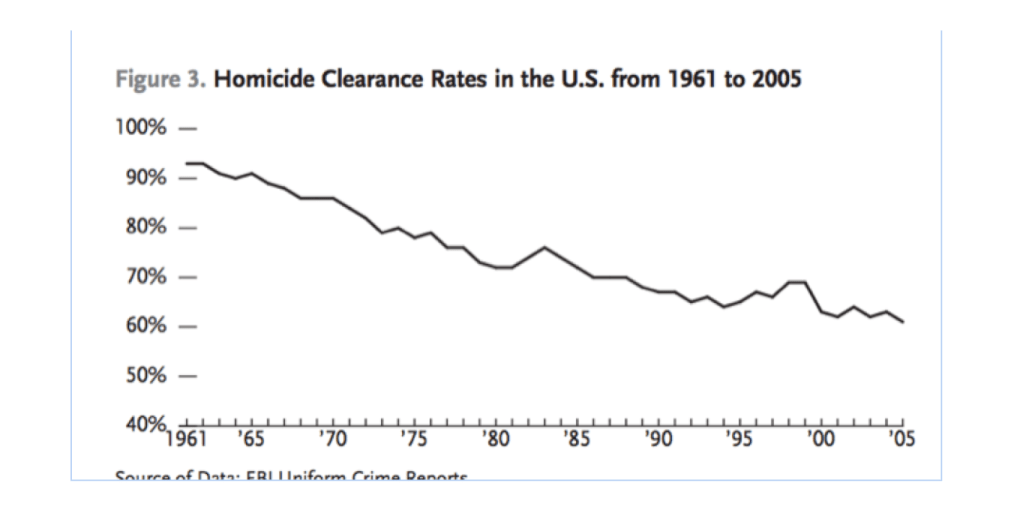
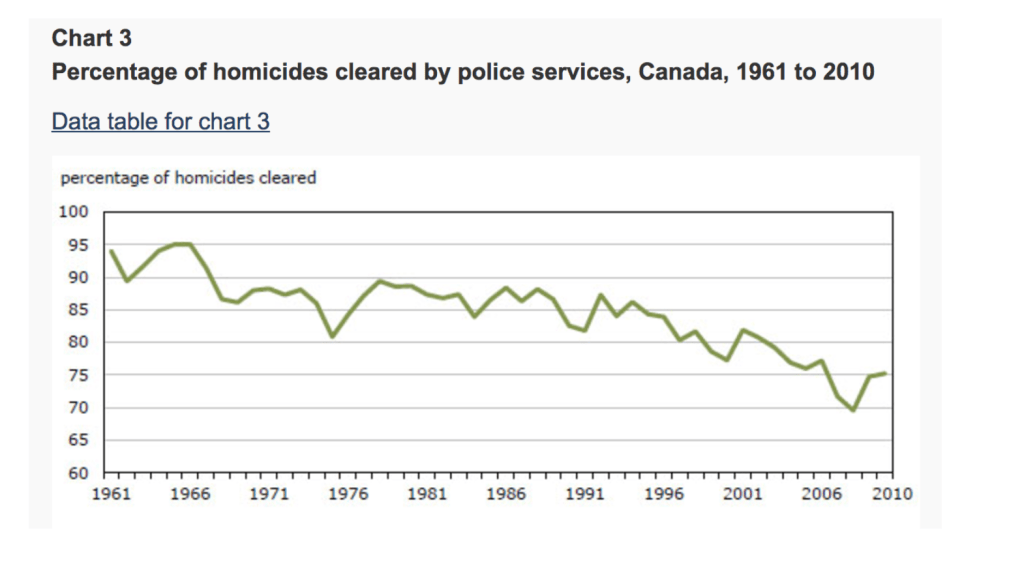
I last wrote about unsolved homicides on February 8, 2017, it was in fact the 2nd blog that I had ever written and it was a topic of some interest for me. In that blog I pointed out, the obvious to those that are in the policing community, but not so obvious to the members of the public, that there were serious problems developing in the field of homicide; more specifically in the ability to solve them and the resulting growing pile of “unsolved” investigations. The blog outlined the declining “solvency” rates or “clearance rates” and that there was a significant and dramatic drop in the number. That article focused on the local B.C. Integrated Homicide Team (IHIT) because it was the area I happened to know best but it was a trend that was North American wide. I’ve reprinted the charts below to graphically show the trend for Canada and the United States and to show that this trend goes back a number of years, in fact decades. This despite the advances in forensics and investigational techniques and increases in police resources over this same set of years. The decline is precipitous, in 2017, IHIT was reporting their solvency rate as 43% (and I believe they were fudging those numbers). In 2003 it was at 78% and there were half the number of police officers in terms of overall manpower.

The blog in 2017 went into great detail as to all the reasons which may have been contributing to this decline, so we won’t repeat them here again. But we need to ask the question, now six years later, has anything changed or improved? The short answer, unfortunately appears to be no. The things that were pointed to in that article; rules of evidence, disclosure, the growth in complexity in terms of warrants and the surrounding case law were all legitimate excuses to varying degrees and in those areas no improvements have been made and as far as I can tell even discussed.

In speaking with a friend of mine, who is now in the academic world and who is constantly looking at homicide and the statistics surrounding the data—that data is now suggesting that the solvency rates in 2024 has dropped further and the trend is still downward, and is now hovering around a very low 30%.

It is one thing to see it in percentages, however it seems even more discouraging when one looks at it in terms of the actual number of files. Just looking at British Columbia, an area that I am most familiar with, when I last checked in 2014, there were approximately 1200 unsolved homicides in the record books for this Province. If we look into the current solvency numbers versus the file intake, using broad measurements would mean that IHIT alone, not including the municipal agencies, is adding about 25 unsolved cases to the file pile every year. So that would mean that at a minimum the unsolved cases would now add up to about 1450 unsolved homicides. The Canadian Police Information Centre (CPIC) estimates that there are 3400 cases in Canada, with Ontario and Quebec leading the way, followed by British Columbia. It goes on to say that in British Columbia there is a “significant number of unsolved murders” and they estimate there are a total of about 1700 unsolved cases in the Province. They succinctly comment that B.C’s high numbers are the result of “systemic challenges in the regions justice system”.

One may ask, what about those “Cold Case” squads or Unsolved teams that the police agencies have working on these relatively dormant files.

In British Columbia, there is an E Division Unsolved Unit for the RCMP, which is moderately successful, but in all it takes about two files per year off of that pile. Often those cold cases are prompted by a submission of older forensic DNA evidence. The public is interested so every successful case is played up by the media and the police managers. This is by no means trying to demean those results, but in terms of real numbers, there is little impact being felt to the overall list.

Some members of the public may say, well that is just a fact of life, we do not have unlimited policing resources. Which is also a fair comment. There are obvious limits to the extent of policing resources. In practice what the police are forced to do is pick and choose and put a series of organizational filters in place in order to decide which one of those hundreds of files are worthwhile. They have to make those choices also within the framework of continuing an investigation in the height of ever-increasing costly policing resources.

There are many factors which go into the decision; the age of the file and therefore the current ages of the people involved; whether there is any forensic evidence already on the file, and whether there is an already obvious suspect. Ironically, the “unsolved” unit usually takes over files where the suspect is already known, and in some senses “solved”. Was the victim a child, a mother, or some other “innocent victim”. In some cases it is just gangsters killing other gangsters and therefore, in most cases not righteous victims in the eyes of the police; although the police will never admit to this level of filtering. While standing at a crime scene, I myself have asked or been asked by managers, whether the victim was a “legitimate” victim– as harsh as that sounds. The police can not deny that if the victim had in fact lived by the gangster edict of “live by the sword die by the sword”, sympathy for that victim is automatically dulled and will adversely affect the length and breadth given any investigation. It is just a fact of policing life. Another filter which comes into play, but is never talked about is the level of public attention that has been given to the case and the victim. Call it a case of the “squeaky wheel” syndrome. The Sherman murders in Montreal come to mind. When your victims are billionaires, you seemingly get a different level of attention. The Surrey 6 murders caught the attention of everyone because of the two innocents among the dead drug dealers.

In a pure and perfect world this filtering or rationalizing is of little comfort to the families of victims regardless of their background.

The police for obvious reasons are not forthcoming about these decision making processes or their solvency rates. To be sure they are in a tough spot. Tell the truth and deflate everyone’s expectations or fudge the abject truth for something that still leads to some measure of hope. In terms of their public face they have chosen to do the latter. It’s why the police never admit to not working on an unsolved case, instead they announce that all files are “active” cases. By strict definition they are not lying, but in actual practise they are being very deceptive. There is a difference in keeping the file “open” and “working the file”. Almost all cold cases, day to day, in fact are dormant, sitting on a shelf, waiting for a “break” or a “new lead” to come out of the ether. The police are not “working” those files, at best those files will only be given a cursory view for any new information every year or two.

Also concerning when one reviews the statistics is that it is also becoming apparent that the data that is being published or distributed on websites by the police or even by Statistics Canada are being skewed. Maybe not intentionally, maybe because of errors in reporting. For instance the Toronto Police Service on their website claim that their clearance rates for homicide are over 80% since 1921. The London Ontario police list only nine “unsolved murders” since 1956. In doing a quick check of London’s numbers, it shows that just between 2019 and 2023 they had a total of 43 murders. Assuming a 30% murder rate clearance, this would mean that during that time period they should actually have about 30 unsolved murders just during that four year time period. Are they deliberately misleading the public, or do they have some top notch investigators who vastly outshine any other agency in Canada. By the way, if you go to the Government of Canada website and ask about “cold cases” you get a 404 error message, and Wikipedia lists only 217 unsolved cases in Canada. It would seem that no news is better than bad news. The Unsolved Section of the RCMP of course does not even give any numbers.

Statistics Canada, says that as of December 31, 2021, for that year, there were 525 murders solved of 788 which were committed –which gives them a 67% clearance rate. How could this be? There is clearly a disconnect between what is actually happening and the offices of Stats Canada. A deeper delve into the data seems absolutely necessary as clearly something is not adding up.

Unfortunately, this blog is not offering up any new instant solutions. It just makes you think that in an advanced society, a G7 country, with theoretically untold resources, that this should not be the case. Should we not be studying and addressing the root causes of this dilemma? What does it say about our society on a fundamental level when homicide goes unpunished or fully investigated? There is no clear fix, but as of today, the sad truth is that Netflix may be trying to solve more files than your local police department. The messaging seems all wrong.

Photo Courtesy of Flickr by Bill Selak – Some Rights Reserved

Another change in Seasons…

As we head into Fall and wind down from summer, it inevitably seems to be a time of imposed reflection. Fall traditionally signals an ending, a time of maturity and incipient decline. This Fall though there are some unusual stirrings in the political winds of Canada and to a certain extent around the world. It could prove to be a welcome breeze, especially for any person involved in policing or involved in the legal system.

Some pundits including Time magazine have called 2024 the “year of elections” . The results in many countries seem to reflect a growing conservatism amongst the democratic countries, a swing away from the socialist progressive agenda. This is fuelled in large part by the realization that there is in fact a defined need for the police, that there is room in a democratic society for enforcement of the existing laws. There is also a desire to remove the politics out of the governmental system and oversight of the legal arms of society. Unlike years past, this time, especially in Canada, the move to a more conservative ideology may be more long lasting.

Now, before those positioned on the far right of the spectrum get too excited, a possible swing to the right is in essence, in Canada, merely a move to the centre. It only seems drastic and is being portrayed as momentous merely because of the fact that the pendulum was so far left for so many years. That being said I do believe that the vast majority of Canadians would like to return to some sort of common sense middle ground. This shifting in sentiment is often hard to discern or measure, often disguised by the fact that they are such small incremental steps. However, it is becoming much clearer that the issue of law and order has once again risen to the top.

I live in Vancouver British Columbia, the wellspring of inanity, where we learn of another grotesque criminal act on a daily basis, for the most part being instigated by the homeless, the mentally disturbed and the drug addicted. The latest was another stabbing, in broad daylight and with no motive. One male stabbed to death, another male knifed and actually had his hand severed from his body. It was perpetrated by an individual who could be the poster child of the wrong headedness of our court system, another too familiar example of where the combination of mental health and criminality collides forcefully and is played out on public streets in broad daylight. All while citizens look on or stop to record it on their phones. This latest suspect male had over 60 encounters with the police, was on probation, and had a history of assault and assault causing bodily harm. His current probation conditions was termed as being “soft”.

The story fomented the usual media hype, the Mayor coming out quickly to assure everyone that this is a “safe city” –when those of us that live amongst the daily visions of unbridled mental illness and drug abuse clearly know better. The Vancouver City Police Chief Adam Palmer when sharing the podium, seemed exasperated and in his statement gave a not so subtle hint that the suspect should not have been out on the streets. The media as usual called for instant solutions to undo the years of policy mistakes, the biggest mistake being the closing of the local psychiatric hospital “Riverview” in 2012.

In the Vancouver and British Columbia political establishment the leaders are clearly taking note of the growing public discontent and it is now looming as the single most important political election issue. Along with this is that in British Columbia there has been a dramatic up-ending of the three political parties in the Province. The Liberal Party (who re-branded themselves the B.C United), they, who were the power brokers for many years in this Province, have simply given up; they have literally withdrawn from the next Provincial election scheduled for November 2024. They have surrendered the proverbial ghost and have freed their candidates to wander away into obscurity or go join the Conservative party. This leaves it a two party race, which is polling now as a neck and neck battle between the governing NDP and the Conservatives.

The upcoming election, if nothing else, will allow the voters to distinguish between two distinct policy groups, the socialists or the conservatives, and should therefore provide a more accurate glimpse of the mood of the people. The Conservatives are predictably running on a platform of law and order and a greater move to private enterprise. They are in essence saying that they want the government to get out of the way. The NDP whose party base are traditionally the victimized and marginalized groups (you pick the group), the unions, and any and all members of the “learned” left. These “progressives” have the added advantage of massive support from the current media establishment, the Indigenous, government workers and the academic institutions. The NDP are remaining true to their ideology and are sticking with policies of all people being part of, by necessity, a fulsome government oversight apparatus. It has been a long time since there has been such a clear choice for the people going to the ballot box and currently it seems be an even battle.

It is always fun at election time to watch all the candidates feel bolstered and sharing their insights on all of the evident problems and the clear solutions that lay ahead. Solutions which they did not see while in power but have now attained a greater vision when in sight of a ballot box. What is equally clear is that it is always someone else’s fault.

When talking about crime and rampant lawless behaviour, the Provincial NDP who have been in power for the last five years in British Columbia (the California of Canada for all you Canadians who live in the east) quickly point to the Federal Liberals as the problem. And to be fair, the Feds are the governing body when it comes to the Criminal Code. The offended Feds in turn point back at the Provinces because they are in charge of Health Care and the current sitting Judiciary. The Provincial leaders then rebound and point the accusing finger downward to the cities as they are responsible for enforcement. Three levels of government, all with no defined action plan in terms of the daily carnage on the streets and apparently unable to find any solutions while in power, now telling everyone they now know the way.

As we in the West look eastward, Alberta has always been Conservative and the Prairies are very similar. Doug Ford in Ontario is now trying to get a Conservative election victory prior to any Federal Election. Newfoundland is the only true vestige left of Federal Liberal supporters.

The Federal NDP and their illustrious shrill leader Jagmeet Singh dramatically announced that he is “ripping up” his prop-up agreement with the Federal Liberals; while at the same time vowing not to be rushed into any confidence vote. It would seem that he has finally realized that the Liberals are circling the drain and he either goes down with them, or finally leaves the safety of the Liberal cocoon for the less than safe seats of his own party. His ratings are below Trudeau but he is hoping his chances will improve with a continuous socialist rhetoric of corporate greed. He is hoping that someone out there actually agrees with him, but his chances of disappearing altogether is growing. The policing fraternity are hoping that the NDP policies disappear with him.

Now Trudeau himself is another story. His actions to date only raise questions for me. As he reads the latest polls and gathers his troops in Nanaimo this week, is he being driven by pure ego? Does he think he can spend his way to a rise in the polls and another minority government? His strategy for a possible re-election is singular. He will continue to try and and will have to make Polievre turn into Trump.

Polievre for his part, will continue to try and avoid any major guffaws and keep his newly coiffed hair and refined look in place. He has to walk a fine line, because he certainly is not going to get any votes from the public service or those that depend on government contracts. The same foes of the BC Conservatives are the same foes for the Federal Conservatives. Let’s face it, what are the chances that members of the CBC vote for him?

Of course there is not a strong enough wind to blow all the usual problems off the headlines and the teleprompters of our television talking heads. In terms of specific policing issues, in the next few months the Surrey RCMP and the Surrey Police Service will continue to dominate the local BC headlines with the snail like place of getting officers on the ground and the equally slow moving RCMP in getting their officers out. The Indigenous will continue to dominate headlines with further demands and true to form, just recently tore up their latest signed agreements for a natural gas pipeline with TC Energy. There is little doubt that the RCMP will once again be manning the barricades in northern B.C.

Back east I have a growing interest in the Bill Majcher case, charged as he is with foreign interference and there are some interesting parallels to the Cameron Ortis case. There is a good chance that CSIS and the RCMP INSET (Integrated National Security Teams) may look bad on this one as they continue to struggle to be a meaningful service amongst the Five Eyes. So we need to keep our own eyes on that one. Their is evidence now coming forward that Majcher was throughout several periods of time , actually working for CSIS.

In a more general sense, the Mounties in Ottawa will continue to find themselves in an environment of increasing public suspicion. They seem to be floundering in terms of leadership and in finding their true reason(s) for being. The larger overall problems have been years in the making and it will be years in the undoing. They will however, continue to do what they still do best. They will apologize somewhere. The most recent was in Nova Scotia where they apologized to the African Nova Scotians for “historic” use of street checks.

There will be the usual public government pronouncements, the Federal government employees will continue to protest having to go back to work 3 days a week and will come up with any inane excuse they can find. Housing prices will stay the same, inflation will continue to hover around 3% and mortgage rates will have little effect on the supplies of housing. The media will continue to pump us full of doomsday proclamations; headlines about droughts, floods, fires, heat, cold, or anything they decide is “record breaking”. Our traditional news sources will continue to be decimated and their managers will continue to replace long time journalists with persons who are quick on the keys to Instagram, and Substack. Ukraine seems to be in military limbo and Israel seems to heading into the same horrendous stalemate in Gaza.

However, life will go on. Get ready, get your thoughts in order and be a little hopeful, as it is never as bad as it seems. Its only an ill wind that blows nobody any good.

Photo courtesy of Jeannine St- Amour via Flickr Commons – Some Rights reserved

The war in Strathcona…

In a recent foray into the Main and Hastings corridor, an area known to this blogger for over 30 years, it was truly shocking to see the level of human desperation which continues to consume that area. What have we to show for the last decades of effort? Seemingly nothing. A whole community is under siege and burning before our very eyes. The area known as Strathcona is gradually being swallowed whole by an industrial level of drugs and the suffocating undercurrent of violence. Mental anguish and conflict layered on top of excruciating poverty.

This despite 30 years of a victim centric infrastructure which has been created, developed and now maintained by myriad levels of social workers, housing advocates, drug counsellors, medical staff, firefighters, police, sanitation workers and all those academics that like to “study” the problem. The advocates of all stripes have been continually moving in and out of these garbage strewn streets and alleyways, pausing long enough to relay their latest theory on how to correct this miasma of despair. Playing in the background, on some sort of victimization verbal loop, is the ever constant narrative of the “oppressed”, the “downtrodden” and the “unable to fend for themselves”.

It is scary place. It is depressing, but it is equally disgusting that in a country as bountiful as Canada, that this monument to everything that ails this society, stands in proud defiance.

Where has it all gone so wrong? Millions and millions of dollars expended in this apparent never-ending war on a drug fuelled mental health epidemic. It is a magnet which draws from all over the country. A bizarrely twisted tourist attraction, for all the wrong reasons. A place where even the hardened from other cities are truly taken aback at such a level of lawlessness and depravity.

Drastic and innovative action is clearly long overdue. Not innovation designed by the leftist victim advocating culture wing of our society, but by some with a modicum of common sense and where individual responsibility becomes part of the solution.

But the very first step, desperately needed and absolutely essential, is an honest managerial and expenditure review. A macro look over decades of funds and governmental decisions. A far reaching and inclusive appraisal of what has been spent and the effectiveness of those expenditures and the managers who have been overseeing the policies and processes for years.

The Washington Post recently unveiled a sweeping story sourced by thousands of pages of information which looked at the true cost of the war in Afghanistan. One can not help but be taken by the many parallels to what seems to be a similar story about the the war zone at Hastings and Main.

What the Washington Post and others found was that the war and the efforts of the Americans and the many other countries, including Canada, in Afghanistan has proven to be not just a failure, but a failure of epic proportions. It’s worth looking at their findings.

It was in 2001 that President George Bush announced the first military action in Afghanistan with the goal to disrupt terrorist operations and attack the Taliban. Today, eighteen years later, the Taliban control much of the country and are killing Afghan security force members sometimes in the hundreds per week. Even though the leadership of the Taliban moved to Pakistan, they have now expanded into Yemen, northern Africa, Somalia and Syrian.

Over $10 billion was spent on counternarcotics. Despite this, Afghanistan remains the source of over 80% of the global supply of heroin. Before the war the Afghanistan government had almost completely eradicated opium when the actual Taliban were in power. Opium production has now quadrupled.

They spent $87 billion to train Afghan military and police forces yet today no one believes that the Afghan military could support themselves. The army is continually fighting desertion and casualties making them replace over a third of their Forces every year.

War related spending has doubled the size of the Afghan economy but the current rate of unemployment is 25%. Corruption in all its forms still runs rampant.

$30 billion was spent on infrastructure and reconstruction. Most of that money has been considered “wasted”. The Inspector General documented over $15.5 billion lost to fraud and abuse between 2008 and 2017.

$500 billion on interest to finance the war spending, as all the monies have been borrowed which will take years to pay.

Over $1.4 trillion will be spent on veterans that fought in post 9/11 wars by 2059. About $350 billion has already gone to medical and disability care for veterans of the wars in Iraq and Afghanistan. They are estimating the total spending bill for the medical problems, over the next 40 years, to amount to another $1trillion.

Afghanistan remains one of the largest sources of refugees and immigrants.

What has this got to do with all of us? It demonstrates the problem when incremental spending and single narratives are accepted as gospel and when the problem is allowed to fester year after year. It demonstrates the need for a great big spotlight to be shone on this smaller version of Afghanistan. Not a study by an interest group that continually circles the DTES, but an independent study, independent of all who have been part of the thirty years of problems.

The usual self-described experts always avail themselves to the cameras and microphones, to riff or to lecture the rest of us on what they believe is the cause of the problems. They have no shortage of people to blame, but that blame seems to stop short of any introspection.

The Libby Davies or Jenny Kwans, or the Pivot Legal Society do not need to be consulted in this proposed study. Their versions are already clear and predictable. They are always pointing to some level of government not providing “more”. The money being demanded is an endless request which re-invents itself with another justification, in one form or other, for the next year.

Money clearly is the common cure all whether you are asking the firefighters or the housing advocates.

Each agency demands annual funding, taking credit for successes which go unchallenged or doesn’t seem to reflect the reality.

There have been studies and counter-studies over this continuum. The studies, like the DTES many services often operate in silos and not always in a singular approach.

Donald McPherson, is a typical example. The former drug policy co-ordinator for the city of Vancouver (who now heads another Drug Policy Coalition) talks about the 10 year plan outlined in the Vancouver Agreement in 2000. It was designed to improve housing and social welfare. He blames the collapse on the Harper government.

Mr. McPherson in this proposed future study should also be ignored.

Governments themselves have come and gone, each offering up their particular version of what is needed. Liberals and NDP equally share responsibility for these disastrous results. None of them take the time to look in the mirror.

On one side of the ledger, groups like the BC Centre for Disease Control takes credit for saving 3000 lives between April 2016 and December 2017.

On the other side of that account is that 2177 people also died in this Province during this time.

There is no shortage of positive spin.

Twenty-three operating supervised injection sites claim to have saved 230 deaths. The overall goal of these sites is to decrease “needle sharing”. Their “observational studies” dutifully report favourable results. Their evidence is that fewer people are “injecting in public”. Anybody walking down Hastings may disagree.

The annual operating cost for the injection sites alone is $ 2,948,101.

The injection sites define “saving lives” and count those that have been treated by “agonist treatment” or “opioid replacement” treatment where the people get put on a methadone program.

Meanwhile those running the Needle Exchange program say that Insite is exaggerating the numbers.

In 2017, 60,000 naloxone kits were distributed. At roughly $70 apiece that works out to about $4.2 million this year just on the kits.

Health officials claim that through their services that they have saved “hundreds of lives” but the numbers often vary according to the individual study quoted. The dearth of agreed upon results and the fact that there is a lot of self-reporting remains one of the major roadblocks to any comprehensive study.

But the fail safe fallback to any counter-argument is the oft quoted maxim that “even one life saved” means that their programs can be deemed a “success”.

On the negative side of the ledger.

Calls to Oppenheimer Park in 2019 for the Vancouver City Police have increased over 50%. Shots fired calls have increased over 800%, weapons calls have increased 300% and assaults in progress are up over 17%.

Vancouver City police estimate the policing costs for Oppenheimer park encampment are over a million dollars so far this year. That is for an encampment of about 100 people in amongst the 2700 estimated homeless in the area.

Meanwhile the BC Centre for Substance Abuse and the University of British Columbia in a recent study argued that the police need to stop policing the DTES because it leads to drug users fearing the police, intimidated, and being harassed by the police.

How did they come to this conclusion: they interviewed 72 persons in the DTES and spent 200 hours hanging around overdose prevention sites. They feel police shouldn’t be checking for drugs, or running persons for warrants and such minimal breaches of the law.

What is not answered is how do they propose that we “de-criminalize” if the people are still doing criminal acts?

In the last five years the number of break-ins to vehicles has doubled to 6538 incidents in the Strathcona area alone.

Vancouver City Police records show in 2018 there were 666 assaults and 68 robberies in the Strathcona area.

In the single month of June 2019 in this small geographic area there were 70 assaults, 106 thefts from vehicles, 11 robberies and 31 break-ins to businesses and residences.

To add insult to injury the number of homeless has increased from 2181 people last year to 2223 this year.

Like the war in Afghanistan over 18 years have now gone by since Mr. McPherson’s study in 2000.

Does anyone doubt that during this time there have been misuses of funds, fraud and corruption? Does anyone believe that governments are providing a full accounting of the costs?

Maybe, just maybe, government spending for more counsellors, housing or drugs is not the answer.

Maybe, it is unjustifiable, or maybe an alternative to a policy of more of the same is out there somewhere.

However, it is difficult to contemplate any alternative which does not include forced rehabilitation; or removal from the core (sorry Pivot Legal Society).

The only way to honestly answer is to see the entire package of funds and resources which have been expended over the many years; the layers of government action and in-action; the levels of bureaucracy; the levels of private industry and the number of social housing models which have been proposed and tried over the decades.

The results may be shocking, but nothing less than a Royal Commission level of study is needed. Just as importantly, it must all be seen by a fresh set of eyes–eyes from outside the DTES, eyes with no vested interest in the promulgation of the current norm.

The first thing is the most difficult admission, especially for those that have toiled under the most trying of circumstances with the best of intentions, is the admission that as of today, it has all been a massive failure. On a small scale, this may be our Afghanistan.

*All crime statistics are from the Vancouver City Police records, as reported by the Vancouver Courier.

Photo courtesy of Dan Toulget of the Vancouver Courier – Some Rights Reserved

Healing Lodges – just a better place to be

Tori Stafford was last seen alive on April 8, 2009, shortly after leaving school, heading home, captured on a video camera going down Fyfe avenue in small town Woodstock Ontario. She was being led by the hand by a woman, feeling be-friended,  no doubt filled with an eight year old’s optimism.

Almost three months later, on July 21, 2009 her body was found in nearby Mount Forest, naked from the waist down, her Hannah Montana t-shirt and a pair of earrings she had borrowed from her mother her last vestiges of her short time on earth. She had suffered broken ribs, a lacerated liver and had died as a result of repeated blows to the head with a claw hammer.

A slow torturous death. Unimaginable to most, perpetrated by two individuals, 28 year old Michael Rafferty and 18 year old Terry-Lynne McClintic. In a trial Rafferty was convicted of sexual assault, kidnapping and first degree murder.

Originally charged with being an accessory to the murder, McClintic eventually pled guilty to a higher charge of first degree murder.

It was a case that in the view of the general public demanded retribution, they needed to pay for their crimes. We have become inured to a lot of public deaths, not this one, it was one of those that went to a level that causes a visceral reaction, you taste the bile in your throat.

She was sent to the Grand Valley Institution for Women in Kitchener, Ontario, a normal conclusion in our Canadian judicial world to a heinous crime. Justice, or some form of justice meted out.

But then she entered our correctional system. And that is where the story re-ignited.

There is a couple of truisms that usually play out by those prisoners doing “Fed time”. First and foremost they quickly develop the need to survive; they need to find the easiest route through the system, the best jobs, the placement of video cameras, where you sit at dinner, who you befriend, who you don’t. A child killer has a path fraught with even greater peril, their heads becomes a swivel, their own deaths anticipated.  If you are capable, you learn the game and then you learn how to play the game.

A second truism is that those that are incarcerated find religion on a regular basis. It would be fair to say that not many murderers or child killers are religious when they enter the institution. But imprisonment, like imminent death, seems to assist in finding that religious part of your soul and lo and behold a child of God is often re-awakened.

Federal institutions are not fun places and one suspects that McClintic somehow learned of a better place to be during her first years in prison. Somehow she became aware of “healing lodges” which had been created primarily for indigenous women prisoners.  Apartment style living, a kitchen, visitors, no guards, versus 8 x 10 cell living, constantly staring at your requisite Orange is the new Black poster. Who could deny the appeal?

One can imagine the semblance of the conversation, where she was told that you had to be Indigenous to get in (which isn’t true), so she asked how do they test for that? They don’t, she was told. You can just say you are.

It is only a short step to then apply, declaring oneself indigenous and probably throwing in for a little positive aggrandizement, that she was very spiritual in nature.

It took eight years, but at last she got her wish, making it to the Okimaw Healing Lodge.  She had just begun enjoying the comforts of something like a home when all hell broke loose; her case came back into the public eye, and finally the Liberals broke down and made sure she got sent back, the public backlash too much for the sensitive Liberals. Sensitive to public outcry, not the plight of the victims family.

One should not resent Ms McClintic, she was just working the system and it almost worked. It may be that her fellow women prisoners are having a good laugh about the whole thing, McClintic now a heroine for gaming “the man”.

But one must hold the “system” accountable. How the decision was made reeks of a bureaucrat not doing a proper job, but should we not be questioning the very existence of the healing lodges themselves.

According to Correctional Services Canada, a healing lodge is a place where “we use aboriginal values, traditions and beliefs to design services and programs for offenders. The approach is “holistic and spiritual”. A religious treatment of the whole being.

Non-indigenous can also live at a healing lodge however they must follow “aboriginal programming and spirituality”. You must be the same religion, in line with indigenous spirituality. One would think that a person fitting this category would be a rare phenomena.

Spirituality is “the quality of being concerned with the human spirit or soul”. But by no means is indigenous spirituality monolithic, there is no religious uniformity across the country, in fact of the 1.7 million indigenous, two out of three identify as being Christian. So it is sometimes difficult to understand what is being sought or would be practised.

Healing Lodges are funded either by Correctional Services Canada (CSC) and staffed by CSC, or funded by CSC and managed by “community partner organizations”.

There are a total of 9 lodges in Canada, 4 run by CSC and 5 by “community partners.”

How they came about is an example of the Ottawa world and the rarefied air they breathe. A constant whirling mix of academia, politicians intent on re-election, and business leaders trying to get in on the gravy; all feeding off each other, absorbing the latest en vogue thoughts and processes, all circling and feeding. A bureaucracy, acting autonomously, guided by the political flavour of the day, then developed and constructed without scrutiny. Nobody allowed to question or look within, and the process itself hidden behind multiple meetings in multiple layers, conducted in their own governmental language.

This force moves and adapts very slowly, moving in concentric circles, through steering committees, Senate and Parliamentary committees, inquiries, task forces, and fact-finding missions. They are unaware and uncaring of the public looking in, common sense often in short supply. To question is to be tossed out of the circle cut off from the government teat. Costs are not often part of the equation. It is from this process that came the belief that a healing lodge made perfect sense.

In 1990 there were calls and plans being made for five new regional correctional facilities.

A task force, as is often the case, was lurking in the background. The Task Force for Federally Sentenced Women, who in their report “Creating Choices” recommended that one of these facilities be specifically designed and run for indigenous women.

The Native Women’s Association, a Federally funded advocacy group, one of the groups in this Ottawa circle of life, proposed the concept of a healing lodge.

There was also a group at the time of  “former Federal aboriginal offenders who were advising the CSC”.  This would normally make one scratch their collective heads, however it is true. They of course agreed wholeheartedly and supported the Native Womens’ Association in the need for and development of a healing lodge.

So what is the logic behind this clearly subjective policy proposal. According  to the CSC there were two main reasons:

“Mainstream programs don’t work for Aboriginal offenders.”  This seems to have been presented as a statement of fact, but it is difficult finding any verifiable research this pronouncement is based upon.

Secondly, they stated that there is a dramatic “over-representation” of Indigenous people in Federal facilities. (Apparently persons convicted of crimes were now “representatives” and not convicts) They were not wrong.

In 2017 Indigenous individuals made up only 5% of the Canadian population; yet 25% of the males and 36% of the females behind bars were Indigenous. This number is expected to continue to grow, mainly due to the ever expanding birth rates and the continuing problems experienced by the Indigenous.

If one accepts the concept of needing a special place, a place where they would be treated differently from all other inmates, then the obvious next question is do they work?

A review of the digital brochures for each of these facilities talks about a holistic and spiritual approach, training and maintenance skills promoted as in other facilities, but all given the opportunity to “heal”, “grow spiritually”and re-connect with Aboriginal culture”.

Again, little to no evidence of its effectiveness, but they continually issue the statement that  “culturally-appropriate environments can contribute to the healing process of offenders”. That participants develop a “stronger familiarity with Indigenous history and traditional languages”. Not exactly an insurmountable goal, and it would be unfair to expect any kind of reduction of criminal activity, as this is after the fact after all. Heinous crimes have already been committed.

By offering beyond the usual training and teaching found in any correctional facility, does the offering of “weekly sweat lodges”, “pipe ceremonies”, “smudging”,”medicine wheel teaching”, “carving”, “beading” and “sun and rain dances” lead to a lesser recidivism rate among indigenous? Is it any better training than what is offered already to the rest of the prison population. Or is it serving as just an easier place to do your time.

In a 2013 government backgrounder, the government said that the recidivism rate was 6%, when the national average was 11%.

However, in an earlier government analysis in 2002, it measured the recidivism rate as being 19%, compared to 13% for indigenous released from minimum security facilities. A dismal failure.

In 2016 the National Post reported that 18 inmates had escaped from healing lodges over the previous five years. Not unexpectedly, as there are only security guards watching video monitors, instructed only to call the police if someone walks away.

There is even a lack of acceptance by the Indigenous Reserves where the healing lodges have been proposed. In 2012, a Review by the government found that there was a problem with community acceptance as not every aboriginal community wanted or was willing to have the lodges in their communities.

So where does leave us. Everyone knows that the ‘real’ problems for the indigenous: substance abuse, inter-generational abuse, residential schools, low levels of education, low employment and income, sub-standard housing, sub-standard health, isolation, violence, greater inclination to gang violence, and mental health issues are the reasons the Indigenous and their youth incarcerations rates are at stratospheric levels.

In March 2018 the government released a report entitled ‘Updated Costs of Incarceration’. A male offender in a minimum security institution costs $47,370 per person or $130 per day. A female offender in a minimum security institution costs $83, 861 or $230 per day. An inmate at a healing lodge is the most expensive, costing $122,796 or $336.00 per day.

The Salvation Army gives out a bowl of soup and a prayer on the skids of Vancouver each and every day, before providing food and lodging, combining their spiritual beliefs of salvation with a social cause. But they are dealing and providing at the source. There is a measurable impact.

The Federal government has released records indicating that since 2011 over 20 child killers have been sent to healing lodges. The Liberal defence in the McClintic case is that the Conservatives did it too.

These lodges are better for the inmates, providing a nicer place to be, but as a tool in the Corrections toolbox, they have been a costly and failed experiment.

Is it not time to close down this experiment?  Besides, we don’t want McClintic to have a nicer place to stay.

It isn’t fair to Tori.

Photo Courtesy of Carlos Ebert via Flickr Creative Commons – Some Rights Reserved


Personal Story – “Heather” Part VII

On hearing the new living arrangements of Shane Ertmoed, I will admit that my first reaction was to drop the “f” bomb a few times, something which was not unusual if you had ever worked with me, but maybe these ones had a little more emphasis and artistry behind them, and I did manage to string quite a few together in sequence.  Of course, after I took a couple of breaths, I realized that I needed to now sell our ability to prevent another child from being hurt, when a five year old girl, was now living steps away from a homicide suspect, with only a ceiling separating them.

So at 8 that morning, in a briefing with upper management, I argued two points which would hopefully allow us to continue on course for the remaining few days. First, surveillance of the new residence was able to determine that there was a separate entry to Mr. Ertmoed’s apartment; which meant that if he tried to gain access to the upper floor, where the 5 year old lived, he would have to first come outside and then go up a separate set of stairs. Secondly and more importantly, the girl was only 5, and therefore was never left alone, and a parent or an adult would always be in the immediate presence of the girl.

The argument was accepted, albeit with some trepidation, but we were allowed to continue on. Needless to say the surveillance team was now under an even greater pressure, especially at night, when visibility to the residence was greatly limited.

(Unbeknownst to me,  I would find out later that one of my manager’s, in an effort to placate the concerns of upper management, took it upon himself to go the landlord of this residence in Langley, and advise him of our homicide target now living in his rented out house. This manager, who will remain nameless,  did not tell me or any of the investigators that he was about to break the police silence on our target, and in effect, jeopardize our entire operational plan. The landlord as it turns out, liked the RCMP, and decided not to tell his tenants right away, to allow us a few days as had been requested. So in the end, we survived this transgression by one of our own but anger would not sufficiently describe my reaction on finding out. My meeting, or confrontation, with this boss did not help my career aspirations I am sad to report. )

As the interview and arrest team continued their preparations, we were also busy with the reporting, the Report to Crown Counsel, and our ending Operational Plan. Other investigational results continued to come in, continued to be reviewed, evaluated, and re-assigned if necessary.

The interview team was in full bloom by Wednesday. The “team”was in its infancy in those days, just having come together more as a think tank, and there was little doubt that this case would be its biggest in terms of the investigational scope, and clearly they would be measured by the outcome and their role. This was the first time that I would not be calling on actual file investigators for the interview,  feeling that a fresh set of eyes, a physically fresh group, a group which did nothing more than concentrate on the interview was a concept worth trying. Greg Bishop who was a member of the team from the North Vancouver detachment was chosen as the primary interviewer, he was going to be the actual “guy in the room” with Shane.

Greg, was similar in stature to Shane Ertmoed, and he had also played junior football like Shane, who as we now learned had played briefly for the Vernon junior football team. (we were interested to learn that Shane would have a large equipment bag when playing football) In fact, Greg bore a resemblance to Shane. Greg’s interest in conducting interviews had begun in North Vancouver detachment, where he specifically took an interest in interviewing sex offenders. This led him to join the interview team. Greg had not interviewed many if any at all homicide suspects.

So it was a bit of a risk, but I was convinced they were going to go to incredible efforts and a better prepared group would not be found. Even two psychologists were hired to take part in the developing of a psychological profile of Shane.

By Wednesday, November 1st, at the end of the day, the interview team sat in the board room with Chris and I, and all the other investigators. For three hours everyone tossed about ideas as to approaches and themes that may work with Shane based on what facts we knew about the case. It was a worthwhile exercise, and what was clearly evident was that almost everyone had taken some ownership of this file, they were all personally invested.

By now we had confirmed that the prints that had been found in Shane’s apartment were not those of Heather, they were a small childs, but who exactly would never be determined. Some minor blood stains which had been found near the bed, also turned out to not be matched to Heather. Blood stains that had been found in the car were also negative.

As to the gymn bag, the Lab was examining the handles and had now identified three DNA samples, and they were now “cooking them”. In layman’s terms this meant that a series of filters were being used to get to the pure sample of DNA. The problem was that this cooking process, this cleaning may actually remove too much, and we may be left with no core sample of DNA. It was a risk that we had no choice but to take.

Some hair had also been found in the bag, but the Lab testing and their eventual results  would be at least another seven days. So any results would not be available to the investigators until after the arrest. Crown counsel would have to take a flyer as to whether we would get positive results in considering charge approval.

Also by this time, we had gone back to Shane’s Cloverdale address and rented the same apartment, allowing our forensic investigators to re-visit the site, but now they could do so with no time constraint or having to anticipate Shane’s return home.

It was also on this day that the funeral was held for Heather in Surrey. Cpl Janice Armstrong, our primary media person, attended along with our Forensic Ident group, who made a pretence of filming the crowd. This is often done by police in the event that the suspect shows up. In this case, we knew where he was, however, a lack of police presence may twig an astute media journalist who may find it strange that the police were not among the crowd.  So far our secret seemed to be holding.

Wednesday quickly led into Thursday, and our report teams were up to date, and the arrest team was now prepared and ready to go once given the word. Our deadline for the arrest was Friday at 5:00 pm.

Thursday morning began with a flurry, when we learned that investigators had uncovered some letters from the complex garbage bins, hand written by what we believed was a young girl to “Shane”. They were able to quickly identify the girl and she and the father came into the office to speak with us. In the interview the girl, probably frightened, probably leery of her present father, would not elaborate on the “diary” letters. It seemed highly likely though, that Shane had befriended other girls in the complex, not a calming notion, but one would have to wait for a few days in terms of searching for other possible victims.

The afternoon also brought some more disquieting news, from the news media itself. Janice Armstrong, our media spokesperson came to meet to discuss a phone call she just received. A reporter was calling to say that they knew we were about to make an arrest, and they knew who we would be arresting!

Clearly our boast of having no leaks to date was now untrue, and our ability to stay on the timeline may now have been jeopardized. The reporter was seeking a comment from the RCMP and the story would be running that night on the 6 o’clock news. However, they wanted to make a deal.

If we allowed them to film the arrest, they would hold off until Friday to go to press.

We played out the various scenarios out loud, the what ifs, and I kept going back to my belief that they likely had one source, thus the need for comment from the police to confirm or deny. They needed confirmation because to go with such an explosive story without doubling their sources could prove devastating (at that time it was well known that news people would not run a story with only one source, sadly, that is not the case today). A final decision was made, we decided we would not have a comment; we would not confirm or deny. No deals would be made.

Of course at 6 o’clock that night, we raptly watched the VTV news, to see if our gamble had paid off.  If they broke the news, then we would need to arrest Shane Ertmoed that night and not as planned. As the headlines scrolled up, the background music intensified, but there was no mention of any arrest. The bluff seemed to have worked, so as we headed out the door that night for a few hours of rest breathing a little easier.

Friday, the 3rd of November arrived.  At 11 that morning I briefed all of upper management of the days activities that were coming, laid out our operational “plan” and the procedures that we were going to follow in terms of the arrest, and subsequent interview.

At 1200 noon, the Crown approved charges under Section 235(1) of the Criminal Code.  1st degree murder. This was the last piece of the operational puzzle that we needed prior to the arrest. So at 3:00 we briefed the arrest team and had them attend to await Shane Ertmoed’s return from work, outside his current residence at 206th and 44 A Avenue in Langley.

Chris and I could do nothing now but wait, so we drove to the perimeter area of the residence, a couple of blocks short of the house, occupied ourself with idle chat and  monitored the surveillance and arrest teams. The calm before the media storm,  waiting for that final radio transmission “subject in custody”.

Of course no arrest ever goes according to a book. The surveillance team lost him briefly for the first time in two weeks. Then they found him again. At 6:00 pm as darkness was falling and the air had become cooler, in this suburban residential area of Langley, with its tree-lined streets, and 1980 style homes Shane Ertmoed arrived home. A passenger in his commuting partner’s vehicle. Just as he stepped out of the vehicle, a plain clothes officer grabbed him by the arm and eased him out, and put up against the police vehicle, There was no struggle or resistance. On being told he was under arrest for murder, he feigned surprise, but said little else, and he was placed in the back of a van where members of the interview team awaited for the drive back to the Surrey detachment.

At 6:05 the local radio station, CKNW, was already broadcasting that an arrest had been made, and as we approached the Surrey detachment, media trucks were waiting at every intersection trying to identify the vehicle that Shane may have been in. They clearly now had their confirmation.

That evening, a press conference was held, where our managers took the podium to announce the arrest, pose for the usual congratulatory pictures, provide the usual “unable to comment at this time” to questions and provided the fodder for the 30 second sound bites. We stood at the back of the room able to hear, but out of sight, some of the adrenaline now draining away. A lot of work was looming ahead, but some satisfaction creeped in, temporarily blocking thoughts as to the further efforts that were going to be needed.

Shane spent the night in a jail cell, with an undercover roommate that had been arranged for him (in the event he would be stupid enough to say something); eating a microwaved meat pie and drinking instant coffee, no doubt preparing for the next day as well.

As he was watched on the cellblock video monitors, listened to on the audio coming from the implanted mikes in cell block, he didn’t seem scared. Was he struggling to control his thoughts, trying to steady his  physical mannerisms, nonchalant, unperturbed by what had just happened to him?

As evening turned to night he curled up under the grey prisoner blanket and went to sleep, snoring slightly.


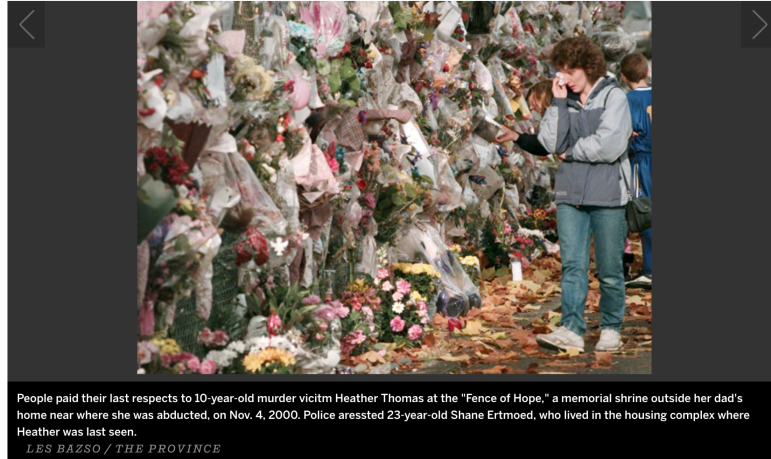
Photo Courtesy of Les Bazso of Vancouver Province newspaper Some Rights Reserved

Personal Story – “Heather” Part V

It was just two days since Heather had been found, and I was sitting, head down in a concentrated effort to get through the neatly arranged stack of reports, fighting the late afternoon doldrums, when I was approached by Gary Burke. Gary, was a former troop mate of mine who was currently working for the E Division Major Crime team, and their unit had been brought in to help.

Gary always had a smile on his face, whether delivering good news or bad news,  but as he plunked himself down in front of me, his grin was a little wider, he looked like he might burst. “I think we have something good for you” he said.

He began to tell me his story. Two investigators in his unit, Laura Livingstone, and Randy Hundt had just called from the road. They had some promising information on a lead they were following up on in the Maple Ridge area.

The day before, a Maple Ridge dispatcher had called our desk. She, like everyone else it seemed had been watching the tragic news and the recovery of Heather in the Park.  She had strong recollections of the day Heather had actually disappeared, and in fact had been working in Maple Ridge on that same date, when Surrey announced the search for Heather in Cloverdale on October 1st.

Hearing that Heather had now been found in Maple Ridge, more importantly in her detachment area was numbing.  She began to replay the time and events of those days in early October, the files she may have dispatched at that time. Disconcertingly I suspect,  she thought she remembered having had a call that day, one specifically concerning  Golden Ears park. It stood out in her memory as the Park was usually quiet at that time of year.

She was hazy on the details, remembering it being something about a vehicle. As she sat home that night reflecting on the news it continued to bother her. She needed to find out more and  try and fill in the blanks for her sake even if there was nothing to it. So she drove down to the Maple Ridge detachment to try and find the dispatch ticket.

She found the ticket by scrolling through the daily dispatch tickets, but it was actually on October 2nd, not the 1st, that she had the call that involved Golden Ears park. It quickly came back to her as she re-read the information.  It was in fact a call of a reported “suspicious vehicle” that  had been called in by park staff working there.  The dispatch information was brief, but indicated that an officer had in fact been dispatched, but there was no licence plate, and the eventual patrols closed the file saying that the vehicle was G.O.A. Gone on Arrival.

Nevertheless, even though she was let down somewhat, she called our office saying that we might want to look into it further, if possible.  So a new investigative tip was created, as were many that day, and Laura and Randy had been given the assignment to see if they could do any follow up on it.

Before I go any further I should point out that Laura is an extremely affable person which often belied an intelligent and investigative mind. Randy, a big guy with a flair for practical jokes, was smart, as stubborn as I, and a no holds barred approach to investigations. Paired up as they were on this date, it could be assumed that they would not miss anything, there would be no cutting of corners, or an un-checked investigative path.

They pulled the old dispatch ticket and identified the complainants as the campground workers; Mike Zabaglia, Michelle Mackie, Kyle Johnson and Stuart Paul.

So Randy and Laura set about finding and speaking with the workers, and they learned that: on October 2nd at 0650 in the morning, the employees were driving into the park heading to their office to pick up their respective work vehicles.

As they drove in their car pool, a slow moving “big boat” of a car appeared in front of them, the driver wearing a hoodie.  It was difficult to pass, so they followed it for quite awhile, until about 1 km south of the boat launch. They thought the behaviour was rather strange, but on they went to the office, got their vehicles and headed out, some going south towards the entrance to the park; in other words back from where they had just come.

One employee, began his work assignment, and was driving back towards the entrance to the park, and is somewhat startled to see this same questionable vehicle, this time parked, also facing south. The hood was up but no driver could be seen in or around the vehicle.

So the park employee drives by but calls on his radio into the office, and reports this second sighting. It was agreed that it was too suspicious to ignore, and decided to call the local police to see if they could come and check on the vehicle.

Meanwhile a second employee around 1030 or 1100, also driving towards the entrance to the park, and after hearing the previous report of the vehicle being parked alongside the road, had driven by and noticed that the vehicle was no longer pulled over on the roadside. So he continues on, heading to do some work at the boat launch area.

As he drives into the normally deserted parking area, there is the vehicle again. This time parked on the boat ramp, again with no sign of the driver in the area. He too calls into the office via his radio, and gives them the updated information.

The Maple Ridge RCMP were now sending a police officer to check it out some the employee continues on his work schedule, and eventually leaves the boat ramp area. The vehicle was still parked and vacant on the ramp as he left.

More minutes go by and now this same employee circles back to the boat launch as much out of curiosity as anything else, but as he approaches the general vicinity of the boat launch, he meets the suspicious vehicle, now heading out of the park, this time driving at about 80 kms an hour. He later describes the vehicle as “large”, and “blue or grey” in colour.

Needless to say by the time the RCMP patrol they do not find the vehicle. Too much time had passed prior to their arrival. The officer concludes his file, typing GOA into the electronic dispatch system. A routine call had ended with little or no effort.

Laura and Randy press on with their inquiries, and they learn from one employee that he thought they had written down the plate number, possibly on one of the park log books, but he could not be certain. They decide to go back with the employee, now with their interest slightly peeked, to try and locate the logbook.  Sure enough they find the logbook. And there in a corner of the book, under the date of October 2nd, there is a hand written inscription, written at an angle along the edge of the page simply stating  “DRE -666”. Clearly a licence plate number.

Now hearing the numbers 666, if you don’t know, it is often referred to as the number of the “Beast” in the New Testament; a symbol of the devil, or used to invoke the devil, a symbol of the anti-christ.  So at this stage of the story it gives me a bit of a pause and I look at my story teller with a raised eyebrow.  To say that I was not in the mood for a black humoured prank would have been an understatement. “No, No” Gary says, picking up on my look. And then he goes on with the story.

The vehicle licence plate, now checked, comes back to a 1971 Chevrolet Impala ( a big boat of a car would be a fitting description), green, and the registered owner was one:

Shane Ertmoed, born December 22nd, 1977. making him 23 years old at this time.  The vehicle was associated through registration records to an address in Vernon.

But it got better, as Gary continued. They had learned on October 2nd, one day after the disappearance of Heather, and on the day that the vehicle was spotted in Golden Ears Park, Mr. Ertmoed had renewed his drivers licence, and dutifully provided his new address, which was now:

Unit #8 at 17700 60th Avenue, Cloverdale, British Columbia. The same address as Heather’s complex.

We both exhaled, and I sat back in the chair, Gary just looking at me. A few seconds went by in silence as if by talking we would have broken a magic spell, the news too good to be true. If I was tired before, that was now all gone. A nervous energy began to build in both Chris and I, as we began to realize the enormity of this information. We may have just caught the the break of our lives. Another mistake by the suspect may have just been uncovered, a big mistake.

Coincidence is defined as a remarkable concurrence of events or circumstances without apparent causal connection. I don’t believe in coincidences, never have, and I did not believe for a moment that this was going to turn out to be a coincidence.

Was it possible that an individual named Shane Ertmoed, who lived in the same complex as Heather, just happened to go for a drive in a park some 40 kilometres away, one day after her disappearance, and it was the same remote park where Heather was found half-naked floating face down in the lake?

Although all the neurons were now firing, I still  needed to restrain initial impulses, needed to be alive to it actually being a coincidence and nothing more. I needed to be alive to the fear of all investigators, the dreaded “tunnel vision”.

After briefing the investigative team, we all headed home around ten that night, exhausted but needing a rest from the marathon, but a marathon that now had become a head long sprint.

There was also one thought that overrode the excitement of the day, one idea, one realization that seemed to be intent on beating the investigative break Gods into submission.

There was no evidence.

We had nothing.

We had a young male that we suspected was involved, but nothing tying him to Heather. No evidence to tie him to the killing in any way, other than proximity to two separate and diverse crime scenes. To know of him, to identify a possible child killer and to not be able to prove it may be a worse fate than not knowing at all.

Exhaustion provided a few hours of sleep, but a very early morning was met with the same mangled thoughts, the testing and re-testing of investigative options, most reviewed and discarded in a few seconds.

But from this filtering and deciphering, this constant give and take, clouded with fatigue,  resuscitated by coffee, something emerged.

I now had a plan.

It was a relatively simple plan, a plan reliant on a single elemental investigative tool, but a tool relished by investigators. We still had the element of surprise.

Photo courtesy of Creative Commons via Flickr by John Lambert Pearson entitled “Clue” Some Rights Reserved


Personal Story – “Heather” – Part III

It was now 0500 in the morning of the next day. So with the third or fourth coffee in hand, and we were back in the Surrey detachment main office, anticipating what was to come, somehow knowing that this office, this desk, and these walls could be my home for the foreseeable future.

Although it was distant from Cloverdale and the search areas, I also knew that this place, once daybreak arrived would begin to take on an atmosphere of its own. There is an ill-defined energy which any homicide generates in a police office. People coming and going in various stages of fatigue, an air of practised urgency, and every once in awhile it would be interrupted with sporadic shots of adrenalin due to some unexpected turn in the evidence.

This early inherent urgency, or drive, can sometimes be short-lived.  There seems to be a direct correlation between victim type and the length as to how long an investigator can keep a file moving.  In this case, a small girl was a possible homicide victim, and she was still missing, in some senses an investigators nightmare.  Twenty hour days would be the norm. There would be less bitching, more cigarettes, less week-ends off, less time with one’s own family, and pizza would be the culinary favourite.  It is not like the television shows in that it is not as emotional as some would like to portray it; it is more of a machine kicking into a higher gear, but like a marathoner, where one had to control pace, and hold focus.

This first quiet moment between Chris and I was therefore likely to be the last for awhile, just a momentary pause.

This of course was the “old days”. So this investigation done on paper.  Hand written reports, forms and notes, would become the 8″ x 10″ medium through which the investigation would take shape. Paper would be filling cardboard boxes, and those boxes would eventually take up spaces around us, giving a bit of a warehouse feel. Often Librarian skills would be more advantageous than investigative skills.

Each piece of paper being assigned a number, each piece of paper being a separate piece of information. If an officer filled in a report, and it addressed or revealed four pieces of other information, then four separate reports would then be generated, then all wold be put in four different folders pertaining to each item. Laborious? You bet. Efficient? We thought so. But of course the coming digital electronic age would make this all seem comically archaic.

For instance, if we had to  search for a single item. Well we had to remember where we had seen it, and in what folder. So, as an example, if someone mentioned a white Ford pickup, we would have to remember where we read it, and in what folder. It worked well when the file may be only a couple of hundred folders and a couple of hundred pages. It relied on a good memory and a concentrated effort.

However, when the file reached thousands of pages, as this one would, it became an exercise in re-reading, duplicated efforts, and it was often frustrating. Overlaying it all,  like Poe’s Raven, was the inherent fear of missing something key to the investigation.

As the days came and went, in amoebic fashion the paper would grow, taking on a life of its own. Everything found, every person spoken to, every news item mentioned, every tip called in would need to be read, documented and filed. It was a mind numbing process and complacency was the enemy. Any follow up was hand-written and forwarded to the individual investigators. An increase in investigators naturally led to an increase in paper, the Catch-22 of police bureaucracy. In a few short days, the investigative team would grow from two of us to over forty or fifty individual investigators, borrowing from Robbery, Serious Crime, and other sections within the detachment.

Decisions big and small, would need to be made as fast as the questions could be uttered, answered more by instinct than a layered thought process. There would be no time for routine debate, or second-guessing, hoping beyond hope that somehow we had learned something over the years that would not let us down, or cause us to overlook something in our needed haste.

And of course there was numerous calls from the general public, which led to the establishment of a “Tip Line”. My immediate boss, Sgt. Mel Trekofski, wanted to pitch in, and offered to take up the monitoring of the tip line, a thankless task at the best of times. It required “carding” each individual, call-backs to verify the information, and therefore seemingly endless conversations with persons, some good, some ridiculous.

As the file went on, over five thousand tips would eventually be received, with over forty psychic callers alone. The self-described “professional” psychics would all offer up where the body of Heather could be found. So you heard the “Woods”, the “water”, and “buried in a shallow grave”. There were many calls where they went on to say who was responsible,  and in many instances it was “the father”.  But, if not then a “white individual” who “worked with his hands.”  Some even offered to take investigators to the body, something we couldn’t ignore, but of course these did not pan out, but did extend my belief that there were a lot of “crazies” in the world. I never had a paranormal observer, if Im being kind, solve a file for me, and this wasn’t going to be the first.

The logistical jigsaw puzzle continued as we needed to address staffing issues and all the usual secondary administrative issues, at times like a Rubik’s cube, multi-dimensional, spinning on the singular axis of trying to keep the investigation on track.

As the searches ended, the neighbourhood inquiries continued in earnest, as did the forensic examination of objects which had been found. Investigators were assigned to each parent, and other investigators began criminal record checks, as well as local police record checks, on all individuals spoken with or identified as part of the investigation.

Panties, jeans, shirts, jackets, socks, sandals, some of which were in dumpsters were shown to the parents in the event that they had belonged to Heather, and if not, catalogued and maintained in any event.

Neighbourhood personalities, like “Pedophile Darcy”, surfaced through the townhouse inquiries as we began to dredge through the individuals in the Cloverdale complex, and the other people in the neighbourhood. “Darcy”, was typical of the type who surfaced. Darcy, of course, drove a white van, and in his past had been caught masturbating on a child’s  bed, and had a record of sexual assault. So he became a subject of our surveillance team, and in the end we were able to eliminate him from any involvement. There were others similar to Darcy, and each took time, each tip had to be ground out, and it took several days to eliminate Darcy and the other archetypes as they surfaced.

Checks through our VICLAS (An RCMP victim Classification software) system for this area of Cloverdale surfaced a possible fifteen individuals of interest because of their sexual predations. Each of these individuals would be located, interviewed, and reported on. Each would need to provide an alibi.

Checks of all those with criminal records for sexual assault and now free in the broader City of Surrey of which Cloverdale was just a suburb, revealed another five hundred possible “individuals of interest”. It would take years to eliminate that many so we had to narrow the search, at least in the short term, to just those that had violently offended on pre-pubescent children living in the Cloverdale area. This still gave us twenty-seven names. Investigators were assigned to each.  It may surprise some to realize that in most cases these individuals co-operated, and were expecting us. When the investigators arrived some had even already prepared their statements and had their alibis in order.

Others, of course would try an investigators patience, testing their emotional mettle, and you could not help but be pulled you down into the dark reaches of sexual perversion.  In matter of fact voices, they would describe how it couldn’t be them involved, as their method was different in terms of the suffering they would inflict in their need for sexual satisfaction. Some described why she could be alive, to be kept as a sexual play toy.  Any killing of her would have be only to get rid of the evidence, and a “waste”,  and any killing of her would be a signal that things must have gone wrong. This insight would later prove to be accurate.

A crack dealer living in the complex, who had been described by persons in the complex as coming and going in another  “white van”  became an obvious possible suspect. Once identified, he admitted to dealing drugs, and offered up his sales notations, his “crib” sheets as evidence of where he was at the time of Heather’s disappearance. No “normal” criminal he explained likes sex offenders; whether in jail or on the street and the drug dealer wanted to help.

As the investigative team grew, briefings, and de-briefings were our life-blood. Every morning at about 0630 I would brief upper Surrey detachment management, and then at 0730 I would brief the investigative group as to any developments or any change in focus. At 4:30 in the afternoon a de-briefing would be held with these same officers to learn of any highlights. In between of course there was the media to deal with; calls dealing with expenses, computer check results, surveillance assignments, tip line results, and other more sundry items.

By 6:00 pm, as things slowed a little, I would sit in front of a stack of reports, about 2′ high, and begin reading. Chris would then read the same paper after me, just to insure there were a second set of eyes. We would check for any cross references, then the paper would be filed, new follow ups drafted and assigned. Coffee was my particular drug, and stretching for the long walk to the bathroom began to be a highlight which broke up the trance like nature of our task.

Three or four hours fitful sleep a night would be our routine.  Upon returning to work, the process started again. Days drifted into nights. Nights became sunrises.

Suspects surfaced and then drifted away after examination; mounds of dirt reported as shallow graves were examined and dug out; clothes continued to be turned in; suspect vehicles were identified from having been seen in the area; and the psychics from around the world persisted on being heard, each with their own, but similar investigative theories.

Americas Most Wanted called wanting to profile the case. That in turn generated two tips that proved of no value. Europe, and parts of North America were all now paying attention.

We read, often re-read, re-shuffled, and then sometimes re-assigned.

And of course, there was the ever present media, their trucks stationed inside the complex itself,  giving nightly broadcasts and voicing the concerns of the general public. With Halloween getting near, they often regurgitated the growing parents concerns with a killer “on the loose” and asking whether they would let their children go out trick or treating.

As the investigation wore on I kept remembering how I was once told (by who I can not remember) that in every murder there are five mistakes made, its just a matter of finding out those mistakes. Simple really.

Of course every murder is different, every set of circumstances different. In this case we believed that this had been an “opportunity killing” by a stranger, and likely sexually motivated. Statistically, at least, the most difficult of all types of murders as these things go. Many remain unsolved. For instance, in 1996 only 14% of homicides were committed by a stranger. In 1976 it was only 18.4%, and in 1985 17.3%. Consistently low numbers.

If you looked further, and included the age of the victim, in a U.S. study only 3% of homicides were committed by strangers of victims under the age of 12. When a sexual related offence was the motivation, it drops even further down to 1% of the cases.

In checking with the FBI on this case, we learned that there had been only 4 or 5 of these cases in Western North America at the time of Heather’s disappearance in the year 2000.  So although abduction of a child is a parents greatest fear, it is actually an extremely unlikely event. Patterns are harder to detect, as there is insufficient historical data. A serial offence on children was almost unheard of, but of course none of the statistical data, or lack of data was of much consolation for the mother and father of Heather.

Investigative pressure does grow, from the public and from within. Maybe not at the levels of the tv drama series, but it is there. The greatest pressure is put on by the investigators themselves. At some point you begin to realize, rightly or wrongly, whether solved or unsolved, that this investigation will be attached to your name, especially in police circles. You will be perceived in a different light in the future.

A sense of pride takes over, the not wanting to be beaten. The emotions shut down, as the  constant images of the victim is too disarming, too distracting. One could not function coherently if you allowed yourself to become fixated on the depravity of it all, the senselessness of it all, the speculation as to whether Heather was alive or dead. To contemplate her alive and being held was in some ways an outcome that could be worse than death.

As a bit of an escape, a need at the very least to breathe fresh air, both Chris and I took a few hours on a Sunday to step away from the office. It was day twenty-two, and I decided to drive up the Coquihalla highway, a lonely stretch of highway in the middle of British Columbia, surrounded only by trees and rivers, just in an effort to clear the fog which had permeated my nerve endings. I stopped at the only rest stop, perched at a 3000′ elevation, three hours from Surrey. It was cold and gloomy, but I went into the darkened men’s washroom in this remote part of British Columbia. There at the urinal, staring at me was the Missing poster of Heather, eye level. I had always taken pride in my ability to disassociate from files when away from work. But clearly, this file was not going to let me do that. There could be no escape, not now anyways, so I decided to head back.

As I drove down the steep decline through the highway snow-sheds, once again I began to fruitlessly re-trace all that had been done, despite my blaring radio trying to change my obsessed thought process. I kept coming back to the fact that we needed to find one of those proverbial “mistakes”. I was not greedy, not all five, just give me one.

As I approached the Detachment in the darkening hours of the afternoon, just to check in, that I got a phone call. I needed to get back a little faster, because they think they had “found” Heather.

Photo Courtesy of Creative Commons by TrixSigio Some Rights Reserved

Personal Story – “Heather” – Part I

I received a “page”, seventeen years ago, that irritating incessant beep which kept repeating every few seconds. The message was always a phone number to call and receiving it implied by its very nature a sense of urgency. In some messages the phone number would be followed by a -911, to further underline the urgent request, which was the case in this instance.

As a member of the Serious Crime Section of Surrey RCMP Detachment, it usually meant that there had been a death, or somebody was barely hanging on, closer to death than life; and that it was likely violent, but above all else, that it was somehow “suspicious”.

It was 10:15 pm, on October 1st, 2000 when I got the page from my Sargent in charge of Serious Crime, Mel Trekofski and he in turn asked that I call to “partner” with me that night, Constable Chris Drotar, also a member of our Serious Crime Section.

Unbeknownst to us at the time, this particular page would change our lives, it would alter our perceptions of man’s inhumanity to man, and it would test our physical and mental abilities to a limit that we likely didn’t feel possible at that time. And thankfully, it would not be often repeated through the course of our careers.

We knew from the initial information that a girl had gone missing, a 10 year old girl, in fact.  Her name was Heather, and she was the daughter of Patrick Thomas who lived at the address. It was a little discomfiting to learn that she had in fact gone missing around 5:30 that afternoon. Already we would be starting with a time disadvantage, which in our world can sometimes mean the difference to success or failure.

The mother, Jodie Thomas was estranged from Patrick and lived in a different part of Surrey and would not be at the house.

Heather and her brother were at their fathers in Cloverdale,  as part of that common suburban divorce dance of shared custody. It was his week-end, but this was Sunday, and the kids were due back at Mom’s. But then things changed.

Search and Rescue had been and were still involved, along with all the neighbours who lived in the complex. Nothing of significance had been found as of yet, but the officers who were in attendance felt that “Dad” was acting strangely, and it was for that reason that we were being called; to interview Dad. The implications were obvious and unstated.

It was a typical October night, wind slighting blowing, leaves beginning to fall but not yet in full decomposition, coloured, but still clinging to the trees. We were asked to attend to Unit 26 at 17722 60th Avenue, in the usually quiet suburban area of Cloverdale, part of the not so quiet City of Surrey, B.C.

As we arrived in the dimly lit complex it was quickly noted that directly across the street was the Cloverdale Fairgrounds and the Racetrack. This was a Sunday, and on this particular day the expansive parking lot during the afternoon became a massive flea market involving hundreds of people. At the time of Heather’s disappearance there could have been thousands within a few hundred yards of the housing complex.

The wood construction of the worn town homes showed the usual green tinge along the edge and rooftops, mold that comes with incessant rains. It was an older complex, u-shaped so you could drive in a semi-circle and go out the other side.  It showed no signs of recent care, just the wear of years of  many children, a complex of about 50 units, who through its life was mostly populated with single parents and young couples starting families. Blue collar, trying to make ends meet, with a tinge of a criminal underbelly always found skirting the edges of poverty flecked neighbourhoods.

As we arrived,  it was quiet, as the people of the complex had by now retreated into their individual homes, no doubt staring out from behind partially closed kitchen venetian blinds.  Almost all had been searching for Heather around dinner time, all likely knew that she had not been located, so one can imagine the variety of explanations given to curious children as they got ready for bed that night.

As we drove up to the residence, with that usual mixture of adrenalin and apprehension, we were fearing the worst, but not quite prepared for that being the case.

The greeting uniform officers, who were unusually quiet, told us that they had searched the residence thoroughly, which is the first place to look for a child. Dad’s vehicle was parked out front, and it too had been searched with nothing found.

Inside the town home, it was like hundreds of others I had been in; some worn furniture, some new, usually a prominent t.v. and the usual evidence of active children. Right at the door, in clear view, was a knapsack, clearly a girls adorned with the usual hanging customized knick knacks which signalled that a girl owned and cherished it. It was in a position clearly in anticipation of heading out of the residence. It was clearly Heather’s and clearly untouched from hours before.

Chris and I introduced ourselves to the father, who sat in the living room, emotionless, wearing jeans and a collared shirt. Blonde, and blue eyed, of average height and build, a good looking man, he was staring straight ahead, saying little, no tears, no anger. There was little in his eyes, which is almost always the giveaway.  Nothing in his composure which indicated a reaction to  the most hellish of torments for a father. So, it was quickly apparent what the original attending officers thought was “unusual”.

I asked Dad if it was o.k. if we conducted another search of the residence, and his vehicle and he quickly and quietly agreed. He did not question why we were being this thorough. I also asked Dad if he would come to the police office, where we could take a statement, which he also readily agreed to, with no questions.

So at quarter to one in the morning, we sat in the interview room with Pat, whose demeanour remain unchanged.

Pat’s story was this.

Pat had been working on some carpentry in his residence. The two kids, Heather and her 8 year old brother Chris had asked around 4:30 to go out and play around the complex while they waited to go to their Mom’s. He said yes, but told them that they had to be back by 5:30 so that he could keep to the proscribed schedule.

Around 5 Chris came into the house, but without Heather, and Pat told him to go get his sister so that they could get ready to leave. Chris went out, could not find Heather, and came back a few minutes later saying exactly that.

Showing the usual parent frustration, Pat packed up and went out into the complex.  He began looking, talking to the various kids and parents as to whether they had seen Heather. It was learned after a short time from some of those parents, that she was last seen riding a 2- wheeled bike that she had borrowed from one of the other children.

A few minutes later, the borrowed bike was found, but no sign of Heather.  According to one witness, the bike tire was still spinning when they found it, near the front of the complex, in a parking stall on its side.

After we finished the interview around 2 in the morning, we were still just as confused as to Dad’s reaction, or more accurately, his non-reaction. Throughout he was totally co-operative, but he never mentioned the proverbial elephant in the room, which was whether we suspected him as doing something to his daughter. He just answered our questions, calmly and without hesitation.

We left the room, and dropped Pat back at the now growing Search and Rescue group on the Cloverdale Fairgrounds.  Still somewhat unsatisfied about Pat, however, we had come to one conclusion. The time-line, both drawn by the original officers, the neighbours, and our interview we felt excluded Pat from being involved. The circumstantial evidence did not leave any room or time for him to commit what would be an unthinkable act. Granted we were leaning on some years of experience and training, and trusting our judgement. Not always a comfortable feeling. And we were about to alter the scope or focus of an investigation as a result. If we were wrong, with the stakes this high, with the focus both within the police and the public that only a 10 year old girl victim can generate, it would be a decision that could haunt or taunt us for the rest of our lives.

In our opinion, we believed that Heather had disappeared, silently, although surrounded by thousands of possible witnesses.

Statistically, if this was a “stranger” abduction as we feared, the chance of Heather being alive was minimal, as too much time had passed since her disappearance. We also knew that there were only a couple of probabilities in terms of motive as to why a young girl is abducted.

If the suspect was not a family member, which was now our investigational theory, then we were now in our own personal criminal investigational nightmare. We were now looking for the needle in the haystack.

To be continued…….

Photo Courtesy of the Surrey Leader newspaper, a picture released to the public during the Search for Heather.