New Commissioner a symbol of Identity politics…

When I sit around with current and former RCMP officers there is a lot of shaking of heads in terms of where the RCMP finds itself now; buried in sexual harassment cases, about to face unionization, and about to have to deal with a possible civilian oversight group.

Operational problems are around every corner, whether it be the lack of policing in rural communities, a completely failed promotion system, mounting PTSD complaints, mounting use of force issues, and the likely partitioning of the RCMP.  All major issues, all daunting to say the least.

So it was baited breath that the members of the RCMP waited an eight month screening process taken on by ten committee members. Thats right. Ten.  These ten were to oversee a selection process, all living on expenses, and I am guessing pretty substantial hourly rates to complete what must have been a more complex task than I imagined.

The Committee was headed by former Liberal Premier and Ambassador to the United States, Frank McKenna. The rest of the committee was comprised of six women and three men, and a job description mandate which included ” having to demonstrate their knowledge of Canada’s indigenous culture and a sensitivity to the issues relevant to the diversity of the Canadian population”.

You will notice a bit of a theme with the Committee members.

Devon Clunis, former Winnipeg Police Chief and the first black police chief in Canada. He was known for dealing with the race issues in Winnipeg, but retired somewhat suddenly just before a police budget came down which included tripling of the promised police budget, and an RCMP investigation into a companies billings for the building of the new police office.

Malcolm Brown , the Deputy of Public Safety who would report to Ralph Goodale.

Daniel Jean, the National Security Advisor to Justin Trudeau, who has now gained notoriety as the fellow who came up with the Indian government conspiracy theory to cover Justin Trudeau’s dinner guest Mr. Atwal. It was a ridiculous slander on the Indian government which they had to apologize for and likely the end of his high flying career. He had no previous experience in Security and Intelligence before taking this job.

Barbara Byers, with the Canadian Labour Congress who specialized in issues such as the LGBT community.

Manuelle Oudar, the CEO of Canada Workplace Standards and Health and Safety.

Marianne Ryan, former Deputy Commissioner of the RCMP in Alberta, and now the Alberta Ombudsman.

Bev Busson, former interim Commissioner of the RCMP, and the first female Commissioner of the Force

Tammy Cook-Searson the elected Chief of the Lac La Ronge First Nation.

It is not difficult to guess, once you see this list as to what the tone and tenor of the selection process would be; clearly a woman, and clearly someone with an understanding or connection to Indigenous issues, or sympathetic to the causes of diversity and inclusion.

So after nine months, lo and behold there were four in the running; three women and one man (the male no doubt thrown in there to avoid any charges of being slanted in their decisions.) Statistically women represent 21.6 of the RCMP, but in this final selected group, they made up 75% of the candidates.

The other candidates were: A/Commissioner Joanne Crampton, A/Commissioner Jennifer Strachan, and Deputy Commissioner Kevin Brouseau.

And the winner and the “absolute best” person according to Justin Trudeau was Assistant Commissioner Brenda Lucki.

Now if they knew they were going to select a female from the RCMP, then I could have saved this committee a lot of work. Just open the internal phone list and look for any female officer above the rank of Superintendent. There aren’t many. I could have come up with this list in a couple of minutes. Now, if you tell me that they must have some sort of Indigenous acceptability, a second screening would have also quickly found Ms. Lucki who received recognition for her work on aboriginal rights. In other words I could have saved them a lot of meetings and expense.

Ms. Lucki, who joined the RCMP in 1986 has had a varied 31 year career, serving in Saskatchewan, Alberta, Manitoba, Ontario and Quebec and then with the U.N in Yugoslavia. She is most recently in charge of Depot Division, the training facility, a former posting of Bev Busson as well, before she became Commissioner.

At first glance it seems impressive but there are a couple of things you need to keep in mind. Every promotion for the most part in the RCMP means that you change jobs, you have to move, regardless. So someone like Ms. Lucki, was promoted seven times in 31 years, serving in a lot of different Provinces, did not land in a place for any length of time. Take off a couple of years while with the U.N. and it measures out to a move every 3-4 years. During that time, she may have had oversight on a couple of hundred officers at any one time. She is now being asked to oversee a vast bureaucracy, over 28,000 personnel, with a budget of over $2.7 billion.

So what put Ms Lucki ahead of every once else? Her resume is almost bland and typical of all white-shirted officers within the RCMP. Constant movement in the promotion process also means that she was not in any one place for any significant period of time, therefore with little time to have any substantial impact. (Bev Busson also suffered from this dilemma leading up to her being made interim Commissioner.)

There is little which points to accomplishments within the RCMP with the exception of the Jubilee award which were given out like candy, and were internally generated.  There is repeated mention of the Governor Generals Order of Merit of the Police Forces and her role with the Indigenous. This too is an internally generated nomination, about fifteen a year get nominated by the Chiefs of Police and almost all nominees are officers as well. There is no evidence or hard factual detail as to what this entailed or what she did to deserve this recognition. These nominations are often part of the upper management Ottawa game in the RCMP of self – promotion.

There are reports that the committee approached Deputy Commissioner Butterworth-Carr who it is said turned the job down more than once.  Butterworth-Carr is a rank above Ms. Lucki and is First Nation from the Tr’ondek Huech’in Han Nation of the Yukon.  She also had the Queen and Golden Jubilee Medals, and the Order of Merit of the Police Forces for her proactive work. There are a lot of similarities with Ms. Lucki, such as her short length of service in a number of locations in the West.

The RCMP is in serious jeopardy as an organization. The problems seem stifling and the threads of the organization are being pulled and torn in every direction. This has been the result of mis-management at the upper levels over the last fifteen to twenty years. There can be no doubt about that. The question in the interview should not have been what can you do for this organization in the future, the question should have been what have you done in the past?

Upper management in the RCMP is known as the “go along to get along crowd” with never a dissenting opinion or a willingness to take a principled stand. Should they be held accountable for this mess, of course. Are they being held accountable, of course not; it is after all government. The upper management of the RCMP are for the most part a self-perpetuating incestuous group, and they should all be given pink slips along with a “thank you for your service” as they are escorted out the door. The roots of this organization are rotting, and the various limbs need pruning so they can grow again. This is not going to be easy.

Ms. Lucki as nice, as personal, and smart as she may be; she was and is part of the problem, not a part of the solution. Shockingly, the Liberals after all this went with someone inside this  same dysfunctional and management challenged organization.  Being female does not exonerate her from management actions of the past. She was part of that management.

Do we really care whether the selected candidate was male or female? Whether your skin is black, white, green, or orange is not a factor. Facing a complicated issue with civilian oversight on the horizon and the disappearance of the administrative side of the Force, one would have thought they would have been looking for someone with a strong administrative or legal background, or a hands on operational background, or at least a familiarity of unionization and all that it entails. Mr. Trudeau assured us that there were “many extraordinary candidates”.  Maybe a Masters in Business Administration, or a speciality in Labour Economics? Were there none out there? Did none apply? Was a candidate with a Bachelor of Arts the height of the academic qualifications? Even the male on the selected group of candidates has a Master of Laws from Harvard, is  Metis, but he did not have a chance.  “He” being the operative pronoun. Clearly indigenous and being a woman were the heavily weighted determinants of their choice, and merit was a very distant third or fourth.

Trudeau’s classified questionnaire must have been multiple choice, no right answer, as decisiveness is not a pre-requisite;  It must have read, Are you:

a) Female?

b) Female?

c) Indigenous? Or do you at least have friends that are Indigenous?

d) Female?

e) Do you like me and agree with everything I say?

Self-declared feminist Trudeau was using his usual clipboard check list selection process, just like his selections to Cabinet.

This country is becoming dangerously polarized, and now the politicalization of the RCMP has reached a precipitous level as well. Trudeau from the left is very similar to Trump on the right, he does not seem to recognize the problems of political interference, the danger of slanting the law and investigations to favour a special interest group.

When you Google check Ms. Lucki, you find video of her participating in the Depot “dunk tank”. Well, new Commissioner Lucki you are about to be thrown in the deep-end once again.

This time the results could have dire consequences for those on the front lines of the Royal Canadian Mounted Police and maybe the very survival of this historic institution.  In her speech she said that she is going to ask “all the right questions”. Doesn’t she know what the problems are at this stage?

What is really needed is someone with answers, someone with a vision and someone with the audacity and authority to do what is right. Rome is burning, we do not need another fiddler.

But good luck to you Ms. Lucki, and I am keeping my fingers crossed that you prove me completely wrong.

I will go back now, to my coffee klatch of the disenchanted, and we will see what they think of Mr.Trudeaus choice, whether they think she will be the next saviour of this once proud organization, and whether positive change is around the corner.

I will withhold my prediction for now, but all should be prepared to hear “diversity” and “inclusion”, as much as we hear Trudeau say “going forward” “working with our partners” and “women”. Hopefully, the two officers that awkwardly fainted during your speech did not have a premonition as to what is to come.

And to this “select committee” of advantaged bureaucrats. Please call me next time, I could have saved you a lot of time and the taxpayer a lot of money.

After all we will be meeting again in four years.

Photo Courtesy of the CBC and may be subject to copyright
 

Personal Story – “Heather” Part VIII – The Ending

On Saturday November 4th, Shane Ertmoed was brought into a small bland 9 x 6 interview room, a desk, and two chairs the extent of the furnishings. Video and audio recordings were turned on, and Greg began his interview of Shane. A few boxes on the desk gave the impression of waiting insurmountable evidence. Greg, always cordial, always playing to the theme that we were there to understand, to “help”. “You didn’t mean to do it did you Shane?”, “you are not an animal are you Shane?” It being more of a misunderstanding than a killing.

Gradually, Shane began to speak, quietly, some times nodding in agreement. Eventually, he began offering up possible alibis, each was perfunctorily shut down, escape routes closed as quickly as they were proffered.

Three hours in, Shane Ertmoed confessed to the killing of Heather.

As Shane nodded in agreement about the killing, I was sitting with others in a nearby room, staring at the television monitor screen our collective breath seemingly on pause. It was a few seconds before one of the investigators let out the restrained exclamation “yes!

On Sunday, the following day, a 2nd interview was conducted, this time by Bill Fordy, wherein all the evidence was reviewed again with Shane, going over specific details, and he in essence confessed a second time. Shane said his newly appointed defence counsel had told him to say nothing, but then he continued, virtually repeating the story of the day before. Not emotional, seemingly resigned to some future destiny he could only guess at.

The confession along with what our investigation had revealed seemed to run in parallel, there were no large discrepancies, and it was consistent with the limited forensic information.  How he killed her and how she was found partially clothed gave us the “holdback evidence”, the evidence that only the killer would know in detail.

This was the chronology of the events as confirmed by Shane in his words, with a few new pieces we were unaware of:

  • Shane lured Heather into his apartment to look at books that contained pictures of “birds”.  (This was new to us and gave us the impression that Shane may have previously spoken to Heather)
  • Shane coaxed her to the floor of the townhouse and was spooning her on the floor stripping off her pants and underwear. It was then that she began to struggle, and he put his hand over her mouth to keep her quiet. (He would not admit to how long that would take but she was likely dead before Dad had even called her in as being missing.)
  • After he killed her, he dumped out his hockey/football bag, and put her in the bag along with her clothes.
  • He carried her out through the fence in his townhouse to his nearby car. (In doing so, some plant material got in the corners of the bag we were able to later match some “cultivated juniper”, unique to that area, to the landscaping in front of his residence).
  • And he placed her in the back seat, and drove out of the complex. Upon driving out and looking east he saw the police doing radar traffic enforcement, and so he circled behind, using the secondary roads, to eventually get over to 200th St in Langley.  (Later a witness came forward, who also happened to be an artist, who sketched what he saw that day on hearing the news of Heather; he showed us his pencil sketch done on a single piece of paper–it was a vehicle pulled over, and a male was standing near the back of the vehicle, adjusting something in the back seat; the male in the sketch looked remarkably like Shane)
  • He needed gas and stopped at the Happy Face gas station on 200th St. He then drove further up the road, when the idea came to him to buy a theatre ticket as he rapidly concocted his cover story. (He never went to the theatre to actually see the show, as we believed and could now prove)
  • He thought of going to Maple Ridge because of the distance away, and he had earlier heard about Golden Ears park through a co-worker (we were able to find the co-worker who he had earlier asked about Golden Ears Park)
  • As he drove into the park, he got a few miles in on the roadway, pulled over, and then put the bag containing Heather into the thick woods, just out of sight of the roadway.
  • He returned home; but was not content with where he put her, thinking that she could be easily discovered. So at 5:30 in the morning he left, was checked by the officer on his leaving and he went back to the Park. (it was here when he was followed by the Park Rangers, driving slowly, trying to find where he left her)
  • He eventually found her, and parked roadside, and put his hood up as if he was broken down. (This was observed by the Park worker #2). But by this time he was running out of time and needed to get to work. He marked the spot, by putting a skid brake mark on the roadway, and he headed to work in Maple Ridge, leaving quickly. (Seen by Park worker #2)
  • He feigned having a headache at work around 10 in the morning, and left. But he went to a Canadian store and bought an inflatable raft and a single paddle. (We figured out the store where he bought the raft later, and were able to get a copy of the receipt).
  • He returned to the Park, retrieved the bag containing Heather, and then headed down to the boat ramp, where he got in and paddled out of sight of those who maybe on the boat launch. (Observed by Park Worker #3)
  • He put Heather in the water, weighed down with rocks (Shane in his statement totally denied putting rocks in the bag – a strange disclaimer considering everything he had admitted to)
  • He came back in and drove quickly out of the park, stopped at a dumpster and got rid of the raft. (we were never able to locate the raft, no doubt it had been emptied by that time)
  • Shane gave no insight, nor any denial of why he called in the break and enter case. (It was our guess that he was worried that if for some reason we were able to go after him, and we found something of Heather in his apartment, fingerprints or hair as an example, he would have a cover story that kids had broken into his condo)

By late Sunday afternoon, the weekend over, Shane was placed back into his cell and I like everyone else headed home, in rush hour for the first time in six weeks; content, feeling  lighter, not fully absorbing all the nuances of the last 48 hours, but aware that something good had just happened.

This was the dramatic end of the operational element of this case. The looming courts and their processes, would be the 2nd marathon.  The forty investigators would dissipate, all  returning to their regular duties.  The excitement of the pursuit would soon be replaced by drudgery, the arguing over minuscule points of law, and those bone weary hours of sitting in a quiet courtroom, the drone of lawyers providing the white noise of the court.

The many involved would become the few left to take the case to the next level. It is the unsung hero portion of the story, it is the under-appreciated, it is paper intensive, and it would be wrapped in all the myriad legal issues that always surface. Preparations would begin for a preliminary hearing, and a possible bail hearing. Both would need to be supported in terms of getting all the gathered evidence into the Crown. The Crown would become our constant companions and our usually friendly thorns in our side, always needing more, or a further explanation, or another copy. Officers notes, exhibits and exhibit records would begin moving constantly back and forth, in the rhythm of the  court dance.

The media would go home for the time being,  only to return rejuvenated for the eventual trial coverage.

The secondary reports, the officers notes, and the loose pieces of information continued to trickle in, so we continued the work of sorting, evaluating and follow-up continued at a manageable pace, but with far fewer resources. Some of the information was valuable background, while other pieces were of little value but still needed to be filed. Some of what came forward:

  • We learned that Shane Ertmoed had only arrived in the Lower Mainland in September 1999, a mere 13 months before committing the homicide on October 1. He had been kicked out of his house in Vernon, and recently fired from working at the Dairy Queen in Vernon.
  • Shane’s aunt confirmed that Shane had a hockey bag (unfortunately those DNA tests that were trying to filter out for a good sample of DNA, did eliminate too much of the core DNA and are results were therefore negative.) ( The Aunt told us that she had “jokingly” asked Shane if he was involved in Heather’ disappearance.)
  • Shane was described by his fellow workers as someone who liked to talk to “kids” and they gave an example of him hanging around a kids lemonade stand at their work site.
  • Eight years earlier, in March 1992, while living in Vernon Shane had been forced to see a counsellor for lifting the skirts of two girls on the school bus, and trying to touch them.
  • Shane had written sexually explicit letters to his teacher/counsellor, and eventually left the school, and he was often described as a “scary character”
  • He also had sexually explicit correspondence with this then girlfriend
  • At his work site, he had offered to babysit for one of his co-workers. (those same co-workers would often tease him about him being involved in Heather’s disappearance.)
  • Heather had apparently been on Paxcil and another prescription drug at the time of her death. (not by itself noteworthy, but one when examined by a court trying to determine cause of death would surface as a complicating issue)

When all the information began to settle, having been sifted through the needed or discarded filters, what we were left with what is commonly referred to as a “circumstantial” case albeit with one what we believed was an “voluntary” confession.

We would never find a magic bullet, such as DNA, fingerprints, or matched blood samples. Cause of death was listed as “undetermined.” Every Crown counsel wants these dream pieces before going to Court. This was not going to be that case. We were pushing  Crown’s charge approval boundaries of every case needing to have a “substantial likelihood of conviction”. As the years have gone by, the pursuit of a circumstantial cases seem to becoming rare events. Crown and the police are more reluctant to let the courtroom decide, and as Wally Oppal once opined it seems that the Crown and the police are trying the cases in the reports now, not having a taste for a courtroom, reluctant to face possible failure. One wonders where this case would have stood in this climate.

However in those years  we enjoyed a strong and positive relationship with Crown Counsel both in Surrey and at the Regional level. All of the Crown lawyers, that we dealt with on this case; through charge approval, bail hearing, the preliminary inquiry and the eventual Supreme Court trial were exemplary. They deserve special mention for the hours that they expended and the roles they played; Terry Schultes who provided almost daily legal advice to me on this case and many others; Winston Sayson who handled the preliminary inquiry along with Lana Del Santo; and finally, Ron Caryer who handled the Supreme Court murder trial along with Roger Dietrich. Their lives were put on hold and this case became all consuming, with the added pressure of a constant media spotlight.

On November 22nd, 2000 Shane Ertmoed appeared in Court in Surrey and pled not guilty to the charge of 1st degree murder.

The Preliminary inquiry in Surrey began a couple of months later on February 19, 2001. As in all preliminary inquiries, Crown does not pull out all the stops in terms of showing all the evidence, and for this case they primarily relied on the confession. All they needed to prove was that there was sufficient evidence to warrant a trial. And the confession by itself when admitted would accomplish this purpose.

All was moving along in quick order, and then came the final trial in Vancouver Supreme court. The defence, oddly had applied and been granted a “change of venue” from New Westminster Supreme Court, successfully arguing that they would not get a fair jury trial in the Surrey area. (This seemed illogical at this time, as this case had been getting extensive coverage throughout the Lower Mainland, but it was not argued  by Crown.) So it was decided that the court would instead be held in Vancouver Supreme Court.

As mentioned previously Ron Caryer was leading for the Crown, an experienced trial prosecutor and one of the few who for the most part conducted only murder trials for the Crown. His second on the case, or partner, was Roger Dietrich, a young prosecutor prone to wearing suspenders to cover his large bulk which he had previously used to his advantage as a player in the Canadian Football League. The two were Ying and Yang. Opposites but ideally suited.

The defence counsel was the rather infamous Sheldon Goldberg.  Mr Goldberg had been a criminal defence lawyer in and around Vancouver for a number of years. He  invariably found the police to be involved in some form of conspiracy or another, and this inevitably would form any part of his defences on almost every case. He had a jail-house reputation as one of the best because of the dirt he would throw at the police. He  was a classic example of  “tossing (expletive deleted)” at the police blue wall, and then standing back and see what stuck. He was also “thorough”, although some may say deliberately obtuse, bordering on obstruction. I have met many a defence criminal lawyer, some I liked some I didn’t. Mr Goldberg was in the latter category.

This was also not my first time dealing with Mr. Goldberg either.  Previously in the 1990’s I had been involved in the case of David Snow, a multiple killer and rapist, who was eventually declared a dangerous offender in North Vancouver, and later convicted in Toronto, Ontario of killing an elderly couple. I testified at both of these trials, and was up against Mr Goldberg’s version of cross-examination which is often derogatory and personal. I don’t know if he even remembered me by the time we got to the Ertmoed trial, nor do I know if his demeanour was more a matter of style rather than personal belief. Needless to say I was anticipating lots of defence motions, and a slow moving trial.

Judge Wally Oppal, also of some fame by this time as a prominent Judge was assigned to sit on the Supreme Court case.

As the jury was selected, and the first days of the trial began, it was quite clear that this was going to be a painful, slow moving process. It was decided that I needed to be at the courthouse for at least the morning portion of the case, helping to find documents, answering questions which had arisen the previous day, assisting with witness preparations and notifications, and being a general handy-man. I was given an office at the courthouse, and I moved in with the file, consisting by now of 17 legal 10″ x 12″ x 17″ sized boxes of paper; charts, photos, statement copies, all pulled and eventually returned. The small room a makeshift file library sitting amongst the usual detritus of coffee cups, plastic wrappers, and styrofoam lunches hurriedly eaten.

Monday thru Friday after lunch, I would then go back to Surrey Detachment, and begin my normal usual shift in the Serious Crime group. Other murder files began to come in, which sometimes would blur my memory on the “Heather file”, but only until the next morning at 800 Smythe Street.

The trial was set for 3 months beginning in March but by the time it wound down, seven months had passed and we were now at the end of August 2002. Final submissions were prepared and presented to the jury.

Crown’s submission was a moving testament to Heather’s life, and at one time, Caryer stopped mid way through, and pointedly asked the jury to consider in silence how long it would have taken to kill Heather. Ninety seconds then went by in excruciating quiet, interrupted by the occasional uncomfortable cough or nervous sniffle which seemed to reverberate around the old ornate courtroom. You could feel the forced thoughts, the ugly sequence of events as they would have un-folded being forced into the minds of all those there. Almost all absently bowed their heads.

The jury was then excused to consider the case and render their verdict.

Five hours later, in the evening of August 29, 2002 in one of the quickest decisions ever seen in a murder trial, the jury reached their verdict finding Shane Ertmoed “guilty” of 1st degree murder,

One can not adequately express what I was feeling that night as the news sprayed across all the television news, people interviewed expressing relief that a nightmare was over.

Shane went down swinging telling Judge Oppal at sentencing when asked if he had anything to say,  “….all that happened today was a fundamental miscarriage of justice”.

Oppal seemed surprised, and said rather unusually, “I happen to agree with the jury….you have been found guilty of the most horrific crime in law….you murdered a 10 year old simply to satisfy your sexual desires…” and then he confirmed and levied the heaviest sentence possible in the criminal courts of Canada. An automatic sentence of life without a chance of parole for 25 years.

The case was over at last.

Congratulations came in;  phone calls, letters, emails, and thank-you cards, over the next days and months, from as far away as Europe and the United States. Gradually I had time to absorb it all, to sort through my thoughts, what went right, what went wrong, the twists and turns, the bad luck and the good luck.

You quickly determine that any investigation of this sort involves multiple people, all doing right by simply doing their job. Policing is not magical when things come together, in fact for the most part it is mundane fact checking, onerous paper work, and incessant interviews, interspersed by heart-breaking disappointments, or adrenaline fuelled giddiness. There is no middle ground and very often there is little sleep.

There are no real heroes, that is the fodder of television as envisaged by those that have never been there. As a lead investigator you are holding the wagon’s reins but you are only holding the reins with little or no power as to how each individual facet is going to perform, or where the next turn will be in the road.  You just have to get on and try not to get thrown. If it all works, and you are thrown a bit of luck, you will succeed.

Epilogue

Chris Drotar my partner for this file has been promoted a couple of times and remains with the RCMP in a different section. He is still a friend.

My boss, Mel Trekofski who provided the confidence I was sometimes needing has since retired and doing well.

Ron Caryer, the Prosecutor was made a Judge and is now also retired. He returned to Golden Ears Park for many years on the anniversary of Heather’s death and erected a small cairn in her memory. We also became friends.

Roger Dietrich, the 2nd Prosecutor is now a senior Crown Counsel in the Toronto area. He wrote a book about the case, as a kind of catharsis, but never submitted it for publication.

Dr. Rolf Mathewes, the Botanist, who matched the “cultivated junipers” to the bag and to Ertmoed’s residence, shortly thereafter opened a Forensic Botany unit at the University of British Columbia. Dr Sweet, the dentist who was able to positively identify Heather also began to also specialize in Forensic dentistry.

Cpl Jean Bouchard the Forensic Identification officer who I had put under the hood of the suspect car went on to be an Instructor at the Canadian Police College in Ottawa, teaching other Forensic Identification officers.

All the other investigators are too numerous to mention, but as much as I have been able to follow them throughout their careers, as expected, they all seem to have done rather well.

We eventually determined there were two “leaks” as to the information which led to the media ultimatum. One was inadvertent and came out of the psychiatrists office, while the other was tracked to an upper level RCMP officer. RCMP HQ, a couple of months later said they were ending their investigation, as it was “unnecessary”, after all “you won the case in the end”. You can read what you want to in that.

Sheldon Goldberg, the defence counsel, in 2009 was forced to resign from the practise of law for 5 years, after being found guilty of professional misconduct and incompetency.

After 15 years Shane Ertmoed applied for early parole under the “faint hope clause” and was denied. He is now scheduled to be up for parole in 2025; he will be 48 years old when he is eligible to walk free.

Jodie Aspin Thomas, Heather’s mother is still a survivor, and still often wears a “Heather” button, with the same picture as you saw in Part I of this story. Her sorrow is always with her just like the picture.

I lost track of Pat Thomas but he was last known to be working as a carpenter in the Whistler area, no doubt, also trying to put his life together.

Heather would have been 28 years old this year. Of course I was never able to meet Heather in a way that humans are expected to meet. My thoughts still often go to her, despite the passage of time, and I feel that we quietly and in our own way travelled some type of dark road together. I think we would be friends now. But, nobody should have to meet someone this way.


Photo Courtesy of Flickr via Commons created by x1klima some Rights Reserved


PM and Justice Minister interfere with our Courts to further Indigenous cry of Racism…

Clearly not interested in facts, Justin Trudeau, your Prime Minister has hit a new and dangerous low in his attempt to become the ultimate superhero for the Indigenous and First Nations. In doing so, he is segmenting this country, siding with fringe radical elements, and showing no concern about trying to interfere with the Justice system. Rational, clear thought is being pushed to the side by blatant political opportunism.

Predictably, he is being parroted by his Justice Minister, Jody Wilson-Raybould, who has already proven that she is Indigenous activist who happened to be chosen to be Justice Minister, rather than a Justice Minister who happens to be Indigenous.

They are playing to their constituencies in such a way that it would make Donald Trump blush.

Of course I am talking about the recent court case where Gerald Stanley, a farmer in Biggar, Saskatchewan was charged with the 2nd degree murder of Colten Boushie a member of the Red Pheasant reserve. Stanley’s subsequent acquittal took place in front of jury of 12 in a North Battleford Saskatchewan courtroom.  Colten Boushie,  was a 22 year old indigenous male, which it should be remembered is the only reason we are talking about this case rather than giving it a cursory glance.

The CBC, seemingly acting as an editorial arm of the government, insistently before and after the court case framed the case as being about racism, even before hearing of a single piece of evidence. In the days leading up and through the trial, the twitter monitoring journalists of the CBC, portrayed the case as one of a “white” male shooting an indigenous “Cree” male. Extensive coverage was given to interviewing indigenous members of the community, highlighting the “two solitudes” theme, and calling the situation “polarized” in terms of race relations.

This was not a race case, as the evidence showed in the end, but that is not a flashy or easy story to write and it certainly doesn’t fall within the narrative being pushed by the government and a radical few.

Boushie’s mother’s lawyer (unknown why, but interesting that she has already obtained legal representation), Chris Murphy  who said that the case “represents the elements of a larger conversation about reconciliation”. A  2nd degree murder case somehow being about “reconciliation”?

So what are the facts?

First, lets deal with the selection of the jury, because the first criticism brought by the Indigenous was that there were no “visibly” indigenous members on the jury, even now they do not for sure if there were indigenous members of the jury, but why bother a narrative with such a small detail.

Using health records to avoid bias, the courts aware of the growing climate, summoned over 750 potential jurors reaching with their summons all the way to the border of the North West Territories.  Under normal circumstances, the courts would only summons 250-400 persons. But the courts, in accordance and compliance with the Supreme Court of Canada,  exercised caution and over extended,  knowing that they would be open to accusations of a non-representative jury pool otherwise. Many of the communities that were included in their canvas are over 80%-90% indigenous; communities such as Beauval and La Loche.

On day one of the trial only 230 showed. There were close to 500 people who decided that they could ignore the courts.

The Judge, Chief Justice Martel Popescul reiterated that those that failed to attend “could” be charged under the “Jury Act”.  It was clear that a lot of the no-shows would be Indigenous persons, so given the opportunity to participate and extend the pool or jurors, decided not to attend.  It used to be considered a serious matter if one failed to attend for this duty, but clearly the dialogue has changed, and Indigenous groups feel they have the right to disregard the laws of Canada. Or do you believe that there will be charges forthcoming?

The Indigenous spokespersons of course explain this lack of caring in a dismissive way,  saying it was hard for them to get to court because of the isolated nature of their communities, and they could not afford to travel for jury selection. One lawyer stated: ” socio-economic issues can lead to people not being available. Health issues. Its anybody’s guess”.

A few years ago another court case reached the Supreme Court of Canada (R vs. Kokopenace) , where an indigenous accused argued that he had a right to have indigenous persons on the jury. One of the issues that this case explored and determined was that the response rate to summons for jury duty on the Reserve was 10% and falling. It would seem that the Boushie case got the same response rate.

A 2nd issue then surfaced; that being the right of the defence in this case, as in all cases, to have pre-emptory challenges to jurors without any reason needing to be articulated.

Of course, the indigenous groups said they were challenging all of the indigenous potential jurors, only because they were indigenous, and in their view this was another example of racism. But anybody who has been involved in these types of cases, and in particular have dealt with the jury selection process know that the defence always tries to exclude all jurors who show bias. Not because they are indigenous but because they are concerned about possible bias. It is not racism, it is our system which is designed to weed out bias, just as they exclude the police, or sherifs.

Historically, indigenous groups  have called to get rid of these challenges, which of course any criminal defence attorney would be opposed to, and would mean changing the concept and basis for impartial jury selection. Whether it works that way is another argument.   .

Furthermore, this entire matter has already been debated at length and even reached the Supreme Court of Canada in R vs. Kokopenace where in a 5-2 decision they decided that there was an onus to make the jury pool representative, but there was no obligation to determine the composition of that jury. Clearly in this latest case, there was an attempt to be all inclusive, and just as clearly there was insufficient response from the indigenous community. You are entitled to a representative jury, just not one you hand pick.

Now lets detail the actual facts of the case.

Five individuals including Boushie, all admitting to being blind drunk, were driving around the area in an SUV, after swimming and drinking at a local fishing hole. One “witness” claimed she was so drunk that she slept through the entire incident.

After leaving the fishing hole, they decided to attempt to steal from a neighbour to Stanley,  breaking a window on a truck, using a .22 rifle, that they had been carrying around with them, “target shooting”  from the vehicle. In breaking the window, they broke the stock on the rifle. This was according to the Crown witness Eric Meechance. (During the investigation he failed to mention the fact that they had a gun in their vehicle, because he had a “gun ban”. )

17 live rounds were found in the SUV vehicle, some in the rifle itself.

They then drove on to the Stanley farm, apparently somewhere in the process getting a flat tire.

They drove their “loud” vehicle on to the Stanley property, where Gerald Stanley and his 28 year old son were building a fence unbeknownst to the trespassers. The Stanleys heard and saw the vehicle come to a stop near to one of their ATVs, and watched as a person from the vehicle get on the ATV and appeared to try and start it.

Sheldon, Stanley’s son, ran towards them to confront them, and the male got off the ATV and ran back to their car and jumped in. Sheldon armed with the hammer he had been using on the fence, got up to their vehicle and smashed the window of the car, while his Dad “kicked at the taillight. The car then accelerated away, spewing gravel in their haste.

But instead of leaving the property, the car turned back and struck another of the Stanley’s vehicles. Gerald Stanley went to his shed where he kept a pistol for “scaring coyotes”, grabbed what he believed to be two bullets and put them in the gun with the intent of helping his son, who again had gone to confront the people in the car.

As he emerged from the shed Stanley fired a shot into the air as a “warning”. He could not see his son, but he could see two who had once again exited from the vehicle, and they turned and looked. He then lifted his gun again and fired “two or three times” into the air. He said he never pointed it at them, thought the gun was empty and popped the clip out into his left hand and carried the gun in his right as he went towards the vehicle.

As he approached the vehicle, he saw that the lawnmower his wife had been pushing was there, but not his wife. He said he felt a pure moment of “terror” thinking that the car had run over her. He said he ran to look under the car, and the car engine revved, and he assumed that he was going to get run over as well. So he went to the driver’s window, wanting to reach in to shut off the car.

He then sees something “metal” sticking out of the drivers side and he noticed the driver for the first time. He slapped at the metal, and simultaneously reached into try and turn off the keys in the ignition.

And it is then that the gun went off, killing Boushie, striking him in the back of the head. Although the gun was believed to be empty the defence argued that it had to be a delayed discharge, a “hanger”. The .22 rifle was beside Boushie in the front seat, as Boushie was in the drivers side.

Sheldon, the son, who had run to get his truck keys from the house and was intending to pursue them, said he heard two shots, and then a third. Consistent with his father’s later testimony.

The forensic evidence found by the police was consistent with this story.

That at least is the version of Stanley which was also consistent with one of the Crown witnesses.

Now, how about the testimony of those in the car, after all there were four of them.  Well, unfortunately, all proved to be unreliable and their testimony such as it was came close to  constituting perjury. Crown Prosecutor Bill Burge even warned the jury that they will here many “contradictions” in the stories.

One of the passengers in the Boushie vehicle, Cassidy Cross-Whitstone admitted to lying about trying to break into a truck on the other property and about how much he had to drink. He said he was worried about losing his drivers licence and that he “lied about that”.

Belinda Jackson, another Crown witness had earlier said that the only person with a firearm on the Stanley farm was a woman standing outside their SUV, but then changed her story to say that she saw Gerald Stanley shoot Boushie “twice” in the head. Boushie was only shot once, and two of the other Crown witnesses confirmed hearing two shots over their head, and then a third when they were in the process of running away.

So in the Crown’s case. Three of four potential witnesses were found, and admitted to lying or leaving out facts in the case. Another witness slept through the entire matter. All of the Crown witnesses admitted to drinking heavily and being at different levels of intoxication. All of course were indigenous, and I have not seen a single report after the acquittal mentioning that unreliable witnesses of the Crown were a big legal problem in this court case.

The Crown case was so bad, one wonders if Crown was pressured into the laying of charges. As a former homicide investigator I could not imagine getting charge approval on a case where all of your witnesses for the Crown were “unreliable” and admitted to high levels of intoxication.

So where does this leave us?

The Prime Minister of this country, a country who recognizes the need for an independent justice system, a justice system that should not be tainted in favour of a special interest group, a justice system that should be able to determine right from wrong without political interference. Our Prime Minister, touring in the United States immediately sides with the Indigenous outcry, and comments on Twitter.

“we need to do better”

“we have come to this point as a country far too many times”.

He then sends them his “love”.

Of course he is then echoed by our illustrious Justice Minister:

“Thank you PM. My thoughts are with the family of Colton Boushie tonight. I truly feel your pain and I hear all of your voices. As a country we can and must do something better – I am committed to working everyday to ensure justice for all Canadians.”

What message are they sending? Clearly they are saying that the court system didn’t work in this case and was biased based on race? It can not be interpreted in any other way.

Clearly both the PM and Wilson-Raybould were reacting as they always do, siding with the indigenous no matter the concern or the facts of a case. Grand standing to show their inordinate support.

In doing so, the clear implication is that the 7 women and 5 men who served on the jury, and the Judge who oversaw the case were tainted by racism. It displays both a lack of judgement, a lack of experience, and a supreme lack of objectivity on the part of these two leaders. This from a Prime Minister and a Justice Minister sworn to uphold the laws of Canada.

But this Liberal group for the last two years, bolstered by the two toadies, Jane Philpott and Carolyn Bennett have done nothing but embolden the radical fringe Indigenous leaders who are demanding different laws, a different Child welfare system, separate police departments, greater infrastructure programs, better schools, and a seat at Premier’s conferences as they strive to be a Nation unto itself.

“Reconcilation”, “colonialism”, and “residential schools” are the rallying cries and populate every conversation, whatever indigenous problem is being debated. They have even shamelessly compared the cultural genocide of the residential schools to that of the Nazi concentration camps.

More money, and more power are being demanded as part of this “reconciliation” and the monetary spigot is wide open as there are no impossible or improbable demands. Every government meeting is opened with the announcement about being on the ceded or un-ceded territorial lands of the local Indigenous group, which also furthers a point of view that most Canadians may not feel is appropriate.

The political parliamentary opposition firmly sit on their hands, and keep their mouths closed, clearly cowed by the thought of being branded racist, no matter what the logic of the argument.

The new NDP leader, Jagmeet Singh, echoed the thoughts of Trudeau saying about the court case:

“There was no justice for Colten Boushie…today they have again been told that their lives have less value. We must confront the legacy of colonialism and genocide so they can see a brighter future for themselves”.  It is even more astounding when you consider that he is a lawyer, not a high school drama teacher, so should have had some appreciation of the facts of a case being paramount.

Yesterday, as I write this, finally the Conservatives and a few others are finally speaking up about this clear political interference on the judicial system. Conservative Deputy Leader Lisa Raitt, and Conservative Finance critic Rob Nicholson are asking the Justice Minister and the Prime Minister as to whether they were saying the jury had arrived at the wrong verdict.

Toronto criminal lawyer Sean Robichaud argued that it was “wholly inappropriate for elected officials to publicly undermine findings of a lawfully delivered verdict, particularly if it was one with a jury.” He goes further saying that the comments from the Prime minister and the Justice minister that by questioning the credibility of the judiciary, “pose a threat to Canada’s democratic system”.

The Liberals don’t learn easily though, as today they flew members of the Boushie family to Ottawa to meet with those oh so sympathetic cabinet ministers Philpott and Bennett, the Public Safety Minister, and of course Wilson-Raybould and Trudeau himself.

The Justice Minister in the House  is also expressing a need to change the judicial system and they are now looking at quickly getting rid of pre-emptory challenges. Justin Trudeau, in the House of Commons, realizing now that he has over-stepped, had the audacity to say during question period, that he could not comment on this “particular case”, to the laughter of the opposition.

The damage is done. He has already commented, he has already sided with the likes of Bobby Cameron, Chief of Federation of Sovereign Indigenous Nations that the verdict was “..a bunch of garbage.” He is sanctioning the words of  Perry Bellegarde, National Chief of the First Nations who says “the system has failed indigenous people, it remains rife with systemic rascism”

So what has all this created?

It has created the fringes on both sides to spout racist comments on social media and the creation of a go fund me page for the defence costs of Gerald Stanley which in three days has now raised $130,000.00. The divide in this country is widening, being pushed by the ridiculous Twitter verse.

The Orwellian “thought police” nature of the politics of Canada today is leading to increasing polarization. The settlers of Saskatchewan who for generations worked this harsh un-forgiving land, who “colonized” this land, are now told to stay out of the debate.

The jury in this case has now been branded, and must be now questioning why they did their civic duty only to be called racists, even obliquely by their own Prime Minister.

This case was one of a rural crime resulting in a needless death. There was absolutely no evidence of this being a racist driven crime.

Tragic, as any death is, it is now further driving a wedge into legitimate debate as to the problems of being indigenous in this country; abject poverty and abysmal education feeding violence and disenfranchisement.  The refusal to look inward, the insistence on blaming everything on colonization, regardless of the facts, is only going to fuel a now slow burning fire among the still silent majority, who it can be argued, have just as much claim to this country as do the 4% of the Canadian population who were here “first”.

We expect our politicians to recognize the need for an independent judiciary, to guard against politicization, to be the rational measure of policy and programs. Trudeau, Wilson-Raybould, Philpott, and Bennett need to know that they represent the entire country, they should not be biased to any cause without considering the whole.  It seems that they are currently incapable of understanding this, and show no concern about attacking the very judiciary and the laws which have founded and served us for 150 years.

The indigenous groups don’t agree of course, so let’s open the debate, let us hear the concrete proposals as to how they feel the system should be altered to serve their needs. But then, let the country decide. Let the courts be the arbiter to insure fairness and individual rights. Yes, the very same courts that they now denigrate, but lets keep in mind they are very selective in their protestations as Courts ruling in their favour are often lauded by them.

There are no other options, as to do otherwise is contributing to a growing backlash in this country. We must continually guard against allowing the radical fringes from both sides who tend to kidnap and hijack an honest, and I stress honest,  debate and resolution. Tough, complicated issues, are not furthered by simplistic sound bites that play to a particular audience. Trudeau and his cronies are driving a very deep and irreversible wedge into the heart of this country, they are dividing an entire nation. That never ends well, just ask the Americans living in the Trump world.

In the end this will be most detrimental to the indigenous people themselves. Ironically, they have chosen this particular case, where there is no evidence of racism once the facts are known, as the one that will be their hill to die on. They should have chosen better.

And, if Trudeau and his Cabinet would like to meet with everyone and show preferential treatment to those that feel the court system has let them down, then warm up the jets, there are going to be lot of people awaiting government limousines at the MacDonald-Cartier airport. By the way, we may need to change the name of the airport.

Photo Courtesy of Flickr via the Commons and Renegade98 Some Rights Reserved 

Epilogue

Well a lot has transpired since this blog, which drew the most views of any written to date.  All of it very positive. I have been contacted by people in Saskatchewan, wanting a blog to cover the issue of rural crime etc.  and I have developed the expected Twitter cries of racism…although none so far has taken up the challenge to demonstrate how this case was racist.

Others, including the Saskatchewan lawyers groups  have also joined in the criticism of Trudeau and Wilson-Raybould for interfering in the process. It took them some time, but they finally got there.

Today, the Saskatchewan Crown said there would be no appeal which of course have renewed the cries of the Indigenous.

However, the Liberal fringe keep firing. The Boushie family have made complaints now of the police conduct. The first internal investigation found no wrong-doing, but why stop there, so they have made another complaint and the Public Complaints group in Ottawa who looks into misconduct, never one to miss getting some public attention, have launched their investigation. The investigation was self- launched by the Chair of the Commission. Political pressure?

They are going to investigate how the Boushie family was advised of his death, whether the Mounties followed policies and practises, and whether those actions were racial discrimination. Again, no evidence of any of that, but I guess if you say something over and over again, it must be true.

Clearly, this case won’t be going away for awhile.

Meanwhile the CBC top notch “investigative journalists” have revealed what they say are the problems of the investigation. They have found a couple of ex cops to say that there were problems.  The report and its bias by the CBC, is a clear attempt to keep this story in the news and fuel the racist claims by the Indigenous groups. The RCMP could not comment because of a possible appeal, and now an investigation by the Complaints commission. Shoddy one-sided journalism at best.


The above will likely be the subject of a future blog.


Personal Story – “Heather” Part VII

On hearing the new living arrangements of Shane Ertmoed, I will admit that my first reaction was to drop the “f” bomb a few times, something which was not unusual if you had ever worked with me, but maybe these ones had a little more emphasis and artistry behind them, and I did manage to string quite a few together in sequence.  Of course, after I took a couple of breaths, I realized that I needed to now sell our ability to prevent another child from being hurt, when a five year old girl, was now living steps away from a homicide suspect, with only a ceiling separating them.

So at 8 that morning, in a briefing with upper management, I argued two points which would hopefully allow us to continue on course for the remaining few days. First, surveillance of the new residence was able to determine that there was a separate entry to Mr. Ertmoed’s apartment; which meant that if he tried to gain access to the upper floor, where the 5 year old lived, he would have to first come outside and then go up a separate set of stairs. Secondly and more importantly, the girl was only 5, and therefore was never left alone, and a parent or an adult would always be in the immediate presence of the girl.

The argument was accepted, albeit with some trepidation, but we were allowed to continue on. Needless to say the surveillance team was now under an even greater pressure, especially at night, when visibility to the residence was greatly limited.

(Unbeknownst to me,  I would find out later that one of my manager’s, in an effort to placate the concerns of upper management, took it upon himself to go the landlord of this residence in Langley, and advise him of our homicide target now living in his rented out house. This manager, who will remain nameless,  did not tell me or any of the investigators that he was about to break the police silence on our target, and in effect, jeopardize our entire operational plan. The landlord as it turns out, liked the RCMP, and decided not to tell his tenants right away, to allow us a few days as had been requested. So in the end, we survived this transgression by one of our own but anger would not sufficiently describe my reaction on finding out. My meeting, or confrontation, with this boss did not help my career aspirations I am sad to report. )

As the interview and arrest team continued their preparations, we were also busy with the reporting, the Report to Crown Counsel, and our ending Operational Plan. Other investigational results continued to come in, continued to be reviewed, evaluated, and re-assigned if necessary.

The interview team was in full bloom by Wednesday. The “team”was in its infancy in those days, just having come together more as a think tank, and there was little doubt that this case would be its biggest in terms of the investigational scope, and clearly they would be measured by the outcome and their role. This was the first time that I would not be calling on actual file investigators for the interview,  feeling that a fresh set of eyes, a physically fresh group, a group which did nothing more than concentrate on the interview was a concept worth trying. Greg Bishop who was a member of the team from the North Vancouver detachment was chosen as the primary interviewer, he was going to be the actual “guy in the room” with Shane.

Greg, was similar in stature to Shane Ertmoed, and he had also played junior football like Shane, who as we now learned had played briefly for the Vernon junior football team. (we were interested to learn that Shane would have a large equipment bag when playing football) In fact, Greg bore a resemblance to Shane. Greg’s interest in conducting interviews had begun in North Vancouver detachment, where he specifically took an interest in interviewing sex offenders. This led him to join the interview team. Greg had not interviewed many if any at all homicide suspects.

So it was a bit of a risk, but I was convinced they were going to go to incredible efforts and a better prepared group would not be found. Even two psychologists were hired to take part in the developing of a psychological profile of Shane.

By Wednesday, November 1st, at the end of the day, the interview team sat in the board room with Chris and I, and all the other investigators. For three hours everyone tossed about ideas as to approaches and themes that may work with Shane based on what facts we knew about the case. It was a worthwhile exercise, and what was clearly evident was that almost everyone had taken some ownership of this file, they were all personally invested.

By now we had confirmed that the prints that had been found in Shane’s apartment were not those of Heather, they were a small childs, but who exactly would never be determined. Some minor blood stains which had been found near the bed, also turned out to not be matched to Heather. Blood stains that had been found in the car were also negative.

As to the gymn bag, the Lab was examining the handles and had now identified three DNA samples, and they were now “cooking them”. In layman’s terms this meant that a series of filters were being used to get to the pure sample of DNA. The problem was that this cooking process, this cleaning may actually remove too much, and we may be left with no core sample of DNA. It was a risk that we had no choice but to take.

Some hair had also been found in the bag, but the Lab testing and their eventual results  would be at least another seven days. So any results would not be available to the investigators until after the arrest. Crown counsel would have to take a flyer as to whether we would get positive results in considering charge approval.

Also by this time, we had gone back to Shane’s Cloverdale address and rented the same apartment, allowing our forensic investigators to re-visit the site, but now they could do so with no time constraint or having to anticipate Shane’s return home.

It was also on this day that the funeral was held for Heather in Surrey. Cpl Janice Armstrong, our primary media person, attended along with our Forensic Ident group, who made a pretence of filming the crowd. This is often done by police in the event that the suspect shows up. In this case, we knew where he was, however, a lack of police presence may twig an astute media journalist who may find it strange that the police were not among the crowd.  So far our secret seemed to be holding.

Wednesday quickly led into Thursday, and our report teams were up to date, and the arrest team was now prepared and ready to go once given the word. Our deadline for the arrest was Friday at 5:00 pm.

Thursday morning began with a flurry, when we learned that investigators had uncovered some letters from the complex garbage bins, hand written by what we believed was a young girl to “Shane”. They were able to quickly identify the girl and she and the father came into the office to speak with us. In the interview the girl, probably frightened, probably leery of her present father, would not elaborate on the “diary” letters. It seemed highly likely though, that Shane had befriended other girls in the complex, not a calming notion, but one would have to wait for a few days in terms of searching for other possible victims.

The afternoon also brought some more disquieting news, from the news media itself. Janice Armstrong, our media spokesperson came to meet to discuss a phone call she just received. A reporter was calling to say that they knew we were about to make an arrest, and they knew who we would be arresting!

Clearly our boast of having no leaks to date was now untrue, and our ability to stay on the timeline may now have been jeopardized. The reporter was seeking a comment from the RCMP and the story would be running that night on the 6 o’clock news. However, they wanted to make a deal.

If we allowed them to film the arrest, they would hold off until Friday to go to press.

We played out the various scenarios out loud, the what ifs, and I kept going back to my belief that they likely had one source, thus the need for comment from the police to confirm or deny. They needed confirmation because to go with such an explosive story without doubling their sources could prove devastating (at that time it was well known that news people would not run a story with only one source, sadly, that is not the case today). A final decision was made, we decided we would not have a comment; we would not confirm or deny. No deals would be made.

Of course at 6 o’clock that night, we raptly watched the VTV news, to see if our gamble had paid off.  If they broke the news, then we would need to arrest Shane Ertmoed that night and not as planned. As the headlines scrolled up, the background music intensified, but there was no mention of any arrest. The bluff seemed to have worked, so as we headed out the door that night for a few hours of rest breathing a little easier.

Friday, the 3rd of November arrived.  At 11 that morning I briefed all of upper management of the days activities that were coming, laid out our operational “plan” and the procedures that we were going to follow in terms of the arrest, and subsequent interview.

At 1200 noon, the Crown approved charges under Section 235(1) of the Criminal Code.  1st degree murder. This was the last piece of the operational puzzle that we needed prior to the arrest. So at 3:00 we briefed the arrest team and had them attend to await Shane Ertmoed’s return from work, outside his current residence at 206th and 44 A Avenue in Langley.

Chris and I could do nothing now but wait, so we drove to the perimeter area of the residence, a couple of blocks short of the house, occupied ourself with idle chat and  monitored the surveillance and arrest teams. The calm before the media storm,  waiting for that final radio transmission “subject in custody”.

Of course no arrest ever goes according to a book. The surveillance team lost him briefly for the first time in two weeks. Then they found him again. At 6:00 pm as darkness was falling and the air had become cooler, in this suburban residential area of Langley, with its tree-lined streets, and 1980 style homes Shane Ertmoed arrived home. A passenger in his commuting partner’s vehicle. Just as he stepped out of the vehicle, a plain clothes officer grabbed him by the arm and eased him out, and put up against the police vehicle, There was no struggle or resistance. On being told he was under arrest for murder, he feigned surprise, but said little else, and he was placed in the back of a van where members of the interview team awaited for the drive back to the Surrey detachment.

At 6:05 the local radio station, CKNW, was already broadcasting that an arrest had been made, and as we approached the Surrey detachment, media trucks were waiting at every intersection trying to identify the vehicle that Shane may have been in. They clearly now had their confirmation.

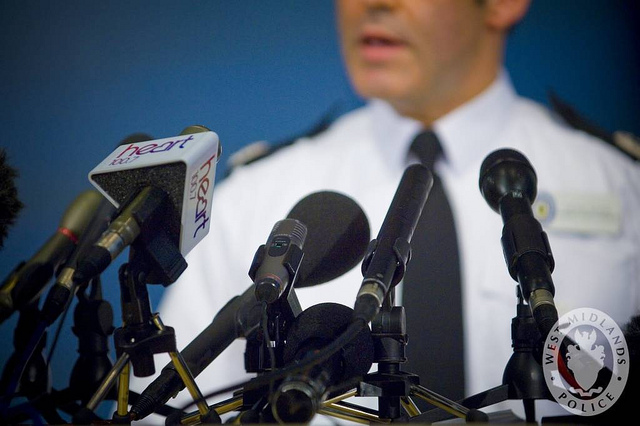
That evening, a press conference was held, where our managers took the podium to announce the arrest, pose for the usual congratulatory pictures, provide the usual “unable to comment at this time” to questions and provided the fodder for the 30 second sound bites. We stood at the back of the room able to hear, but out of sight, some of the adrenaline now draining away. A lot of work was looming ahead, but some satisfaction creeped in, temporarily blocking thoughts as to the further efforts that were going to be needed.

Shane spent the night in a jail cell, with an undercover roommate that had been arranged for him (in the event he would be stupid enough to say something); eating a microwaved meat pie and drinking instant coffee, no doubt preparing for the next day as well.

As he was watched on the cellblock video monitors, listened to on the audio coming from the implanted mikes in cell block, he didn’t seem scared. Was he struggling to control his thoughts, trying to steady his  physical mannerisms, nonchalant, unperturbed by what had just happened to him?

As evening turned to night he curled up under the grey prisoner blanket and went to sleep, snoring slightly.


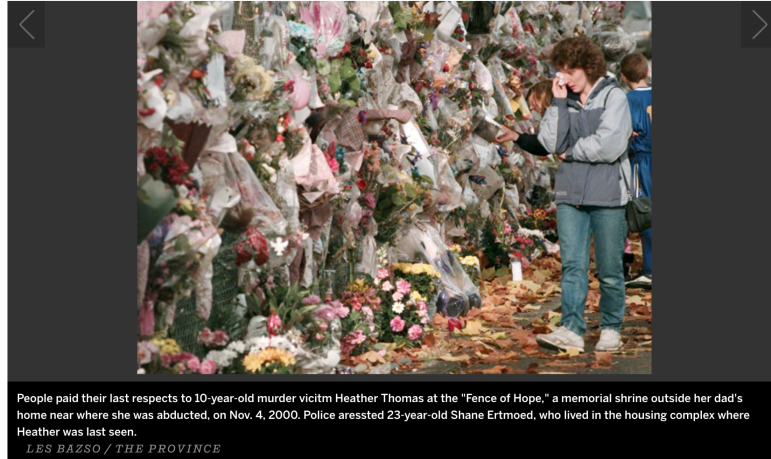
Photo Courtesy of Les Bazso of Vancouver Province newspaper Some Rights Reserved

Personal Story – “Heather” – Part III

It was now 0500 in the morning of the next day. So with the third or fourth coffee in hand, and we were back in the Surrey detachment main office, anticipating what was to come, somehow knowing that this office, this desk, and these walls could be my home for the foreseeable future.

Although it was distant from Cloverdale and the search areas, I also knew that this place, once daybreak arrived would begin to take on an atmosphere of its own. There is an ill-defined energy which any homicide generates in a police office. People coming and going in various stages of fatigue, an air of practised urgency, and every once in awhile it would be interrupted with sporadic shots of adrenalin due to some unexpected turn in the evidence.

This early inherent urgency, or drive, can sometimes be short-lived.  There seems to be a direct correlation between victim type and the length as to how long an investigator can keep a file moving.  In this case, a small girl was a possible homicide victim, and she was still missing, in some senses an investigators nightmare.  Twenty hour days would be the norm. There would be less bitching, more cigarettes, less week-ends off, less time with one’s own family, and pizza would be the culinary favourite.  It is not like the television shows in that it is not as emotional as some would like to portray it; it is more of a machine kicking into a higher gear, but like a marathoner, where one had to control pace, and hold focus.

This first quiet moment between Chris and I was therefore likely to be the last for awhile, just a momentary pause.

This of course was the “old days”. So this investigation done on paper.  Hand written reports, forms and notes, would become the 8″ x 10″ medium through which the investigation would take shape. Paper would be filling cardboard boxes, and those boxes would eventually take up spaces around us, giving a bit of a warehouse feel. Often Librarian skills would be more advantageous than investigative skills.

Each piece of paper being assigned a number, each piece of paper being a separate piece of information. If an officer filled in a report, and it addressed or revealed four pieces of other information, then four separate reports would then be generated, then all wold be put in four different folders pertaining to each item. Laborious? You bet. Efficient? We thought so. But of course the coming digital electronic age would make this all seem comically archaic.

For instance, if we had to  search for a single item. Well we had to remember where we had seen it, and in what folder. So, as an example, if someone mentioned a white Ford pickup, we would have to remember where we read it, and in what folder. It worked well when the file may be only a couple of hundred folders and a couple of hundred pages. It relied on a good memory and a concentrated effort.

However, when the file reached thousands of pages, as this one would, it became an exercise in re-reading, duplicated efforts, and it was often frustrating. Overlaying it all,  like Poe’s Raven, was the inherent fear of missing something key to the investigation.

As the days came and went, in amoebic fashion the paper would grow, taking on a life of its own. Everything found, every person spoken to, every news item mentioned, every tip called in would need to be read, documented and filed. It was a mind numbing process and complacency was the enemy. Any follow up was hand-written and forwarded to the individual investigators. An increase in investigators naturally led to an increase in paper, the Catch-22 of police bureaucracy. In a few short days, the investigative team would grow from two of us to over forty or fifty individual investigators, borrowing from Robbery, Serious Crime, and other sections within the detachment.

Decisions big and small, would need to be made as fast as the questions could be uttered, answered more by instinct than a layered thought process. There would be no time for routine debate, or second-guessing, hoping beyond hope that somehow we had learned something over the years that would not let us down, or cause us to overlook something in our needed haste.

And of course there was numerous calls from the general public, which led to the establishment of a “Tip Line”. My immediate boss, Sgt. Mel Trekofski, wanted to pitch in, and offered to take up the monitoring of the tip line, a thankless task at the best of times. It required “carding” each individual, call-backs to verify the information, and therefore seemingly endless conversations with persons, some good, some ridiculous.

As the file went on, over five thousand tips would eventually be received, with over forty psychic callers alone. The self-described “professional” psychics would all offer up where the body of Heather could be found. So you heard the “Woods”, the “water”, and “buried in a shallow grave”. There were many calls where they went on to say who was responsible,  and in many instances it was “the father”.  But, if not then a “white individual” who “worked with his hands.”  Some even offered to take investigators to the body, something we couldn’t ignore, but of course these did not pan out, but did extend my belief that there were a lot of “crazies” in the world. I never had a paranormal observer, if Im being kind, solve a file for me, and this wasn’t going to be the first.

The logistical jigsaw puzzle continued as we needed to address staffing issues and all the usual secondary administrative issues, at times like a Rubik’s cube, multi-dimensional, spinning on the singular axis of trying to keep the investigation on track.

As the searches ended, the neighbourhood inquiries continued in earnest, as did the forensic examination of objects which had been found. Investigators were assigned to each parent, and other investigators began criminal record checks, as well as local police record checks, on all individuals spoken with or identified as part of the investigation.

Panties, jeans, shirts, jackets, socks, sandals, some of which were in dumpsters were shown to the parents in the event that they had belonged to Heather, and if not, catalogued and maintained in any event.

Neighbourhood personalities, like “Pedophile Darcy”, surfaced through the townhouse inquiries as we began to dredge through the individuals in the Cloverdale complex, and the other people in the neighbourhood. “Darcy”, was typical of the type who surfaced. Darcy, of course, drove a white van, and in his past had been caught masturbating on a child’s  bed, and had a record of sexual assault. So he became a subject of our surveillance team, and in the end we were able to eliminate him from any involvement. There were others similar to Darcy, and each took time, each tip had to be ground out, and it took several days to eliminate Darcy and the other archetypes as they surfaced.

Checks through our VICLAS (An RCMP victim Classification software) system for this area of Cloverdale surfaced a possible fifteen individuals of interest because of their sexual predations. Each of these individuals would be located, interviewed, and reported on. Each would need to provide an alibi.

Checks of all those with criminal records for sexual assault and now free in the broader City of Surrey of which Cloverdale was just a suburb, revealed another five hundred possible “individuals of interest”. It would take years to eliminate that many so we had to narrow the search, at least in the short term, to just those that had violently offended on pre-pubescent children living in the Cloverdale area. This still gave us twenty-seven names. Investigators were assigned to each.  It may surprise some to realize that in most cases these individuals co-operated, and were expecting us. When the investigators arrived some had even already prepared their statements and had their alibis in order.

Others, of course would try an investigators patience, testing their emotional mettle, and you could not help but be pulled you down into the dark reaches of sexual perversion.  In matter of fact voices, they would describe how it couldn’t be them involved, as their method was different in terms of the suffering they would inflict in their need for sexual satisfaction. Some described why she could be alive, to be kept as a sexual play toy.  Any killing of her would have be only to get rid of the evidence, and a “waste”,  and any killing of her would be a signal that things must have gone wrong. This insight would later prove to be accurate.

A crack dealer living in the complex, who had been described by persons in the complex as coming and going in another  “white van”  became an obvious possible suspect. Once identified, he admitted to dealing drugs, and offered up his sales notations, his “crib” sheets as evidence of where he was at the time of Heather’s disappearance. No “normal” criminal he explained likes sex offenders; whether in jail or on the street and the drug dealer wanted to help.

As the investigative team grew, briefings, and de-briefings were our life-blood. Every morning at about 0630 I would brief upper Surrey detachment management, and then at 0730 I would brief the investigative group as to any developments or any change in focus. At 4:30 in the afternoon a de-briefing would be held with these same officers to learn of any highlights. In between of course there was the media to deal with; calls dealing with expenses, computer check results, surveillance assignments, tip line results, and other more sundry items.

By 6:00 pm, as things slowed a little, I would sit in front of a stack of reports, about 2′ high, and begin reading. Chris would then read the same paper after me, just to insure there were a second set of eyes. We would check for any cross references, then the paper would be filed, new follow ups drafted and assigned. Coffee was my particular drug, and stretching for the long walk to the bathroom began to be a highlight which broke up the trance like nature of our task.

Three or four hours fitful sleep a night would be our routine.  Upon returning to work, the process started again. Days drifted into nights. Nights became sunrises.

Suspects surfaced and then drifted away after examination; mounds of dirt reported as shallow graves were examined and dug out; clothes continued to be turned in; suspect vehicles were identified from having been seen in the area; and the psychics from around the world persisted on being heard, each with their own, but similar investigative theories.

Americas Most Wanted called wanting to profile the case. That in turn generated two tips that proved of no value. Europe, and parts of North America were all now paying attention.

We read, often re-read, re-shuffled, and then sometimes re-assigned.

And of course, there was the ever present media, their trucks stationed inside the complex itself,  giving nightly broadcasts and voicing the concerns of the general public. With Halloween getting near, they often regurgitated the growing parents concerns with a killer “on the loose” and asking whether they would let their children go out trick or treating.

As the investigation wore on I kept remembering how I was once told (by who I can not remember) that in every murder there are five mistakes made, its just a matter of finding out those mistakes. Simple really.

Of course every murder is different, every set of circumstances different. In this case we believed that this had been an “opportunity killing” by a stranger, and likely sexually motivated. Statistically, at least, the most difficult of all types of murders as these things go. Many remain unsolved. For instance, in 1996 only 14% of homicides were committed by a stranger. In 1976 it was only 18.4%, and in 1985 17.3%. Consistently low numbers.

If you looked further, and included the age of the victim, in a U.S. study only 3% of homicides were committed by strangers of victims under the age of 12. When a sexual related offence was the motivation, it drops even further down to 1% of the cases.

In checking with the FBI on this case, we learned that there had been only 4 or 5 of these cases in Western North America at the time of Heather’s disappearance in the year 2000.  So although abduction of a child is a parents greatest fear, it is actually an extremely unlikely event. Patterns are harder to detect, as there is insufficient historical data. A serial offence on children was almost unheard of, but of course none of the statistical data, or lack of data was of much consolation for the mother and father of Heather.

Investigative pressure does grow, from the public and from within. Maybe not at the levels of the tv drama series, but it is there. The greatest pressure is put on by the investigators themselves. At some point you begin to realize, rightly or wrongly, whether solved or unsolved, that this investigation will be attached to your name, especially in police circles. You will be perceived in a different light in the future.

A sense of pride takes over, the not wanting to be beaten. The emotions shut down, as the  constant images of the victim is too disarming, too distracting. One could not function coherently if you allowed yourself to become fixated on the depravity of it all, the senselessness of it all, the speculation as to whether Heather was alive or dead. To contemplate her alive and being held was in some ways an outcome that could be worse than death.

As a bit of an escape, a need at the very least to breathe fresh air, both Chris and I took a few hours on a Sunday to step away from the office. It was day twenty-two, and I decided to drive up the Coquihalla highway, a lonely stretch of highway in the middle of British Columbia, surrounded only by trees and rivers, just in an effort to clear the fog which had permeated my nerve endings. I stopped at the only rest stop, perched at a 3000′ elevation, three hours from Surrey. It was cold and gloomy, but I went into the darkened men’s washroom in this remote part of British Columbia. There at the urinal, staring at me was the Missing poster of Heather, eye level. I had always taken pride in my ability to disassociate from files when away from work. But clearly, this file was not going to let me do that. There could be no escape, not now anyways, so I decided to head back.

As I drove down the steep decline through the highway snow-sheds, once again I began to fruitlessly re-trace all that had been done, despite my blaring radio trying to change my obsessed thought process. I kept coming back to the fact that we needed to find one of those proverbial “mistakes”. I was not greedy, not all five, just give me one.

As I approached the Detachment in the darkening hours of the afternoon, just to check in, that I got a phone call. I needed to get back a little faster, because they think they had “found” Heather.

Photo Courtesy of Creative Commons by TrixSigio Some Rights Reserved

Personal Story – “Heather” – Part I

I received a “page”, seventeen years ago, that irritating incessant beep which kept repeating every few seconds. The message was always a phone number to call and receiving it implied by its very nature a sense of urgency. In some messages the phone number would be followed by a -911, to further underline the urgent request, which was the case in this instance.

As a member of the Serious Crime Section of Surrey RCMP Detachment, it usually meant that there had been a death, or somebody was barely hanging on, closer to death than life; and that it was likely violent, but above all else, that it was somehow “suspicious”.

It was 10:15 pm, on October 1st, 2000 when I got the page from my Sargent in charge of Serious Crime, Mel Trekofski and he in turn asked that I call to “partner” with me that night, Constable Chris Drotar, also a member of our Serious Crime Section.

Unbeknownst to us at the time, this particular page would change our lives, it would alter our perceptions of man’s inhumanity to man, and it would test our physical and mental abilities to a limit that we likely didn’t feel possible at that time. And thankfully, it would not be often repeated through the course of our careers.

We knew from the initial information that a girl had gone missing, a 10 year old girl, in fact.  Her name was Heather, and she was the daughter of Patrick Thomas who lived at the address. It was a little discomfiting to learn that she had in fact gone missing around 5:30 that afternoon. Already we would be starting with a time disadvantage, which in our world can sometimes mean the difference to success or failure.

The mother, Jodie Thomas was estranged from Patrick and lived in a different part of Surrey and would not be at the house.

Heather and her brother were at their fathers in Cloverdale,  as part of that common suburban divorce dance of shared custody. It was his week-end, but this was Sunday, and the kids were due back at Mom’s. But then things changed.

Search and Rescue had been and were still involved, along with all the neighbours who lived in the complex. Nothing of significance had been found as of yet, but the officers who were in attendance felt that “Dad” was acting strangely, and it was for that reason that we were being called; to interview Dad. The implications were obvious and unstated.

It was a typical October night, wind slighting blowing, leaves beginning to fall but not yet in full decomposition, coloured, but still clinging to the trees. We were asked to attend to Unit 26 at 17722 60th Avenue, in the usually quiet suburban area of Cloverdale, part of the not so quiet City of Surrey, B.C.

As we arrived in the dimly lit complex it was quickly noted that directly across the street was the Cloverdale Fairgrounds and the Racetrack. This was a Sunday, and on this particular day the expansive parking lot during the afternoon became a massive flea market involving hundreds of people. At the time of Heather’s disappearance there could have been thousands within a few hundred yards of the housing complex.

The wood construction of the worn town homes showed the usual green tinge along the edge and rooftops, mold that comes with incessant rains. It was an older complex, u-shaped so you could drive in a semi-circle and go out the other side.  It showed no signs of recent care, just the wear of years of  many children, a complex of about 50 units, who through its life was mostly populated with single parents and young couples starting families. Blue collar, trying to make ends meet, with a tinge of a criminal underbelly always found skirting the edges of poverty flecked neighbourhoods.

As we arrived,  it was quiet, as the people of the complex had by now retreated into their individual homes, no doubt staring out from behind partially closed kitchen venetian blinds.  Almost all had been searching for Heather around dinner time, all likely knew that she had not been located, so one can imagine the variety of explanations given to curious children as they got ready for bed that night.

As we drove up to the residence, with that usual mixture of adrenalin and apprehension, we were fearing the worst, but not quite prepared for that being the case.

The greeting uniform officers, who were unusually quiet, told us that they had searched the residence thoroughly, which is the first place to look for a child. Dad’s vehicle was parked out front, and it too had been searched with nothing found.

Inside the town home, it was like hundreds of others I had been in; some worn furniture, some new, usually a prominent t.v. and the usual evidence of active children. Right at the door, in clear view, was a knapsack, clearly a girls adorned with the usual hanging customized knick knacks which signalled that a girl owned and cherished it. It was in a position clearly in anticipation of heading out of the residence. It was clearly Heather’s and clearly untouched from hours before.

Chris and I introduced ourselves to the father, who sat in the living room, emotionless, wearing jeans and a collared shirt. Blonde, and blue eyed, of average height and build, a good looking man, he was staring straight ahead, saying little, no tears, no anger. There was little in his eyes, which is almost always the giveaway.  Nothing in his composure which indicated a reaction to  the most hellish of torments for a father. So, it was quickly apparent what the original attending officers thought was “unusual”.

I asked Dad if it was o.k. if we conducted another search of the residence, and his vehicle and he quickly and quietly agreed. He did not question why we were being this thorough. I also asked Dad if he would come to the police office, where we could take a statement, which he also readily agreed to, with no questions.

So at quarter to one in the morning, we sat in the interview room with Pat, whose demeanour remain unchanged.

Pat’s story was this.

Pat had been working on some carpentry in his residence. The two kids, Heather and her 8 year old brother Chris had asked around 4:30 to go out and play around the complex while they waited to go to their Mom’s. He said yes, but told them that they had to be back by 5:30 so that he could keep to the proscribed schedule.

Around 5 Chris came into the house, but without Heather, and Pat told him to go get his sister so that they could get ready to leave. Chris went out, could not find Heather, and came back a few minutes later saying exactly that.

Showing the usual parent frustration, Pat packed up and went out into the complex.  He began looking, talking to the various kids and parents as to whether they had seen Heather. It was learned after a short time from some of those parents, that she was last seen riding a 2- wheeled bike that she had borrowed from one of the other children.

A few minutes later, the borrowed bike was found, but no sign of Heather.  According to one witness, the bike tire was still spinning when they found it, near the front of the complex, in a parking stall on its side.

After we finished the interview around 2 in the morning, we were still just as confused as to Dad’s reaction, or more accurately, his non-reaction. Throughout he was totally co-operative, but he never mentioned the proverbial elephant in the room, which was whether we suspected him as doing something to his daughter. He just answered our questions, calmly and without hesitation.

We left the room, and dropped Pat back at the now growing Search and Rescue group on the Cloverdale Fairgrounds.  Still somewhat unsatisfied about Pat, however, we had come to one conclusion. The time-line, both drawn by the original officers, the neighbours, and our interview we felt excluded Pat from being involved. The circumstantial evidence did not leave any room or time for him to commit what would be an unthinkable act. Granted we were leaning on some years of experience and training, and trusting our judgement. Not always a comfortable feeling. And we were about to alter the scope or focus of an investigation as a result. If we were wrong, with the stakes this high, with the focus both within the police and the public that only a 10 year old girl victim can generate, it would be a decision that could haunt or taunt us for the rest of our lives.

In our opinion, we believed that Heather had disappeared, silently, although surrounded by thousands of possible witnesses.

Statistically, if this was a “stranger” abduction as we feared, the chance of Heather being alive was minimal, as too much time had passed since her disappearance. We also knew that there were only a couple of probabilities in terms of motive as to why a young girl is abducted.

If the suspect was not a family member, which was now our investigational theory, then we were now in our own personal criminal investigational nightmare. We were now looking for the needle in the haystack.

To be continued…….

Photo Courtesy of the Surrey Leader newspaper, a picture released to the public during the Search for Heather.


And then there were none….

Last night I re-watched the 1976 movie “All the Presidents Men”; the story of an investigative journalistic effort that led to the discovery of the illegal activities of The Committee to Re-Elect, and then to President Richard Nixon himself. In the end there were many guilty pleas, and the resignation of the President himself. The two year long investigative reporting was unprecedented, and may be never duplicated in our current climate as we head forward, where we seem to only want news fixes, like a junkie in the alley looking for a cap of heroin. We want this short burst of adrenalin laced news feeding our eyes and not our heads, before we duly nod off.

The parallels to the situation in the U.S. in 1974 to today, become obvious upon review, almost startling. The Trump presidency is difficult to even fathom, but in no way do I think that Trump and the family lackeys who are already proven liars, are not capable of further deception, not capable of illegalities, in order to maintain their power.

The positive side of this, in some backward fashion, at least in the short term, has been the rejuvenation of an active and determined group of journalists who have now tasted blood. They have the resources, and the experience to both confront the administration and write about it. Even more importantly, they seem to have the backbone necessary to withstand the onslaught of government power run amok, who try to bend, or deny each and every story with a spin that is both dangerous and sometimes laughable.

The Washington Post and the New York Times seem to be the central figures in this relentless daily battle with the truth. Both are decorated newspapers. The Washington Post with Woodward and Bernstein were the central figures in the Watergate matters in 1974, which brought down Nixon. And here again the Post is providing in-depth laudatory coverage of the daily crisis, which is the Trump Whitehouse.

Before Trump, both newspapers were in financial trouble, both cutting personnel and funding. Since Trump, their subscriptions have increased and they have been given a temporary respite from the unenviable and seemingly inevitible dwindling of subscriptions.

The sourcing of their stories, and protecting those stories is relentless. Anybody with an interest in how to conduct, and source investigations should take note. This is not an easy undertaking, their jobs are often on the line should they misspeak or be wrong in any of their reportage.

Where is television in all of this?  Unfortunately, in the last few years, it is trying to re-invent itself, it has become a medium, not a message. They are consumed with banner headlines, breathless “breaking news” but make no mistake, and they seem to have abandoned the time and effort needed for investigative reporting. Their  “news” is no longer journalism.

In an effort to capture the attention of the latest generation, they have come to believe, maybe correctly that this generation is only capable of 30 second attention spans. Therefore anything on video, twitter, Facebook, or trending on YouTube is re-invented as the news regardless of its worth. A good video of a cat up a tree jumps the news queue and becomes headline material. It is cheaply available, and citizens with their phones have become their “stringers” in the field, at no significant cost.

In covering Potus, the TV news groups; CNN, Fox, CBS etc. are for the most part reporting what the newspapers are writing, then putting a lot of talking heads around a dais to pontificate about it.  The more outrageous the talking head, the better the chance of capturing the eyes of the viewing public so we get the likes of Kelly-anne Conway spinning ludicrous analysis and misinformation about the latest Presidential gaff posing as policy.

In many ways, this President has mastered Twitter and the wants of the new age, and has reduced governing to a sitcom. His statements, such as the one where he talks about grabbing women by the genitals, is outrageous, but it goes no further than that, the outrageousness is the news, not the meaning or the implications.  The United States reputation around the world is now tarnished, and may not recover for some time. The United States is now reduced to being a large military with an unstable leader. Sound familiar?

Of course this lack of investigational interest is all applicable to Canada, with its smaller population concentrated around the cities and the borders with the U.S., our television is a smaller mirror image of the U.S. It is astonishing to see how much the CBC National news coverage now revolves around the U.S. trending stories. In  the last couple of days, hours of repetitive footage of the hurricane stories. Here they are able to rollick in the abundance of 10 second videos that are available showing  bent over palm trees, shot through a rain covered lens;  and of course always maintaining a look out for  a “Canadian” located in the centre of the storm to give them some relevancy to Canada.

I am not saying this big story should not be reported, but it should not be all consuming. Are there no issues in Canada worthy of some form of journalism? Of course there are, but they are hampered by this new age of video at all costs, and dwindling funds to conduct those stories. A journalistic Catch-22.

As I opined before, television should be written off as a model of investigative journalism as it simply does not exist at any measurable level, nor is it even possible in their new corporate mission statements.

Newspapers in Canada are in equally dire straits, The Globe and Mail, although business oriented still is the bell-weather of Canada’s newspapers, today they announced a couple of further layoffs.

But the other problem, although we are a highly literate country, is that we are no longer reading.

The newest generation has fallen prey to the love of convenience, wanting summaries, not depth in their reporting. Coles Notes versions, not the details. They need to be constantly fed only enough for them to form an opinion in a few seconds, and damn the details.

Of course, the devil has always been in the details.

This leaves us susceptible to being victimized by misleading or downright false reporting. We are often misled by the headlines, and only when one chooses to read the whole article does it make sense, and it is usually a more calm explanation than advertised.

We are manipulated as a result. Our own governmental agencies have learned that if they issue singular statements of little meaning, it goes unquestioned. The reporters can not be bothered to check the truthfulness of the statement as they are being pre-empted and diverted to a story which may have caught the attention of YouTube and the assignment editor. If you don’t believe me, check out what is currently trending on Youtube, or what the top 10 stories are on Reddit.

Justin Trudeau gives speech after speech making generalized statements of fixing this problem or the next. It goes un-examined for the most part, but we will get pics or video of his latest selfie canoeing, or of him photo bombing a wedding. It makes me think that Trudeau may be a Canadian version of Trump, one who has mastered social media, but but not the relevant issues, but he is young, photogenic and polite. The left in the United States think he is god like, as they too are only reading the headlines. He is a former high school drama teacher, born with a famous name and reputation, how could we not be concerned about what he actually understands.

As experienced journalists are being replaced by the young, the photogenic, who stand in front of endless monitors and fast-moving graphics (I assume it is their attempt to show they are on the cutting edge of technology), and push buttons which play the latest newly trending video.

And now the Americans have confirmed that the Russians and other intelligence agencies have figured this out. You just need to put out the headlines, no need for details, nothing gets checked.

Facebook just revealed the confirmation of false ads, a total of 3000 from 470 “dark accounts”, during the American election, in-directly tied to the Russians, and aimed at altering the election to a candidate they feel they can manipulate. Despite some intrepid reporting a few months ago which Facebook initially denied, it was not until two days ago that Facebook admitted to the problem. The New York Times summed it up by saying “we are in the midst of a world wide, internet-based assault on democracy”.

None of this sounds good, or leaves much room for optimism.

Will we go back to newspapers, unlikely?  Will television be simply a stopping off point where they re-package video? Likely.

There is no immediate answer to these changing times, but this generation does need to question, and it needs to go deeper than Twitter; our democracy depends on it, and we will lose faith if truth becomes the first casualty.

Photo Courtesy of : Razvan Orendovichi via Flickr Creative Commons licence


An apology to my faithful but few readers

In the last few weeks there has been a lack of output from your faithful scribe, for two reasons.  The first is the inability to force myself to sit in front of a computer, which is  a human fraility, the failure to be disciplined. Instead, I have been enjoying the comforts of a warm summer; bbq’s, still and sultry nights, family members coming together, shorts and flip flops. But in my defence, I did feel a twinge of guilt.

The second reason is that about mid-August, just as I was being pulled back to the laptop, unannounced,  I was forced to undertake an investigation into the Canadian medical health care system; having being literally forced to my knees by sudden acute sciatica. A few weeks of intense pain has a way of taking away your ability to concentrate, and did not even allow me to sit in front of the afore mentioned computer. I am not looking for sympathy, just trying to justify my lack of written output.

My medical investigation so far by the way, has revealed that although better than the third world without a doubt, I have some serious questions on the costs of our system, and the eventual medical outcomes. I have concluded that you are your own best diagnostician, and the enormous monies being spent are feeding some segments but not others.  After two emergency room visits surrounded by crying babies, alcoholics, and drug addicts with their often ill-defined problems, and an ambulance ride where we discussed poor pay and our mutual dislike of firemen, I was left wondering where all the money that goes into health care. Is it really finding its way to where it is needed? But that is for another time and blog.

So now, still on crutches, and probably destined for a life style change which incorporates physiotherapy for the duration of it, I have been re-defined, and find myself in need of the succour of writing. When I first started this sometimes moving target blog I wondered if I would find enough issues which would inspire me to undertake and dedicate myself to a daily writing process.

Rest assured. That has not been the case. Quite the opposite actually as I, like you, are continuously being bombarded by “breaking news”.

There is the continual distraction of the bombastic, idiotic, and war mongering U.S. President, who can not put a grammatical sentence together. But that aside here are the few things that are of interest to me.

Hurricane Harvey in Houston happened a few weeks after BC was declaring the whole province a state of Emergency due to wildfires. Stunning photographs from Houston, while here, thousands of people evacuated under growing frustration with the process itself. Emergency planning as exercised in this Province, I think needs to be placed under a microscope. Hidden behind the “rescues” and the “hero” stories there is a need for an audit, a need for some non-emotional analysis.

In Ottawa, the Indigenous inquiry is proving to be a political disaster and at the very least, as predicted, will be an ineffectual exercise. But the Liberals push on, now making two departments in the Federal government to deal with indigenous affairs, rather than INAC.  Billions of dollars in expenditures seem to be on the horizon, apparently without a smidgen of opposition.

Also in Ottawa, Senator Mike Duffy, guilty of gouging the system legally and lacking any ethical and moral compass, he is now suing the RCMP and the Federal Government for $8 million. I suspect he is going to get a payout, due to an inferior RCMP investigation of which I have some personal knowledge, and an investigation which was wrapped in political interference.

Locally, Surrey and the surrounding areas seem to have a new drug war developing. So what else is new you ask?  Meanwhile, IHIT (Integrated Homicide and Investigation Team) at last count solving only 6 out of 36 murders this year.  I am hearing rumblings that the officers in the Unit itself, are now questioning the effectiveness of their own organization.

The daily Fentanyl news coverage has now dwindled from public view, the news agencies finally running out of variations on the theme of reporting the “crisis”.  A sense of acceptance seems to have taken hold in the general public.

The Mounties still have no Commissioner, still awaiting for a large committee of eight politicos led by ex-Premier Frank McKenna to render their decision. I wonder what that will all cost, and what direction will the new Commissioner take this organization.

And in a more comic and reflective vein, the CBC, could not make a decision on who to replace the venerable Peter Mansbridge. Instead, and I can just picture the boardroom meeting, they have chosen to not pick a singular person, but to pick four possible persons.  Why use one, when you can use four for the same job? And the genius of course, is that the four will represent the gender and ethnic groups that are now championed throughout the Federal government.

So there are just a few of the things that interest me and my wandering mind (and it may be the medication) …. I will keep you posted.

Photo courtesy of Enric Fradera via Flickr at Creative Commons 


Breaking News…well, not really, just kidding

In this story rich times of Donald Trump, where the President of the United States and POTUS politics have become a long running (about 100 days so far) sitcom, a combined version of a political Gilligans Island and a Washington DC Survivor series. Like everyone else I have tuned in daily to see if the Americans with Mr Trump as their fatuous leader have launched another tweet, then a defense of said tweet, and then the round of procrastinations that follows on the alt-right and the liberal left. Its tiring but enthralling. Now that Mr Trump has thrown bombing targets of zero resistance into the mix, there now has become an element of danger added to the fray.

The media has been reinvigorated, subscriptions are up in newspapers, such as the NY Times, and the Washington Post, and the major cable news-stations are attracting more viewers, like me. Which all leads me to my complaint.

I watched two full hours of CNN, the other night, and every story line, was preceded by the announcement by a breathless anchor, usually in a sombre voice, intoning about how the next story was ” breaking news”.  One story would be followed by another “breaking news” story.  Eventually, I had to shut it off, I could not handle this artificial exaggeration of a story, which was not “breaking”,  and sometimes would not even be considered “news” on any kind of  importance scale.

CNN of course is the worst offender in this, but it is a attention getting tactic which seems to infuse all the media, including our local media here in British Columbia. They combine this with the often heard line “and in a Global exclusive”…or in “a CTV exclusive” which in the end usually means that someone talked to them and nobody else. Whether it is newsworthy seems to be secondary to saying that it is exclusive.

Of course the papers can’t sound the alarm in this way, so the newspapers instead make the headlines bigger, in capital letters, or with exclamation marks, which forty years ago usually meant the start of a war, or in the Tabloid circles of England was reserved for the Royal watchers when another baby was born into the monarchy.

A few weeks ago, in an anticipation of another snowstorm, Global dispatched all their reporters around the LMD so that they could report on the grief and upheaval that a few inches of snow may bring. The storm did not materialize, so we were left with anchor Chris Galius describing in great detail, dressed in the pre-requisite parka, telling us of the “slushy” road conditions as if a tsunami had been barely avoided.

It caters of course to a generation with numerous sources of information, a generation that seem for the most part only interested in the headlines, maybe not so much the explanation, and can scroll through several media outlets with a quick twitch of their thumbs.  The traditional media outlets are drowning in this undertow of Twitter, Facebook and Instagram. They are in a desperate fight for every viewer and advertising dollar that another claim to a set of eyes will bring them. At some point it becomes pathetic.

Everyone is falling to this ruse, and the police media sites are in full drive trying to keep up with bringing “breaking news” to us, the apparently eagerly anticipating public. Now to be fair, the media is often pestering and pushy when dealing with the police, because they want to get the “exclusive”, and break that “breaking news” story.

So the police issue ridiculous and premature summations often are short on detail,  such as that the killing “was a targeted hit” or “there is no safety concerns for the general public”.  They are  often issuing these pronouncements after a very short period of time at the site of the incident, so in other words they don’t really know if it was a “targeted hit” or not.  A few years ago it became au courant to have someone of a higher rank there for the photo opportunity, armed with a few day media course offered to police. A nattily attired Inspector would make sure he or she was present at the scene, to be the focal point for the 30 second sound bite.  Fire chiefs and police chiefs alike are drawn in like moths to the light.

There is also a real concern of details being spoken about which could be detrimental to the case, but that concern seems to fall on deaf ears, when there is that need to speak to the public within minutes of an event. At some point this need to feed has become secondary to a possible investigative need.

Well here is a news flash for you; every murder is targeted. And if someone is shooting someone in public places, there is a concern. These trotted out phrases have little or no actual meaning to the circumstances.

By the way, do you need to be told again that the police “are seeking the public’s help”, or do you need to see another table of guns, money, and stolen goods laid out for the photo shoot to demonstrate that there were actually things seized. Is it possible that they just keep the same table, with fake guns and money on it, and then bring it out every news story? Just kidding, but it could save a lot of time and effort.

Another trend is to have a number of senior officers at every press conference, with 5-10 individuals standing behind the speaker, not saying anything, not adding anything to the conference. But clearly, trying to make some sort of impression, as to their strength and to give one a photo impression of long and complicated investigations. The  Warhol quote “everyone will be famous for fifteen minutes in the future” seems to be in full evidence as they are often jockeying for position in this media directed receiving line.

To guide this growing police media presence,  the police now call themselves media “strategists”.  (When and why did the police feel the need to have a media strategy?) The police have gone from a “strategy” of saying nothing to the media and a perfunctory “no comment”  to one where they feel that they need to control  and guide the media stories, creating a “spin” conducive to the police efforts.

The police have become more sophisticated in their approach, and are now using the media appetite for a video or grainy photograph to use to an operational advantage.

For instance, when investigating homicides or other major crimes, the police have often used video or photographs to draw the publics attention, while at the same time not really caring about the general public commentary; but behind the scenes,  concerned with drawing out or observing a suspect once it gets played in the media, hoping the reaction of any suspect may further the investigative case.

This of course is tenuous ground, fraught with cynicism, but it invariably worked. The  media sites are forever pulled in by a 10 second black and white fuzzy video without any kind of editing or wondering of its relevance.  This should make everyone pause when seeing the news, and a police bulletin, or alert, or a “breaking news story”. Approach with a modicum of caution, as it may be part of a “strategy” of the police.

So where does this leave us in this world where Facebook now is the supplier of news for 44 % of the American public and where fact checking  and “fake news” has become a growth industry.

As writer John Irving observed in a NY Times feature, “I don’t think the news has changed much over the years, only the way we report it”.  And how it is reported of course determines the level of sophistication of its readers, and their ability to discern reality from imagined, when it is being bombarded with screaming headlines, full of pizazz,  but lacking any discernible mature content.

How can we trust when it is possible that the news is being manipulated by the hackers of Russia, or Wikileaks with their clearly political agendas. Or maybe, an investigative agency closer to home who is “strategizing” the news release to orchestrate a reaction.

It leaves us in a quandary. The Canadian Journalists for Free Expression states that (in an opinion shared by many others) that Canadian’s have a right to information; which is “the raw material of expression…enables citizens to engage fully in a democracy and hold their governments to account”.  A lofty principle no doubt, but the journalists themselves and the people they work for are abandoning or have abandoned the ability to provide researched and accurate information, and are busily festooning themselves in “Breaking News” and Youtube videos. Graphics have become the news.

They should be held accountable and follow the lead of such media sites as Politico, or the Atlantic, and the Washington Post who are some of the few remaining stalwarts of accurate and well done journalism, and who have recently been brought to further life with the advent of Trump.

In Canada, the CBC and its clear political slant pervert their attempts to be fair and accurate, and the Globe and Mail tips to the right sometimes to their detriment. Locally in British Columbia, our newspapers are dying before our eyes, as they continue to downsize their journalist ranks. The ethical use of sourcing and journalistic integrity seems to be degrading. I worry about the truth being delivered, and the truth actually being read.

As to the police. Please stop with the pat phrases, stop the officers from wanting to be in the spotlight, stop worrying about presenting a diverse set of talking heads, and please stop spinning the story. Stop being breathless, or crying, or feeling the need to show empathy as if it is more important than the job you are hired to do. The public sees you as an arm of the judiciary so they want to know the facts, and how they are impacted. You don’t need to strategize, you need to be there in times of crisis as a sturdy and competent voice, unswayed by politics, unassailable in terms of the truth. Your ethics should be unquestionable and it is then, and only then, that the public will regain their trust and appreciate your efforts.


Photo: Courtesy of West Midlands Police via Flickr Commons