Loved and Defunded…

My news intake has admittedly been reduced to an almost ignorant level. A few snippets in the morning and then nothing else for the rest of the day. A prescription for a blissful day and for the most part unabashedly content in that ignorance. No t.v., no Twitter, no Facebook, no radio intruding on rational thought. The world, or at the least the world of large capitalized headlines, temporarily pushed aside. 

Yet, the continuous carousel of causes swirls around and around, constantly exposing us, albeit inadvertently, to the special interest punch lines. The catch lines are designed to instil a reaction of fear or outrage. In turn the politicians continuously seek public affirmation. Constantly chumming the waters for us to bite and be hooked.

 Frustratingly— you once again find yourself having fallen into their trap. 

The bellowing cry to “Defund the Police” is one that has garnered the herd following, and like almost all of the ideas born by protestor insemination it seems to lack any real substance. There is no specifics on how this would work or any articulated policy flowing from this fragile concept. Of course this does not deter the politicos. Form and function is irrelevant.

In New York City, which commands the largest city police force in North America, the city counsel just “defunded” the police to the tune of a $1 billion. N.Y of course, is an enclave of democratic power, so it is not much of a surprise that they have reacted with knee-jerk reflexes and near sightedness. The polar fringes reacted with those on the left saying that it was “not enough” while on the other end of the spectrum, usually portrayed as “red necks” saying it was “too much”.

Nevertheless, this fashionable debate forces one to ponder what started this process, this lack of confidence in policing? How did the police manage to ostracize so many? Did we help to create this?  Is it wrong to look inward when things go awry? Should we just assume that all who level  criticism at the police are by definition fools?

How did we get here and how do the police get out? After all the police practise and policies during the last number of years has been driven by the  need to be “liked. Is it possible that the police in their attempts to be everything to everyone has completely backfired?

Managers of the various police outlets all adapted and were co-opted to the theory that the way to improve policing was to be accommodating, to be all encompassing to special interest groups. The new school of management preached in public administration that government bodies needed to be more imbued within “the social fabric”. All the problems that that would entail could be surmounted by an understanding police department. This was the birth of the politics of “inclusion”.

It’s explains how when the police hear the recent cries of “systemic” racism that it all seems so ludicrous. The police can not relate to these allegations. They have been living through this “new”age when the RCMP and other police forces have been extolling the virtue of the police being all good, all present, and all connected. 

Police departments sought out affirmation and were being directed to the goal of being loved by everyone; to be one with all members of society, no matter where you appeared on the economic or political spectrum, we wanted to see through your eyes. The police began hugging everyone in their immediate vicinity, crying when deemed appropriate by those that demanded empathy and conceded the need for retribution for all of the historic real or even perceived “wrongs”.

If you want the gay movement to like the police, march in their parades.  

 If you want children to like you, let them climb around your cars and hit the siren button. (That was learned that from the fire departments actually)

 If you want to relate to teenagers, put officers in the schools where they can be one of them; play basketball with them, or dance with them at school fund raisers. After all, officers dancing in the streets to some neighbourhood rap has become one of the favoured youtube draws. It plays.

Recently, a video showed a female officer in full uniform going down a “slip and slide” became a viral video; clearly aimed to garner love and “likes.  The police have been feeling the need to demonstrate to all that they are in fact humans too; we feel, we rejoice, we are sad. Or so was the theory.

This love and acceptance would lead us into a better policed world and therefore a better society, a “just society” to intone former Prime Minister Pierre Elliot Trudeau. They wanted to grow beards or wear tattoos as it would show that we were just like them. We would be “cool”.

The events of the past few weeks has proven that this theory which was to drive the police to a utopian acceptance –was entirely wrong. 

In the love/hate relationship with the media the pendulum has also been swinging with abandon. Modern thinking was that if you want the press to like you, then answer all and every question. Be at their constant disposal. Twitter out events as fast as you can— god forbid that the press didn’t have the latest police sound bite. In this quest the police have issued tweets that were about events before the police even got to the scene.

It is this incessant need to accommodate that led to the questions as to where was the Amber Alert in Nova Scotia? They want the press to love them, to come to some understanding of how hard they work, to not misunderstand them. They are doing good work, so how can you possibly write bad stories about us.   

This too clearly is not working. That damnable ungrateful press has now turned on them.

This overall theory founded on the need to be “liked” is clearly and universally flawed. The counter argument being suggested here is that the police do not in fact need to be liked by everyone and not all the time. 

But, they do need to be “respected”.

The way to gain and achieve that respect is to be seen as being objective, fair; both in their investigations and in their decisions. A police force should never be seen as being on one side of an issue no matter what the issue. The police can not be “political” and survive in a society made up of disparate and diverse groups.

It is impossible for the police to be seen as independent, fair, or objective if they are seen as being influenced by their political masters or favouring one political entity over another. They are there to enforce the laws, not to influence or pander to variations or interpretation and enforcement of those laws.

In all areas of policing, the police having been enamoured with inclusion and affirmative action politics have by necessity become political on multiple levels. The once arms length approach to the role of government and the political executive arms has disappeared.

In the RCMP Ms. Lucki and her mandarins have proven conclusively that they are under the direction of the current government. One does not have to look any further than the recent flip flops over “systemic racism”. But, there are numerous examples, some far more damaging in their outcomes. 

Does anyone believe that the RCMP will investigate with any fervour the corruption that is implicit in the recent awarding of almost $1 billion to the WE organization and its connection to the Trudeaus. Does anyone believe that any corruption on the part of the Indigenous would ever be investigated? Does anyone believe that SNC-Lavalin was investigated without prejudice?

The general population of Canada, watches and sees this clear political influence being exerted on an almost daily level on the police. They roll their collective eyes and shake their collective heads. The confidence of the public is wavering in the ability of the RCMP to conduct any investigation, not just the ones that require some level of sensitivity. 

So, if they want to defund the police, lets throw them some bones. Let’s defund the sections that are solely aimed at being “liked” and instead reinforce the investigative mandate.

Let’s get rid of all community policing officers and let’s get rid of all school liaison officers. Give that money over to the hiring of another school counsellor or some other community program. Let’s shut down those child safety programs, like the bike rodeos, or the pretend officer training programs. Let’s get rid of any program that are echoes of social work. Let’s get rid of the Safety Bear. 

Let’s get rid of all those media relations officers and all their respective units, including the “strategic” media units. From now on, officers on a case of particular importance can issue a one page press release if there is a need.  (Believe it or not this was easily done in the past). Let’s get rid of the Twitter and Facebook feeds. We should not be part of the social media universe with all its frantic and frenzied radicalism on both the right and the left. It’s an internet conversation and therefore those conversations are mostly ridiculous. 

Let’s not react to any 12 second video clip without conducting a full investigation.

Again, remember the public wants confidence in your fairness and your thoroughness. Prove through investigative results your case for the value of objective policing. 

Investigate all in a timely and fair manner.

If undue influence results, then the leaders of those investigative units must step forward and publicly call out any attempt to influence. The police leaders have to re-establish their independence from the legislative and administrative arms.

There is little doubt that this would take tremendous courage, which is admittedly in very short supply in these off-kilter days. The managers need to lead and not just post on Linked-In their leadership skills. There would be some “hills to die on”.

The public would eventually be on their side if that trust could be re-established. 

 Chief Adam Palmer of the VPD recently stepped forward after some hesitation to address systemic policing. It was a dangerous move with the left leaning NDP Mayor of Vancouver watching from a safe political distance. Maybe Chief Palmer was still angry over having his police budget cut by the bike lane loving mayor, but in any event he stepped up. He will likely pay an eventual price, but he did what was right. 

The people just want to have faith in their police force. It is really that simple. It will be difficult and will involve facing numerous hurdles, but it can be done.

The public wants to be assured of the police arrival, confident in the job that will do in a fair and impartial manner, without regard for race or community. The public want the police to be professional and above all else immune to all the faces of favouritism.

We do not need to like them.

Photo courtesy of Carole Raddato via Flickr Commons – Some Rights Reserved

Bowing to Ignorance

It was hard not to feel sorry, or a better word may be uncomfortable for the beleaguered Commissioner Lucki, or maybe even the befuddled Deputy Commissioner Zablocki. These two individuals have risen to the upper echelon of the Mounties and have been drinking in that rarefied air, playing to a political agenda in relative peace and harmony. But here they were, in the last few days, cornered and out-gunned by the more politically correct, the masters of appeasement. Even they could not have imagined this looking glass world of righteous indignation which was being thrust upon them with increasing ferocity.  

Through their careers they have been promoted and extolled for their adherence to the themes of diversity and inclusion, and in many cases had to abandon ethics and principle. They were required to chant in unison the mantra of the enlightened progressives. Go along to get along would have been their placard as they eyed and encircled that executive corner office. In this and that environment there was absolutely no tolerance for dissension or counter-point. Similar minds were recruited and pulled up the ladder by the other similarly minded. 

Say nothing offensive, say nothing for which you could later be held accountable. Job experience or the position that was held was a distant second to conforming to “the system”. Pandering to those favoured interest groups and following the progressive line has been “systemic” for a number of years. 

But in the last number of weeks, we reached a point of significant accounting, a “crisis” if you prefer the new word for news. Of course I am referring to this newly professed outrage of police brutality and rampant racism in the RCMP, all of which had been ingrained by some sort of conspiratorial process.

The force of the cable news pushed Ms. Lucki out of hiding. Most of all the throngs were demanding acquiescence. Like the Papal blessing from the Vatican, they wanted the head of the RCMP to publicly acclaim their beliefs and proclamations of “systemic racism”.

So, she consented to do an interview with that bastion of special interest bias, the CBC, to be conducted by the“Senior Political correspondent” Rosemary Barton. Ms. Barton, who no doubt feels that she is the epitome of the probing journalist, is well connected to Justin Trudeau and the inner Liberal sanctum. Ms. Lucki must have believed or may have been comforted in the fact that she was in normally friendly territory. 

Throughout this interview, it was clear that Ms. Lucki was referring to her notes when she was being pressed on the terminology of “systemic racism”. Finally, Ms Barton pushed, so “you you didn’t answer the question, do you believe there is systemic racism in policing organizations, including yours in the country?” 

What followed was an inept stumbling meandering response to that “interesting question”.  Clearly, Ms. Lucki knew it was coming, clearly it was the thematic background for the entire interview. It was also equally clear that  the CBC was pressing to have Lucki admit on camera to “systemic” racism. The masses demanded it. Ms. Lucki was not ready. 

Ms. Lucki chose to respond by saying that she was confused by the many definitions of “systemic racism”.  One had a mental picture of Ms. Lucki surrounded by Funk and Wagnals, Oxford English, or Miriam-Webster dictionaries desperately thumbing the pages trying to gain some insight. But, it was all to no avail apparently, frustrating she said, as there were so many “versions” of it. 

It should be noted that the interview with Ms. Lucki was a day or so after the interview given by Mr. Zablocki— who in after an apparent dose of sodium amytal stated that there was no “systemic” racism in the RCMP. Unfortunately, the dosage wore off a few hours later. 

Still struggling, Lucki looked down at her notes to say “if you mean unconscious bias” —then she would admit that the RCMP was guilty as charged. 

The interview painfully continued and Ms. Barton opined at one point that in this country “people feel scared calling the police”.  Even this outrageous comment did not force the docile, pliant Commissioner to react in defence. She trotted out her tested and true response: “We need to get better”…”my expectations are high”. She went on to agree to review the carotid hold which was still in use, to bring better accountability through possible use of body cams, as that was part of her “digital policing strategy”. After all “we need to get better”.

The interview concluded with the Commissioner inappropriately telling Ms. Barton “thanks for your respectful questions”. She was clearly relieved; but this too would be short lived. 

A day or so later, Trudeau threw them all under the bus. 

Of course, there is systemic racism in the RCMP according to Trudeau. It was everywhere. 

No one missed the irony that this was coming from the three times “black face” Prime Minister, the white privileged Prime Minister. 

Shortly thereafter, predictably, Ms. Lucki turtled, fell into the prone position, hands over her head and ears, instinctively warding off the blows of the persistent masses. Through the safety of a press release said:

“…I did not say definitively that systemic racism exists in the RCMP…I should have”. 

So given this state of confusion, this intrepid blogger feels obligated to help these poor confused mandarins of the RCMP.  

“System”, from which the word systemic originates, is referred to as the “structure, organization, order, complex, administration” etc. If one stretches the definition and refers to “the system” in the modern vernacular, one could be referring to “the ruling class, the regime, bureaucracy”.

So follow along you poor, confused, Mountie managers, if one is claiming “systemic racism” one is claiming that the bureaucracy, the administration, the laws of this country, the structure of the RCMP, is in fact racist. Systemic racism to exist and meet the definition, must be built into the rules and the structure of the organization. Miriam Webster says that “systemic” means that it is “fundamental to a predominant social, economic or political practise”

Does anybody inside the RCMP believe that to be the case? 

Of course, you are allowed to have that opinion but, there is a convincing argument to be made that in the last twenty or thirty years that the administration and the bureaucracy, and the management of the RCMP organization has in fact been the exact opposite. 

Affirmative action hiring, recruiting, promotion, transfer policies, have in fact been tailored to meet the demands of the growing multi-racial society of Canada. Community policing, school liaison programs, Youth Intervention, and the like have all been tailored to meet the growing demand of diversity and inclusion. (How successful they have been is quite another matter. )

Nevertheless the Commissioner of the RCMP (and there have been no dissenting voices among the other RCMP managers) has now implied that everyone and everything in the Mounties is racist. The entire system. 

This charge is absolute nonsense. But, no one is daring to step in front of the stampeding herd. The herd has declared it to be, therefore it is. Celebrities and sports figures joined in.

It should be noted that when we go to these protestors, or their talking heads and seek specific examples of this systemic racism none are proffered.

Chief Allan Aden of the Athabascan Chipewyan First Nation in Alberta stated “If a white man is denying systemic racism, that is systemic racism”.  This is the level of intelligent debate in this country.  If I deny I am a sexual predator, I am therefore a sexual predator. 

This very same logic was used by the minority leaders of the Opposition NDP who has never missed a cause or a bandwagon on which to jump. So he was poised for this latest cause. He proposed a “unanimous consent” bill, for all parties to agree, that the RCMP was systemically racist and that RCMP officers were killing the Indigenous and blacks in this country. It was clearly an act of grand-standing, and after making his support speech, he pompously sat in his seat, assuming all would agree.

All political parties voted for it, a disturbing lack of support for the police to say the least, but one single member of Parliament, Alain Therrien for the Bloc PQ, said no.

NDP leader Jagmeet Singh, jumped up, clearly upset. He then called the Member of Parliament a “racist” for not going along with the bill.

He was a racist according to Mr. Singh because he didn’t agree with Mr. Singh. The same logic as the Chief.

Justin Trudeau, went further and refused to criticize Mr. Singh, despite Mr. Singh having been removed from the Commons for the day for his “un-Parliamentary” comments. His justification was that Mr. Singh was a “racialized” leader and therefore it was forgivable.  

These last few days, the seemingly endless accusations continue to be stoked by the irresponsible of this country. It is discouraging and is tearing at the very fabric of this country. The lack of informed narrative, and the often ridiculous proposals to counter this ill-defined problem have left many parts of this country speechless. The pundits and media commentators in this progressive world have gone from being expert on the coronavirus to experts on policing with often comedic speed. A quote from Oscar Wilde resonates, “by giving us opinions of the uneducated, journalism keeps us in touch with the ignorance of the community”.

Where will it all end? When will reasonable dialogue return? It is difficult to say. This blogger never imagined a time when political dialogue in this country was so blatantly biased and absent of substance. The level of this demand for conformity rivals any historical third world despot.

The tearing down of statues and the rewriting of history, the calls for defunding the police, and the chants for a revamping of the RCMP will one day run into the wall of reality. These protests and cries for reformation are not based on any intimate knowledge of policing, they are based on slogans. The day when the social worker arrives at the domestic dispute or to deal with the mental health patient instead of the police, is a very long way off. 

When someone can actually point to systemic racism with an objective rationale, then we can begin to address it. The danger now is knee-jerk policy to appease the masses and Trudeau is already floating trial balloons. Most will end up meaningless, a let them eat cake moment and of no intrinsic value. 

As for the Commissioner and the rest of the Executive of the RCMP. Maybe they should consider that now is the time to fade into the night. Their time to show leadership arrived and they shrivelled before your very eyes. They should be bowing their heads in shame.

Some one should also wake up the National Police Federation from their slumber. Although willing to speak out about the formation of a Surrey Municipal Force, they have now conveniently lost their voice, when their officers are being slandered, ridiculed, and even endangered in the heat of these protests.

Maybe, it’s time for the police of this country to march on Ottawa. Maybe it’s time that the ground level police nationally form a strong and singular political voice. It may be time for their protest. And if I was planning the parade route, it would definitely go by Mr. Trudeau’s “cottage”, and end by occupying Mr. Singh’s office.

I wonder who they would call to remove these 68,000 blue uniformed protestors? Maybe a social worker.

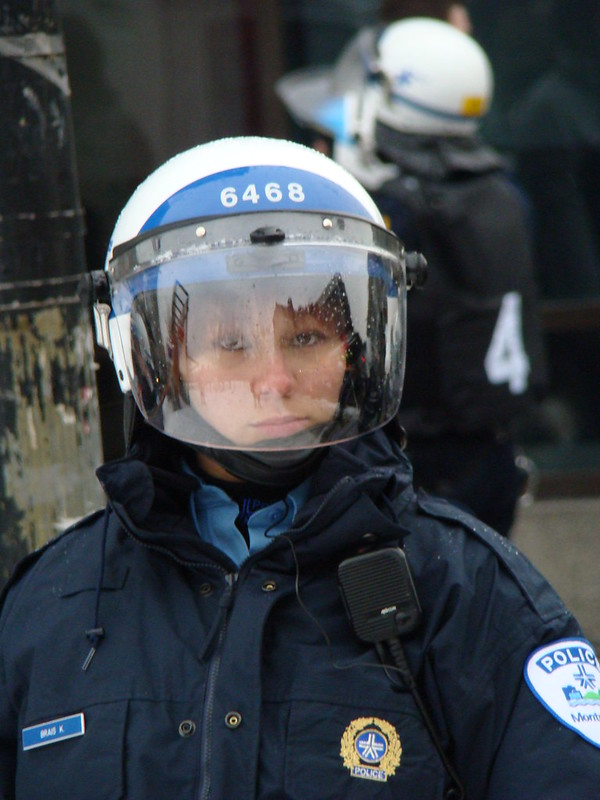
Photo courtesy of Flickr Commons and Yannick Gingras – Some Rights Reserved

Fires burning…

One wondered what would break the journalistic overkill on the Covid virus story. What could possibly interfere with that  endless diatribe of  stories?  The litany of accounts, after a few months were admittedly beginning to weaken slightly, as the practitioners of journalism began to pen items on how to wear a mask, the lack of yeast in the grocery stores, or the various coping skills of young and old when constrained in your individual hovels. The illogical and outright stupid began to blend with fragments of intelligent commentary but in the end it all became a stew of righteous and contradictory dialogues. The science on the virus was not clear then and it is not clear now. 

But fear sells and as such was the underlying theme running throughout the 24 hour news cycle—fear of dying— fear of others—fear of travel—fear of hugging—fear of having to wear masks which turned into fear of not wearing masks. 

The press finally tasting greater ratings after being in decline for the last number of years, fully gave over to the theory that the greater the pronouncement, the greater the fear generated, the more that people would be paying attention to those newscasts. They have always known that a multi-car crash always draws better than a two car fender bender, but this had the greatest potential—the ability to turn the daily infection numbers into a catastrophe of “never been seen before” dimensions.

Television news clearly told the banner producer on “Breaking news”, to just leave it running. Death was everywhere as if posing for the 5th Estate that pursued the glimmers of devestation .  The media became addicted. Pictures of bodies, pictures of people laying in the street, or pictures of gowned and masked fatigued hospital workers, sweat stains outlining their newly lined worried faces. 

In the early simpler days, the press always waited around for the picture or video of the body bagged victim, being rolled from the residence on a gurney. This virus was a new heaven to the throng of journalists who dutifully culled and edited videos from around the world, while sitting safely behind their laptops. Tents full of body bags or mass burial grounds were portrayed every night, over and over again, helping to keep the grim and ominous dark clouds hanging over the future. 

The media generated fear with single minded attention on a scale never seen before. The level of their deceit knew no bounds. Shallow unsubstantiated subjective reporting has now put the mainstream media in Canada in the category of grocery store tabloids. 

So as we entered the fourth month we braced for more covid stories while the death lottery numbers droned on. 

Then out of the blue, with head-snapping alacrity, that same intense media attention all swung south of the border. 

A new crisis was born and this new “crisis “contained all the elements of headline seeking editors and broadcasters; violence, crowds, tear gas, endless videos of police pushing the “innocent”, journalists being “targeted” with pepper bullets. A veritable smorgasbord of tweets, photos and videos were uploaded.  Unverified raw video, no background reporting, just a torrent of information from which to feed this new appetite for fear and consternation.  

Predictably, social media exploded, as did any pretence on the part of the Canadian media establishment of being “journalists”. Subjective, point of view, opinionated journalists have now replaced the old guard that had once prided themselves on being objective, who felt that they had a duty to report the news, not create the news. 

Damn the ethics and standards espoused for the last 100 years. Objective, fact checked and dual sourced reporting was now officially extinct. 

It has been replaced by the simple emphatic declaration stated and then presented as fact.  Black and white prognosis only, no longer room for the grey areas where most problems actually live. They have become accumulators of cellphone clips. Thirty seconds or stories of two hundred characters are now being encouraged, followed, repeated, and disseminated with alarming speed. The new short attention span generation, the selfie generation apparently needs to be satiated. 

Fear for your safety and those out of control police it has been decided now going to replace fear for your health. The death of a middle-aged black man has now been declared more dramatic than an eighty-four year old with “underlying” health’s issues. The fact that in Minneapolis that a man died at the hands of the police was the bonus, the fact that he was black was the ignitor to the combustible fuel of racism. The police were the obvious and easy targets.  

Thus, 21st century social outrage has once again been released. 

The Canadian media was not deterred in their presentations, even though it was hundreds of miles and a country away. They played the outrage at full volume and were then rewarded with Canadians now taking to the streets to protest racial inequality in the United States. Canada was pulled in by its proximity, and the internet pulled in the rest of the world. 

Videos began surfacing in Canada of various incidents throughout the country which the media now deemed as racist or intolerant. No details, no examination, just outright speculation and proclamations. 

The usual liberal fringe interest groups then began to emerge, excited by the prospect of a new fire to flame. The more vocal, outlandish, and hopefully photogenic, the more media attention they would receive. 

The Indigenous in Canada always willing to claim racism no matter the context, climb aboard the racist allegation train, a fresh spotlight pointed at them in which to air their complaints. There was no room or time for a counter narrative. Cameras immediately flashed to an Indigenous chief claiming assault at the hands of the police, which even in its subjective telling seemed dubious. A female is killed by police in Edmonston New Brunswick, which the media immediately imply is suspicious, hints of racism because she is “indigenous”.

Canadian media and much of the American media lives on the left of the political spectrum, so they spin victimization, and excoriate anyone with a counter view. They are thoroughly smitten by the  liberal democratic and “progressive” viewpoint. Everyone must comply with their viewpoint, to do otherwise is to pronounce you an “ist”…racist, chauvinist, misogynist— take your pick. 

Equally disturbing is that the new age politicians aren’t very far behind the media and what is “trending”.  They now always follow the herd. Where and when social media declares a story or video snippet to be of grave significance and it enjoys any kind of momentum, that is where you will now find the politicians. Politicos must be seen as on the leading edge, at the forefront of what is all good and righteous. As the Facebook or Instagram twirl begins to spin out of control a politician can not countenance disagreeing with the mob. Lead the mob, don’t be left behind or you court political insignificance or ostracization. 

So fully armed with a 30 second video clip as full and damning evidence they mount their pulpits; our Prime Minister and Opposition Leaders in full throat bemoaning the new “crisis”.  There is no time for debate or opposition. Trudeau is “deeply alarmed” over the incident involving the Indigenous Chief; Bill Blair comes out form behind the coat tails of Trudeau to chime in that “people across the country deserve answers” (on Twitter of course). The Indigenous Service Minister Marc Miller, on seeing only the initial report, despite any evidence “strongly condemned recent acts of violence by police against Indigenous people.” “I’m pissed, I’m outraged” said this Minister of the Crown using clearly his best Parliamentary language and putting his ignorance on full display.  

Is there anything wrong with this new age of media? Is there anything wrong with this semi-spontaneous “outrage”? The President of the United States is a great player of this game. Is there anything wrong with him standing in front of the White house with his bible, posing for his alt-right followers? Of course. Is there anything wrong with our Prime Minister, on the other side of the political spectrum, dressed in his current costume of long hair and a mask, kneeling amongst those protesting police brutality and systemic racism? Of course. These two individuals are very similar in their hypocrisy and deceit,  just opposite ends of the political stick. 

 It is this disturbing dumbing down of the facts that is the most concerning.  It is sapping intelligence and the need to think. It is crowd think. It is follow the herd and it is also fleeting. The need to react and deal with an issue and explore possible options to resolution is lost as quickly as it developed. The herd always moves on. 

Social media is spontaneous and therefore often leaderless. Its only mantra is that “everyone’s voice matters”, no matter how misinformed or irresolute that voice may be. Slogans and jingos are passing as possible policy. Apparently they want the disassembling of the Minneapolis police department, they just don’t know why or how to do it.

Make no mistake about it there is racism in all parts of the world, including our world. There is no denying of that fact. There are also bad cops, sometimes really bad cops. Why? Because they are human beings. There should be no tolerance for those that breach, but there must be a fair and just investigation as well. Derek Chauvin, the Minneapolis police officer who kneeled on the neck of George Floyd will face a trial. The other three officers, standing idly by were also charged. All the evidence will surface at the trial. 

But, George Floyd as a symbol of systemic racism?  A former convict with several convictions; high on fentanyl, and methamphetamine, and found with a baggie of powder at the time of the arrest. His most serious conviction involved him and others doing a home invasion, where he put a gun to the belly of a pregnant woman to force compliance. Is this who should be held up as the next Reverend King? 

A black conservative commentator Candace Owens recently brought up some interesting statistics. A police officer has an 18 1/2 times more chance of being killed by a black man in the United States, than a black man has of being killed by the police. She calls these protests and the black lives matter movement as “smoke and mirrors” in that the statistics simply don’t back up claims of systemic racism by the police. You may not agree with her, but you at least need to be allowed to hear her. The burning books mentality once confined to the right are now coming from the left.

We are truly in very unsettled times. Not because of covid, or riots, but because of the perilous road chosen by the media of this country and the dissolution of debate and learned thought. The media are fomenting fear and dissent in pursuit of remaining part of a social media fabric that now rules this 21st century. The politicians now govern and are being placed in power by implementing the tools of that same social media trade. 

Trump and Trudeau despite their political differences are now holding hands as they skip down this road to that dark spot where image has replaced substance. What it looks like much more important than what it is. 

And if you happen to be a police officer in these times, do not hope for any support from these same politicians, or your superiors, who are now poised to jump on this media driven bandwagon if given any opportunity. Their continued political and managerial existence depends on burning you at the stake.

In the last 48 hours police officers are being charged with new found efficiency,  Chief Saunders, the first black Toronto PD Chief, is running for the exit, and the National Police Federation and RCMP Commissioner Ms Lucki are in hiding. 

You are now officially on your own.

The Pay Raise Gamble

Police officers and their managers have always had a comfy, cocoon like existence —somewhat removed from the economic up and down and cycles of the “real” world. Profit, loss and the measurement of productivity is an anathema to the world of policing.

They have often been able to “social distance” itself from the the pettiness and give and take of pesty budget concerns. “Cutbacks” during the last few decades, and especially in the RCMP has never really been in the policing lexicon.

To be sure there were years where in the “police universe” the Mounties received the short end of the stick, falling behind some of the bigger municipalities, at least for short periods of time. In the end, the Mounties were almost always dragged up the wage ladder by the other unionized forces across Canada. 

There was a time when the Federal government “froze” the wages of government workers, but that time is lost to the institutional memory of this group of officers. But for the most part, time was always on their side and the Mounties were able to live off the others. Their “universe” was a close orbit, made up of only other police agencies. When given to complain, the RCMP officers were only forced to an easy comparison. Any higher wage was justified by pointing to those other cops on the other side of the street. If they got a raise, you got a raise.

Quite naturally, there was no comparison to the economic worlds around them—those who were paying the freight. To be fair, the lack of caring or understanding of the general population mood is a characteristic of all government. Mounties policing in small towns were unfazed and unconcerned about the local budgets in terms of wages and salaries, their vision solely focused on the universal wage for police that was being determined in Ottawa. There was a constant and repetitious cry for new officers whenever a a detachment commander appeared before city counsel and never would it be couched in terms of concern for an overall budget. 

This all may be about to change.

Bankruptcy is now facing various governments on all three levels. The blame for these financial circumstances which have been thrust upon them, points directly at the “fight” against the “virus”.

Albeit, these same governments have cheered on the Federal government and their daily largesse. Every level of politician during this time had only one concern when pressed and that was to keep the electorate consoled. Only the truly brave offered up any question as to the need to be fiscally responsible.

So as the CERB cheques and business loans were shotgunned out to those in need, the deficit balloon rose to unrecognizable levels. The fiscal hammer above the political heads across the country got raised up further every day. And as gravity tells us, that hammer will eventually come down. The economic light will be shining very brightly on the unbridled spending in the next few months, and the glow from the economic fallout may be lasting for many years. 

Even before the “virus”, this blogger wrote several months ago, about the revelation that the Ontario government and various Ontario municipalities were trying to come to grips with budget shortfall issues and in particular with the growth of police budgets. The “ratcheting” of police and fire budgets was finally reaching levels where they began to get noticed. 

Defending the spending, fell to the age old axiom of the need for “public safety”. This tired and repetitious explication is now being seriously questioned for the first time in many years.

A number of police departments have three year Constable pay levels which have breached that psychological barrier of $100,000 and Police and fire services continue to grow at levels beyond the reach of the general population where salaries have stagnated for the last number of years. Police and fire budgets as a portion of municipal and provincial budgets is now the elephant in the hearing room.  

Tremors of anxiety are beginning to vibrate through the policing world as the word “cutback” is seeping in, gradually, but now discussed as an imaginable option.

This nervousness and angst finally touched down in the lotus land capital of Vancouver. This is happening in a city where government decidedly leans to the left and spends money on the services of the downtown Eastside like drunken sailors on shore leave. Although, it should not be totally surprising or unexpected when this is the same government which views whale-watching and the dispensing of cannabis edibles as suitable economic replacements for lumber or the building of gas pipelines. 

That aside, the City of Vancouver now finds itself facing a $152 million shortfall (Surrey is facing a $42 million shortfall as a comparison). The loss of jobs and shuttered businesses drying up revenues. Many argue that the full economic destruction has yet to be felt in this City of the Dispossessed.  

The other cognizant point which needs to be included in this discussion– the City of Vancouver has a legally dictated obligation to balance the budget. 

Canada’s third largest city has an overall budget of $1.6 billion. The Vancouver City Police now make up 21% of that overall budget with an annual expenditure of $340.4 million. And the greatest portion of the Vancouver city police budget is for salaries. 

To meet this $150 million shortfall the City of Vancouver has already proposed a very substantial increase of 8.2% in property taxes.

During this time they had also written to the Vancouver City police board to ask that they come up with proposals for  possible budget cuts. That was on April 14, 2020. OnApril 27th, the Police Board responded but didn’t offer any spending cuts. So City counsel imposed a 1% pay cut in the police budget, which amounted to a $3.5 million cut out of the $340 million pie for the remainder of 2020. 

They also directed, maybe more significantly, that the Vancouver Police Board in their pursuit of collective agreements with all of the three involved unions at the Police Department— that there will be  a stipulated 0% increase in 2020.  

Now, it would seem to most observers’ and probably the taxpayers of Vancouver that the proposed cuts and their proportion to the overall budget are in fact quite reasonable under these financial circumstances. But predictably, Chief Adam Palmer felt that the cuts were disastrous and went to the media with his complaint. 

What did he offer up as his major concern? 

Well “public safety” of course.

“Public safety”according to Chief Palmer was now once again in jeopardy due in part to the increase in “anti Asian racism complaints” that the Vancouver City Police were needing to now handle in the age of the virus. 

Well, it least it shows some politically correct astute thinking on behalf of the Chief, but no one is going to believe that the few cases  or a rise in commercial break-ins which have emerged have pushed this City department to the precipice. 

He also argued that City counsel did this without further conferences with him; he did not mention that he had been given opportunities to get involved in the cutbacks— but maybe being in that police cocoon may have thwarted his belief that someone would dare to cut his employees. (It should be pointed out that the Fire Department, which is always aware of its political surroundings, voluntarily made their own cutbacks.)

The Vancouver City Police union predictably also chimed in. They said that with the cutbacks and the disintegrating morale, many officers may choose to leave for the upcoming new police force in Surrey. The fact that Vancouver City could lose a number of officers to the proposed new Force is a bit of a red herring, as it is already being planned in the VPD that even outside of any budget complaints– they are going to lose a number of officers to Surrey. 

Some sources tell me that the management of the VPD are planning on the possibility that they could lose up to 200 officers to the new agency.

The ripple effect of this Surrey agency is also going to impact dramatically with the Cities of West Vancouver, Delta, and New Westminster PD’s, but that is for another blog.  

So where does this place the new union of the RCMP as they start building their case with Treasury Board for a 17% pay increase nationally. They are normally not encumbered by any sense of fiscal fallout, but along comes the damned Corona virus. The monkey wrench has now clearly been thrown into the cozy often egocentric policing world. 

It is one thing for the Federal government to feel that the Mounties need or should get a pay raise. Clearly the Liberal government is in a spending mood, so maybe Mr Trudeau will extend his daily giveaways. A 17% increase seems like a stretch at the best of times but under these depression/recession times it may be a little much to swallow all in one gulp for any government. 

But the biggest flaw in this large increase is not the willingness of the Federal government, it is that almost all of the raise would be simply pushed on to the municipalities and Provinces. At most the Feds would only have to pay 30% of that raise for those involved in contract policing. The rest, up to 90% in the case of Burnaby, or Coquitlam, has to be paid by the municipalities. As the municipal agencies are already crying to the Federal government for further financial support because of the virus burden, they would be incensed to have another huge expenditure thrust on them. 

So this leaves the Feds in a rather difficult and untenable position. Nor is it an easy one for the new leadership of the Mountie union. Now no longer needing to prostrate themselves before Treasury Board, but now facing some extraordinary budget considerations.

In terms of the policing structure in the Lower Mainland, and in the rural Provincial contracts, managers may be looking over the precipice of a significant re-structuring of the policing dynamics throughout this country. It’s possible that the virus will also be the catalyst that will re-awaken talks of Provincial forces, a Federal government RCMP/FBI, and regional police forces. 

 It could also mean– dare it be said,  “cutbacks”. 

For the younger RCMP officers, just like their Vancouver counterparts, their future may be the new Surrey PD, the same group recently lampooned by the Mountie union.

The next 12 months will be telling. The Mounties will build their case, no doubt continually underlining their current standing in the police universe and equally predictable, will be arguing “public safety”; striving for that instant 17% increase.

But, if you were gambling on the bet of a substantial RCMP raise, an odds maker may be telling you to now to “take the under”.

Photo Courtesy of Eric Flexyourhead via Flickr Commons – Some Rights Reserved

The NPF- Plunging into Surrey politics

Now that we all have been satiated, assured by Toyota, Ikea, and the Muffler shop, and of course the beloved Bonny Henry, that they are all here for us during these trying times, maybe it is time to talk about something else as we head or get driven to a utopian “new normal”.  

Recently, Brian Sauve the President and leader of the newly formed National Police Federation, which represents those in the red scarlet, managed to divert the news briefly and our attention with his pro-active coming out stance in arguing for the retention of the RCMP in Surrey.

In the last number of days in fact Mr. Sauve has been doing the full rock and roll circuit; visiting the CBC, the Province newspaper, CTV news, and running three full page ads in Surrey’s local newspaper extolling both the virtues of the RCMP and stating as the gospel truth –that the citizens of Surrey want to retain the RCMP. 

So naturally interest was piqued. Puzzling somewhat, that at this late juncture, Mr. Sauve who barely has his feet wet in his new role has apparently decided, one would assume along with his senior managers to jump with both feet into the Surrey and Provincial political arena.

It should be said that Police unions have the right to be political, but this particular set of circumstances in Surrey seems curious on a few levels. Police enjoy discretionary powers in this country and are formally required to be non-political, so a union representing those police are in a rather unique position requiring balance and forethought.

Clearly the NPF and its 20,000 strong membership are concerned about losing Canada’s biggest RCMP detachment to another union. Nobody wants to lose 850 members (about 4% of their union) before they even get started. But, according to the NPF web site there is a deeper reason for their stance: “This is about your national labour relations agency standing up for the exceptional work of all our members across Canada and internationally.”

Does the RCMP and the NPF feel chastened? Is it possible that they have missed the broader issues or more accurately the issues which have been raised by Surrey and have chosen to ignore the specifics, and just feel insulted?

Mr. Sauve seems to be conflating a local political issue with the reputation of the entire RCMP throughout Canada. He does not seem to understand that this a big city issue where the RCMP is being questioned and has been for a number of years, on its effectiveness vis a vis another more locally controlled city department. This should not be viewed as a personal affront to the membership of the RCMP.  Surrey is primarily seeking a change in structure, to no longer report to the three headed monster of Ottawa; to convert to an agency which may be more fitting to a municipal sized police force.

Mr. Sauve, more than most, should be aware of the issues within the RCMP which have been plaguing them for the last number of years, yet he feels the need to argue that they are the best solution under these circumstances? His argument if stretched out is that a unionized RCMP would be better than an independent municipal, also unionized force. 

Three of the four main players of the NPF: President Sauve, Vice-President Dennis Miller and VP Michelle Boutin all were part of the SRR program. There they would have argued for and defended members against the arbitrary and pernicious management of the RCMP.  

The fourth VP, Pete Merrifield evven stands out a bit from the others. If there was anyone who may be a little jaundiced with the RCMP and maybe even hold a tinge of bitterness towards them it should be Merrifield. Pete Merrifield during a 7 year stint, sued the Force for harassment after he had become involved with the Conservative Party of Ontario. 

In February 2017 a Superior Court ruled in Mr. Merrifield’s favour awarding him $141,000 for the “unrelenting harassment” he suffered and an additional $825,000 to cover his legal expenses. This was no small victory, but unfortunately for him it was short lived. 

The Appellate Court rejected the lower court. In fact they went even further stating that Merrifield had not been “completely truthful” with his superiors and had given them reason to “mistrust” him. 

Recently, the Supreme Court of Canada refused to hear Mr. Merrifield’s appeal to the highest court. 

All four of these individuals in the last number of years, clearly reached a point in their beliefs that the massive problems within the RCMP and its system could not be corrected without independent representation. A union was desperately needed they would have argued. 

Is it not fanciful that this same group of individuals is now arguing that this same flawed RCMP management is now better than another agency regardless of its makeup?

Is it possible that after a lifelong career in the RCMP these individuals who were “members” of the RCMP can not separate their apparent comfort and loyalty to the RCMP from their new roles as advocates for their membership.

However, my biggest concern in that this new union group has gone a step further than a policy decision to defend the RCMP in Surrey; but in order to defend it vigorously they went and paid for a slanted “survey” –to argue and prove their point and have been holding it up as their evidence throughout their media campaign.  

The survey was conducted by Pollara Strategic Insights .

If one was conducting a survey to determine the wishes of the general population with regard to police force of choice, wouldn’t the obvious and clear question that should be posited would be: Do you prefer retaining the RCMP over forming a new police agency?

But clearly the NPF requisitioned this survey because they wanted to make sure it backed up their political argument. A straightforward and clear question may have resulted in statistics that may have not fit in as easily with the political argument that they wished to launch.

So they made sure that the question was couched in terms that would prove more favourable.  

The survey asked whether in these times of the virus and municipal funds taking a beating, whether the taxpayers of Surrey should be spending additional monies on a separate police agency.  The weighted survey question, which was randomly sent out to 803 people asked: 

“With the CoVid virus causing a major disruption” is now the time to “replace the Mounties?” 

This was after the city of Surrey revealed that due to the virus and the shutdown, Surrey counsel would be running a $42million budget shortfall.

This style and question format linked the budget deficit and the fear of the coronavirus to convince the polled that this was not the “time” for a change. They then took the favourable responses, translated, and interpreted these results to say that 77% support keeping the RCMP and 82% support a referendum. 

The clearly planted headline in the Surrey Now-Leader said:  “New Poll Indicates 83 per cent of Surreyites say now not the time to replace the RCMP.”  And they argued that 90% of the respondents agree that it is time to take a “step back and evaluate its spending plans to ensure that they are focused on the most urgent priorities”.  

This is spin, and spin which has been done in such a fashion as to be disingenuous if not duplitcious.  

So what should we take from all this? The NPF in its infancy as a union —elections only recently conducted for detachment representatives this month —has decided to enter the political arena, to fight the duly elected and mandated government. This despite that the political  mandate of the Mayor in Surrey was very clear during the last election and was totally tied the wanting of a new police force. 

Sauve is now publicly saying that the Mayor should have another new referendum on the same issue and vigorously points to the “new survey” as evidence of the wishes of the Surrey residents, bought and paid for by the RCMP union membership. 

The illustrious Surrey councillor Linda Annis has been coaxing the NPF in promoting both the survey and the need for a referendum.  Annis is that Surrey counsellor who has long been in a political fight with MacCallum and who has been pushed from her corridor of power since the last election. 

Annis, despite being always commenting or extolling the virtues of the RCMP in her fight with MacCallum has this blogger’s vote as probably the most ill-informed politician in this debate. Her arguments for the retention of the RCMP border on ludicrous in her effort to get back to power. For example, when asked why it wasn’t possible that some members of the Surrey RCMP may choose to go to the new agency, she felt that was not possible— because when they became police officers —they choose the RCMP.  Who could argue with that logic? Apparently she had never heard of officers changing agencies.

On a recent talk show on CKNW, emboldened by the interviewer Sauve argued that the Mounties were doing “a great job”, “despite the fact that Surrey has under-funded the RCMP for years”.  He repeated a few times that the RCMP was doing a “wonderful job” in Surrey and pointed to the  evidence that the crime rate has been falling in Surrey for the last fourteen years. This is a trend throughout Canada and not just Surrey but why quibble with details.

He was asked about the need for more officers on the street to fight the gang violence. He pointed to the amazing job the RCMP Youth group was doing in fighting the gang problem.

He grasped further by saying that if the community wanted more cops on the street, then maybe they should be discussing increasing funding to the RCMP. So Mr Sauve, had up to this time, structured his argument to retain the RCMP with the need to save money.  But if the voters were not satisfied then one of his solutions was to spend more money on the RCMP if they wanted more officers on the street.

This back and forth countering logic is a little disconcerting and shows a very shallow understanding of the issues in Surrey. 

So we end up back at the question. Is the NPF loyalty to the RCMP pushing this drive? Is their argument that no one is better than the Mounties in any circumstance? This despite having been dealing with the vagaries of the RCMP management for years; sexual harassment, claims in the hundreds of millions of dollars, still this group feels that their unionized environment within the RCMP will be better then the unionized environment in a new fresh Municipal Force. 

As their primary function is to represent their membership, do they realize that a lot of Mounties currently in Surrey may switch to a new agency and it may be in their best interest to do so.  

Maybe this is an overreaction. Maybe some officers feel better that the NPF is defending them as the Force has been going through many years of criticism. But they are late to the game, since its possible that the newly approved Surrey Police Force could be in effect as early as April 2021, less than a year away. 

As a new union, the early days are crucial, as they try to build a credible and strong representative group.  They have many diverse issues in front of them, all of which will demand their utmost attention. Their membership will become increasingly more demanding as the union begins to form and get involved in the various facets of police personnel administration. This will be nothing like the SRR program. They will need to exude the utmost professionalism because now there will be exposure and accountability. 

This is not the time to get into a fight with a duly elected and mandated government and now is not the time to demand something which is outside their purview or control. Now, was not the time to put up a slanted survey, or to gather behind the likes of Linda Annis. 

In the future, any political arguments will need to become a little more sophisticated. The NPF will need to be smarter. This is new world for everyone. The new RCMP membership is now paying for you —and they are watching.

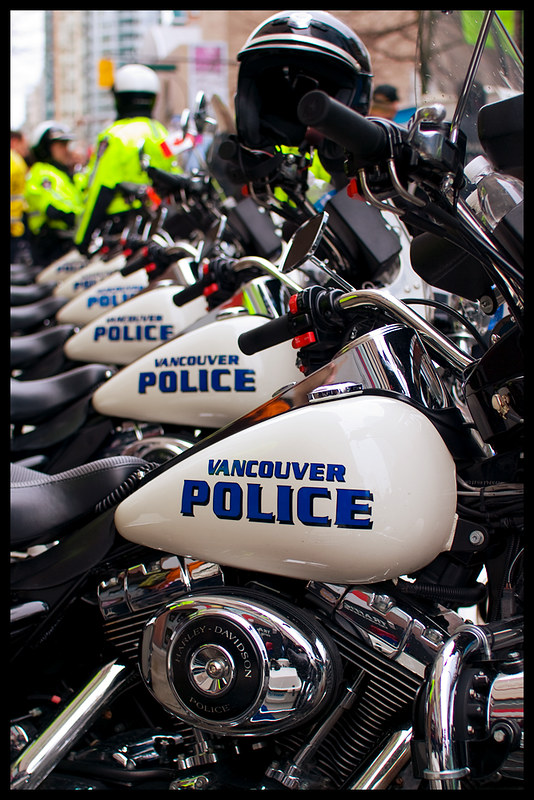
Photo courtesy of Ewe Neon via Flickr Commons — Some rights reserved

To Heidi….

Once again, circumstances of the last number of days overwhelm our senses.  One struggles to piece together some rational thought when given such an illogical set of circumstances like those that occurred in rural Nova Scotia.

It is now clear that a single domestic abuse moment sparked in the mind of a seemingly, innocuous middle class denturist. It then ignited, and unleashed a firestorm of uncontrollable deep-seated rage. In an apparent need to destroy as well as wipe out the physical memories of his life, this disturbed male  needed to kill and burn. He needed to satiate this hunger on a byzantine trail of mayhem, a night of twisted terror, inhumane death, and hellish flames. Twenty-two people in six different communities stood in his way. 

The killing and the psychological need for destruction is not unusual, but the level of ferocity, the cold bloodedness and the instantaneous blossoming of the inner rage has rarely been seen before, at least in Canada. 

Even writing about these events it still somehow seems un-savoury and maybe premature, so it is with some reluctance that we even make some comment.

I am not going to join the chorus of former cops or “experts” who have apparently been seduced by the media to comment, seduced by the possibility of 15 seconds of fame. The audacity to think that they can offer some insight into a set of events without any knowledge of the circumstances continues to both amaze and distress me. 

Nor am I going to comment on the topic of the lack of an “Amber alert.” Each check of a residence turned up another body, another burned house, people lying in the street deformed by gun violence, their positions in death miming their last moments on earth. The officers personal survival, their minds struggling to make sense of the visual overload, would cause them to focus on the immediacy of it all. Their peripheral vision challenged.

An alert, at least initially, was likely far from the top of their minds.

To learn that it was later the next day when management, who needed to authorize such an alert, had to be prompted by the government and then that same management spent some time on the “wording”, is sadly unsurprising in this new age. Would it have saved lives, one will never know. Possibly, but it seems un- likely. 

My personal thoughts under these circumstances instead wander to how many random intersecting lives and circumstances all had to come together, and that they did so with such devastation.  A gathering of unrelated groups and their personal timelines; cops, civilians driving or walking down the street, a girlfriend tied to a chair, others huddled in their houses. A retired firefighter, two correction officers, a teacher, a 17 year old violin player and her mom and dad all united and forced into a human drama –by a cop loving or hating middle aged male who made a living by making dentures. 

 I safely sit thousands of kilometres away, on the other side of the country, in a peaceful spot on a lake, but drawn to an affinity to people I do not know and will likely never meet. The difficulty is that I can picture Constable Heidi Stevenson as if she was standing beside me; I can hear her voice, see her laugh. All cops know a Heidi.

I started my career in rural New Brunswick, in the Miramichi. It was much like rural Maritime Nova Scotia, my Portapique could have been the small fishing village of Baie Ste. Anne; Loggieville New Brunswick, your Wentworth Nova Scotia. Our night patrols like theirs covered a large swath of small often disparate villages, wrapped in endless forests or farmers fields. Often at night, we would be policing with two or three vehicles covering a vast geographic area of responsibility.

Rural policing is not the same as city or municipal policing. They are distinct entities that offer different perspectives and experience. Of course, there is crime everywhere, but in rural Canada it comes at a different pace, it is in a different rhythm. Domestic violence, impaired driving calls, and traffic accidents dominate in these often  placid and bucolic villages. Crime when it happens still is talked about, pedestrians still stop and watch as an ambulance or fire truck goes by–crime is still largely an abnormality.

If you are a police officer in these rural areas in a relatively short time, you are able to identify the problems; the individuals who are always driving drunk, the ones who are always abusing their spouses. People lose lives in hunting accidents and traffic accidents, not normally in drive-by shootings. In the rural areas you believe you know where the problem is, in the city you have no idea where danger could lurk. There are too many people, too many nameless faces. In the city you are more on edge.   

In rural Maritimes the calls are often intermittent, unlike the scroll of complaints in the city—often endless hours go by without a call. Mindless hours are common, often spent driving down seemingly endless roads, street lighting spare and halting. Continual meetings with fellow officers in the wee hours, sitting car to car, stifling yawns and talking about other things. 

Of course At 10:26 pm that changed for these H Division officers. The intersecting life lines, the fate of circumstances were about to take on a pathological tenor. Could they have predicted it? No. Could they have prevented it? No. Could they have reacted differently? Maybe, but also not likely. 

There will be questions and arm chair quarterbacks second guessing for weeks and months to come.

The Commissioner of the RCMP will implore all to seek mental help and consolation, sending out reams of material of being “there” for the members to support them in their grief and any future fears.

There will be some voices imploring for better training, for better gun laws, for a re-jigging of authorizations for Amber alerts. Psychologists and sociologists will examine the women hating characteristic which is being found as a commonality in similar situations. A group of feminists are already arguing for a full inquiry to demonstrate that misoginy was central to the eruption of violence.  

The RCMP investigation will concentrate on the weapons and how he obtained them, how he got a police uniform, or how he managed to deck out the Ford Taurus. They will promise to “review” what they could have done better. 

The SIRT group will examine the police exchanges with the suspect. They will find the shooting justified. How could they not? The SIRT group will also examine the rather bizarre shooting at the Onslow Fire Department which seems to be headed to an embarrassing finding.  

Were there any parallels to the Moncton police shooting? The only similarity may be the unpredictability of the event followed by the chaos.  

It’s possible that all this future introspection and pontificating will lead to some good. My guess is that none of it will really change anything. 

Why? Because these are events that defy definition and solution. You will always have limited resources in the small towns, you will always revert to being human in times of unbridled stress. You always react viscerally in these types of confrontations.

Some training would have kicked in, some muscle memory may be in evidence, but these are bare and raw human experiences which but for the grace of some possible higher authority few people will ever have to confront. Everyone reacts differently, their ingrained tools are what comes to the fore. 

The ability to react, the ability to see through the swamped senses, to keep your head when confronted with the unexpected is what separates policing from other first responders. A firefighter or a paramedic drive towards the known, any hint of danger allows them to fall back. No one believes them to be the enemy.

In policing, one is always driving into the unknown. In policing there is the consistent chance that you are being hunted, that you are the ultimate enemy.

I have no idea how these officers reacted or individually dealt with the unfathomable, but I am certain that they dealt with it as  best they could and individually did what was humanly possible. 

In the meantime, the aftermath to these events is predictable.

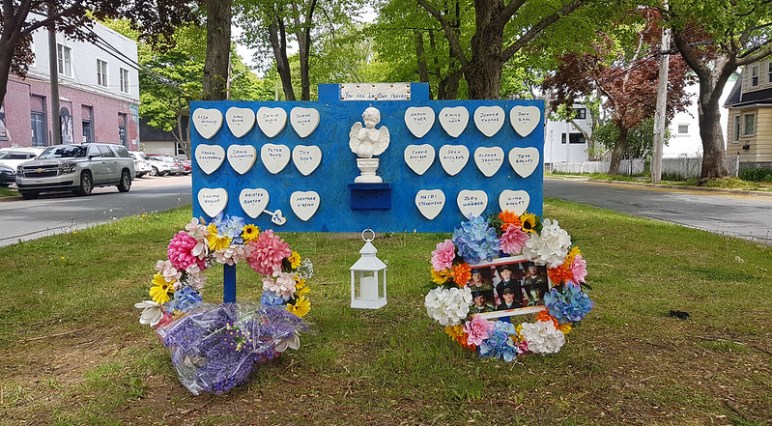
Empathy and prayers will inundate the Stevenson family, from around the country and the world. Locally, meals will be delivered, neighbours will share a bond of unmentionable grief; flowers will spray intersections and fence lines for all of those who lost their lives over those many kilometres of sadness. 

The media will take every opportunity to intone “community” grief and constantly push the rhetoric over the lack of an Amber alert. They will push and cajole all of those that they connect with to come on and broadcast their feelings of grief to a national audience. If you can cry on camera the better the footage.

I am just as certain that Gabriel Wortman deserved to die. No matter his eventual diagnosed torment and the uncontrollable demons that devoured him.

I disagree with the Prime Minister and the CBC— everyone should know his name–at least every police officer should remember his name.

But, what will last for me, what will stay with me indefinitely is that on that day– Constable Heidi Stevenson ran towards the fire.  

She did not know she was heading into a pit of madness, she did not know that she would be making the ultimate and unthinkable sacrifice. 

Your brothers and sisters now stand in solemn silence and salute you.

You were a cop.

Photo courtesy of Flickr Commons by Jan Kalab…Some Rights Reserved

Moments in Time

“May you live in interesting times”, it is both a blessing and a curse according to the Mandarin Chinese. The intended implication was that life is better when “uninteresting”. That seems apropos in this age of this latest virus, everyone now hoping for a return to some level of normalcy.   

As a former police officer of a little over three decades, I have now reached a stage where one seems to be spend an inordinate amount of time in introspection. And as one navel gazes, there is a realization that in this quick changing world, you are more than likely to live through some “interesting times” regardless of what decades you examine.  If one is fortunate to lead a sustained career, there actually may be more than a few moments where you will pine for the dull and the routine. 

 Each and every generation will have points of reference, points of time where the ordinary became the extraordinary. My run was during the late 1970’s into 2011. Of course, everyone marvels at the speed of the passage of time, a year easily blending and blurring into other years. Significant moments are easily recalled and many are common to all of us who went down this career path. Arriving at a new detachment, being in a high speed pursuit, or walking into a robbery in progress. In particular vicious and violent cases seem always to be in a special memory file. The very nature of “police“work means that “our” moments are intrinsically more dramatic and often outside the purview of the general public. Our thoughts and moments were often shielded behind “the blue wall”. The vagaries of the mind let us remember oddities such as file numbers, or peoples names, often because of the oddest of circumstances. 

Then there are those moments that change us. They are often unpredictable. Those pieces of time where events collide, where up seems like down, where right can not be told from wrong. Where pre-held opinions and beliefs get questioned, striking and shaking you at your core. It is during these moments that one almost always seems find themselves questionning the basic tenets of life. 

The generation that succeeded me, the ones now driving the streets and dusty rural roadways are in one of those moments today. The virus of 2020 will mark their personal journey through policing. In later years and beyond, they will be the greying veterans telling stories over bad coffee at a disinterested coffee shop.  Sombre stories often interwoven with dark laughter. 

For my generation, we remember mortgage interest rates in the teens, seeing our fellow officers turning over their keys to the family home to the uncaring faceless bank, unable to meet that payment on the three bedroom 1500 square foot bungalow. There were no tears outside the house, just a grim smile at the troubled economic times, after all you were not the only one. In 2008 the economic crisis would visit once again. 

But there was a very dramatic moment which was to come to us on September 11, 2001. Our world caved, turned wrong way up, the enemy was everywhere. 

As a child I had remembered when John F. Kennedy, Martin Luther King, and Robert Kennedy were all assassinated in seemingly quick succession. Those deaths played heavily on those small, often black and white 20” screens, but we were children and we rapidly moved on. It was a story in a different country, near but far away to a child.  We were moved but we didn’t know why really.  

But September 11 happened while I was working as a police officer. It was a moment for my generation. 

On that day, I was driving to work in the usual way, coffee in hand, driving Hwy 1 in those early hours, prepared for a full day which was to involve executing a warrant on a house in Surrey which the local press had come to call “The house of Horrors”.  Arrangements had already been made for a command vehicle to be present, and ground radar was going to be brought into the backyard of the now empty, dilapidated crack house. Our investigation had led us to believe that this house had been the scene of multiple assaults and murders and it was rumoured that bodies were buried in the backyard. We were going to try and find them. It was a clear and sunny Tuesday morning.  A dark task lay ahead in the brilliant sunshine. 

A friend called while I was still enroute, their voice was quavering slightly, in a way that you know something is wrong. They told me to stop over before getting to work and began telling me I had to come see what was going on—a plane had hit the World Trade Centre in New York. A second one followed shortly thereafter as I sat on the friend’s couch transfixed. My world completely changed in a matter of minutes. Images of people covered in grey ash running from the centre of the carnage. The second plane confirmed the enormity of what we were witnessing. Two thousand and nine hundred and seventy-seven people would die that day, and over twenty-five thousand would be injured.

After watching for a few minutes though, the policing tasks for the day were still in front of me. I had to move on, work was calling, the warrant needed to be executed. So as I completed the drive to the site, my thoughts were frenetic, bouncing around from the job at hand to a world on the precipice. The a.m. Radio was acting as background, the announcers seemingly more alarmed as the weight of the “moment” began to be fully realized. 

 I continued to watch what was transpiring, on the small television from inside the motorhome “command centre” now parked in the driveway of the Whalley residence. It truly was “breaking news”. They were now diverting flights to Gander. 

Of course, the work did go on, and as we came and went from the motorhome, hurried glances at the ever-playing drama of the news, replaying sequence after sequence of the horror of planes hitting the inanimate object which had become the symbol of New York. A call part way through our day informed me that the command centre had to be re-deployed to Vancouver airport for use with processing the grounded aircraft from around the world. 

By three in the afternoon, I found myself alone, the job complete, as I sat on the curb finishing my notes. An eerie silence surrounded me. The people and usual activities of that rough and tumble neighbourhood in East Whalley, the normally busy drug chaotic humans, usually interspersed with screeching cars, horns, distant curses, homeless pushing grocery carts, all now seemingly frozen in time. 

Our generation of police officers had been through HIV in the 1980’s, and we were still destined to go through SARS in 2003, and the H1N1 in 2010. But 9/11 was different in scope, it was intentional, and we needed our government leaders to remain calm and clear in their thinking.  We trusted that they would make the right call. 

The individual stories of our generation live on. Those times of being threatened by HIV blood filled needles now being used as weapons, of terror related files now being more than an abstract. If the Air India bombing in 1985 did not bring terrorism home, this event seemed to. An abandoned knapsack in an airport would take on new meaning for the rest of our lives.

Ours was a generation marked by heavy drinking, sky-rocketing divorce, rollicking office affairs and parties. It was acceptable, a rite of passage, part of being one of the group. Not always admirable to be sure, but there was a sense of camaraderie brought about by hardship and often personal stupidity. There was no such thing or more accurately did not recognize someone suffering from depression, suffering from PTSD; no police officer being charged with assault. There was no group of non- officers questioning and second guessing every decision which had been taken in a micro-second. There were no cellphones recording your every move, there was no Twitter or Facebook in those early chapters of our generation. No one really wanted our jobs at the time. Salaries were solidly lower middle class. 

This current generation will have your stories too. You will be threatened by those claiming to have the virus in futile attempts to avoid going to jail or being handcuffed. Stories will abound of toilet paper filled houses. The clinically depressed calls for help and the domestic disputes will grow in numbers and swarm the dispatch centre. There will be anguish and concern over returning to your families after a day or a night of dealing with the 8% of society that are your “clients”. Ridiculous edicts will come down from your superiors about social distancing and being safe while doing your job—impossible to enforce or comply. 

You will be somewhat alone in your tasks. 

The parades will continue for the medical staff, gowned and masked as they enter their wards, as will the paramedics who wheel the stretchers. Some firefighters have even chosen to opt out of “medical“calls now. But you will march on. 

You will not likely be protected in the same way or have the ability to refuse attending a call. You will live “herd” immunity. You will continue to deal with the dispossessed, the downtrodden, the ignorant and the violent. You will hopefully keep a clear head; hopefully you will not succumb to the depression of incessant threats and you will be continually surprised by the ignorance of many of the general public. 

You will carry on, because there is no other way. You have no choice. Of course you will take precautions when you are able, but that will not always be the case. You will have some fellow officers who will find excuses not to be coming to work, some legitimate, some not so legitimate. You will have officer friends, in different jobs, who sit at home throughout this time, laptops at the ready, answering emails. Even they may not understand. 

Your group remaining on the 12 hour shift, will likely be under staffed, often tired, not really seeing the point of writing up that break and enter report. You will be spraying and cleansing your hands until raw. But there will be comfort in being in your group, you will laugh and point to the often ridiculous, helping to relieve the numbing reality. You will try and not touch your face, but at 3 in the morning, when fatigue begins to settle, that may be overlooked. 

Like all moments, it too will come to an eventual end. Sometime in the future, you will be looking back, proud of your singular efforts when the rest of the world seemed out of control and was not making much sense. Proud of being out there, when all the rest huddled inside. 

You may not get a parade, but inhale deeply and take it all in, as this is your moment.  

Photo courtesy of Raymond Wambsgan via Flickr Commons – Some Rights Reserved

Tom Hanks has the flu!

Let me apologize for this blog from the start. I resisted, I tried, I really did, and I fretted about being lumped in with the cacophony of 24 hour looped newscasts and radio programming–  pontificating, lecturing, and speculating on what the World Health Organization  originally called a “containable” virus. 

However, there are a few aspects of this virus and the efforts to contain it which seems particularly troubling, maybe even frightening and needing comment. These worries have very little to do with the actual treatment of the virus itself. 

First and foremost is the cynical and hypocritical political elements tainting this pandemic. Layers of policy and regulation, confusion spread day after day, by multiple levels of government, all vying to give the impression of knowing and assuring us of their being in control.

Maybe even more troubling is that Canadians seem willing to suspend their beliefs, their rights and even their democratic system of government—without question or debate, to the point of allowing arbitrary arrest and detention. Rationality and common sense seem to have been put in suspended animation. 

What is also becoming painfully clear, is that our health system, which is often held to be of the highest standard, is lacking the medical architecture and preparation to deal with an event of this nature. We have a sometimes naive optimism of our health system, especially if we look south of our border, but this pandemic has exposed for the world to see that the critical care infrastructure in Canada when compared to other countries is lacking.

The final major concern is the trumpet blaring 5th Estate; continually poking and prodding those very susceptible twitter influenced politicians, not for some greater good, but so that they can engage and re-claim the viewership which a few weeks ago was disappearing. It is blatant and its alarming that journalism has erupted into a medium which is only driven by ratings. CTV, CBC, and Global have become the National Enquirers of Canadian television. Drunk in the knowledge that  blaring headlines, like the title of this blog, whether in the grocery store lineup, or on every news broadcast during an epidemic does draw looks. 

The inflammation of headlines, the use of distorted and misleading statistics, the constant blaring of dire warnings and war terminology are all an attempt to pull viewers back into their net. The election of Trump is often credited with saving the large daily newspapers in the U.S., this pandemic has become for television, their future lifeline. 

American television news and cable organizations are now seeing gains in their viewers, not seen since 2005. Canadian news, equally, has been invigorated by the need by all Canadians now drawn to their dire pronouncements, like pedestrians to a car accident, bugs to the light. They are hoping that by converting their network to strictly coronavirus news networks (CNN ironically) that they will be saved from future oblivion. They are unworried about responsible reporting or fact checking, the headline or bannered scroll is king. If this were the only repercussion from their self-interest maybe it could be tolerated, but it is driving stock markets, fomenting a possible recession, increasing anxiety and depression, and alarmist behaviour. 

 The herd mentality thanks to the networks devotion is in full swing; economic damage, reports of ridiculous and increasingly abhorrent behaviour, jammed Emergency rooms, the Prime Minister intoning in eulogistic tones of “the government being here for you”. Christya Freeland the other day telling the old folks that “we love you” all forming part of the “news”.

The media is akin to the snapping wolf at a herd of sheep, trying to incite the herd to panic. Panic after all is news, calm is not. The description of this virus as the “Apocalypse” plays through the broadcasts in a rising crescendo, day after day, one story more dire than the next. In the last couple of days the “catastrophe” is evolving to war terminology, comparisons to Vietnam war losses the latest angle of reporting. As normally an ardent admirer of the journalistic cause, the situation in Canada is dispiriting. 

 Every day, in every Province, the Prime Minister, Health heads, Cabinet, Mayors and the like trot out the daily numbers like lottery numbers, feeding the media beast, of those that have tested positive for the coronavirus. 

The problem with this of course, is that all numbers are skewed and as any one who has taken a basic statistics course will tell you, all data can be manipulated. 

 There are some basic numbers that seem consistent. Those that are being tested, believing that they may have the virus and are sick enough to come in for testing, only 6% of those people tested are hospitalized. As numbers of tests are increased, that 6% number will also decrease. So roughly 94% of the country will not be affected in any major way during this time of “crisis”.

Let’s look at another number. As of today there are 15,443 cases in Canada. That is .04173 percent of the population of Canada. If, speculatively the cases should rise to 10 times that number, to 154,443 cases. That would represent 0.4174 percent of the Canadian population getting the virus. 

In terms of fatalities there are currently 277 fatalities which represents .000748 % of all Canadians. 

Deeply flawed numbers and thus their projections and models, are what the government is going to rely on to determine if the “curve has flattened”. As the New York Times stated recently: “no complete picture of the virus exists anywhere because of factors beyond government suppression, including testing shortages and asymptomatic infections that could account for up to one in four coronavirus cases”.

Ontario just released its modelling data. Showing, of course, how many lives are being saved by medical incursion, while at the same time Dr. Aleman an Ontario doctor states that “it is essentially impossible to obtain real data”. He went on to say the at “real data wasn’t readily available for H1N1 which is just ten years ago and its not readily available now.” All this is to say that modelling and projecting is a very inexact science”.

This is not to downplay any death, but if one is developing and presenting national policies one needs to look at the larger picture, at a macro level. It may seem cold and calculating, but it is absolutely necessary to gaining some level of perspective and understanding. When imposing a policy of shutdown, it would have been more ideal to have numbers that were more relevant and verifiable.

A month ago, few were believing in the Liberals and their ability to run this country— as roadblocks halted the Canadian economy—as Alberta oil business was being destroyed piece by piece— we still had a government who for the last four years is still unable to fix the Phoenix Pay system. 

Suddenly, three weeks later we are now believers in their ability to manage government, after all they were assuring us that they are there “for you” resolutely standing “shoulder to shoulder”. Now, apparently capable of minor miracles in order to ease the suffering and pain of the virus. 

They make constant referrals to how they have learned from the SARS epidemic. Really? What did they learn? One would have thought that having enough face masks for medical staff during a time of predictable pandemics, would have been a basic learned lesson. One would also have thought that respirators were a basic component of any intensive care unit. Apparently not. 

Daily briefings by Mr. Trudeau in that sotto voce voice is pure politics. Every day he feels the need to announce something, anything. Do you believe that Trudeau and his cohorts are un-concerned about how this “plays” to the national audience? Do you believe that he is unaware that the nation turns their eyes to him, that every newscast is solely on him for a half hour a day? No one could normally afford such political advertising. 

 Their cover story for constant tuning in, and constantly changing policies is that the situation is changing “every minute”. Well that is not quite true is it?  Do you really think that there are daily changes in the virus, other than its spread. We have been told from the beginning about “social distancing” and “washing our hands”, not much is changed in terms of the science. We have known from the very beginning that the elderly and those with respiratory ailments were the most vulnerable. 

But of course Mr. Trudeau has some competition in this contest of one up man ship as the Provinces and even the Mayors don’t want to be left behind in the parade of caring. The health backed policies came out day after day, changing constantly, varied between Provinces and the Feds. No central answer or direction, all went through the governmental political filters of each Province, and then to the Municipalities.

Province after Province, declaring states of emergency.  The government actions increased day after day. Close the schools, close the parks, crowds of 500, no crowds of 50, no, no crowds at all allowed. Free flowing borders are o.k. No they are not, close the borders. 

These political decisions have led to more than a few oddities. Public Beaches in Vancouver being patrolled and individuals being ticketed for standing too close to one another, while a few blocks down on the Downtown Eastside, they lay side by side on the sidewalks. Provincial parks are closed but Oppenheimer Park, that campground of drugs, violence, and general mayhem is in full bloom. 

Below the surface the Canadian government is not telling you everything. No news about the fact that almost all the Federal government is sitting at home, and many can not work from home because of technical issues. Band-width a growing deterrent to Federal employees working at home. This includes the RCMP. Services Canada offices, the agency, which a lot of people depend in terms of employment issues etc. has closed its offices.  The CBC has closed its local offices, once an agency willing to send its journalists into war ravaged countries in the interest of obtaining the news, now unwilling to face a “possible” virus in a local Vancouver office.

It is well known that government as a functioning enterprise is flawed. It doesn’t work well, efficiently or quickly even in the best of times. Governments working efficiently with other governments is a rarity. Government working on three levels simultaneously does not happen. No government works quickly. 

 Their ability to deliver the economic promises is questionable —  but everyone wants to believe. In economic terms the Trudeau Liberals had already established a very clear method in dealing with any problem. Spend, spend, and then spend some more. 

To be fair, most economists seem to agree that the nature of this economic stalemate is that monies should be pumped into the economy.  It is contingent that when this is all over, the economy will bounce back to its former place without a hitch. That is a big assumption and as time ticks on, it is becoming a less safe bet.

The pronouncement of the Quarantine Act only triggered calls by the press for the Emergencies Act to be declared. Formerly the War Measures Act, it constitutes the complete removal of individual rights; allowing for arrests, detention and deportation with no recourse. 

Clearly we do not learn from history. We didn’t learn from SARS, or any of the other pandemics, and as history has taught us, declaration of the War Measures Act on three occasions was an unmitigated disaster. Are we bound to repeat our mistakes? Trudeau did say that nothing was off the table.

Television commentators are pushing the government on why they haven’t used it, politicians such as Rona Ambrose are even calling for it. You can rest assured that if the ill-informed cries gain momentum, pressure will build and Mr. Trudeau and his Cabinet may not be far behind. So far he has resisted in copying his father into history.

Justin Trudeau did try and pass a bill giving him total authority of spending for the next two years, and suborning Parliament. Hyperbole of “we as a nation” and “team Canada” are fuelling a consideration of authoritarian limits on individual freedom. As Mr. Trudeau says, “if it comes to that”.

The neo-Liberal press, normally playing the victimization card and the rights of the dis-enfranchised, are disconcertedly now cheer leading from the sidelines for an Act that would do away with civil liberties. Apparently their principles of civil liberties has a limit.

At the end of all this and there will be an end, Canadians need to be asking a couple of basic questions. Was this the right response to the virus? There is some evidence that we are hitting a mosquito with a sledge hammer.  Maybe a more targeted and specific response was warranted. Maybe a cruise missile rather than the atomic bomb. 

Sweden, which did undertake a contrarian viewpoint, is worth watching.  It has isolated the very vulnerable, but many aspects of life such as schooling are carrying on. 

We have quickly learned that there has been a single solitary reason to panic during this disease. Simply put, our hospitals are not equipped to handle this pandemic, in fact next to Mexico our hospitals are the poorest equipped of all OECD countries. Frances Woolley, professor of economics at Carleton University in a Financial Post article states that “a cold hard look at the numbers suggests our hospitals cannot cope with the most flattened of curves. Indeed, they cannot cope with any kind of curve at all”

Consider that Italy has one-third more acute care hospital beds per capita than Canada, and twice as many per capita as Ontario. Half of Ontario hospitals are at over capacity for much of the year. The U.S., is in contrast also in trouble despite a hospital sector that is only at 64 per cent capacity nationally. 

Will the subsequent economic damage be overwhelming and reach into the heart of both the economy and its democracy?  Only time will tell, but there is little doubt that the lower middle class and poor will suffer disproportionately .

It is doubtful as to whether the Liberal government or any of the Provincial governments will be in the mood for a critical review, much more likely they will be applauding their efforts on every front. But we need to insist on a thorough and broad examination of both our preparatory efforts and our conclusions. 

Maybe a global approach, not a closed border approach would have worked better, a sharing of information, a global scientific approach as opposed to a political singular approach with all its vested selfish interests. In this inter-connected world our first reaction when pushed, was to insulate ourselves.

In the meantime,  my only advice is to turn off the news, ignore the numbers being spewed at you. Ignore the politicians. Listen to the scientific community.  

Will we get through this? Of course, but it won’t be because of swift and insightful actions of government agencies. This is not a “war” it is a string of proteins trying to find a place to live, there is a big difference. The great majority of the population that gets infected, well over 90% will survive with symptoms resembling the common cold.

For others, it is a devastating sinister disease which seems intent on taking out those that have lived long lives and maybe we didn’t do enough to protect them. Close to 30% of the deaths in Canada are occurring in nursing homes. Hopefully in the future we will learn from this single startling fact.

The health care workers, doctors and other emergency personnel will continue to do their job, they will go to work as always.  They will improvise and go around the levels of authority to get things done. Private industry is stepping up and adapting, breweries making hand sanitizer, clothing companies making masks, private labs trying to develop a vaccine. Police officers are still answering calls and the government will “eventually” get cheques to people. 

The eerie sound of people clanging pots and pans reverberating through the downtown abandoned corridors of Vancouver will eventually subside, but that sound should not be forgotten. 

We apparently didn’t hear it the last time. 

Photo Courtesy of Dan Gaken via Flickr Commons – Some Rights Reserved

Through the Looking Glass

The title of this blog reflects the feeling that one has when one delves into any government report, an apt metaphorical expression to describe when looking into that strange side, that strange parallel world which is the National RCMP. 

Only the policy nerds seem to flourish in this world, fed and sustained by a never-ending stream of political social narratives; while those looking in from the outside wonder what it all means, or whether it means anything at all.  For those that are paying attention (admittedly, that may not be many) the latest government aphorism, is a rehearsed and vetted document outlining the future for the RCMP.  It will both confound and mystify the average reader, but in equal measure it will please their political masters.  

This is a reference to the newly released benignly named: Royal Canadian Mounted Police 2020-2021 Departmental Plan.

This document is not an exception to the usual government production, as it should come with a warning label, a warning that its contents are chock full of numbing bureaucratize. The reader sometimes needs a skill set similar to Alan Turing  to break the code of government speak and terminology. It is recommended that it should only be read in small doses.  

It is also clearly designed to be somewhat obtuse, as specifics are often an anathema to any government agency. What we do get is 35 pages of clouded statements on the future intentions of the RCMP as outlined by its leadership. It includes for the novice reader, an appendix of “definitions”— in case you are wondering what is  “gender-based analysis +”. 

As one begins to read, it should be noted that this is the first time that the RCMP has an assigned Management Advisory Board in its midst, now part of the influential upper management. You may remember that Brenda Lucki in announcing this Board stated that the RCMP “thrives on diversity of knowledge and ideas” (actually the RCMP has been called out many times for being a closed system so this seems a little precious) and was looking to the Board to help build a “modern, effective, healthy and inclusive organization”. (Keep the word inclusive in mind, as it will re-surface). 

In reading this document one does get a sense of the political goals having become more intertwined with the policing goals, but there is nothing attributed to the input of this new Board otherwise.

It is also the first time the RCMP is reporting under the banner of the illustrious Bill Blair, who has gone through the “transition”, from the tough former cop to the  wholly pliable 100% Liberal politico. 

The report is broken up into its four respective groups: Federal Policing, National Police Services, Contract and Indigenous Policing, and Internal Services. It is quickly evident by the majority of the narrative that the majority of the emphasis in this particular document is under the Federal Policing banner. 

The officers in this Federal group are mandated with the ominous sounding and numerous portfolios of: terrorism, foreign interference, money laundering, organized crime, proceeds of crime, border integrity, transnational serious and organized crime, cyber-enabled criminal activities, and foreign influenced cyber crime. Out of this litany, the ultimate priorities are noted as being; national security, transnational crime, and cybercrime. Some may argue that these particular priorities are some of the already very weak areas in terms of operational performance.  Few of those that work there would argue with the fact that improvement is needed.  

The report then goes on to examine the  “Departmental results” –those of the past, alongside the new and projected targets. An examination of this area, is a little more specific and therefore a little more telling. 

They list the “Percentage of National Security Serious and Organized Crime investigations” and “Financial Crime investigations” that have been “opened and cleared” within the fiscal year(s). In Financial Crime, their future target is 30.5% of the files. Keep in mind “cleared” is open to interpretation. 

In 2016 the actual results were 7%, in 2017- 19% and in 2018 -0%. 

Thats right, 0% of files in 2018 and 2019 were opened and cleared in that year under the banner of Financial Crime. 

In the area of National Security there future goal is 11.5% opened and cleared files. In 2016 they achieved 6%, 2017-8% and last year 2019-10%.  You get the picture. 

The budget for these high level investigations on the Federal side is estimated at $870,180,294. However, over the projected next three years into 2022-2023, the monies actually drop to $862,409,515. So despite the emphasis at the beginning of their report on anticipated greater focus on cyber crime investigations and transnational serious and organized crime, no more money is currently planned nor are they anticipating any increases.    

The writers concede there are some “risks” in reaching these projected targets. They explain that “without new funding”, they “will be unable to deliver on its already narrowed and focused scope” and they will also need to “re-direct” resources to the Federal side.

Further down the list of importance comes Contract and Indigenous Policing.  Again, one needs to decipher the phraseology. In this portion of the document there are multiple references to such things as “developing relationships”, “guiding investigations”, and “supporting other agencies”.  What they mean is that in the future, it will continue to be hard to measure any impacts when they are working in an assistance capacity. It is difficult to measure success or failure, or attribute positive or negative results when one points to others. If there is a failure they will point at the others, but at themselves when it is a success.

Under the roof of Contract Policing also comes “developing” a Gender Based Violence program; a Sexual Assault Review team to “guide” others;  and to “support” other agencies dealing with Cannabis and Cannabis related enforcement issues. Contract operational policing, of which most of the readers of this blog belong, garners four lines of narrative while talking about something called “Gender Based Analysis Plus”.  There is little or no reference to day to day operational policing on the contract level. 

There is a portion of greater specifics, in the Departmental result indicator list for Contract policing, where they outline the “weighted clearance rate” across contract policing jurisdictions.

Their target is 64.5 % by March 31, 2021.

So what did they achieve in 2016–37.80%; in 2017–36.91 % and in 2018–36.6%. So in the next several months the RCMP is planning to almost double their current clearance rate. To say that is a stretch would be an understatement and one has to wonder who came up with a target number so out of reach.

What do they see as the key risks in contract policing? There is no mention of their largest detachment possibly becoming a separate municipal department. The single risk they speak about is the “lack of an effective dispute resolution process”. At least that is true, when you open up to the unionized environment, the current lack of any workable process is exposed. Things such as “binding arbitration” have never been dealt with before. Why are they worried about this risk?  Because it poses “significant financial liability”. 

Now in case you think the Ottawa types have let you down and they are not moved by the salary issues, or the bottom of the pit morale issues. You would be mistaken, because they announced—wait for it— “Vision 150”.  This is a five year plan built upon the “Four Pillars” of : “Our people”, “Our Culture”, “Our Stewardship” and “Our Policing Services”.  

Under “Our people” you will find the usual promises and problems  of recruitment, mental health, diversity and harassment. Under “Our Culture” there will be “ethical standards modeled and enforced” and they will be “fostering diversity”. 

All of you must be breathing a collective sigh of relief.  

As a carrot after the proverbial stick they did mention that they are going to be expending time on developing “apps” to allow an officer to access RCMP systems from anywhere— they will be increasing their “mobile presence”. The government which gave us the Phoenix pay system is heading down the road to greater App development.

So what is the projected budget for all of this? What is the overall cost of the Mounties? 

In 2019-2020 the forecast results are $6,175,703,214. 

The projected expenses for 2020-2021 are: $5,561,803,617. A drop of $613 million. 

Are they not expecting a pay raise for 2020-2021? To be fair though, in the footnotes they do allow for “technical adjustments later in the fiscal year”. 

All of this leaves me with a couple of impressions. The first is that the latest buzz word in Ottawa is “perimeter less”. Meaning no barriers or boundaries between the various departments one assumes. But this term bounces around throughout the pages of this document. As a career tip, most Mounties should try and include this term in any written administrative correspondence for the next year or so.  

But aside from the latest government speak, the more over-riding impression in this document is its disconnectedness. The problems of the Surrey or Burnaby member is not the problem of Federal Policing. This lack of relevance to the core mandate is striking. And that core mandate seems to be changing, slowly but inexorably.  Federal policing is clearly the popular flavour in those Ottawa committee meetings, at least in terms of projected operational priorities. 

However, at the same time, the structure for change appears deeply flawed.

Surrey detachment seems to be a microcosm of the larger problems. As this blogger has watched the progression of debate in Surrey, one can not help but be dumbfounded that the argument for keeping the Mounties centres around a belief that the opposition just want a change in personnel.

It is not a question of the personnel. It is the structure. The pyramid there is upside down and it needs to be dynamically and unapologetically flattened. Too many supervisors, too much management, too many specialized members; not enough officers doing core policing. It is that simple. But this simply defined problem is not an easily solved problem as it runs head-on into the current rank and promotion structure. 

The  broader question for Canada may be whether or not the Mounties on a national basis need to be re-structured.

The jack of all trades, master of none attitude of management is central to this debate. They seem to be still harbouring the illusion that all members are interchangeable—pluck them from general duty, give them a couple of courses at that Institute of higher learning in Chilliwack or Regina and now they are experts in their new field. 

It simply doesn’t work. Maybe, as an example, cyber crime with its multiple facets demands changes in its personnel and computational infrastructure. It seems to scream a pressing need which may demand a separate and distinct agency.

Maybe, just maybe, it is time for the RCMP to get out of the city policing areas like Burnaby or Richmond altogether. Their ability to make policy and structure for the officer in Moose Jaw do not fit the problems in Surrey, or Gander and is totally un-relatable to the Ottawa Mountie working in “national security”. But they seem resolved to try and drive square pegs into round holes.

The RCMP is being propped up by the “too big to fail” phenomena. It continues to be a monolithic organization, grinding slowly and inexorably to some ill-defined or irrelevant goal. It is without a singular vision, and that vision is blurred by its very own organizational structure, with all its complex layers and forms nullifying the ability to see clearly.

The entire current structure of the RCMP may have outlived its due date.

Alas, there is no solution or even hope in this Departmental report. This latest “report” is nothing more than bureaucratic pablum. The good news is that probably nobody is going to read it or pay it any heed. After all, why would you?

Photo courtesy of Fickr Commons by sammydavisdog- Some Rights Reserved.

Is the Cullen Commission about to steamroll the Mounties?

In a previous blog your faithful and diligent blogger had opined about the state of white collar crime in this country and the obvious and pressing need to “follow the money”. Naturally, there seemed to be an obligation to follow the formal start of the Cullen Commission on Money Laundering in British Columbia. It will be one of the few government proceedings, where in essence, following the money will be the primary and necessary investigative step of the inquiry.

So for two and a half days this blogger watched the live streaming of the Commission, which began on February 24th, 2020, held in the bland and austere government appointed room at 701 West Georgia St. in Vancouver.

The pursuit of winding trails of money is almost always fascinating, although admittedly it is often easy to drown in the details. Understanding has to start with the basic but safe assumption that in our current society, that if there is money to be gained, and if you follow that money to the end, someone will have found either a legal or illegal advantage. Many, will be found to have tried walking that often moving line between fraud and simply taking advantage of ill-written policies, regulations, and lacklustre enforcement.

This commission is about to go down some roads built by political entities who were lured by the pursuit of unencumbered government revenues emanating from the vices generated by greed. The road will wind through the corridors of power once enjoyed by the Provincial Liberals, but likely will veer past the current governing New Democratic Party. The out-stretched political hands of British Columbia in recent years are to be sure a little dirty, stained possibly by a willingness to look the other way.

There is an old maxim that justice delayed is justice denied. This is rarely heeded by the variety of Commissions, Inquiries or government projects and this Commission will not be the exception. Headed by Judge Austin Cullen it is mandated to prepare a preliminary report in 18 months and a final report in two years. By the time this commission releases its preliminary report we may be in the middle of the next election in 2021. A report that has the real possibility of pointing a finger at the former Christy Clark Liberals will be just in time for the next election. Coincidence or good planning depends on your level of cynicism.

In their defence the terms of reference for this Commission are very broad; everything from gaming, horse racing, real estate, financial institutions, money services, luxury goods, and the legal and accounting communities will be examined.

Clearly, three days in, it is far too early to come to any conclusion on the possible findings by this Commission. But, what did become clearer, even at this early stage, was where the guns were soon to be pointing. Listening to the early proceedings was like being able to look through the sights of a long rifle, the targets evident, but somewhat blurry in the distance.

It was equally clear that those wearing the dark target circles on their chests know who they are. They have been preparing their defences and strategies for some time, having already hired their own hired guns. These are the ones that have applied and received “standing”.

You couldn’t swing a three ring binder in the somewhat austere courtroom without hitting a lawyer. The Cullen Commission itself has a total of nine lawyers, and there are twenty-four lawyers representing the eighteen parties who have been granted that “ standing “. Thirty-three lawyers and we are just getting started. The Commission is expected to incur costs of $15 million, with little doubt that the majority of the funds will be going to lawyer fees, as there is not much chance of anyone doing pro bono work here.

Charles Dickens said that “if there were no bad people there would no good lawyers”.

The British Columbia Lottery Corporation has already paid (up to March 2019), a total of $1.637 million to one of the Vancouver downtown firms: Hunter Litigation Chambers Law Corporation. This is for the services of high profile lawyer William Smart QC and Shannon P. Ramsay.

The fired, or let-go (depending on which version of the story you want to hear) former BCLC Vice- President Robert Kroeker has hired the high profile lawyer Marie Henein—who has been written about before by this blogger and her representation of Jian Gomeshi and Admiral Norman .

The current CEO of BCLC, James Lightbody, felt the need to hire his own personal lawyer; not satisfied with just the lawyers hired for his employer and instead has obtained Robin McFee QC and Jessie Meikle-Kahs of Sudden, McFee and Roes LLP. Mr. Lightbody is apparently currently away on medical leave.

These initial three days consisted of the respective lawyers for those with standing, making and reading scripted presentations. All, as expected, were self-serving documents defending of their own personal predicaments. The reading into the record, with an occasional question by Cullen was at times slow, tedious, and nuanced. But, there were some interesting takes and tidbits of truth buried under mounds of legalese and acronyms.

James Lightbody, ably represented by Robert McFee, began by outlining all the myriad duties and responsibilities his job entailed, and pointed out that he was always guided by the Board of Directors in terms of strategy and annual plans. He proclaimed that he was a stalwart defender of the “vision, mission and values” of the organization and that he had worked diligently to help fulfill “social responsibility”. That he shares the public concern and always recognized the threat brought on by money laundering.

It will be remembered that previously unnamed sources have alleged that senior management at BCLC had turned a blind eye to what was going on. Lightbody argued that the evidence will show otherwise, that he made “active efforts” and that he brought in greater co-ordination with law enforcement.

The lawyer was also quick to point out that the role of BCLC was one of “Detecting, reporting and supporting” the enforcement and regulatory government branches and added that he had been pressing for more resources since 2011. He said that through him BCLC had initiated a sharing agreement with RCMP in 2014 and that JIGET (Joint Intelligence Gaming Enforcement Team) was supported and partially funded by BCLC.

Then there was the statement of Robert Kroeker, who was represented by Christine Mainville of the firm headed by Heinen. Kroeker was the former head of Security and Compliance for almost four years, but left suddenly in July 2019. He was the fourth high level executive to suddenly leave the Corporation within a year. The others being Bohm, Delinski, and Hobson. All four were earning over $240,000 per year. There was no confirmation of their having been fired, but all this occurred after Peter German’s report in 2018. Kroeker was replaced by the Vice-President of Casinos Brad Desmarais.

As an aside. If these names seem familiar; Kroeker was a former RCMP officer and was the head of Security for Great Canadian Gaming Corporation which includes the highly profiled River Rock casino, before joining BCLC. Prior to that he was a former director of BC Civil Forfeiture office. Brad Desmarais was also a former RCMP and Vancouver City Police officer and and had overseen the bungled rollout of the anti-money laundering software in 2013. Kroeker had also been appointed to a chair at the Justice Institute from which he eventually resigned under pressure after the German report.

Former Mounties have their fingerprints everywhere. Kevin deBruyckere, also a former Mountie, who at one time headed up Commercial Crime and then went to HSBC, is now the the Director of Anti-Money Laundering and Investigations at BCLC.

It seems that BCLC became a second lucrative home to many of the executives of the RCMP. Even potential witnesses Fred Pinnock and Joe Schalk are former Mounties. Peter German of course is a former Mountie. And it is rumoured that former Liberal Cabinet member Rich Coleman is going to end up being the focus from the former Liberals. He too is a former Mountie. It all seems rather incestuous.

In any event, Kroeker his lawyer said, looks forward to testifying and also defending the various “false” assertions against him. Mainville indicated rather forcefully that her client will testify under oath.

She went on to outline how Kroecker was in charge of regulatory affairs from 2006-2012 and had worked “extensively” with police and that during his time the Director of Civil Forfeiture had recovered $30 million.

He claims to have called for a tracking and monitoring of STRs (suspicious transactions reports) and it was also his understanding that after the review by FINTRAC that all activities had been cleared of wrong doing. He pointed out more than once that all information was passed on to the “authorities.”

Kroecker said that he “tried” to get the police and the regulator to investigate through 2013 and onward. That he “urged” investigations and was told by “Senior RCMP management” that all things inside BCLC and the Casinos were fine —that they were doing their part in the battle of money laundering.

In June 2014 Kroecker said that under his direction an information sharing agreement with the police was constructed. That BCLC had been led to believe that the police would investigate and that they continually raised alarms. But that subsequently there was no evidence of police investigation, nor were any investigative steps being taken. Officers with police powers were needed, he underlined, to get involved— and they weren’t. Calls for investigation were repeatedly “ignored” according to Kroecker.

In one interesting side-bar, Kroecker indicated that he tried to implement a “chip replacement” program to counter the constant holding and misuse of casino chips. It needed to be done with some stealth but that the program was delayed by GPEB (Gaming Policy and Enforcement Branch) thus allowing some of the nefarious actors to get rid of the suspect chips.

Anon and malicious claims that he allowed “dirty money” to flow into casinos were patently wrong he said and that he has been cleared of this false allegation by GPEB. GPEB determined them to be “unfounded” and the “matter was now closed”. He expressed frustration that he had not been interviewed for the German report, which at first glance does appear to be a rather curious. An administrative fine against BCLC in 2010 was explained away as resulting from “technical deficiencies between FINTRAC and BCLC. He pointed out that the fine was eventually set aside.

There were other presenters.

Members of the Notaries Public appeared, clearly worried as to the allegations of impropriety in real estate transactions that have been alleged. Predictably they too claimed that they have been doing due diligence all along. They went further in saying that currently legal investigations and regulatory bodies are fundamentally “broken”. That through no fault of their own, money laundering convictions are rare. They said that the sharing of information with them was rare and would have gone a long way to make a dent in what was going on.

They mentioned being part of Project Athena, but this project got side-tracked when it took 11 months for the RCMP to get information from FINTRAC. They even implied that maybe the Stinchcombe decision on disclosure was hurting investigations.

The notaries expressed surprise that the Financial institutions were absent from the Commission. They opined that they needed and should be present and agreed with the Kroeker lawyer that money that was being laundered may be being done through banking institutions. They lamented that the financial sector have almost been ignored and may in fact be needed to help explain the problem of money laundering.

BMW was also granted standing and made a presentation that spoke about the “grey market” in high end luxury cars and the use of “straw buyers”. Money launderers were buying vehicles for shipping out of the country and then went on to describe a loophole allowing the funnelling of monies through these purchases and their subsequent applications for Provincial tax refunds. They stated that they too had passed on information to the authorities.

The Great Canadian Casino Corporation counsel also appeared. Part of its conglomerate is the River Rock Casino. They described a highly regulated industry that was at times audited by FINTRAC. They too spoke of the fact that they were not investigators, they had a duty to report, which they insisted they did profusely.

Of course the Provincial Government and the Federal Government were also present. Their presentations were guarded and as one listened you were left to wonder if there ever was a problem. All, according to these two presenters were functioning as designed and GPEB and FINTRAC were guarding our interests with diligence and concern. Acronyms and current bureaucratic buzzwords bounced off the walls with abandon, “best practises”, “working with stake holders”, and the “regime” of regulation and investigation. Of course there are the Committees, the many Committees, all designed to “educate” and involved in “intelligence gathering” and “sharing”.

The Feds did outline the vagaries of FINTRAC and outlined how a mind warping 2400 agencies and service providers reported to them. But then they reminded the Commission that they are about regulations and oversight and all criminal activities would be pointed to the Police and Crown.

At the end of the three days, where does all this predictable posturing leave the taxpaying public?

You are left with the impression that there are three spinning tops— three divided layers, none of whom seem to be interacting in anything approaching cohesion. The Federal government spins in their isolation, the Province is eager to point at the previous administration; and at the ground level are the Casinos, the racetracks, the car dealerships and the housing industry. Most will clearly point at the Police, FINTRAC and any one else charged with enforcement.

What is curious is that the RCMP did not ask for standing with the Commission.

This could either be explained by: their hope to hide behind the camouflage and obfuscation of the Federal bureaucracy, a common default position, or, that they are in denial of this Commission doing them any harm. Unfortunately, they may find there is little defence for dereliction of duty. Hopefully, they are now at least paying attention.

Photo courtesy of Images Money via Flickr Commons – Some rights reserved