In Need of Love…

Policing like most trends in society has often been described as being on a constant invisible pendulum, not necessarily evolutionary, but constantly moving to or away from its central role and the perception of that role in the eyes of the public.

In the 1950’s the cop was perceived as stern but benign face, but mostly fair. A neighbourhood icon, someone familiar with each and everyone, the good people and the troubled. Quiet justice was enforced, discreet sometimes to a fault. The cop was part of a Norman Rockwell painting, an emblem of a white middle class, protecting values of the then well-defined church and state.

The 1960’s brought on Woodstock, kids were dropping in or dropping out. An amalgam of life currents where below the surface, there was a brewing discontent, aimed at a war in Viet Nam, or more loosely, anything representing the establishment. Woodstock was the age of Aquarius, set in an unlikely location, a coming together on a bucolic dairy farm in up state New York.

But, it was also the year of Charles Manson and his followers. A vicious and random massacre of nine innocents– Aquarius now blending with Helter Skelter. The peace symbol tilted and perverted into a Nazi symbol.

Joan Didion in her book ‘ The White Album’ detailed this era when drugs were mixing with the Black Panthers; where a communal sense of well being was being curiously mixed with a sense of paranoia and detachment.

The pendulum had moved decidedly to the left. Cops began growing into the enemy. A thousand young Americans were dying every month in 1968 in Viet Nam generating protest after protest on streets and on campuses throughout the United States. During a political convention in Chicago violence erupted, cops now featured on the television screens of America beating on people mercilessly with their night sticks. The violence was now coming directly to the people through their television sets, aimed at the contented middle class as they ate their t.v. dinners on their couches and loungers.

The police represented “the man”, stalwart defenders of the establishment, tools of the rich, now being repeatedly termed racist, amid accusations of brutality. The disquieted older generation still sided with the cops for the most part, but in this Nixonian age public opinion would eventually swing to the young.

J Edgar Hoover continued building the FBI into a monolith, his iron-gripped tenure lasting until 1972. But, even this agency fell into distrust when it was learned that its agents were also gathering information on sometimes legitimate dissenters.

Policing on every front was now becoming suspect in its intent and motivations.

Extolling the virtues of remaining some distance from the bad influences of the U.S., Canada, with its hybrid French/English policing efforts began to grow in size and scope, but Canadian policing management and Canadian policies kept one eye trained to the goings on south of the border.

The RCMP now formed the nucleus of policing in Canada. It was a para-military organization from the outset where discipline and adherence to the orders of one’s superiors was sacrosanct, untouchable, never challenged, never questioned.

Gradually the influences of the neighbours to the south began to seep into the mindset of Canadians and thus policing managers. SWAT became ERT, Homicide cops became Serious Crime or Major Crime Units.

It was confusing too many, even those inside Canadian police groups, who tried to keep up with this somewhat copycatted version of policing during this growth process. Dissemination was followed by integration. Integration followed by de-centralization.

The RCMP was further confounded by trying to be all things to all people–mixed mandates, Provincial, Municipal and Federal responsibilities all overlapping in some governmental policy rubik’s cube.

Cops in Canada during the 1970’s were perceived as gentler, more open to argument or differing views than their American counter parts. They initially believed that the problems of the Chicago south side, or the Bronx could not be applied to the suburbs of Mississauga or Burnaby.

But then the downtown skids of Vancouver began to grow and expand; the Mafia took root in Toronto, Montreal and Hamilton. The Hells Angels were no longer restricted to Northern California and were not just a disenfranchised bunch of rogues.

Heroin, cocaine, and poverty began to drive the crime rates. The police both inside and outside management felt that they needed to become more like their American counterparts– more street cop, crime fighters, disciplined, and brothers in arms; the blue wall was being built brick by brick.

Crime rates, including homicides began to reach its zenith from the years 1968-1983.

It was into this generation that most of us, newly retired or about to retire baby boomers grew up and thrived. Solving the case was your reason for being, sometimes by any means; burning barns in Quebec to combat the FLQ a glaring example. You needed to be tough, you needed to exude combativeness, you always needed to get your man. It was during this time that Pierre Trudeau said “Just watch me” in instituting the War Measures Act and bringing in the army to the streets of Montreal. Even the politicians of the time had developed an edge.

Internally police officers gravitated to alcohol and cigarettes which were proscribed to combat the fear or what was witnessed on the street; a way to dull the observations of man’s inhumanity to man.

And you always respected the uniform, the symbol of what you stood for, some battles won, some lost, but it was us against them. You were proud to be standing in blue.

Then the pendulum began to swing left, just like in the U.S. Criticisms of the police and their policies began to emerge. The barn burning turned into the MacDonald Commission, which would eventually strip Security Service from the Mounties and lead to the formation of CSIS.

Problems were identified as originating with policing not being representative of the very population over which they held sway. Policing was portrayed as neanderthal, incapable of adapting to the new realities.

It was gradual, as the old guard kicked up a fuss over the hiring of females in the early 1970’s, but the theory being that women would bring a more humane and understanding attitude to the hardened police departments managed to hold sway. There was a loosening of physical height and weight restrictions to try and be realistic in terms of the physical differences between man and woman, or the different ethnicities. The Bill of Rights in the United States became the Charter of Rights in Canada. Some still saw it as a general slide into policing oblivion.

The pendulum continued to swing to the outward reaches of the left. Representation became inclusion in all its forms. Natural recruiting programs, since they were still failing, were replaced by affirmative action hiring, promotional incentives dangled in front of all who had the cultural genetics to claim to be one of the dis-enfranchised.

Police wanted to be one with the public. Not distant enforcers, but caring, understanding and educated in the cultural differences, and therefore as the theory went, trusted by these groups to the point that they were better able to deal with crime.

A subtle switch to crime prevention, crime enforcement now in the background to a myriad of social worker styled programs –community outreach, school liaison, bike patrols, and victim services.

The police now wanted to be loved. They are being ordered and taught to be more sensitive. They wanted to be seen as persons who suffered from the same problems as the general public, no longer the immovable rock of authority, but able to cry and empathize. We are people too and we need a hug from time to time.

If everybody grew to love the police, the job of policing would be better served–again, in theory anyways.

And more dramatically in terms of its effect, the Mounties decided that it was ok to be political in their ongoing battle to be sympathetic to all causes, whether it be gender, ethnic or life-style based.

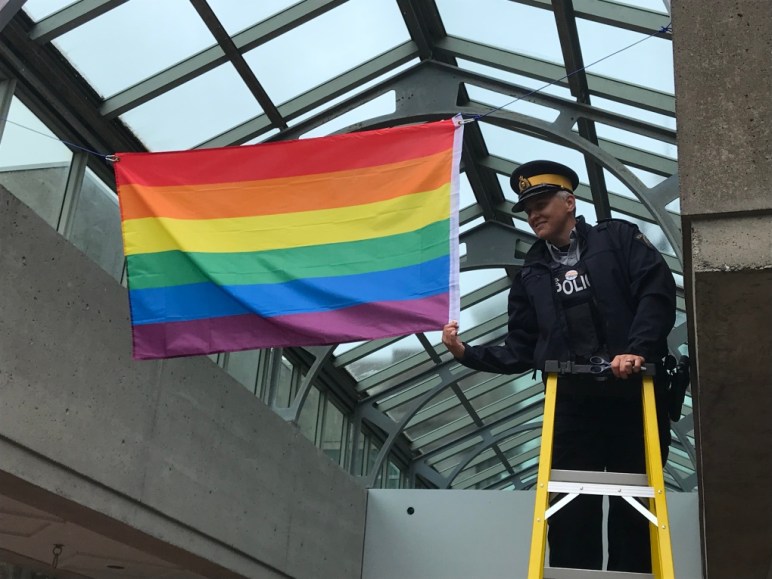
Recently Surrey Detachment hung the Gay Pride flag at the detachment. It was met with some opposition, and even the City of Surrey declined to enter into this political fray in case of appearing to one-sided. The local Mounties did not see a problem.

In a recent circulating video a red serged Mountie, also in Surrey, became another one of the “dancing cops”; this Mountie lip syncing to Queen–mincing and strutting at the Gay Pride festival to the applause of those attending.

Many are beginning to feel brave enough to voice concerns over this latest evidence of the pendulum going too far. They point out that Section 37 (d) of the RCMP Code of Conduct states that the Mounties are to “avoid any actual, apparent or potential conflict of interest” and according to the deportment guidelines, Section 7.1 of the Code of Conduct ‘Objectives’ states that “members behave in a manner that is not likely to discredit the Force”.

Does this most recent caricature of a gay Mountie cross the line? it all depends on where you think the pendulum is right now.

Does the striving and quest for acceptance and love by all supersede the need to be neutral? Does it allow for such obvious pandering? The local RCMP justify it by saying “the RCMP lead by example in promoting diversity and inclusion”.

Management does seem to have lost the ability to see that this was a political supportive statement of a specific political group and its mandate, being still blinded and forever loyal to the government led need for “inclusion”.

Under this obvious strategy the obvious question that never seems to be asked is, does it work?

Did years of marching in the Pride parade in Toronto, aid or hinder the gay community criticism or aid in the investigation of the Bruce McArther killings? The Toronto Police , despite their loving efforts, were even disinvited to the parade this year. (Of course, the Toronto Police Chief vowed to work harder to understand why they have been disenfranchised. )

So the pendulum slows slightly in its grind to the left, but police management seems unable to change track, unable to move away from this politicization of their agency.

The overall effects of the politics of inclusion will probably be unknown or even measured in the coming years, as government rarely looks at things that don’t work; but cracks are beginning to show. Surrey RCMP faced protestors in the raising of the Pride flag and one could argue that the attempt to switch from the local RCMP detachment to a civilian Force is the result of people tiring of the current political model of the RCMP, that they just want safer streets.

In somewhat menacing fashion, right wing political populism is growing around the world, reflective of a changing mood, whether it be to immigration or justice.

There is evidence of growing crime rates after being at all time lows.

Some may argue that all this political pandering works, but only when political culture remains calm, when the public is economically content. That too may be changing. One only needs to look once again to south of the border.

The middle class is in jeopardy, being gradually forced to two ends of the wealth spectrum. Economics or more specifically, economic power, may be a better measure of the need and demand for policing change. Poverty breeds unrest. Unrest breeds violence and a call for stricter policing.

In Canada, the latest ‘Breaking News’ and the fodder for all amateur sleuths and commentary is the ongoing search for two Port Alberni teenage alleged “killers”. The focus on the police intensifies with each passing day.

What does the public want? Do they want empathy over their public safety being threatened? Do they worry about policing models of inclusion?

No, they want the two caught.

All the dancing in the world is not going to change that.

The pendulum seems to swing back in times of trouble, when the policing role gets stripped down to its barest essentials. The key is to let it return to some middle ground without going too far to the very dangerous right.

The public don’t want to love you, they want to respect you.

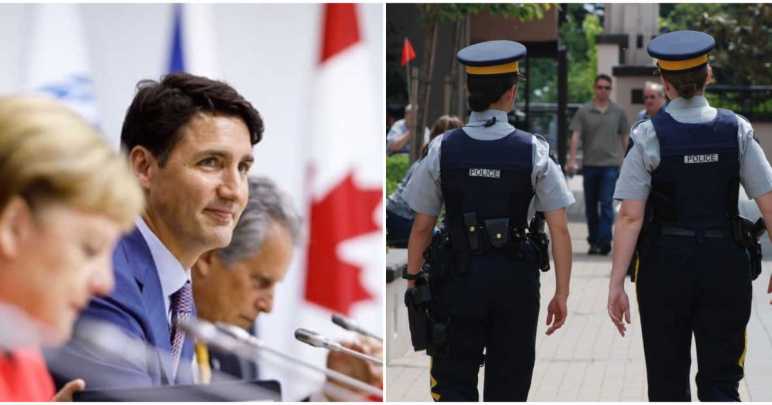
Photo courtesy of CTV and Global News – Some Rights Reserved

Civilian Oversight – Optical Illusion?

Well, it took about ten years from when RCMP management was called “horribly broken ; then a further two reports, one by Auditor General Sheila Fraser and the other by the Civilian Review and Complaints Commission calling for change in 2017–all before Ralph Goodale in January 2019 announced the formation of a 13 member civilian oversight committee to “give advice on best ways to manage and modernize the Force”.

Commissioner Lucki called the announcement in practised dramatic tones, an “unprecedented journey”, which will lead to a “healthier and more diverse police force”.

Several more months of delay followed before in June 2019 they finally named the chosen 13. The numbers are reminiscent of the last Supper and the 12 Apostles. One wonders how they arrived at this number? Who is the tie breaker and gets to play Jesus?

Religious comparisons aside, this whole political play raises the rather obvious question as to whether this is a serious effort on the part of government, or is this the latest of some pre-election pandering to the unwashed masses? Is it a band aid when many believe surgery is needed?

If one is to make a decision, one must first consider the makeup and structure of this committee.

The estimated cost for this committee is $1.56 million per year, not an unusually high amount (about $120,000 per year per committee member); especially when one considers that just a few days ago the Mounties announced their latest thumb in the sexual harassment dyke; another $100 million for civilian members or public servants harassed or hurt by those old, leering, ass grabbing Mounties of the past.

Suffice to say the RCMP is not investing a lot of money on this righting of the administrative ship.

The structure of this effort is also somewhat puzzling.

It would appear that this ‘oversight’ group is there only to give “advice”.

It is not there to re-write or reform policy, but to tell Lucki and Goodale what they would recommend. Goodale had already gone on record in that the committee will not be dealing with any operational policing matters. Goodale stated that the committee will not “have any direct role in policing operations, which will remain the purview of the independent RCMP”.

This of course raises the obvious question as to the effectiveness of a group which only gives recommendations to a politician who always has his finger in the air testing the winds of change. When pressed by a reporter as to the effectiveness of such a committee, Goodale defensively added that the Minister could issue “directives” based on recommendations coming from the Committee.

Commissioner Lucki who is about to lead the Mounties on this “unprecedented journey” said that she would meet the Committee for the first time “sometime” in “the upcoming months”.

With young Mounties jumping around trying to get into the station wagon, clearly Mother Mountie is in no hurray to get going on this trip of a lifetime. Needing to pump up the value of this exercise, she obliquely added, “their advice will provide additional, valuable perspectives to help us make decisions that support our people and the communities they serve”.

She later said that she planned on meeting with this group 3 or 4 times a year. Quarterly in other words. Now anyone who has graced the corridors of HQ, or any government department will tell you that nothing, absolutely nothing, gets done without dozens of “meetings” usually choked down between bitter thermos coffee and chicken wraps. Meetings, often to arrange other meetings– never-ending discussions which often spiral into infinity, no resolution in site.

Finally, the mandate of this current group of committee members is a mere 18 months. One would have to assume that they are then to be replaced, by another group of committee members and the process could start anew.

18 months is about time enough to order office supplies, get new business cards printed, and get some cafeteria jello in your belly.

Nothing in government gets done in 18 months; it’s a political, logistical, impossibility. It took six months for the government to decide who was going to be on the committee.

As to the members of this new committee, well first and foremost you better be on the Liberal end of the political perspective, conservatives or any other political stripe need not apply. The eventual chosen could have fallen out of any Liberal convention gathering in Ottawa– all would be waving their brightly coloured red placards with stencilled slogans crying for diversity and inclusion.

So who are the lucky thirteen, in the apparent overwhelming number of applications that were received? (the Liberals said the delays were caused by the many applicants)

The thirteeen are; Richard Dicerni, Leanne Fitch, Randy Ambrosie, Elaine Bernard, Angela Campbell, John Domm, Ghayda Hassan, Maureen Darkes, Douglas Moen, Wally Oppal, Kevin Patterson, Keith Peterson, and Emoke Szathmary.

There are a couple of eyebrow raising selections in this group, but most of the membership is quite predictable, at least in terms of their backgrounds, even if their names are not easily recognizable.

Seven men and six women. Good balance on the gender teeter-totter keeping in mind that whoever is going to play Jesus will need to be standing in the middle.

Five list themselves as academics or public servants, so the ivory tower will be looming large over the proceedings, government jargon will rain down, political niceties will be evident, Senate committee style protocols will be observed.

There is some police representation, albeit a little suspect.

From the policing world they chose a female, Leanne Fitch from that hotbed of city policing–Fredericton, New Brunswick. There are a total of 113 officers on the Force there, and Ms Fitch recently gained headlines in that city by not replacing retiring officers in a budget cutting initiative. But she is female and was named officer of the year by the Atlantic Women in Law Enforcement and the International Association of Women. Goodale could not possibly ignore the opportunity to hit so many boxes in one move.

There is also John Domm, a former Chief of Police for the Nishnawbe-Aski Police Service. At the time he was the Chief of Police they were not even a fully mandated police department which did not occur until 2018. He is also a member of the First Nations Chiefs of Police Association. Two more checks for Mr. Goodale.

Doug Moen, a lawyer and public servant helped establish the Saskatchewan Commission on First Nations and Metis Peoples and Justice Reform. Check.

Keith Peterson was a former member of the legislative assembly for Nunavut. Check.

Elaine Bernard is an academic and according to her listed resume is a “proponent of the role of unions in promoting civil society”. Actually, this could come in handy when members begin trying to figure out the union dues they will soon be paying. Check.

There is Emoke Szathmary, the former president of the University of Manitoba, an advocate for “diversity, inclusion and accessibility”. Check.

There is the head scratching appointment of Randy Abrosie, a former member of the CFL and the current commissioner of the CFL. Apparently he has “championed diversity”, which may explain his selection, but maybe he just needs to stick to making the Toronto Argonauts viable again and avoiding any talk of concussions. No check mark here.

Finally there is Wally Oppal, who I am going to proclaim as Jesus for the time being, as he miraculously walks over water into another government contract. The 79 year old Wally just does not seem to want to retire, but one has to wonder whether he represents a new, modern voice. This savant of double dipping goes on; and on, and on.

One must not get the wrong impression. All of these people are well educated, accomplished in their professional lives. They should have some good “suggestions” in areas where the senior management Mounties have proven themselves utterly of no consequence.

But there are many questioning this Committee and its ultimate effectiveness.

The always available for a quote Robert Gordon of Simon Fraser University said “I don’t think the mandate, at this point, is to undertake the significant restructuring and reform of the RCMP that is required…It’ll be settling problems that have arisen inside the house as opposed to problems that have arisen as a result of the structure of the house”.

Other questions arise. Will Mr. Goodale be still around after October 2019?

Will Commissioner Lucki turn into some sort of leadership firebrand, able to forge ahead without her political Prairie brother in arms, while relying on those Executives who now encircle her, many of whom who have contributed to this mess?

Maybe she underestimates the problems.

On May 30th, 2018 Ms. Lucki appeared before the Standing Senate Committee on National Security and Defence. Her primary testimony was about indigenous, harassment and diversity issues, which seems to be the focus in Ottawa, seemingly oblivious to the myriad more substantial issues facing the RCMP.

She ended and summed up her testimony this way: “I tell my staff, don’t ask me how to fix it because my answer is going to be “”We’re not broken””. Because we are not broken”.

“Do we need to innovate, and do we need to modernize? Absolutely…”

“We’re not broken and I am not here to fix it but we need to move forward from those past experiences, and if we don’t, shame on us. If you have a great idea of how you can help me to navigate things, don’t be shy to call me”.

Well Ms. Lucki, many believe that the RCMP is in fact kinda broken and actually we expect you to fix it.

So maybe call that Committee and maybe meet them every week, or every day, and not just in a few months; then listen to those voices who are from outside the RCMP, listen, and then have the courage to lead.

For all the rest of you out there, her phone number is 613 993-7267, because apparently she would like you to call with any ideas you may have.

(If that doesn’t work, the website tells yo how to fill out a “contact form”)

Currently, this committee in both form and structure looks like a political stop gap measure, one which garners a few headlines, speaks to the liberal left, and holds out little hope for the working officer.

So maybe Canadians should be calling 911 and not waiting for a callback from the Commissioner’s office.

Photo Courtesy of Matty Ring via Flickr Commons – Some Rights Reserved

Project Trooper more like ‘F Troop’

Often, well maybe not often; but occasionally, a small tinge of guilt washes over this blogger when finding myself caught up in writing a seemingly unending narrative of incompetence, inefficiency and political nonsense which has been affecting our National Police Force. It seems to imply that no good work is coming out of the Scarlet force, which is not accurate, but it also seems to imply that this is a phenomena only found in this increasingly burdened institution.

As I write this, another video has surfaced taking aim at the RCMP police response to a remote Indigenous community where the officer, gun drawn, is screaming at the arrestee that he is going to kill him. Off with his head the sanctimonious Indigenous scream, the ‘breaking news’ media jumps on board, and near the end of the story you find out that the man was actually in possession of a machete and was being arrested in the heat of the moment. But I digress.

The Mounties are wearing a dark silhouette in the media range at all times, awash in nonsense, but we should not lose sight of the fact that other municipal and Provincial Forces are assuredly giving them some hearty competition for dunce cap awards. There is a pandemic in the world of policing; seemingly fuelled by politicalization, but its stem cells are inexperience and the evaporation of supervision.

A couple of months ago, the Vancouver City Police were exposed.

Recently, well regarded Justice James Williams (a former RCMP officer in years gone by- with impeccable credentials) took aim at the Vancouver Police Department and the investigators involved during the trial for Project “Trooper”.

Let there be no mistake, this is not about the Vancouver Police simply stumbling and falling in an investigation, the investigators in this case managed to blow up this case in grand fashion.

They never learned, we find out, that there is a Charter of Rights in this country and once in awhile you have to pay it some attention.

Again, this was not some low level drug case or a break and enter case that got effectively gutted, these officers displayed their lack of investigational chops on one of the biggest fentanyl trafficking cases in Vancouver.

You remember fentanyl? That drug which is causing hundreds of people to die. It is hard to imagine that the Vancouver Police Department investigators missed the myriad of stories and newscasts talking about this latest killer of the downtrodden. Hard to believe that they did not realize the importance of this case and the media attention it would garner.

At the conclusion of this 7 month long investigation, Supt. Mike Porteous boasted of the great impact resulting from their investigation, as he stood before the usual display of guns and drugs spread out before him.

And it was good work.

They seized $1.8 million in drugs, 20.5 kgs of cocaine, 1.6 kgs of heroin, 12.2 kgs of methamphetamine, 23,000 fentanyl pills, and 228 kgs of phenacetin.

Just as significantly they also seized twelve guns, a crossbow and eight vehicles.

A good haul and at the time that deserved a round of applause and the Vancouver Police Department upper echelon certainly did not miss the opportunity to present themselves as crime fighters of the highest order.

A total of six people were arrested and charged, with the kingpin Dennis Alexander Halstead as the primary target, and Jason James Heyman as a secondary “business” associate.

A couple of the dealers in the group, Charleen Terresa Fintray and Cameron Mak, probably as not well represented, pled guilty to possession for the purpose of trafficking on two counts and are now awaiting sentencing. With little doubt they are now kicking themselves for cashing in early with a guilty plea.

Of course anytime you put yourself on a pedestal, there is always the danger that someone will along and kick out the stool beneath your feet.

Four years after the arrests in 2015 we now learn that the senior investigative drug echelon of the Vancouver Police Department didn’t seem to comprehend when a search or a general warrant is required.

In summing up the various misdeeds, Justice Williams pointed out some of Charter breaches by the Vancouver City Police and summarized that “These breaches, considered individually and cumulatively are of such seriousness and impact that, having regard to all the circumstances, admitting that evidence in the trial proceedings would bring the administration of justice into disrepute”.

Somewhat sadly he then added, “society deserves a better outcome”.

Some basic tenets of an investigation and the tools that are commonplace in any investigator toolbox seems to have been misplaced, overlooked or ignored.

The circumstances under which a warrant is needed and how the results of searches needed to be reported, seems to have been an illusive concept to these future Serpico’s.

So what happened? Was this a case of a Judge stretching the rules and provisions of the Charter as some in blue may argue. Unfortunately, that does not seem to have been the case.

First, the VPD set up a months long video surveillance of the residence without a warrant. The courts have long held that if police are going to train a camera at a residence, that it is intrusive, and therefore requires judicial authorization. The VPD ignored this.

The VPD then swabbed vehicles and residences associated to the suspects; also without a warrant.

Not quite done yet, the investigators also obtained passport photos of the individuals; again without warrant.

As a result of these breaches, the subsequent searches of Halstead’s Coquitlam home, Heyman’s Surrey apartment, and an alleged ‘stash’ house in New Westminster on March 11, 2015 were all effectively ruled warrantless and therefore breaches of the accused rights.

There were a total of seven searches conducted, involving six or nine officers at each location. So there was a total of between 42 and 63 officers during this operation, all overseen by an Inspector. Suffice to say that there was a significant number of officers involved throughout the case, who collectively, apparently did not know some basic law.

There were more breaches.

When arrested, the Judge ruled that the police stalled the accused when they asked to speak to their lawyers.

They then failed to file reports of the searches in a “timely manner”.

The delay in access to counsel interestingly was under the guidance of the Inspector in charge himself. The Inspector made an arbitrary decision to delay allowing the accused counsel, then when called into question in court, he could not explain the reasons for which he had issued the temporary order.

The reports which were delayed and called into question centred around the Form referred to as a 5.2. This report is made to the Courts when police seize items from an accused under or not under warrant which according to the Criminal Code needs to be filled out as “soon as practicable” and is generally done within a few days of any seizure once all exhibits have been catalogued. It is a bureaucratic necessity, tedious to say the least, but central to the rules of search and seizure, and the principle and the form are taught at the most basic levels of policing academies.

Judge Williams stated that “it is somewhat disconcerting that VPD training was inadequate in this regard”. He further adds that it was apparent that “there was no supervision in place…”

It should be noted that the officers did file the reports. But they did so several weeks after the seizures. When questioned at trial as to the delays, one officer stated that “she had to deal with the evidence as to her other police activities…”. In other words, she was busy.

A second officer excused the delay as she was “ill for some time after the search warrant execution and that her work schedule was limited (she worked a four day per week shift assignment) together with the volume of the police work she had to do….” So she too was busy and this was compounded by her limited work schedule.

One of the above officers testified as to not knowing there was a time limit on filing the 5.2 report, but guessed it was “60 days” and was unaware as to it being as “soon as practicable”.

There was one officer who was involved in a search of a Rochester Avenue address who simply did not fill out the form as required by Section 489 of the Criminal Code.

All of the officers involved in the breaches of the reporting were Detective Constables. Officers one would assume who were selected and elevated from the street units due to their abilities to these specialized units.

Confronted by the media as to the reasons for this implosion and the VPD now facing the possibility of having to return some of the seized items while watching the primary suspects walk out the courtroom doors; the Vancouver City Police stated: “No comment”.

No doubt banking on the passage of time to wipe out any memories of this incident.

Were there any repercussions for any of the officers involved? Not likely.

Was there any accounting of all the monies being spent in this case, all to no avail? Also not likely.

What is the most frustrating of all this is that these errors were not grievous in terms of the actions or more accurately the lack of action on the part of the officers.

This case was lost because of a lazy and disquieting unawareness of the basic principles of investigation, committed by officers with some seniority who missed the lessons covered in basic academy training. How is this possible. The Form 5.2 through mere repetition during the course of an officer rising up through the ranks should have been an involuntary response to the seizures.

The Inspector who ordered a delay in allowing the accused to access counsel may have been allowed, if only he could have articulated reasons that can often validate such a course of action.

The investigators who placed cameras at the residence have no excuses.

The Crown counsel who reviewed this file prior to charge, and prepped for the court case should have seen this breach upon further examination causing one to wonder what level of scrutiny did the Crown undertake before embarking on a lengthy and costly trial.

Of course, Crown is always unaccountable in this Province.

Inexperience and a lack of supervision were on full display.

As one who had the utmost respect for the Vancouver City Police and who worked jointly with many in the Major Crime sections through the years, this case was a revelation.

The investigative officers of the VPD in earlier times always exuded experience and court savvy. It is unfathomable to think that in those earlier times they would not have been up on the latest court rulings regarding search and seizure and would not have forgotten to fill out the basic paperwork. They also would have spent many years getting to these specialized sections.

It seems to be time for the Vancouver City Police to re-group. Supervision and training need to once again come to the forefront in trying to overcome the vast loss of credibility and experience that logistically, like all police agencies, has impaired them as an organization.

They are fortunate in being an organization of about 1300 officers; it is a ship that can be turned, unlike the RCMP group of 28,000 who are under the helm of the Liberal party in Ottawa who insist on steering the ship towards the iceberg, while the orchestra plays on.

This is the age of close examination of everything the police do, they are on trial not the accused. It is not the time when one cannot forget or ignore the law or the building blocks of investigation. It is expected of them and it should be demanded of them by their supervisors.

There is a general need for all police to get back to basics. Let’s spend less time on initiatives blowing in the political winds, less time worrying about gaining acceptance in the various ethnic, religious or gender groups and more time on delivering a case through the courts. Less time on media spin, more time on understanding the ever changing laws of this country.

The public in this country need to see the police as fair, thorough and competent, unswayed by political machinations or initiatives. They are the backbone of the justice system from which all else flows and the public needs to trust them.

Does the public care when they have been victimized that the officer is short, tall, black, white, male or female? What they want is to know that the officer is a professional.

The public does not want police department empathy, what it needs is to know that if they bring forward a complaint that it would be investigated thoroughly and honestly, without prejudice.

The mandate of the police despite the many social worker styled popular policing initiatives remains the same. The police are there to understand and enforce the laws in this country in an objective manner that withstands scrutiny.

That in itself is a massive undertaking requiring great vigilance.

What separates a good investigation from a bad investigation, or a good officer from a mediocre officer is in the details. The devil as the VPD found out, is in those details.

What does the public want?

They want the Blue Wall back.

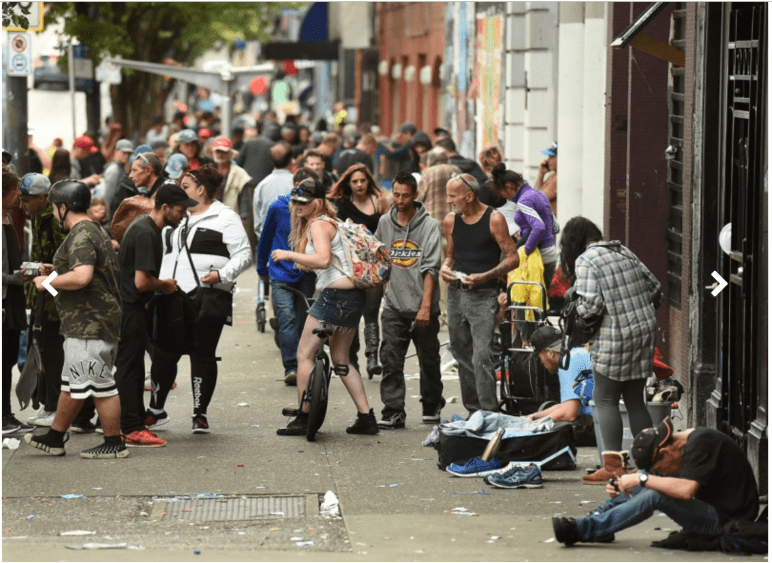
Photo courtesy of Kris Krug via Flickr Commons…Some Rights Reserved

Defending the only slightly Indefensible…

In the last few days, politicians, political pundits and radio and television personalities have been sending themselves into a tizzy, into another anti-police feeding frenzy. The water has been chummed this time by a videotape resurrected from a 2012 criminal case which captured an interview between a police officer and a 17 year old female held in an interview room in the West Kelowna RCMP detachment.

It was not dug up by intrepid reporting, Global News had the videotape sent to them. Now, the edited version has been virally shared, with Global News direly warning for those softened listeners, that it is “hard to listen to”; no doubt in an attempt to draw in more viewers as it is like saying “look away there is a car accident”.

It took hold and it has now been called “abhorrent” by our illustrious Ralph Goodale, the Minister of Public Safety, whose opinion blows in the political wind incessantly, shifting with any voter high pressure system.

My favourite Judge, Marion Buller said that the interview put on display “racist stereotypes of Indigenous women” and it rose out of the “historical tension” due to residential schools. Keep in mind that Buller finds all that ails Canada and the indigenous can be summed up in the residential schools.

Jenna Forbes of the Vancouver Aboriginal Transformative Justice Services Society was “outraged” and asked whether this type of questioning was “part of policy”.

On Simi Sara’s talk show on CKNW, which is affiliated with Global News –in her best holier than thou voice proclaimed that this was “unacceptable” and questioned whether the officer involved had been “fired” for such an atrocious breech of the public standards. Of course she was echoing and re-enforcing the prevailing wisdom spewing forth from the usual go-to for comment “experts”. Thirty second encapsulations bounced around the internet and across Canada, each indignant voice louder than the first, all calling for the head of the officer involved.

The new E Division Commanding Officer finally feeling the pressure weighed in on the video; announcing a “fulsome review”; and throwing a little pre-judgement in for good measure, “on the surface this case doesn’t appear to align with public expectations or the current standards and practises in place”.

Clearly she was making an attempt to say that was the way then, way back in 2012, but now, things are better.

In this more aware year of 2019, the RCMP , according to the Commanding Officer was now “supporting victims”, and members were being exposed to a “course recently updated”. The strategic spin doctors of the RCMP went further commenting that they were advancing “cultural competency training…trauma informed investigations and an advanced course for sexual assault investigation”.

The cultural reference was because all commentators noted in their reporting that the female victim was “indigenous”, intentionally putting a match to spark the gas line of indigenous reconciliation outrage.

Experts ran to the flame, braying about another example of the police being incapable of understanding their culture, just another example of the ill effects of colonialism.

The officer involved no doubt could not have felt more alone.

In viewing the video, nothing will get around the fact that the officer asked inappropriate questions. That is apparent and should never have happened, the questioning of whether she was “turned on by it at all” showed a glaring lack of knowledge of the nature of sexual assault.

However, if you examine the circumstances, it may be in-appropriate and completely unfair to rush to such a harsh judgement. The commentary on this subject comes from those that have never been in that interview room, let alone investigated any sexual assaults.

Some of the questions and the perceptions that arise from this videotape need to be looked at through an investigators lens.

First, this videotape did not surface as a result of a complaint coming forward from the female, or some representative of her about the investigation or the lack of charges. One should always be somewhat suspect about the release of information which may aid someone in their particular cause or pursuit.

It is the result of a civil suit, totally unrelated to the crime of sexual assault.

It is part of the evidence that surfaced as a result of an investigation into a social worker in 2012, Robert Riley Saunders. It was alleged that Saunders stole monies from some teens, including the female in the video; monies that were forwarded to them through the Ministry over a four year period totalling $40,000.00. Basically he was taking monies from vulnerable clients and putting it in his own bank account.

The female youth victim, one of a dozen, was forced, according to the civil claim, to living on the streets and into a life of drug addiction using meth, crack, cocaine, and MDMA.

On March 4, 2012 the female youth then made allegations of a sexual assault. The two defendants in the civil case, (as by now another female social worker was named as a defendant), countered, along with the girl’s foster parents, saying that the female victim was “falsifying the allegations for an excuse for using drugs”.

We also learn that this same female victim alleges that she was sexually assaulted by her grandfather earlier in life. She makes reference to it during the videotape. She says on the tape, “nobody believed me then and nobody believes me now”.

The officer responded, “I have reason to believe what happened in your past, but I do have a lot of concerns about your story here”. Earlier the officer, had said that he wants to probe “inconsistencies in her story”. No doubt some of that concern centred around the fact that the victim said she “didn’t not say no” to the alleged assailant throughout the assault. It should also be pointed out that she was making this allegation against an “acquaintance”.

This of course is possible as she said she was “scared” but some further layering of the explanation was needed.

All this is to say is that regardless of who is telling the truth in this case, what had been raised was a possible alternate story, a possibility that there was some fabrication on the part of the victim. To an investigator tasked with getting to the truth, you are now in a position where one must consider a couple of different narratives. Therefore that has to form part of your questioning of the victim. As a truth seeker any investigator can not have a tunnel version of the truth, one needs to walk the middle road, consider all possibilities.

There are some in this current political environment who believe that there is no such thing as a made up sexual allegation. This blogger is not one of them and has been involved in a number of investigations where some allegations were clearly false and were eventually proven to be in fact pure fiction. This goes counter to the #metoo movement and the left leaning liberals which constantly assert that no woman is capable of lying under these circumstances. That is just factually incorrect, regardless of how acceptable that dogma has become.

So this particular investigator, under these circumstances, has to consider that this particular female, who was living a street level existence and addicted to drugs, could possibly have an alternate reason for coming forward with this story.

One should also note that this female, in the days or months following this interview, wrote a letter of apology to the accused and the RCMP for making this sexual assault investigation.

Of course, it is now being claimed that she was “allegedly forced by her social worker to write letters of apology to the accused man and the RCMP for wasting their time”.

The female victim, now no doubt re-enforced with a lawyer and a civil claim now says that she has been “re-traumatized after watching the video”.

Again, this too could be true, but there is a great deal of evidence which this investigator could not ignore in terms of the line of questioning.

Secondly. The interview and the way it was conducted had absolutely nothing to do with this female victim being indigenous. Listen to the videotape and if anyone can find anything suggesting that this interviewer was being racist, or that some line of questioning would lead one to this conclusion, they need to step forward and point to it.

What critiques are doing is implying that the line of questioning is the result of her being indigenous, not understanding that this line of questioning would occur, and should occur if an investigator is divining the truth no matter who the witness may be. The wording of some of his questions can be criticized, the intent of his questioning should not be characterized as racist.

If a victim or witness or suspect has raised a different set of facts than that has to be explored. An investigator or an interviewer should be criticized for not exploring these and all venues, but the exploring or questioning easily leads to criticism in the techniques used by the arm chair quarterbacks.

Hopefully the police have not reached a stage in this country during an investigation when they can be told that there must be wholesale acceptance of everything being put forward. Remember, it has been said, “it is a basic truth of the human condition that everybody lies. The only variable is about what.”

There are also some questions that need to be explored about the time leading up to the conduct of this interview and of the logistics surrounding the taking of this statement.

For instance, was there someone monitoring this interview as is the usual protocol?

Was this investigator ever given instruction on interviewing techniques?

How many interviews of this ilk had he ever done? What level of supervision was given with regard to the conduct of the interview?

The RCMP management can talk about sexual assault investigator courses. But was this particular officer ever on one? Quite often those types of courses go to the specialized units, and the general duty cop is the last on the list for such specialization.

There has been a lot of questioning of why there was no female present acting on behalf or as support? One must remember that this person is a witness, a victim witness, she is not a suspect. Her story could be suspect, but she is not being treated as a victim in these circumstances, therefore there is no legal need for someone to be present.

Police also try to avoid having more than one person in a room for a witness interview, for fear of interference, or coaching. If she wanted someone there and had asked for it, it is likely that she would have had that choice if it would help her in feeling secure. But this would not be likely at the age of 17. If she had been under investigation for possible charges, then the rules would be entirely different.

So should the officer have worded his questions differently? Of course, the questions showed a lack of knowledge, not evil intent.

The ability to talk to people, to interview, is an art, learned over time and through repetition. You need to go “into the room” to get proficient. It takes years to be both a listener and a talker– especially when that person may be trying to deceive. Some say the skill is being lost in the millennial generation, dominated by the land of laptops, a growing perception that interviewing is a specialized skill that warrants specialists and special training. That is not the case, it requires a willingness to enter the interview room and run the risk of being fooled, maybe hundreds of times, and those that do should not be chastised by the 20/20 hindsights of the courts and the academics. Some would argue that it is the greatest skill needed by a police officer.

No doubt this officer will get some sort of discipline letter, but if that is the case, let’s give one to his Supervisor and on up the line.

To debase and libel this investigator as being racist is completely unfair and one would hope that it would be actionable.

And while you’re at it let’s give the likes of Marion Buller, and Jenna Forbes a ride in a police car for a couple of shifts, and let them do some interviews.

And as they enter that drab room at 2 o’clock in the morning, tired, and having to perform on camera for later court scrutiny– give them a hint…. not everybody tells the truth to the police.

Photo Courtesy of James Cridland via Flickr Commons – Some Rights Reserved

The MMIWG –as Predicted: Wasteful and Disturbing results

A lunatic, admittedly an antiquated term, comes from the latin “lunaticus” or “moonstruck”, referring to a mentally ill person, or as in this case, a person who is dangerous, foolish, or unpredictable. So this blog’s nomination for the most moonstruck politician in this current age is Marion Buller– the head of the Missing and Murdered Indigenous Women and Girls public inquiry –which is about to end (finally) its over two year long reign as the most ridiculous waste of taxpayer money in the last number of years.

This blog wrote about the then pending inquiry in February 2017; with a prediction that it was a massive waste of time, that it was pandering to the Indigenous but offered little to no hope of it helping the indigenous. Well, it has more than met all expectations and its delayed final report will hit the new stands on June 3rd, 2019. This too is late, and late after even having won an extension as it was originally supposed to be concluded in November 2018.

This inquiry started out with a projected cost of $70.5 million so from the start it promised to be the most expensive inquiry in Canadian history. Two years in, they then had the audacity to ask for an extension, wanting another two years which they didn’t get. They did get another $50 million bringing the un-official total cost in the neighbourhood of $120.5 million.

This group is so blind to taxpayer consideration, that in honour of their massive and brilliant undertaking, they are going to have a party and fund over 100 Indigenous communities to thank all the participants and in celebration of the “conclusion of this journey with us”. It is fully expected, that Jody Wilson-Raybould will enter the official party carried by six, like Lady Gaga at the 2011 Grammy’s; an entry befitting the media’s patron saint of reconciliation.

If ever there was a gathering of people with a one dimension interest and with a single purpose in the guise of an actual inquiry, this was it. The people assigned to this working group, started off with a set of beliefs and then set out to prove it, with a surfeit of anecdotal evidence. Witnesses testifying to a time frame between 60 and 100 years ago, often anecodotal, often based on story telling.

According to the inquiry of course, in their words, they have been diligently working on “exposing hard truths about the devastating impacts of colonization, racism, and sexism…aspects of Canadian society”. That was clearly their reason for being and that is what they set out to prove. There was no inquiring in this inquiry.

Throughout this time the inquiry has been persistently hampered by allegations of mis-management and in-fighting, and even factions of the indigenous wanted it scrapped.

According to their own web site, there was a total of 2386 participants; 1484 family members and “survivors” (the last residential school closed in 1996- some 23 years ago- to date the indigenous have been paid out $1.9 billion in compensation) and 819 of these participated through “artistic expression”. This inquiry was calling it “evidence” even if that evidence came through traditional story-telling and art. With this level of understanding of what actually constitutes evidence you should not be surprised later in this blog as to what some of her recommendations will be.

There were 83 “experts”, “knowledge keepers” (my favourite term) and “officials” providing testimony.

In January 2018, the Executive Director of the Inquiry, Debbie Reid resigned. The previous Executive Director had already resigned, as had one of the Commissioners. Indigenous Relations Minister Carolyn Bennett had by now began admitting that she was concerned about the number of staff withdrawals. A total of eight people had resigned or been fired at this time.

In June 2018 Commissioner Audette threatened to resign because her request for a two year extension had been declined by Indigenous Affairs Minister Carolyn Bennett.

Audette, returned to work a couple of weeks later and began to make excuses for the final report saying that “the final report will not be as comprehensive as it could have been” when she had been only given another six months and not the two years she requested.

In July 2018, lawyer Breen Ouelette resigned, the sixth lawyer to do so stating that the “inquiry was speeding towards failure”. Their primary allegation being political interference from the Federal government, that there was a lack of “transparency, communication and effectiveness.” Actively biting the hand that fed them.

In October 2018, Ms. Buller and Commissioner Michelle Audette were already expressing concerns that the government had not acted quickly enough after the release of its mid-term report. Buller described the interim report as “ground-breaking” and she was concerned that the final results may be ignored. She said that it was “horribly disappointing not only to us but to Indigenous people and non-Indigenous people all across Canada”. Ms Buller may be over stating the inquiry and its eventual impact, as there are very few people in Canada who would have read it at this time.

In November 2018 two further staff members left. This was in keeping with the mass exodus of staff, which by now had reached an epic 30 staffers.

It was about this same time that co-counsel Jennifer Cox, became the 7th lawyer to leave the inquiry. Buller of course had no comment, and the lawyers who are bound to confidentiality, conveniently remain muzzled.

Now, with only a couple of weeks to go before issuing the final report, the inquiry is still in front of the Federal Court trying to get access to two RCMP files. They are arguing that these two files represent the core of the inquiry’s mandate to look into the systemic causes of violence against indigenous woman.

Seems a little late to say the least, not to mention that they have had access to many files during this two year period, a total of 119 investigations, 23 of which were related to ongoing investigations. Department of Justice counsel argue that the two files aren’t necessary. The inquiry lawyer Ravi Hira said that there are deficiencies with “one of the cases”. A little suspicious to say the least. Even the Judge asked how they were going to possibly review two large files and still make it to the report.

Throughout this agonizing process, the Federal government remained mum, did not step in, forever fearful of being accused of being big colonial brother. Hoping beyond hope that all things would get worked out by some miracle of bureaucracy.

This inquiry was an act of appeasement. Bring all the indigenous together, give them unlimited funding, give them legal and technical resources, and then have hundreds testify to the same issue.

If you spent any time at all watching these the public hearing proceedings you will have seen the same thing, played out daily for hours upon hours.

A woman or man tearfully testifying, unscripted, often meandering off topic, and never a question asked as to the truthfulness of the testimony. All that was said was accepted. There would be rows of counsellors, holding religious or sacred icons comforting the woman, nodding sagely, dramatic empathy oozing. A parade of tears, some real, some brought about by pointed prodding.

The Indigenous political factions are consistent in only two areas as this Inquiry found out.

First, a time in history when they were present on the land before the arrival of the Europeans. They were here first and this translates according to their broad interpretations, to some form of veto over all things in Canada.

Secondly, they now realize that this is their golden moment, the Federal coffers have been opened up and they have a national government seeking their approval. All levels of government are woefully short of ideas on how to solve the multitude of indigenous endemic problems. So they throw money and apologize profusely.

However, other than for these two factors the indigenous groups are divided along hundreds of political lines. Some are wanting to invest in pipelines, some are protesting, but all are seeking financial redress of varying description. Others argue that they are one of two nations in this country. Some are arguing for laws to protect their rights while others argue that the laws of Canada do not apply to them. While some want to return and preserve culture and language, others are chasing dreams of casinos and medicinal marihuana stores.

This in-fighting infiltrates any and all proposed policy options, making it almost impossible to reach consensus. They don’t even agree on the Inquiry itself, some calling for another inquiry, some just giving up.

The only constant is the constant outreach for more funds and the hundreds of lawyers now pursuing those dreams on their behalf. The lawyers also being funded by the government.

It was clear from the start that the “inquiry” was made of a political necessity, not necessitated as should be the case by an actual need to know. The statistics already pointed to the hundreds of factors that result in missing and murdered indigenous: poverty, lack of education, drug and alcohol abuse, housing, nutrition, criminal activity, staggeringly high birth rates etc. It has already been calculated that 80% of the violence against indigenous women and girls is perpetrated by their own, their families, the friends, and the neighbours.

All this was known before the inquiry and the factors will still be the same after the inquiry.

The original Commissioners of this “Inquiry” were Buller, a member of Saskatchewans Mistawsis First Nation; Michelle Audette an Innu woman who failed to win a Liberal seat in Quebec; Qajaq Robinson a Nunuvut born lawyer who was legal counsel at the Federal Special Claims Tribunal; Marilyn Poitras, a Metis law professor at the University of Saskatchewan; and Bryan Eyolfson, a First Nations lawyer who served on the Ontario Human Rights Tribunal and also in the Ontario Ministry of Indigenous Relations and Reconciliation.

The appearance of bias and slant could not have been more obvious. If there was an inquiry into the oil industry and all the Commissioners worked for Exxon and Shell would it be considered fair? If there was an inquiry into policing and all the Commissioners were members of the police would it be considered fair? Would there be an outcry? Of course, so why was there no outcry in the most expensive Inquiry ever taken on in Canada? Interestingly, the media was and remains completely mute.

So after this smorgasbord of like-minded social workers, lawyers, counsellors, and commissioners finish draining millions in their efforts, they are about to present that final report.

Recently, Marion Buller gave a hint of what was to come.

Testifying before the Senate Committee on Legal and Constitutional Affairs over Bill C-75, Ms. Buller suggests, that if it is an indigenous woman that is murdered, then it should be automatically first degree murder. She believes that the Indigenous should be treated differently legally, by the courts and the judges, in that they should get special consideration.

There are only certain provisions in the Criminal Code which allow for this automatic update to 1st degree murder; the killing of a policeman, a corrections officer, or in moments of terrorism.

But now, this former B.C. Judge, Ms. Buller, believes there are different classes of victims, and that the indigenous death is more serious than the others. The policeman and the corrections officers have been singled out as the jobs they do entail the protection of the general public. Ms. Buller now wants charge determination dependent on the colour of your skin or heritage.

She deems that this would be an act of reconciliation.

It would mean an automatic sentence of life and no chance of parole for twenty-five years. When it was pointed out to her that indigenous women are for the most part killed by their own, she was therefore advocating putting indigenous killers in jail for longer periods of time; she seemed taken aback. It was almost like she had never had seen that possibility.

The recommendation is ludicrous of course. Or is it?

With a coming election and the Liberals desperate to put Jody Wilson-Raybould behind them, would they consider such a criminal code change as an act of appeasement. Another apology if you will.

If you don’t think so, consider the latest Supreme Court of Canada ruling concerning the tragic case of the death of Cindy Gladue, an Indigenous sex trade worker. The accused was acquitted, but the Supreme Court ordered a new trial for “manslaughter”.

Justice Moldaver in a 4-3 decision writing for the majority stated in the decision: “As an additional safeguard going forward, in sexual assault cases where the complainant is an indigenous woman or girl, trial judges would be well advised to provide an express instruction aimed at countering prejudice against Indigenous women and girls”. It is not going as far as Ms. Buller, but it’s at the top of the hill, looking down the slippery slope.

Qajaq Robinson, of the MMWIG, who of course intervened in the case, called it a “tremendous step forward” saying that the courts have recognized that “in cases of sexual assault against Indigenous women and girls, that there is an obligation on the courts, on judges, to be gatekeepers to ensure that bias, prejudice, racism and sexism do not form part of the evidence…”

Again, on first blush this too seems somewhat logical, but there was no evidence of this being the case in this trial, it is based on a presumption.

Complicating this was the fact that the victim was engaged in a 2nd day of prostitution with this same man and the Crown argued that it went towards a determination of “consent” and therefore evidence of the victim being a paid sex worker was relevant.

So a new trial has been ordered.

But now have a Liberal leaning Supreme court warranting “express instructions” in the case of an Indigenous victim, a Federal Liberal apologist government, and a completely biased and unapologetic special interest Inquiry, all of whom may be taking us down a very dangerous road.

Section 15 (1) of the Canadian Charter of rights says that “everyone is equal before and under the law and has right to equal protection and equal benefit under the law”.

Apparently Ms. Buller doesn’t agree.

Photo Courtesy of the Canadian Press — Some Rights Reserved

Dear Jennifer…

Ms. Strachan, let me be one of the first to welcome you back to beautiful British Columbia — the land of the highest gas prices, mountains, water, big trees, horrendous traffic, and where the Green Party has a pulse.

Being a born and raised Okanagan girl, no doubt you are feeling the geographic magnet that is B.C., and like Dorothy in Oz, you probably wanted to return– as there is no place like home. So with a click of those RCMP high-browns and the nod from Wizard Lucki you are now on your way.

It’s been awhile, over 16 years since you were in the policing world here in Lotus land and a lot of things have changed, so I feel bound by some inexplicable duty to give you at least a heads up on what to expect.

Let us first deal with the politicians in this land who you may end up spending some time with considering your new role. The Green party has locked arms with the NDP to see who can be more righteous; who can spend the most money, and clearly would have a love for any future unionized RCMP. It is a mixed political blessing though, as they are not pro-police necessarily, more in favour of groups like the Pivot Legal society, or the Elizabeth Fry Society.

The Federal world of Justin Trudeau and their policies still have an audience out here, even though they seem to be in a political free fall in the other parts of the country.

So don’t be fooled by the blooming Conservatism of the west throughout the Prairies. The right leanings of political philosophy has not seeped over the mountains, conservatism is merely a mirage in this marihuana infused land. There is more chance of Jody Emery being elected out here than a Jason Kenney.

President Bush was chasing Saddam Hussein when you left B.C.and the Americans were about to invade Iraq.

Paul Martin was the Liberal Prime Minister (probably one of the last times the budget was balanced).

Giuliano Zaccardelli was the Commissioner of the RCMP (who was impugned for irregularities in the management of the Pension and Insurance fund).

The RCMP was heralding the first female officer to be placed on an Emergency Response Team and the wave of female empowerment was in its infancy.

This unparalleled growth in female advancement is being mentioned because Commissioner Lucki decided that in announcing your move to head up E Division, she felt that she needed to underline your gender and not your curriculum vitae. It is a bit of the elephant in the room when it comes to the succession plan for E Division.

Ms. Lucki seems pretty one dimensional so far, aiming to fulfill her proscribed and dictated agenda, but in including you she makes you appear as a pawn in her Liberal sanctioned corporate strategy. It clearly drew attention to the possibility that your gender was a central characteristic that was needed for one to get this job. In the end it detracts from your resume, taints the appointment, and tends to confirm thoughts of the older guard.

For the record, I don’t believe the average RCMP officer gives a whit as to whether you are a woman, a man, or a variation of the two. Whether you are green, brown, wearing a turban, or wearing a Scottish tam means nothing in the current real world of policing. Gender does not imbue anyone with intelligence or leadership skills although it is quite clear that the two are equated in government corridors of power.

Putting all that aside, you are here to replace Butterworth-Carr, who heralded not only her femaleness, but her indigenous background, and she had zero impact. She didn’t stay long, enticed by an offer to join the politicos in Victoria. She used a quick stay on the job to springboard into the double-dipping pool, no doubt financially setting herself up for a lucrative run towards pension. It is hoped that you may still a little longer, as the wheels of government turn very slowly, the ability to have any impact takes years not weeks, so some time on the job is needed.

You will be hampered upon your arrival as senior members of the RCMP demographic bubble are leaving, the experienced baby-boomers are reaching their logistical end. Some, like Butterworth-Carr, have discovered a tunnel under the Georgia Strait which leads directly to the Provincial government coffers. The sands of time are changing, whether that is good or bad we will see, but there is little doubt it is creating a vacuum in terms of experience.

Since your departure from the West, almost the entire latter half of your career seems to have been focused on O Division and HQ.

You were the District Commander for N.E. Ontario from 2009-2012; then the Officer in Charge of Criminal Operations in Ontario (interesting in that in Ontario the RCMP is not responsible for most criminal investigations) from 2012-2016; then up the ladder once again to being the Commanding Officer of O Division from 2016-2018.

And of course what resume would be complete in this day and age without being the Officer in Charge of Operations Policy and Programs in Contract and Indigenous Policing in Ottawa. You then followed that by becoming Deputy Commissioner for “Specialized Policing Services”. A steady rise for sure but I will admit to being a little concerned about this rather central Canada version of the RCMP being the substantive part of your resume.

You probably don’t need to be reminded that there is a big gap between O and E, not just a couple of vowel spaces. The fact that you survived and thrived in this non-contract world can be either seen as a plus or a minus. You may be commended or condemned for being able to breath deeply in this rarefied air, as it is a milieu where most of us in the contracts would often feel out of place.

O Division has often been accused of riding and hiding behind the curtain of Federal statutes, where a lack of enforcement and investigational strength is a theme common to those that have worked in both areas. Enforcing such Federal statutes as the Migratory bird Act; or watching the Indigenous hustling cigarettes back and forth from the U.S; or helping illegal immigrants with their luggage; has never been considered the leading edge of police investigation know-how.

This lack of operational acuity has been the standard slam against this Province for years, whether management admits to this operational schizophrenia or not. Another example showed up in the last few days, in the Mark Norman case, serious questions are now being raised about this two year investigation in Ontario which resulted in a single charge. It has been stayed as the defence counsel seems to have been a little more thorough in their inquiries than the police officers that conducted the investigation and there are implications of political interference in the process. Further Mountie embarrassment is on the horizon.

The Force in general has not had such a smooth ride for the last couple of decades and there has been a number of serious setbacks during the time that you were part of the RCMP management power group. A growing legacy of mismanagement whether looking at the carbine issue, internal sexual harassment, and a large number of failed investigations.

Mountie salaries in relation to other agencies have tanked. Recruitment is down. Staffing levels have dwindled to lows never seen before. The Mounties are being questioned over their actions at every turn, whether it be the shooting on Parliament Hill, or the latest, the Mark Norman investigation.

I am not sure of what role you may or may not have played during this last number of years but there is no doubt you have been either a witness or a participant in some of the inane programs and policies which have left this agency in a state of major disrepair. It would be interesting to hear your take and historical role in this troubled time. Actually, it would be nice to finally hear from someone, anyone, of this management era who would admit to the errors, the wrongdoing, and try to set the record straight. Not crocodile tear apologies for things like harassment, but clear, concise explanations as to things like $100 million settlements. Maybe I am asking for too much.

The RCMP in its official bio of you points to your “passion for supporting others”. In 2014 you were given the Ontario Women in Law Enforcement award for the “Mentor of the Year Award”, and then in front of the International Association of Women Police you were also given a “Mentor of the Year Award”. Clearly a 21st century new policing virtue but who knew there was such a thing. Hard to argue with someone who wants to support you though.

You have been away from the dirt and grime of contract policing, living and breathing the filtered world of a Mountie in Ontario. Previously, you were in the corridors of subject matter experts, puffed up self-important people wandering in that dazed mind numbing bureaucracy all spouting pithy truisms at any opportunity.

You have now been freed and at a time in your career where you are un-flammable.

You are back to the heart of the RCMP Criminal operations block, where your Masters degree in “conflict analysis and management” will no doubt come in handy. You are being thrown into a logjam of a multitude of unaddressed and unattended issues, compounded by lacklustre stints of some of your predecessors.

You are about to be thrown into the wolfs lair. E Division with its constant stream of issues can eat and will eat managers up so you need to be careful.

I am hoping that this will be seen by you as a chance to speak out.

My primary recommendation is to be honest and straightforward and speak to the issues. Let’s hear what the RCMP stance will be if the Surrey RCMP get ousted; let’s hear what you are going to do about the vast understaffing that is in all corners of the Force; lets hear about gender and diversity promotions and your view of this dictated policy; lets hear about the politicization of the police force mandated role, which clearly is in full swing in Ottawa; and lets hear about upcoming unionization of the RCMP.

Even if one is able to be exposed to a truly honest appraisal of the issues and opens up the debate to real dialogue, you will have accomplished something not seen in many years in this Province.

The issues surrounding the RCMP will seem endless and at times look very bleak. The constant pablum being fed to the officers of just “you’re doing a great job” is both insulting and demeaning to their intelligence. Talking openly and honestly would be a breath of fresh air.

I am not optimistic, but I stand to be corrected, and will gladly sing the laurels of someone who walks the walk, speaks to the issues and puts on display possible solutions. It seems counter-intuitive that one needs to seek an open and honest management group from a police institution, but sadly this is now the case. It has been missing and it has caused irreparable harm.

Once that is all done, then you can go and enjoy your retirement….

I do wish you the best….

Signed:

A once faithful servant

Photo courtesy of CTV News via Google Images- Some Rights Reserved

Historical Unsolved Homicides…the value of the past…….

Hundreds of bankers boxes– dusty, worn and frayed at the edges, worn down by the weight of other boxes stacked on top, often damp in the corners, all lodged in inconspicuous backroom places. Out of sight and mostly out of mind, they are spread throughout this Province and the other Provinces; the responsibility of the RCMP, the OPP, the QPP and various scattered Municipal agencies. Historical mysteries sitting, undisturbed, and now in danger of being lost forever. 

Each box has scrawled on it in black marker, a number the start of which indicates the year of the file box being created; 73-1234 or 98-5678 indicating 1973 and 1998. Most will have a surname, also written on the outside of the box, underneath the number, the first indication of the box containing information on a life lived and in all likelihood a life taken abruptly away. A snapshot of a moment in time, life stories, lives abruptly ended. 

If one lifts the uniformly folded cardboard lids and peek inside one finds manila folders, each folder containing assorted government styled papers, each folder numbered, implying some form of organization. The order of importance often seems haphazard. There will be original documents, photocopies, carbon copies, compact discs, floppy discs, even blueprints and loosely bound photographs.  Each document part of a whole, each pointing to a dramatic and often gruesome ending to a life. 

Shoved into these boxes will be exhibits, exhibit reports, and boxes of 3 x 5  index cards, clues as to the relevance of the folders. Sometimes there are many of these boxes, with this same name, or number; the more numerous the boxes the more likely that this was a long case, or a more complicated case, or a case involving more than one person. The breadth and depth of the case in direct correlation to the weight and the number of  volumes. 

In police parlance these are “dormant” cases. Technically “open” or “still under investigation” as the police like to intone when asked; but they are in a deep state of slumber, never to be awoken unless something out of the ordinary occurs. Maybe a dictated annual review, which is usually sporadicly enforced, will sometimes force a reluctant officer to pull the case from the storage room, check the final pages for any “new” information and generally meander through the boxes.

Then, under most circumstances the boxes get put back, back into the darkened rooms, a single page added indicating that there has been no change in the contained information.  Some boxes may be difficult to even find.  

The paper or original information in these boxes is now being lost, inexorably beaten up by time itself and inadequate physical storage.  They all contain the most intimate of stories, real stories of people, their backgrounds, their lifestyles and their fates.  Some of the people in these boxes have prematurely met the ultimate fate, their deaths by a variety of methods only limited by the depravity and the darkness of the human spirit. Long gone to the eyes of the original investigators, but probably not forgotten. Every old investigator cognizant of the one that got away. 

They have not been solved, the killer remains free in the world, unless time and circumstances has also caught up with them as well. 

If one believes that history, or that records of the past are important,  or that every effort should be made to solve any murder, then you may be interested in this story. For this is a story of a largely ignored problem by the RCMP and other Municipal forces and the single attempt at a proposed solution, one which proved ultimately futile. 

This is a story of a need to archive and preserve police files.  It admittedly has never been fashionable to be interested in the library sciences, or the  similar but more current world of digital archiving.  It conjures up images of dusty books, microfiche and bespectacled introspective librarians, lonely figures confined to being the keepers of untold secrets. 

This is not to say that there is not public interest in unsolved homicides; one can tune into the many Netflix docs, the CBC, read Wikipedia, or the Vancouver Sun and find stories of historical murders, served up in some form of sensationalist fashion. The RCMP post pictures of historical victims and the Coroners office publicly maps out found remains cases. Unfortunately, this is mainly public fodder and a needle in the haystack in terms of trying to solve some of these cases, designed more to entice the reader or the watcher, designed for instagram investigators, not a serious study of this dark world nor a studied attempt to make a dent in the growing pile of the unsolved.   

There is an actual need for a concentrated effort to preserve, to digitize these paper files, to capture forever the information that could be lost to deterioration and neglect. 

In this Province and for most other parts of Canada, there is a relatively short historical period of time which is of primary concern. This is mainly the period from 1960 to 2003,  the dominant ages of the paper files in this relatively new country.

In general, around 2003 many police agencies slowly began to go to electronic formats, although it varies by jurisdiction. The paper format was gradually replaced, electronic data finally being made acceptable as a possible original document pushed by the quickly developing technical advancements.

It is somewhat ironic to understand that the paper age has an actual shelf life longer than the digital age, with experts estimating that paper, if properly preserved, has a life of about 50-100 years. (In our now digital storage era, the shelf life of electronic documents is only 10-20 years. Some think that since the newer material has been electronically filed it will last in perpetuity– a largely false belief.) 

However, now the paper files are of the most immediate concern. They are   reaching the end of their shelf lives, the ink is beginning to fade, the photos are beginning to deteriorate and the memories of the investigators are becoming faulty. 

The numbers of unsolved homicide files that are on “paper” in this Province are somewhat daunting. In 2016, when this blogger began to look at this issue, there were 900-1300 unsolved homicides held by the RCMP in the Province of British Columbia alone. There was another 200-300 which would be the responsibility of the Municipal Forces and there is no evidence to suggest that those Municipal agencies have been any better than the RCMP in their preservation. If one draws this issue outward, on a national basis, the situation would be magnified by 10 times. 

In British Columbia and in the Lower Mainland, since the birth of the Integrated Homicide and Investigation Team, they alone have generated at least another additional  300 “unsolved homicides”.  To be sure, those files are being captured in an electronic format, but not a format that is in a consistent with other agencies, nor are they in a position to be integrated and compared to other similar data bases. So the problem of being able to archive and preserve all information, on a fundamental basis, is growing every year. Solvency rates are also declining– further exasperating the issue. 

The police agencies are rarely asked about this archiving problem, but on that rare occasion that they are, the blame is usually placed on the constantly shifting policing priorities and jurisdictions. It simply has not been operational priority. 

Even if reviewed, there is no digitization of the file, so the only electronic reference to this file may be a name or a file number. The contents are not available to investigators without fully and physically reviewing the paper file. If an investigator feels an ongoing investigation may have some relevance to a historical file, whether it be a suspect or some other circumstance, they would need to go back and physically review the entire file, maybe on just a chance of finding some opaque reference. 

There is no cross-pollination of the information contained in those files, none of the more recent files can see or compare information on their files to older investigations.

The police agencies have a public relations mantra which is that no file is ever “closed” without it being solved. Technically they are right in their assertions, they don’t put a big “CH” (Concluded Here) on the file, but they are being totally misleading. They are trying to generate the impression that they are active and constructively reviewing and comparing these files on a regular basis. That is not true.

They are not digitizing these older files, and they are not actively investigating these files.  The only salvation for police management is that the public simply doesn’t know; the public assume wrongly, that all police files are instantly and readily available to all homicide investigators. 

There is one exception in this Province in terms of units re-investigating historical files in the RCMP. That is the Unsolved Homicide Unit of about 10-20 officers who review old files and selectively work historic files. Sounds good, but one needs to consider that each team in the group, may only take a new file every 8 months or so.

The other bit of sleight of hand is that the Unsolved Unit actually re-investigates only the “solved files”; files where a suspect has actually been already identified, but where for some reason the file was not being worked. It is hard to explain, but the fact is there are many files that have already identified suspects, but for one reason or another have been neglected. These files alone keep this unit busy and it only makes sense in terms of productivity to go for the low hanging fruit. 

Now if you optimistically assume that this group does 3-5 files per year, you can easily do the math and see the finger in the dyke problem here.  There is no way to catch up or even make a dent in the pile. It is not for lack of effort by this relatively small unit, it is just a matter of numbers. 


https://www150.statcan.gc.ca/n1/pub/85-002-x/2018001/article/54980-eng.htm

The preservation of historic information is finally being recognized in various forms throughout the rest of society as various organizations are striving to cope with this growing issue.

Interestingly, some locations are actually using police inspired methods to try and solve their respective archiving problems.

At Harvard University they are in the process of trying to develop an operating system for capturing their paper and digital archives using workflow modelled after “police forensic standards”. The idea is to “create, authenticate, unimpeachable source data….” at a standard that would make the archive “suitable as evidence in a criminal trial”. Now, if capturing hundreds of homicide investigations seems to be a difficult task, Harvard is attempting to go back 375 years of history.

The problems they are encountering are similar to the police issues; files with floppy discs, zip drives, tapes, and cassettes. So they are not only capturing the information, they are also preserving the techniques that are needed to retrieve that data.

In California, in a former San Francisco Church, Brewster Kahle continues with the goal he started with in the 1990’s, which was to curate and create an “Internet Archive”. His lofty goal? To save all the world’s information.

Even to the pessimist he has been quite successful: 435 billion web pages have been preserved, 7 million books, 2.1 million audio recordings, and 1.8 million videos have been preserved and digitized, and now accessible to the Public. This archive draws 2-3 million visitors daily.

This is to say that although the archiving and digitizing of police homicide files seems both time consuming and manpower intensive, it is doable. It pales in comparison to these more ambitious projects and one would think that the goal of preserving these investigations and their contents dealing with the most heinous of crimes should be a laudable goal. But so far neither the police, or their respective government administrations, feel that is part of their duty or responsibility.

Which leads me to the more personal and subjective 2nd half of this story.

For two years, the writer of this blog, along with a couple of associates joined with the School of Criminology at Simon Fraser University, the Institute of Canadian Urban Research Studies (ICURS) and the School of Applied Science in a proposal on a non-profit basis to digitally archive these old historic homicide files.

It was supported by many people including the former RCMP head of E Division, a former VP and CIO for BC Hydro, the Dean of the school of Applied Science, and the School of Criminology at SFU.

Without going into all the details, the business plan outlined the logistics of locating files and moving them to a secure facility where the paper files would be reviewed, scanned, and converted to a digital format, one that would eventually be shared by all those participating. The reviewing would be done by PHD students in combination with the departments of Applied Science. SFU was motivated by being able to have access to a vast database for research purposes and the hands on review would give students ideas for that research.

There were many hurdles to overcome, as one would guess; security clearances, privacy issues, physical security issues, evidence chains, research controls and results, database construction, expert and standards of review, personnel, exhibit issues, and photo issues.

This is just to name a few of the problems, but over a two year period, these questions were for the most part answered and a proposal was put forward to the RCMP and the Vancouver City Police.

Initially the RCMP expressed interest, each meeting leading to a few more questions on how the operation will be housed and how it will work. Budget issues often came up (we estimated that it would take a financial commitment of 1/2 of 1% of the RCMP E Division Policing budget) The biggest concern of course, was the RCMP turning over, at least temporarily, unsolved homicide investigations to an outside party, even though they would have the appropriate security clearances. At one time they even proposed the possibility of giving up space inside their HQ at Green Timbers to get around this continuity issue.

The possible expandability of this proposal was obvious. Other Municipal agencies, other Provinces, and in a utopia, a database of all unsolved homicide files in the country. One could also bring in the solved files, as they too could have links to other investigations and be of great value.

Of course all the information would be owned by the agencies themselves, and throughout there would be oversight by those same police agencies.

“Digital 229” was the Project name and it was a non-profit enterprise. No one involved was paid during this two year period, all the extra effort was put in on a volunteer basis.

So what happened?

It was a surprise to some, but not a surprise to others who felt all along that the RCMP would have a difficult time ever climbing out of the proverbial operational “box”, the inability to go against the way it was always done.

There is no clear answer as to why the idea died. In the end, we were not given a reason which made any sense. It was un-ceremonious to say the least, as we only heard through the grapevine that negotiations had been terminated; nobody made any direct contact with any of the parties involved.

After many attempted phone connections to re-ignite the business plan, an Inspector (who had not ever been involved in the process) wrote to us and gave up an excuse over needing “sole source funding”, which had also been previously addressed, as the reason of not going forward.

Was this the real reason? We don’t think so. It was clear this officer was directed to kill the project at the direction of some higher ups and to come up with some justification for it.

At one of the original meetings with the heads of the E Division RCMP one officer said he had one question. “What if you guys uncover a number of files that need further investigation?” In other words, if this process we proposed actually assisted in solving some files or pointing to possible suspects, where would they find the resources to re-investigate them?

I’ll admit to being slightly dumbfounded, the question seemed to indicate that the police were concerned about the actual solving of homicides. This was a through the looking-glass moment, a parallel reality where the police were actually more concerned about political administrative repercussions more than the actual solving of cases.

But, so ended an extensive effort to address the unsolved homicides in this Province.

It was and is disappointing of course. What we clearly lacked was a political incentive, one fired up by government.

A few years ago in 2010, the National Inquiry into Missing and Indigenous Women was announced. Their mandate in particular was to dig into the police handling of these Indigenous files. Sources tell me that E Division quickly found a number of officers to travel the Province and review all of these files, clearly in the hope that there would be no problems uncovered.

Of course, they reviewed all these files and then wrote a report, but we have been told they were not converted to digital files.

The RCMP had no problem funding these specific reviews nor in finding the personnel to conduct the inquiries.

So while you routinely watch Netflix, or tune in to CBC True Detective, and assume the mantel of being the next Columbo, one should realize there is a far better way of actually impacting this problem. Less dramatic for sure, but truly effective.

They are currently ignoring the history and one knows what happens when you ignore history.

So the files sit in the boxes, languishing in the file rooms, all in need of a boring librarian. We can see them and touch them, they are contained, but they are hidden from view. The veil of secrecy enshrouds them, protecting them from public scrutiny.

It would seem that at the very least it is owed to the families who have been touched in the most profound way possible. We need to preserve their stories. And maybe, just maybe, give them actual hope. A concentrated and earnest academic effort is needed to make this possible.

As to the suspects, the criminals who killed and remain unaccountable–maybe it’s time for that slogan from history to be resurrected, you know the one, the one where the Mounties “always get their man”.

After all, the past causes the present and so the future.

Photo courtesy of the kirbster via Flickr Commons – Some rights reserved

Alas, the Emperor has no Clothes…

In British Columbia, or E Division (just for this blog we will let the E stand for Emperor) there has been one area of investigation where the RCMP has been woefully inadequate, for at least a couple of decades, whether one wants to measure it statistically or in terms of impactful effort.

In the last couple of weeks, that weakness has been revealed and underscored once again, this time by the NDP government and former RCMP Peter German, in a report on money laundering, a significant sub-set in the general category of financial crime.

Inside the police community it has been well known for quite some time, that the RCMP has ignored “white collar crime”, both in term of the allocation of funds or personnel. An often quoted inside joke amongst members in talking about job transfers, was throughout their career how they had ducked and avoided being assigned to the the “fraud” section. A small reflection perhaps, but this attitude of avoiding the financial investigative groups in terms of a possible career, is not a phenomena of the last couple of years.

The growth of internet crime in the 1990’s has thrown fuel on to this constantly burning flame and left Canada with a reputation of being a safe harbour for the financial criminal. This type of crime has often been portrayed as the “victimless” crime, after all the only ones being hurt were those cold-hearted bastions of industry– the banks. The police held this view for the longest time, equally guilty of looking the other way, the problem not worthy of serious examination or study. Even today, in terms of “strategic priorities” you will find it listed fifth, right after “youth” and the “indigenous”.

This lack of a concentrated effort has now been exposed once again, this time spurred on by a new found public and media interest who have taken to conflating money laundering with inflated real estate prices. Of course, there are many fundamental economic issues causing high prices in Vancouver but the one that seems to grate on the middle affluent is the thought of illegal monies from mainland China driving up the price in real estate or on luxury cars. Of course, there are also direct links to drug dealing and therefore the opioid crisis, the other hot button issue. The monies have been traveling through the only pipeline they seem to be able to build in this Province, the one of elastic bound $20 dollar bills pushed through the conduits provided by the casinos.

In the lastest instalment BC Attorney General David Eby called a press conference to discuss a finding of Peter German in his 2nd report on the subject in this Province. Eby claimed to have been so shocked by an early edition of these latest findings that he felt it necessary to go to the public now, not waiting for the entire 2nd report.

So what was the shocking revelation for the NDP?

Well, Peter German being the intrepid former RCMP officer that he was, decided to ask how many officers were actually on the job in terms of investigating money laundering?

The answer: Zero.

Now, one would think that this information would have been known before this time, as it seems like an obvious avenue of inquiry, even for us lesser informed. At the beginning of this inquiry it would have seemed logical to search out who the investigative experts were in the field? Apparently not.

The original answer of course was not zero.

We would not be able to identify the RCMP involvement, if they did not, at the very least try to cover or fudge the actual numbers, hoping of course that there was only the one question; no follow up, no probing allowed.

The RCMP answer to German was that there was 26 “positions” .

German knows the code of when the answer is “positions” and knew enough to then ask, well how many were actually filling those 26 positions?

Answer 11.

German decided to dig further and asked of those 11 how many were actually on the job?

Answer 5.

And those 5 that were actually showing up to work, he persisted, what were they doing?

Well, long pause, they are just packaging and referring all files to the Provincial Civil Forfeiture group.

Thus the secret was out of the bag. Afterword, if you had listened closely and put your ear to the ground outside Green Timbers, you would have heard the sound of bodies scrambling in and out of conference rooms, frantic terse phone calls, the bumping together of the police and political brains entrusted with these matters — stumbling and mumbling on how could they justify such an apparent illustration of lack of operational effort.

Even for those adroit at media manipulation in the “Strategic Communications unit” must have been struggling, proposing spins that at the very least would have been difficult to say with a straight face.

Bill Blair (who had apparently been warned by Eby and given an early copy of the report) started off by admitting that indeed there had been “significant cuts” in some of the Federal units. Then his political survival senses kicked in, and the Liberal godfather of pot began his spin: “We have made very significant announcement in Budget 2019, restoring the RCMP capacity and making significant new investments in intelligence gathering and furthering steps that will facilitate investigation and the prosecution of money laundering offences”. So in translation this means; yup, we haven’t been doing anything so far, but look out now, we are coming with guns blazing.

Assistant Commissioner Kevin Hackett who is becoming remarkably proficient with this kind of yarn spinning, no doubt through un-wanted practise, came up with a buzz worthy comment calling the report and the findings only a “snapshot in time”. If it was indeed a snapshot it must have been taken on a Polaroid One Step.

But like Blair, Hackett when prompted feels the need to beef up his response. He said that the report “didn’t capture all personnel who are involved in cases where money laundering is a component”. He goes on to say that there are over 40 prioritized “projects” underway, and guess what, they found out that “8 of them involve money laundering.” One wonders what standard may be in play here. For instance, a drug dealer being investigated who has a house or a car, could be referred to as being a possible “money laundering” case, using this criteria.

We should also point out that it would be somewhat negligent to not understand a bit of Peter German’s former history with the RCMP. Just six years ago, German was a high ranking officer in the RCMP, the Deputy Commissioner in fact, and as such was at one time technically overseeing financial investigations throughout Canada. He was in charge during the time of the Integrated Marketing Enforcement Teams. Remember them? They were “equipped to respond swiftly to major capital market fraud”. It was by any measure a total flop with three cases brought to court during their first nine years in existence. In essence these positions have been now rolled into the BC Securities Commission, but the RCMP still have a difficult time in providing an adequate minor level of trained officers.

In his 31 years with the RCMP, German did use his time wisely, earning an MA in Public Policy and a Phd in Law from the University of London. He apparently transitioned into an expert in the area of money laundering, wrote a book on it in fact. So someone at the 2nd highest rank in the RCMP (and was rumoured to be in contention for the Commissioner ) and was responsible for areas such as money laundering, did not make a dent in this problem or more importantly did not at least become vocal about the issue while in a policing position. But now, retired and running his own consulting business he has been hired to write a report on the problem of money laundering and throw dirt at the Mounties for their lack of effort. This is not to day say that this makes his report of little value, Mr. German is a well respected learned fellow, so quite the contrary, but one has to appreciate the irony.

Those of course are just the Federal job positions. What has the Province been doing? Well the Liberals being the party in power for most of this time in question have many questions that need to be answered, and the NDP is for the most part still able to feign ignorance.

Ex-RCMP and whistle blower Joe Schalk was the Senior Director of Investigations for BC’s Gaming and Enforcement Branch and was reporting this issue for many years, as early as 2012.

This branch at the time reported to the B.C. Lottery Corporation who would have received many of the reports issued pointing out the problem. They apparently didn’t like the attention it was getting and inevitably the relationship between the two groups began to deteriorate.

In April 2014, the Ministry of Finance conducted a review of BCLC and concluded that the two groups had become dysfunctional and “adversarial”. They recommended a full review of the entire Corporation. Meanwhile, in 2014 Schalk was fired for his efforts, a victim of the old management game very prevalent in this Province, that if you don’t like the message shoot the messenger.

Even with this kind of attention and concern, BCLC, according to German, was still accepting government awards for their exemplary performance.

Schalk was finally exonerated in German’s report for “nailing the issue” and continues to speak openly about the issue, even calling for a full public inquiry. The NDP are still holding back on such an inquiry, no doubt worried that if they let “it” hit the proverbial fan, how much is going to blow back on them.

As said earlier, this is all just one component of a much larger problem in this Province and in this country which has taken root and many can share in the blame; besides the police, Federal and Provincial governments, Crown Counsel offices.

In a recent poll, 36% of Canadian organizations say they have been victimized by white collar crime.

There is the fallacy that most of this crime is too sophisticated to detect, when in fact 61 % of that crime is done by a perpetrator inside the organization. The cost for this; 1 in 10 organizational victims are in excess of $5 million.

According to Criminal Intelligence Service Canada, organized financial crime, including debit and credit card fraud, totals over $5 billion per year. That works out to a cost of roughly $600 per family in Canada.

Canada has produced some famous fraudsters in the past; Harold Ballard the now deceased but former owner of the Toronto Maple Leafs, who was convicted of 47 counts of tax evasion, Alan Eagleson the hockey agent, and Conrad Black who in 2007 was convicted of using $60 million in company funds. Mr. Black, now apparently reformed, writes a column for the National Post.

Among the 35 member countries of the OECD (Organization for Economic Cooperation and Development) bid rigging, cartels, and collusion are estimated to add 20% in costs to any government procurement initiative around the world.

Suffice to say, it is fair comment that there are some financial crime issues in Canada, not just British Columbia.

The RCMP web sites are misleading and have not been updated if one was ever trying to untangle and look behind this bureaucratic veil of secrecy. There are still references to IPOC (Integrated Proceeds of Crime) who on their site point to successes in 2006 and 2009. They are references to IMET (Integrated Market Enforcement Team) which have virtually disappeared, many members re-assigned, some others melding into the BC Securities Commission. IPOC was reviewed back in 2010 by Public Safety Canada and described their operations being severely impacted by “partners leaving…vacancy…staff turnovers..and recruitment issues..are all contributing to less than optimal performance” . It wasn’t working even then.

The RCMP still list having 27 Commercial Crime Sections across the country. They don’t really.

Re-organization in the RCMP has become a dogma, which has been combining and mutating with aggressive promotions and the push to specialization. It has been in full swing over the last number of years and German even makes reference to 2013 as being one of the recent turning points in this current system.

To understand the depth of the problem, one has to understand the depth of the re-organization, and the vast number of personnel involved.

There are four groups of agencies involved with the potential to be involved in money laundering and other associated financial crimes. The RCMP, CFSEU-BC, OCABC, and JIGIT. (Never doubt for a moment the policing ability to come up with acronyms- JIGIT being a personal favourite)

The RCMP has a Federal group named the Federal Serious and Organized Crime Unit (FSOC). It is in this group that you will find a series of Teams and officers (a team usually being about eight). It was about 2013 that various separate departments, drug sections, commercial crime sections etc. got rolled under this Federally controlled apparatus. Operational direction and the assigning of priorities began coming from Ottawa, national priorities were going to outweigh local or Provincial authorities.

Two of the teams in this FSOC deal now with Financial crimes and supposedly have some expertise in the money laundering field. Of course this is the group that German was told had 26 positions, but there were only 5 actually working, and those 5 were simply bundling up investigations and passing the information to BC Civil Forfeiture (yes, another group).

Sources estimate that there is about a 30% vacancy rate Canada wide in the Federal positions being overseen by Ottawa, and this staffing problem is clearly causing major disruptions in any consistent effort in any of these specialized fields.

Besides FSOC and the RCMP, then there is the CSFEU-BC (Combined Forces Special Enforcement unit) whose primary mandate is gangs and gang activity. In addition there is OCABC (Organized Crime Agency of BC), a Provincial organization which is the new iteration of the old CLEU (Combined Law Enforcement Unit). Confused yet.

Wait, there is still JIGIT which is the Joint Illegal Gaming Investigation Team. This was formed in April 2016 and consists of 36 police officers and over 200 civilian personnel. They claim to have 8 active investigations. At first glance, no matter what file/member ratio you may employ, this seems pretty light.

CSFEU-BC and OCA-BC are both managed by a Deputy Commissioner of the RCMP; in this case, Mr. Hackett. So you can see why he feels the need to defend. In his defence he very cleverly talks about the investigations inside CFSEU (40 ongoing investigations) thus avoiding outing the Feds.

The Senior Management team has representatives from all of the agencies, OCA, RCMP and CFSEU.

CFSEU and OCABC has over 400 officers and civilians.

When you consider the number of personnel involved in all these groups combined, it would seem difficult to argue that the number of officers is insufficient.

What may be the crux of the problem, what the issue at its core may be more simple at least in broad terms.

The RCMP has a now ingrained inability to be forthright; the inability to say things were tried and didn’t work, the inability to speak to their political masters and say there is not enough resources to be all things to all people. The no job too small or “doing more with less” is a never ending conundrum that leads nowhere.

Like all government groups, failure is not and can not be an admitted option. Everything is always a success, no matter how dismal the effort or how big the lie. Honesty about their lack or strength of effort has been side-lined and obfuscation is the media tool.

They just can not bring themselves to admit that they can not do it all. They are no longer capable of being a one stop shop on the Federal or Provincial level. When you combine this with low priority being given to financial crime, with the concurrent need for highly specialized academic personnel, what results is a smorgasbord of uncoordinated piece meal investigational files on all levels. Any substantial efforts are being frustrated from the very start and often met with failure. (You will note that we haven’t mentioned the most recent abject recent failure in the Silver International Investments case, which deserves attention on its own)

Throw in governments always in flux who are continually altering the political priorities, a dis-connected Ottawa, insufficient funding in both the needed technology and personnel and a recalcitrant justice system and you end up with zero prosecutions.

The same number now apparently working on money laundering.

Christine Duhaime, an financial crime and money laundering specialist with Duhaime Law said “It’s pretty serious, it’s saying there is no oversight and no real enforcement in this area for the whole province–it’s a little bit crazy”.

A telling snapshot for sure, let’s hope that someone, sometime, takes a look at the issue with a little longer lens.

Photo via Flickr Commons by Andrew Kuchling – Some Rights Reserved

Machiavelli in the Midst

.

It keeps pulling you back, you try to get out, and it just pulls you back in again, a sucking vortex of palace intrigue. An Ottawa drama, part Downtown Abbey, part the Office; backroom politics on full enticing display. Throw in the ridiculous opposition parties with over the top hyperbole and a salivating ‘breaking news’ media, and admittedly it makes for a delicious soup for the political junkies. We all know, or at least presume, that behind these syrupy politicians there is often a hidden counter message, but we are not often given a glimpse of the nuances, the real dialogue, where honesty often hides behind the curated media releases.

Trudeau’s gossamer world of appointments based on identity politics and minimal merit are now crashing head long into reality, a reality played by a group of less than pure politicians. The Liberal policy planks of women advancement and Indigenous reconciliation are being gutted– ripped from their promised platform by a woman who maybe should be identified as more Louis Riel than a Federalist Trudeau Liberal.

We have now learned that Ms. Raybould was audio recording her meeting with Michael Wernick and has now provided a 17 minute tape to the Justice Committee, unbeknownst to Mr. Wernick. So, it would appear that JWR (as the fawning press like to call her) has more in common with Michael Cohen, the greasy lawyer for Trump than any of us would have thought, or has been written in a previous blog where we compared the two. Cohen recorded Trump during the time he was negotiating with the ‘affair’ girls. Cohen wanted Trump on the record, for blackmail or for just covering his posterior, it is not quite clear.

So we would be remiss if we didn’t ask Ms. Raybould as to why she was recording her discussion with Michael Wernick? What was her intent?

Having been around for a few years in policing, this writer dealt with wiretaps, interview recordings, and the surreptitious recording of suspects. It becomes very clear if operating in this world, that if one is recording someone else, unbeknownst to that party, they are hoping for one of two possibilities. That the recorded person says something out of the ordinary, or, they are hoping to entice that recorded person into saying something out of the ordinary. In other words, there is a singular purpose to the effort. Was Ms. Raybould recording this conversation as possible “evidence” of wrong-doing, or is it a little more sinister, something that she could use as a weapon against the powers to be, especially if they tried to get rid of her.

“it is better to be feared than loved, if you can not be both” – Machiavelli

The questions that this recording and its content engenders are numerous. Remember that she never mentioned having a recording of Wernick when she testified for 4-5 hours. Did it slip her mind? Did she not see it as relevant at that time? What changed? Did she record anyone else? Are there other recordings that she doesn’t think are relevant at this time?

The recording basically covers the same territory as has been outlined by JWR and Wernick. There is nothing earth shattering in it. It is clear that the Liberals were putting pressure on her, and it was equally clear in what she said and how she said it, that JWR was adamant and somewhat belligerent about having made up her mind. Wernick says the Prime Minister is concerned that they are not considering a DPA (Deferred Prosecution Agreement) even though it is a tool that is open to them, and the loss of jobs for SNC should be a consideration. Wernick on a couple of occasions argues with her about it constituting in undue pressure saying “I’m not seeing anything inappropriate in it”. This of course fits with what he said during his appearance before the Justice committee.

There are some other tantalizing clues in the audio recording.

Wernick expresses concern that it is not good that the Prime Minister and his Justice Minister are at “loggerheads”. Clear indication that this is not the first disagreement which has occurred between JWR and JT.

Ms. Raybould is clearly agitated in this conversation. She in clear and no uncertain terms says that she believes that this is “interference”…that they are “politically pressuring me”. Was she speaking to the recording? It was a very clear and concise choice of words, somewhat out of sync, but deliberate in their delivery.

She is also clearly agitated by the fact that Wernick tells her that the PM may get some advice from Beverly McLaughlin, the former Supreme Court Chief Justice. You don’t have to read too far between the lines to see that they are questioning her competence, and she does not like it.

She even misstates during the phone call that she has “evidence” of a copy of the Section 13 being sent early in September to the PMO; then quickly changes it to having notes of it being sent to the PMO. This slip in language is further evidence that this phone call, her note-taking, her direction to her staff to take notes on this matter, is clearly indicative that Ms. Raybould was in the stages of preparing her personal case. She felt the need to prepare a case against her leader and his minions, but is she preparing this case because of her ‘principles’ or is this because, as she states in this very conversation that she is waiting “for the other foot to drop”? Her “dream job” after all (at least in her mind )was in jeopardy. So was this plotting and framing a case about her job security or was it for standing up for prosecutorial independence?

It is this writer’s belief that JWR was not taking this stance because of the SNC-Lavalin affair. What has often been largely ignored in the reporting to date is the fact that JWR has shown no previous problem with interfering in the judicial process– she has in fact interfered in a direct way on more than one occasion. Whether it be the Colten Boushie trial in Saskatchewan, or in the Restoule case, which has been outlined by former Judge Brian Giesbrecht of Manitoba in his article in the CTC Journal.

In the Restoule case, Indigenous lawyers argued that treaty annuity payments in the Robinson treaties (covering the Northern Great Lakes) should be retroactive for the last 150 years. A “practise directive” was issued by JWR’s office which deliberately weakened the Crown case making it inevitable that the Judge would “find for the plaintiff”. In effect the Minister “threw the game”. Other indigenous groups are now lining up to try and get the same rulings in their cases. This could cost in the “billions of dollars” and an anonymous Crown stated at the time and that if “these directives are not reversed there will be huge financial consequences for taxpayers”.

How this is not a conflict of interest should be the first question. When the Justice Minister, a former Assembly of First Nations Executive, is making policy and issuing directives directly affecting the Indigenous and their future claims. (Do you remember the furor by the opposition when Morneau was involved in legislation affecting the insurance industry) But besides being a clear conflict, it is also clear evidence that JWR has no compunction in interfering in the judicial process. She just doesn’t want to interfere for SNC Lavalin.

One of her last acts as the Justice Minister, after being demoted, was to affirm her Practise Directives to the Justice Ministry where it was stated that they should cease “adversarial” arguments in all litigation involving “indigenous claims”. In other words, find a settlement with the Indigenous claims, do not take them into court.

In this audiotaped phone call it starts with Wernick saying that he is “not calling you about the litigation directive”. Was there a previous dispute about the litigation directives? Were her directives which could effectively cost the taxpayers millions if not billions of dollars maybe being seen as a cause gone too far, even for the Liberals?

We have also now learned, apparently by a Liberal leak, that Ms. Raybould was trying to have a Manitoba Justice, Justice Glenn Joyal elevated to the head of the Supreme Court of Canada. An unusual move as Joyal was not already a member of the Supreme Court of Canada. The credentials of Mr. Joyal aside, apparently Ms. Raybould planned to then move an Indigenous judge into the vacated Manitoba Court of Queens Bench. Apparently, Trudeau did not go along with this recommendation and instead appointed Richard Wagner.

The leak itself has caused consternation among the Conservative and NDP pundits (although they had no concerns about the original Globe and Mail leak–which clearly pointed at Raybould’s office), but the fact that Ms. Raybould’s was maybe orchestrating another pro- Indigenous political move, seems to be secondary to the partisan commentaries.

It is mesmerizing that Ms. Raybould is escaping close scrutiny of her motivations and tactics. Is it possible that our level of political correctness does not allow for the same scrutiny for a woman, and that an indigenous woman is somehow fireproof? Is it possible we overlook a clear conflict of interest, a single issued focused minister, who is in the habit of recording her colleagues, and instead want to believe her to be some form of principled Mother Theresa?

This blog would never be judged a supporter of Justin Trudeau and this group of Liberals. They have brought this on themselves. But they are awakening now to the fact that there was a Machiavelli in their midst, someone capable of deceit who was prepared, if scorned, of taking all of them down.

In July 1974 Richard Nixon went down in flames over a recorded conversation, the infamous “smoking gun” tape that had been exposed by Alexander Butterfield. Ms. Raybould’s tape may also be her downfall, as the element of mistrust of her is now forefront in Liberal caucus minds and the cracks in her armour are beginning to appear.

Does Ms. Raybould have an agenda? There should be little doubt.

She clearly has designs on being a power player in the Liberal party in the future. That is why she has not left the Party, which seems counter-intuitive in light of her slagging of Justin. How could one possibly argue their personal “principles”, say you have no confidence in the leader of that party, while at the same time stay in the Liberal party?

Today as this is being written she is arguing that she should be allowed to remain in caucus. She clearly wants to stay and take advantage of being in the Liberal circle. One can only wait and see if the Liberal caucus will be swayed by her claim of pure intentions and that she is doing the “best job she can” as she told Global News in a somewhat arrogant and testy reply as to whether she should resign.

In her public posture she will keep polishing the teller of truths narrative. She has no other choice, but one wonders if the recording was a step gone too far in terms of her political agenda. Whether it was a mistake or not, it clearly was a revelation of her true character.

During a recent feast hosted for her in Campbell River on Vancouver Island her tried and true repetitive theme came through– “I come from a long line of matriarchs and I am a truth teller in accordance with the laws and traditions of our Big House…”.

One has to wonder whether “her truth” is actually the same as our truth and whether the “Big House” includes the Houses of Parliament.

Photo courtesy of Jody Wilson-Raybould via Twitter

“20th century vs 21st century”

Sit and eavesdrop in any worn, linoleum floored coffee shop, anywhere in the grey haired parts of this Province, anywhere where you can find the blue wall retirees, and you will hear 20th century retired cop bitching about the present state of policing. The “good old days” is a tried and true theme with this coffee klatch audience, sagely nodding in agreement, or shaking their heads about the latest RCMP news tale. They lament the old times, when “men were men” or any other tired aphorism– in between the normal senior comparisons, about ill-health, urination, and the kids.

Was it all good then? No, it wasn’t. Was it fun? Yup, for the most part. But time heals and memories often become selective, making it easier to forget the alcoholism, the suicides, the divorces, and the inevitable creeping cynicism.

But as we march forward through 2019, it is clearly time to give over to the 21st century cop, to pass the baton or torch which was long held high. It is time for this generation of police to start ignoring the allegedly wise and learned 20th century cop. They are irrelevant, their stories are clearly of a different time, a time that will never be re-captured. It is time for the 20th century cop to let go, time to stay quiet. Nothing is being gained by bemoaning the passage of time.

Let’s consider some of the subtle and not so subtle differences.

The recruits of yester-year came from the Prairies, the Maritimes and the rural areas in between. They were often escaping life on a farm or on a fishing boat. The pay was irrelevant, the 19 year old wanted to get away. It was a steady job with a pension, yes, but more importantly it looked exciting and often a path out.

No real qualifications were needed. Strong backs more important than advanced matriculation. Ability to fight, withstand abuse and go through the door without questioning, were the valuable and lauded attributes.

The 21st century individual needs to question, in fact doesn’t understand why anything would go unchallenged. Their better educations tend to lead one to question and a greater appreciation for the grey area; no more the black and white of the 20th century where there was only right or wrong. It did seem simpler then.

The 20th century cops were physical specimens. As one neared graduation local Regina club goers knew not to take on the 5th and 6th month recruit. They were in the best shape of their lives but it was all down hill from there. In the 20th century the ability to fight was more valued than the 21st century Queens Silver Jubilee medal.

The 21st century cop is less physical, less the body builder, more the marathoner. The latest individuals leaving Depot or the Training Academy try to eat well, they “maintain”, drink tea rather than copious amounts of black coffee, go to yoga and are usually fitted in Nike or Adidas from head to toe. Their ball cap is always backwards. They pack their own lunches in neat compartmentalized lunch bags– no longer are they caught wolfing down the lasagna special at the Knight and Day at two in the morning.

Salaries were almost irrelevant to the 20th century cop, the government was presumed to be looking after them, so they rarely checked their pay cheques. They were never going to get rich, but they would always have a roof over their heads. Their economic goals were firmly middle working class.

The 21st century Mountie has greater expectations, they expect to live well, and often marry accordingly. Two vacations a year, two good vehicles, and eating out are regular activities, and with a little overtime can reach the upper echelons of society.

They are considering unionization, a possibility unheard of and demonized by the 20th century cop. The 20th century cop was more likely to be wearing a gas mask and holding plexiglass shields, breaking up union demonstrations, not organizing them.

Until the 1970’s police officers were only men. Think about that and one will begin to understand the uncomprehending looks, when trying to explain harassment, bullying and life in the blue bubble during the 20th century.

The 20th century female cop who appeared in the 1970’s had the most difficult job in policing, there should be no doubt. They were harassed and subject to intense bullying.

In the 21st century women have become hiring priorities and are now running the organizations that once could not comprehend them. They are now controlling the dialogue. “Inclusion” can be heard around the water cooler.

By the same measure the 20th century male cop was also abused; harassed as a matter of course, starting in Depot where the training syllabus depended on a strict regimen. The theory being that it could only make you tougher, it was just discipline. Trainers went to the Depot Pub to celebrate when one of the recruits “couldn’t take it” and had dropped out as a result of their abuse. A troop of 32 rarely graduated with all 32, at least two or three failed or quit, usually because the abuse and ridiculous punishments was not what they anticipated. It was part of the curriculum. No complaints were heard, but graduation meant that you beat them at their own game. You were now a “member”.

The 20th century cop who grew in this world does not understand the problem with harassment, doesn’t understand the definition of bullying growing up in this atmosphere of survival of the fittest. The 20th century cop admired the female officer who was “one of the boys”. The 20th century cop often did not abide or recognize the line where that behaviour became sexual, often based more out of ignorance than evil intent. When measured in the 21st century it was all wrong. When measured in the 20th century it was also wrong, but the perpetrators did not recognize it, abuse of their power and position, somehow an extension of a man’s right in a man’s world.

The 20th century cop talked to people. They didn’t like being in the office, where they could be encumbered by bosses and extra duties. The placement of computers in police cars was the key to bliss and the avoidance of the bosses. The 21 st century cop seems to enjoy the office, more socializing possible, the loneliness of a single person patrol car an anathema to this forever socially integrated group.

The 20th century cop avoided the press, the media were the enemy. Say nothing was the dogma. The 21st century cop has a full corps of media relations officers and knows to include media considerations in the investigational process. Twitter launches before police have even got to the crime in many cases. All 21st century cops are aware of cameras.

The 20th century cop had no awareness of “career”. They depended on assessments by their peers and the passage of time to lead to promotion. All in due time and they expected to ride a police car for many years. The 21st century cop who has been exposed to early promotions plans on only a few years in the “harness” and have preconceived notions as to what rung of the ladder they should have reached. The first promotion to Corporal for the 20th century copy was often fifteen to twenty years, they were part of the baby boomer bubble. Coming behind the bubble the 21st century cop is promoted much earlier, sometimes as early as five years.

The 20 century road cop was surrounded by experienced officers, it was not uncommon to have many officers holding twelve or fifteen years of service. The 21st century road cop averages about eighteen months service. Guidance for them is almost non-existent. Even the newly minted bosses sometimes have less seven or eight years service.

The 20th century cop started off with a Sam Browne holster, a .38 revolver constantly swivelling about on his hip, a couple of plastic holders for a trusted yellow plastic flashlight, and maybe a baton. When they got pepper spray issued, they used it more on themselves while horsing around then they did on any contrite suspects.

The 21st century cop carries the 9mm, extra handcuffs, pepper spray, gloves, a taser, a collapsible baton, a radio hearing bud, mechanical tools, and a carbine rifle. There are no more foot chases, nor any such thing as a roomy police car.

That .38 revolver rarely came out of its holster. Most 20th century cops were not going to shoot anyone for erratic behaviour, or disobeying their commands to comply. If there were no other options, it was going to get physical. The 21st century cop believes in a circle of safety surrounding them that can not be breached.

When confronted with violence, the 21st century cop turns to escalating levels of tools while the 20th century cop takes off his watch, not wanting to cause any damage to the watch his or her kids gave them. They anticipated violence, but first try to figure out how to try and talk to the individual. The bad guy was allowed the first swing. Rarely were there charges for assault of a police officer if there was a fight and just as rarely would there be a complaint about assaultive behaviour.

The 20th century cop has no conception of the approach undertaken by four officers at the Vancouver airport, where a single male threatened them with a stapler. The 21st century members in this case did not hesitate to go to their tool belt to avoid a physical confrontation. If they had wrestled the man to the ground the 20th century cop may also have inadvertently caused the man to have a heart attack– but there would not have been the same toll. Nobody would have gone to jail.

The current spate of complaints against police is a glaring and often abusive example of the 20th century cop being held to 21st century management. The vast majority of the cases which are hitting the public eye and seem examples of brutality or ill-advised police decisions are often just the result of two completely different mind sets, 20th vs 21st.

The 20th century cop is continually being exposed by cell phone video technology, no matter the level of the confrontation. The 21st cop is always aware of being watched.

The 20th century cop wanted to be able to type, and often wrestled with carbon copies and with a ham fist pounded the typewriter keys. The 21st century cop knows “apps”. “There is an app for that” may have become the mission statement.

The 20th century cop talks to the neighbours at the scene of a crime, the 21st century cop asks if there is any video. In this new age; if there is no DNA, or no video, there is no crime.

In the 20th century the Operational Manual was a “guideline”.

In the 20th century there was the Blue Wall. No more, as brick by brick it has been dismantled. There is no concept of a blue wall being acceptable in the 21st century.

In the 20th century cops were held in high public esteem, a positive element of society, a black and white answer in the non-political world of policing.

The 21st century cop is political, forced there by social media and the new 180 character journalism.

The old school guy or girl rising through the ranks replaced by the politically correct, where you are recognized for your identity and gender as much as your resume. It is no individual’s fault, it is just accepted as being a better way.

In public, the 20th century cop stands erect, Ray-Bans in place with a stern demeanour. The 21st century cop is often seen dancing or marching in the latest cause parade. They both still look ridiculous.

So where does this leave us?

In the Venn diagram of 20th and 21st century policing the area of congruence is becoming smaller and smaller. The commonalities are disappearing. Neither side is right or wrong, they are just different.

Policing has not changed, the police are still the medium between the interactions of people. You are still trying to discern right from wrong, Your principles should still be your guide. In the end, it is no more complicated than that.

So here is to the 21st century cops, assiduously working to “maintens le droit”.

It is indeed a new world, full of both the same and different problems.

Learn from history, but ignore the old silver backs chirping on the sidelines like Statler and Waldorf, as they wander in search of the early-bird special.

Listen to their stories out of respect, but make your own stories, and enjoy the ride. We did.

Photo courtesy of Dennis Sylvester Hurd via Flickr Commons – Some rights reserved