Defending the only slightly Indefensible…

In the last few days, politicians, political pundits and radio and television personalities have been sending themselves into a tizzy, into another anti-police feeding frenzy. The water has been chummed this time by a videotape resurrected from a 2012 criminal case which captured an interview between a police officer and a 17 year old female held in an interview room in the West Kelowna RCMP detachment.

It was not dug up by intrepid reporting, Global News had the videotape sent to them. Now, the edited version has been virally shared, with Global News direly warning for those softened listeners, that it is “hard to listen to”; no doubt in an attempt to draw in more viewers as it is like saying “look away there is a car accident”.

It took hold and it has now been called “abhorrent” by our illustrious Ralph Goodale, the Minister of Public Safety, whose opinion blows in the political wind incessantly, shifting with any voter high pressure system.

My favourite Judge, Marion Buller said that the interview put on display “racist stereotypes of Indigenous women” and it rose out of the “historical tension” due to residential schools. Keep in mind that Buller finds all that ails Canada and the indigenous can be summed up in the residential schools.

Jenna Forbes of the Vancouver Aboriginal Transformative Justice Services Society was “outraged” and asked whether this type of questioning was “part of policy”.

On Simi Sara’s talk show on CKNW, which is affiliated with Global News –in her best holier than thou voice proclaimed that this was “unacceptable” and questioned whether the officer involved had been “fired” for such an atrocious breech of the public standards. Of course she was echoing and re-enforcing the prevailing wisdom spewing forth from the usual go-to for comment “experts”. Thirty second encapsulations bounced around the internet and across Canada, each indignant voice louder than the first, all calling for the head of the officer involved.

The new E Division Commanding Officer finally feeling the pressure weighed in on the video; announcing a “fulsome review”; and throwing a little pre-judgement in for good measure, “on the surface this case doesn’t appear to align with public expectations or the current standards and practises in place”.

Clearly she was making an attempt to say that was the way then, way back in 2012, but now, things are better.

In this more aware year of 2019, the RCMP , according to the Commanding Officer was now “supporting victims”, and members were being exposed to a “course recently updated”. The strategic spin doctors of the RCMP went further commenting that they were advancing “cultural competency training…trauma informed investigations and an advanced course for sexual assault investigation”.

The cultural reference was because all commentators noted in their reporting that the female victim was “indigenous”, intentionally putting a match to spark the gas line of indigenous reconciliation outrage.

Experts ran to the flame, braying about another example of the police being incapable of understanding their culture, just another example of the ill effects of colonialism.

The officer involved no doubt could not have felt more alone.

In viewing the video, nothing will get around the fact that the officer asked inappropriate questions. That is apparent and should never have happened, the questioning of whether she was “turned on by it at all” showed a glaring lack of knowledge of the nature of sexual assault.

However, if you examine the circumstances, it may be in-appropriate and completely unfair to rush to such a harsh judgement. The commentary on this subject comes from those that have never been in that interview room, let alone investigated any sexual assaults.

Some of the questions and the perceptions that arise from this videotape need to be looked at through an investigators lens.

First, this videotape did not surface as a result of a complaint coming forward from the female, or some representative of her about the investigation or the lack of charges. One should always be somewhat suspect about the release of information which may aid someone in their particular cause or pursuit.

It is the result of a civil suit, totally unrelated to the crime of sexual assault.

It is part of the evidence that surfaced as a result of an investigation into a social worker in 2012, Robert Riley Saunders. It was alleged that Saunders stole monies from some teens, including the female in the video; monies that were forwarded to them through the Ministry over a four year period totalling $40,000.00. Basically he was taking monies from vulnerable clients and putting it in his own bank account.

The female youth victim, one of a dozen, was forced, according to the civil claim, to living on the streets and into a life of drug addiction using meth, crack, cocaine, and MDMA.

On March 4, 2012 the female youth then made allegations of a sexual assault. The two defendants in the civil case, (as by now another female social worker was named as a defendant), countered, along with the girl’s foster parents, saying that the female victim was “falsifying the allegations for an excuse for using drugs”.

We also learn that this same female victim alleges that she was sexually assaulted by her grandfather earlier in life. She makes reference to it during the videotape. She says on the tape, “nobody believed me then and nobody believes me now”.

The officer responded, “I have reason to believe what happened in your past, but I do have a lot of concerns about your story here”. Earlier the officer, had said that he wants to probe “inconsistencies in her story”. No doubt some of that concern centred around the fact that the victim said she “didn’t not say no” to the alleged assailant throughout the assault. It should also be pointed out that she was making this allegation against an “acquaintance”.

This of course is possible as she said she was “scared” but some further layering of the explanation was needed.

All this is to say is that regardless of who is telling the truth in this case, what had been raised was a possible alternate story, a possibility that there was some fabrication on the part of the victim. To an investigator tasked with getting to the truth, you are now in a position where one must consider a couple of different narratives. Therefore that has to form part of your questioning of the victim. As a truth seeker any investigator can not have a tunnel version of the truth, one needs to walk the middle road, consider all possibilities.

There are some in this current political environment who believe that there is no such thing as a made up sexual allegation. This blogger is not one of them and has been involved in a number of investigations where some allegations were clearly false and were eventually proven to be in fact pure fiction. This goes counter to the #metoo movement and the left leaning liberals which constantly assert that no woman is capable of lying under these circumstances. That is just factually incorrect, regardless of how acceptable that dogma has become.

So this particular investigator, under these circumstances, has to consider that this particular female, who was living a street level existence and addicted to drugs, could possibly have an alternate reason for coming forward with this story.

One should also note that this female, in the days or months following this interview, wrote a letter of apology to the accused and the RCMP for making this sexual assault investigation.

Of course, it is now being claimed that she was “allegedly forced by her social worker to write letters of apology to the accused man and the RCMP for wasting their time”.

The female victim, now no doubt re-enforced with a lawyer and a civil claim now says that she has been “re-traumatized after watching the video”.

Again, this too could be true, but there is a great deal of evidence which this investigator could not ignore in terms of the line of questioning.

Secondly. The interview and the way it was conducted had absolutely nothing to do with this female victim being indigenous. Listen to the videotape and if anyone can find anything suggesting that this interviewer was being racist, or that some line of questioning would lead one to this conclusion, they need to step forward and point to it.

What critiques are doing is implying that the line of questioning is the result of her being indigenous, not understanding that this line of questioning would occur, and should occur if an investigator is divining the truth no matter who the witness may be. The wording of some of his questions can be criticized, the intent of his questioning should not be characterized as racist.

If a victim or witness or suspect has raised a different set of facts than that has to be explored. An investigator or an interviewer should be criticized for not exploring these and all venues, but the exploring or questioning easily leads to criticism in the techniques used by the arm chair quarterbacks.

Hopefully the police have not reached a stage in this country during an investigation when they can be told that there must be wholesale acceptance of everything being put forward. Remember, it has been said, “it is a basic truth of the human condition that everybody lies. The only variable is about what.”

There are also some questions that need to be explored about the time leading up to the conduct of this interview and of the logistics surrounding the taking of this statement.

For instance, was there someone monitoring this interview as is the usual protocol?

Was this investigator ever given instruction on interviewing techniques?

How many interviews of this ilk had he ever done? What level of supervision was given with regard to the conduct of the interview?

The RCMP management can talk about sexual assault investigator courses. But was this particular officer ever on one? Quite often those types of courses go to the specialized units, and the general duty cop is the last on the list for such specialization.

There has been a lot of questioning of why there was no female present acting on behalf or as support? One must remember that this person is a witness, a victim witness, she is not a suspect. Her story could be suspect, but she is not being treated as a victim in these circumstances, therefore there is no legal need for someone to be present.

Police also try to avoid having more than one person in a room for a witness interview, for fear of interference, or coaching. If she wanted someone there and had asked for it, it is likely that she would have had that choice if it would help her in feeling secure. But this would not be likely at the age of 17. If she had been under investigation for possible charges, then the rules would be entirely different.

So should the officer have worded his questions differently? Of course, the questions showed a lack of knowledge, not evil intent.

The ability to talk to people, to interview, is an art, learned over time and through repetition. You need to go “into the room” to get proficient. It takes years to be both a listener and a talker– especially when that person may be trying to deceive. Some say the skill is being lost in the millennial generation, dominated by the land of laptops, a growing perception that interviewing is a specialized skill that warrants specialists and special training. That is not the case, it requires a willingness to enter the interview room and run the risk of being fooled, maybe hundreds of times, and those that do should not be chastised by the 20/20 hindsights of the courts and the academics. Some would argue that it is the greatest skill needed by a police officer.

No doubt this officer will get some sort of discipline letter, but if that is the case, let’s give one to his Supervisor and on up the line.

To debase and libel this investigator as being racist is completely unfair and one would hope that it would be actionable.

And while you’re at it let’s give the likes of Marion Buller, and Jenna Forbes a ride in a police car for a couple of shifts, and let them do some interviews.

And as they enter that drab room at 2 o’clock in the morning, tired, and having to perform on camera for later court scrutiny– give them a hint…. not everybody tells the truth to the police.

Photo Courtesy of James Cridland via Flickr Commons – Some Rights Reserved
Dear Jennifer…

Ms. Strachan, let me be one of the first to welcome you back to beautiful British Columbia — the land of the highest gas prices, mountains, water, big trees, horrendous traffic, and where the Green Party has a pulse.

Being a born and raised Okanagan girl, no doubt you are feeling the geographic magnet that is B.C., and like Dorothy in Oz, you probably wanted to return– as there is no place like home. So with a click of those RCMP high-browns and the nod from Wizard Lucki you are now on your way.

It’s been awhile, over 16 years since you were in the policing world here in Lotus land and a lot of things have changed, so I feel bound by some inexplicable duty to give you at least a heads up on what to expect.

Let us first deal with the politicians in this land who you may end up spending some time with considering your new role. The Green party has locked arms with the NDP to see who can be more righteous; who can spend the most money, and clearly would have a love for any future unionized RCMP. It is a mixed political blessing though, as they are not pro-police necessarily, more in favour of groups like the Pivot Legal society, or the Elizabeth Fry Society.

The Federal world of Justin Trudeau and their policies still have an audience out here, even though they seem to be in a political free fall in the other parts of the country.

So don’t be fooled by the blooming Conservatism of the west throughout the Prairies. The right leanings of political philosophy has not seeped over the mountains, conservatism is merely a mirage in this marihuana infused land. There is more chance of Jody Emery being elected out here than a Jason Kenney.

President Bush was chasing Saddam Hussein when you left B.C.and the Americans were about to invade Iraq.

Paul Martin was the Liberal Prime Minister (probably one of the last times the budget was balanced).

Giuliano Zaccardelli was the Commissioner of the RCMP (who was impugned for irregularities in the management of the Pension and Insurance fund).

The RCMP was heralding the first female officer to be placed on an Emergency Response Team and the wave of female empowerment was in its infancy.

This unparalleled growth in female advancement is being mentioned because Commissioner Lucki decided that in announcing your move to head up E Division, she felt that she needed to underline your gender and not your curriculum vitae. It is a bit of the elephant in the room when it comes to the succession plan for E Division.

Ms. Lucki seems pretty one dimensional so far, aiming to fulfill her proscribed and dictated agenda, but in including you she makes you appear as a pawn in her Liberal sanctioned corporate strategy. It clearly drew attention to the possibility that your gender was a central characteristic that was needed for one to get this job. In the end it detracts from your resume, taints the appointment, and tends to confirm thoughts of the older guard.

For the record, I don’t believe the average RCMP officer gives a whit as to whether you are a woman, a man, or a variation of the two. Whether you are green, brown, wearing a turban, or wearing a Scottish tam means nothing in the current real world of policing. Gender does not imbue anyone with intelligence or leadership skills although it is quite clear that the two are equated in government corridors of power.

Putting all that aside, you are here to replace Butterworth-Carr, who heralded not only her femaleness, but her indigenous background, and she had zero impact. She didn’t stay long, enticed by an offer to join the politicos in Victoria. She used a quick stay on the job to springboard into the double-dipping pool, no doubt financially setting herself up for a lucrative run towards pension. It is hoped that you may still a little longer, as the wheels of government turn very slowly, the ability to have any impact takes years not weeks, so some time on the job is needed.

You will be hampered upon your arrival as senior members of the RCMP demographic bubble are leaving, the experienced baby-boomers are reaching their logistical end. Some, like Butterworth-Carr, have discovered a tunnel under the Georgia Strait which leads directly to the Provincial government coffers. The sands of time are changing, whether that is good or bad we will see, but there is little doubt it is creating a vacuum in terms of experience.

Since your departure from the West, almost the entire latter half of your career seems to have been focused on O Division and HQ.

You were the District Commander for N.E. Ontario from 2009-2012; then the Officer in Charge of Criminal Operations in Ontario (interesting in that in Ontario the RCMP is not responsible for most criminal investigations) from 2012-2016; then up the ladder once again to being the Commanding Officer of O Division from 2016-2018.

And of course what resume would be complete in this day and age without being the Officer in Charge of Operations Policy and Programs in Contract and Indigenous Policing in Ottawa. You then followed that by becoming Deputy Commissioner for “Specialized Policing Services”. A steady rise for sure but I will admit to being a little concerned about this rather central Canada version of the RCMP being the substantive part of your resume.

You probably don’t need to be reminded that there is a big gap between O and E, not just a couple of vowel spaces. The fact that you survived and thrived in this non-contract world can be either seen as a plus or a minus. You may be commended or condemned for being able to breath deeply in this rarefied air, as it is a milieu where most of us in the contracts would often feel out of place.

O Division has often been accused of riding and hiding behind the curtain of Federal statutes, where a lack of enforcement and investigational strength is a theme common to those that have worked in both areas. Enforcing such Federal statutes as the Migratory bird Act; or watching the Indigenous hustling cigarettes back and forth from the U.S; or helping illegal immigrants with their luggage; has never been considered the leading edge of police investigation know-how.

This lack of operational acuity has been the standard slam against this Province for years, whether management admits to this operational schizophrenia or not. Another example showed up in the last few days, in the Mark Norman case, serious questions are now being raised about this two year investigation in Ontario which resulted in a single charge. It has been stayed as the defence counsel seems to have been a little more thorough in their inquiries than the police officers that conducted the investigation and there are implications of political interference in the process. Further Mountie embarrassment is on the horizon.

The Force in general has not had such a smooth ride for the last couple of decades and there has been a number of serious setbacks during the time that you were part of the RCMP management power group. A growing legacy of mismanagement whether looking at the carbine issue, internal sexual harassment, and a large number of failed investigations.

Mountie salaries in relation to other agencies have tanked. Recruitment is down. Staffing levels have dwindled to lows never seen before. The Mounties are being questioned over their actions at every turn, whether it be the shooting on Parliament Hill, or the latest, the Mark Norman investigation.

I am not sure of what role you may or may not have played during this last number of years but there is no doubt you have been either a witness or a participant in some of the inane programs and policies which have left this agency in a state of major disrepair. It would be interesting to hear your take and historical role in this troubled time. Actually, it would be nice to finally hear from someone, anyone, of this management era who would admit to the errors, the wrongdoing, and try to set the record straight. Not crocodile tear apologies for things like harassment, but clear, concise explanations as to things like $100 million settlements. Maybe I am asking for too much.

The RCMP in its official bio of you points to your “passion for supporting others”. In 2014 you were given the Ontario Women in Law Enforcement award for the “Mentor of the Year Award”, and then in front of the International Association of Women Police you were also given a “Mentor of the Year Award”. Clearly a 21st century new policing virtue but who knew there was such a thing. Hard to argue with someone who wants to support you though.

You have been away from the dirt and grime of contract policing, living and breathing the filtered world of a Mountie in Ontario. Previously, you were in the corridors of subject matter experts, puffed up self-important people wandering in that dazed mind numbing bureaucracy all spouting pithy truisms at any opportunity.

You have now been freed and at a time in your career where you are un-flammable.

You are back to the heart of the RCMP Criminal operations block, where your Masters degree in “conflict analysis and management” will no doubt come in handy. You are being thrown into a logjam of a multitude of unaddressed and unattended issues, compounded by lacklustre stints of some of your predecessors.

You are about to be thrown into the wolfs lair. E Division with its constant stream of issues can eat and will eat managers up so you need to be careful.

I am hoping that this will be seen by you as a chance to speak out.

My primary recommendation is to be honest and straightforward and speak to the issues. Let’s hear what the RCMP stance will be if the Surrey RCMP get ousted; let’s hear what you are going to do about the vast understaffing that is in all corners of the Force; lets hear about gender and diversity promotions and your view of this dictated policy; lets hear about the politicization of the police force mandated role, which clearly is in full swing in Ottawa; and lets hear about upcoming unionization of the RCMP.

Even if one is able to be exposed to a truly honest appraisal of the issues and opens up the debate to real dialogue, you will have accomplished something not seen in many years in this Province.

The issues surrounding the RCMP will seem endless and at times look very bleak. The constant pablum being fed to the officers of just “you’re doing a great job” is both insulting and demeaning to their intelligence. Talking openly and honestly would be a breath of fresh air.

I am not optimistic, but I stand to be corrected, and will gladly sing the laurels of someone who walks the walk, speaks to the issues and puts on display possible solutions. It seems counter-intuitive that one needs to seek an open and honest management group from a police institution, but sadly this is now the case. It has been missing and it has caused irreparable harm.

Once that is all done, then you can go and enjoy your retirement….

I do wish you the best….

Signed:

A once faithful servant

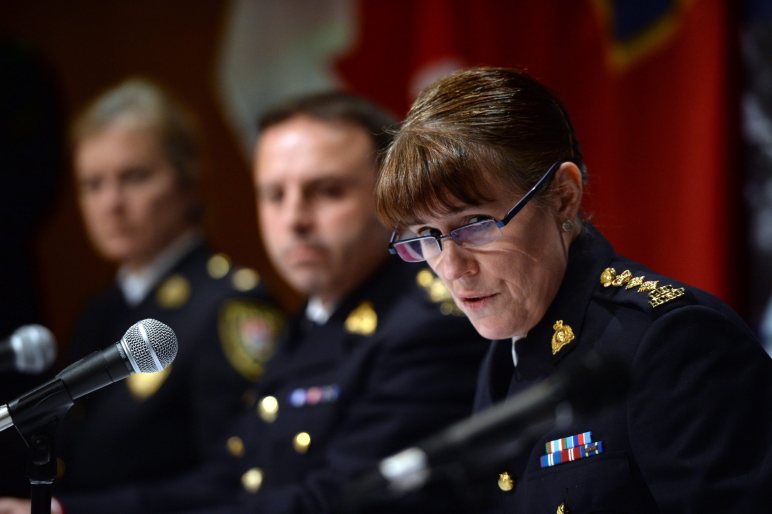
Photo courtesy of CTV News via Google Images- Some Rights Reserved

Jumping Ship….

If you have been keeping track you may have noted that some significant officers of the Executive rank of the RCMP have decided that now is a good time to get out of Dodge. Maybe most noteworthy is Kevin Brosseau the Deputy Commissioner, who was in the running for the Commissioners job; and a couple of months ago another Deputy Commissioner, Joanne Crampton, announced her retirement. She too had been in the running for the job of Commissioner. So both have announced their departure after they were jumped over in terms of rank, by the eventual winner of the Commissioner sweepstakes by Goodale friend Ms. Lucki. In Ottawa, where the Peter Principle seems to run freely and where nepotism is of second nature, one would have to assume that both saw the writing on the wall, that the ultimate brass ring was now officially out of reach.

Meanwhile, out on the West Coast, another darling of the political identity movement, Deputy Commissioner Brenda Butterworth-Carr has also announced her retirement as head of E Divsion. She too was rumoured to be in the running for the Commissioners job and according to some reports was in effect the front runner. Many speculated that the person who was once trumpeted by the Vancouver Sun as a “trail-blazing First Nations leader” saw the grass growing greener on the other side of the political fence, time to put the resume to monetary use.

It is not unusual of course for people to depart, especially when most have a furtive eye on lucrative second jobs, and ex Mounties seem to have a knack for not wanting to retire, and often have ambitions of joining Canada’s 10% economic elite.

To accomplish this they seem to have developed the ability, like “Bumblebee”, to morph into jobs where their lack of expertise does not hinder their aspirations. There are many examples, such as Bill Blair who mysteriously found a new calling in the marihuana industry as a preamble to launching a political career with the Liberals; Julian Fantino, former Chief of the Toronto Police Service who once called the legalizing of marihuana equivalent to the legalizing of murder; and a former West Vancouver Police Chief, the illustrious Kash Heed, who never saw a camera he didn’t like, or a podium he didn’t want to stand on, has also been advising the marihuana industry for years.

Ms. Butterworth-Carr not letting any grass grow under her feet, has joined the ranks of the disaffected and announced her new 2nd job as the incoming Deputy Minister and Director of Police Services for the Province in Victoria; replacing Clayton Pecknold. Needless to say, she has raised a few eyebrows, and concerns about this possible conflict of interest.

Ms Butterworth-Carr was not in her current role as the titular head of the RCMP in British Columbia very long, only have taken the job with great fanfare in March 2017. So she has been in her current top post for two years, maybe long enough to get a cup of coffee at the in-house Green Timbers Tim Hortons, but clearly not enough time to undertake any initiatives of significance.

Her CV is replete with First Nations references and the requisite buzz phrases: “strategic planning” “coaching” “mentoring” and the always suspect assignments of community policing, employee safety and crime prevention. It is therefore fair to question her qualifications for the job as deputy minister where she will be “superintending” policing in the Province, “establishing Provincial Policy standards” and “inspecting and reporting on the quality of police services”, amongst and including the municipal police agencies.

Between her anticipated pension and her new salary, an educated guess will put her pension and salary income over $300,000.00. Clearly she will be joining the select few with a combined salary as much as the Chief of Vancouver City Police and far in excess of any other police chief in the Lower Mainland.

But qualifications and exorbitant compensation aside, what is more curious is both the timing and obvious conflict of interest in this appointment.

During her brief tenure, she saw the City of Surrey vote to pronounce that they are going to go to a Municipal force, a major move which must have sent some shock waves even to the often seemingly disconnected Ottawa RCMP establishment.

As Professor Rob Gordon of Simon Fraser University has said this move by Butterworth-Carr has left him “astounded by the bravado with which they have gone ahead and done this”. What he is referencing is that the City of Surrey must submit a plan to the Province to leave the RCMP, which will need the approval of Mike Farnworth the current Minister of Public Safety and Solicitor General. An advisor to this application will be none other than Butterworth-Carr in her new role, the former RCMP spokesperson and defender of the Surrey RCMP.

To be fair, Butterworth-Carr has never said she disagreed with the people of Surrey a possible indication that she is at least politically savvy enough to avoid the obvious pitfalls. However, since the election in Surrey, she has clearly been directed or taken her own initiative to show and demonstrate how the RCMP, in her opinion is doing an exemplary job in Surrey.

There was evidence of this public defence during a bizarre interview with Global news.  She along with Assistant Commissioner Eric Stubbs and Assistant Commissioner Kevin Hackett presented themselves saying they wanted to speak to the Forces “successes and challenges”. So on December 17, 2018 the three sat, looking uncomfortable, to clearly try and curtail the buzz over the election in Surrey and all the negative news which has been circling the RCMP over the last several months.

They clearly were not prepared despite this interview being by their request. When asked what were the big successes in 2018 Ms. Butterworth-Carr pointed to the “technological advancement” of the RCMP; that they were “piloting digital evidence” and “advancing interactions with Crown”.

If that wasn’t head scratching enough, they promised they were going to be more “tenacious with the social media environment” and they were going to “get out in front of news stories”. They said that the RCMP needs a “progressive culture” and that they were working at improving the “workplace culture”.

Of course the Global news anchor recognizes government nonsense patter when she hears it, so she then asked about the Lemaitre inquiry. Ms. Butterworth-Carr said that she was not in “a position to respond to that”. There was no follow up question, so it was never asked why the head of the RCMP for the entire Province would not be in a position to respond to this issue. The RCMP have been perfecting for many years the old dodge and hide but this defied normal logic.

When asked about the Surrey election and the move to go to a municipal police force she said that it would be up to her Federal and Political masters (she of course did not mention that she was heading over to be one of the politicos -a fact that at the time of the interview must have been known to her)

She did say that the RCMP is “delivering an exceptional service”, which she also had mirrored in an internal memo to her RCMP brothers and sisters saying that there had been “great work done by the RCMP”.

Near the end of the interview, as if he had been jabbed under the table, Mr. Hackett then jumped in to this fragmented interview, with the observation that in travelling the Province with Mr. Stubbs they had noted that there was a lot of “positivity out there”.

So there you have it, the three top Mounties in the Province and their take on the current political and criminal climate in British Columbia. Is there any wonder this group is in trouble or that Ms. Butterworth-Carr is bailing out? With their promises to meet with Crown more often and maybe sending their files in PDF rather than on discs, the RCMP officers watching this display must have felt positively giddy about the future.

It was a glaring example of the total lack of leadership in the RCMP. From top to bottom there is a shortage of principled, dynamic, and informed leadership. Maintaining the status quo, doing the same thing over and over again and but expecting different results and expecting the general membership to fall in line, is in fact the sign of insanity,

The system is such that the commissioned officers of the RCMP need to comply with and be part of an accepted creed of conformity to government and political needs, and they literally spend hundreds of hours playing the system, learning the new terminologies, and gaming the new political identities.

But just once, you would hope that someone arrives at a higher level, with some vision of the future, with some solutions to the pressing problems, and with some ability to communicate that vision. Just once, you would like to see some of them stay around long enough to enact that commitment. Just once, you would like to see someone turn down the rolls of money being wafted tantalizingly under their noses because of their inflated sometimes conjured resumes, and instead hang around long enough to have some success.

This group needs to spend less time on LinkedIn, more time on honesty and integrity, and less time echoing their political masters. In the wise words of Sir Winston Churchill, “kites rise highest against the wind, not with it”.

Leaders become leaders when they step forward and only when they are accepted by their followers. The RCMP is in desperate need of a leader unencumbered or enamoured by trappings or future benefits.

In terms of Ms. Butterworth-Carr and the announcement of her new job, the management of the RCMP and the NDP lead government will likely put on their blinders once again ignoring the obvious conflict and maybe a little jealous of her financial windfall. The police rank and file will resignedly shrug their shoulders, give a ‘told you so’ smirk, and carry on, as there is no other choice.

Potter Stewart, a former associate justice of the U.S. Supreme Court said, that “ethics is the difference between what you have the right to do, and what is right to do”. Sadly, there seems to be no one in the upper echelons of the RCMP or in the current B.C. government that seems to understand that distinction.

Photo Courtesy of DVIDSHUB via Flickr Commons – Some Rights Reserved
Want to be a Terrorist? Call the RCMP help line..

In the last couple of months, the RCMP and its multiple investigative arms have been dealt several kicks to its institutional gut. They have had three major cases stayed in the last couple of months; one involved money laundering, another drug smuggling, and the third was a case of domestic terrorism. They say time heals and thanks to our speedy court system, all of these cases have had some years pass, making us forget the RCMP management bouquets of self-congratulations and the blowing of trumpets at the time of the original arrests. All three of these cases deserve scrutiny and demand some explanations, however the novelty of the terrorist case may be the most interesting and the most concerning.

The RCMP foray into the case of domestic terrorism involved the two now infamous “targets”; John Nuttall and Amanda Korody. A startled public expressed shock and consternation, as for some reason most Canadians still believe they are immune to this kind of thing, while the media tried to outdo each other with terrorism hyperbole.

A trial and the appeal courts five years later however found something quite different. After the initial trial the presiding judge basically overruled the jury, and announced that the two had been entrapped and entered a stay of proceedings on all charges. A couple of more years later, the Appeals court agreed with Judge Catherine Bruce, that this was a “clear case of police manufactured crime…”. That the police “did not disrupt an ongoing criminal plan” as had been advertised, in fact the police conduct of this file was a “travesty of justice”. Harsh words, even for a court system which is never reluctant to put the police on trial.

It is too easy to just say that the police “screwed up” in this incidence. One needs to dig down, sift through some layers of bureaucracy and investigational mandates, to begin to understand where this case went wrong and to begin to understand who should be accountable.

One has to start with the “targets”. Who were these terrorists, Nuttall and Korody? Well, their most notable feature may be the fact that they were two heroine addicts on the methadone program; they did not have their own residence living with Nuttall’s grandmother in a basement suite. They were on financial assistance, spent hours watching endless videos, and, rarely left the house. But somewhere in this sad, desperate, and often mindless existence, Mr Nuttall and Ms Korody decided to convert to Islam. Why? That will be left to the psychiatrists, but in hindsight their religion choice was probably the most significant factor. They likely would have gone unnoticed if they had turned to a different God.

It was 2013, the year of the Boston Marathon bombing by the Tsarnaev brothers. Islamic terrorism around the world was front and centre, both in the news and in the minds of the Ottawa Federal authorities. It would be a year later when a lone gunmen known in B.C. circles as “Muslim Mike” would attack the Parliament buildings in Ottawa. The political climate and the police were on edge. And it was the beginning of this mis-guided investigation.

There was a political environment fermenting in Ottawa, bubbling over with a need to thwart any budding terrorism. A need for the RCMP to prove itself to the world of our contribution to the righteous fight against terrorism. Instead, this investigation would turn out to be a shining example of institutional investigational “tunnel vision”, susceptible to over reaction and seeing ghosts where none existed.

It is also a story of how once the police machine is grinding along it is very difficult to reverse or stop the process, often rolling over any contrary narrative, or any human rights in the process. It is a difficult to explain, a mindset of how everything undertaken must be a success, there was no other option.

Compounding this clouded vision was a lack of supervision, a lack of understanding of the law, and two factions in the RCMP who were at odds with each other on how to proceed.

Clearly he was a violent person, but there are many of them that come across the police blotter, so what made him different than the others. How did this common criminal step over the threshold into terrorism?

In July 2012, the first mention of Nuttall showing some signs of his new prescription for life occurred when a female accidentally overheard a conversation on the street. Mr. Nuttall was on a cellphone, talking or yelling, about “blowing up” Islamic countries and making references to the “afterlife”. The female contacted the police, who attended and spoke with her to verify what she heard. When they spoke with her they noted that she was intoxicated.

A few months later another individual, who the courts call M.C. met Mr. Nuttall at a mosque. The recently converted Nuttall spoke of having killed a Jewish woman (which was later determined to be false); and he wanted help travelling to Afghanistan to take part in a violent jihad. Mr Nuttall was banned from several mosques because of his aberrant behaviour and the individual M.C. expressed concern for Nuttall’s mental health.

There should be no doubt that Nuttall was violent: convictions for robbery, kidnapping, aggravated assault and at least two incidents of domestic violence against his girlfriend/spouse Amanda Korody. All the files referred to his mental instability and behavioural issues.

In normal times, under normal circumstances, Mr Nuttall would have continued to be a proverbial flag in police computers a notation on his police file should he pop up in terms of any investigation or complaint. He seemed more of a subject for the Mental Health Act, seeming to always exhibit behaviour consistent with mental instability. In this case, if he was indeed a wannabe terrorist, he had no problem announcing to the world or anyone that would listen, that he was one, or at least wanted to become one.

An overheard phone call by itself does not warrant too much further action, but then along comes the Canadian Security and Intelligence Service (CSIS), who sends a letter to the Integrated National Security Enforcement Team (INSET) stating that Nuttall was a “potential threat to national security”. It was a “tip”, there was no source of the information given, and there were no actionable details.

A couple of months after this, CSIS sends another letter, updating their information to INSET; upping the ante as it were, now declaring that Nuttall had tried to purchase or had bought potassium nitrate. A chemical that can be used in the creation of explosives. This report too was unconfirmed at the time and in the end never corroborated.

So armed with this rather limited and unbacked information, INSET launches into an investigation. They conduct surveillance on Nuttall and Korody, and quickly learn that they are quite boring, never leave the house, and appear to have no life outside the walls of their house.

Yet, despite the negative findings, and despite it being uncorroborated information, this investigative group decides somewhat surprisingly that they will enter into an expensive undercover investigation, a technique usually used when in possession of much harder information. No terrorist activities had been uncovered, they had little more than one individual, Mr Nuttall, who may have been qualified for examination under the mental health act to justify this next step.

There was no evidence that Mr Nuttall was involved with a terrorist group, but to give the benefit of doubt, the police in this instance presumably must have felt there was enough there to warrant some form of “infiltration”.

There were three investigational groups that became directly involved. The respective mandates and the nuanced differences was where this file left them susceptible to mistakes.

CSIS is an intelligence agency that deals only in intelligence, it does not go to court, its investigations do not face scrutiny or examination in any public forum. It does not want to be exposed to any public light, out of necessity they argue.

CSIS was formed in the early 1980’s when the MacDonald Commission took Security Service away from the RCMP and formed this alternate agency (the primary reason, ironically considering this case, being that the Commission felt that the RCMP lacked the political sophistication to investigate groups such as the FLQ at the time).

The effectiveness of CSIS and its contributions to our national security, are up for conjecture and debate, as no one is fully versed on what they are doing; short of the cabinet committee on security and intelligence. Therefore, the public will likely remain in the dark, now and into the future. It can be argued that there is an investigational necessity to secrecy in the world of intelligence, but the fact that there never will be a shining light on their operational effectiveness, also makes for a convenient and easy hiding place, and is fully reliant on the public trust of Ottawa and its politicians.

With this mandate and with this structure at CSIS, when they receive or are exposed to information which is of a criminal nature, they are mandate bound to turn it over to the police for further investigation, which in this case is INSET. When CSIS makes the decision to turn over this or any criminal information, in some ways their interest in the case fades, as does their willingness and ability to cooperate.

INSET is the Federally directed group within the RCMP, with sections in the various Provinces including British Columbia. For a number of years it has been an innocuous group, hardly heard from, with a reputation of a good place to spend your retirement years, a sleepy hollow, an arm who often liked to hide behind the nomenclature of “national security” if ever questioned. As a result INSET is rarely heard or seen in the public eye.

However, over the last few years it has enjoyed a renewal, brought on by greater Ottawa Federal interest, a large increase in their manpower resources and budget, and this section began to catch the eye of Major Crime investigators who wanted a little quieter lifestyle. As an example, two of the three INSET investigators who formed the investigative group in this Nuttall case came from Major Crime backgrounds. One other thing should be noted and may be a key to understanding what went wrong, is that these major crime investigators brought with them some major crime investigative techniques; which often included undercover operations. That was their experience, it was part of their toolbox.

The third group of significance who may have played the most significant role in this investigation was the “Undercover Shop”. A relatively small section, which developed about 30 years ago. It was a group specifically designed to get close to the criminal element by being one of them, becoming entrusted by them, with the ultimate goal of obtaining confessions or uncovering criminal ties. It enjoys a somewhat misplaced allure not often found in other investigational teams.

As the years have moved on they have become more exposed through the courts, the techniques often on full display, the methods studied in criminology courses. They even talk about it on their own public website. If you were listening to talk radio today you would have heard their techniques being the subject of talk radio. Any technique that is exposed to such a great degree, is less effective and possibly dangerous.

Over they years the Undercover Unit developed tried and true “scenarios”; staged one act plays with police officers pretending to be part of the criminal element, designed to further their credibility with the target; all hopefully leading to a point where the target fills the need to inform “Mr. Big” about his previous criminality. Ultimately the target wants to please, to gain approval of the actor playing Mr. Big and the acceptance and protection of the fake criminal group. In some cases, these scenarios drag on, and there can be over over fifty such “scenarios” or more, but in this Nuttall case, there were only twenty-eight, which may also be a flag of either wanting the file to end, or one borne of a hurried desperation to reach the goal.

In the late 1990’s the U.C. unit became heavily involved with Major Crime teams and began to deal almost exclusively with homicide cases. since 2008 they have been involved in some 350 cases in which 95% have resulted in conviction.) These were cases where murders had been committed, the suspect had been identified by major crime investigators, and the goal of the undercover operation was to get a “confession” to the crime, often to corroborate and verify the circumstantial evidence in the case. It was an important role to play, but it was not up to this group to conduct the investigation.

The Undercover Unit’s exposure in the courts over the last ten years has led many investigators, lawyers, and academics to question whether their techniques are becoming fragile; that these techniques only work on the feeble minded, the un-connected, the neophytes of the criminal world. The unit was becoming less successful with more exposure, and several times have been called out by their “targets” as being the police. They do not talk about the cases that went wrong, nor should you ever hear about them, at least in theory.

So these two factions came together, INSET and the U.C. group, no doubt with the approval of upper management in both B.C. and in Ottawa and a decision was made that an undercover operation would be undertaken. Even though there had been no offence committed, by Nuttall or Korody, and maybe just as notable even though there was no confession being sought. This was by its very design somewhat of a fishing trip, characteristic in some ways of any “infiltration”.

The U.C. group was about to undertake an operation with no goal other than the infiltration of these two abhorrent but sad individuals, but began using a technique that was geared to obtaining specific results, a confession, a “Mr. Big”. The nature of the scenarios were a combination of a need to infiltrate, but they also began using techniques aimed at ending at a Mr. Big. This seems somewhat counter-intuitive from any investigators standpoint and could lead to confusion in the goals if nothing else. How does one aim for a confession if there is no crime? The very setup and the road they were going down was pre-destined to lead to claims of entrapment. They needed to create the crime and push the two targets toward it, the building blocks to an argument of being entrapped.

One should also point out that these types of operations can easily get into the millions of dollars in terms of cost, but there was no municipal or provincial budget oversight–INSET and the U.C. group were playing with Federal monies. (It is interesting to note that with this new found interest in terrorist files in Ottawa, INSET’s budget went from $717,000 in 2003 and in 2013, the year of this case, it was at $22.9 million.)

So the Undercover Operation began. The “hook” or “bump” into Nuttall by the undercover operators was tried and true, the old “would you help me look for my sister” line to act as a public introduction. Nuttall fell hook line and sinker, which in some ways should also have been a red flag, a warning signal as to Nuttall’s mental capacity and competence. He eventually became so enamoured with the operator that he even declared his love for him.

Without going into all the scenarios that were employed, suffice to say that Nuttall throughout: talked of extravagant plans, made ridiculous demands, was unable to focus, could not carry out the simplest of tasks. He went from wanting to kill civilians, to wanting to kill soldiers, from wanting to blow up a nuclear submarine, to blowing up a passenger ferry but not wanting to kill children or innocents. He wanted to blow up the “train” to Victoria, so was quite disappointed to find there was no train that went to Victoria.

He went from wanting to build rockets, and getting access to sniper rifles, to eventually settling for the building of pressure cooker bombs just like the Boston bombers. This more controllable goal was pushed at the suggestion and direction of the Undercover group.

The U.C. “shop” continued to focus on getting Nuttall to write down his plans, no doubt believing that it would be corroboration of his intent and capabilities. Nuttall claimed to have those plans on his laptop, then discovered to not having plans, to being asked to write down plans, and then not being able to physically complete them.

His goals went from freeing Omar Khadr, to forcing the American army out of Afghanistan, to having all the prisoners released from Guantanamo. He was “in training” when he was playing “paintball”. His goals, dreams, needs and plans changed daily. He could not carry out a common grocery list even when directed by the UC operator.

So it was borne out of necessity that the Undercover group began to direct him. (It should be noted that the primary undercover operator despite all of the above, testified that he did not believe that Nuttall was “incapable”).

Once the police begin to direct, all the police personnel involved should have been aware that they were no longer toying with “entrapment” they were now within its grasp. And as early as May 2013 some opinion inside the U.C. shop began to talk about the fact that they were exerting too much influence through the primary undercover operator. One of the investigative team Sargents argued that Nuttall and Korody did not represent a “risk”. Sources say that this Sargent ended up leaving the investigative team, turning over the running of the file to someone with more intensity to push this file.

So it carried on, with Nuttall carrying on his delusional path. At one point he even breaks down crying because he can not write out a plan as he had been directed. He fears the wrath of the undercover operator because he couldn’t do what he was told, even on one occaisson bringing a “marble gun” for protection. After finally settling with a plan, albeit unwritten, to blow up the Parliament buildings in Victoria.

Nuttall insists on videotaping a “recce” to check out the target area discreetly. He is promptly seen talking to police, tourist guides, and using his own name, clearly not having learned the lesson that he should be somewhat covert.

Nuttall emerges from this mayhem, with an agreement with the undercover team to build pressure cooker bombs, just like the Boston brothers. The undercover team manages to control this process, to the point that they were able to make them inert and give them back to Nuttall, so they could be buried in the bushes outside the Victoria Legislature buildings. (They also forget to get the appropriate warrant to give the “bombs” back to Nuttall with a minute trace of C4 and the courts pointed out that the RCMP had in fact broken the law)

Nuttall gets cold feet as the moment nears, to the point of asking for a “spiritual advisor”, and refers to dying like a “martyr”. Graciously, he says he would bequeath his paint gun to the undercover operator for future training purposes.

In the end of this farcical operation, they are allowed to bury the bombs in the “bushes”, and then went and sat in a hotel room waiting for the news to report their feat. Of course, they were bitterly disappointed when the news did not erupt.

With little trouble they were then arrested.

Equally surprising in this tale of misdeeds is that at the end of it all, the police managed to convince the Crown to lay charges.

And then, after the stay of proceedings placed by the trial Judge, The Crown had the audacity to appeal it, spending more tax dollars on clearly a fruitless mission. The Crown, argued in its appeal, that the two suspects were “completely responsible for crafting and carrying out the plan…and the RCMP operation was not manipulative”. It must have been hard keeping a straight face in their applications. There may have been mistakes made by the trial Judge in terms of some of the more legal issues, but no one could possibly argue that this was not entrapment.

The trial judge, Justice Catherine Bruce rightly said that the undercover operator “actually propelled Nuttall to a more extreme view”. She said the RCMP “instigated and skillfully engineered the very terrorist act committed by the defendants”. The RCMP “induced the commission of an offence..without reasonable suspicion or while acting mala fides”. One can forgive the odd Mountie from not understanding “entrapment”, but how do a group of lawyers not understand it.

So where does this leave us. After millions of dollars spent in lawyers and police operations and the errors in judgement will there be repercussions? Obviously not, this is government, this is the infallible RCMP, after all they are not holding anyone responsible for hundreds of millions of dollars in sexual harassment claims.

It should raise questions, not just confined to the individual officers, but to the upper echelons, the supervisors who read and approved of these actions. We have a multi-layered and dysfunctional RCMP in terms of investigational mandates and recognition as to what constitutes a security threat. Sources are telling me that there is another three year long operation, which has also fallen under the same spell as Nuttall. That is trying to find suspects where none exist.

All of this is amplified by an Ottawa which has a severe disconnect with those officers on the ground who are conducting the investigations.

Miscommunication and understanding was compounded by a dogmatic and unbendable and unimaginative Undercover group who continue to use outdated techniques, not being able to recognize that the circumstances should not have been addressed by another “Mr Big”.

It was hurt by an intransigent investigative team, who seemed incapable of understanding entrapment, who just let the machine grind forward. One does not believe for a minute that the officers involved were ill-intentioned. They were struggling inside some vague criminal laws, were lacking sound guidance from Crown along the way and needed a fuller appreciation of the level of sophistication needed to prove an act of terrorism.

There is a monumental lack of understanding that a terrorist act is a political act. There is a 120 year old saying that “One man’s terrorist is another’s freedom fighter”. Nuttall and Korody were neither.

Was Mr. Nuttall and Ms Korody dangerous individuals? To be sure. There are lots of dangerous people out there, just read Twitter.

There is a layered dysfunction in the RCMP. It is an organization consumed by gender and identity politics while a tornado of police needs and demands circle. Always trying to be the one fits all agency, all things to everyone. Doing everything, but not anything well. Whether it be white collar crime, child or internet crime, it never admits its failure, nor do they admit that they have been pulled in every direction while the government ignores or exacerbates chronic manpower and resource issues. They have grown or have been stretched too far, now too big to succeed. Only strong leadership and an honest appraisal of the capabilities and needs of this organization will pull it out of this flat spin.

*All the quotes in this story can be found from the judgement itself listed here:  2018 BCCA 479.

**Also, in terms of full disclosure, the author has had experience in major crime cases, and specifically in major crime cases, where an undercover operation which used the Mr. Big was employed. Some were successful, some were not. The author also was a member of Security Service which then became CSIS.

Photo courtesy of Google Pics- Some Rights Reserved

The Politics of “First Responders”

In March 2017, there was a blog on this site which posed the question as to whether it was time to cut back on Fire Services, who despite a diminishing need for their services,  were in fact expanding in terms of manpower, equipment, and general presence.

The self-justifications for the fire services expansion all hinged on their incursion into medical calls, fanned by the publicity burning opioid crisis. It was the continuing perpetuation of the somewhat mythical life saver dynamic, they being the foremost and therefore indispensable “first responders” that made up the Group of Three.

What stirred this pot which highlighted the decreasing need, was the review in Ontario of the Fraser Research Report, which reviewed Fire Services in Ontario for the period of 1997-2012.  It discovered that during this time period in Ontario the number of firefighters increased by 36.3% while fires (including autos) had decreased in the same period by 41.4%.  In British Columbia in this same time period the number of firefighters had increased by 43.8%.

The hourly wages for firefighters followed suit, in Ontario, their wages went up 47.8% in this same time period, whereas price levels only increased by 34.6%.

All of this growth in both wages and infrastructure, while at the same time there has been a phenomenal decline in the need for “fire” services. There are some estimates that say as little as 5% of the fire department calls now relate to actual fires.

Clearly, this should call for most persons aware of ever dwindling municipal budgets and ever increasing tax levels, that maybe one could do away with some of the equipment, halls and personnel involved in firefighting. Although Ontario did cut back some of their services, most areas including British Columbia seem oblivious to the seemingly obvious.

So how is it that governments, municipal counsels, and the governing bodies seem to have missed this obvious decline in the need for fire services?  In searching for explanations one finds a masterful blend of self-promotion, coupled with an outright expansion of their roles outside of their intended mandate, which this blog covered previously.

Now it would seem that we need to add another component, a political component.

But we need to review how we got this new level.

With subtle flourish even the modern day lexicon has been transformed. No longer, police, fire and ambulance. Now, all are “first responders”.  Their’s is the only one group who has a vested interest as being on par with the others, both in terms of how they are viewed, how they are paid, and the significance of the role they play.

To their credit the firefighters early on figured out that they needed to expand their roles, they need to aggressively move into other mandates, areas where they were not before. In terms of mandate, of course the only place for them to go was to cross-over into the ambulance and police services.

They even made the subtle name change from Fire Department, to Fire and Rescue Services as they jumped headlong into car accidents and medical calls and they have been remarkably successful. They point out in somewhat boastful tones that they estimate 70% of their calls are now medical, as they “rescue” opioid overdoses, or respond to heart attacks. This is true, even though they do not and can not provide the same level of service as the paramedics.

Even their “rescue” capabilities, has become more specialized, now under the umbrella of “Technical rescue”.  ‘Auto extraction’, marine, or bridge rescue components are now separate tranches, in an attempt to be more expansive and all inclusive.  They have also  become, through little debate, the Hazardous Material experts.

Why? Their very employment and infrastructure survival depends on a sleight of hand, the general public needs to believe that they are the “first responders” of record. They need to convince you that they are the white hats, always there, always the first on scene. They are the life savers which we can not do without.

In B.C. there was a recent budget increase for paramedics of $31million.

The firefighters had the audacity to actually complain that it had cut into their calls for service. They justified their complaint saying that they were often first and more capable of getting to a scene “quicker”. The argument of getting there first by the way, is a constantly repeated theme. The obvious counter argument would be if there were more paramedics on the road, people more qualified, than their ability to get there first becomes moot.

The fire departments are unflagging in their efforts. Vancouver Fire Department and “Rescue Services” prior to the municipal elections were asking for an additional 21 fire personnel. They justify this of course on the need  to respond to 6200 opioid calls.

All of the above has been obvious for quite some time but what caught one’s eye during these same elections in the Lower Mainland was a somewhat new twist. It would appear that the firefighters are now honing their political voice, enhancing their political efforts, and are now becoming an active political force, a true definition of a self-interest group.

No more was this more obvious than in the City of  Burnaby, who have now elected an independent mayor, a former firefighter, Mike Hurley in an upset victory over Derek Corrigan.

Burnaby is an interesting case study.

All 281 firefighters in Burnaby belong to the International Association of Fire Fighters, Local 323.

If one visits their website, they make no mistake as to what they believe: “When it comes to Political Action, we support those that support us” – May 17, 2014.

It is equally clear from their website that the building block from which any political action will flow is the charities. Golf tournaments, city fairs, parades, and charitable balls dominate their photos and exclamations of fealty to the community.

In recent years the Burnaby firefighters came into the news on a couple of occasions, one when Burnaby firefighter Nick Elmes and a couple of others formed the Florian Knights, who met with and were sanctioned to wear their “colours” by the Hells Angels. They used to ride to work showing their “colours” before management stepped in.

Then there was Bryan Kirk, a 36 year firefighter who decided to retire after being confronted on his support of “Camp Cloud” which was the campsite put up by Indigenous protestors at the site of the Trans Mountain pipeline in Burnaby. The camp was eventually taken down, via court injunction by the Burnaby RCMP, but Kirk supported the protestors and went on record saying “I’m more inclined to put out the Olympic torch then put out a First Nation ceremonial fire”.  (Newly elected Hurley is also on record, aligning with Kirk, saying that he supports no pipeline.)

As one watched the celebrations at the Hurley election campaign, which was held at the Firefighters Public House in Burnaby, where a smiling Hurley was surrounded by Firefighters in similar styled t-shirts as they celebrated one of their own being elected. One could guess that a serious look at the monies being spent on the firefighters in a time when municipal budgets are under crises will not occur in Burnaby, at least while under the faithful guidance of Mr. Hurley.

This was not the only example.

In Langley the Langley Township Fire Department IAFF Local 4550 were out endorsing certain candidates.

In Surrey, the Surrey Firefighters endorsed Tom Gill for mayor (who lost to McCallum). Already on counsel in Surrey was the former firefighter Mike Starchuk, who was a firefighter for 32 years, and still headed up one of their Charitable foundations.

In 2014 Surrey First party raised $1.7 million in support of Linda Hepner– one of the biggest donors, if not the biggest were the Surrey Firefighters who donated $32, 564. 01.

In fairness, it should be pointed out that other “first responders” have become active in politics. Former police officers have taken roles as counsellors on various cities and townships, and one ex-RCMP member is now mayor of Pitt Meadows.

But this firefighter involvement seems different. It seems more organized, more overt, with an exposed agenda. A concerted effort to get their candidate elected.

Many will argue that they are members of the public, they too therefore have a right to get involved in the politics of the day. That is true and there are special interest groups who put forward candidates, and organize to support those candidates. But this seems somehow different.

One needs to ask, do fire, police and medical personnel hold a special role in our society? Clearly their mandates enter into our lives in different ways than other members of the general public. Are they in a position of undue influence? Do they have access to the media which is not available on a regular basis to the members of the general public?  Should or could it be perceived that there is a political component to the service provided by “first responders”? Police are held back from overt political support by a pressing need to be neutral in terms of the laws and its applications. Should medical and fire service be bound by any kind of neutrality?

It is the slippery slope of mixing politics with your role, especially one that is specifically mandated to serve the public. One should be equally alarmed at the Chiefs of Police supporting a particular party, or ambulance attendants supporting a particular pro-union politician.

One can not help but feel that the firefighter new found interest in municipal politics is also being influenced by the need to get a friendly face on the inside. One who will not question the need for greater and greater expansion, who will not look at the statistics, one who will not worry about unneeded financial expenditures. Is there a faint taint on the Burnaby election?

Maybe we need to go back to “police, fire or ambulance?” which is the first question still asked by 911 operators. Maybe the three services should be examined as separate entities, both in terms of budget and mandate, not as a single group of “first responders”. Taxpayers need to pay attention.

But hey, it’s the Xmas season, and the firefighters are busy setting up the Bright Nights Xmas Train in Stanley Park, where a portion of the proceeds goes to the BC Professional Fire Fighters Burn Fund. The media will be fawning over the children and the sponsoring firefighters on every news channel and after all who could argue with the cause. It’s brilliant and not just because of the 3,000 lights.

It used to be beefcake calendars, it’s much more subtle now, but the impression remains the same.

Photo Courtesy of  Pete at Flickr Commons – Some Rights Reserved

Healing Lodges – just a better place to be

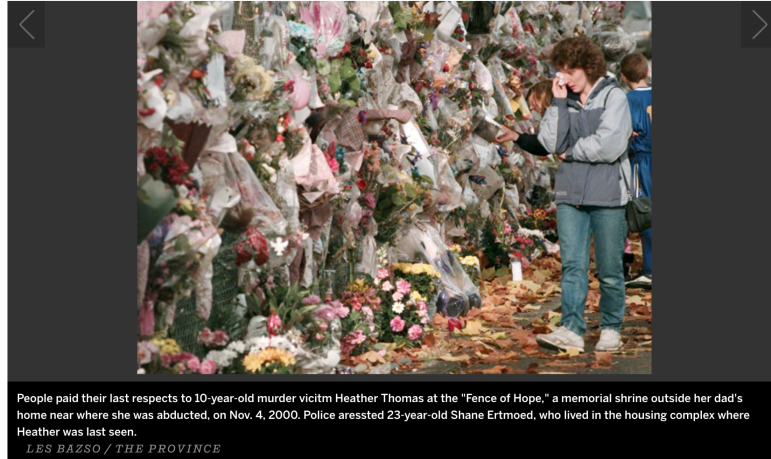
Tori Stafford was last seen alive on April 8, 2009, shortly after leaving school, heading home, captured on a video camera going down Fyfe avenue in small town Woodstock Ontario. She was being led by the hand by a woman, feeling be-friended,  no doubt filled with an eight year old’s optimism.

Almost three months later, on July 21, 2009 her body was found in nearby Mount Forest, naked from the waist down, her Hannah Montana t-shirt and a pair of earrings she had borrowed from her mother her last vestiges of her short time on earth. She had suffered broken ribs, a lacerated liver and had died as a result of repeated blows to the head with a claw hammer.

A slow torturous death. Unimaginable to most, perpetrated by two individuals, 28 year old Michael Rafferty and 18 year old Terry-Lynne McClintic. In a trial Rafferty was convicted of sexual assault, kidnapping and first degree murder.

Originally charged with being an accessory to the murder, McClintic eventually pled guilty to a higher charge of first degree murder.

It was a case that in the view of the general public demanded retribution, they needed to pay for their crimes. We have become inured to a lot of public deaths, not this one, it was one of those that went to a level that causes a visceral reaction, you taste the bile in your throat.

She was sent to the Grand Valley Institution for Women in Kitchener, Ontario, a normal conclusion in our Canadian judicial world to a heinous crime. Justice, or some form of justice meted out.

But then she entered our correctional system. And that is where the story re-ignited.

There is a couple of truisms that usually play out by those prisoners doing “Fed time”. First and foremost they quickly develop the need to survive; they need to find the easiest route through the system, the best jobs, the placement of video cameras, where you sit at dinner, who you befriend, who you don’t. A child killer has a path fraught with even greater peril, their heads becomes a swivel, their own deaths anticipated.  If you are capable, you learn the game and then you learn how to play the game.

A second truism is that those that are incarcerated find religion on a regular basis. It would be fair to say that not many murderers or child killers are religious when they enter the institution. But imprisonment, like imminent death, seems to assist in finding that religious part of your soul and lo and behold a child of God is often re-awakened.

Federal institutions are not fun places and one suspects that McClintic somehow learned of a better place to be during her first years in prison. Somehow she became aware of “healing lodges” which had been created primarily for indigenous women prisoners.  Apartment style living, a kitchen, visitors, no guards, versus 8 x 10 cell living, constantly staring at your requisite Orange is the new Black poster. Who could deny the appeal?

One can imagine the semblance of the conversation, where she was told that you had to be Indigenous to get in (which isn’t true), so she asked how do they test for that? They don’t, she was told. You can just say you are.

It is only a short step to then apply, declaring oneself indigenous and probably throwing in for a little positive aggrandizement, that she was very spiritual in nature.

It took eight years, but at last she got her wish, making it to the Okimaw Healing Lodge.  She had just begun enjoying the comforts of something like a home when all hell broke loose; her case came back into the public eye, and finally the Liberals broke down and made sure she got sent back, the public backlash too much for the sensitive Liberals. Sensitive to public outcry, not the plight of the victims family.

One should not resent Ms McClintic, she was just working the system and it almost worked. It may be that her fellow women prisoners are having a good laugh about the whole thing, McClintic now a heroine for gaming “the man”.

But one must hold the “system” accountable. How the decision was made reeks of a bureaucrat not doing a proper job, but should we not be questioning the very existence of the healing lodges themselves.

According to Correctional Services Canada, a healing lodge is a place where “we use aboriginal values, traditions and beliefs to design services and programs for offenders. The approach is “holistic and spiritual”. A religious treatment of the whole being.

Non-indigenous can also live at a healing lodge however they must follow “aboriginal programming and spirituality”. You must be the same religion, in line with indigenous spirituality. One would think that a person fitting this category would be a rare phenomena.

Spirituality is “the quality of being concerned with the human spirit or soul”. But by no means is indigenous spirituality monolithic, there is no religious uniformity across the country, in fact of the 1.7 million indigenous, two out of three identify as being Christian. So it is sometimes difficult to understand what is being sought or would be practised.

Healing Lodges are funded either by Correctional Services Canada (CSC) and staffed by CSC, or funded by CSC and managed by “community partner organizations”.

There are a total of 9 lodges in Canada, 4 run by CSC and 5 by “community partners.”

How they came about is an example of the Ottawa world and the rarefied air they breathe. A constant whirling mix of academia, politicians intent on re-election, and business leaders trying to get in on the gravy; all feeding off each other, absorbing the latest en vogue thoughts and processes, all circling and feeding. A bureaucracy, acting autonomously, guided by the political flavour of the day, then developed and constructed without scrutiny. Nobody allowed to question or look within, and the process itself hidden behind multiple meetings in multiple layers, conducted in their own governmental language.

This force moves and adapts very slowly, moving in concentric circles, through steering committees, Senate and Parliamentary committees, inquiries, task forces, and fact-finding missions. They are unaware and uncaring of the public looking in, common sense often in short supply. To question is to be tossed out of the circle cut off from the government teat. Costs are not often part of the equation. It is from this process that came the belief that a healing lodge made perfect sense.

In 1990 there were calls and plans being made for five new regional correctional facilities.

A task force, as is often the case, was lurking in the background. The Task Force for Federally Sentenced Women, who in their report “Creating Choices” recommended that one of these facilities be specifically designed and run for indigenous women.

The Native Women’s Association, a Federally funded advocacy group, one of the groups in this Ottawa circle of life, proposed the concept of a healing lodge.

There was also a group at the time of  “former Federal aboriginal offenders who were advising the CSC”.  This would normally make one scratch their collective heads, however it is true. They of course agreed wholeheartedly and supported the Native Womens’ Association in the need for and development of a healing lodge.

So what is the logic behind this clearly subjective policy proposal. According  to the CSC there were two main reasons:

“Mainstream programs don’t work for Aboriginal offenders.”  This seems to have been presented as a statement of fact, but it is difficult finding any verifiable research this pronouncement is based upon.

Secondly, they stated that there is a dramatic “over-representation” of Indigenous people in Federal facilities. (Apparently persons convicted of crimes were now “representatives” and not convicts) They were not wrong.

In 2017 Indigenous individuals made up only 5% of the Canadian population; yet 25% of the males and 36% of the females behind bars were Indigenous. This number is expected to continue to grow, mainly due to the ever expanding birth rates and the continuing problems experienced by the Indigenous.

If one accepts the concept of needing a special place, a place where they would be treated differently from all other inmates, then the obvious next question is do they work?

A review of the digital brochures for each of these facilities talks about a holistic and spiritual approach, training and maintenance skills promoted as in other facilities, but all given the opportunity to “heal”, “grow spiritually”and re-connect with Aboriginal culture”.

Again, little to no evidence of its effectiveness, but they continually issue the statement that  “culturally-appropriate environments can contribute to the healing process of offenders”. That participants develop a “stronger familiarity with Indigenous history and traditional languages”. Not exactly an insurmountable goal, and it would be unfair to expect any kind of reduction of criminal activity, as this is after the fact after all. Heinous crimes have already been committed.

By offering beyond the usual training and teaching found in any correctional facility, does the offering of “weekly sweat lodges”, “pipe ceremonies”, “smudging”,”medicine wheel teaching”, “carving”, “beading” and “sun and rain dances” lead to a lesser recidivism rate among indigenous? Is it any better training than what is offered already to the rest of the prison population. Or is it serving as just an easier place to do your time.

In a 2013 government backgrounder, the government said that the recidivism rate was 6%, when the national average was 11%.

However, in an earlier government analysis in 2002, it measured the recidivism rate as being 19%, compared to 13% for indigenous released from minimum security facilities. A dismal failure.

In 2016 the National Post reported that 18 inmates had escaped from healing lodges over the previous five years. Not unexpectedly, as there are only security guards watching video monitors, instructed only to call the police if someone walks away.

There is even a lack of acceptance by the Indigenous Reserves where the healing lodges have been proposed. In 2012, a Review by the government found that there was a problem with community acceptance as not every aboriginal community wanted or was willing to have the lodges in their communities.

So where does leave us. Everyone knows that the ‘real’ problems for the indigenous: substance abuse, inter-generational abuse, residential schools, low levels of education, low employment and income, sub-standard housing, sub-standard health, isolation, violence, greater inclination to gang violence, and mental health issues are the reasons the Indigenous and their youth incarcerations rates are at stratospheric levels.

In March 2018 the government released a report entitled ‘Updated Costs of Incarceration’. A male offender in a minimum security institution costs $47,370 per person or $130 per day. A female offender in a minimum security institution costs $83, 861 or $230 per day. An inmate at a healing lodge is the most expensive, costing $122,796 or $336.00 per day.

The Salvation Army gives out a bowl of soup and a prayer on the skids of Vancouver each and every day, before providing food and lodging, combining their spiritual beliefs of salvation with a social cause. But they are dealing and providing at the source. There is a measurable impact.

The Federal government has released records indicating that since 2011 over 20 child killers have been sent to healing lodges. The Liberal defence in the McClintic case is that the Conservatives did it too.

These lodges are better for the inmates, providing a nicer place to be, but as a tool in the Corrections toolbox, they have been a costly and failed experiment.

Is it not time to close down this experiment?  Besides, we don’t want McClintic to have a nicer place to stay.

It isn’t fair to Tori.

Photo Courtesy of Carlos Ebert via Flickr Creative Commons – Some Rights Reserved


Surrey Election 2018- is it the beginning of the end of the RCMP as we know it?

On October 20th, the electorate of Surrey said that they are fed up with the RCMP.  With the number of shootings seemingly unstoppable, followed by the usual explanations formulated by practised media spin units,  saying it was a “targeted” homicide, and the “public has nothing to fear”, it seems to have reached a breaking point. Yellow police line tape seems to stretch for miles and dominate the weekend news in Surrey. There are the innocents who have died in Newton, businesses and people who don’t even bother to report crime anymore in Whalley and Guildford,  and they seem to have finally reached the end. It has been a long time coming.

In the past, the 10% discount for the RCMP seems to have silenced the critics who complained of less officers on the street, a growing and expansive police budget, and increases in property crime and drive by shootings. Maybe this is no longer true.

The RCMP has been part of the City of Surrey since 1951 when fifteen constables began patrolling the town which became a city in 1993. It  has been growing at remarkable speeds ever since, with a population now exceeding over 500,00 and the detachment in seeming lockstep, has grown to over eight hundred officers. It is the flagship detachment of the Royal Canadian Mounted Police, their largest detachment in Canada, and that flagship is now sinking under its own weight.

Now, a party led by the irascible, tempestuous and often incomprehensible Doug MacCallum has re-swept into power at the age of 73; running on a singular party theme of safety in the streets.

His newly founded party is a one issue group, calling itself the Safe Surrey Coalition. Counsellors who have swept into office with him, including ex-RCMP police officer Jack Hundial, also have identified themselves as singular in their focus, and that focus is to get rid of the RCMP. In their view and clearly in the view of the electorate the RCMP has failed the people of Surrey.

MacCallum is a colourful character, never an admirer of the RCMP, who was last in power in 2005. MacCallum was removed from power originally in 2005 by Diane Watts, and then followed by her appointed successor Linda Hepner. Both were clear fans of the RCMP, buying into the agenda of the RCMP and sprinkling every press conference with plaudits and statements of the excellent job the RCMP was doing.

But the scepticism has been brewing under the surface for years. Many police officers have openly expressed the opinion that the RCMP can not keep up with the times, including this writer; that it is governed and directed by the highly political Ottawa, an Ottawa and Federal Liberal government which has long since lost the confidence of the public, at least in terms of policing.

A police force which seems to be embroiled in internal unrest, whether it be sexual harassment, or poor wages. Wrapping themselves in the flags of diversity and inclusion, seemingly oblivious and unable to relate to the citizens of Surrey where the bullets continued to richochet around the community police stations.

This is an RCMP which seems to have grown into and become an ineffective agency.  Ridiculously low solve rates, officers constantly complaining about low wages and poor working conditions, insufficient manpower, and a parade of weak leadership at the top of the detachment have been fuelling this slide.

A top management level interested in keeping Ottawa happy,  interested in career advancement and promotion while expanding a bloated and inefficient plainclothes sections, all the while seemingly oblivious to countering the day in and day out criminal activity for which Surrey has always been infamous.

Their only response to the crime, to the death of innocents was that they needed more officers. From Bill Fordy to Dwayne McDonald, always the same, they need more. During Hepner’s time as mayor she claimed to have added 134 officers, but it was never enough.

It was a tried and true chant while at the same time there were several re-organizations of the detachment, each seeming to add further and further layers to the detachment bureaucracy, and a clear bloating of the numbers of officers in specialized sections to the obvious detriment of officers on the “road”.

No one questioned the inside shenanigans at the detachment. At the time of the last municipal election a few days ago, McDonald was again scheduled to request further officers. (It should be pointed out that from 2014-2017 Mr. McDonald was the officer in charge of IHIT, which grew from 48 officers to 110 individuals and a collapsing solvency rate hovering around 20% )

In the last number of years, you would hear words like “progressive”, “community first”, “engaging our youth”; innocuous silly platitudes, all designed to fudge over detailed analysis of what was going on both inside and outside the detachment.

Over the years the RCMP has hidden behind those detachment walls, never allowing outside examination of management to any degree. Annual Performance Plans have been tailored to speak in generalities, no deep dives into the statistics, little of substance or real meaning. An annual exercise in bureaucratic concealment, far from the eyes of the public.

So the citizens of Surrey are now going to begin an exercise to exorcise themselves from the red tunic, and for many that served in this community over the past number of years, it will indeed be sad. But it is inevitable.

The RCMP management of the last twenty years have been oblivious, unable to speak the truth either for political reasons or because they were “going along to get along”. Somewhere the vision was blinded, lost to political expediency, somewhere there has been the disappearance of the goals to “uphold the law and provide quality service”  (RCMP Mission Statement.)  They focused on the writing of the Mission statement and selling it, as opposed to the actual performing of the Mission statement.

They began to develop “strategic media units” to create the spin. Honesty became blurred.

None of this is to say that any upcoming Municipal police force will be a bed of roses. It will be more expensive for sure and political control will be local. Not Ottawa, but political none the less.

Most officers currently policing Surrey will likely switch over to any new agency, grown tired of the RCMP, no longer concerned about being a member of a National police force and not overly concerned with the history of boots and breeches. They are the millenials after all — careers, work life balance and wages are their new loyalties.

There is good work being done at the Surrey RCMP. There are good people working long and difficult hours. There are good investigations which have been successful and most of these people would likely join and be part of any new Municipal agency, lost to the RCMP for good.

The singular and most obvious problem was that the operational policing structure, the traditional pyramid where the solid base was the uniform on the street was turned upside down. It became a top heavy bureaucracy infatuated with promotion and specialization, forgetting that everything starts on the streets. They lost sight of the fact that policing principles, its basics, has not changed for decades. It is a government agency which should never have lost track of what was important, where the expertise and productivity actually come from, those formative years in policing.

Seniority, supervision, and continuity took a back seat to what was perceived and sold as being more sophisticated. Everyone became an expert. This combined with demographic issues has led to the average service of the RCMP on the road in General Duty in Surrey to be 1.8 years. (This according to sources, as the RCMP will not admit to the public that this is the case).

If MacCallum succeeds in removing the RCMP then the RCMP nationally will be affected. It would be an admission that they are incapable of city policing, an admission which  would be a loss of face.

For the people of Surrey who are demanding change, their only hope is that it is successful and the Mounties get the proverbial boot.

To date the Mounties have not re-acted to the election. Maybe, they don’t care. Maybe, they want it to come about as it may lead them toward a possible goal of an FBI style RCMP. Maybe, there will be a domino effect and regional policing will once again come to the fore. Further time will tell.

To the officers that came and went from Surrey Detachment, part of their policing heritage will be altered, and as the “white shirts” toddle off to their better than average pensions, they should at least consider apologizing for their inability to adapt, for being caught up in playing the government political game, for not taking principled stands and  for being dishonest in terms of accountability.

Like the battered and bruised boxer answering the bell after 8 rounds; the RCMP question is whether they can make it to the final round, still answering the bell, arms up trying to avoid head shots, muttering about being cheaper, in an effort to keep from being knocked out. As Roberto Duran said when fighting Sugar Ray Leonard and famously declared “no mas”;  there indeed may be “no more” fight left in the RCMP.

Photo Courtesy of Douglas Miller via Flickr Commons – Some Rights Reserved
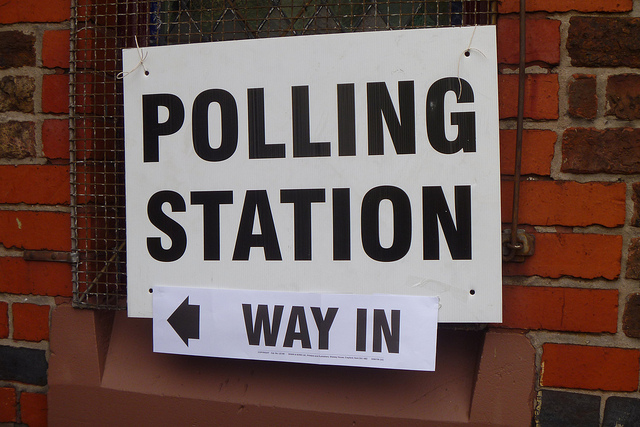


Crime and Punishment on the Prairies…


Like a prairie thunderstorm, building on the horizon and starting to move quickly, the normally placid bucolic life of the small towns of Saskatchewan now lay in the path of this building storm. The W.O. Mitchell’s “Who has Seen the Wind” version of the Prairie lifestyle, is being enveloped and blown aside in a dark wind of violence, racism, fear, and desperation.

This barometric change was entirely predictable. It has been developing over many years, all the while complacent government bureaucracies and police agencies stood idly by; consumed by “modern” issues, seemingly ignorant of the core basic need in government, that of public safety.

It is the most pronounced in the small unique and sparsely populated Province of Saskatchewan, where its main street small towns have become involved in a war of attrition. One side engaged in the fight of maintaining a largely rural lifestyle, the other side fighting for radical change and reimbursement, with an ill-defined final goal. As Ottawa fiddles, rural Saskatchewan is now burning.

This is in reference to the tenuous, often violent,  see-saw balance between the mostly white agricultural community and the Indigenous.  It has been in play for over a hundred years in Saskatchewan.

Reconciliation is the new cry. The Indigenous demand further rights, demand more monies, fresh water, oil rights, the right to hunt, the right to fish, the right to deal marihuana and their cut of the economic pie. These demands and expectations fuelling a seemingly endless amount of court cases.

Whether one sees these demands as fair or intemperate, underlying all of it is a group of Indigenous leaders that has lost control of its own constituents. Many reserves in this country have become crime infested, and a culture of crime is emanating from them in ever increasing concentric circles. Rampant poverty driven crime spilling out into the towns and countryside.  Those waves are now crashing into an armed and increasingly vigilant population not willing to be overrun, not willing to succumb to the apparent effort to subsume them.

The statistics back up the claim that the crime is becoming out of control. The most dangerous cities in this relatively peaceful country of Canada, the ones having the most violent crime statistics are in order:

a) North Battleford,  Saskatchewan

b) Thompson, Manitoba

c) Prince Albert, Saskatchewan.

Saskatchewan remains the most crime plagued Province. A dubious distinction for sure but they hold and have been holding it for many years.

The Prairies is where the Indigenous world meets the other world. It is where radical aboriginal rights meets head on with a stubborn and resistive farm community. It is where it is more eye for an eye, unburdened and unconerned by the latest socio-economic impact study.  It is for the most part, caucasian versus aboriginal, as much as we are not supposed to point that out. It is where racism abounds, on both sides.  The racism has become accepted, part of the dialogue, part of the new way of life.

North Battleford, the most violent city is the epicentre. It is of course near the Red Pheasant reserve, the home of the recent Colten Boushie/Gerald Stanley case. The one where the white Gerald Stanley was acquitted in defence of his property and his family. This was contrary to what the Indigenous wanted, contrary apparently to the outcome wished for by the Liberal government.

The Indigenous, the Boushie family and the Federal Liberals all held it out as a gleaming example of racism in this country. It became a National liberal cause, Canada’s version of the Confederate South and the Yankee North.

Actual details of the trial took a back seat to flashier banner headlines, stoked by a CBC media group which seemed intent on inciting the racist tone to the case.  The whites were forced into hiding, supportive comment for Stanley was pushed underground.

This factional divide did not start in the last few years in this part of Saskatchewan.  It has been building for decades, going back to as early as 1885,  during the North West Rebellion, where eight Indigenous were hung in the Battleford area.

There are two versions of this event. One, according to the whites, was that the suspects were hung for “ransacking”, for stealing from the residents of  Fort Battleford. The Indigenous version on the other hand, said they had only come to “plead” for supplies and were simply massacred. Which side you believe, which is your truth, depends on which side of the divide you fall.

The city of North Battleford is located two hours away west from Saskatoon. It has placed highest in the Crime Severity index since 2009 when they began compiling this information, and still carries this title into the 2017 records. This index and North Battleford’s ranking is heavily weighted by intoxication, theft, and a mass of mischief offences.

Fourteen (14%) percent of the population of Saskatchewan is Indigenous,  but in 2016/17 a staggering seventy-six (76%) of admissions to jails were indigenous peoples. This was the highest of all the Provinces.

The liberal left call it the result of rampant systemic racism, and decry that the system is not working. In response to the high incarceration rates, the Federation of Sovereign Indigenous Nations vice-Chief Heather Bear is quoted as saying “we are working with a broken system….its about lock the Indian up”.  On the conservative right they say the system is working exactly at it should; it is catching those that are committing the crime.

Two worlds colliding. Colonists initially enticed to settle this vast and often barren landscape with promises of 160 acre tracts of land. The ability to own their own piece of the land, made them set sail from faraway shores, leaving impoverished and desperate conditions to fight for a piece of land, a better life. Their new life was not always as advertised, it was often harsh and unforgiving whether fighting drought or bitingly cold winters.

The Plains Cree, hunters and traders meanwhile patrolled this same vast landscape, but they were a culture that did not share the same conceptual framework of property and ownership.

The settlers settled while the Cree continued to roam these vast, and for the most part, unpopulated regions. It was unlikely that anyone believed then that the country was not big enough for everyone.

Colonialism continued, evolved, and developed. Rules and laws were established. Responsibility was based on the concept of the individual. Being agrarians, the land which they struggled with from season to season was their reason for being.  This land was their very existence and thus needed to be defended to the death.

The Cree life began to stagnate, their economic system was beginning to falter. Two very different economic and political systems were destined to clash. One system continued to thrive, the other fell into the abyss. The Cree old way of life is now for the most part unrecognizable.  Successive governments of the settlers tried to reach agreements or impose agreements on sharing, and the treaty system and residential schools were all geared to some form of assimilation.

The 21st century Cree now believe that the historical wrongs need to be righted. Having stagnated for years on the Reserves, they now want their share of the economic pie. They now want what those first settlers wanted. A new life, free of recriminations along with financial wealth and independence. And if the government doesn’t want to give it to them, they will take it.

And therein lies the rub. If the government is going to give the Cree property or transfer wealth then someone else must lose it. The First Nations have tied their demands to the belief that because they roamed the lands, worshipped the lands, it is their land. It is all their land, because they never “ceded” the land.

This very concept is incomprehensible to a group like the Prairie settlers who believe that being here first is not a right to claim all of the land, that their rights should be considered as much as anyone’s, that there is no singular entity beyond the law, no one that is special, no one should have a priority over everyone else.

They describe a Federal government which is continually siding with the Indigenous, afraid to call out the violence, afraid to hurt their constituency.

They describe a cowering police force, sometimes miles away offering little support or even attendance.  The RCMP masters are this same Liberal government and therefore they dare not talk or point the finger at this obvious politically protected group.

So the unpleasantness grows, a liberal social media fuels the invective and the polarized arguments. The farmers in the small towns, arm themselves, preparing for a fight. The farmers demand that individual responsibility and adherence to the laws are a must, something not negotiable.

The result. Fort Battleford which went on to become North Battleford, is now the “most crime plagued city in Canada”. A town of 13,000 surrounded by seven First Nations groups with a total population of around 14,000, are still fighting and the battles may soon turn in to all out war.

The farmer, and the Plains Cree, who once worked together over the last hundred years has inexorably been pushed closer to the gaping chasm where extremists on both sides get the audience and the attention. Can it all be blamed on “colonialism”, or on the perpetration of “residential schools”? Does the 60’s scoop explain alcoholism, abnormally high pregnancy rates, malnutrition, and illiteracy. Not absolutely, it is much too simple an explanation.

The First Nation and Indigenous leaders, who trumpet the need for “reconciliation”, who are quick to cry systemic racism see the only remedy as money and more money.  Separate education, separate justice, separate police, endless health care workers, boundless hospitals and  health systems.

Another truism that never seems to let us down, is that people who have little, see people who have a lot, and they want it too. Two percent (2%)of people in Saskatchewan are on income assistance, while forty-four (44%) per cent of the Indigenous in Saskatchewan are on Federal income assistance. It has created an environment and an addiction to government funds on the part of the Indigenous, while helping fuel a belief that the other side is lazy, not willing to work, not wanting to be part of the larger society.

The Indigenous leaders are quick to jump into any fray, smelling fear in government circles of being branded racist, salivating at settlements way beyond the pale or understanding of the ordinary citizen. But at the same time blindly ignoring the obvious.

Colten Boushie grew up surrounded by alcohol and drugs, not atypical to many reserves.  He talks on Facebook about Red Power interspersed with bragging up the effects of marihuana, all while lamenting the raw deal given to his race.

Colten Boushie died because Colten Boushie grew up surrounded by violence; his banter  more in keeping with the Bloods and the Crips from a land far away.  He had a misguided bravery,  fuelled no doubt by a ridiculous video game level of understanding of that violence and its outcomes. To his group violence was heroic, copied from mediums which were far removed from their personal situations. Spewing toughness, “Fuckn punk d lee duck you talk shit back it up nigga I’m always on my tos come on niggah”, (Facebook – April 24, 2016) when none may have existed.

Colten Boushie’s uncle, his mother’s brother Colin Leonard Baptiste was found guilty of a home invasion in 1994 looking for gas and money. They put two people, Gordon Tetarenko and Bryan Kipp, in separate rooms, and then he and his co-accused Ron Coldwell individually shot them dead with a rifle. Colin was only 23 and served only two years for his murder conviction.

Stewart Baptiste was the Chief of the Red Pheasant Reserve and in 2012 was re-elected finding out from his jail cell where he had been put for breach of probation, and driving while disqualified.

Colten Boushie through no choice of his own grew up surrounded by violence and poverty. He did not have a chance.

The government talks about the “over representation of Aboriginal peoples in correctional services” as if it was a vote. Let us be clear, Saskatchewan aboriginal incarceration rates are reflective of who is doing the crime, who are committing the offences. They are not all innocent, they are not victims, they are hard core criminals, no different than any gang banger or a Hells Angel.

The government of see no evil will not go there. They say things like, the need for an “equitable justice” system. They want policies that address the “representation” of Aboriginal people in the justice system. They make it sound like a misunderstanding that they need to correct.

The Reserves like the ghettos of Jamestown in Toronto, the downtown eastside of Vancouver, are festering pits of violence, fueled by alcohol and drugs and mental illness. This is where criminal activity is bred. There are parts of Winnipeg in the north section which have greater crime rates than the Compton area of Los Angelas.

With over 600 Nations, speaking 60 different languages, they are not a united front, nor one where each nation is equal. Some reserves are heavily involved in the 21st century, building apartment complexes, developing their own pipelines, their own businesses. The others are living in poverty where the dialogue is representative of ghetto rap. They are often being governed by corrupt management and over paid chiefs and “development officers”. Some drive Mercedes while others have no covered windows in their residence.

Some Indigenous are using their political connections to a huge advantage, gaining air miles continually being summoned to Ottawa for their viewpoint. The others are smuggling cigarettes, have no running water, are drinking copier fluid, and breaking into cars in the city for spare change.

Which all leads to what is believed to be a pretty obvious certainty. If there is a chance to stem this growing civil unrest than there needs to be a meeting half-way. Personal responsibility by Indigenous leaders and by their followers must enter the equation.

In this country which is often referred to as a cultural and social mosaic, there is no room for one group having greater rights than others. Each in their own sphere allowed to grow and cultivate their culture and language, but not to the detriment of others. A single set of laws acting as a binder, property rights recognized, but holding to central tenets of decency and honesty.  A respect for others must be re-gained. Assimilation not domination. There is no room for a separate state in Canada.

The Indigenous leadership needs to be held responsible for their people and the actions of their people. The radical statements and cultivating a culture of being owed, of everything being blamed on racism must end.  They need to address issues on these reserves. They need to gain control of their youth, the monies they are receiving need to be distributed down and put to the people directly. The government needs to monitor and audit that spending giving it a chance to be accountable and visible to all.

And it is then and only then that the other side will get out from under a siege  mentality. Once there is a recognition of an attempt to be accountable, only then will it be possible for a reconciliation. Calm measured voices from both sides need to meet in the middle.

In the meantime the farmers will continue to arm themselves and the Indigenous youth will continue to mimic their gangster kin, still destined statistically for a Regina jail.

Colten Boushie and his family, living in squalid conditions, no sense of a future, no  reason for participating, surrounded by a family who seemed to be hinging their future on “reconciliation” and what they believed the government owed them.

Glimpsing Colten’s facebook is in many ways similar to what one would expect from any immature early 20’s male. Random often non-sensical thoughts, but with repetitive themes of boredom, the beauty of marihuana, and the lack of money. But interspersed with comments no doubt particular to Indigenous youth; Red Power, the wanna be affiliation with gangster style and music. Their “bros” are their lifeblood. One friend brags about his friend “doing 25 to life in the Federal pen”

Always newsworthy when the cops are on “the rez”… “a good morning to all back in the saddle again middle finger up to the law” (Colten Boushie on Facebook July 27, 2016) ” and often brave talk of dying or the willingness to live on the edge.

“Its a good day to ride or die” (Colten Boushie on Facebook July 28, 2016)

“Back in the saddle again throw my middle finger up to the law, ain’t gotta rob nobody tonight but I do it just because I’m a nut i get bored did some pills but I want more fuck this world fuck this town” – (Colten Boushie on Facebook April 29, 2016.)

Until the Indigenous leadership recognizes and takes some responsibility for the problems on the Reserves and only when everyone can openly talk about the criminal element which saturates the Reserves and blinds people to real solutions, only then will there be hope.

The current Federal government doesn’t see the storm, only appeasing one part of the equation. This is a Federal Justice Minister who was an advocate for the Indigenous in her previous life and it is obvious to all that she is compromised. She is clearly an advocate of a separate state, a separate set of laws. She has no credibility with one half of the two sides that need to come together. The Poles, Ukranians, Estonians and others who also and equally “settled” this country need to be recognized and have a voice. They are after all the majority.

To do otherwise is a recipe for disaster. Blood is being and will continue to be spilled. The extremists on both sides need to be ignored and reasonable arbiters need to come forward.

Sylvia McAdam from the Big River First Nation in Saskatchewan and a co-founder of the IdleNoMore Movement was typical in her statements, saying after the Colten Boushie verdict that “There’s something very rotten to the core about what’s happening in Saskatchewan”. She’s right, but she is part of the problem, not the solution.

The truth and the road to understanding is in the facts buried just beneath the rhetoric.  Only an honest assessment by honest leaders will pull both sides out of this ever downward spiral.

As Henry David Thoreau said “It takes two to speak the truth..one to speak and the other to hear”.

Photo Courtesy of Mark Goebel via Creative Commons Flickr. Some Rights Reserved


The Case of the Missing 100 Police Officers…

The RCMP in almost every field of endeavour for the last several years has been beaten up, the badge tarnished; the criticisms coming fast and furious, sometimes unfair, but more than often deserved.

They, meaning the management of the RCMP,  have been displaying a lack of operational understanding, often proving themselves to be ineffectual in times of crisis or at critical investigational junctures. This has been in combination with an embarrassing lack of leadership in terms of managing their own personnel.

The RCMP’s inability to solve crimes, their inability to bring terrorists to successful trial conclusions, their inability to defend Parliament hill,  and their inability to appreciate and anticipate sexual harassment civil suits costing hundreds of millions of dollars, have left this once proud organization, this policing icon to the world in shambles. Piece by piece it is being exposed and stomped on, while being watched over and supervised by ineffectual governments.

The current group of managers extoll the qualities of political correctness, strive at being inclusive; they are not known for principled steadfastness, successful investigations or timely intelligence gathering.

The RCMP does not operate in a vacuum. If internal ineptness is not enough they are also being hampered and hindered on several fronts, whether it is the judiciary and the Jordan rule, prosecution services hiding behind “substantial likelihood of conviction”, or a simple lack of resources and an absence of  human relations policies.

The incestuous world of RCMP upper management is now being governed by a new leader, one known apparently for her inclusiveness, and as recently announced her willingness to go along with the mandate of the Liberal government. She has effectively declared herself a follower, not a hoped for leader.

Present day officers have been suffering for years from a flawed promotional and staffing system, an unsupportive  management and an infusion of political correctness that has left this organization confused, struggling with 21st century issues, and in need of a complete re-build.

Many wonder how the RCMP has lost its way in such a profound manner?

The RCMP is being buffeted by wave after wave of 21st century standards and policies being forced upon a 20th century stultified organization. Nowhere is this more evident than at their flagship for operational policing in Canada, the Surrey detachment of the RCMP, its largest operational Detachment.

Located at 14355 57th Ave., in Surrey, British Columbia, its city sculpted flowered entrance belies a troubled organization. Behind this somewhat imposing concrete bunker style building the problems battering the RCMP play themselves out on a daily basis.

As any quantitative researcher will tell you, numbers matter, and an examination of the statistics coming out of this office are enlightening. (After a year long wait, an Access to Information request was recently received.)  Questions have been asked about the makeup of the detachment, the deployment of resources to see what could be found out from this rather secretive group. It is believed that Surrey is an example of what is going wrong within the RCMP in terms of its operational capabilities.

First: the population of Surrey has been growing.  In 2006, the population of Surrey was at 394,080; in 2016 the population was 530,443 an increase of 34% in those 10 years. So you may assume that there must have been a requisite change or increase in the number of occurrences or operational files generated by the RCMP just based on the increase in population? More people, more problems? (Most policing agencies base their requests for further manpower on the numbers, the more people the greater the need for officers, based on a police/per person ratio of anywhere from 1/600 to 1/900 for example)  However, if you look closer you will find a different story.

The actual number of  operational investigational files generated by calls for service went from 162,973 in 2006 to 185,801 in 2016.  That is only a 14% increase. How can this be explained?

One theory is that the reporting of actual crime has dropped. Businesses in Whalley for example, which have been broken into a number of times simply are not reporting them anymore, keeping the numbers at an artificial low. Difficult to measure for sure, but the anecdotal evidence is strong.

It is also possible that the makeup of the population is changing;  is Surrey becoming a wealthier suburb of Vancouver? Is the criminal element shifting further east? Also possible but not being measured as of yet.

So if the occurrences are not growing, because those numbers show an occurrence rate growing at only 1.5% per year, what about the actual types of crime: comparing the years  2006 with  2015.

                                 *2006                            2015

**Homicide                 11                                 15

Assaults                  4,909                              3464

Robbery                   670                              762

Abduction                144                                 45

Crim. Harassment   1, 708                          1,907

B &E                          4675                              3786

Theft MV                 4,769                              3,291

Total thefts             15,068                           15,262

*All Stats are from the RCMP Web sites. ** One should also note that homicides in Surrey are handled by IHIT, not resources of Surrey Detachment.

These are just a few examples listed on the RCMP Web site. What is striking is that the numbers are pretty similar even though nine years of growth have occurred. The crimes of 2006 are the crimes of 2015. Some went up, some went down, and in the totals: Criminal Code offences per population as measured in 2006 was 113.91; in 2015 that number was 97.74.

The 10 year average was down overall. So if one were to generalize, you would have to lean to the fact that the crime rate has actually decreased during this time period.

So if the investigational files generated has only grown by 14% in terms of actual calls to the police, then should we not expect to find that the Detachment has grown accordingly?  The actual detachment size has grown at a staggering rate, despite the drop in crime and a very meagre growth in investigational calls, and despite cries for more officers.

The number of personnel now working in Surrey Detachment during this time period has grown by f 41.069 % .

The annual budget for the Surrey RCMP has gone to $144,981,000.00 in 2017. This is roughly 45% of the Surrey municipal government’s overall budget.

If we examine just one of the ranks in the building, the Sargeants for instance they have gone from 29 in 2006 to 73 in 2017. In strict pay dollars that amounts to an increase in spending on Sargeants who make a salary of $102,715 (not counting overtime) from $2,978,735 in 2006 to $7,498,195 in 2017.

The number of personnel working in the Detachment in all capacities has grown from 570 in 2006 to 837 in 2017.

There is a general theory in policing, that boots on the ground matter. The “broken window” theory of policing as espoused by the New York Police Department to great effect has become an accepted belief. That if you look after the small crimes, the rest will come naturally.  In looking at the growth in Surrey detachment you would probably assume that the streets of Surrey are heavily policed. A police car and an officer on every corner.

One must bear in mind, that the face of operational policing in any detachment is the uniform personnel. They are the ones that take the calls, patrol the streets, and conduct the  majority of the investigations that are generated day to day. The RCMP management continually call it the “backbone” of the RCMP.

The RCMP does not seem to agree or go along with the “broken window theory”.  Remember the cries for help and the 100 new officers that were being promised in the wake of the murder of middle aged mom, Julie Paskall outside the Newton Wave Pool?  The Surrey RCMP decried the lack of resources but promised all would be solved by an increase of 100 officers. (a perfectly round number and one wonders what formula came up with this)

Unfortunately what they say and do is quite different. For the last number of years and possibly decades, the uniform personnel have been treated as 2nd class citizens, and the RCMP management has taken this opportunity to enhance their plain clothes establishment, increasing the numbers and increasing the promotions, growing the policing empire. Upper management at this Detachment have thoroughly bought into the theory that everyone is a specialist, policing is more sophisticated, more in need of specialized education and investigation to combat the overwhelming problems of policing. They have become more of a Federal government department, fat with oversight, fat with overtime, fat with jobs that seemingly grow more distant from the actual job needs. They have lost sight of the core job of policing a City like Surrey.

All officers start on the streets, in uniform, but after three or four year service, most of the current crop of officers believe that their career path has to mean going to a specialized unit. The demographics of the last twenty years with senior officers leaving in droves, means that officers who once stayed on the road in uniform for 12-15 years have been replaced by officers of  3 or 4 years service. And these junior officers, in this environment feel that they should be promoted earlier and be allowed to go to these specialized units much earlier. The current experience of officers on the road has decreased to a significant and marked degree. With seniority declining, the level of experienced supervision has also declined.

According to our filed Request for Information, in 2014, the total police establishment in Surrey was 703. According to the statistics provided by them,  there were 276 officers assigned to General Duty (uniform) for Surrey Detachment.

Remembering there are 4 Watches, that would mean on paper, 69 officers per watch. Unfortunately the RCMP is being misleading.

In actual fact for the years 2011 to 2017 the numbers on the Watch are actually between 40 and if being generous, 50 officers. So 20 or so officers per Watch, have been taken from the uniform side, and also seconded to specialized units. By simply moving the position numbers to the secondary units.

In 2011, when personally last in Surrey, we had difficulty sometimes putting 35 officers on the road, and were routinely calling in officers on overtime to reach the unwritten “minimum” of 35.

Nothing has changed much since 2011. Patrol officers continue to be swamped, unable to obtain meal breaks, unable to get done their 12 hour shift without an extra two hours of paperwork. They were and continue to be over-worked.

If off for prolonged sick leave, or for maternity leave, there is no replacement member put in their stead.

Meanwhile the Detachment managers have for years have been consumed by growth and the perks and enhancements that come with it. The upper echelon have come up through the plainclothes ranks and have become adept on growing departments, padding the payroll, and increasing the promotions, while on the road the uniform numbers remain virtually unchanged, sometimes at dangerous levels.

The  “plainclothes sections”, rule the ship, taking their coffee breaks, lunch breaks, and throwing in a little time for the gym.  Overtime is selective and plentiful. It is “easy street” in comparison to working in uniform.

These are the two worlds in the RCMP; both revolving in the same police universe, but seemingly unconnected. Pepper spray and tasers on one side,  the laptop on the other side. The specialists are not encumbered by a gun belt with the numerous tools of the day, never tied to a radio demanding attention and attendance. They are sometimes “affectionately” referred to as the “carpet cowboys”. It is only natural that they lose site of, and then can not relate to the uniform officer in Estevan Saskatchewan, or the officer patrolling the King George Hwy in Surrey.

In this same orbit, is the uniform officer; tied to the radio, tied to the need for answering calls for service, tied to 12 hour shifts, infinite court, and infinite reporting.

This era of specialization is a mantra, it has taken hold and this general aggrandizement of the roles and ranks of the operations is now firmly ensconced. The Federal and Provincial governments buy the propaganda put out by policing managers giving credence to the theory that if you repeat something enough times, eventually everyone will come to believe it.

So with this increase in sophistication, the argument will be that they are more successful,  it would mean more prosecutions, more success in the courts? Have  prosecutions in Surrey have increased?

In the Annual Report for the Prosecution Service in British Columbia, in  2014/15 there were 59,447 number of accused persons approved to Court in all of B.C. In 2016/17 there were 63,733, a 6% increase.

In 2014 Professor Curt Taylor Griffiths of the Criminology Department at SFU did a study and found that Surrey had the “lowest crime clearance rates” in the Lower Mainland. Also, remember that this was the time that Surrey Detachment was asking and got “100 more officers”.

So clearly all this increased specialization, this increase in manpower, this increase in all these tactical units has not led to a great increase in prosecutions.

So where are those 100 officers that was going to be a solution to all the shootings and the increased crime around Newton.?  They arrived but you can’t see them.

This disappearing magic act is easily explained.  The officers who arrived quickly became absorbed in the operational monolith.  The uniform officers already on the road took this time to apply for and get assigned to plainclothes, to be replaced by these brand new officers. So the detachment numbers increased, not the uniform officers on the road.

The numbers grew inside the building, not on the outside which was the public’s expectation.  There was no increase in the number of “boots on the ground”, which was what was being promised. The taxpayers were duped. More “carpet cowboys” were created, maybe a new Sgt position.

So in this age of declining violent crime, (in 2016 it dropped 16%, in 2017 it dropped an additional 8%) how is that this detachment continues to grow, expand its promotions, expand its core base, and add to the increasing cost of policing in Surrey? How is it that the actual police presence on the road is static, while the ability to respond for calls for service remains virtually the same over the last several years, and the experience on the road is dwindling as is the supervision?

The Surrey Detachment flagship is a reflection of the policing times we find ourselves, and a reflection of the “new” management. Specialization, talking of diversity and inclusiveness, telling the governments of the day what they want to hear.

Uniform policing in the RCMP, its very core, is dying a slow death while bureaucracy rules. Growth of the mandate, growth of the secondary roles is more glamorous, more in keeping with a certain level of sophistication. It is safer, less in the public eye, less risk for a risk averse management group.

Meanwhile day to day policing is looked down upon, where people get sent if they are in trouble. Day to day policing is un-glamorous, 12 hour shifting, working on holidays, endless report writing, Crown Prosecutions sheets prepped while dog tired, all of which will be wrapped in legal arguments to be played out in courts for days on end.

Couple an inability to deliver a core service with thousands of claims of sexual harassment, internal investigations that would make many blush, unionization on the horizon, and unbridled self-promotion and you get a sense of further impending chaos with little or no sense of an ending.  To the old observers and former participants it is futile, doomed to an awkward death.

To the few that hang on; the few that continue to work hard, continue to put the job ahead of their life and their family, they just shake their heads. They keep forging ahead, hoping that someone will care— one of these days.

As to those 100 officers that were received to solve the street policing problem in Newton; don’t look for them on the street. They haven’t actually disappeared. Go down to the detachment and peer in the windows facing 144th Street. That’s where they are, through the tinted glass.

And when you next see four police cars of baby faced officers, sitting in the Tim Hortons at 2 in the morning on Fraser Hwy, having their break of coffee and cruellers, don’t think ill of them. They are not being supported and it is probably their first break in a 12 hour shift. During their fitful sleeps between day and night shifts, sugar plum fairies are not dancing in their heads, they are dreaming of being able to one day sit behind those windows on 144th St. They want to be part of the new policing.

(In terms of full disclosureSurrey Detachment  it was this writer’s home for 10 years. It is my alma mater, and I look back with fondness of my years spent there. I worked in uniform and in plainclothes)

Photo courtesy of Flickr via Commons by FB Some Rights Reserved

Some follow-up

In recent days, Surrey has once again been hit with a string of shootings, one case of particular concern, as the victim appears to be completely innocent; a case of mistaken identity. (This is not the first case of mistaken identity in Surrey over the years as a point of fact). The media are re-acting on talk shows and on television to this latest outpouring of violence.

The RCMP management team in Surrey led by Dwayne MacDonald have provided the expected reaction.  In a rehearsed statement talking about his sadness and outrage and promising to bring the perpetrators to justice.  And in a cute deflection move, released pics of some gangsters who have been shot at recently, and telling the public to avoid hanging around them. Really? He also reiterates how the Surrey Detachment Gang Enforcement Team is “working” with CFSEU. Again, the specialized units who target these individuals over long periods of time is going to solve this, the theme being just trust us we are working hard. He assures everyone that they are “making headway” and they are “strategically targeting” the wrong doers and of course he is asking for “the community to join us in this effort”

There are rumblings developing and judging by the hits on this blog from police and politicians, some people are now seeing the problem of being of one of deployment rather than resources. Current Surrey mayor candidate Tom Gill is calling for a re-assessing the RCMP contract in terms of how the resources are deployed. There have been a call for a “beat program”.  There are even a few persons calling for a regional or city force to replace the RCMP.

The RCMP, if they do not adapt and change are going to go down. MacDonald’s platitudes despite his best intentions are tired, well-worn and of little value. Put away the talk of community “initiatives”, “strategies”, “targeting”, “community effort”, “youth initiatives” and “more resources”.  My advice, get back to the core of policing , put officers on the street. It really is not complicated.


Personal Story – “Heather” Part VII

On hearing the new living arrangements of Shane Ertmoed, I will admit that my first reaction was to drop the “f” bomb a few times, something which was not unusual if you had ever worked with me, but maybe these ones had a little more emphasis and artistry behind them, and I did manage to string quite a few together in sequence.  Of course, after I took a couple of breaths, I realized that I needed to now sell our ability to prevent another child from being hurt, when a five year old girl, was now living steps away from a homicide suspect, with only a ceiling separating them.

So at 8 that morning, in a briefing with upper management, I argued two points which would hopefully allow us to continue on course for the remaining few days. First, surveillance of the new residence was able to determine that there was a separate entry to Mr. Ertmoed’s apartment; which meant that if he tried to gain access to the upper floor, where the 5 year old lived, he would have to first come outside and then go up a separate set of stairs. Secondly and more importantly, the girl was only 5, and therefore was never left alone, and a parent or an adult would always be in the immediate presence of the girl.

The argument was accepted, albeit with some trepidation, but we were allowed to continue on. Needless to say the surveillance team was now under an even greater pressure, especially at night, when visibility to the residence was greatly limited.

(Unbeknownst to me,  I would find out later that one of my manager’s, in an effort to placate the concerns of upper management, took it upon himself to go the landlord of this residence in Langley, and advise him of our homicide target now living in his rented out house. This manager, who will remain nameless,  did not tell me or any of the investigators that he was about to break the police silence on our target, and in effect, jeopardize our entire operational plan. The landlord as it turns out, liked the RCMP, and decided not to tell his tenants right away, to allow us a few days as had been requested. So in the end, we survived this transgression by one of our own but anger would not sufficiently describe my reaction on finding out. My meeting, or confrontation, with this boss did not help my career aspirations I am sad to report. )

As the interview and arrest team continued their preparations, we were also busy with the reporting, the Report to Crown Counsel, and our ending Operational Plan. Other investigational results continued to come in, continued to be reviewed, evaluated, and re-assigned if necessary.

The interview team was in full bloom by Wednesday. The “team”was in its infancy in those days, just having come together more as a think tank, and there was little doubt that this case would be its biggest in terms of the investigational scope, and clearly they would be measured by the outcome and their role. This was the first time that I would not be calling on actual file investigators for the interview,  feeling that a fresh set of eyes, a physically fresh group, a group which did nothing more than concentrate on the interview was a concept worth trying. Greg Bishop who was a member of the team from the North Vancouver detachment was chosen as the primary interviewer, he was going to be the actual “guy in the room” with Shane.

Greg, was similar in stature to Shane Ertmoed, and he had also played junior football like Shane, who as we now learned had played briefly for the Vernon junior football team. (we were interested to learn that Shane would have a large equipment bag when playing football) In fact, Greg bore a resemblance to Shane. Greg’s interest in conducting interviews had begun in North Vancouver detachment, where he specifically took an interest in interviewing sex offenders. This led him to join the interview team. Greg had not interviewed many if any at all homicide suspects.

So it was a bit of a risk, but I was convinced they were going to go to incredible efforts and a better prepared group would not be found. Even two psychologists were hired to take part in the developing of a psychological profile of Shane.

By Wednesday, November 1st, at the end of the day, the interview team sat in the board room with Chris and I, and all the other investigators. For three hours everyone tossed about ideas as to approaches and themes that may work with Shane based on what facts we knew about the case. It was a worthwhile exercise, and what was clearly evident was that almost everyone had taken some ownership of this file, they were all personally invested.

By now we had confirmed that the prints that had been found in Shane’s apartment were not those of Heather, they were a small childs, but who exactly would never be determined. Some minor blood stains which had been found near the bed, also turned out to not be matched to Heather. Blood stains that had been found in the car were also negative.

As to the gymn bag, the Lab was examining the handles and had now identified three DNA samples, and they were now “cooking them”. In layman’s terms this meant that a series of filters were being used to get to the pure sample of DNA. The problem was that this cooking process, this cleaning may actually remove too much, and we may be left with no core sample of DNA. It was a risk that we had no choice but to take.

Some hair had also been found in the bag, but the Lab testing and their eventual results  would be at least another seven days. So any results would not be available to the investigators until after the arrest. Crown counsel would have to take a flyer as to whether we would get positive results in considering charge approval.

Also by this time, we had gone back to Shane’s Cloverdale address and rented the same apartment, allowing our forensic investigators to re-visit the site, but now they could do so with no time constraint or having to anticipate Shane’s return home.

It was also on this day that the funeral was held for Heather in Surrey. Cpl Janice Armstrong, our primary media person, attended along with our Forensic Ident group, who made a pretence of filming the crowd. This is often done by police in the event that the suspect shows up. In this case, we knew where he was, however, a lack of police presence may twig an astute media journalist who may find it strange that the police were not among the crowd.  So far our secret seemed to be holding.

Wednesday quickly led into Thursday, and our report teams were up to date, and the arrest team was now prepared and ready to go once given the word. Our deadline for the arrest was Friday at 5:00 pm.

Thursday morning began with a flurry, when we learned that investigators had uncovered some letters from the complex garbage bins, hand written by what we believed was a young girl to “Shane”. They were able to quickly identify the girl and she and the father came into the office to speak with us. In the interview the girl, probably frightened, probably leery of her present father, would not elaborate on the “diary” letters. It seemed highly likely though, that Shane had befriended other girls in the complex, not a calming notion, but one would have to wait for a few days in terms of searching for other possible victims.

The afternoon also brought some more disquieting news, from the news media itself. Janice Armstrong, our media spokesperson came to meet to discuss a phone call she just received. A reporter was calling to say that they knew we were about to make an arrest, and they knew who we would be arresting!

Clearly our boast of having no leaks to date was now untrue, and our ability to stay on the timeline may now have been jeopardized. The reporter was seeking a comment from the RCMP and the story would be running that night on the 6 o’clock news. However, they wanted to make a deal.

If we allowed them to film the arrest, they would hold off until Friday to go to press.

We played out the various scenarios out loud, the what ifs, and I kept going back to my belief that they likely had one source, thus the need for comment from the police to confirm or deny. They needed confirmation because to go with such an explosive story without doubling their sources could prove devastating (at that time it was well known that news people would not run a story with only one source, sadly, that is not the case today). A final decision was made, we decided we would not have a comment; we would not confirm or deny. No deals would be made.

Of course at 6 o’clock that night, we raptly watched the VTV news, to see if our gamble had paid off.  If they broke the news, then we would need to arrest Shane Ertmoed that night and not as planned. As the headlines scrolled up, the background music intensified, but there was no mention of any arrest. The bluff seemed to have worked, so as we headed out the door that night for a few hours of rest breathing a little easier.

Friday, the 3rd of November arrived.  At 11 that morning I briefed all of upper management of the days activities that were coming, laid out our operational “plan” and the procedures that we were going to follow in terms of the arrest, and subsequent interview.

At 1200 noon, the Crown approved charges under Section 235(1) of the Criminal Code.  1st degree murder. This was the last piece of the operational puzzle that we needed prior to the arrest. So at 3:00 we briefed the arrest team and had them attend to await Shane Ertmoed’s return from work, outside his current residence at 206th and 44 A Avenue in Langley.

Chris and I could do nothing now but wait, so we drove to the perimeter area of the residence, a couple of blocks short of the house, occupied ourself with idle chat and  monitored the surveillance and arrest teams. The calm before the media storm,  waiting for that final radio transmission “subject in custody”.

Of course no arrest ever goes according to a book. The surveillance team lost him briefly for the first time in two weeks. Then they found him again. At 6:00 pm as darkness was falling and the air had become cooler, in this suburban residential area of Langley, with its tree-lined streets, and 1980 style homes Shane Ertmoed arrived home. A passenger in his commuting partner’s vehicle. Just as he stepped out of the vehicle, a plain clothes officer grabbed him by the arm and eased him out, and put up against the police vehicle, There was no struggle or resistance. On being told he was under arrest for murder, he feigned surprise, but said little else, and he was placed in the back of a van where members of the interview team awaited for the drive back to the Surrey detachment.

At 6:05 the local radio station, CKNW, was already broadcasting that an arrest had been made, and as we approached the Surrey detachment, media trucks were waiting at every intersection trying to identify the vehicle that Shane may have been in. They clearly now had their confirmation.

That evening, a press conference was held, where our managers took the podium to announce the arrest, pose for the usual congratulatory pictures, provide the usual “unable to comment at this time” to questions and provided the fodder for the 30 second sound bites. We stood at the back of the room able to hear, but out of sight, some of the adrenaline now draining away. A lot of work was looming ahead, but some satisfaction creeped in, temporarily blocking thoughts as to the further efforts that were going to be needed.

Shane spent the night in a jail cell, with an undercover roommate that had been arranged for him (in the event he would be stupid enough to say something); eating a microwaved meat pie and drinking instant coffee, no doubt preparing for the next day as well.

As he was watched on the cellblock video monitors, listened to on the audio coming from the implanted mikes in cell block, he didn’t seem scared. Was he struggling to control his thoughts, trying to steady his  physical mannerisms, nonchalant, unperturbed by what had just happened to him?

As evening turned to night he curled up under the grey prisoner blanket and went to sleep, snoring slightly.


Photo Courtesy of Les Bazso of Vancouver Province newspaper Some Rights Reserved