Going Gently into the Homicide Night…

On the now widely circulated dash cam footage, on a clear sunny day near the Vancouver International Airport, a black Honda Pilot flies through an intersection, a witness recording the chase excitedly exclaiming that there was a shot fired. A few seconds later, the police car slowly drifts up into the camera angle, to the same intersection, slowly coasting to a stop. A fitting metaphor to the ponderous decline of the abilities of new age policing. The gentler, kinder, softer police up against a rash of gang related homicides which are now plaguing the lower mainland of British Columbia.   

As maddening as it was to watch a police officer give up on a pursuit of these brazen suspects, who had a few seconds before, emptied a clip into Karman Grewal— no apparent inner rage on the part of the officer at having been shot at— it was even more frustrating to watch the spin of the executives of the police brass as they scramble to make the old failed attempts at gang intervention and containment look new. 

One should disregard the ridiculous often asinine media commentary of the last number of days with their simplistic pronouncements and their exclamations of how the police need to do more. The police executive are 21st century conditioned now though, to  always respond to the media inanities, no matter how futile the exercise, while at the same time only capable of trotting out the usual 20th century bromides.  

Spokesperson for the responding Integrated Homicide Team Sgt Frank Jang, in a presser at the Airport, implores those misunderstood gangsters to “Please don’t kill one another”.  In feigned disbelief he laments and states the obvious, that these incorrigibles “are putting us all in jeopardy”. 

Other police responses are equally predictable. “More visible police presence” exclaims the new CFSEU head, Assistant Commissioner Manny Mann, who explains that there are “more gangs than there were 11 years ago” . Don’t fret he says, they are going to counter with ”intelligence led policing”.  

Assistant Commissioner Dwayne McDonald, now head of Federal, Investigative Services and Organized Crime (FISOC) assures the public that the police are “working around the clock” to solve the 10 shootings since April. 

Solicitor General Mike Farnsworth had a meeting with all the LMD police executives wherein they “share their collected and unified strategies”. Assuring all that will listen, that there was an “intelligence led enforcement under way” and that they were engaged in “proactive enforcement”. This is followed by the obligatory “your safety is our number one priority”. The subsequent police press release from this meeting signed by all the Chiefs assured us that they will “not waver in our relentless pursuit to prevent, suppress and investigate”. (They should have sent that memo to the police officer in Richmond— at least the part about the relentless pursuit.) 

Over the last number of years as policing transitioned to social work, there was the singular  solution to this mess. Sociological bandages all coming from a friendlier, more understanding and diverse police departments, all playing on the theme of prevention. The need to stop these kids from entering the gangs in the first place was the stated belief. 

“Stop Now and Plan” (SNAP), “Multi-Agency School Support Team” (MAAST-Calgary), “Wraparound”, then “High Fidelity Wraparound” which was “a complex, multi-faceted intervention strategy aimed at youth crime and gang prevention”. “Youth at Risk Development” (YARD- Calgary) “Positive Attention to Youth Gangs” (PAYG), “Regina Anti-Gang Services Project” (RAGS). And in Abbotsford in 2013 the “In it Together” campaign.  

The latest academic treatise which has been making the rounds;  the Irving Spergel Comprehensive Gang Prevention Model (Dr. Spergel is from the University of Chicago). 

None of the above programs could ever be proven to be effective, so they proffer up anecdotal evidence of a young person turning the corner. It should be considered  irrelevant to the gang homicide discussion. No program ever admits defeat however, but if they do it is almost always blamed on a lack of funding or “limited police capacity”. By the way Sgt Jang is now asking parents to report on their kids which is probably not in the spirit of the afore mentioned programs. 

Other most recent solutions include the Vancouver City Police have putting out a poster with several persons they describe as being at “risk”, people you shouldn’t be around. Presumably these are aimed at people who already hang around the chain wearing Mercedes driving bad guys, directing them to run the other way and maybe call CrimeStoppers and see if you can get a reward for their efforts. One has to also wonder the criteria for selection for this recent imitation of a wild west “Wanted” poster, but you can be rest assured that the individuals chosen will see this as a medal and not a blemish on their budding Scarface careers. 

The Delta PD, for their part have recently introduced an “interdiction” team, rather than a target team. When in doubt, change the name. 

The National Police Federation in one of the silliest statements during this time, is urging the new Surrey Police Force to stop recruiting from the other departments as it is hurting in their gang fight. (This is the same NPF who has argued for the last number of months that no one is leaving the RCMP to go to this new outfit)

In 2014 CFSEU was bragging about how their hard work had led to a reduction in gang homicide. So in 2021 should we conclude that they haven’t been working as hard?  Of course not, there are a lot of hard working, albeit frustrated officers running from pillar to post, trying to patch a case together despite all the significant hurdles. 

If one wants to seriously counter some of the gang violence and I am not sure they do, then you must look at and dissect the issues that are impairing the police at this time. 

There are three parts to every homicide, gang related or not. There is the finding and arrest of the suspect;  putting the case together to get charge approval; and, finally leading it through the Courts. 

Unfortunately, while policing has been strapping on body cams to defend against all arrests being racist, these three stages have developed significant barriers to combatting gang related violence. These hurdles have been growing for a number of years in size and scope and this sorry state of affairs has been brought about by senior police managers, the Crown and the Judicial court system. 

Almost all gang related homicides are solved on two fronts. Simply put, by uniform officers working in the patrol cars— and by informants. “Intelligence led policing” would be in a very distant third place. Any significant gang arrests over the years, have been brought about by attentive policing on the street level and by gangsters turning on themselves. 

So to significantly combat the gangs, more uniform officers are needed and they need to be fully supported. They need to be engaged in pro-active checks, confident in their grounds and support of their supervisors and managers. They need to once again gain control “of the streets”  to the point where the gangsters are fearful of being checked with a gun in the car or breaching their probation and parole curfews. This has to be accompanied by a strong physical presence.The managers like to talk about “boots on the ground” however nowhere has there been a re-structuring of the organizations to insure the uniform officer contingent is the most valued, the best staffed, and where one goes to earn those promotions. 

The need for informants. This blog has written previously about the need for “rats” so there is no need to go into it deeper at this time. But the use of informants has to be both condoned and emphasized a practise which has fallen into disrepair in this social worker age. It needs to be re-instated. Funds have to be made available for agents, rewards, and re-location. Most importantly the reporting process for this has to be heavily redacted and stream lined. The RCMP is the biggest offender in this regard and have literally through bureaucratic oversight killed (pardon the pun) the use of paid informants. 

Once the culprits are arrested, you are only part way there. To state it the most simply, Crown needs to come back to the charge approval of “beyond a reasonable doubt”and away from beyond absolute doubt which they seem to have adopted in the last number of years.

This goes hand and glove with the need to address the problems of “disclosure”. In layman’s terms, disclosure is the need for full and frank exposure of all relevant investigative material to the courts and the defence. The police and the Crown have been erring on the side of caution over the last number of years interpreting relevant to mean “all” investigative material and this in combination of digital record keeping have seen files grow in size from a couple of hundred pages to averaging over five thousand pages. It has even morphed into the warrant applications where at one time they were a few pages long to now look they were written by Tolstoy. All of it is time consuming, manpower heavy, and the vast majority of the information produced of no probative value. Cases have become so heavy in terms of disclosure that they have become mired in a state of suspension, never going forward in a timely way and running headlong into the Jordan decision, which requires timely Court proceedings. 

Finally there is a BC Court system, a court system, which has still failed to recognize that the Hells Angels are a criminal organization. 

Lets face it, B.C. is Canada’s version of California, a society highly tolerant of criminal and predatory behaviour.  The billion dollar drug industry and all the violence that comes with it is virtually ignored in this part of the country and this is simply the payback. 

Drugs are the root of the gang wars, control of the turf paramount to their money and stature. The B.C. Government continues to  turn a blind eye, whether it be drugs, the laundering of monies or the street crime on the downtown Eastside. It’s the three pillar approach the social workers and the welfare infrastructure exclaims and points to as the solution.  If any of this is to change the Judges need to be governed by the protection of the public not the welfare of the suspect. In this new age of “defunding the police” this may be the most difficult wall to climb. 

As those inside the system know, the amount of change that is needed is indeed staggering, requiring all levels of government to come together and make real court tested changes. There is a need for strong and formidable police leadership. Advancement of one’s career in policing is now attached to the ability to appease, to talk the talk of diversity and inclusion not the usurping of criminal behaviour. The police executives seem content to absorb themselves in the spin to the public, promoted by keeping the public satisfied, even if it means lying to them. 

The BC government has no problem, in this time of Covid, of directing police resources and breaching the Charter rights, to check for people going camping. A rather laughable effort to stem virus transmission, but have shown no interest in a concerted effort against the gangsters who have been recently opening fire on outside dining spots. 

The officers of IHIT and other homicide agencies are spinning their wheels, albeit making a lot of money doing it, as overtime is driving file costs in the neighbourhood of half a million dollars per file. There are 400 officers in CFSEU, 100 plus officers in IHIT, now being out gunned by teenage hoodie wearing gangsters with under nourished intelligence. It’s frustrating to them and it’s frustrating to the general public.  Prof Gordon of Simon Fraser University, never one to dodge the cameras, when asked when the gangster war will ease said, “probably when they run out of targets”. 

Unfortunately, he’s probably right. 

Photo courtesy of Flickr Commons by Mika ___ Some Rights Reserved

Rolling the Dice in a Homicide

It was May 2011 when Samandeep Singh Gill, likely with a gangster strut, got involved in a “road rage”altercation and a “fender bender” quickly turned into a cold blooded killing. Gill (allegedly of course) shot the other driver Manbir Singh Kajla several times and Kajla died at the scene. For good measure Gill also shot at Kajla’s newly wed wife, Pavan, before disappearing.

Seven long years later, after IHIT had turned the file over to the Unsolved Homicide Unit in 2016, Gill was finally charged in 2018 with 2nd degree murder and attempted murder. Since the arrest and up to the time of the trial in 2021, Gill was simmering away in jail. The Court did not feel this gun toting Mr. Gill was safe to be allowed out to await his trial.  

However, in March 2021 it all went sideways for the police and the Crown when the presiding Justice of the Supreme Court ruled that the Integrated Homicide Team had engaged in a “systemic, flagrant disregard” for the law, and were “at best wilfully blind” to  this “egregious” behaviour,“. What had been exposed he stated was a long standing policy of “deliberate non-compliance” with the law. With these words Justice David Masuhara of the  Supreme Court then turned to the accused killer and told him he could go home; a free man. 

A good day for Mr. Gill and a horrendous day for the family of Kajla. A catch and release for IHIT and the Unsolved Homicide Team after many years of investigation. Furthermore, there was also the grim prospect that this ruling would ripple through to other cases —especially those which had been brought forward between 2007 and 2014.

The allegations of the Justice, applauded by defence counsel, were indeed troubling. However, as one read the blaring headlines, there was a tenor to the pronouncement which didn’t resonate with those of us that had worked in this field of death investigation. Really, a policy to break the law? Fracturing the law was possible, but how could one be so stupid as to make policy around it.The allegation seemed illogical. 

The answer on further review turns out to be much more understandable; albeit still wrong, but worthy of an explanation. 

The knee jerk furor of the media aside and ignoring the autonomic NDP political damage control that quickly ensued, what kick-started the panic was a low profile, somewhat innocuous section of the Criminal Code –Section 490. Twenty pages of fine print in Martin’s Criminal Code which deals with the subject matter of   “Detention of Things Seized”.  

For greater clarity, the portion in specific contention is section 490(2) which says that “Nothing shall be detained under the authority of paragraph 1 (b) for a period of more than three months after the day of seizure, or any longer period that ends when an application made… unless a justice, on the making of a summary application to him after three clear days…notice thereof to the person from whom the thing is seized, is satisfied…that its further detention is  warranted”.  

In laymen’s terms, when the police seize anything as evidence, usually under warrant, the police can hang on to the items for three months but if they wish to hold it longer they need to apply to the courts to do so. Sounds simple, but it is not. This is in fact a highly burdensome section. Arguably a largely administrative procedure which involves contacting all those from whom the items were seized,  notifying them individually of the future court proceedings where the police would be arguing to extend the exhibit(s) detention.  

But, imagine a case where there are 1200 seized exhibits (the Surrey 6 file as an example) , or a drug conspiracy case with hundreds of exhibits. Imagine an investigation taking a few years, where every 3 month period requires a court application and then you begin to see the problem. To continually comply with this section over forty cases (IHIT average) in one year alone, an army of additional officers would be needed on a full time basis.  Without doubt it is the law but it is equally largely unworkable. Remember that the law never caters or entertains an argument wherein the police or the Crown say something requires further manpower or resources.  It is a police resourcing problem they would rationalize, not a law problem. 

IHIT in this case, and apparently in several others, during the years 2007 to 2014  never complied with this Section. In fact, the Justice goes further and says that IHIT  had an actual  “policy” to contravene the Criminal Code. A written policy to intentionally break the law despite their having been legally counselled on many occasions not to do so.  

The explanation of this being “policy” is also a little more textured. 

To fully understand one must travel back in time to 2007; it was what was going on in 2007 that created the problem for the 2011 case, which was discovered in the trial of 2021.   

2007 was part of the golden era for homicide investigation. It was an atmosphere of smoke filled rooms, drinking, dark humour, and inappropriate jokes on a regular basis. It was the Mad Men years. The pace was often frenetic, demanding hours at the cost of family or relationships. But, it was good, a lifestyle choice rather than a career choice. For some reason, it also worked, with a  solvency rate that brushed against 78% in those early years, while only consisting of four teams of eight investigators.

It was also a time where the officers of early IHIT were experienced and were thus comfortable working on the high wire of the law. There was no principled argument against bending or stretching the law to meet some investigative need. Bending and not breaking was in fact the learned art. 

The Criminal Code was the only policy and guide. Crown prosecutors were trusted mentors. There were no homicide pamphlets, nor did anyone turn to an “operational manual” for any kind of guidance. Just a group of head scratching cops with a tendency to not believe anyone, trust no one, and often used a strong epithet to counter a learned argument, a disgruntled grunt serving as  a yes or no. 

Court was the stage, it was part of the game. Best player wins.  It was a small, compact and familiar group— there were the cops who investigated the murders, the Crown lawyers who prosecuted and the defence counsel who represented the “pieces of shit”.  A grudging but mutual respect built up over years.  

In 2007,  Sgt Al Ross headed one of the four IHIT investigational teams.  During a routine conversation with a  Justice of the Peace, it was pointed out to him that many officers were not complying with the provisions of Section 490, and they (the police)  needed to address the matter. Sgt Ross took it upon himself to try and find a solution to this problem; all while remaining fully aware of the logistical nightmare that this could represent. 

So he sought out and went to speak with Sr. Crown Counsel John Labossiere. Labossiere gave the correct legal answer, “there is no latitude for covert police operations” that the Criminal Code was clear in that regard. There was also discussion and recognition of the issue the police were facing —in trying to comply with this arduous section. 

Sgt Ross then goes to another Sr Crown, Terry Schultes (now a Supreme court Judge) who tells Sgt Ross that they can not ignore the law in this case. Again, there is no easy out., but informally again there was recognition that they “had to make it work”, just no solution as to how that could be done.

Sgt Ross, not known as one that gave in easily, then went to the RCMP legal counsel at the time, Les Rose, seeking yet another legal opinion. Mr. Rose one of the go-to individuals inside the RCMP had a reputation for being somewhat more pliable when it came to the policing efforts. In this case, Mr. Rose told Sgt Ross that he needed to comply, but he also opined that there was a need for “balanced risk management” and that he knew of no case where there had been an “exclusion of real evidence” based on a breach of Section 490.  

Sgt Ross met with the Officer in charge of IHIT, Wayne Rideout, and also Inspector Bill Fordy the latter being one who also leaned to the explanation of the need for a “balanced risk management”.  This was followed by “a memo” coming from the Officer in Charge telling officers not to seek extensions, if they felt that by requesting the extensions they would “attract attention to the non-compliance”.  They seemed to follow that old standard RCMP policy solution –ignore the problem, and in the meantime don’t tell anyone. 

In January 2008, Sgt Ross writes to Supt Wayne Rideout “warning of the circumstances” brought about by non-compliance however he does throw in that  “I anticipate the possibility of real evidence being excluded in a homicide is low”. He recommended that IHIT  try and obtain some further resources and manpower, absolutely needed he argued, if they were going to get some sort of ability to comply with the section.  

Fast forward now to 2011. 

S/Sgt Gorgichuk, who was then a Constable with the 2nd generation of IHIT investigators, was the file co-ordinator for the Gill attempted murder case. She appeared at the trial in 2021. Her testimony and explanation of Section 490 did not go well. 

In this case, search warrants were executed on the Gill residence. They seized nine cellphones because “they didn’t know which one was the accused”. They also seized a home security videotape (which was not included on the warrant), after getting access to the residence. Amongst the phones seized was a 60 second audio clip, captured apparently because of a “pocket dial” during the time of the shooting; which implicated Mr. Gill in the killing and therefore a central piece of evidence for the Crown. 

Unfortunately the Crown and their police witnesses ran into a very able and formidable criminal defence attorney Matt Nathanson. One could question Nathanson’s choice of high paying clients, but one could not question his experience and intelligence.  

Nathanson challenged the seizure of the video on the grounds that the home security camera was not on the warrant.  He also challenged the seizure of the phones on two primary grounds. The “over reach” of the warrant and the criminal “policy” of IHIT of not complying with Section 490 of the Criminal Code as testified to by S/Sgt Gorgichuk. Nathanson no doubt with his most theatrical voice pronounced that he had “never seen anything like this before”, this wanton disregard for the law.

Justice Masuhara agreed. The over reach or what the Justice calls “over-seizure”on the cellphone seizure and the fact that it was an unlawful search of the security camera system was what warranted exclusion of the evidence flowing from it. 

What pushed the Justice over the line seemingly was the “policy” which S/Sgt Gorgichuk “acknowledged her awareness” of —that  “direction” in 2007  not to comply with Section 490.  

Far be it for this outsider to question S/Sgt Gorgichuk, but it is difficult to believe that she did not comply with Section 490 in the Gill case— because of a remembrance of this “direction” that was issued in 2007. Gorgichuk was a Constable in 2011.

 The Justice wasn’t enamoured with her when describing her evidence: “I determined that S/Sgt Gorgichuk was not a credible witness and that she engaged in advocacy, though I did not find she intentionally misled the court…  As I have stated, I did not find S/Sgt Gorgichuk to be a credible or reliable witness …she refused to acknowledge errors in her testimony even when confronted with clear evidence..her testimony was nonetheless misleading, combative, and at times contradictory” 

S/Sgt Dwayne MacDonald (now the Officer in Charge of Federal Investigation Services and Organized Crime) was the Team Commander for the Gill case. The Justice speaks to his testimony and of his apparent cancelling of the “directive” in 2014 (worthy of noting that the Justices’ language went from calling it policy to a directive)when he says:  

“On XXXX 2011, S/Sgt Dwayne McDonald was a Team Commander at IHIT, responsible for the investigation of the murder of XXXX Kajla. Since 2007, the senior management at IHIT had provided direction with respect to applications for the extension of 5.2 Detention Orders. Specifically, that no extension of the 5.2 Extension Order would be sought upon the expiry after 3 months (I believe that the two XXXX references by A/Comm Dwayne McDonald in this email were a direct result of him not remembering the exact information);” In other words, he was guessing a bit. 

From a police perspective, is some of this understandable and even arguable? Maybe. 

This writer believes that non-compliance with this Section is rampant in every part of this country, in every police agency in the land. It is largely an unworkable Section of the Criminal Code that needs re-vamping, especially in times of limited resources and “defunding” of the police. 

It is obvious though that IHIT rolled the criminal trial game dice, and they lost, they busted.  In doing so have blemished the already burnished reputation of IHIT.  Only Mad Men would have taken the chance. 

For the record, this writer does not believe there was any “policy” of non-compliance. In fact the Acting Officer in charge Michelle Tansey of IHT recently said “this was not policy”.

David Eby the Attorney General for the Province of B.C. is “studying the viability of an appeal” even though the BC Prosecution Service has already stated that an appeal would “not likely” be successful.

To measure his chance at a successful appeal, Mr. Eby may want to go down the hall in Victoria and speak with his new hire—the Director of Police Services for the Province— Wayne Rideout– and ask him whether in fact he authored a  direct “policy” of non-compliance. Seems simple enough.

Or the NDP and the RCMP can just roll the dice again …and hope no one else goes free.

(Full disclosure: this writer was one of members of Integrated Homicide Investigation Team from its inception in 2003 to 2008. All the parties in this blog were not only known by me, but I worked and consulted with the cops and the lawyers mentioned in this blog on a relatively regular basis. In addition, as a team leader of one of the investigative teams would also have been privy to any policies within IHIT )

Photo Courtesy via Flickr Commons by PositiveCandie_N –Some Rights Reserved

Pandering

Under the cloak of COVID, while monies are raining down from on high, the Canadian government has decided that this is an opportune time to pander to the select groups who hold the Federal Liberals dear to their socially active and political hearts. Their slobbering self interest doesn’t seem to know any bounds and it is certainly not constrained by any concern for budget. 

Is it all aimed at a near future election call by the Liberals? Most likely. Is it cynical, opportunistic and ethically questionable? Yes it is. Do their actions have any merit? Possibly, but it would be difficult to measure. However, their motivations are obvious. 

On February 19th of this year, in a single day, the Prime Minister announced three items with that somber voice designed to instil righteousness and clearly aimed at those of us with Grade 8 education levels.  

The first, which is economically debatable but politically obvious, was the extension of the CERB benefits for an additional 12 weeks. Sick benefits were extended as was Employment Insurance for a cumulative total of 54 weeks. The pros and cons of doing this is one for the economists to debate. Clearly though, the handing out of funds never seems to engender any liberal or social antipathy and Mr. Trudeau seems to relish the daily ritual coverage of the doling out of monies, as he guides us to health and prosperity and implores us to save lives.

The second announcement was the re-tooling of the Official Languages Act, which Mr. Trudeau described as legislation to further enhance that “beautiful french language”. In this “modernization” of the Languages Act  as presented by Ms.Joly (a rumoured “favourite” of Mr. Trudeau) should raise some concern and debate; although admittedly no one seems to be paying close attention to an Act to do with languages. It seems like strange timing in terms of priority, until you read what the changes entail. The Bloc Quebecois and the NDP who are currently supporting the minority Liberals must be aware that Mr. Trudeau is preparing to try and pull the rug out from under them— by usurping their claim as being a better representative of the people of Quebec. 

The first amendment is to Section 83 —which states that “nothing in the Act abrogates or derogates from the rights of other languages, by explicitly mentioning Indigenous languages”.  This is lawyer inspired convoluted language but the intended results are that Nunavut and the North West Territories will officially recognize English, French and “indigenous languages as official languages”.  Surprisingly, little fanfare to announce that Canada has another “official” language? It may also seem trite but compliance to this could have profound effect on the courts and the providing of government services.

Also in this Languages Act the government is proposing to “encourage” further funding for french immersion across the country– including the hiring of more french immersion teachers, and even stream lining a “Francophone immigration corridor”. All this to aid them in their search for French speaking teachers outside of Quebec. 

No matter how meritorious this promotion of the french culture and language it is coming at a time when French as a language and culture is dwindling. Using their own statistics, the francophone population outside of Quebec in 1971 was 6.6%. It was 3.9% in 2011 and is anticipated to be at 3.0% by 2036.  One has to question whether an “immersed” Canada outside of Quebec is a relevant and achievable goal. The Liberals clearly think so, but they are likely more concerned in how it will “play” in Quebec. 

Finally, since 2016 the Government of Canada has been “committed” to appointing “only functioning bilingual judges to the Supreme Court of Canada”. However, there was an exception clause in the act under Section 16(1) which was purposefully placed there in consideration of the need for geographic representation on the courts and a possible lack of bilingual judges in the unilingual West. The Liberals are now going to remove this exemption, so that all will have to be fluently bilingual to serve on the highest court in the land. This could have a direct impact on the makeup of this highest court, more francophone than representative.

As an oblique aside, the Government says that “it will be necessary to keep in mind the importance of representativeness of Indigenous peoples in the highest institutions of our country….”. They then direct the Government to “actively envision the appointment of Indigenous judges to the Supreme Court of Canada”.  One has to admire the “actively envision” language as camouflage for a direct order.

Which brings us to the the third announcement of this busy day.

It pertained to Bill C-22, which is to deal with the “Mandatory Minimal Penalties (MMP) as outlined in the Criminal Code and the Controlled Drugs and Substances Act.  They are announcing changes to the fourteen offences in the Criminal Code and six in the Controlled Drugs and Substances Act. Why? If you follow this Liberal government you probably have already guessed. Because, minimum sentences “targets black, indigenous and racialized communities”. 

Their blatantly stated goal is to bring down the numbers of the Federally incarcerated who are there due to “systemic discrimination and racism” and a system which they believe punishes “black and indigenous people”.   Mr. Lametti seems to want us to believe that this “over representation” was some form of pointed racist selection process, not the result of persons having committed the crimes.

The statistics are bold and clear.

 From 2007-2017 they argue “black and indigenous were more likely to be admitted to federal custody for an offence punishable by a MMP”.  Although only 5% of the population is indigenous, they make up 30% of the Federal inmate population; blacks represent 3 % of the population but represent 7.2% of the incarcerated. The answer, according to the social progressives, is not to try and stem the crime by fighting the obvious crime instigators like poverty and unemployment in these communities. Their solution, if parties are caught in a criminal offence, is to promote “judicial discretion”. They are directing Judges that they “must take into consideration the individual and their experience with systemic racism”. 

They will even be funding $28 million to “social contracts training” for  Judges in case they are missing the message. 

Is there evidence that mandatory sentencing doesn’t work? Yes, but there is also evidence that it does work, so this reformation is not necessarily based on the evidence— what it is based on is playing to a certain minority.  

In 2008 the Supreme Court of Canada ruled that minimum sentencing was constitutional but maybe not an “appropriate response” to Section 12 of the Charter which deals with cruel and unusual punishment. 

The pros of minimum sentencing point out that it eliminates disparity, provides consistency, and avoids Judge shopping. If one holds that the law should reflect the peoples wishes, in 2005 —74% of Canadians felt that sentencing was too lenient. It should be remembered that the minimum sentencing was brought into effect under the dreaded Stephen Harper Conservative government in response to Canadians and their complaints about the lack of justice. 

But none of this seems to have been the motivating factor for Justice Minister Lametti. What may be more relevant is that the multi-party “black caucus” issued a call to action  and “demanded the elimination of mandatory minimums”. Mr. Lametti a signatory to this document.  

There is little doubt that Mr. Lametti has been emboldened and given comfort by the courts, which are allowing him to play to the minority audience. 

In 2016 in R vs Lloyd, when dealing with some drug offences, the court thought that the drug offences and sentencing for them did not take into account “indigenous heritage and the impact of colonialism”.  In R vs Gladue the Judges said that a different “analysis and approach is required by Judges when sentencing aboriginal offenders and that “imprisonment is a less appropriate or less useful sanction”.  

Far be it for this writer to be in disagreement with the learned judges of the Supreme Court of Canada. They are a distinguished group of scholars, but their voting records seem to have a very natural lean to the left. Mr. Lametti and the Liberals are also playing in the Biden band and trumpeting whatever is currently playing in the North American media. The riotous Trump entourage is now thankfully gone but we now have the Trudeau and Biden love-in which could prove equally destructive and divisive with its approach to social issues, or rather its dogmatic adherence to Twitter driven policies.

Having lived most of my life in the criminal world, the positions of this Liberal government when it comes to crime and minority rights, seems at times completely ludicrous. We have been traveling down this left branch of the victim road for an interminable many years now. One has to wonder and ask that with each further step— are we getting any closer to some ill-defined justice utopia ? By creating different classes of criminals with different levels of personal and cultural responsibility are we moving towards justice and fair and equal treatment, or away from it? 

The Merriam-Webster dictionary says that the definition of justice is a concept on ethics and law “that means people behave in a way that is fair, equal and balanced for everyone”. Minimum sentencing seems to fit that definition whereas the policy of Mr. Lametti feels that the principal of proportionality applies and one should allow for “the role of the social context”, which seems counter-intuitive.

The symbolic scales held by the Roman Lady of Justitia symbolizes giving fair and objective consideration to all evidence, without showing bias one way or the other. Mr. Lametti and his Liberal colleagues are unhesitatingly standing on those scales and even trying to influence who hold those scales. They are brazen in their efforts, choosing a time when debate and accountability have been Zoomed out.

The fifth estate have been completely coopted by the the social agenda, content to just count the number of COVID cases and their variants. To them, application of justice, or the breach of charter and constitutional rights are far less interesting than Oprah, Harry, and Meaghan. The pablum of celebrity successfully diverting us from worthy debate on issues of importance; and, that is what the Liberals are counting on.

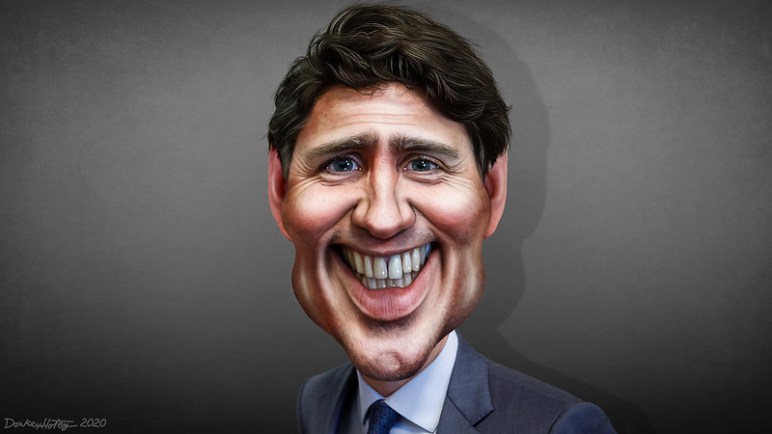
Photo courtesy of DonkeyHotey via Flickr Creative Commons – Some Rights Reserved

Let them Eat Cake

As you or may not be aware, there are three classes or categories of employees within the RCMP according to the Federal Public Sector Labour Relations Act.  The first are those that have representation; those officers now being represented by the novice union, the National Police Federation (NPF), and the officers are now dutifully paying union dues. The second category are those who are managerial, but are excluded from representation, civilian members for the most part. The third and final category are the officers of the RCMP who have no representation. This final category are the upper managerial ranks —Inspector and above, purposely distinguished from the rank and file by their “white shirts” and their brass laden uniforms. 

No doubt you are wondering how these “white shirts” are faring in this day and age when the RCMP is being pummelled from all sides. They have had no pay increases either since 2017— despite this loftier status.

To be sure many of those in the elevated ranks have already gathered up their challenge coins and headed for the exits, driven out by old age or a sense of foreboding. Some are clearly worried about their perceived paltry pensions and are seeking salvation and further riches on the civilian horizon; bound for guarding the pipeline, the Independent Investigations Office or dare one mention the new Surrey City Police.  

But for those that remain behind and for all those that aspire to become one of the knighted, there is still some hope. 

The general public may be a little amazed to to learn that these officers, who have gone from one disaster to another in the last number of years, feel that they need a pay raise and an increase in benefits, usually the reward for a job well done.

However, in the policing world, pay raises are the result of a constant ratcheting effect, a keeping up with the Jones’ kind of rational. 

That aside, the difference this year is that for the most part, their pay and benefits are going to be paradoxically tied to the unionized rank and file and the capabilities of the union negotiators of the National Police Federation.  

Recently, I listened in to a recorded zoom style meeting, billed as a “Town hall” meeting which was open to all of the white shirts of the RCMP.  Admittedly, it was a bit like crashing a get together at a Masonic Hall, as one could not help but feel that by listening in, without an invitation, was somehow illicit. 

The meeting was chaired by C/Supt Leslie Ohare and Supt. Bert Ferreira who have been overseeing the “Officer Consultative Committee”. This committee is designed to be an intermediary or representative body for the officers with the Treasury Board Secretariat. The TBS will end up making the final determinations as to the white shirted officers in terms of pay and benefits and is the same Treasury Board Secretariat that is currently negotiating with the NPF. 

So things have now changed with the coming of age of this union movement. The white shirts are for the first time facing Treasury Board, cap in hand as usual, but this time dependent on the NPF settlement. The reason is that Treasury Board must know the end results of those negotiations, before they can make a determination as to the rates of pay for the senior executive. 

There were two terms heard when listening in on this meeting with reference to the demands of the executive and that is what they call the “pay line” and the need for there to be “no inversion”.  In simple terms, they just mean that depending on what a Staff Sargent gets will by necessity determine what an Inspector gets. The accepted labour relations argument being that there is a need for pay separation and also satisfying the need to incentivize these higher positions. They don’t want some lower position getting greater pay and benefits than the white shirted, which would be an “inversion” of the salaries. It is a caste system after all, so one could not bear the thought that some operational lower rank could surpass an administrative manager, no matter what their respective roles and responsibilities. 

So, now the white shirts are cheering on the NPF. Ironic to say the least considering that for decades these same managers argued and fought the battle against unionization.

In terms of the current ongoing NPF negotiations, Treasury Board confirmed during this meeting that the negotiations are currently scheduled into June 2021. They are meeting monthly (the next meeting is scheduled for March 2-4, 2021) and all  are hoping to have a deal done by the summer –which would require ratification by the rank and file and a possible pay raise by the Fall of 2021. 

Should no agreement be reached and arbitration needed, it was also learned that this would delay any settlement for at least another year. One would think that this would not be a very sellable position for the NPF.  

Originally, the NPF was arguing publicly for a 17% pay request, but lately in their news releases or interviews they seem to be avoiding those bald numbers in terms of what they are asking, likely thinking that it is better to slightly dampen expectations. One would have to think, that inflation alone for the last few years would probably guarantee an 8% increase. That in itself would bring the 131st rated RCMP constable from $86,110 to $92,998. This is still a long way from the Delta Police who are currently ranked number one at $107,840. Even third ranked Edmonton is at $106,262, still leaving a discrepancy of $13,264 per year. 

Of course no one knows what the free spending Liberals are thinking. The Treasury Board makes recommendations to the Cabinet and they base their recommendations on three major factors; the size of the total compensation package, the internal relativity to other similar agencies, and the “state of the economy”. One of the negotiators with Treasury Board described the negotiations with the NPF as “the mood being receptive” but added that there were still “many issues outstanding”. 

During this “town hall” the officers asked why they couldn’t get their pay raise immediately, but were given the standard answer of needing to wait for the NPF.  These same officers are  also now demanding (or asking for) : – unlimited sick leave, an increase in their pay to make up for the fact that they do not get overtime, and forty more hours of annual leave. They were also seeking greater benefits. On their list were increases in the dental service allowance; an increase in the PSHCP dependent coverage and an increase in life insurance from $160,000 to $500,000 with the employer paying all premiums. 

These demands would or should not be considered out of line in terms of executive compensation. However, it will be difficult for the general public to rationalize demands for pay raises with the demonstrated fallibility of the RCMP senior ranks. The RCMP has hit a new low in terms of recruitment, morale, pay, and the implementation of the diversity and inclusion agendas. 

The last few years has also watched them pay out hundreds of millions of dollars in compensation from the harassment suits, has seen report after report demanding changes of the RCMP. Shortages in manpower have been termed a “crisis” and over 3,000 complaints were filed against the RCMP in 2017 alone. The use of force during this era of Freddie Gray has risen 10% in the last three years. It has overseen operational and investigational disasters such as Mark Norman and are now waiting for the fallout from Port au Pique, and Cameron Ortis. An internal audit in 2020 said that the Mounties were accepting applicants who were poorly qualified and some even with criminal records. That the emphasis was now on “the quantity of applicants with less focus on the quality”. The solution to these recurring pitfalls is not either obvious or on the horizon.

The senior ranks throughout history have promoted their distinct and honourable position in the RCMP. They are to be saluted when passing, paying deference to their wisdom, experience and at having reached the upper echelons of a world class police department. All of these perceived notions can now be effectively argued and challenged. Promotion to this group has become diluted by policy, dwindling experience and best intentions. The red serge is becoming threadbare, exposed threads being pulled on a daily basis.

This fraying of this once proud organization has been overseen by this same group who are demanding, in fact assuming, they are to be rewarded nevertheless.

Like Marie Antoinette telling the throngs to eat cake in lieu of enough bread to eat, they seem to have “a frivolous disregard for the starving peasants and a poor understanding of their plight.”

Their personal financial goals on the other hand are seemingly quite clear. The senior ranks of the RCMP will continue to demand their cake.

Photo courtesy of Irina via Flickr Commons – some Rights Reserved

Commissioner Lucki and Her New (but Old)”Strategy”

This headline and announcement came on January 26, 2021, relayed to all members of the RCMP in the form of a Commissioners Broadcast. One would have thought on first glimpse that finally there was finally some addressing of the multiple concerns now facing this organization. Had the Chief Executive of your National Police Force finally awoken from her semi-slumber to finally deal with some of the many issues plaguing the boys and girls in red? 

Well you would be both right and wrong. You would be right in assuming that there is in fact a new announced strategy. You would be wrong in thinking this was a strategy that was new in terms of goals and or objectives. You could also be right if you paid it little heed and put it in the category of the never ending pablum which continues to spill forth from Ottawa.

There will be a very select few within this vast organization who will be nodding their heads in affirmation of this new “strategy” but we would be equally safe in saying that those that would applaud this new development are not the same people that are working the night shifts in Coquitlam or Burnaby tonight.  So what is it?

 Is it a strategy to deal with recent gun violence?  No.

 Is it a strategy to deal with the lack of ability to recruit new members? No. 

Is it a strategy to deal with the current salary structure of the RCMP? No. 

Rather “today is an important day for the RCMP” because on this date, the RCMP has launched (with the fanfare of an Elon Musk Space X rocket) the “Equity, Diversity and Inclusion Strategy”.  If this was not enough excitement, she also announced that this strategy would also be part of the “Vision 150 Agenda”.  Most of you will have to admit that you have no idea what Vision 150 is, but apparently this is a good thing so nod your head approvingly.  

Not only is this a “new” strategy; but it is a “LIVE” strategy.  (Someone will have to explain to me how a strategy takes on the qualities of a human being—but remember that this is coming out of Ottawa –the generator of all acronyms and inanities).

We should also note, that neither the RCMP in general or Ms. Lucki in particular came up with this strategy on their or her own. This is not an original thought. No, they admit, this strategy came from “consultation” with the National Council for Diversity and Inclusion; other Federal employee “networks”; and “policy centers with direct impacts on EDI”.  One could cynically translate this to mean that this policy was being pushed down to the Mounties– causing them to now on bended knee genuflect before those very busy gods of correctness.

According to the announcement, “this robust and comprehensive strategy introduces fundamental changes to the RCMP’s systems that will allow us to promote an inclusive organization that values diversity and serves employees and communities with dignity and respect”.

“It also focuses on identifying and reducing workplace and service delivery barriers for Black, Indigenous, and People of Colour (believe it or not, even this has an acronym BiPoC) women, persons with disabilities and members of LGBTQ2+ communities”.

It goes on. “The EDI strategy identifies clear, concrete and transparent actions under four “pillars” that will embed equity, diversity and inclusion into the way we think about, and perform all aspects of our mandate.” What are those four pillars you ask:

-Provide Leadership and Governance

-Be Clear, Accountable and Transparent

-Enhance Awareness and Education

-Change Culture and Transform. 

You will be forgiven if none of these general life statements mean anything to you. It is the language of LinkedIn resumes, supervisor assessments, or senior RCMP executive speeches. Does anyone remember Mission Statements? This is a similar exercise. It says a lot, but its beauty in its crafting is that it says nothing. 

 They are going to “review workplace policies and practises through an “EDI, GBA+ and anti-Black racism lens to combat systemic racism”. (Remember when Ms Lucki didn’t’ think there was systemic racism and then within 48 hours recanted—she clearly has now been fully indoctrinated into the cult of goodness)

Even more specifically, there will be more “representation on selection boards” and they will be establishing “talent development plans for occupational groups with low diversity”. They will be “linking EDI goals to Performance, Promotion and Compensation”. 

As said before, this will all be aligned with “Vision 150”, a description of which you can find on the government website, that is if you have endless mindless hours and a propensity to like watching paint dry. If you dare to dive down on this government site you will find a Vision 150 “tracker”, which is divided into the four “pillars” once again. Deeper still, you will find a “tracker” for each program that is being initiated. 

It is here where you will see most of the proposed programs such as; the increase in body cams, further training in cultural understanding and diversity, a number of programs which involve consultation with the Indigenous and Indigenous women, promotions to advisory boards of various minority representative groups, and oversight programs in the major crime areas. There is even a program designed to hire civilian investigators in the area of financial crimes. 

There is an uncomfortable dystopian feel to all this. A new type of Republic of Gilead. The RCMP has even created the ominous sounding position of “Special Designated Officer for Diversity and Inclusion” and named Nadine Huggins as its first leader. Ms. Huggins of course, is “looking forward….to bring a results oriented approach to establishing an inclusive workforce and workplace.”  

One could make an educated guess as to the eventual goals of Ms. Huggins with a quick check of her resume. Her masters thesis was entitled: “Canadian Nationhood and the Identity Discourse: Incorporating Minority and other Groups”. In this thesis she refers to the French and English as the “Charter groups”  and all others make up the “marginalized”. Her Twitter universe is filled almost entirely with all the requisite black lives matter tweets or tweets on reconciliation and inclusion. The Federal government has always been her home, and all her jobs have a heavy emphasis on Indigenous representation and working at such things as the Taskforce on Diversity and Inclusion. Ms. Huggins fits the woke stereotype and her solutions will be patently obvious and predictable.

None of this is news. These policies of inclusion have been around for decades, although the terminology has changed. Affirmative action to inclusion and diversity, the French and English in this country are no longer the founding nations, now according to Ms. Huggins they are the “Charter groups”. The RCMP have been flying gay pride flags over detachments, holding diversity and inclusion detachment strategy sessions for quite some time. The RCMP in other words have been “awoke” for some time.

Forty years ago, discussions in RCMP management circles were concerned about how physical requirements for admission often precluded those coming from the Asian community. To address this problem height and weight requirements were altered and a point system was developed. The pendulum then swung towards the need to recruit females in the late 1970’s and 1980’s and the physical training was changed to accommodate. 

The solutions then were the same as now, greater inclusion and representation which almost always translates to more hiring and promotion. The only difference in this strategy from those of thirty years ago is that the target beneficiary for greater inclusion keeps moving and that marginalized pendulum has now reached its full arc.  

One can not argue that the idea of greater representation of the Canadian mosaic in policing is a wrong-headed idea. It is not. The flaw is in the belief that the barriers are “systemic” within the current system. They are not, that is only an easy and convenient simplification. The barriers are much more complicated and broader in scope. Culture, language, education, and economic well being are much greater contributors to a lack of entry and inclusion. 

The other blemish in these simplistic academic theories is the fundamental assumption that policing– meaning in its simplest form, the investigation of crime and the enforcement of laws can be bent by a cultural, colour or gender bias.

The conduct of investigations are based on simple concepts and on answering the five w’s. Techniques can change, but ultimately, all investigations follow a practised format based on experience which form a type of checklist. Straying from the orthodoxy would be rare. The checklist is largely unaffected by cultural or ethnic influence.

The creation and passage of laws is done by the duly elected in the various legislatures and the Federal Parliament. They laws are based on a perceived or pre-determined need by those elected representing the citizens at large. It is highly subjective.

However, enforcement of those same laws is objective and should be by its very nature, immune from influence by outside factors.

If these future strategies are aimed at infusing cultural or gender differences into the course of an investigation or imply choices in enforcement of those laws –we are going to find ourselves in a very dangerous neighbourhood. 

As this next chapter begins, one must realize that this strategy is a pure, made-in Ottawa “strategy”, and as such it will have little to no impact on the general population of the RCMP involved in day to day operational policing. What it is doing is enshrining for the future years a gender and culture check-list for promotion and advancement.  That is already in full swing, so this “strategy” is only serving to codify and legitimize advancement based on factors other than competency. 

This is a long bumpy road but is largely an academic exercise being played out by mandarins in the hushed halls and padded conference rooms of the Ottawa cognoscenti. The topic is in the wheelhouse of Commissioner Lucki, fitting nicely into her comfort zone and is likely part of her bid to retain her job. However, it is unlikely to be part of the conversation at one in the morning when uniformed officers are hunched over their 7-11 coffee.

Photo Courtesy of Serge Saint via Flickr Commons – Some Rights Reserved

Freedom and the Battle with Public Safety

As a person who once wore blue— it was often drummed into our cerebellum that civil libertarians were the devil; and if not the devil, then they were doing the devils work. 

So I am approaching this well established policing tenet with some trepidation. Somewhat shockingly, I have found myself in agreement with the Canadian Civil Liberties Association (The Pivot Legal Society still remains way outside my new found conversion) This dark metamorphosis has come to me parallel with an over-riding feeling that we Canadians have become sheep.  We are following an eager and willing governmental shepherd –as we traverse the rolling hills of Covid.   

Our Liberal shepherds seemingly believe and voice in convincing fashion that they are part of the greater and principled good. Their stated goal is to insure that none of us fall into harms way, they are protecting us from ourselves. Our once personal decisions have now been taken over by an all knowing government, only they in a position to know what is right and guide us. To save us in their crusade, they are clearly willing to subjugate the many for the sake of the few. They are so convinced of their noble-mindedness that there is no apparent need for any evidence or justification.  Every question is met with a perfunctory rejoinder: “public safety”.

We, the unwashed masses, in return, have become wilfully blind to the trampling of our rights and freedoms. Seemingly ignorant as to the cost of that blindness. 

The “public safety” chorus is being used as a societal hammer to nail down those non-believers, the heretics who question any or all of the protocols. To question is to be labelled un-educated, selfish, or as one local media personality called those that dare to be contrary, the “knuckle draggers”. 

The strange symbolic flag of this righteous cause has become a cloth item that fits over the ears. Remember, it is not protecting you, it is protecting them from you. A grandiose symbol that conjures up fits of love or rage—ironically produced for a few pennies mainly in a communist China. 

The “health” ordered rules have led to police identification checks, roadblocks, warrantless searches and arrests. In the last few weeks there has been a hue and cry for increased charges and allusions to possible jail time. The ever changing restrictions, rules, regulations and creation of  anonymous tip lines are supported by the exhortation that the  government is “standing with us”. 

They deflect accountability, either financially or administratively with the axiom that they are only following the “science.” The fact every Province is gathering the science and interpreting that “science” differently seems to be lost to the many. Doctors can be found on every side of the issue, doctors signing letters to have children get back to school, other doctors insisting that they are kept away. Leaders hide behind the un-elected health officials when there is any sign of push back. 

 The right to life, liberty and security as enshrined under Section 7 of the Charter of Rights and Freedoms has been pushed aside by medical mandates designed primarily to save an encumbered and clearly inadequate health care system. But the most mystifying element is how quickly the populace fell into acquiescence. Are we so complacent in our freedoms that the removal of them is met with a shrug of the shoulders. 

Did anyone foresee that it would be a flu virus that would lead to the subjugation of basic human rights in this country? A flu virus that would cause people to turn onto each other —willing to report often minor contraventions of a health order, yelling on Twitter for the jailing of their fellow citizens for gathering in a group of more than a totally subjective pre-determined few. 

Some of the more restrictive covenants have come out of the Maritimes. Newfoundland recently  placed an almost outright travel ban, completely contrary to the mobility rights outlined by Section 6 of the Canadian Charter of Rights and Freedoms. The CCLA decided that this was finally enough to act and brought the matter to court. They lost that case when Justice Burrage of the Newfoundland Supreme Court felt that it had been justified in the “name of public health”. (The CCLA is appealing.)

In Prince Edward Island after the revealing of four (4) new cases began closing gyms and dining rooms. There was a total of fourteen (14) cases at that time in the entire Province, which has a population of 157,000 people. That is a percentage of 0.00891%. They argued that they were being “precautionary”; the CCLA counters that in “terms of civil liberties..proportionality should trump precautionary”. 

The irresponsible media continues to fuel a rather perverse fear that non-compliance was associated with quick death. This continual marketing of fear in search of life giving headlines has played a massive role in the public acceptance of these ever increasing freedom restrictions. 

Doom scrolling has become a thing. Children afraid to leave their house, visit their friends. Suicide rates doubling, unbridled mental health issues, the education system put on hold, elective surgeries postponed possibly for years, unemployment the highest since the depression, and businesses collapsing. 

This is not to say that there was indeed a segment of the population, the elderly and the enfeebled, who with often numerous frailties would clearly be put in a struggle to survive if exposed to this particular flu variant. A drastic curtailing of those that were allowed to be near or intermingle with the vulnerable, seems more plausible and therefore more justifiable in these instances. 

For the others in society the presented justifications require a real stretching of the imagination. It is also become increasingly apparent that the battle against Covid is being waged by only 20% of the population. A large segment of the population remain unaffected. They didn’t see their income decrease, they did not lose their jobs, they were not forced to work in possible contamination. The responsibility for this fight against the virus has fallen directly on the most vulnerable and the financial underclass in Canada. The immigrant factory worker in the meat processing plant must get the product undisturbed to those of us trying out some new recipes at home. 

The mandarins making up the fight and speaking from the pulpit have not been touched by the virus in general terms. They speak to us from on high, above the tidal waters, above the possibility of drowning. The governor of California out with a group at the “French Laundry” restaurant, the Ontario finance Minister vacationing out of the country, the Kingston public servant raising a glass of cheer on her boat during the summer, another day off thanks to virus. School in, school out. Tickets to six persons playing poker, or to people not of the same residence having dinner together. 

In the news today, the clinics for the vaccine closed for the weekend in Ontario. Its a crisis for some, not for a lot of the others. It is easy to tell other people to conform, it is easy to be in the right, if the impinging on those rights does not have a palatable and economic effect on your personal circumstances. 

So with all these vagaries of cause and effect can we justify the breaching of our constitutional rights? Can we forego Section 2 which declares our fundamental freedoms of belief, expression, peaceful assembly and freedom of association? Can we forego Section 6 which encapsulates our mobility rights, the right to enter, remain and leave Canada, and the ability to move and take up residence in any Province? It is a fundamental question as to whether we should be trusting the government to make those decisions for us. Ask the people in Hong Kong.

As the years have gone by I have found myself moving from the left side of the political spectrum to the centre right; more libertarian, now wavering in my belief that the government had to play a significant role in our lives. My outlook is less philosophical and more practical, based almost exclusively on decades of observation rather then on some natural political bend in philosophy. 

Government just doesn’t do things well in many instances. This isn’t conspiratorial, this isn’t for lack of effort by sometimes well meaning government employees, but more a matter of structural logistics. (The RCMP in its current form is clear cut proof of a too big, often illogical and structurally inert governmental institution; able to see the problem, but just not capable of doing anything about it. ) The current rollout of the vaccine seems to be hell bent on proving this to be true. 

There are some instances when public safety could or may invoke restrictions on the right to life and liberty. But, at the same time, there needs to be justification with compelling and testable evidence of any governmental action. Any constriction of fundamental human rights needs to be seriously examined. It can not be based solely on possibilities. Most importantly it has to be proportional to the cause. (The latest stats: 1.625% of the population of Canada has contracted Covid—85 % of those have recovered; so 1.3% of the 1.6% have recovered. Currently there are 0.24% of the population with active Covid)

Where does this leave the police? It needs to be learned that discretion in law enforcement is always a fundamental determinant of policing.  The larger the discretionary factor in terms of law applicability, the more the difficult and subjective the job for the police. When you put in place ever-changing and questionable rules and regulations, enforcement becomes dangerous territory. The value of a police force is measured in its level of credibility and its demonstrated integrity. Moral and ethical reputation is crucial to the policing life-blood.

The arbitrary or discretionary use of force and rule applications has to be seen as consistent, practical, and effective. Otherwise, you are open to ridicule and cynicism, neither of which will be helpful when it comes to enforcing the laws. The inconsistencies in the health orders and proclamations are too numerous to mention. Should you be able to outlaw dining outside in a public space, or to attend church services, or to go to another Province, while at the same time allowing NHL hockey teams to gather in their local hockey rink, or wave the need for Blue Jays officials to quarantine or deeming liquor and cannabis stores as essential. 

 It is getting harder and harder to understand and believe in this all being a rational exercise. The din of apoplectic  doctors wanting more and more infringements of your rights in an effort to save their Intensive care units seems endless. Those same ICU units, which according to the authorities have been on the “brink” of collapse, every day, day in and day out for the last six months. 

We need to take some time, to pause and consider the obvious stomping on the Canadian Constitution which is now underway. For some it is their economic livelihood and ability to care for their families which is at stake, for others it is their mental and physical health and ability to carry on. For all of us it is our personal freedom. No one should like the direction this country is going in terms of human rights and the arbitrary and the often counter-intuitive enforcement of its laws. 

Somewhat apropos Benjamin Franklin said, “They who can give up essential liberty to obtain a little temporary safety deserve neither liberty nor safety”. Or if you would like something a little closer to our Canadian home, Pierre Trudeau said “I remember thinking that walking on the beach as a free man is pretty desirable”. 

Photo Courtesy of Edna Witni via Flickr Commons – Some Rights Reserved

Waiting for Godot…and 2021

In the two Act play, Waiting for Godot by Samuel Becket, two characters have discussions and encounters while waiting for Godot-who in the end never shows up.

In some ways we have been waiting for this new year in similar fashion, a similar tragic comedy. Unlike Godot, thankfully, 2021 should show up.

Wits and pundits have been pontificating on the year 2020 in endless narratives. The virus of course the main theme, maddeningly repetitive, to the point of being irritating. The second tried and true theme or headline maker in the year that was, Mr. Trump, will like the year also be leaving centre stage; with reluctance, but going all the same. The heads of CNN, that liberal cheerleading foghorn is already meeting to figure out how to deal with the impending drop in ratings. 

So we will try not to dwell on either of those stories. 

For instance, did you know that 2020 was declared the “International Year of Plant Health” by the United Nations and the “Year of the nurse and the Midwife” by the World Health Organization?  Me neither. 

 Did you remember that this was a leap year —which started on a Wednesday of the Gregorian calendar. I didn’t know that either. 

There were other news events, contrary to Facebook, Twitter, Instagram or the news editors around the country. 

The Australian bushfires killed over 500 million animals; thousands of people were evacuated after a volcano in Luzon erupted; in February the stock market crashed and plunged by over a million points; 23 people were killed in Portapique Nova Scotia; in May, China reports no new cases of Covid since the pandemic began; Africa is declared free of wild polio since the eradication of smallpox in that continent some 40 years previously; the International Criminal Court accuses the Philippines of crimes against humanity in its war on drugs, while the United States formally accuses Switzerland and Vietnam of currency manipulation. 

Mary Higgins Clark an American novelist died this year; as did Kobe Bryant. As did Little Richard and just this past week, John Le Carre. Different voices, different impacts but all having tilted the earth a bit on its axis. Many others left this world, less notable maybe, some you knew, some you knew of, and some with whom you had no connection. But their impacts were no less meaningful to those within their inner circles. 

The finality of death confirms for each of us that we are but a small speck in this infinite universe and all of us are on an unpredictable time line. It should make us appreciate our own reality and the part that we play in it. It should allow us to have a perspective. Although it is often difficult to ponder a larger time line in this current social climate, bombarded as we are with the narcissistic pull of selfies, tik tok, and memes substituting for conversation.We are often snug in own self-interest, often oblivious on what really matters. 

The trial by fire for this generation is now judged by many to be this dastardly flu. A flu affecting 1% of the population, but killing in great numbers our elders. Many of those elders, those walking history lessons, have been forced to spend their last minutes on earth separated by glass partitions from the very people who really matter to them. That was and is the true single tragedy of this virus. 

The vast majority of us have been unaffected. The wealthy have been exponentially increasing their wealth, and many others have been relegated to bemoaning Netflix and iTunes for not providing enough to keep us entertained. It seems difficult at times to compare our fight to the “greatest generation” and their 20th century battles.  

During this crisis, the middle income earners, have been free to buy up all that is in the stores, bake more, build decks, and put money usually gone to vacations into a new boat or a home large screen television.  All while working at home –claiming to be at the same level of productivity— which still doesn’t seem logistically feasible. 

People in the service industry predominantly have lost their jobs, while housing prices in Vancouver are predicted to rise 4% next year, car sales are up and no hot tubs can be found in stock. 

The bottom 10-20 % who should be in revolt because of their having to bear the weight of this pandemic, have been temporarily satiated or more accurately sedated by the unlimited spending needle of the various levels of government. That will come to an end in 2021 and one can only wonder how long that cash infused stupor will last.  

The drama of the virus plays every night, every waking hour on the 24 news cycle, which has really been reduced to a fifteen minute loop.  A constant stream of fear, bolstered by constant experts with ever more dire predictions. Who would have thought that there were so many epidemiologists in this country? Many have seized on this period of time to be their Warhol fifteen minutes. I have also sadly concluded that not all of them are that smart. Emergency room and ICU doctors present themselves are now folding under the pressure of having to make constant “life and death” decisions. One would have thought that was part of the job description.

Other doctors, who have a counter narrative, are often pushed to the side, while others are elevated to super human pedestals. Dr Bonnie Henry dancing in her Fluevogs. Dr Fauci the tiny  U.S. superman called upon to defy both Trump and the virus. 

Big Pharma once the subject of all that is evil (where is Michael Moore now?) are now riding white steeds into the breach to save us all.  Does anyone now care what the vaccine costs?  

Does anyone believe that we are well positioned in our hospitals and emergency rooms for any natural disaster? All those emergency planning departments that have been around for years apparently did not have enough foresight to make sure there were enough medical masks for an ICU unit that may have to run at 100%. We learn throughout the country that are capacity is in the hundreds, when thousands may be needed.

But let’s not digress too deeply into that deep anxiety ridden hole. Let us pull out of this flat spin and talk about what the hopes, aspirations and predictions are for the new year. 

First the predictions. 

It seems too easy to predict that our news for the next few months will be stories of who gets to be first in line. Stories of blackmarket vaccine, why them and not me will push us to the point of a mental breakdown. 

It is just as easy to predict that the government line will continue to brag about having ordered enough vaccine to inoculate the country several times over.  (Trump’s group by the way say that they will have inoculated their 300 million by June…Canada with its 37 million by September.) All politicians are now hoping that the vaccine and its life saving qualities will paper over the sometimes ridiculous anomalies and undulating policies of the last few months. 

I will predict that the RCMP members will finally get a pay raise. A secondary prediction which flows from this—  half of them will bitch that it is not enough, while their union will brag about their skillful negotiations. 

I will predict that the new Surrey Police Department will begin to form contrary to the RCMP Union wishes. I will also predict that the to be named Deputies under the new Chief Lepinsky will be announced and identified first by their race or gender. I know, too easy. 

I predict that there will be a story about a 1950’s Armed Forces jeep breaking down on Hwy 401 in the slow lane, filled with vaccine, stopped in its delivery of the vital lifeblood on the way to Doug Ford’s house. 

I predict in the next few months that theatres and gyms will remain closed, but liquor stores will remain open. 

I predict that the Federal Liberals will call an election in 2021, feeling that the general population sees them as the only gift that keeps on giving. In that vein, I will predict until that election time, fraud in CERB claims will not be investigated. 

Trudeau will salivate at the chance to run again (how could he possibly go back to being a high school teacher) and Ms. Freeland’s rising star will start to dim as the burden of the Finance Ministry and commanding a trillion dollar economy with no background in finance will begin to wear her down.  

More people will work from home and government productivity will continue downward. They will also continue to blame Covid 19 into the years 2022 and 2023 for the delays and obfuscations. 

I will predict that the newsrooms of the world will be scouring video and online chat, to identify a possible a new Covid-2021 to replace Covid-19, in a need to re-capture the ratings of 2020 and their very survival.  (They have recently latched on to “variations” in the virus.)

I predict Trump will retire to Florida, will hole himself up in golf memorabilia filled room, eating cheeseburgers and Kentucky Fried Chichen- growing his hair to his waist, with darkened long fingernails peeking out from under his kaftan a la Howard Hughes. Forever tweeting from obscurity but never being seen in public. 

I will predict that Biden will be sworn in as U.S. President and for the next four years will do nothing, which will please everyone. Kamala will continue to be frustrated as the President reaches the ripe old age of 81. Fit as a fiddle and in good spirits despite having to try and keep his son out of jail. Hunter Biden will continue to be the hunted. 

What are our hopes for the New Year? 

I do hope that Commissioner Lucki will find the fortitude to begin a major re-building of the RCMP. That somehow she will begin to realize that she is running an operational police force, not a cultural institution. (I should point out that I do not have a good track record when it comes to projecting hope…every year I hope that a Porsche Carrera ends up in my driveway with a big red bow)

I hope that Bill Blair is replaced.  

I hope that we will return to a level of civility in this country, one where people are allowed to speak and be heard, in spite of having a different perspective. 

I hope that this virus will at the very least lead to an improvement in how we treat and handle our elders. That we re-think the warehousing model. That an extended family once again becomes “a new normal” (I also hope with all my heart that the phrase the ‘new normal’ also goes the same way as the virus). 

I hope that we begin to read and understand history. Believe it or not, most if not all the problems of the future have been part of the past. To pay attention to that past will show us the way, or at the very least lead to some greater depth of understanding. 

I hope people will find the fortitude to give an honest assessment of all this Covid fighting and the ominous repercussions which have yet to be measured. I sincerely hope that human rights is once again is part of that measurement. 

I hope that journalism finds its way. It is completely lost.

I hope that you coppers out there stay safe. 

But most of all, I hope that all of you enjoy Xmas and have someone near and dear (Zoom near of course) I hope that all of you find something under the tree ( shares in Zoom? )

I am a lucky person, with both friends and family, and I wish all of you the same luck.

 I will continue to pompously lecture from this blog site, safe and forever comfortable in always being right and very wise. 

Happy Holidays everyone…. thank you all for reading and your support.  

Merry Xmas.

Photo courtesy of SilverTD via Flickr Commons – Some rights reserved

A Tainted and Expensive Report

Hard to imagine, but it may be time to starting to feel sorry for Commissioner Lucki. The bombardment of the RCMP image continues unabated– the latest being the internally commissioned “Final report” by the team headed by Mr. Michel Bastarache. It is sometimes referred to as the Merlo-Davidson settlement on harassment and gender based discrimination.

Bastarache,  a former Supreme Court of Canada judge, has since October 2016 been assigned to oversee the sexual and gender harassment claims process as part of the settlement. As a parting note Bastarache issued this Final Report and in doing so unabashedly took centre fire aim at Commissioner Lucki and the RCMP. 

Titled, “Broken Dreams, Broken Lives” the cover sets the tone found in the pages of the report –featuring a stark image of a clearly distraught woman, hands over face, over a dark background also reflecting a grim and fractured reality.    

The dramatic title and the subsequent press conference were also designed to inflame and garner those action demanding headlines. It served as a justification and delineation of this groups efforts over the last four years and naturally leading to their recommendations. The overriding theme –everything is wrong in the Mounties and it is time for outside direction.

The problem is that Bastarache has jumped from specific privacy protected examples to broad open-ended generalizations. He describes the atmosphere within the Mounties as “toxic”. That the RCMP “tolerates misogynistic and homophobic” behaviour and that what the women told the assessors was so outrageous that it “shocked them to the core”. 

This type of language and allegation demands some level of examination. Journalists as is their practise repeated the allegations to the applause of Ms Merlo and Davidson on the nightly news. A reading and look at the contents of this report suggest that at best this is a highly subjective document and it may even be deeply flawed. 

One needs to understand the process, the people involved and the evidence that was presented. The eventual conclusions that this group arrived at, given the structure of the process and the makeup of the individuals who participated, was both predictable and suspiciously may have been pre-ordained. Cynically, it could even be interpreted as a platform for the eventual transformation of the RCMP as now envisioned by this Liberal government with their current 21st century sensibilities.

This is not to deny or downplay sexual harassment and serious sexual assault as having occurred within the RCMP.  That would be ridiculous. 

The question that needs to be asked is did the results and determinations made in this report, by this group, justify the language and national condemnation of the RCMP?  Does the RCMP deserve to be depicted as an organization locked in a vacuum of unbridled misbehaviour —far beyond what could be imagined or found in other parts of society or other organizations? 

Michel Bastarache  sat on the highest court in this land from 1997 to 2008 and then joined a group of other Supreme Court judges who went into legal practise after retirement. (Beverly McLachlin and Thomas Cromwell are a couple of the others) This judicial “double dipping” is something of a new and somewhat controversial phenomena. It has been discouraged in the past because of some clear conflicts in perception and possible undue influence. 

In fact, Mr. Bastarache did get caught up in one such incident in 2018 —he appeared as a counsel of record for a client— for a case in which he had sat while on the SCC.  In fact, he wrote the majority opinion for the SCC. (Dunsmuir case 2008SC9). He got caught out appearing on behalf of a client but managed to skirt allegations of impropriety as the Law Society rules only state that he could not “personally” appear before the Supreme Court judges. He was allowed to go ahead with the written submissions on behalf of his client. 

Despite this apparent ethical contretemps, Mr. Bastarache enjoys a very lengthy and commendable career coming out of his New Brunswick roots. His legal background for the most part notable for his writings and championing of human rights. That being said, it would be difficult to mistake him as anything but a left-leaning card carrying Liberal. It is also unlikely in this current political climate that the Liberals would appoint anyone who did not at least fit the expected dialogue. 

The Liberal government hires and assigns Bastarache to this four year odyssey. In turn he brings in some like-minded lawyers; some from his previous firms such as Power Law, but all of similar legal backgrounds. The other two official “assessors” were Lynn Smith (named as a “Trudeau mentor” in 2017) and like the second assessor, Marion Allen, were both former Supreme Court of B.C. Judges. Another lawyer on staff was Emily McCarthy —who at one time was the Director of Legal Operations at the Privy Counsel Office in Ottawa. 

Again, there is nothing objectively wrong with their legal background or their capabilities, but one would have to conclude that the predilection of these individuals would be to a very socially left and broad interpretation of the individual cases.  

The group reviewed a total of 3086 claims. This was out of a potential 33,513 female officers, public servants and civilian members who had worked for the RCMP between Sept 1974 and May 30th 2017. (It should be noted that the public servant members of the RCMP have a current class action pending in their own right – represented coincidently by the very same law firms) 

So out of a potential client base —9.2% of all the female employees over the last forty years claimed some form of sexual harassment. 

Of the 3086 female applicants, only 2304 were then forwarded for processing and for consideration of some level of compensation. Therefore, roughly 25% of the initial claims were considered invalid. They explain “a significant number of claims were not compensated because a claimant did not demonstrate sufficient connection to her gender or sexual orientation”. The fact that 25% of those that were applying had insufficient evidence supporting their claims seems worthy of comment. It is not polite to ask, but one has to wonder what the incentive that money brings to these claims; it is a legitimate concern that goes to motive.   

For those that were approved, there were six levels of degree of severity. 

“Minimal”-  possible payment of up to $10,000

“Mild”- possible payment of up to $35,000

“Low Moderate Injury”- possible payment of up to $70,000

“Upper Moderate”- up to $100,000

“Significant Injury”- up to $150,000

And finally “Severe Injury”- with up to $220,000

For their purposes, the Bastarache group interviewed only those they assessed as being in Level 3 or above. 

Under the first two levels, claimants were only required to describe a “sexualized environment” —which could be portrayed as “frequent use of swear words”, “sexual jokes and innuendo”. The definition of harassment included “objectionable art, comment, or display that demean, belittle or cause personal humiliation or embarrassment”. Patterns of egregious conduct included “working conditions”, “disparaging women in general”, and “treating claimants unfairly with respect to training opportunities”.

Even if a claimant had one or two individual incidents and did not meet the threshold for compensation —the group decided that there was a need to consider that the harassment “was systemic” and therefore may still warrant compensation. 

There was a total of 644 individuals who they determined to be Category 3 or higher. This represented 20.86% of the 3086 claimants. If you consider the ratio of the overall female members that went through during those 43 years, this number gets down to a much smaller 1.9%.  

The number which was emphasized in the news was that 130 of the claimants disclosed “penetrative sexual assaults”. This is a number which is initially staggering but this too demands some further dissection. 

The examination of the “evidence” behind these 644 claimants were considered under a set of guidelines and rules, which were stringently and purposefully one dimensional.

a) First and foremost was that the “assessors” were not “required to investigate claims”. The assessment of those claims would be “based almost exclusively on the information provided by the claimant”. 

b) The assessor role was further limited by the fact that there was “no cross examination of the claimants” and that evidence

c) “of the persons whose conduct was culpable was also not available”.

d) The interviews were directed to be conducted in a “non-adversarial” way so as to limit “re-victimization”.

e) Allowances were also to be made for “difficulty remembering key details and specifics” because of the passage of time.

When all these rules were followed then the case would be judged on— a “balance of probabilities”.  No criminal proof needed to satisfy the “substantial likelihood of conviction” or even “beyond a reasonable doubt” was needed in these cases. A “sworn statement” from the victim therefore could constitute almost the sum total of the evidence.

As explanation and in a rather telling bias Bastarache stated that  “I have tried to give the claimants a voice”.  

A total of $125,266,500 was paid to claimants. 

Two legal firms, Klein lawyers and Kim Spencer McPhee received $30,789,975 in fees. (Bastarache does not outline his costs and that of his team over this four year period)

Some of the recommendations based on this uncontested testimony; with no investigation undertaken, or room for a counter narrative were then detailed.

a) Training will include “screening” for “misogynistic, homophobic or racist tendencies in the past”.

b) In the future to get into the training academy you should have “two years of post secondary education”.

c) Those applying from “diverse” groups should have programs in place to “assist them in the meeting the entry requirements”. 

d) Training will need to find a different “esprit de corps”; as the “para-military” nature of the current environment must change. The current climate they say does “not extend to women”.

e) Recruit field training should be changed, so that female officers are no longer exposed to “trainers”, but instead are assigned “mentors”. 

f) There should be a “counselling program” for all the recruits who are part of the current LGBTQ2S+ community. 

g) Postings to remote locations are “detrimental to women”. They believe that for a female to be assigned to one does not offer a sufficient  “social support network”. At those isolated locations they were being forced to “share common housing” and “forced”  to be “reliant on colleagues”. 

Once you are firmly ensconced in the Mounties, according to Bastarache, one must remember that “staffing members” are biased, and that “promotions are fundamentally flawed and unfair”.  

There are many other recommendations, but there is no need to go further. Some of these recommendations should actually offend some female officers.

Do some of the recommendations have merit? Possibly, but if one doubts the accuracy of the findings in terms of the numbers and if incontestable content is the foundation of the eventual recommendations should we assign them any weight?

If the behaviour found in the RCMP,  was applied with the same strictures to other employment groups would the numbers be different? If  for instance one examined the legal community and the Law Societies for the last forty years, would that bastion of male dominance not end up with similar figures to the RCMP? The medical profession? Any profession which for the last number of decades has had a glass ceiling. 

Pick any “Mad Men” era communities and then introduce women to the Type A male component — would they not all have examples of bad behaviour? It doesn’t make it right, but is there no need for context or historical parameters? It was not 21st century appropriate, but were the Mounties any different from any other segment of society?

Unfortunately, Commissioner Lucki has never demonstrated any willingness to question and as a result her executive group have trotted out the classic pathetic –governance by more government solution.

The RCMP will be introducing: “Gender Based Analysis”, they will be establishing an ” Independent Centre for Harassment Resolution”, and instituting a“RCMP Diversity, Equity and Inclusion strategy” to of course, “articulate a firm stance against racism and discrimination”. 

They will be “re-vamping our recruitment process” and the “training model at RCMP academy is under review. They are going to develop; a “Character Leadership Approach”. The evolution of changing bias and gradual acceptance takes time, but time is not a dimension considered in this age of quick fix and tidy political announcements. 

Do I believe that almost all females that have gone through the decades have experienced and could argue for being in Categories 1 and 2?  Yes. Completely. 

Do I believe that the recommendations of this group— based on their interviews of Categories 3 to 6 should be seriously considered? No. This was a complete ivory tower biased exercise. He produced and did what he was paid to do: advocate, not judge.

As I have opined before. If there were serious sexual assaults there should have been criminal charges. Those officers should have been fired as a matter of course and as a first step. This settlement agreement and the  compensatory process allowed a papering over of some serious wrong-doings. A great number of Mounties, some very high placed Mounties, have been allowed to skate with their pensions intact, when they should have never been allowed to wear the uniform. Some are still wearing those uniforms. 

It is all too sad. 

Photo Courtesy of Flickr Commons and Cal Injury Lawyer – Some Rights Reserved

Advice on getting to the Top

This blog is going to attempt to use somewhat brilliant semi-objective analysis to guide you to the top echelon of the RCMP– where you will at long last be able breathe the thin air of the enlightened hierarchy. This is based on an in-depth study and analysis of those that have already reached the pinnacle of policing in the RCMP–the Commissioner and the Senior Executive Committee –the very cornerstones of this rather large organization. I did not look at mere Inspectors or lowly Superintendents. They are too commonplace now.

This advice pertains to those of  you who want to be grabbing at the highest rung, becoming the next Commissioner, or at the very least, to be part of the Senior Executive Committee of the RCMP. Why aim low after all? This is for those of you who want Putin power–not Jagmeet Singh pretend power.  

Reaching these heights would give you the ability to control your own destiny, make your own hours and prepare you for a post retirement lucrative double-dipping job, once you have passed your best due date. Those put your feet up jobs like the Chief of Oak Bay police Department, or maybe a highly favoured job with Interpol, which for years was the ultimate in luxurious semi-retirement (has anybody every figured out what Interpol does?)

The sky is the limit for those of you who plan ahead. If you play your political cards right, you could even be made a Senator

To undertake this study I have been busily examining the background and makeup of that Senior Executive Committee and the current Commissioner.  What type of service did they come from? What Division of the RCMP was a better step into those upper echelons? What type of policing forms a good grounding for the next promotion? You may or may not be surprised at my conclusions. 

In reading this please bear in mind that this writer is not a Statistician, nor do I purport to have the mathematical skills of an Alan Turing.  Nevertheless, I remain undeterred by this lack of number crunching skills and am focused in my goal of writing this primer on advancement.

If you are already one of those in the officer candidate program, you likely would have researched and may have already chartered your path to senior executive pay. If you are already leaping over the backs of your co-workers you are reminded that you will still need to maintain your outward political face of conformity and therefore should not read any further.

For those that are just thinking about future career paths and do not want to remain a Constable or a Corporal for life (the old timers out there will remember the C.F.L. club) then you need to keep reading.

Let’s start with the gender issue, for which obviously you have no control, but it is something you should at least be aware of where the competition is lurking.

So for the first newsflash-you have better chance of making it to the top if you are a female. This by the way is contrary to the historical record as this was not always so. But in this 21st century, currently 21.6% of the RCMP is made up of women. In terms of the SEC, 47% of the positions are currently filled by women. There are 9 men and 8 women. Women are therefore over-represented in terms of their numbers in the Force, but about equally reflected in terms of society as a whole.

While we are on the tenuous and sometimes dangerous topic of women in policing, there has long been reported in many places that women make up the majority of the Division heads in the RCMP. That, upon actual investigation is not true. Of the 12 Divisions only 5 are headed by females. That is still better than their current RCMP numbers would suggest. It is still 42% of the leadership. 

Which Divisions have produced the best opportunities for our future executives? This is a little more difficult to measure as some have served in different provinces throughout their championship ride. It is clear that Manitoba, Saskatchewan and Alberta are odds on better places to be coming from; while A Division, B Division, G Division, J Division and M Division are death holes. Nobody on the SEC is from any of these latter Divisions. E Division has a couple of representatives but then again, E Division is the biggest operational Division, therefore competition is greater and we are trying to avoid competition, so we do not recommend E Division.

Another factor which was discovered is that if you want to make it to the SEC, you will likely have to like the city of Ottawa and enjoy lunches with the rest of the polyester crowd on the Spark St. Mall. That is because the vast majority of the SEC group spent some and in a few cases almost all their time working in Ottawa.

Now before anyone jumps to conclusions, one must remember that there are five civilian members on the SEC, mandarins from the nation’s capital and all of its sundry government departments. The lawyer in charge of Legal and the human resources head are two obvious examples of those that come to be running parts of the RCMP with no policing background. Surprised? Didn’t think so.

To be fair, it is easy to argue that a Chief Financial officer moving the monies around does not need to know anything about policing, and a lawyer is a lawyer is a lawyer. The disadvantage, is that prior to arriving at Leikin Drive, they would have been heavily involved in the bureaucratic politics of Ottawa. They would have risen in their respective Federal Departments fully understanding the need to fit in with the government agendas. Therefore it is unlikely that they would see policing as much different from any other Federal government department. Surviving for a long period in Ottawa is directly related to your ability to be invisible to political machinations. Do not expect innovation from this group.

Another operational background in this personal study which proves significant, way beyond its apparent operational value, is that a number of the SEC did a stint with International peacekeeping duties, including your Commissioner. Four or five of the members did stints in Haiti or Kosovo or some other “hot” spot.  It is not clear what the relevance of this is in terms of value to the organization but it is a clear advantage to volunteer. Go overseas where you will have lots of time to day dream of a more comfortable leather chair in which to put your likely expanding posterior –after having been nourished by all those U.N salary dollars.

Also clear is that Federal policing, in terms of background, far out weighs the advantages of coming from a Provincial criminal background. In fact, if you have some connection to Depot in Regina you are statistically almost as well off as someone on the contract side of the policing ledger. 

In terms of education, nothing surprising here, Bachelor degrees are commonplace, a few have Master degrees and one, a civilian has a PhD. Nor is it surprising that the regular Mounties of the group like to collect Silver and Golden Jubilee medals as they build up their curriculum vitae. Stay friendly to the Queen.  

Three of the SEC had connections to contract policing and of those two had connections to some form of Indigenous portfolio; three had been involved in diversity initiatives.  This too is not surprising if one has been paying any attention to the Liberal agenda. The retrenchment of the regular religions has been superseded by the supremacy of the eagle feather.

The Commissioner is a shining example having received the Order of Merit for “improving Indigenous relations”. Where the bar would be to receive that Order is difficult to guess. Brian Brennan, another member of the SEC, claims to have first introduced the eagle feather, the sweat lodge and spiritual cleansing to operational policing in H Division. 

It is a bit of the elephant in the room when talking about the Indigenous, but no one can deny that there is a clear advantage to being Indigenous right now in any level or department of the Federal government. This is unlikely to change in the near future, as the Indigenous since 2006 has seen their population increase by 42.5%, four times the growth rate of the non-aboriginal population. As the numbers increase, their ability to get to the top is going to continue to be a smoother road than most. This also explains the very large increase in those who have recently “found” themselves and are now identifying as Indigenous.

So get checking your Ancestry sites, the governments of this country have made it official– your skin colour matters, whether you are applying for a business loan or running for a seat in the BC NDP government.  

Also remember if you want a piece of that “risk bonus” that Paulson started handing out a couple of years ago to his senior executives, or, you want to move on to Interpol like former Commissioner Bill Elliott who was living in an $8000 a month condo in Manhattan, then you have to be tactical. You have to pay attention to the trends in government, the nuances, the language of the corridors of power. You must go along to get along. Promote one self but do not rock the proverbial boat.

So, skin colour aside, who would make the perfect candidate? 

Someone who likes Ottawa, has spent a great deal of time in Federal policing, is willing to go overseas, and who started out their service on the Prairies.

However, if you have a natural affinity for Ottawa and enjoy the political atmosphere of cocktail parties, conferences and thousands of meetings, you should seriously consider quitting. Seriously.

Instead, go to some other Federal department. Go to the Department of National Defence or Revenue Canada, get a good education in law or human resources, and immerse yourself in the diversity agenda. Learn both official languages of course –then just lateral across. Seems simple. 

In summation. No matter which path you choose, as you head down and manoeuvre through those corridors of power and begin your climb to greatness, remember the little people, the general duty member in Claresholm, Alberta or Flin Flon Manitoba who still blindly believe those adages of hard work. Keep telling them they are the backbone of the Force. It worked on me for some thirty years.

Please Note: For those that want and need to learn more– supplementary courses on policing “advancement” are available at any grey haired coffee klatch of grumbling retired Mounties who are arguing over who gets the bill. You just need to say something to get them started.

And by the way, you’re welcome. 

Photo courtesy of Flickr Commons by Angelo Amboldi – Some Rights Reserved

Tinker, Tailor, Friend of Bob’s

Is he a spy? Is he a criminal?  Or was he just an academic who turned out to be not quite the wunderkind that the upper management of the RCMP purported him to be. 

Who is this 47 year old Cameron Ortis? Someone out of a le Carre novel? A dysfunctional nerd? Someone living quietly in the shadows, but craving adrenalin? A crass profiteer? It is likely that the eventual story will be some combination of all of the above. 

As John Le Carre said in his most famous of novels Tinker Tailor Soldier Spy “the more identities a man has, the more they express the person they conceal”.

But whoever he is, or was, or wanted to be, things didn’t turn out for him as well as he expected considering his somewhat blessed rise in the RCMP. 

Mr. Ortis joined the RCMP, in 2007, coming in from the academic cold; after having obtained a PhD in International Relations from the University of British Columbia. It may prove relevant to his eventual court case to note that Mr. Ortis spoke Mandarin and for his Phd had travelled extensively through China. As part of that thesis he interviewed many individuals in the underground world of hacking in China.

By 2016, nine years into his job, he had convinced many of his ability to lead, and was promoted to being the Director General of the National Intelligence Coordination Centre. 

This is also the unit responsible for the RCMP efforts against cybercrime.  As originally structured, the Cyber Crime Fusion Centre stood on its own but in 2014 was placed under the aegis of the National Intelligence Coordination Centre. This higher profile for the Centre resulted in greater funding and resourcing with the inclusion of that cybercrime responsibility. Mr.Ortis with his academic background in cybercrime was therefore, it would have been argued, a natural fit.

It was in November 2011 that Bob Paulson became the Commissioner of the RCMP.

Clearly the appointment and some level of friendship Cameron Ortis enjoyed with the new Commissioner aided in this bureaucratic re-structuring as well as his rise in status. Global News quotes four high level sources who all say that Paulson was “instrumental” in Ortis’s rapid rise in the RCMP.  It was in 2016 that Ortis was promoted to the Director of the Centre by Paulson and the Executive Committee of the RCMP. He also became the first-ever civilian director-general. 

Since the arrest of Mr. Ortis now ex-Commissioner Paulson is backing away from his relationship from Ortis; saying only that “they had a friendly relationship” and then playing with semantics said  “I never personally promoted him”…but he was “ always impressed with him”.  

The Globe and Mail reported that Paulson even attempted to convert Mr. Ortis to a cop, rather than remain a civilian member, but ran into opposition from the uniform ranks.

As the Director General Mr. Ortis would have been cleared Top Secret and he would have enjoyed access to human sources and learned covert methods of information collection; not just by Canada but by other allied agencies. He would also have had access to the Canadian top secret network often referred to as “Mandrake”. This network links twenty different Federal Departments and distills the most important and secretive information flowing between them.  

It all came to an end for Mr. Ortis in 2019 when the coy and secretive Clark Kent look a like, was officially charged with eight counts under the Security of Information Act as well as the Criminal Code for Breach of Trust and Unauthorized use of a Computer. These multiple charges concerned passing on secrets to a foreign entity in 2015 and that he was gathering information in 2018 to do the same– that he had taken “steps to access, for concealing, or surreptitiously obtaining information”.

Commissioner Lucki later described these events as “unsettling” and that she was “shaken”, but maintained that all was well in terms of the RCMP relationship to the other intelligence partners. That is probably untrue.

Canada is a member of the “Five Eyes” which is an oblique reference to the other countries to which Canada shares or receives information. The United States, Britain, Australia and New Zealand are part of the group, but it should be pointed out that Canada is usually a “net consumer” of intelligence information. A bureaucratic way of saying that they are given far more information than they provide. 

There is absolutely no way that the Americans and the others would have been pleased nor happy about going into damage control. It would have by necessity caused a long audit of all operations, some with possible major ramifications. The ripple effect of this traitorous behaviour can often be far reaching in the world of the cloak and dagger. It could have endangered lives and significant covert operations around the world. Foreign intelligence cases may have had to have been pulled after being exposed by his subterfuge. 

As a former member of the Security Service, it can be said with little hesitation by this writer, that it was always  pretty well accepted that the United States had very little faith in Canada and would often vet any information given to Canada, fearful of its leaky bureaucracy. This episode is not going to help this decades long fear that others have had with the level of security in the RCMP.  It would be completely natural for all the partners to fall back and reassess all information sharing.

To better understand how Ortis rose through the ranks, one needs to look at the history of this unit .

Ottawa and the focus on Federal policing by the RCMP, was for the most part prompted by the single event of 9/11. 

The shock and exposure that this tragic event exposed was two fold; that North America could be a target, and secondly, that the RCMP in Ottawa was severely lacking in the Federal intelligence sphere. It was discomforting to know that the hijackers came through Canada for a reason. 

The Mounties had already had the Federal Security Service  taken away from them in 1984 (and transformed into CSIS) and they were scrambling to both appear and be relevant to their political bosses.  That effort continues to this day, as the Mounties continue to struggle with the Federal versus Provincial divide. The RCMP is currently a schizophrenic organization, seemingly underpowered and overwhelmed in both mandated spheres. Spread thin many argue with an overwhelming mandate for any singular agency. 

But after 9/11, in all too typical knee jerk fashion, the RCMP began to exponentially expand its Federal presence; re-assigning both manpower and monies in an attempt to grow an FBI style policing model around intelligence gathering and dissemination. This quick expansion was often administratively cumbersome, often amateurish, and often shotgun-like in its approach. 

Some would argue that the Maher Arar episode in 2006 was evidence of this unprofessionalism and due in part to this unbridled expansion.  Suffice to say there are and were some serious growing pains that continue to this day. 

As part of this expansion and the need to demonstrate its prowess the Mounties greatly expanded its analytical role and like CSIS sought out academia. It was hoped that by plumbing the ivory tower this would at the very least add a level of educational sophistication, often difficult to find in the homegrown RCMP members. Like CSIS, the pendulum swung too far.

Management fell in love with the academics, who in turn were pushing away the investigational component and thus downplaying investigational experience. All effort was in exchange for this “enlightened” approach. Mr. Ortis climb to the top was part of this trend.

What is equally interesting is how this genius level Phd, head of an intelligence agency within the National Police Force; with a speciality in cybercrime; how you may ask did he got caught. 

To answer this question there is a great deal of evidence pointing to one individual. Mr. Vincent Ramos. 

Mr. Ramos headed a company called Phantom Secure, or Phantom Security Group. It turns out that Mr. Ramos had come under scrutiny by the Americans as he was pedalling “secure” phones to criminals. These phones allowed those intent on criminality to “go dark” –technically invisible to the authorities. This consisted of removing, using Blackberry phones, the GPS and tracking hardware and install encrypted messaging capabilities. He did this by routing the encrypted data through servers in Hong Kong and Panama while also using hidden usernames. 

To obtain one of these $4,000.00 per year phones, someone, another client, had to vouch for you. By 2018 Ramos and his company had about 10,000 subscribers. Proceeds were kept in cryptocurrencies. 

The attention Mr. Ramos garnered led to a massive investigation, made up of the FBI, the Australian Federal Police and the RCMP —the company business address was in Pickering Ontario. By the end of the American led investigation, over 25 search warrants were executed, and the RCMP had targeted Ramos using an undercover operation in Las Vegas.  

The arrest of Ramos in May of 2019, in San Diego, by the U.S FBI,  then led quite incidentally to the uncovering of an as yet unidentified individual who was  trying to pedal intelligence information to Ramos and his well-connected criminal group.   

The answer to how he got caught? Apparently, our Canadian cyber security expert and head of intelligence had sent an email to the Ramos group “offering valuable information”. 

Thus was borne “Project Ace”.  (The A in the name indicates that it was run out of A Division in Ottawa) . This investigation would therefore have been headed by the SIU in Ottawa, the same investigational group that gave us the Mike Duffy case and the Mark Norman case. One can only hope this turns out a little better.

Mr. Ramos has now been sentenced in the United States, to nine years and forfeited $80 million. 

It should be mentioned that there were other people involved with Ramos; Kim Augustus Rodd  (an Australian Thai citizen), Younes Nasri, Michael Gaboa and Christopher Poquiz. All of whom remain at large. 

After the initial headlines and the “shock” expressed by the Commissioner there have now been a couple of further developments.

Apparently Mr. Ortis had some administrative problems while heading the Intelligence unit. Three former “investigational analysts” (Francisco Chaves, Michael Vladars, and Danya Young)  have launched a civil suit against Ortis and the RCMP for “strange and controlling behaviour” under his direction.

They claim Ortis “misappropriated their work and used it for personal gain”, and further claim that Ortis and therefore complicit senior managers of the RCMP had mishandled the situation to the point that over 1/2 of the analysts had left the organization. In all they are blaming a “failure of leadership”.  

The obvious implication of this civil suit is that Mr. Ortis may have come under some level of managerial investigation prior to his attempts at being a spy. This possibility seems a little weak in terms of whether a human resources complaint would have in the end exposed Mr. Ortis.

Interestingly, neither Paulson or Lucki are named in the suit, although Paulson has already had to answer media questions as to whether he was protecting his friend from the employee complaints of mismanagement.   

The case against Mr Ortis is now before the Ontario Superior Court and by no means is a fait accompli that he will be found guilty of all these charges. There is a possibility that the demands of disclosure to a proper defence, will include presumably asking for names of witnesses and this could reveal some state secrets. Rather than expose these secrets the government could be forced to withdraw certain charges. 

The initial disclosure package contained 14,000 pages, a new normal in terms of the courts. This too could delay the process. It has also been learned that Mr.Ortis apparently kept a number of encrypted computers at home. 

There has long been a long standing saying that only the dumb ones get caught. That can be argued, but if a long history of investigations has taught this writer anything it is that even the good ones make mistakes. That being said, this academic was not that smart in terms of wanting to stray into the dark world. But he was clearly good at impressing those that needed to be impressed. 

Nor does this imply that Mr. Paulson is culpable.

It has long been known that Mr. Paulson was loyal and royally rewarded his faithful followers. (One only needs to check all the promotions his friends received just prior to his departure). Equally, Mr. Paulson in demeanour and in action seemed to want to portray and hangout with the learned academic clan. With his glasses perched at the end of his nose, he seemed intent on promoting the air and idea of being an intellectual constrained in the confines of the RCMP. It is extremely likely that he would have been enthralled with Mr. Ortis.  

It’s now been a year since Ortis’ arrest. In his last court appearance on September 4th., Crown and defence were still struggling with the large disclosure packages and arguments over what will be allowed to be introduced into court, and what will be determined to be too sensitive for the public eyes.

It is expected that the case will go well into next year.

Best bet would be that the Mounties are looking for a guilty plea. Guilty pleas are apt political camouflage and the intelligence partners will be demanding that nothing be revealed. It also seems likely that the upper management of the RCMP would like to avoid putting on display how well they were duped.

Will we ever learn the truth? More likely is that the small beam of truth when and if it finally shines through will have passed through a series of intelligence agency prisms.

Such is the world when one lives in the shadows.

Photo courtesy of Phillip Sidek via Flickr Commons – Some rights Reserved

Correction: This was recently pointed out, quite rightly, by an astute reader:

 “I enjoy your blog posts, and in general consider myself a kindred spirit. I must point out an error in your latest, however–the canard, rolled out again and again by U.S. conspiracy theorists, that “It was discomforting to know that the [9/11] hijackers came through Canada for a reason. ” 
This is incorrect. True, the LAX bomber was intercepted coming through from BC. But none of the 9/11 hijackers had circumvented US immigration controls by coming through Canada. The closest mention one can find of a Canadian connection to this atrocity is in the following article:https://www.nytimes.com/2020/01/23/magazine/9-11-saudi-arabia-fbi.html

If the 9/11 commission had identified such a Canadian loophole, it would have said so. 
Canada doesn’t have a perfect record in the intelligence and security field (with the Air India bombing being the most egregious failure on our part to date) but we’ve made some progress. With, as you point out, some backsliding.
My only suggested correction to an otherwise sharp and perceptive blog post.”