Citizen Paulson

The 23rd Commissioner of the RCMP has now entered into the phase of life in policing where you become redundant– back to being one with the people. Some coppers are pushed or dragged kicking and screaming into the older year phase; others just fade out, content in having reached the end worn but intact.

Of course, most doubted whether Mr. Paulson would fade out and spend his time “On Golden Pond“. Most ex-Commissioners seem to feel the need to return, to pad their already lucrative accounts, but also to catch a bit of the remaining light.

We all share some ego, some love of the limelight, no matter how brightly or dimly it lit your career. Some often get hooked on that ill- defined and elusive drug of empowerment that is part and parcel of this policing vocation. In some cases that power was dwindling by the time one leaves, for others their power was more perception than substance. Individual circumstances always fed this self-conceit.

In a recent podcast we heard in a public way from the recently retired Commissioner.

Mr Paulson is inarguably articulate, fluid in his delivery. He transitions gracefully from self-deprecation to being self-aggrandizing.

He chose to speak to an American based podcast; with an American based audience entitled: “The Oath with Chuck Rosenberg” which is a product of MSNBC.

Mr Rosenberg, the host and interviewer has an extensive and impressive legal background; formerly Chief of Staff to FBI Director Jim Comey and Counsel to FBI Director Bob Mueller among his many credits.

Mr. Paulson talked at great length about his career in the RCMP and as a result displayed some insight into his persona, whether it was intentional or not. Sometimes startling in his honesty, but in other instances he was conveniently vague.

Surprisingly and counter to my expectations, in light of Mr. Rosenberg’s legal background, this was far from a hard hitting interview–this was in fact a syrupy love-in. Mr. Rosenberg clearly was a fan of Mr. Paulson and clearly the two had met before and established some sort of relationship. He began by describing Mr. Paulson as “thoughtful”, “progressive” and an “impressive” leader. There is no point in quibbling with this description, but it was clear that Mr. Rosenberg had an American Nelson Eddy view of the Mounties.

Mr. Rosenberg allowed the free-wheeling Mr. Paulson to describe his career unencumbered, free of any questioning or challenges, failing to even come near the edges of some of the controversies which were in play during his reign. Mr. Paulson had clearly prepared and easily embarked on a lengthy running monologue, with Mr. Rosenberg only interjecting in to elaborate or explain what was being said in terms of the function and process in the RCMP.

There is nothing wrong with this type of interview of course, and Mr. Paulson clearly warmed to the style and narrative he was being handed.

The theme of this podcast as we gradually learn, was leadership; the ability to lead and what it takes to be a great leader. It became clear early, that both Mr. Rosenberg and Mr. Paulson seem to count themselves as members of this select few.

It was equally clear that Mr. Paulson and Mr. Rosenberg feel that they are now in the world of academia, philosophers rather than practitioners. Now, both safely ensconced in the ivory tower, now willing to share their intimate insider knowledge with the general masses.

It was during this theme of leadership and what had led him down the trail to eventual head of the RCMP that Mr. Paulson talked about his early life with the RCAF. His life as a “fighter pilot”, a Canadian “top gun”.

In the interest of accuracy, this blogger knew Mr. Paulson, but not extensively, and was certainly not one of his seemingly plentiful fawning inner circle. I knew him by personal and professional reputation, by observation of his manner among the police and in the face of the public.

Suffice to say that not all police officers were fans. In fact there was a distinct dichotomy between the lovers and the haters of his style and personality. The Paulson who elicited tears on the national stage when apologizing for the sexual harassment of female members was not the Paulson some of us knew or had seen in action.

One often repeated story included his days as a “fighter” pilot. Why he left was never fully explained. In this podcast he tells his version of what happened.

As it turns out Mr. Paulson got kicked out of the RCAF. Or as he terms it in the podcast “I had a bad go” in the RCAF.

In 1977, Mr. Paulson was an “instructor pilot” who even in his early assessments was accused of having a “downward flowing loyalty”; which apparently in bureaucratic speak, translates to mean that he was concerned with being one of the boys and girls, not too concerned with the organization, or the rules of that organization. He was interested in being “popular”, being their “friend” and “partying” in his own words.

His first major run in with the Air Force authorities occurred when Mr. Paulson had a student pilot, who in turn had a brother who was working at the Pitt Meadows airport control tower; a small airport east of Coquitlam, British Columbia. Mr. Paulson who was instructing on flying in high density airports at the time was in the Vancouver area and decided to stray over to Pitt Meadows– it is pertinent to note that at the time his military jet had no radio communication with civilian air traffic control.

Nevertheless, he decided to go out and do some high speed fly-bys by the small control tower in an obvious attempt to impress the brother of the student. He dived and climbed, spinning through the cloud ceiling in this impromptu air show– oblivious to the fact that he was flying directly into the civilian air path with whom he had no radio contact.

Unfortunately for him, he was observed by a civilian flight instructor who quickly took down the call sign of Mr. Paulson’s aircraft. Fortunately for the general public, there was no fatal air incident that resulted from this early Tom Cruise impression.

The Air Force was not as impressed as the air traffic controller.

He was officially “grounded” and was found guilty of a Code of Justice offence (the Air Force equivalent of a criminal act) and sent to a desk job in North Bay Ontario.

Mr. Paulson has the gift of gab and eventually talked his way once again into the airways, into a limited role of being able to fly Tudor training jets.

He hadn’t learned his lesson though, so this respite didn’t last.

There was a second incident when a warning light came on in the aircraft during one of these training sessions. Aviation protocol dictated that he land for safety purposes, but emergency landing protocol also dictated that he needed to burn off the extra fuel load prior to attempting that landing. Mr. Paulson, being smarter than everyone else including his over-ranking navigator, brought the plane in “heavy”, as they say and ended up almost using up the entire runway and over-heating the plane.

After this second incident, the RCAF sat with Mr. Paulson and told him maybe the Air Force was not to be his true vocation mainly due one assumes due to his lack of judgement and disregard for authority.

In other words he was terminated.

So, while back at school and bar tending at a shady bar for extra monies, Mr. Paulson decided to become a Mountie after meeting a “narc” doing his rounds, becoming enthralled apparently with the policing role.

While going through the application process he decided that being kicked out of the RCAF would not be the best look on his application form. When questioned further by the staffing officer as to why someone as clearly gifted as he would have left the glamour world of flying fighters, he decided to fudge the truth and just said he was “incompatible” with the Armed Forces.

Again, he got caught in the lies and was confronted.

He was told in no uncertain terms that there was no room in the RCMP for “liars”. Remember, in those earlier times applicants were often turned down for seemingly minor matters, such as less than 20/20 eyesight. So the fact that he got caught lying would and should normally have concluded his chances. But, for whatever reason, the interviewer decided to take a chance on him and he was given a “big break” and allowed in to the RCMP.

Mr. Paulson then goes into a fairly lengthy narrative of his mercurial rise to the top of the organization. He related a couple of stories– convincing a heroin addicted female into telling him about her crime spree in Chilliwack. Finishing “first in the country” on the Corporal’s exam while in Comox. He also bonded with the indigenous in Prince Rupert while investigating victims of the residential schools; which he highlighted with a story of crying while embracing an indigenous male. He was trying to make up for the “black marks on the Force” and their role when “the indigenous were ripped from their families”.

“I’m good at talking to people” he underlined.

He tells the story of driving around with his young daughter in tow during his time off, looking to pick up local criminals with warrants for their arrest, and bringing them in to face justice. This reckless behaviour, even in recounting, seemed to be only a display of his determination and drive.

He also confirms that during his rise, his mentor was Gary Bass, then the 2nd highest ranking officer in British Columbia and he became an Inspector in 2001. He was asked to become the Major Case Manager by Bass himself and tasked to go after the Hells Angels in British Columbia. He described the Hells Angels as being untouched “until his arrival”.

His personal determination in his telling of the story led to turning an agent from the Prince George biker chapter, by paying him $50,000. This was “leading edge stuff I was doing”. They were “ultimately successful” and had “several successful prosecutions” although he admitted that they “burned out the agent”.

In this re-telling of course, he is leaving out some of the background story. The project “E-Pandora”, spent $10 million investigative dollars, a total of 18 persons were charged. In the end the Hells Angels were still not declared a “criminal group” by the courts.

Mr. Paulson was promoted again by Mr. Bass, and eventually ended up going to Ottawa in 2006 where he continued to move up and ended up working under Bill Elliott, the first civilian Commissioner of the RCMP.

At that time in history there was an awful lot of talk and innuendo of a backlash against Elliott; stories came out of him having temper tantrums, of fighting with the upper established Mounties. Mr. Paulson would have been in the thick of it and casually makes reference to the Deputy Commissioner under Elliott not liking him.

In the end Mr. Paulson clearly prevailed. He came out of the melee as the new Commissioner and Elliott was sent to Interpol, the police executive equivalent of a lucrative elephant graveyard. Mr. Paulson’s role in all this, knowing his personality, would have been an interesting insight, but was not one which he decided to relate in this podcast.

So in December 2011 Prime Minister Harper appoints Mr. Paulson, despite in Mr. Paulson’s words, there was a lot of “political pressure for someone else”.

The interview only strayed into some of the touchier points during Paulson’s tenure when the topic of “sexual harassment” and the various lawsuits came up.

He admitted that the lawsuits were mounting and he described it as not being “failures of individuals” but “failure of a system”. Of course, there may be many that may take issue with this characterization.

Asked how he dealt with this, Mr. Paulson said that “I brought process to it”.

After ninety minutes and by the end of the podcast one could not help but think that this will not be the last we hear from civilian Paulson.

Apparently he is now lecturing on “leadership” and portraying himself as somewhat of an academic; similar to his old mentor Mr. Bass who now teaches at Simon Fraser University.

It is not easy to sum up Mr. Paulson and his eventual contribution to the history of the RCMP.

While in office, he tried to give the impression of being of the new dynamic, but it was simply not believable. Ultimately, the man appointed by Harper would not be able to adjust to the new progressives, the cowboy had to hand it over to the archetype of modern policing Ms. Lucki.

Nowhere in this regurgitation of the past did he talk about having to testify in Moncton over the delay in carbine rifles and the charges relating to violating the Canadian Labour Code. It was in Moncton that he testified in dramatic fashion that “I am accountable to the safety of my officers”; but then was ridiculed for denying any responsibility in the deaths of the three officers.

At no time did he mention his lack of support for civilian oversight which is now being thrust upon the RCMP.

At no time did he mention the critical report on the RCMP mental health strategy where the RCMP was decried as being “poorly funded, partially implemented, and no one measuring results”.

At no time was it mentioned that the frustration level of the uniform officers led to an uprising where some officers pulled off the yellow stripes from their uniforms.

At no time was it mentioned the stagnating level of pay, the frustration with working conditions, the inability to fill the contracted positions, and the changes to health and dental benefits.

At no time did he answer to the constant criticism of the RCMP being too secretive.

In some ways Mr. Paulson could have been rejected outright as a member of the RCMP, but in the end he rose to the very top. A somewhat remarkable story to be sure– but historians may not end up being as kind to Mr. Paulson as was Mr. Rosenberg.

Welsh poet Dylan Thomas , who in writing about death and oblivion said that one should “not go quiet into the night”. Civilian Paulson probably agrees. He even joked during the podcast that he had driven down to the local RCMP office to sign up for the Reserve program of the RCMP.

Of course, he laughed, how could one expect him to be just a Reserve officer?

A leader he may be, you can be the judge, but humility clearly is not one of his strong points.

Photo Courtesy of Luigi Mengato via Flickr Commons – Some Rights Reserved
Did the RCMP purposely aid the Liberals in the election?

On September 24 2019 Nancy Pelosi, the Speaker of the U.S. House of Representatives announced to the public that there would be an impeachment inquiry of the 45th President of the United States Donald Trump. It had all been initiated by a “whistleblower”, and for the last month there have been a half dozen witnesses paraded before the Justice Committee overseeing the “investigation”. Most of their evidence has already been corroborated by a team of investigators. Several persons including the U.S. Attorney General William Barr have been implicated.

Let’s compare the speed and efficacy of the U.S. with the Canadian ability to investigate political over-toned “investigations”.

Go back to February 2019, when former Attorneys General Peter McKay and Douglas Lewis (albeit Conservatives under Harper and Mulroney) in an open letter to the RCMP requested that the RCMP investigate “fully and fairly” allegations of obstruction on the part of Justin Trudeau and several of his inner circle. In total, five former attorneys-general also came forward, calling for this same investigation.

An official complaint which would under normal circumstances trigger a formal “investigation”. This is relevant because the RCMP from the beginning, in the odd public utterance or reference, has been glossing over the “investigation” terminology. This in itself should raise an eyebrow.

Is it that they don’t like to implicate themselves in anything for which they will be asked to be accountable? Are they reluctant to even go so far as to use the very phrase just to avoid any taint associated with the word “investigation”?

Even seven months after this initial complaint, in August, the RCMP stated in a press release that “The RCMP is examining this matter carefully with all available information and will take appropriate steps as required” according to spokesperson Chantal Payette. Examining? Carefully?

It is not often that one sees this obvious dancing on the head of a pin. An investigation being referred to as a “careful” examination. The evidence was continuing to mount that the RCMP was more than reluctant to call this an investigation. Any reason for this terminological dance could only come down to politics.

The “careful examination” wording came in spite of a separate report from the Ethics Commissioner which was issued this summer. In the report the Ethics Commissioner concluded rather emphatically that indeed the Prime Minister Justin Trudeau, had in fact violated the Conflict of Interest Act.

Ethics Commissioner Mario Dion stated in his findings that Trudeau had “improperly pressured former Justice Minister Jody Wilson-Raybould to reach a deferred prosecution agreement with SNC Lavalin”.

The Ethics commissioner’s report did not stop there. It described:” flagrant attempts to influence Wilson-Raybould…directly and through the action of his agents to circumvent, undermine and ultimately attempt to discredit the decision of the Director of Public Prosecutions”.

We also learned, maybe even more significantly, that even though the Ethics Commission produced their report, they also remarked that their investigation had in effect been hampered in gathering the testimony of nine (9) witnesses. It had effectively been blocked from gathering further evidence by the Prime Minister’s office.

Mr. Dion was damning in his criticism: “Decisions that affect my jurisdiction under the Act, by setting parameters on my ability to receive evidence should be made transparently and democratically by Parliament, not by the very same public office holders who are the subject to the regime I administer. ”

This of course created a bit of kerfuffle in those old limestone buildings and a tingling in the groin of the Conservatives. So the matter which had begun to fade from the public conscience came to life once again.

All the righteous Liberals who were implicated, pointed to the clerk of the Privy Counsel Office, Ian Shugart, as their scapegoat. They said it was out of their hands because Mr. Shugart was, conveniently, described as the ultimate guardian of “cabinet confidences”. To underline their lack of culpability, Cameron Ahmad, a spokesman for Trudeau, said that the PMO had no role in the Clerk’s decision. However, he didn’t dawdle on the fact that Trudeau could have waived that privilege.

In other words the foxes were guarding the henhouse.

Now, in a freely functioning and unencumbered police agency, whose job is to ferret out crime, you would have thought this alone would have spurred the Mounties to at least think that they needed to get moving on their separate investigation.

There are a small group of people who would be central to this “investigation” or “examination”. That would be of course, Jody Wilson-Raybould, Gerald Butts and Michael Wernick. They testified in a very public forum, to the Standing Committee on Justice and Human Rights in late February and March of 2019.

In other words the version of three of the key players, all of which would have to be instrumental in any complaint of obstruction had now exposed the details, in their respective versions of course. Or as Wilson-Raybould likes to call it “her truth”. She also later revealed that in the spring of 2019 she had already been interviewed by the RCMP.

It is indeed rare for any investigator or investigative team, to have the bulk of the statement evidence handed to them on a platter and already on the public record, which would it make it difficult to refute at some later date. The speed of this investigation and the complexity of it was greatly aided by these details, making it even more difficult for someone to argue that this was a long drawn out investigative process.

There was a bit of a slip up in this iron curtain that had been put up by the Commissioner when on September 17, 2019 Lucki during a news conference which had been called to deal with the latest embarrassment for the the RCMP. Wannabe spy, Cameron Ortis (an apparently favoured child of ex-Commissioner Bob Paulson but that may be another blog) had been found out and charged with seven counts of having contravened the Security of Information Act.

It was during this rather painful press conference that Lucki was asked– off topic –about the SNC-Lavalin investigation. The ever smiling cherub faced Lucki grew a little ashen, stumbled a bit, but came back with:

“Today we are here for the Ortis investigation so I don’t want to comment very much…but we do take all investigations seriously and investigate to the fullest”. The counter narrative to this of course would be that the RCMP doesn’t investigate fully and some of those investigations are not to be taken seriously.

Lucki however with her repost did not get her out from under the press glare. After the press conference was over, no doubt once she was back in the safe hands of the media liasion group, she discovered that she had gone off her earlier practised talking points. She had committed the sin of referring to the matter an “investigation” and not an “examination”.

That political tiger, Andrew Scheer, hiding in the Conservative weeds leaped on this quickly; tweeting immediately that his nemesis Justin was in fact “under investigation.”

The Mounties had to act quickly.

An RCMP spokesperson Cpl Caroline Duval came to the rescue of Commissioner Lucki and provided a clarification. She re-framed the words of her boss saying that her leader’s statement was just “a general statement about investigations”. She was able to say this with a straight face. For good measure she underlined the fact that “The RCMP will not comment on the SNC-Lavalin issue”.

Phew, back to calling it an “issue”, not an “investigation”. Scheer had to take back his tweet as a result of the RCMP clarification.

Since September and up to the time of this blog, the RCMP are still saying nothing. The usual “no comment”— a stance which seems to be becoming commonplace under Ms. Lucki’s reign.

In October just before the election, the Globe and Mail further revealed that the RCMP will put the investigation on “hold” pending the “election”. In the Globe story they confirmed that there was indeed an “investigation” into the SNC-Lavalin affair, and that the Mounties had been stymied, like the Ethics Commission, by the lack of witnesses or documentation that would support the allegations due to cabinet privilege.

The decision to put any investigation on “hold” pending the election is alarming.

If true, the RCMP may have crossed the line. Were they now purposefully aiding the Liberals in the election?

At this time it might be beneficial to go back in history. One must also keep in mind that Commissioner Lucki at that time was reporting to Ralph Goodale, the Minister of Public Safety.

Back in 2006, we were also in the midst of an election campaign, one which eventually would bring Harper to power. The Liberals were suffering in that the “sponsorship scandal” was tainting them; although still leading in the polls.

The RCMP Commissioner at the time was Giuliano Zaccardelli, who announced during this election period that there was a criminal investigation into an alleged leak from the Federal budget. The Liberals had decided not to tax income trusts and that information leaked out from somewhere in the Finance Department.

Commissioner Zaccardelli named Ralph Goodale in that investigation and there were calls for his resignation. Goodale was eventually cleared and an official in the Finance department was eventually charged. Many argued at the time that this allegation and investigation was a fatal blow to the Liberal campaign, who ended up losing to Harper.

The RCMP complaints commissioner of that time looked into the matter, but concluded that there was no evidence that Zaccardelli meddled in the election for political purposes. Interestingly, Zaccardelli refused to answer questions during the investigation by the complaints commission.

The parallel is obvious and a little disarming.

So what can we conclude from all this?

a) The Mounties would have had to enter into an investigation. Anytime a formal complaint is made, a file is started, a file number assigned. Whether the investigation is big or small. In this case, several individuals had made complaints, and formalized those complaints in writing. If the RCMP did not open a formal complaint, they were simply derelict in their duties. Call it an examination if you are so inclined, but there is no doubt a process was started.

b) What was being alleged is a serious offence.

The definition of Obstruction under Section 139(1) of the Criminal Code: “every one who wilfully attempts in any manner to obstruct, pervert or defeat the course of justice in a judicial proceeding, a) by indemnifying or agreeing to indemnify a security, in any way and either in whole or in part …”

This is termed an indictable offence; with a maximum 10 year sentence.

c) The investigation may have been hampered by Cabinet confidences which blocked testimony and documentation. But, is there an obligation on the RCMP to report that fact; to report that indeed the investigation had been compromised by the Privy Counsel office and that the PM did not waive those privileges? Does the public have a right to know this fact? Justin Trudeau Prime Minister Mandate Letter to Ralph Goodale in Public Safety, emphasizes the need “to set a higher bar for openness and transparency in government”. If only they chose to live by their words.

d) Has sufficient time passed to have conducted this investigation? The complaint was originally received in February 2019, so at the time of this writing nine months have gone by. This is more than sufficient time to have conducted this investigation. The case was not complicated, the numbers involved relatively small and the documentation for the most part would have been emails. The key witness Raybould-Wilson was interviewed in the “spring” and even some of the email documentation was willingly provided by some of the witnesses.

That being said HQ division operates at a pace of a snail on heroin, so it is still possible that they have not concluded their investigation, but investigations besides being competent should also be timely. The Supreme Court Jordan decision was based on this very principle. As was referred to at the beginning of this article, the U.S. may impeach the President before the Mounties can investigate a relatively simple obstruction charge.

For the investigation to still be ongoing is the equivalent of being put on hold in terms of its effect. There is only one political party that would benefit from this. The same party that appointed Lucki as the Commissioner.

It should be stated that this blogger is not convinced that Trudeau and his associate actions in this case were in fact an act of obstruction.

It’s not clear that Trudeau didn’t obstruct justice, but it’s also far from clear whether there is any reasonable expectation of conviction.

Maybe, there is no crime.

Even Wilson-Raybould testifying before the Senate committee said she did not believe that it amounted to a criminal action, but forgive this writer for not holding the legal opinion of Ms. Wilson-Raybould as the learned final authority on this matter, especially when she at the time was trying to remain a Liberal.

But we can reach one final conclusion. The RCMP, under Lucki, made a concentrated effort to both downplay the investigation, and then to withhold any results until after the election.

There is only one party that stood to benefit from nothing being said. The same Liberal party that appointed Lucki, and a Liberal party which has now been re-elected with a minority government.

Is it possible that a revelation, whether proven or not, of a criminal investigation of a Prime Minister would have dealt a fatal blow to the Liberals? Equally, is it possible that the RCMP purposefully aided the Liberals in their election?

If there is any element of this thesis which is indeed correct or is later proven to be correct, then it is a very dangerous political game the Mounties are playing, one that could and should result in the removal of the Commissioner if true.

It is a game that has no place in a democratic government.

Photo Courtesy of the RCMP Instagram Some Rights may be Reserved

The Ridiculous notion of “Closure”

Every once in awhile this blogger has to be reminded of the new cultural order; to be reminded that this is the new age, the age where everyone is a victim and where there is any evidence of trauma it is followed by the need for counselling. Anxiety is the new lifeblood; life counsellors, death counsellors, trauma counsellors, all part of a growth industry. Counsellors of all shapes and sizes now held up as the new absolutely necessary guides to carry us through this selfie driven world. Unable to deal with a situation? No worries, there is a help line for you.

We go even further now, now imbuing whole communities with human characteristics: “the town” is “in shock”, the community is “grieving”, the city is “living in fear”.

To counter these ailments, the pundits, the journalists and the psychologists advise there is the ever increasing need for “closure”.

“This should bring closure to the community”….

“This should bring closure to the families”…

“this should bring closure ____” ( fill in the blank with a person or a place)

Closure, closure, closure. It has now joined the annals of the most repeated and misplaced with those other words like “diversity” or “reconciliation”.

It has been uttered and repeated thousands of times and the most recent trigger has been the discovery of the two individuals responsible for the three killings in B.C.

The social order has to be restored, there is the need for healing, as two desperate and disturbed youth, Kam Macleod and Bryer Schmegelsky have been found and identified. They were rotting in the bush, in a remote part of Manitoba, a long way from Port Alberni.

The orchestra of grief on hearing the news, warms up, and within a few hours is in full throttle. The message needed to change, no longer was this a hunt for fugitives, now we had entered into the phase where everyone needed “closure”.

In the last few few weeks all had become enraptured by the homicide of three innocents in northern B.C. The search and the theories grew with each passing day as journalists burned up Whats App and Facetime with reputed experts, all of whom knew nothing and added nothing to the conversation. Even ‘Mantracker’ offered up the opinion– that they were in the woods, escaped from the woods, or were dead. Pretty safe bet, but apparently riveting journalism.

The public and whatever retired detectives could be found fuelled the speculation with more speculation.

Therefore the ending, because of this massive buildup was unsatisfactory –at least to the rapt arm chair Sherlocks and viewers of the 6 oclock news.

Not great for the future ratings.

The pair apparently were not willing to face a rather limited and dark future, not wanting to return to a society that somehow never worked for them, so they took the easy way out. It was a pretty common ending to this kind of case, but how dare they.

What sustained this possibly sociopathic relationship seems to have been some sort of twisted bond shared over coffee breaks working at Wal Mart. All hard to understand at an initial glance, but there is little doubt that the dysfunction ran deep and may come out as time goes on.

As evidence of that, the father wrote a book apparently while his son was running with blood on his hands, running for his life, and as it turns out his eventual death. It was now that Dad apparently took the time and had the ability to sit at a desk and type out his life story explaining how the world had made him a victim too.

A type written selfie, his 15 minutes of fame now extended.

Yes, the dysfunction is there, it usually is, likely to be strip-mined by anyone willing to undertake the process.

But everything has now changed in the public forums.

With no shoot out, or video capture, to entice the viewing internet the narrative had to change course. It was now about the need for healing. Everyone after all needs “closure”.

The mayor of Gillam Dwayne Forman said, “If you see someone that is holding it in, just make sure you let them know that help is available, and bring them to the help, or bring the help to them. One way or another we have to heal as a community”.

Grand Chief Garrison Settee speaking for the nearby Cree community where the two were found said, “for the indigenous culture, the land is our way of healing ourselves, now they can go back to the land and they can go back to that and that will bring the healing for their minds and spirits. “

As one who by choice and by circumstance was surrounded for many years with victims of violence –suspects who had committed violence, and all those secondary individuals who had somehow been touched by the violence; here is my take.

There is no such thing as “closure”.

It is the one characteristic particular to murder; there is no finality. Murder is a fascination to those of us that worked in this environment, partly because murder can never be fully understood.

Senseless death is incomprehensible to the casual observer, but unfathomable to those in that family circle or close to the situation. Everything in the lives that have been in direct contact with this case, from this point forward, will be viewed through the prism of death.

They will be forever haunted by the nature of the death, and the unsatisfying outcome.

There will not be a day, a couple of hours maybe, where they do not think of those that died. Families will break apart, couples will divorce, brothers and sisters will develop latent psychological issues –all because of a single act of violence.

The condolences will flow in, neighbours will deliver dinners to ease the family daily existence, but slowly that will stop. There will be funerals, eulogies, women in black dresses and veils, pews filled with incomprehending children. But that too will end.

The affected will then be left alone with their gruesome nightmares, trying to cope with daily existence –a going through the motions life– one where even inanimate objects reminds them of someone gone.

The religious buoyed by their leaders, will attempt to ease their suffering by pretending in their belief that there is a place where the victims can look down and be with them, comforting them in their disquiet.

Trying to cope will be never ending, a chapter turned maybe, but the book itself will never end.

For the alleged killers, their families will suffer as well. Forever tainted, forever in ignominy.

They will never escape the “look” by other townspeople.

School or work mates will be seen as having wrongly befriended the two. It will be a point of reference, a point of infamy, of having known either of the boys.

The parents of the two will be seen as having birthed and raised two children; two children who as semi-adults were capable of cold blooded murder. Nurture versus nature. People will point, snicker, but always turn away. People will drive by their houses, as if part of a Hollywood tour group, identifying the now forever damned houses as places where a satanic mind must have been hatched.

The parents of the suspects will be identified just like the Salem witches, but they will not be offered a trial to prove their innocence, to prove their inability to stop what happened. They will live forever behind closed doors.

Both sets of parents on polar ends of the spectrum, victim and suspect families will point at each other, often accusing, replaying a mistake that was made, an error in judgement, which in some sort of obscure tangential way, may have added to this outcome.

For the police the file will not end even though they do have an outcome. Behind closed doors, they will breathe a sigh of somewhat twisted relief having avoided going to trial to and proving their case in full scrutiny of the courts. God forbid there would be an acquittal. The justice system itself has averted some costly litigation, but the file will not end.

There will be exhibits, continued tips that need to be followed up on, further secondary and maybe pointless inquiries still to be done. When that is complete, the file will stick around for annual reviews and possible updates. Some officers who were left holding the case will spend months just sorting and filing the information.

For the rest of us, life goes on pretty much how it was before. We will try and ease those odd pangs of regret and the social media will be filled with expressions of sympathy, round faced emojis with streaming tears, hearts and flowers exuding empathy. All will opine that now, finally, there will be “closure”. Some may even start up a ‘go fund’ me site, which seems to be the latest panacea and repository for misplaced guilt.

The only closure is for the media as it needs a bow to be tied around the present that this story was for them.

These practised and knee-jerk anxieties seem somehow disingenuous. They may even be insulting to those truly hurting; to those who wake up every night in a cold sweat, replaying their child’s moment of gruesome death. For them there is no end in sight, no counsellor, no spirits, that will relieve their torment.

Life amongst the living is not always easy and death is never easy.

Violent death is obscure, secretive, and often profound and the grief is unrelenting.

Photo courtesy of Robert Dill via Flickr Commons – the 9/11 Memorial some Rights Reserved

In Need of Love…

Policing like most trends in society has often been described as being on a constant invisible pendulum, not necessarily evolutionary, but constantly moving to or away from its central role and the perception of that role in the eyes of the public.

In the 1950’s the cop was perceived as stern but benign face, but mostly fair. A neighbourhood icon, someone familiar with each and everyone, the good people and the troubled. Quiet justice was enforced, discreet sometimes to a fault. The cop was part of a Norman Rockwell painting, an emblem of a white middle class, protecting values of the then well-defined church and state.

The 1960’s brought on Woodstock, kids were dropping in or dropping out. An amalgam of life currents where below the surface, there was a brewing discontent, aimed at a war in Viet Nam, or more loosely, anything representing the establishment. Woodstock was the age of Aquarius, set in an unlikely location, a coming together on a bucolic dairy farm in up state New York.

But, it was also the year of Charles Manson and his followers. A vicious and random massacre of nine innocents– Aquarius now blending with Helter Skelter. The peace symbol tilted and perverted into a Nazi symbol.

Joan Didion in her book ‘ The White Album’ detailed this era when drugs were mixing with the Black Panthers; where a communal sense of well being was being curiously mixed with a sense of paranoia and detachment.

The pendulum had moved decidedly to the left. Cops began growing into the enemy. A thousand young Americans were dying every month in 1968 in Viet Nam generating protest after protest on streets and on campuses throughout the United States. During a political convention in Chicago violence erupted, cops now featured on the television screens of America beating on people mercilessly with their night sticks. The violence was now coming directly to the people through their television sets, aimed at the contented middle class as they ate their t.v. dinners on their couches and loungers.

The police represented “the man”, stalwart defenders of the establishment, tools of the rich, now being repeatedly termed racist, amid accusations of brutality. The disquieted older generation still sided with the cops for the most part, but in this Nixonian age public opinion would eventually swing to the young.

J Edgar Hoover continued building the FBI into a monolith, his iron-gripped tenure lasting until 1972. But, even this agency fell into distrust when it was learned that its agents were also gathering information on sometimes legitimate dissenters.

Policing on every front was now becoming suspect in its intent and motivations.

Extolling the virtues of remaining some distance from the bad influences of the U.S., Canada, with its hybrid French/English policing efforts began to grow in size and scope, but Canadian policing management and Canadian policies kept one eye trained to the goings on south of the border.

The RCMP now formed the nucleus of policing in Canada. It was a para-military organization from the outset where discipline and adherence to the orders of one’s superiors was sacrosanct, untouchable, never challenged, never questioned.

Gradually the influences of the neighbours to the south began to seep into the mindset of Canadians and thus policing managers. SWAT became ERT, Homicide cops became Serious Crime or Major Crime Units.

It was confusing too many, even those inside Canadian police groups, who tried to keep up with this somewhat copycatted version of policing during this growth process. Dissemination was followed by integration. Integration followed by de-centralization.

The RCMP was further confounded by trying to be all things to all people–mixed mandates, Provincial, Municipal and Federal responsibilities all overlapping in some governmental policy rubik’s cube.

Cops in Canada during the 1970’s were perceived as gentler, more open to argument or differing views than their American counter parts. They initially believed that the problems of the Chicago south side, or the Bronx could not be applied to the suburbs of Mississauga or Burnaby.

But then the downtown skids of Vancouver began to grow and expand; the Mafia took root in Toronto, Montreal and Hamilton. The Hells Angels were no longer restricted to Northern California and were not just a disenfranchised bunch of rogues.

Heroin, cocaine, and poverty began to drive the crime rates. The police both inside and outside management felt that they needed to become more like their American counterparts– more street cop, crime fighters, disciplined, and brothers in arms; the blue wall was being built brick by brick.

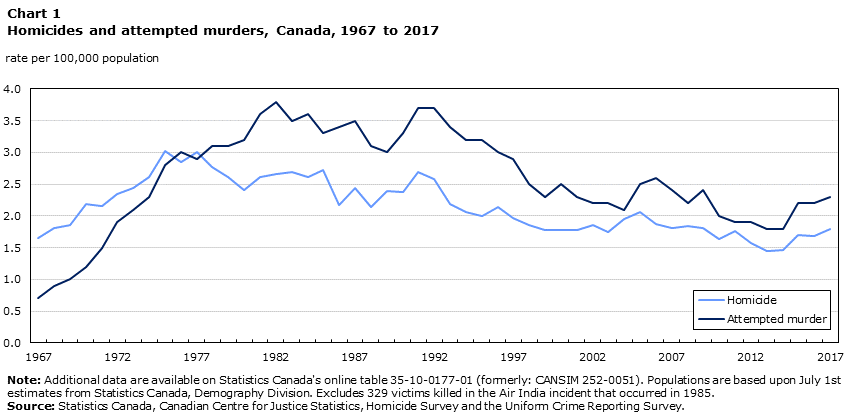
Crime rates, including homicides began to reach its zenith from the years 1968-1983.

It was into this generation that most of us, newly retired or about to retire baby boomers grew up and thrived. Solving the case was your reason for being, sometimes by any means; burning barns in Quebec to combat the FLQ a glaring example. You needed to be tough, you needed to exude combativeness, you always needed to get your man. It was during this time that Pierre Trudeau said “Just watch me” in instituting the War Measures Act and bringing in the army to the streets of Montreal. Even the politicians of the time had developed an edge.

Internally police officers gravitated to alcohol and cigarettes which were proscribed to combat the fear or what was witnessed on the street; a way to dull the observations of man’s inhumanity to man.

And you always respected the uniform, the symbol of what you stood for, some battles won, some lost, but it was us against them. You were proud to be standing in blue.

Then the pendulum began to swing left, just like in the U.S. Criticisms of the police and their policies began to emerge. The barn burning turned into the MacDonald Commission, which would eventually strip Security Service from the Mounties and lead to the formation of CSIS.

Problems were identified as originating with policing not being representative of the very population over which they held sway. Policing was portrayed as neanderthal, incapable of adapting to the new realities.

It was gradual, as the old guard kicked up a fuss over the hiring of females in the early 1970’s, but the theory being that women would bring a more humane and understanding attitude to the hardened police departments managed to hold sway. There was a loosening of physical height and weight restrictions to try and be realistic in terms of the physical differences between man and woman, or the different ethnicities. The Bill of Rights in the United States became the Charter of Rights in Canada. Some still saw it as a general slide into policing oblivion.

The pendulum continued to swing to the outward reaches of the left. Representation became inclusion in all its forms. Natural recruiting programs, since they were still failing, were replaced by affirmative action hiring, promotional incentives dangled in front of all who had the cultural genetics to claim to be one of the dis-enfranchised.

Police wanted to be one with the public. Not distant enforcers, but caring, understanding and educated in the cultural differences, and therefore as the theory went, trusted by these groups to the point that they were better able to deal with crime.

A subtle switch to crime prevention, crime enforcement now in the background to a myriad of social worker styled programs –community outreach, school liaison, bike patrols, and victim services.

The police now wanted to be loved. They are being ordered and taught to be more sensitive. They wanted to be seen as persons who suffered from the same problems as the general public, no longer the immovable rock of authority, but able to cry and empathize. We are people too and we need a hug from time to time.

If everybody grew to love the police, the job of policing would be better served–again, in theory anyways.

And more dramatically in terms of its effect, the Mounties decided that it was ok to be political in their ongoing battle to be sympathetic to all causes, whether it be gender, ethnic or life-style based.

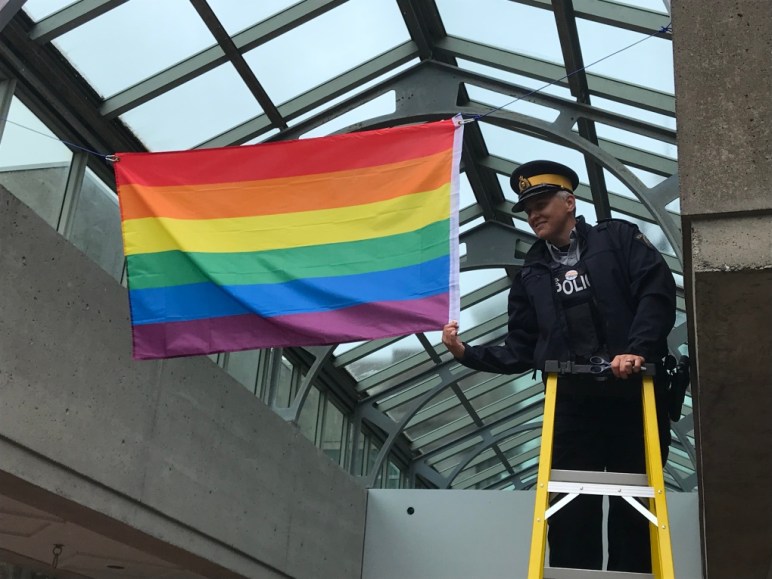
Recently Surrey Detachment hung the Gay Pride flag at the detachment. It was met with some opposition, and even the City of Surrey declined to enter into this political fray in case of appearing to one-sided. The local Mounties did not see a problem.

In a recent circulating video a red serged Mountie, also in Surrey, became another one of the “dancing cops”; this Mountie lip syncing to Queen–mincing and strutting at the Gay Pride festival to the applause of those attending.

Many are beginning to feel brave enough to voice concerns over this latest evidence of the pendulum going too far. They point out that Section 37 (d) of the RCMP Code of Conduct states that the Mounties are to “avoid any actual, apparent or potential conflict of interest” and according to the deportment guidelines, Section 7.1 of the Code of Conduct ‘Objectives’ states that “members behave in a manner that is not likely to discredit the Force”.

Does this most recent caricature of a gay Mountie cross the line? it all depends on where you think the pendulum is right now.

Does the striving and quest for acceptance and love by all supersede the need to be neutral? Does it allow for such obvious pandering? The local RCMP justify it by saying “the RCMP lead by example in promoting diversity and inclusion”.

Management does seem to have lost the ability to see that this was a political supportive statement of a specific political group and its mandate, being still blinded and forever loyal to the government led need for “inclusion”.

Under this obvious strategy the obvious question that never seems to be asked is, does it work?

Did years of marching in the Pride parade in Toronto, aid or hinder the gay community criticism or aid in the investigation of the Bruce McArther killings? The Toronto Police , despite their loving efforts, were even disinvited to the parade this year. (Of course, the Toronto Police Chief vowed to work harder to understand why they have been disenfranchised. )

So the pendulum slows slightly in its grind to the left, but police management seems unable to change track, unable to move away from this politicization of their agency.

The overall effects of the politics of inclusion will probably be unknown or even measured in the coming years, as government rarely looks at things that don’t work; but cracks are beginning to show. Surrey RCMP faced protestors in the raising of the Pride flag and one could argue that the attempt to switch from the local RCMP detachment to a civilian Force is the result of people tiring of the current political model of the RCMP, that they just want safer streets.

In somewhat menacing fashion, right wing political populism is growing around the world, reflective of a changing mood, whether it be to immigration or justice.

There is evidence of growing crime rates after being at all time lows.

Some may argue that all this political pandering works, but only when political culture remains calm, when the public is economically content. That too may be changing. One only needs to look once again to south of the border.

The middle class is in jeopardy, being gradually forced to two ends of the wealth spectrum. Economics or more specifically, economic power, may be a better measure of the need and demand for policing change. Poverty breeds unrest. Unrest breeds violence and a call for stricter policing.

In Canada, the latest ‘Breaking News’ and the fodder for all amateur sleuths and commentary is the ongoing search for two Port Alberni teenage alleged “killers”. The focus on the police intensifies with each passing day.

What does the public want? Do they want empathy over their public safety being threatened? Do they worry about policing models of inclusion?

No, they want the two caught.

All the dancing in the world is not going to change that.

The pendulum seems to swing back in times of trouble, when the policing role gets stripped down to its barest essentials. The key is to let it return to some middle ground without going too far to the very dangerous right.

The public don’t want to love you, they want to respect you.

Photo courtesy of CTV and Global News – Some Rights Reserved

Civilian Oversight – Optical Illusion?

Well, it took about ten years from when RCMP management was called “horribly broken ; then a further two reports, one by Auditor General Sheila Fraser and the other by the Civilian Review and Complaints Commission calling for change in 2017–all before Ralph Goodale in January 2019 announced the formation of a 13 member civilian oversight committee to “give advice on best ways to manage and modernize the Force”.

Commissioner Lucki called the announcement in practised dramatic tones, an “unprecedented journey”, which will lead to a “healthier and more diverse police force”.

Several more months of delay followed before in June 2019 they finally named the chosen 13. The numbers are reminiscent of the last Supper and the 12 Apostles. One wonders how they arrived at this number? Who is the tie breaker and gets to play Jesus?

Religious comparisons aside, this whole political play raises the rather obvious question as to whether this is a serious effort on the part of government, or is this the latest of some pre-election pandering to the unwashed masses? Is it a band aid when many believe surgery is needed?

If one is to make a decision, one must first consider the makeup and structure of this committee.

The estimated cost for this committee is $1.56 million per year, not an unusually high amount (about $120,000 per year per committee member); especially when one considers that just a few days ago the Mounties announced their latest thumb in the sexual harassment dyke; another $100 million for civilian members or public servants harassed or hurt by those old, leering, ass grabbing Mounties of the past.

Suffice to say the RCMP is not investing a lot of money on this righting of the administrative ship.

The structure of this effort is also somewhat puzzling.

It would appear that this ‘oversight’ group is there only to give “advice”.

It is not there to re-write or reform policy, but to tell Lucki and Goodale what they would recommend. Goodale had already gone on record in that the committee will not be dealing with any operational policing matters. Goodale stated that the committee will not “have any direct role in policing operations, which will remain the purview of the independent RCMP”.

This of course raises the obvious question as to the effectiveness of a group which only gives recommendations to a politician who always has his finger in the air testing the winds of change. When pressed by a reporter as to the effectiveness of such a committee, Goodale defensively added that the Minister could issue “directives” based on recommendations coming from the Committee.

Commissioner Lucki who is about to lead the Mounties on this “unprecedented journey” said that she would meet the Committee for the first time “sometime” in “the upcoming months”.

With young Mounties jumping around trying to get into the station wagon, clearly Mother Mountie is in no hurray to get going on this trip of a lifetime. Needing to pump up the value of this exercise, she obliquely added, “their advice will provide additional, valuable perspectives to help us make decisions that support our people and the communities they serve”.

She later said that she planned on meeting with this group 3 or 4 times a year. Quarterly in other words. Now anyone who has graced the corridors of HQ, or any government department will tell you that nothing, absolutely nothing, gets done without dozens of “meetings” usually choked down between bitter thermos coffee and chicken wraps. Meetings, often to arrange other meetings– never-ending discussions which often spiral into infinity, no resolution in site.

Finally, the mandate of this current group of committee members is a mere 18 months. One would have to assume that they are then to be replaced, by another group of committee members and the process could start anew.

18 months is about time enough to order office supplies, get new business cards printed, and get some cafeteria jello in your belly.

Nothing in government gets done in 18 months; it’s a political, logistical, impossibility. It took six months for the government to decide who was going to be on the committee.

As to the members of this new committee, well first and foremost you better be on the Liberal end of the political perspective, conservatives or any other political stripe need not apply. The eventual chosen could have fallen out of any Liberal convention gathering in Ottawa– all would be waving their brightly coloured red placards with stencilled slogans crying for diversity and inclusion.

So who are the lucky thirteen, in the apparent overwhelming number of applications that were received? (the Liberals said the delays were caused by the many applicants)

The thirteeen are; Richard Dicerni, Leanne Fitch, Randy Ambrosie, Elaine Bernard, Angela Campbell, John Domm, Ghayda Hassan, Maureen Darkes, Douglas Moen, Wally Oppal, Kevin Patterson, Keith Peterson, and Emoke Szathmary.

There are a couple of eyebrow raising selections in this group, but most of the membership is quite predictable, at least in terms of their backgrounds, even if their names are not easily recognizable.

Seven men and six women. Good balance on the gender teeter-totter keeping in mind that whoever is going to play Jesus will need to be standing in the middle.

Five list themselves as academics or public servants, so the ivory tower will be looming large over the proceedings, government jargon will rain down, political niceties will be evident, Senate committee style protocols will be observed.

There is some police representation, albeit a little suspect.

From the policing world they chose a female, Leanne Fitch from that hotbed of city policing–Fredericton, New Brunswick. There are a total of 113 officers on the Force there, and Ms Fitch recently gained headlines in that city by not replacing retiring officers in a budget cutting initiative. But she is female and was named officer of the year by the Atlantic Women in Law Enforcement and the International Association of Women. Goodale could not possibly ignore the opportunity to hit so many boxes in one move.

There is also John Domm, a former Chief of Police for the Nishnawbe-Aski Police Service. At the time he was the Chief of Police they were not even a fully mandated police department which did not occur until 2018. He is also a member of the First Nations Chiefs of Police Association. Two more checks for Mr. Goodale.

Doug Moen, a lawyer and public servant helped establish the Saskatchewan Commission on First Nations and Metis Peoples and Justice Reform. Check.

Keith Peterson was a former member of the legislative assembly for Nunavut. Check.

Elaine Bernard is an academic and according to her listed resume is a “proponent of the role of unions in promoting civil society”. Actually, this could come in handy when members begin trying to figure out the union dues they will soon be paying. Check.

There is Emoke Szathmary, the former president of the University of Manitoba, an advocate for “diversity, inclusion and accessibility”. Check.

There is the head scratching appointment of Randy Abrosie, a former member of the CFL and the current commissioner of the CFL. Apparently he has “championed diversity”, which may explain his selection, but maybe he just needs to stick to making the Toronto Argonauts viable again and avoiding any talk of concussions. No check mark here.

Finally there is Wally Oppal, who I am going to proclaim as Jesus for the time being, as he miraculously walks over water into another government contract. The 79 year old Wally just does not seem to want to retire, but one has to wonder whether he represents a new, modern voice. This savant of double dipping goes on; and on, and on.

One must not get the wrong impression. All of these people are well educated, accomplished in their professional lives. They should have some good “suggestions” in areas where the senior management Mounties have proven themselves utterly of no consequence.

But there are many questioning this Committee and its ultimate effectiveness.

The always available for a quote Robert Gordon of Simon Fraser University said “I don’t think the mandate, at this point, is to undertake the significant restructuring and reform of the RCMP that is required…It’ll be settling problems that have arisen inside the house as opposed to problems that have arisen as a result of the structure of the house”.

Other questions arise. Will Mr. Goodale be still around after October 2019?

Will Commissioner Lucki turn into some sort of leadership firebrand, able to forge ahead without her political Prairie brother in arms, while relying on those Executives who now encircle her, many of whom who have contributed to this mess?

Maybe she underestimates the problems.

On May 30th, 2018 Ms. Lucki appeared before the Standing Senate Committee on National Security and Defence. Her primary testimony was about indigenous, harassment and diversity issues, which seems to be the focus in Ottawa, seemingly oblivious to the myriad more substantial issues facing the RCMP.

She ended and summed up her testimony this way: “I tell my staff, don’t ask me how to fix it because my answer is going to be “”We’re not broken””. Because we are not broken”.

“Do we need to innovate, and do we need to modernize? Absolutely…”

“We’re not broken and I am not here to fix it but we need to move forward from those past experiences, and if we don’t, shame on us. If you have a great idea of how you can help me to navigate things, don’t be shy to call me”.

Well Ms. Lucki, many believe that the RCMP is in fact kinda broken and actually we expect you to fix it.

So maybe call that Committee and maybe meet them every week, or every day, and not just in a few months; then listen to those voices who are from outside the RCMP, listen, and then have the courage to lead.

For all the rest of you out there, her phone number is 613 993-7267, because apparently she would like you to call with any ideas you may have.

(If that doesn’t work, the website tells yo how to fill out a “contact form”)

Currently, this committee in both form and structure looks like a political stop gap measure, one which garners a few headlines, speaks to the liberal left, and holds out little hope for the working officer.

So maybe Canadians should be calling 911 and not waiting for a callback from the Commissioner’s office.

Photo Courtesy of Matty Ring via Flickr Commons – Some Rights Reserved

Defending the only slightly Indefensible…

In the last few days, politicians, political pundits and radio and television personalities have been sending themselves into a tizzy, into another anti-police feeding frenzy. The water has been chummed this time by a videotape resurrected from a 2012 criminal case which captured an interview between a police officer and a 17 year old female held in an interview room in the West Kelowna RCMP detachment.

It was not dug up by intrepid reporting, Global News had the videotape sent to them. Now, the edited version has been virally shared, with Global News direly warning for those softened listeners, that it is “hard to listen to”; no doubt in an attempt to draw in more viewers as it is like saying “look away there is a car accident”.

It took hold and it has now been called “abhorrent” by our illustrious Ralph Goodale, the Minister of Public Safety, whose opinion blows in the political wind incessantly, shifting with any voter high pressure system.

My favourite Judge, Marion Buller said that the interview put on display “racist stereotypes of Indigenous women” and it rose out of the “historical tension” due to residential schools. Keep in mind that Buller finds all that ails Canada and the indigenous can be summed up in the residential schools.

Jenna Forbes of the Vancouver Aboriginal Transformative Justice Services Society was “outraged” and asked whether this type of questioning was “part of policy”.

On Simi Sara’s talk show on CKNW, which is affiliated with Global News –in her best holier than thou voice proclaimed that this was “unacceptable” and questioned whether the officer involved had been “fired” for such an atrocious breech of the public standards. Of course she was echoing and re-enforcing the prevailing wisdom spewing forth from the usual go-to for comment “experts”. Thirty second encapsulations bounced around the internet and across Canada, each indignant voice louder than the first, all calling for the head of the officer involved.

The new E Division Commanding Officer finally feeling the pressure weighed in on the video; announcing a “fulsome review”; and throwing a little pre-judgement in for good measure, “on the surface this case doesn’t appear to align with public expectations or the current standards and practises in place”.

Clearly she was making an attempt to say that was the way then, way back in 2012, but now, things are better.

In this more aware year of 2019, the RCMP , according to the Commanding Officer was now “supporting victims”, and members were being exposed to a “course recently updated”. The strategic spin doctors of the RCMP went further commenting that they were advancing “cultural competency training…trauma informed investigations and an advanced course for sexual assault investigation”.

The cultural reference was because all commentators noted in their reporting that the female victim was “indigenous”, intentionally putting a match to spark the gas line of indigenous reconciliation outrage.

Experts ran to the flame, braying about another example of the police being incapable of understanding their culture, just another example of the ill effects of colonialism.

The officer involved no doubt could not have felt more alone.

In viewing the video, nothing will get around the fact that the officer asked inappropriate questions. That is apparent and should never have happened, the questioning of whether she was “turned on by it at all” showed a glaring lack of knowledge of the nature of sexual assault.

However, if you examine the circumstances, it may be in-appropriate and completely unfair to rush to such a harsh judgement. The commentary on this subject comes from those that have never been in that interview room, let alone investigated any sexual assaults.

Some of the questions and the perceptions that arise from this videotape need to be looked at through an investigators lens.

First, this videotape did not surface as a result of a complaint coming forward from the female, or some representative of her about the investigation or the lack of charges. One should always be somewhat suspect about the release of information which may aid someone in their particular cause or pursuit.

It is the result of a civil suit, totally unrelated to the crime of sexual assault.

It is part of the evidence that surfaced as a result of an investigation into a social worker in 2012, Robert Riley Saunders. It was alleged that Saunders stole monies from some teens, including the female in the video; monies that were forwarded to them through the Ministry over a four year period totalling $40,000.00. Basically he was taking monies from vulnerable clients and putting it in his own bank account.

The female youth victim, one of a dozen, was forced, according to the civil claim, to living on the streets and into a life of drug addiction using meth, crack, cocaine, and MDMA.

On March 4, 2012 the female youth then made allegations of a sexual assault. The two defendants in the civil case, (as by now another female social worker was named as a defendant), countered, along with the girl’s foster parents, saying that the female victim was “falsifying the allegations for an excuse for using drugs”.

We also learn that this same female victim alleges that she was sexually assaulted by her grandfather earlier in life. She makes reference to it during the videotape. She says on the tape, “nobody believed me then and nobody believes me now”.

The officer responded, “I have reason to believe what happened in your past, but I do have a lot of concerns about your story here”. Earlier the officer, had said that he wants to probe “inconsistencies in her story”. No doubt some of that concern centred around the fact that the victim said she “didn’t not say no” to the alleged assailant throughout the assault. It should also be pointed out that she was making this allegation against an “acquaintance”.

This of course is possible as she said she was “scared” but some further layering of the explanation was needed.

All this is to say is that regardless of who is telling the truth in this case, what had been raised was a possible alternate story, a possibility that there was some fabrication on the part of the victim. To an investigator tasked with getting to the truth, you are now in a position where one must consider a couple of different narratives. Therefore that has to form part of your questioning of the victim. As a truth seeker any investigator can not have a tunnel version of the truth, one needs to walk the middle road, consider all possibilities.

There are some in this current political environment who believe that there is no such thing as a made up sexual allegation. This blogger is not one of them and has been involved in a number of investigations where some allegations were clearly false and were eventually proven to be in fact pure fiction. This goes counter to the #metoo movement and the left leaning liberals which constantly assert that no woman is capable of lying under these circumstances. That is just factually incorrect, regardless of how acceptable that dogma has become.

So this particular investigator, under these circumstances, has to consider that this particular female, who was living a street level existence and addicted to drugs, could possibly have an alternate reason for coming forward with this story.

One should also note that this female, in the days or months following this interview, wrote a letter of apology to the accused and the RCMP for making this sexual assault investigation.

Of course, it is now being claimed that she was “allegedly forced by her social worker to write letters of apology to the accused man and the RCMP for wasting their time”.

The female victim, now no doubt re-enforced with a lawyer and a civil claim now says that she has been “re-traumatized after watching the video”.

Again, this too could be true, but there is a great deal of evidence which this investigator could not ignore in terms of the line of questioning.

Secondly. The interview and the way it was conducted had absolutely nothing to do with this female victim being indigenous. Listen to the videotape and if anyone can find anything suggesting that this interviewer was being racist, or that some line of questioning would lead one to this conclusion, they need to step forward and point to it.

What critiques are doing is implying that the line of questioning is the result of her being indigenous, not understanding that this line of questioning would occur, and should occur if an investigator is divining the truth no matter who the witness may be. The wording of some of his questions can be criticized, the intent of his questioning should not be characterized as racist.

If a victim or witness or suspect has raised a different set of facts than that has to be explored. An investigator or an interviewer should be criticized for not exploring these and all venues, but the exploring or questioning easily leads to criticism in the techniques used by the arm chair quarterbacks.

Hopefully the police have not reached a stage in this country during an investigation when they can be told that there must be wholesale acceptance of everything being put forward. Remember, it has been said, “it is a basic truth of the human condition that everybody lies. The only variable is about what.”

There are also some questions that need to be explored about the time leading up to the conduct of this interview and of the logistics surrounding the taking of this statement.

For instance, was there someone monitoring this interview as is the usual protocol?

Was this investigator ever given instruction on interviewing techniques?

How many interviews of this ilk had he ever done? What level of supervision was given with regard to the conduct of the interview?

The RCMP management can talk about sexual assault investigator courses. But was this particular officer ever on one? Quite often those types of courses go to the specialized units, and the general duty cop is the last on the list for such specialization.

There has been a lot of questioning of why there was no female present acting on behalf or as support? One must remember that this person is a witness, a victim witness, she is not a suspect. Her story could be suspect, but she is not being treated as a victim in these circumstances, therefore there is no legal need for someone to be present.

Police also try to avoid having more than one person in a room for a witness interview, for fear of interference, or coaching. If she wanted someone there and had asked for it, it is likely that she would have had that choice if it would help her in feeling secure. But this would not be likely at the age of 17. If she had been under investigation for possible charges, then the rules would be entirely different.

So should the officer have worded his questions differently? Of course, the questions showed a lack of knowledge, not evil intent.

The ability to talk to people, to interview, is an art, learned over time and through repetition. You need to go “into the room” to get proficient. It takes years to be both a listener and a talker– especially when that person may be trying to deceive. Some say the skill is being lost in the millennial generation, dominated by the land of laptops, a growing perception that interviewing is a specialized skill that warrants specialists and special training. That is not the case, it requires a willingness to enter the interview room and run the risk of being fooled, maybe hundreds of times, and those that do should not be chastised by the 20/20 hindsights of the courts and the academics. Some would argue that it is the greatest skill needed by a police officer.

No doubt this officer will get some sort of discipline letter, but if that is the case, let’s give one to his Supervisor and on up the line.

To debase and libel this investigator as being racist is completely unfair and one would hope that it would be actionable.

And while you’re at it let’s give the likes of Marion Buller, and Jenna Forbes a ride in a police car for a couple of shifts, and let them do some interviews.

And as they enter that drab room at 2 o’clock in the morning, tired, and having to perform on camera for later court scrutiny– give them a hint…. not everybody tells the truth to the police.

Photo Courtesy of James Cridland via Flickr Commons – Some Rights Reserved
Dear Jennifer…

Ms. Strachan, let me be one of the first to welcome you back to beautiful British Columbia — the land of the highest gas prices, mountains, water, big trees, horrendous traffic, and where the Green Party has a pulse.

Being a born and raised Okanagan girl, no doubt you are feeling the geographic magnet that is B.C., and like Dorothy in Oz, you probably wanted to return– as there is no place like home. So with a click of those RCMP high-browns and the nod from Wizard Lucki you are now on your way.

It’s been awhile, over 16 years since you were in the policing world here in Lotus land and a lot of things have changed, so I feel bound by some inexplicable duty to give you at least a heads up on what to expect.

Let us first deal with the politicians in this land who you may end up spending some time with considering your new role. The Green party has locked arms with the NDP to see who can be more righteous; who can spend the most money, and clearly would have a love for any future unionized RCMP. It is a mixed political blessing though, as they are not pro-police necessarily, more in favour of groups like the Pivot Legal society, or the Elizabeth Fry Society.

The Federal world of Justin Trudeau and their policies still have an audience out here, even though they seem to be in a political free fall in the other parts of the country.

So don’t be fooled by the blooming Conservatism of the west throughout the Prairies. The right leanings of political philosophy has not seeped over the mountains, conservatism is merely a mirage in this marihuana infused land. There is more chance of Jody Emery being elected out here than a Jason Kenney.

President Bush was chasing Saddam Hussein when you left B.C.and the Americans were about to invade Iraq.

Paul Martin was the Liberal Prime Minister (probably one of the last times the budget was balanced).

Giuliano Zaccardelli was the Commissioner of the RCMP (who was impugned for irregularities in the management of the Pension and Insurance fund).

The RCMP was heralding the first female officer to be placed on an Emergency Response Team and the wave of female empowerment was in its infancy.

This unparalleled growth in female advancement is being mentioned because Commissioner Lucki decided that in announcing your move to head up E Division, she felt that she needed to underline your gender and not your curriculum vitae. It is a bit of the elephant in the room when it comes to the succession plan for E Division.

Ms. Lucki seems pretty one dimensional so far, aiming to fulfill her proscribed and dictated agenda, but in including you she makes you appear as a pawn in her Liberal sanctioned corporate strategy. It clearly drew attention to the possibility that your gender was a central characteristic that was needed for one to get this job. In the end it detracts from your resume, taints the appointment, and tends to confirm thoughts of the older guard.

For the record, I don’t believe the average RCMP officer gives a whit as to whether you are a woman, a man, or a variation of the two. Whether you are green, brown, wearing a turban, or wearing a Scottish tam means nothing in the current real world of policing. Gender does not imbue anyone with intelligence or leadership skills although it is quite clear that the two are equated in government corridors of power.

Putting all that aside, you are here to replace Butterworth-Carr, who heralded not only her femaleness, but her indigenous background, and she had zero impact. She didn’t stay long, enticed by an offer to join the politicos in Victoria. She used a quick stay on the job to springboard into the double-dipping pool, no doubt financially setting herself up for a lucrative run towards pension. It is hoped that you may still a little longer, as the wheels of government turn very slowly, the ability to have any impact takes years not weeks, so some time on the job is needed.

You will be hampered upon your arrival as senior members of the RCMP demographic bubble are leaving, the experienced baby-boomers are reaching their logistical end. Some, like Butterworth-Carr, have discovered a tunnel under the Georgia Strait which leads directly to the Provincial government coffers. The sands of time are changing, whether that is good or bad we will see, but there is little doubt it is creating a vacuum in terms of experience.

Since your departure from the West, almost the entire latter half of your career seems to have been focused on O Division and HQ.

You were the District Commander for N.E. Ontario from 2009-2012; then the Officer in Charge of Criminal Operations in Ontario (interesting in that in Ontario the RCMP is not responsible for most criminal investigations) from 2012-2016; then up the ladder once again to being the Commanding Officer of O Division from 2016-2018.

And of course what resume would be complete in this day and age without being the Officer in Charge of Operations Policy and Programs in Contract and Indigenous Policing in Ottawa. You then followed that by becoming Deputy Commissioner for “Specialized Policing Services”. A steady rise for sure but I will admit to being a little concerned about this rather central Canada version of the RCMP being the substantive part of your resume.

You probably don’t need to be reminded that there is a big gap between O and E, not just a couple of vowel spaces. The fact that you survived and thrived in this non-contract world can be either seen as a plus or a minus. You may be commended or condemned for being able to breath deeply in this rarefied air, as it is a milieu where most of us in the contracts would often feel out of place.

O Division has often been accused of riding and hiding behind the curtain of Federal statutes, where a lack of enforcement and investigational strength is a theme common to those that have worked in both areas. Enforcing such Federal statutes as the Migratory bird Act; or watching the Indigenous hustling cigarettes back and forth from the U.S; or helping illegal immigrants with their luggage; has never been considered the leading edge of police investigation know-how.

This lack of operational acuity has been the standard slam against this Province for years, whether management admits to this operational schizophrenia or not. Another example showed up in the last few days, in the Mark Norman case, serious questions are now being raised about this two year investigation in Ontario which resulted in a single charge. It has been stayed as the defence counsel seems to have been a little more thorough in their inquiries than the police officers that conducted the investigation and there are implications of political interference in the process. Further Mountie embarrassment is on the horizon.

The Force in general has not had such a smooth ride for the last couple of decades and there has been a number of serious setbacks during the time that you were part of the RCMP management power group. A growing legacy of mismanagement whether looking at the carbine issue, internal sexual harassment, and a large number of failed investigations.

Mountie salaries in relation to other agencies have tanked. Recruitment is down. Staffing levels have dwindled to lows never seen before. The Mounties are being questioned over their actions at every turn, whether it be the shooting on Parliament Hill, or the latest, the Mark Norman investigation.

I am not sure of what role you may or may not have played during this last number of years but there is no doubt you have been either a witness or a participant in some of the inane programs and policies which have left this agency in a state of major disrepair. It would be interesting to hear your take and historical role in this troubled time. Actually, it would be nice to finally hear from someone, anyone, of this management era who would admit to the errors, the wrongdoing, and try to set the record straight. Not crocodile tear apologies for things like harassment, but clear, concise explanations as to things like $100 million settlements. Maybe I am asking for too much.

The RCMP in its official bio of you points to your “passion for supporting others”. In 2014 you were given the Ontario Women in Law Enforcement award for the “Mentor of the Year Award”, and then in front of the International Association of Women Police you were also given a “Mentor of the Year Award”. Clearly a 21st century new policing virtue but who knew there was such a thing. Hard to argue with someone who wants to support you though.

You have been away from the dirt and grime of contract policing, living and breathing the filtered world of a Mountie in Ontario. Previously, you were in the corridors of subject matter experts, puffed up self-important people wandering in that dazed mind numbing bureaucracy all spouting pithy truisms at any opportunity.

You have now been freed and at a time in your career where you are un-flammable.

You are back to the heart of the RCMP Criminal operations block, where your Masters degree in “conflict analysis and management” will no doubt come in handy. You are being thrown into a logjam of a multitude of unaddressed and unattended issues, compounded by lacklustre stints of some of your predecessors.

You are about to be thrown into the wolfs lair. E Division with its constant stream of issues can eat and will eat managers up so you need to be careful.

I am hoping that this will be seen by you as a chance to speak out.

My primary recommendation is to be honest and straightforward and speak to the issues. Let’s hear what the RCMP stance will be if the Surrey RCMP get ousted; let’s hear what you are going to do about the vast understaffing that is in all corners of the Force; lets hear about gender and diversity promotions and your view of this dictated policy; lets hear about the politicization of the police force mandated role, which clearly is in full swing in Ottawa; and lets hear about upcoming unionization of the RCMP.

Even if one is able to be exposed to a truly honest appraisal of the issues and opens up the debate to real dialogue, you will have accomplished something not seen in many years in this Province.

The issues surrounding the RCMP will seem endless and at times look very bleak. The constant pablum being fed to the officers of just “you’re doing a great job” is both insulting and demeaning to their intelligence. Talking openly and honestly would be a breath of fresh air.

I am not optimistic, but I stand to be corrected, and will gladly sing the laurels of someone who walks the walk, speaks to the issues and puts on display possible solutions. It seems counter-intuitive that one needs to seek an open and honest management group from a police institution, but sadly this is now the case. It has been missing and it has caused irreparable harm.

Once that is all done, then you can go and enjoy your retirement….

I do wish you the best….

Signed:

A once faithful servant

Photo courtesy of CTV News via Google Images- Some Rights Reserved

Historical Unsolved Homicides…the value of the past…….

Hundreds of bankers boxes– dusty, worn and frayed at the edges, worn down by the weight of other boxes stacked on top, often damp in the corners, all lodged in inconspicuous backroom places. Out of sight and mostly out of mind, they are spread throughout this Province and the other Provinces; the responsibility of the RCMP, the OPP, the QPP and various scattered Municipal agencies. Historical mysteries sitting, undisturbed, and now in danger of being lost forever. 

Each box has scrawled on it in black marker, a number the start of which indicates the year of the file box being created; 73-1234 or 98-5678 indicating 1973 and 1998. Most will have a surname, also written on the outside of the box, underneath the number, the first indication of the box containing information on a life lived and in all likelihood a life taken abruptly away. A snapshot of a moment in time, life stories, lives abruptly ended. 

If one lifts the uniformly folded cardboard lids and peek inside one finds manila folders, each folder containing assorted government styled papers, each folder numbered, implying some form of organization. The order of importance often seems haphazard. There will be original documents, photocopies, carbon copies, compact discs, floppy discs, even blueprints and loosely bound photographs.  Each document part of a whole, each pointing to a dramatic and often gruesome ending to a life. 

Shoved into these boxes will be exhibits, exhibit reports, and boxes of 3 x 5  index cards, clues as to the relevance of the folders. Sometimes there are many of these boxes, with this same name, or number; the more numerous the boxes the more likely that this was a long case, or a more complicated case, or a case involving more than one person. The breadth and depth of the case in direct correlation to the weight and the number of  volumes. 

In police parlance these are “dormant” cases. Technically “open” or “still under investigation” as the police like to intone when asked; but they are in a deep state of slumber, never to be awoken unless something out of the ordinary occurs. Maybe a dictated annual review, which is usually sporadicly enforced, will sometimes force a reluctant officer to pull the case from the storage room, check the final pages for any “new” information and generally meander through the boxes.

Then, under most circumstances the boxes get put back, back into the darkened rooms, a single page added indicating that there has been no change in the contained information.  Some boxes may be difficult to even find.  

The paper or original information in these boxes is now being lost, inexorably beaten up by time itself and inadequate physical storage.  They all contain the most intimate of stories, real stories of people, their backgrounds, their lifestyles and their fates.  Some of the people in these boxes have prematurely met the ultimate fate, their deaths by a variety of methods only limited by the depravity and the darkness of the human spirit. Long gone to the eyes of the original investigators, but probably not forgotten. Every old investigator cognizant of the one that got away. 

They have not been solved, the killer remains free in the world, unless time and circumstances has also caught up with them as well. 

If one believes that history, or that records of the past are important,  or that every effort should be made to solve any murder, then you may be interested in this story. For this is a story of a largely ignored problem by the RCMP and other Municipal forces and the single attempt at a proposed solution, one which proved ultimately futile. 

This is a story of a need to archive and preserve police files.  It admittedly has never been fashionable to be interested in the library sciences, or the  similar but more current world of digital archiving.  It conjures up images of dusty books, microfiche and bespectacled introspective librarians, lonely figures confined to being the keepers of untold secrets. 

This is not to say that there is not public interest in unsolved homicides; one can tune into the many Netflix docs, the CBC, read Wikipedia, or the Vancouver Sun and find stories of historical murders, served up in some form of sensationalist fashion. The RCMP post pictures of historical victims and the Coroners office publicly maps out found remains cases. Unfortunately, this is mainly public fodder and a needle in the haystack in terms of trying to solve some of these cases, designed more to entice the reader or the watcher, designed for instagram investigators, not a serious study of this dark world nor a studied attempt to make a dent in the growing pile of the unsolved.   

There is an actual need for a concentrated effort to preserve, to digitize these paper files, to capture forever the information that could be lost to deterioration and neglect. 

In this Province and for most other parts of Canada, there is a relatively short historical period of time which is of primary concern. This is mainly the period from 1960 to 2003,  the dominant ages of the paper files in this relatively new country.

In general, around 2003 many police agencies slowly began to go to electronic formats, although it varies by jurisdiction. The paper format was gradually replaced, electronic data finally being made acceptable as a possible original document pushed by the quickly developing technical advancements.

It is somewhat ironic to understand that the paper age has an actual shelf life longer than the digital age, with experts estimating that paper, if properly preserved, has a life of about 50-100 years. (In our now digital storage era, the shelf life of electronic documents is only 10-20 years. Some think that since the newer material has been electronically filed it will last in perpetuity– a largely false belief.) 

However, now the paper files are of the most immediate concern. They are   reaching the end of their shelf lives, the ink is beginning to fade, the photos are beginning to deteriorate and the memories of the investigators are becoming faulty. 

The numbers of unsolved homicide files that are on “paper” in this Province are somewhat daunting. In 2016, when this blogger began to look at this issue, there were 900-1300 unsolved homicides held by the RCMP in the Province of British Columbia alone. There was another 200-300 which would be the responsibility of the Municipal Forces and there is no evidence to suggest that those Municipal agencies have been any better than the RCMP in their preservation. If one draws this issue outward, on a national basis, the situation would be magnified by 10 times. 

In British Columbia and in the Lower Mainland, since the birth of the Integrated Homicide and Investigation Team, they alone have generated at least another additional  300 “unsolved homicides”.  To be sure, those files are being captured in an electronic format, but not a format that is in a consistent with other agencies, nor are they in a position to be integrated and compared to other similar data bases. So the problem of being able to archive and preserve all information, on a fundamental basis, is growing every year. Solvency rates are also declining– further exasperating the issue. 

The police agencies are rarely asked about this archiving problem, but on that rare occasion that they are, the blame is usually placed on the constantly shifting policing priorities and jurisdictions. It simply has not been operational priority. 

Even if reviewed, there is no digitization of the file, so the only electronic reference to this file may be a name or a file number. The contents are not available to investigators without fully and physically reviewing the paper file. If an investigator feels an ongoing investigation may have some relevance to a historical file, whether it be a suspect or some other circumstance, they would need to go back and physically review the entire file, maybe on just a chance of finding some opaque reference. 

There is no cross-pollination of the information contained in those files, none of the more recent files can see or compare information on their files to older investigations.

The police agencies have a public relations mantra which is that no file is ever “closed” without it being solved. Technically they are right in their assertions, they don’t put a big “CH” (Concluded Here) on the file, but they are being totally misleading. They are trying to generate the impression that they are active and constructively reviewing and comparing these files on a regular basis. That is not true.

They are not digitizing these older files, and they are not actively investigating these files.  The only salvation for police management is that the public simply doesn’t know; the public assume wrongly, that all police files are instantly and readily available to all homicide investigators. 

There is one exception in this Province in terms of units re-investigating historical files in the RCMP. That is the Unsolved Homicide Unit of about 10-20 officers who review old files and selectively work historic files. Sounds good, but one needs to consider that each team in the group, may only take a new file every 8 months or so.

The other bit of sleight of hand is that the Unsolved Unit actually re-investigates only the “solved files”; files where a suspect has actually been already identified, but where for some reason the file was not being worked. It is hard to explain, but the fact is there are many files that have already identified suspects, but for one reason or another have been neglected. These files alone keep this unit busy and it only makes sense in terms of productivity to go for the low hanging fruit. 

Now if you optimistically assume that this group does 3-5 files per year, you can easily do the math and see the finger in the dyke problem here.  There is no way to catch up or even make a dent in the pile. It is not for lack of effort by this relatively small unit, it is just a matter of numbers. 


https://www150.statcan.gc.ca/n1/pub/85-002-x/2018001/article/54980-eng.htm

The preservation of historic information is finally being recognized in various forms throughout the rest of society as various organizations are striving to cope with this growing issue.

Interestingly, some locations are actually using police inspired methods to try and solve their respective archiving problems.

At Harvard University they are in the process of trying to develop an operating system for capturing their paper and digital archives using workflow modelled after “police forensic standards”. The idea is to “create, authenticate, unimpeachable source data….” at a standard that would make the archive “suitable as evidence in a criminal trial”. Now, if capturing hundreds of homicide investigations seems to be a difficult task, Harvard is attempting to go back 375 years of history.

The problems they are encountering are similar to the police issues; files with floppy discs, zip drives, tapes, and cassettes. So they are not only capturing the information, they are also preserving the techniques that are needed to retrieve that data.

In California, in a former San Francisco Church, Brewster Kahle continues with the goal he started with in the 1990’s, which was to curate and create an “Internet Archive”. His lofty goal? To save all the world’s information.

Even to the pessimist he has been quite successful: 435 billion web pages have been preserved, 7 million books, 2.1 million audio recordings, and 1.8 million videos have been preserved and digitized, and now accessible to the Public. This archive draws 2-3 million visitors daily.

This is to say that although the archiving and digitizing of police homicide files seems both time consuming and manpower intensive, it is doable. It pales in comparison to these more ambitious projects and one would think that the goal of preserving these investigations and their contents dealing with the most heinous of crimes should be a laudable goal. But so far neither the police, or their respective government administrations, feel that is part of their duty or responsibility.

Which leads me to the more personal and subjective 2nd half of this story.

For two years, the writer of this blog, along with a couple of associates joined with the School of Criminology at Simon Fraser University, the Institute of Canadian Urban Research Studies (ICURS) and the School of Applied Science in a proposal on a non-profit basis to digitally archive these old historic homicide files.

It was supported by many people including the former RCMP head of E Division, a former VP and CIO for BC Hydro, the Dean of the school of Applied Science, and the School of Criminology at SFU.

Without going into all the details, the business plan outlined the logistics of locating files and moving them to a secure facility where the paper files would be reviewed, scanned, and converted to a digital format, one that would eventually be shared by all those participating. The reviewing would be done by PHD students in combination with the departments of Applied Science. SFU was motivated by being able to have access to a vast database for research purposes and the hands on review would give students ideas for that research.

There were many hurdles to overcome, as one would guess; security clearances, privacy issues, physical security issues, evidence chains, research controls and results, database construction, expert and standards of review, personnel, exhibit issues, and photo issues.

This is just to name a few of the problems, but over a two year period, these questions were for the most part answered and a proposal was put forward to the RCMP and the Vancouver City Police.

Initially the RCMP expressed interest, each meeting leading to a few more questions on how the operation will be housed and how it will work. Budget issues often came up (we estimated that it would take a financial commitment of 1/2 of 1% of the RCMP E Division Policing budget) The biggest concern of course, was the RCMP turning over, at least temporarily, unsolved homicide investigations to an outside party, even though they would have the appropriate security clearances. At one time they even proposed the possibility of giving up space inside their HQ at Green Timbers to get around this continuity issue.

The possible expandability of this proposal was obvious. Other Municipal agencies, other Provinces, and in a utopia, a database of all unsolved homicide files in the country. One could also bring in the solved files, as they too could have links to other investigations and be of great value.

Of course all the information would be owned by the agencies themselves, and throughout there would be oversight by those same police agencies.

“Digital 229” was the Project name and it was a non-profit enterprise. No one involved was paid during this two year period, all the extra effort was put in on a volunteer basis.

So what happened?

It was a surprise to some, but not a surprise to others who felt all along that the RCMP would have a difficult time ever climbing out of the proverbial operational “box”, the inability to go against the way it was always done.

There is no clear answer as to why the idea died. In the end, we were not given a reason which made any sense. It was un-ceremonious to say the least, as we only heard through the grapevine that negotiations had been terminated; nobody made any direct contact with any of the parties involved.

After many attempted phone connections to re-ignite the business plan, an Inspector (who had not ever been involved in the process) wrote to us and gave up an excuse over needing “sole source funding”, which had also been previously addressed, as the reason of not going forward.

Was this the real reason? We don’t think so. It was clear this officer was directed to kill the project at the direction of some higher ups and to come up with some justification for it.

At one of the original meetings with the heads of the E Division RCMP one officer said he had one question. “What if you guys uncover a number of files that need further investigation?” In other words, if this process we proposed actually assisted in solving some files or pointing to possible suspects, where would they find the resources to re-investigate them?

I’ll admit to being slightly dumbfounded, the question seemed to indicate that the police were concerned about the actual solving of homicides. This was a through the looking-glass moment, a parallel reality where the police were actually more concerned about political administrative repercussions more than the actual solving of cases.

But, so ended an extensive effort to address the unsolved homicides in this Province.

It was and is disappointing of course. What we clearly lacked was a political incentive, one fired up by government.

A few years ago in 2010, the National Inquiry into Missing and Indigenous Women was announced. Their mandate in particular was to dig into the police handling of these Indigenous files. Sources tell me that E Division quickly found a number of officers to travel the Province and review all of these files, clearly in the hope that there would be no problems uncovered.

Of course, they reviewed all these files and then wrote a report, but we have been told they were not converted to digital files.

The RCMP had no problem funding these specific reviews nor in finding the personnel to conduct the inquiries.

So while you routinely watch Netflix, or tune in to CBC True Detective, and assume the mantel of being the next Columbo, one should realize there is a far better way of actually impacting this problem. Less dramatic for sure, but truly effective.

They are currently ignoring the history and one knows what happens when you ignore history.

So the files sit in the boxes, languishing in the file rooms, all in need of a boring librarian. We can see them and touch them, they are contained, but they are hidden from view. The veil of secrecy enshrouds them, protecting them from public scrutiny.

It would seem that at the very least it is owed to the families who have been touched in the most profound way possible. We need to preserve their stories. And maybe, just maybe, give them actual hope. A concentrated and earnest academic effort is needed to make this possible.

As to the suspects, the criminals who killed and remain unaccountable–maybe it’s time for that slogan from history to be resurrected, you know the one, the one where the Mounties “always get their man”.

After all, the past causes the present and so the future.

Photo courtesy of the kirbster via Flickr Commons – Some rights reserved

Alas, the Emperor has no Clothes…

In British Columbia, or E Division (just for this blog we will let the E stand for Emperor) there has been one area of investigation where the RCMP has been woefully inadequate, for at least a couple of decades, whether one wants to measure it statistically or in terms of impactful effort.

In the last couple of weeks, that weakness has been revealed and underscored once again, this time by the NDP government and former RCMP Peter German, in a report on money laundering, a significant sub-set in the general category of financial crime.

Inside the police community it has been well known for quite some time, that the RCMP has ignored “white collar crime”, both in term of the allocation of funds or personnel. An often quoted inside joke amongst members in talking about job transfers, was throughout their career how they had ducked and avoided being assigned to the the “fraud” section. A small reflection perhaps, but this attitude of avoiding the financial investigative groups in terms of a possible career, is not a phenomena of the last couple of years.

The growth of internet crime in the 1990’s has thrown fuel on to this constantly burning flame and left Canada with a reputation of being a safe harbour for the financial criminal. This type of crime has often been portrayed as the “victimless” crime, after all the only ones being hurt were those cold-hearted bastions of industry– the banks. The police held this view for the longest time, equally guilty of looking the other way, the problem not worthy of serious examination or study. Even today, in terms of “strategic priorities” you will find it listed fifth, right after “youth” and the “indigenous”.

This lack of a concentrated effort has now been exposed once again, this time spurred on by a new found public and media interest who have taken to conflating money laundering with inflated real estate prices. Of course, there are many fundamental economic issues causing high prices in Vancouver but the one that seems to grate on the middle affluent is the thought of illegal monies from mainland China driving up the price in real estate or on luxury cars. Of course, there are also direct links to drug dealing and therefore the opioid crisis, the other hot button issue. The monies have been traveling through the only pipeline they seem to be able to build in this Province, the one of elastic bound $20 dollar bills pushed through the conduits provided by the casinos.

In the lastest instalment BC Attorney General David Eby called a press conference to discuss a finding of Peter German in his 2nd report on the subject in this Province. Eby claimed to have been so shocked by an early edition of these latest findings that he felt it necessary to go to the public now, not waiting for the entire 2nd report.

So what was the shocking revelation for the NDP?

Well, Peter German being the intrepid former RCMP officer that he was, decided to ask how many officers were actually on the job in terms of investigating money laundering?

The answer: Zero.

Now, one would think that this information would have been known before this time, as it seems like an obvious avenue of inquiry, even for us lesser informed. At the beginning of this inquiry it would have seemed logical to search out who the investigative experts were in the field? Apparently not.

The original answer of course was not zero.

We would not be able to identify the RCMP involvement, if they did not, at the very least try to cover or fudge the actual numbers, hoping of course that there was only the one question; no follow up, no probing allowed.

The RCMP answer to German was that there was 26 “positions” .

German knows the code of when the answer is “positions” and knew enough to then ask, well how many were actually filling those 26 positions?

Answer 11.

German decided to dig further and asked of those 11 how many were actually on the job?

Answer 5.

And those 5 that were actually showing up to work, he persisted, what were they doing?

Well, long pause, they are just packaging and referring all files to the Provincial Civil Forfeiture group.

Thus the secret was out of the bag. Afterword, if you had listened closely and put your ear to the ground outside Green Timbers, you would have heard the sound of bodies scrambling in and out of conference rooms, frantic terse phone calls, the bumping together of the police and political brains entrusted with these matters — stumbling and mumbling on how could they justify such an apparent illustration of lack of operational effort.

Even for those adroit at media manipulation in the “Strategic Communications unit” must have been struggling, proposing spins that at the very least would have been difficult to say with a straight face.

Bill Blair (who had apparently been warned by Eby and given an early copy of the report) started off by admitting that indeed there had been “significant cuts” in some of the Federal units. Then his political survival senses kicked in, and the Liberal godfather of pot began his spin: “We have made very significant announcement in Budget 2019, restoring the RCMP capacity and making significant new investments in intelligence gathering and furthering steps that will facilitate investigation and the prosecution of money laundering offences”. So in translation this means; yup, we haven’t been doing anything so far, but look out now, we are coming with guns blazing.

Assistant Commissioner Kevin Hackett who is becoming remarkably proficient with this kind of yarn spinning, no doubt through un-wanted practise, came up with a buzz worthy comment calling the report and the findings only a “snapshot in time”. If it was indeed a snapshot it must have been taken on a Polaroid One Step.

But like Blair, Hackett when prompted feels the need to beef up his response. He said that the report “didn’t capture all personnel who are involved in cases where money laundering is a component”. He goes on to say that there are over 40 prioritized “projects” underway, and guess what, they found out that “8 of them involve money laundering.” One wonders what standard may be in play here. For instance, a drug dealer being investigated who has a house or a car, could be referred to as being a possible “money laundering” case, using this criteria.

We should also point out that it would be somewhat negligent to not understand a bit of Peter German’s former history with the RCMP. Just six years ago, German was a high ranking officer in the RCMP, the Deputy Commissioner in fact, and as such was at one time technically overseeing financial investigations throughout Canada. He was in charge during the time of the Integrated Marketing Enforcement Teams. Remember them? They were “equipped to respond swiftly to major capital market fraud”. It was by any measure a total flop with three cases brought to court during their first nine years in existence. In essence these positions have been now rolled into the BC Securities Commission, but the RCMP still have a difficult time in providing an adequate minor level of trained officers.

In his 31 years with the RCMP, German did use his time wisely, earning an MA in Public Policy and a Phd in Law from the University of London. He apparently transitioned into an expert in the area of money laundering, wrote a book on it in fact. So someone at the 2nd highest rank in the RCMP (and was rumoured to be in contention for the Commissioner ) and was responsible for areas such as money laundering, did not make a dent in this problem or more importantly did not at least become vocal about the issue while in a policing position. But now, retired and running his own consulting business he has been hired to write a report on the problem of money laundering and throw dirt at the Mounties for their lack of effort. This is not to day say that this makes his report of little value, Mr. German is a well respected learned fellow, so quite the contrary, but one has to appreciate the irony.

Those of course are just the Federal job positions. What has the Province been doing? Well the Liberals being the party in power for most of this time in question have many questions that need to be answered, and the NDP is for the most part still able to feign ignorance.

Ex-RCMP and whistle blower Joe Schalk was the Senior Director of Investigations for BC’s Gaming and Enforcement Branch and was reporting this issue for many years, as early as 2012.

This branch at the time reported to the B.C. Lottery Corporation who would have received many of the reports issued pointing out the problem. They apparently didn’t like the attention it was getting and inevitably the relationship between the two groups began to deteriorate.

In April 2014, the Ministry of Finance conducted a review of BCLC and concluded that the two groups had become dysfunctional and “adversarial”. They recommended a full review of the entire Corporation. Meanwhile, in 2014 Schalk was fired for his efforts, a victim of the old management game very prevalent in this Province, that if you don’t like the message shoot the messenger.

Even with this kind of attention and concern, BCLC, according to German, was still accepting government awards for their exemplary performance.

Schalk was finally exonerated in German’s report for “nailing the issue” and continues to speak openly about the issue, even calling for a full public inquiry. The NDP are still holding back on such an inquiry, no doubt worried that if they let “it” hit the proverbial fan, how much is going to blow back on them.

As said earlier, this is all just one component of a much larger problem in this Province and in this country which has taken root and many can share in the blame; besides the police, Federal and Provincial governments, Crown Counsel offices.

In a recent poll, 36% of Canadian organizations say they have been victimized by white collar crime.

There is the fallacy that most of this crime is too sophisticated to detect, when in fact 61 % of that crime is done by a perpetrator inside the organization. The cost for this; 1 in 10 organizational victims are in excess of $5 million.

According to Criminal Intelligence Service Canada, organized financial crime, including debit and credit card fraud, totals over $5 billion per year. That works out to a cost of roughly $600 per family in Canada.

Canada has produced some famous fraudsters in the past; Harold Ballard the now deceased but former owner of the Toronto Maple Leafs, who was convicted of 47 counts of tax evasion, Alan Eagleson the hockey agent, and Conrad Black who in 2007 was convicted of using $60 million in company funds. Mr. Black, now apparently reformed, writes a column for the National Post.

Among the 35 member countries of the OECD (Organization for Economic Cooperation and Development) bid rigging, cartels, and collusion are estimated to add 20% in costs to any government procurement initiative around the world.

Suffice to say, it is fair comment that there are some financial crime issues in Canada, not just British Columbia.

The RCMP web sites are misleading and have not been updated if one was ever trying to untangle and look behind this bureaucratic veil of secrecy. There are still references to IPOC (Integrated Proceeds of Crime) who on their site point to successes in 2006 and 2009. They are references to IMET (Integrated Market Enforcement Team) which have virtually disappeared, many members re-assigned, some others melding into the BC Securities Commission. IPOC was reviewed back in 2010 by Public Safety Canada and described their operations being severely impacted by “partners leaving…vacancy…staff turnovers..and recruitment issues..are all contributing to less than optimal performance” . It wasn’t working even then.

The RCMP still list having 27 Commercial Crime Sections across the country. They don’t really.

Re-organization in the RCMP has become a dogma, which has been combining and mutating with aggressive promotions and the push to specialization. It has been in full swing over the last number of years and German even makes reference to 2013 as being one of the recent turning points in this current system.

To understand the depth of the problem, one has to understand the depth of the re-organization, and the vast number of personnel involved.

There are four groups of agencies involved with the potential to be involved in money laundering and other associated financial crimes. The RCMP, CFSEU-BC, OCABC, and JIGIT. (Never doubt for a moment the policing ability to come up with acronyms- JIGIT being a personal favourite)

The RCMP has a Federal group named the Federal Serious and Organized Crime Unit (FSOC). It is in this group that you will find a series of Teams and officers (a team usually being about eight). It was about 2013 that various separate departments, drug sections, commercial crime sections etc. got rolled under this Federally controlled apparatus. Operational direction and the assigning of priorities began coming from Ottawa, national priorities were going to outweigh local or Provincial authorities.

Two of the teams in this FSOC deal now with Financial crimes and supposedly have some expertise in the money laundering field. Of course this is the group that German was told had 26 positions, but there were only 5 actually working, and those 5 were simply bundling up investigations and passing the information to BC Civil Forfeiture (yes, another group).

Sources estimate that there is about a 30% vacancy rate Canada wide in the Federal positions being overseen by Ottawa, and this staffing problem is clearly causing major disruptions in any consistent effort in any of these specialized fields.

Besides FSOC and the RCMP, then there is the CSFEU-BC (Combined Forces Special Enforcement unit) whose primary mandate is gangs and gang activity. In addition there is OCABC (Organized Crime Agency of BC), a Provincial organization which is the new iteration of the old CLEU (Combined Law Enforcement Unit). Confused yet.

Wait, there is still JIGIT which is the Joint Illegal Gaming Investigation Team. This was formed in April 2016 and consists of 36 police officers and over 200 civilian personnel. They claim to have 8 active investigations. At first glance, no matter what file/member ratio you may employ, this seems pretty light.

CSFEU-BC and OCA-BC are both managed by a Deputy Commissioner of the RCMP; in this case, Mr. Hackett. So you can see why he feels the need to defend. In his defence he very cleverly talks about the investigations inside CFSEU (40 ongoing investigations) thus avoiding outing the Feds.

The Senior Management team has representatives from all of the agencies, OCA, RCMP and CFSEU.

CFSEU and OCABC has over 400 officers and civilians.

When you consider the number of personnel involved in all these groups combined, it would seem difficult to argue that the number of officers is insufficient.

What may be the crux of the problem, what the issue at its core may be more simple at least in broad terms.

The RCMP has a now ingrained inability to be forthright; the inability to say things were tried and didn’t work, the inability to speak to their political masters and say there is not enough resources to be all things to all people. The no job too small or “doing more with less” is a never ending conundrum that leads nowhere.

Like all government groups, failure is not and can not be an admitted option. Everything is always a success, no matter how dismal the effort or how big the lie. Honesty about their lack or strength of effort has been side-lined and obfuscation is the media tool.

They just can not bring themselves to admit that they can not do it all. They are no longer capable of being a one stop shop on the Federal or Provincial level. When you combine this with low priority being given to financial crime, with the concurrent need for highly specialized academic personnel, what results is a smorgasbord of uncoordinated piece meal investigational files on all levels. Any substantial efforts are being frustrated from the very start and often met with failure. (You will note that we haven’t mentioned the most recent abject recent failure in the Silver International Investments case, which deserves attention on its own)

Throw in governments always in flux who are continually altering the political priorities, a dis-connected Ottawa, insufficient funding in both the needed technology and personnel and a recalcitrant justice system and you end up with zero prosecutions.

The same number now apparently working on money laundering.

Christine Duhaime, an financial crime and money laundering specialist with Duhaime Law said “It’s pretty serious, it’s saying there is no oversight and no real enforcement in this area for the whole province–it’s a little bit crazy”.

A telling snapshot for sure, let’s hope that someone, sometime, takes a look at the issue with a little longer lens.

Photo via Flickr Commons by Andrew Kuchling – Some Rights Reserved

Show me the Money…

A rumour was recently heard that the RCMP may be in line to get a 12% pay raise; but before everyone jumps for joy and goes out and buys the new F150, or puts up that downpayment on the east end fixer upper, all of which you have been putting off for the past seven frozen years– there was a bit of a caveat in that rumour. There was no term or length mentioned, nor was it thought to be retroactive. So if 12% seems great, imagine it spread over the next five years and it loses some of its lustre.

A needed pay raise seems to be on the lips of almost all officers in the RCMP. Meanwhile they wait. The yet to be certified National Police Federation (NPF) state that in terms of their priorities, an interim pay agreement is the first order of business should they reach the goal of certification.

The NPF are currently in a holding pattern, much to the dismay of many RCMP members. They are being held in abeyance by those upstart C Division members, otherwise known as the QMPMA, who are challenging bill C-7, which allows for the unionization of the RCMP, but it only allows for a single representative union. The votes are in throughout the country, but the results are not being revealed until such time as the challenge launched by the QMPMA has been reviewed by the Federal Public Sector Labour Relations and Employment Board (FPSLREB)

The Quebec members are challenging the constitutionality of Bill C-7, in particular where the Act calls for a single police voice. Though the Board can not change or amend Bill C-7, they can decide whether the law infringes on Quebec members Charter rights. The hearing is currently scheduled for March 26-27, and a ruling should be given within the week, or so they promise.

Clearly the NPF does not want a ruling in favourof the QMPMA and its 800 members; it argues and wants to represent Canadian RCMP officers as a whole, not a sum of many parts.

The QMPMA for its part and partially in response says it is being unfairly scapegoated for these further delays. It has argued in the past and continues to argue that there should indeed be one union representing Canadian Mounties, but feel that Quebec, because of its cultural and language differences, should have a strong position or seat at the executive table. They say there are “geographical, functional, administrative, and linguistic characteristics” which make them unique.

To reflect their distinct nature, for instance in the proposed seven member Executive counsel, they believe that there should be a guaranteed Vice-President position coming from or guaranteed to the QMPMA . The problem is arguably two-fold; only 4.4% of the RCMP works in Quebec so the mere numbers do not demand such over representation and secondly; it is the question as to whether cultural and linguistic differences are measurable in terms of police work. Many would say that the police role in a union or bargaining unit, should be relatively blind to cultural differences, thereby making it a moot argument.

Whether one believes that a special seat should be reserved for Quebec members is a political issue, it is not an argument that is impactful in terms of the economics of labour. The members will need to decide, but in the meantime this issue seems to be destined to be played out further for at least the short term. If the Board rules in the favour of the QMPMA, one could only think that this would force some serious coming together on the part of the NPF to try and resolve the issue, rather than force further delays.

Politics aside, there is little argument over what constitutes the primary issue in the short term, everyone seemingly is banging the same drum of necessity for “a pay increase”. They reflexively point to the current seven year freeze on the RCMP salaries as the obvious and primary justification for a pay raise. The freeze has meant they have fallen behind the other police forces which form their universe.

The RCMP salary structure over the years has always relied on the police “universe” which is made up of other municipal and Provincial agencies who negotiated their own separate pay increments. The Mounties simply attached themselves to these groups and watch as the “ratcheting” effect forces the Federal government to try and keep the RCMP officers in the same general range– an apple to apple comparison they argue. Just as clearly, the RCMP management has been woefully inadequate in their ability to keep up, as there are current claims that the membership is now 65th out of 80 police agencies. Implicit in this argument of course is that the RCMP by its very nature should at least be in the top ten.

Is this an opportunity to address some of the glaring problems of the salary structure?

Every officer in the RCMP are viewed as being the same, doing the same job, interchangeable. Therefore one raise, one salary fits all. It falls from this logic that everyone in the RCMP is equal in value, therefore, the pay should be exactly the same across the board.

Clearly this automatic pushing up of salaries has stalled in the past 7 years, but it is equally clear that there are some who are studying this ratchet effect, and questioning the viability of continuing with this same model. It naturally leads to the discussions as to whether police officers are becoming unaffordable.

Will the discount coupons that municipalities in this country get by using cheaper Mountie labour be removed by unionization? Will political control of the police service in their community be more viable if they are paying the full bill when the discount disappears as a result of increased salaries.

This one size fits all in terms of pay raises has pointed to some recurrent issues over the years which have never been dealt with in any substantive way. The single pay structure has created holes in the system, impediments that have negatively impacted such things as recruitment and retainment.

For many years there has been internal and eternal debates across the country. Does an RCMP officer stationed in New Brunswick deserve the same pay as an officer working in Surrey? Does an officer working in uniform on the streets deserve the same salary as an officer working in an administrative function?

Is it time that the RCMP gives some consideration to the clearly obvious, that all jobs in the RCMP are not the same, and all officers are not working in the same location.

If one looks at some agreed upon factors for employment classification programs which lead to a determination of a salary, in most jobs and in most circumstances, they can be summed up in nine categories:

  1. geographic location
  2. Industry – what industry are you in? are you a lawyer working for a large firm, or are you a public prosecutor
  3. Education
  4. Experience
  5. Performance Reports
  6. Whether or not your’e a boss- Supervision
  7. Associations and Certifications
  8. Hazardous Working Conditions
  9. Shift Differentials

What is interesting in reviewing these categories is that the one size fits all argument of the RCMP does not fit into most of these factors. Geographic location, industry, education, performance reports, associations or certifications have no bearing on the actual salary determination in RCMP negotiations with Treasury Board. Five of the nine factors that should be considered are not in the RCMP model.

The disconnect is the most obvious when one considers the geographic factor. There is no allowance for where you live in the calculation(with the obvious exception for isolated posts). An officer can pay $300,000 for a house in the Maritimes where in Vancouver the average house price is $1.2 million. When there is a requirement to work and live in the area you are policing, how can this still not be a factor.

A New Jersey police officer makes about $70,000 per year, whereas an officer in Wyoming makes about $40,000.00 per year. Almost the entire difference is due to the geographic component.

The average Toronto police officer makes $98,000 and more than half of those officers make over $100,000. This partly comes from the labour argument of having to live in an expensive city. Burnaby or Richmond RCMP officers can easily make this same argument, but it is not quite as simple if you are in fact working in Weyburn, Saskatchewan.

Going down the factor list. Education is at a bare minimum to get into the RCMP, let alone a consideration in determining ultimate salaries. There is no accounting for graduate degrees or specialized courses of study when factoring in how much money someone should earn.

Experience is not a factor, the only pay raise that is expected is one where one is promoted, where one would be taking on supervisor duties. There is no value given to someone being on the job for a length of time. A twelve year member makes the same amount of money as the three year member. Somewhat ludicrous when one considers the amount of “learning on the job” that is experienced and is especially particular to police work.

How well you do the job is not really a salary issue either. Yes, there are performance requirements in terms of bare minimum, but the officer doing a great job is not rewarded through any kind of salary renumeration. There is no structure in place to measure or implement such a scheme.

There are a couple of factors that do apply currently. There are in fact shift differentials in place, and everyone points to the hazardous nature of the job.

One should be cautious about the hazardous nature of the job in arguing it as a primary factor. It is not as cut and dry as imagined by the general public. Statistically policing is not the most dangerous job, in fact it is not even in the top ten. The QMPMA argue in their web page writings, that their officers are on the “front line” implying a greater need for consideration. Are they on the front line in a non-contract Province?

Statistically the most dangerous policing job may in fact be highway patrol, or an officer working in a rural area, far from backup.

So is it possible in this age of data and data scientists that some form of algorithm could calculate some base salary which is consistent with the specific job, in a a specific location, or take into account some specialized training or experience. Could it be loaded in such a way that measurements could be made of the level of hazard to a specific job, that there would be greater compensation for those working in uniform interacting with the public everyday? Could those calculations make it more palatable to be working in shift work, in uniform, in an expensive city? Could this be beneficial in keeping officers on the road? Possibly.

In a discussion of RCMP salaries and the expectations of a pay raise, one would be remiss if one did not examine the current salary figures, especially in comparison to the general public. Consider the following:

The average police officer in the U.S. makes $54,462 as of January 1, 2019. Now, this is U.S dollars, so let’s add another 25% to take into account the American dollar. That would be an additional $13,615,50 for a total salary of $68,057.50.

The RCMP fresh from Depot Mountie makes $53,144 and at the end of 36 months is making $86,110.

The average RCMP officer makes $94,081.

To be in the top 10% of compensation for all employments in this country you need to be above $93,000. So the vast majority of police officers in this country, and in particular the RCMP are already making in the top ten percentile. If one is going to argue financial need, it is tentative ground. The highest paid public servants are currently, police, fire and ambulance workers.

When one considers all these factors and arguments, is there any expectation that this is anything more than food for thought?

No.

It seems unlikely that any union in its early stages could venture down the road of changing the current salary structure and in fact there may be no current capability to undertake a more complicated formula. And, everyone knows RCMP management is not exactly a troupe given to improvisation. And, if you listen closely you can hear the howls of dismay even on reading these suggestions, as there is normally not much sympathy in the East for the members on the West Coast. A brother and sisterhood maybe, but when it comes to money most Mounties have historically been quite insular.

If one is reading the tea leaves, in terms of where the Mounties are headed both in salary and in terms of the structure of the whole organization, one also can not discount the recent developments; the emphasis on Federal over Provincial policing; Surrey the largest Canadian RCMP detachment going to a Municipal force; the removal of the administrative role for the RCMP; an advisory Board to begin exerting its influence over change in the RCMP; and a growing concern amongst the public and the politicians as to the ratcheting of police salaries.

This also may be for nought as the other rumour being heard out of Ottawa is that the RCMP may be aiming to get out of contract policing altogether. Throwing uniform policing back to the Provinces, and heading for an FBI styled RCMP. Commissioner Lucki to be the next Herbert Hoover?

Either way it is clear that any new union is going to have its hands full in the next few years and hopefully it will not end up spending its time just re-arranging the deck chairs on a sinking ship.

It is difficult to imagine Mounties arm in arm, bullhorn at the ready screaming “Workers of the world unite”! And it may be a little premature to picture the red serge marching in lockstep to the Communist Manifesto, as imagined by Karl Marx and Frederick Engels.

Maybe Bob Dylan summed it up the best.

Photo courtesy of Flickr Creative Commons and “Images Money” with Some Rights Reserved.